

Cold Email Templates That Actually Get Replies in 2026
One operator on r/coldemail sent 30 deeply personalized emails - scraped posts, read 40-50 pages of each prospect's site, crafted every line by hand. He got 3 replies. All three ghosted. His cold email template wasn't the problem. Everything underneath it was.
That's the uncomfortable truth about cold emailing in 2026. The average reply rate across 16.5M emails is 5.8%, down 15% from the year before. Cold email isn't dead, but it's punishing anyone who skips the fundamentals.
What You Need (Quick Version)
1. Your sending setup matters more than copy. bounce rate under 2%, warmed domains, SPF, DKIM, and DMARC authenticated - without these, your beautifully written email lands in spam.
2. Keep it short and soft. Under 60 words. Two-to-four-word subject lines. Soft CTA ("Worth a conversation?") instead of a hard meeting ask. (If you want more tested options, see these email subject lines.)
3. Verify your list before you send. The best template is worthless if the email address doesn't exist. Run every list through a verification tool before you hit send - a single high-bounce campaign can torch your domain for months. (More on managing bounces: bounce rate.)
2026 Benchmarks Worth Knowing
Let's ground this in real numbers. Belkins analyzed 16.5M cold emails across 93 business domains throughout 2024, and the trends are clear.
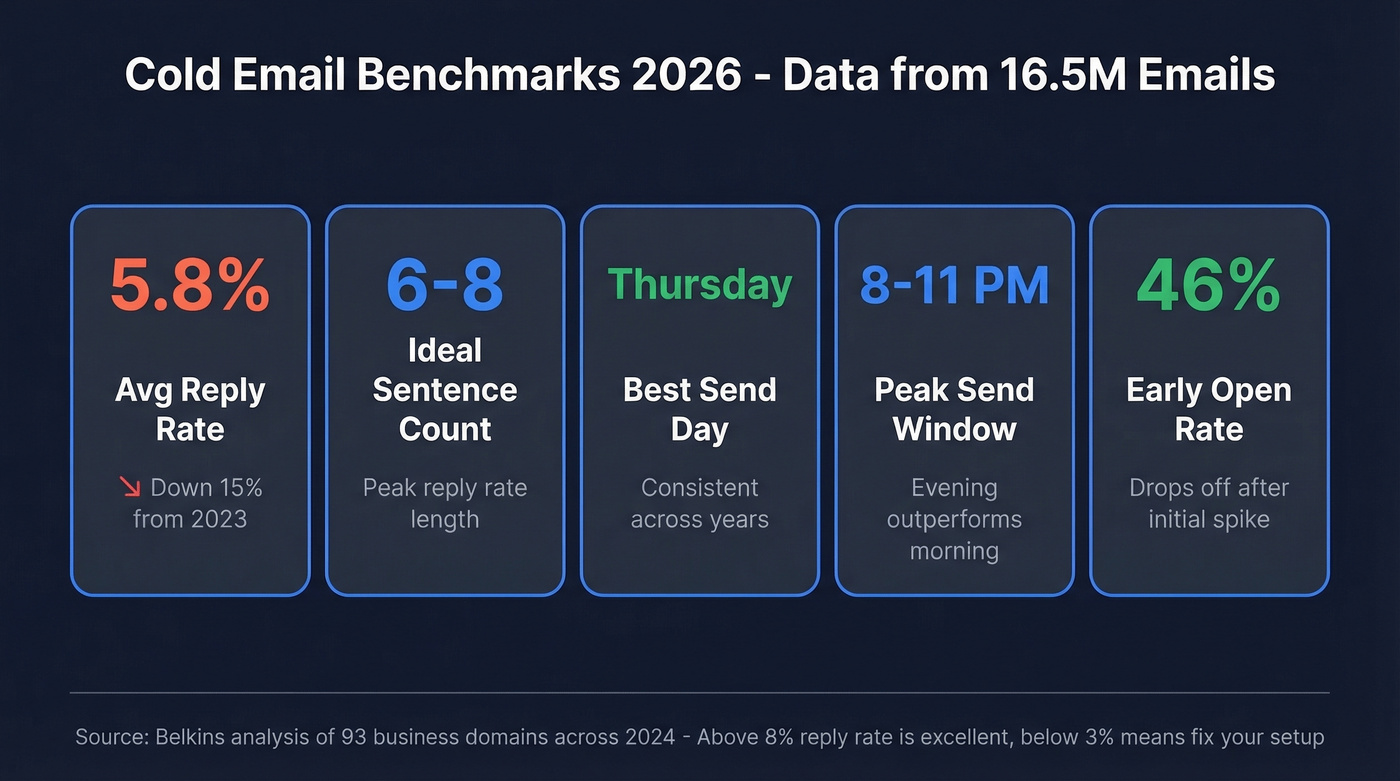
| Metric | 2023 | 2024 | What It Means |
|---|---|---|---|
| Avg reply rate | 6.8% | 5.8% | Declining fast |
| Best email length | Not tracked | 6-8 sentences | Peak reply rate |
| Best send day | Thursday | Thursday | Best day confirmed |
| Peak send time | Evening | 8-11 PM | Evening edge |
| Open rates (early) | ~40% | 46% | Early spike, then drop |
The GMass benchmark puts the "widely accepted" range at 1-5%, which tracks with what most teams experience before optimization. Anything above 8% is excellent. If you're consistently below 3%, the problem is almost certainly your deliverability setup or targeting - not your copy. (Deep dive: email deliverability.)
Thursday evenings, especially 8-11 PM, remain the sweet spot. (More data here: best time to send cold emails.)
The Technical Checklist
Here's the thing: most cold email advice jumps straight to templates. That's like optimizing your golf swing while playing on a flooded course. Fix the course first.
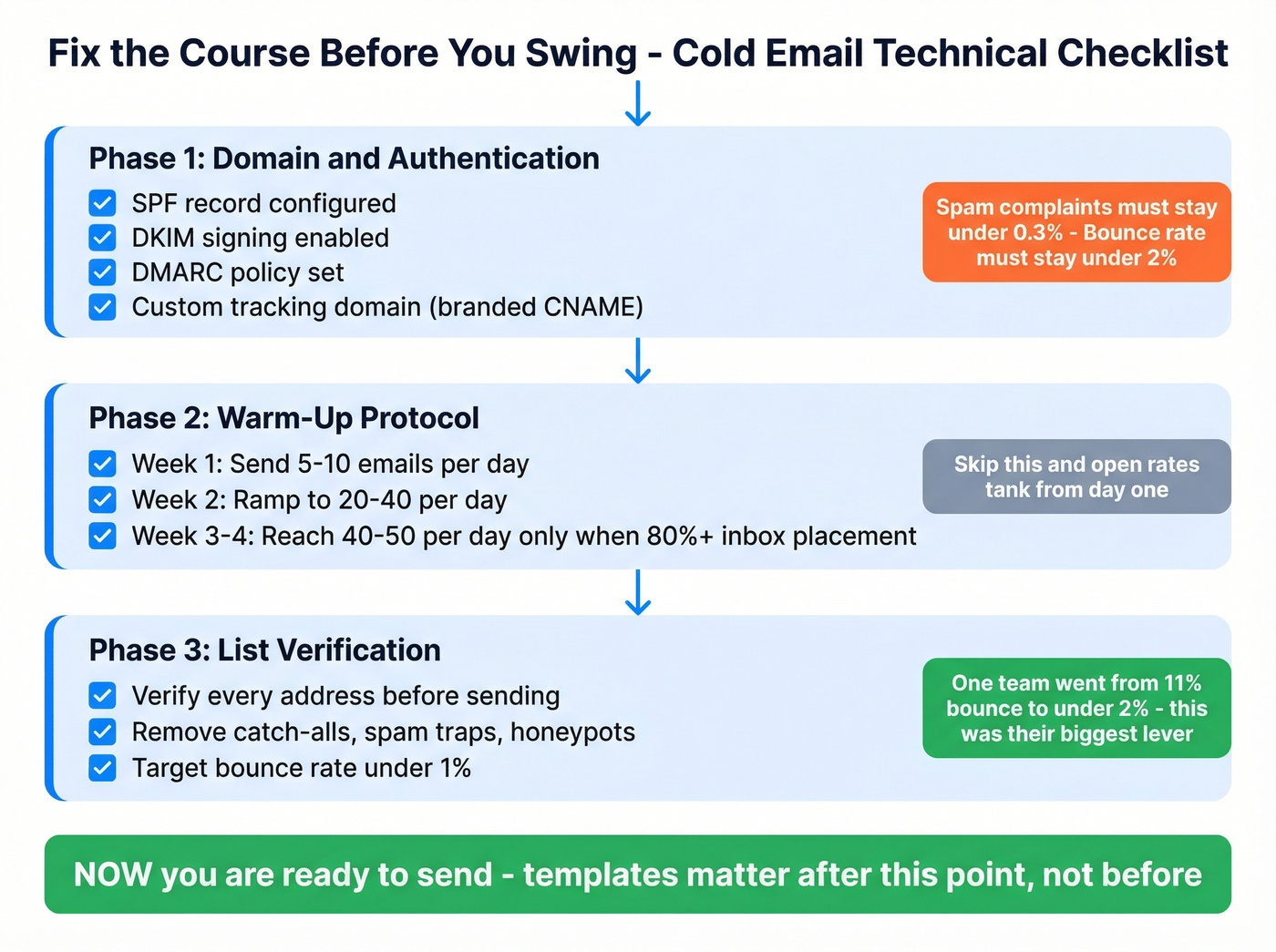
One operator on Reddit shared a detailed rebuild that took his reply rate from 3% to 6% over 62 days. He set up 7 domains, capped at 26 emails per day per domain, verified every address, and warmed up for weeks before sending. His total stack cost: ~$420/month, producing 16 qualified leads per month. The templates he used were almost identical to what he'd been sending before. The difference was everything underneath.
Domain & Authentication
Every cold email domain needs three things configured before you send a single message: SPF, DKIM, and DMARC. Google, Yahoo, and Microsoft have enforced these as requirements for bulk senders - and enforcement has only tightened in 2026. You also need RFC 8058 one-click unsubscribe headers and a custom tracking domain, a branded CNAME subdomain that isolates your reputation from shared tracking pools. (Related: tracking domain.)
The thresholds that matter: spam complaints under 0.3%, bounce rate under 2%. Exceed either and you're fighting an uphill battle against inbox placement algorithms. (Also useful: email reputation tools.)
If you're emailing EU prospects, GDPR applies. In the US, CAN-SPAM requires a physical address and opt-out mechanism. Cold email isn't illegal, but ignoring these rules gets expensive fast.
Warm-Up Protocol
New domains need 2-4 weeks of warm-up before real campaigns. Start at 5-10 emails per day, ramp to 20-40 by week two, and reach 40-50 per day only when your inbox placement tests show 80%+ delivery. The consensus on r/coldemail is blunt: skip warm-up and you'll get awful open rates from day one. (Tooling overview: unlimited email warmup.)
List Verification
In our experience, teams that verify their lists before every campaign see bounce rates drop below 1%. The Reddit operator's rebuild proved this - his bounce rate dropped from 11% to under 2% after he stopped buying lists and started verifying every address. That single change was the biggest lever in his entire 62-day overhaul.
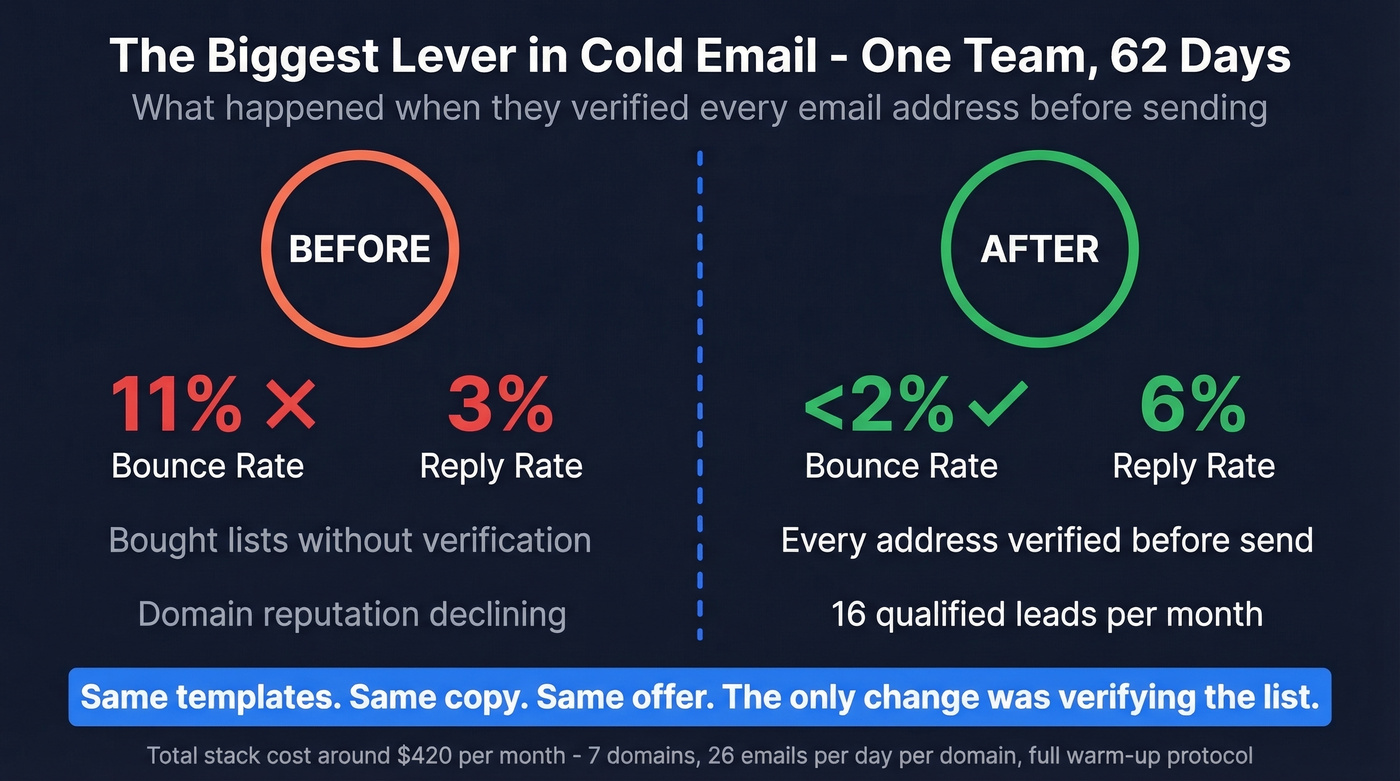
Prospeo runs every address through a 5-step verification process - catch-all handling, spam-trap removal, honeypot filtering - at 98% accuracy. If 11% of your emails are bouncing, no template saves you. (If you’re comparing options: Bouncer alternatives.)

That Reddit operator cut bounce rates from 11% to under 2% by verifying every address. Prospeo's 5-step verification - catch-all handling, spam-trap removal, honeypot filtering - delivers 98% email accuracy at ~$0.01/email. Your templates deserve a clean list.
Fix the foundation before you optimize the copy.
The best cold email template in the world gets a 0% reply rate when it lands in spam. Prospeo refreshes 300M+ profiles every 7 days - not every 6 weeks like competitors. That means the contacts you pull today are verified today, not stale data from last month.
Send to real inboxes or don't send at all.
Subject Lines From 5.5M Emails
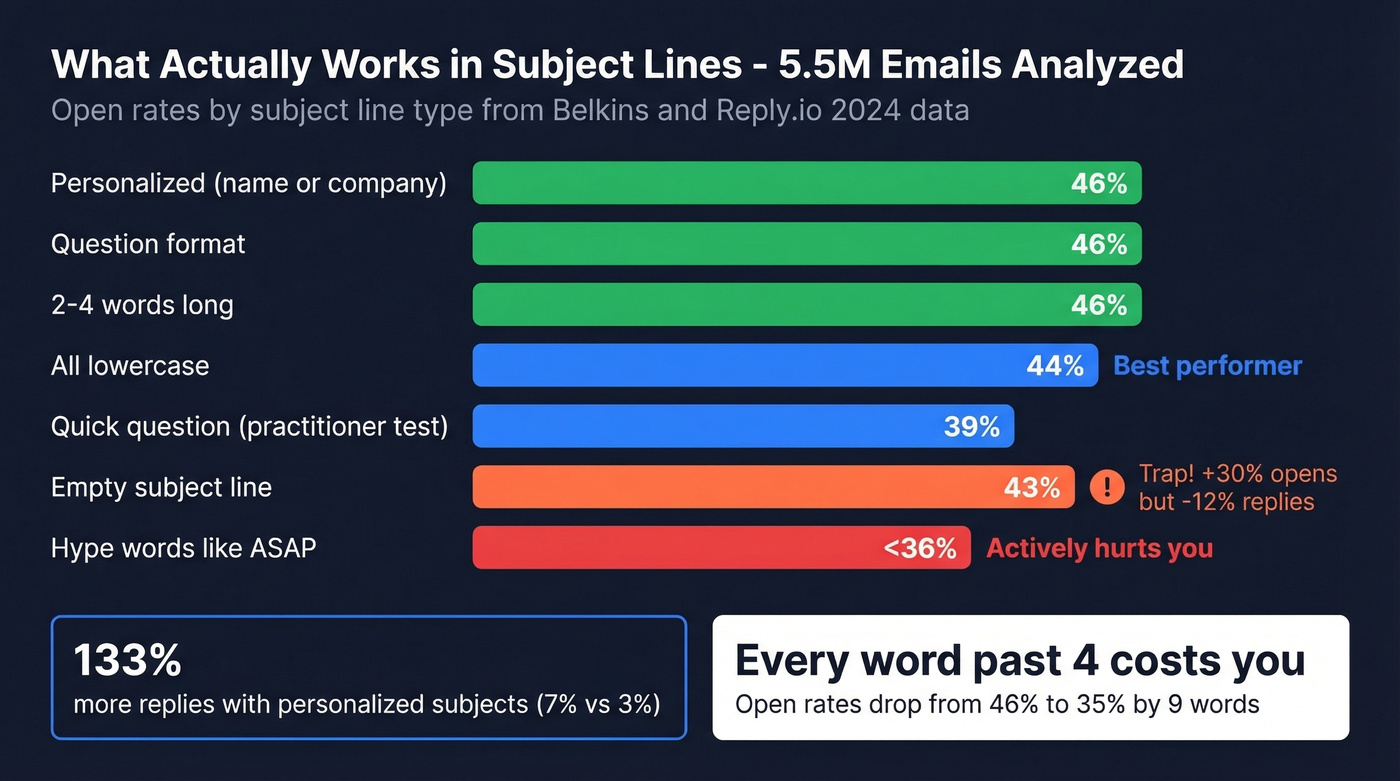
Belkins and Reply.io analyzed 5.5M emails across all of 2024 and the data is surprisingly clear on what works.
| Subject Line Type | Open Rate | Notes |
|---|---|---|
| Personalized (name/company) | 46% | vs 35% without |
| Question format | 46% | Highest-performing type |
| 2-4 words | 46% | Sweet spot for length |
| Custom attribute (job title, etc.) | +7% lift | Per Hunter, 20K+ emails |
| All lowercase | Best | Outperforms title case |
| Empty subject | +30% opens | But -12% replies - a trap |
| Hype words ("ASAP," etc.) | <36% | Actively hurts you |
The personalization effect is massive: 7% reply rate with personalized subjects versus 3% without - a 133% increase. And the length data is definitive. Two-to-four words hit 46% opens. By nine words, you're down to 35%. Every word you add past four costs you.
"Quick question" as a subject line pulled 39% opens in one practitioner's test. It's simple, it's lowercase, and it mirrors internal communication. That's the playbook - make your subject line look like it came from a colleague, not a vendor. Numbers in subject lines performed slightly worse, and urgency words like "ASAP" pushed opens below 36%. (More: subject lines that get opened.)
10 Proven Templates
One copywriting heuristic worth memorizing: keep your I/my-to-you/your ratio at 1:2. For every time you reference yourself, reference the prospect twice. Front-load the most important information in your first sentence - prospects scan fast, so the opener carries disproportionate weight. (Related: email copywriting.)
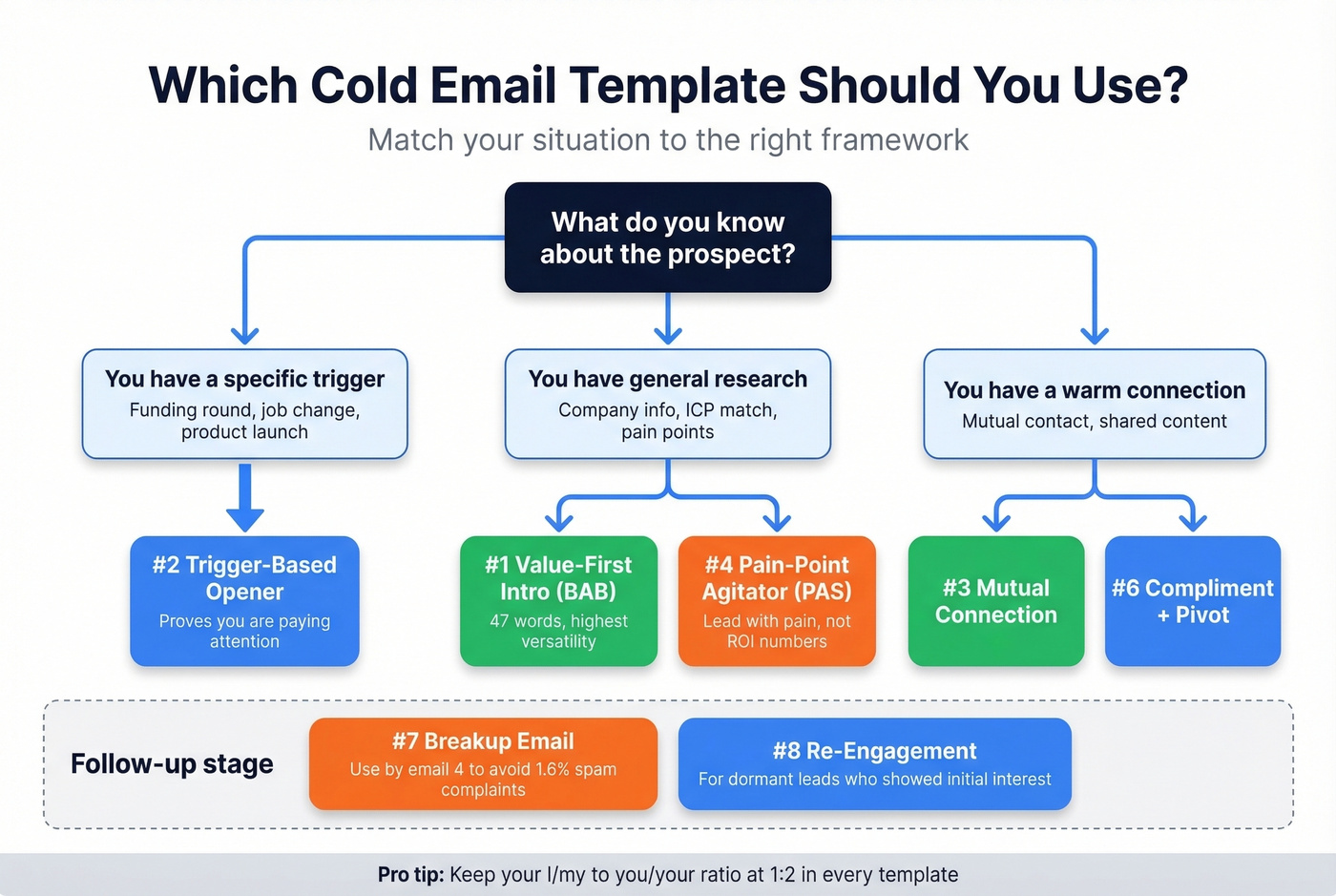
1. The Value-First Intro (BAB Framework, 47 Words)
Before-After-Bridge compressed to its minimum. You name the prospect's current state, hint at a better one, and bridge with proof. Under 50 words.
Subject: quick question
Hi {{first_name}},
Noticed {{company}} is {{specific observation - hiring, launching, expanding}}.
We help {{ICP description}} {{specific outcome}} - recently helped {{similar company}} {{concrete result}}.
Worth a quick conversation?
{{Your name}}
An interest CTA like this is the highest-performing CTA type versus asking for a meeting time. Every extra sentence is a reason to delete.
2. The Trigger-Based Opener
When you have a specific trigger - funding round, job change, product launch - this email converts because it proves you're paying attention.
Subject: {{company}} + {{trigger}}
Hi {{first_name}},
Saw {{company}} just {{specific trigger event}}. When {{similar companies}} hit that stage, they usually run into {{specific problem}}.
We built {{product/service}} to solve exactly that - {{one-line proof point}}.
Interested in seeing how?
This follows the Intro-Observation-Bridge-Vision-Offer structure that practitioners on r/b2bmarketing recommend. Personalized subjects drive 133% more replies than generic ones, but personalization at scale requires accurate data on job titles, company triggers, and recent changes - the kind of enriched prospect data you'd pull from a platform like Prospeo's 300M+ profile database with intent signals and job-change alerts. (See: data enrichment services.)
3. The Mutual Connection
Subject: {{mutual connection name}}
Hi {{first_name}},
{{Mutual connection}} mentioned you're working on {{initiative}}. We helped their team {{specific result}} and thought it'd be relevant for {{company}}.
Worth a conversation?
Starting with trust lowers resistance. The soft CTA keeps pressure low.
4. The Pain-Point Agitator (PAS Framework)
Classic Problem-Agitate-Solve, compressed to under 60 words. One critical note from analysis of 304K cold emails: ROI language ("save $X," "increase revenue by Y%") actually reduces success rates by 15%. Lead with the pain and the fix, not the dollar figure.
Subject: {{pain point}} at {{company}}
Hi {{first_name}},
Most {{job title}}s at {{company stage/type}} companies spend {{time/money}} on {{pain point}} - and still {{negative outcome}}.
We cut that by {{percentage/metric}} for {{similar company}}.
Interested in a 10-minute walkthrough?
5. The Social Proof Play
Here's a counterintuitive one. Reddit practitioners hate the opener "Hope all is well." But data from 304K cold emails says it correlates with 24% more meetings booked. Trust the numbers.
Subject: how {{similar company}} did it
Hope all is well, {{first_name}}.
{{Similar company}} was dealing with {{problem}}. After working with us, they {{specific measurable result}} in {{timeframe}}.
{{Company}} looks like it's in a similar spot. Want to see the playbook?
The social proof does the heavy lifting - you're not pitching, you're sharing a result.
6. The Compliment + Pivot
Use this when you've genuinely consumed the prospect's content or admire their work.
Subject: loved the {{content piece}}
Hi {{first_name}},
Your {{blog post/talk/podcast episode}} on {{topic}} nailed it - especially the point about {{specific detail}}.
It got me thinking about how {{your solution}} could help {{company}} with {{related challenge}}. Worth exploring?
P.S. {{Personalized detail - a specific quote, a shared connection, a recent win}}
The P.S. line is worth adding when it's truly specific. Skip it if you're just padding.
7. The Breakup Email
We've seen the breakup email pull replies from prospects who'd been silent for weeks. By follow-up #4 (the 5th email), spam complaints rise to 1.6% from 0.5% on email 1. This template respects the prospect's inbox and occasionally triggers a response from people who meant to reply earlier.
Subject: closing the loop
Hi {{first_name}},
I've reached out a couple times and haven't heard back - totally fine. If {{pain point}} becomes a priority, I'm here.
Deleting you from my list otherwise. No hard feelings.
{{Your name}}
8. The Re-Engagement (Dormant Lead)
For prospects who showed initial interest but went silent.
Subject: still relevant?
Hi {{first_name}},
We chatted {{timeframe}} ago about {{topic}}. Things may have shifted since then.
If {{original pain point}} is still on your radar, happy to pick back up. If not, no worries at all.
Data from 304K cold emails shows guilt phrasing ("I never heard back") decreases meetings booked by 14%. This template avoids guilt entirely and gives the prospect an easy out, which paradoxically increases reply rates.
9. The Referral Ask
Subject: quick ask
Hi {{first_name}},
I've been trying to connect with whoever handles {{function}} at {{company}}. Would you be the right person, or could you point me in the right direction?
Appreciate it either way.
The 16.5M-email dataset found that targeting 1-2 contacts per company yields a 7.8% reply rate, versus 3.8% when you spray 10+ contacts. The referral ask helps you find the right person without carpet-bombing the org chart.
10. The Event/Content Trigger
Subject: congrats on {{event}}
Hi {{first_name}},
Saw {{company}} just {{event - raised Series B / hired VP Sales / launched new product}}. Teams at that stage usually start thinking about {{challenge your product solves}}.
We helped {{similar company}} navigate that - happy to share what worked. Interested?
Hunter's analysis of 20K+ subject lines found that including at least one custom attribute boosts open rates by more than 7%. Trigger events are the highest-signal custom attribute you can use.
The Follow-Up Sequence
About 60% of replies come after the first follow-up, not the initial email. But there's a sharp decay curve after that, and most teams send too many. (If you want more options, use these sales follow-up templates.)
Follow-Up #1 (3-4 Days Later)
Circling back, {{first_name}}. The {{specific result}} we got for {{similar company}} might be relevant given {{company}}'s {{situation}}.
Worth 10 minutes this week?
Keep it under 40 words. The first follow-up lifts replies by up to 49% - it's the single highest-ROI email in your sequence.
Follow-Up #2 / Breakup (7-10 Days Later)
Use the breakup template from above, or a variation:
Last note from me, {{first_name}}. If {{pain point}} isn't a priority right now, I get it. I'll check back in a few months.
When to Stop
We recommend 3 emails total over 10-14 days. The 16.5M-email dataset found that adding a third email drops reply rates up to 20%. By follow-up #4 (the 5th email), response rates are down 55% from earlier touches, and spam complaints hit 1.6%. Every email past the third hurts your sender reputation more than it helps your pipeline.
For deals under $10K, three emails is probably too many. Two touches - one intro, one follow-up - and move on. The domain reputation you preserve is worth more than the marginal reply from email three.
5 Mistakes That Kill Reply Rates
Sending from unwarmed domains. This is the most common and most destructive mistake. Two weeks of warm-up isn't optional - it's the minimum.
Using shared tracking domains. Mailshake's research flags shared tracking domains as a major deliverability risk. Set up a custom CNAME tracking subdomain. It takes 15 minutes and DNS propagation takes up to 72 hours.
Including HTML, images, or links in excess. Plain text wins. Images and heavy HTML formatting trigger spam filters. Keep it to one link maximum - your calendar link or a landing page, not both.
Using ROI language in your pitch. "We'll save you $50K" or "increase revenue by 30%" sounds great in theory. Analysis of 304K cold emails says it reduces success rates by 15%. Lead with the problem and the fix, not the financial projection.
Skipping A/B testing. Don't send all 10 templates at once. Pick two, split your list, and run them for 200+ sends each before declaring a winner. Deploy the winner to the remaining 80% of your list. Most teams guess when they should be measuring.
FAQ
What's a good reply rate in 2026?
The average across 16.5M emails analyzed by Belkins is 5.8%. GMass puts the typical range at 1-5%. Anything above 8% is excellent and suggests strong targeting, clean deliverability, and relevant messaging. Below 3% usually points to technical setup or list quality issues rather than bad copy.
How long should a cold email be?
Six to eight sentences - roughly 80-120 words - hit the highest reply rate at 6.9% in the 16.5M-email dataset. Practitioners on Reddit report even shorter messages, under 60 words, work best for initial outreach. Start short and test up.
How many follow-ups should I send?
Two maximum. The first follow-up lifts replies by up to 49%, making it the most valuable email in your sequence. By follow-up #4, spam complaints hit 1.6% and reply rates drop 55%. Three emails over 10-14 days is the data-backed ceiling.
Do I need to warm up a new domain?
Yes. Two to four weeks minimum. Start at 5-10 emails per day, ramp to 20-40 by week two, and reach full volume only when inbox placement tests show healthy delivery. Skipping warm-up is the fastest way to land every message in spam from day one.
What free tools help with cold email deliverability?
Prospeo offers a free tier with 75 email verifications per month - enough to validate a small campaign list at 98% accuracy. For sending, tools like Mailshake and Lemlist offer trial periods. The biggest free lever is proper SPF/DKIM/DMARC configuration, which costs nothing but prevents the majority of deliverability failures.