

Cold Email Templates for Sales: 12 Data-Backed Templates + the System Behind Them
Cold email didn't die. Bad cold email did.
Inboxes got louder, filters got stricter, and a lot of "proven templates" stopped working because they were written for a 2023 inbox. Across 16.5 million cold emails analyzed by Belkins, the average reply rate slid from 6.8% to 5.8% - and teams with shaky deliverability are living under 3% whether their copy is "good" or not. (Belkins data)
Let's break this down the way we do when we're troubleshooting outbound: first diagnose the real bottleneck, then pick a template that matches the situation, then protect your sender reputation so the email actually lands.
Diagnose Before You Optimize
Before you touch a single template, figure out where your problem lives:
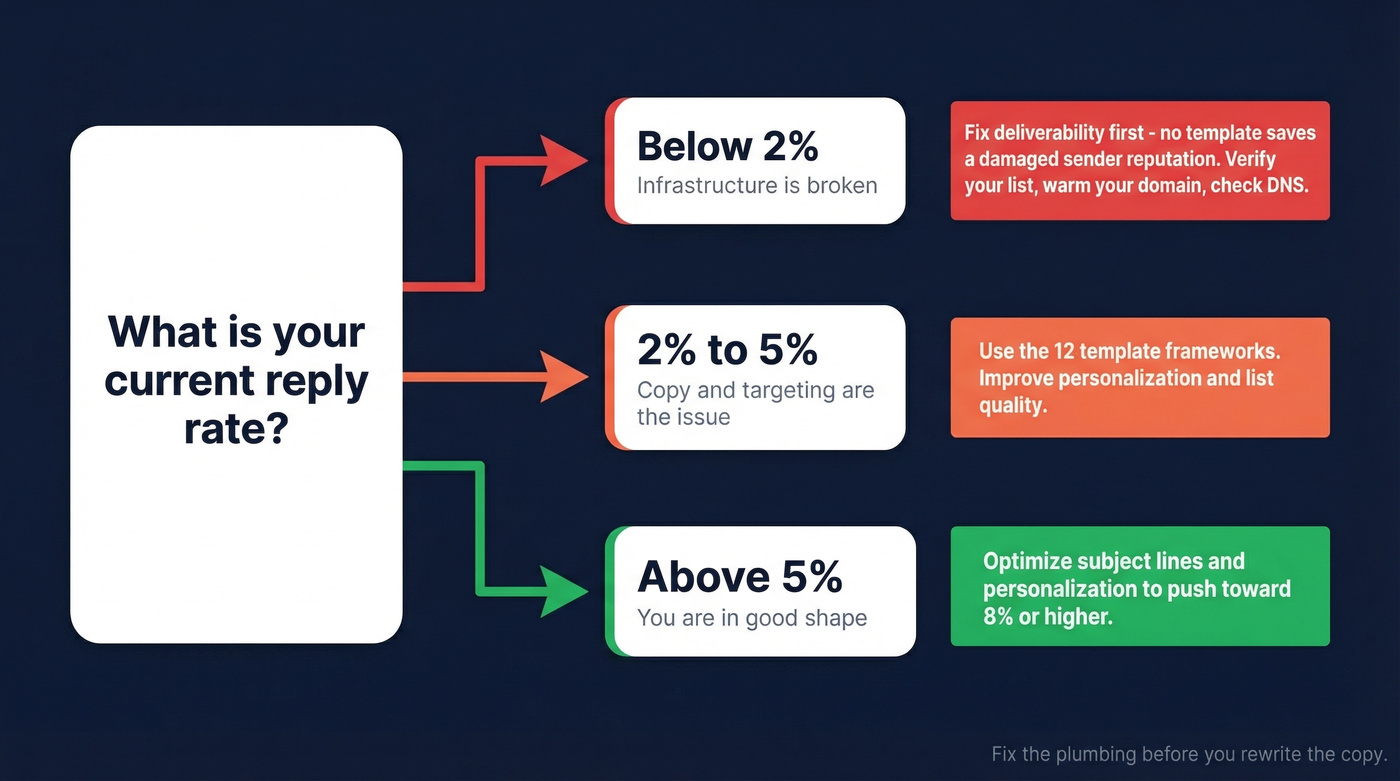
- Below 2% reply rate? Infrastructure's broken. Skip to the infrastructure section. No template saves a damaged sender reputation.
- Between 2-5%? Copy and targeting are the issue. Start with the 12 frameworks below.
- Above 5%? You're in decent shape. Now subject lines and personalization can push you toward 8%+.
Look, it's frustrating watching teams rewrite the same first line ten times while they're still blasting unverified lists from a brand-new domain. Fix the plumbing first.
2026 Cold Email Benchmarks
Belkins analyzed 16.5 million cold emails across 93 business domains from January through December 2024. Cold email still works, but the bar's higher. (Belkins benchmark write-up)
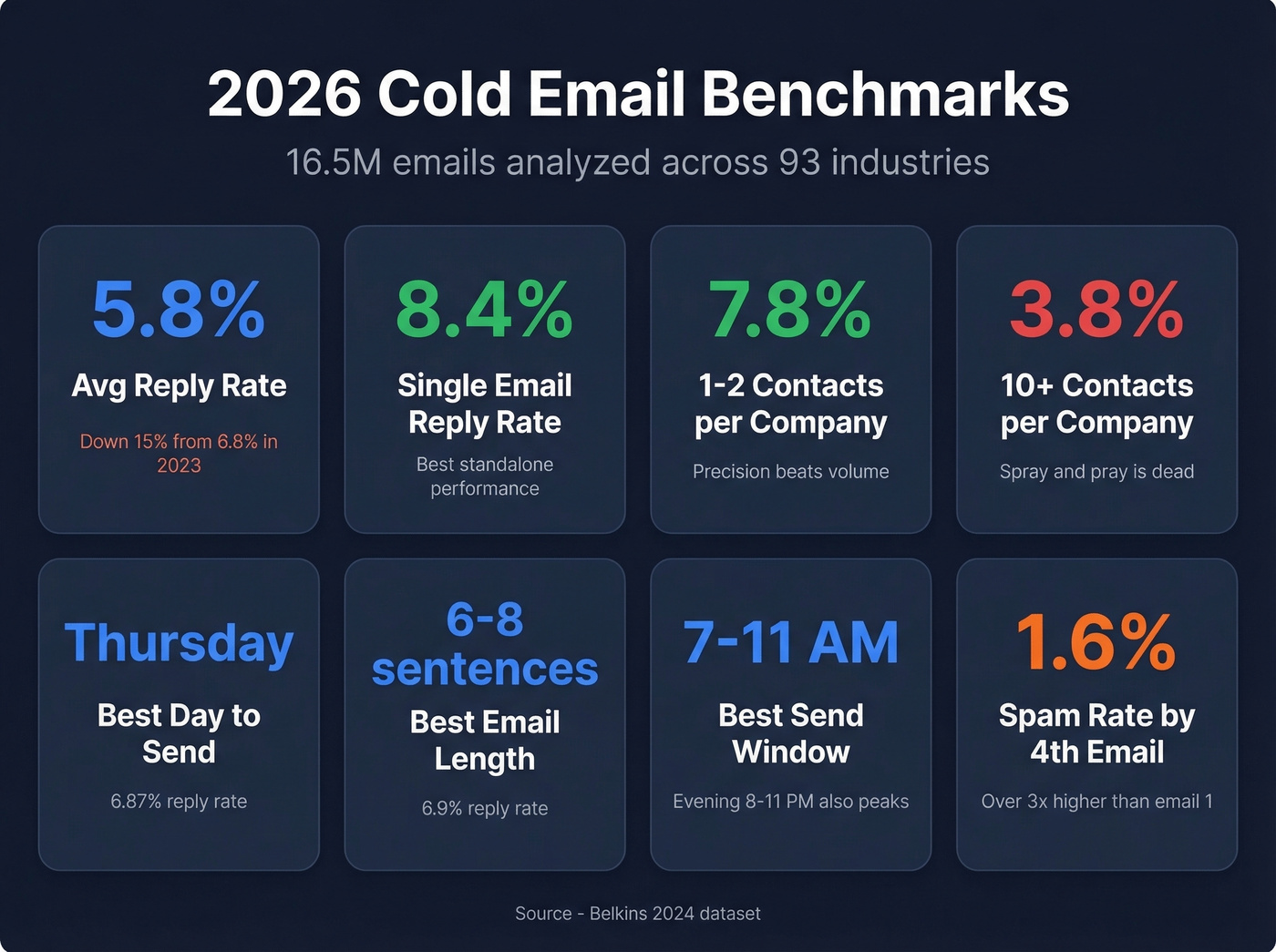
| Metric | 2026 takeaway (from 2024 dataset) | What it means |
|---|---|---|
| Avg reply rate | 5.8% | Down 15% from 6.8% in 2023 |
| Best email length | 6-8 sentences | 6.9% reply rate |
| Single email reply | 8.4% | Best standalone rate |
| 1-2 contacts/company | 7.8% reply | Precision beats volume |
| 10+ contacts/company | 3.8% reply | Spray-and-pray is dead |
| Best day | Thursday | 6.87% reply rate |
| Best time | 7-11 AM & 8-11 PM | 8-11 PM peaks at 6.52% reply rate |
| Spam by 4th email | 1.6% | Over 3x higher than email 1 |
Single emails had the highest reply rate at 8.4%. That doesn't mean "never follow up." It means your first touch can't be a throwaway.
One more benchmark that matters in 2026: opens are a shaky metric. Belkins saw a 3% higher response rate without open tracking, which lines up with what we've seen as more teams disable pixels to protect deliverability. If you're still optimizing around opens, you're optimizing around noise. (Belkins on open tracking)

12 Cold Sales Emails That Get Replies
Each template below includes when to use it, the full copy, and why it works. Swap the specifics, keep the structure.
Quick writing check before you send anything: count pronouns. If your email has more "I" and "my" than "you" and "your", flip the ratio. Aim for at least 2:1 you-to-I. It's the fastest "free" improvement you'll ever make.
1) Value-First (short + specific)
Use it for totally cold outreach when you can offer something concrete.
Hi {{first_name}},
Noticed {{company}} is {{trigger - hiring SDRs / expanding into EMEA / launching a new product line}}. We help {{ICP type}} {{specific outcome}} - recently helped {{similar company}} {{result with number}}.
Worth a quick conversation?
Keep it around 40-60 words. The consensus on r/copywriting is blunt: short emails win when the offer's specific and the CTA isn't pushy. "Worth a conversation?" usually beats "Can I grab 15 minutes Thursday at 2?" because it doesn't force a calendar decision from a stranger. (r/copywriting thread)
2) Trigger Event (funding, hire, launch)
Use it when something changed at the company. The trigger does the heavy lifting.
Hi {{first_name}},
Congrats on {{specific event}}. When {{similar companies}} hit that stage, they usually run into {{specific problem your product solves}}.
We helped {{company}} navigate that and {{quantified result}}. Want the quick version of what worked?
Trigger-based outreach converts because it gives you a real reason to show up in their inbox. No fake flattery required.
3) Referral Request (find the right owner)
Use it when you're not sure you've got the decision-maker.
Hi {{first_name}},
I'm trying to connect with whoever owns {{function}} at {{company}}. Are you the right person, or can you point me to who is?
Appreciate it either way.
This is a "yes/no/redirect" email. That's the point.
4) PAS (Problem-Agitate-Solve)
Use it when the prospect knows the pain, but hasn't made it urgent.
Hi {{first_name}},
Most {{ICP role}} teams at {{company size/stage}} are dealing with {{specific problem}}. It gets worse when {{agitation - you're scaling headcount / entering new markets / trying to hit Q3 targets with Q1 data}}.
We built {{product/solution}} for this - {{one-line proof point}}. Want me to send a quick breakdown?
PAS (Problem-Agitate-Solve) works because it mirrors how the problem already feels inside their org: manageable, then suddenly not.
5) AIDA (fast differentiation)
Use it in competitive markets where you need to stand out quickly.
Hi {{first_name}},
{{Attention - bold stat or surprising claim relevant to their role}}. {{Interest - what's changed or why it matters now}}. {{Desire - what "better" looks like, with a proof point}}.
Worth a look for {{company}}?
Don't over-write this. Three tight sentences, then a soft ask. If you want to go deeper on the framework, see the AIDA breakdown.
6) Personalized Observation (for high-value accounts)
Use it for accounts where generic outreach won't cut it. This is the one you earn.
Hi {{first_name}},
I noticed {{specific observation - a comment they made, a recent initiative, a job posting that signals a problem}}. It stood out because {{bridge to why this matters}}.
Teams we work with in {{their space}} are handling this by {{your approach}} - {{company example}} saw {{specific result}}.
Worth 15 minutes to see if it's relevant at {{company}}?
Practitioners on r/b2bmarketing keep repeating the same point: relevant personalization beats brevity. A longer email with a real observation will outperform a short email stuffed with tokens, and it won't even be close. (r/b2bmarketing thread)
7) Competitor Mention (direct + relevant)
Use it when you know they use a competitor.
Hi {{first_name}},
Saw {{company}} is using {{competitor}}. A few teams switched to us recently because {{specific differentiator}}.
{{One proof point - "Team X cut bounce rate from 35% to under 4%"}}.
Worth comparing? I can send a quick side-by-side.
Keep the tone calm. You're not starting a fight; you're offering a comparison.
8) Quick Question (one question only)
Use it when you want the lowest-friction reply.
Hi {{first_name}},
Quick question - how's {{company}} handling {{specific function your product addresses}} today?
We've been helping {{similar companies}} {{outcome}}. Curious if it's even on your radar.
One practitioner reported "Quick question" subject lines hitting 39% opens. Opens aren't everything, but the bigger point is that simple, human subject lines still get through. (practitioner post)
9) Video Email (only for whales)
Use it when the account's valuable enough to justify a Loom/Vidyard.
Hi {{first_name}},
I recorded a quick 90-second video walking through {{specific insight relevant to their business}}: [Watch here]
No pitch - just thought it'd be useful based on {{trigger}}.
Outreach notes it takes an average of 5 touches to engage a prospect. A good video can compress that because it feels like effort, not automation. (Outreach resource)
Skip this template if you're not actually recording a personalized video. A fake "personalized video" link is a fast way to burn trust. If you are doing it for real, this Loom video cold email playbook helps.
10) Follow-Up #1 (value add, not a bump)
Send 2-3 days after the first email.
Hi {{first_name}},
Circling back with something useful: {{new insight / relevant article / quick data point}}.
If {{company}} is working on {{related initiative}}, this tends to help.
No "just bumping this." Add something. If you need more options, pull from these sales follow-up templates.
11) Follow-Up #2 (social proof)
Send 4-7 days after Follow-Up #1.
Hi {{first_name}},
Quick result to share: {{customer}} was dealing with {{same problem}} and saw {{specific outcome with numbers}} after {{timeframe}}.
If {{company}} is seeing something similar, want the playbook?
Lead with the result. Don't lead with your feelings about being ignored.
12) Break-Up (close the loop)
Send around day 14. Low pressure. Door stays open.
Hi {{first_name}},
I've reached out a couple times and haven't heard back - all good if timing's off.
If {{problem you solve}} becomes a priority later, want me to reach back out in a few months?
A clean break-up email protects your domain and your dignity.
Subject Line Rules (5.5M Emails)
Belkins also analyzed 5.5 million B2B cold email subject lines across 2024. The findings are specific enough to use immediately. (Belkins subject line stats)
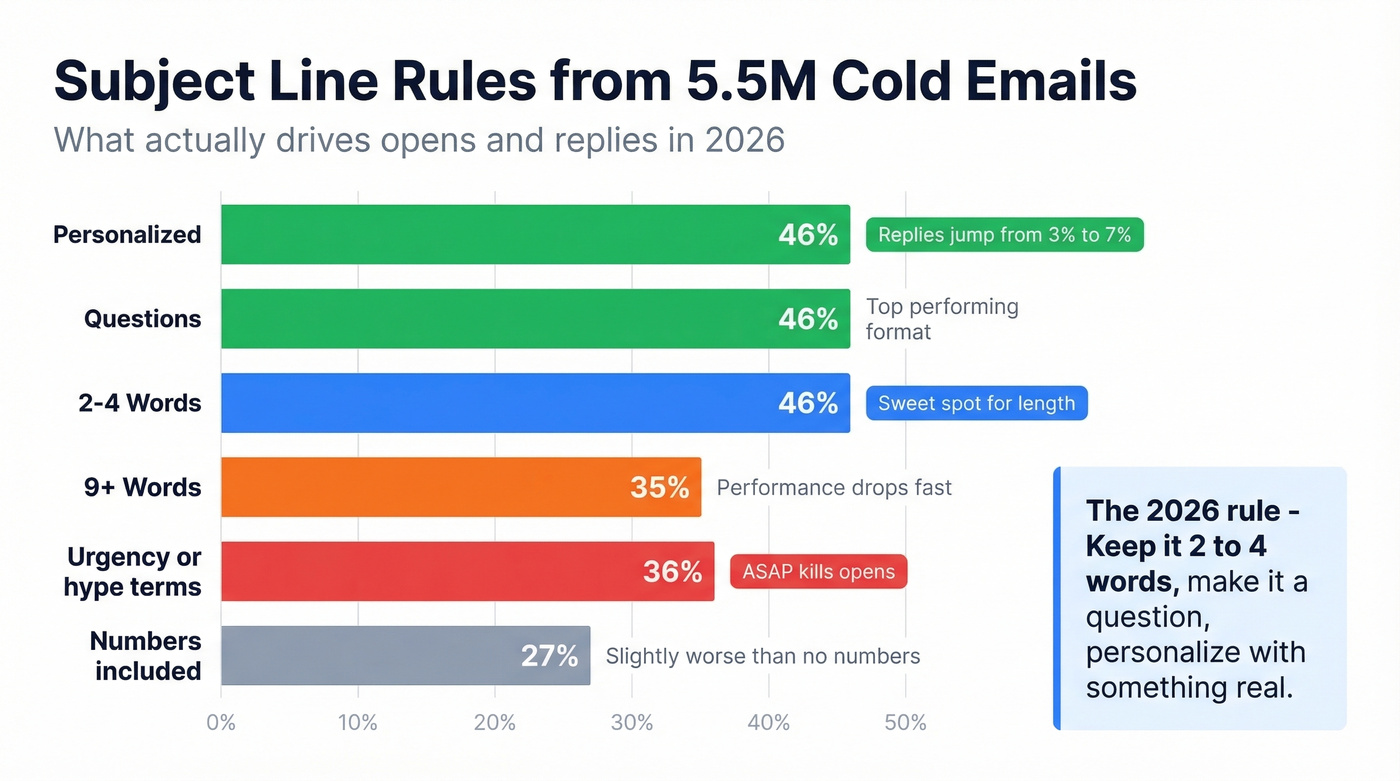
Personalized subject lines hit a 46% open rate versus 35% for generic ones, and reply rates jumped from 3% to 7% with personalization. That's not a rounding error - it's the difference between "outbound works" and "outbound is dead."
| Subject line type | Open rate | Notes |
|---|---|---|
| Personalized | 46% | Replies jumped from 3% to 7% with personalization |
| Questions | 46% | Top-performing format |
| 2-4 words | 46% | Sweet spot for length |
| 9+ words | 34-35% | Performance drops fast |
| Urgency/hype terms | <36% | "ASAP" kills opens |
| Numbers included | 27% | Slightly worse than no numbers |
Our rule of thumb in 2026: keep it 2-4 words, make it a question when you can, and personalize with something real (company name, a trigger, a specific initiative). Also, the inbox has developed antibodies against marketing-speak. "ASAP" and "limited time" don't sound urgent; they sound like spam. For more swipeable ideas, use these cold email subject line examples.

Below 2% reply rate? The template isn't the problem - your data is. Prospeo's 5-step verification delivers 98% email accuracy, and our 7-day refresh cycle means you're never emailing stale contacts. Teams using Prospeo cut bounce rates from 35% to under 4%.
Fix the plumbing before you rewrite the copy.
How to Personalize at Scale (without wasting your week)
Personalization is the biggest lever for reply rate. The mistake is treating every prospect like they deserve a 15-minute research session.
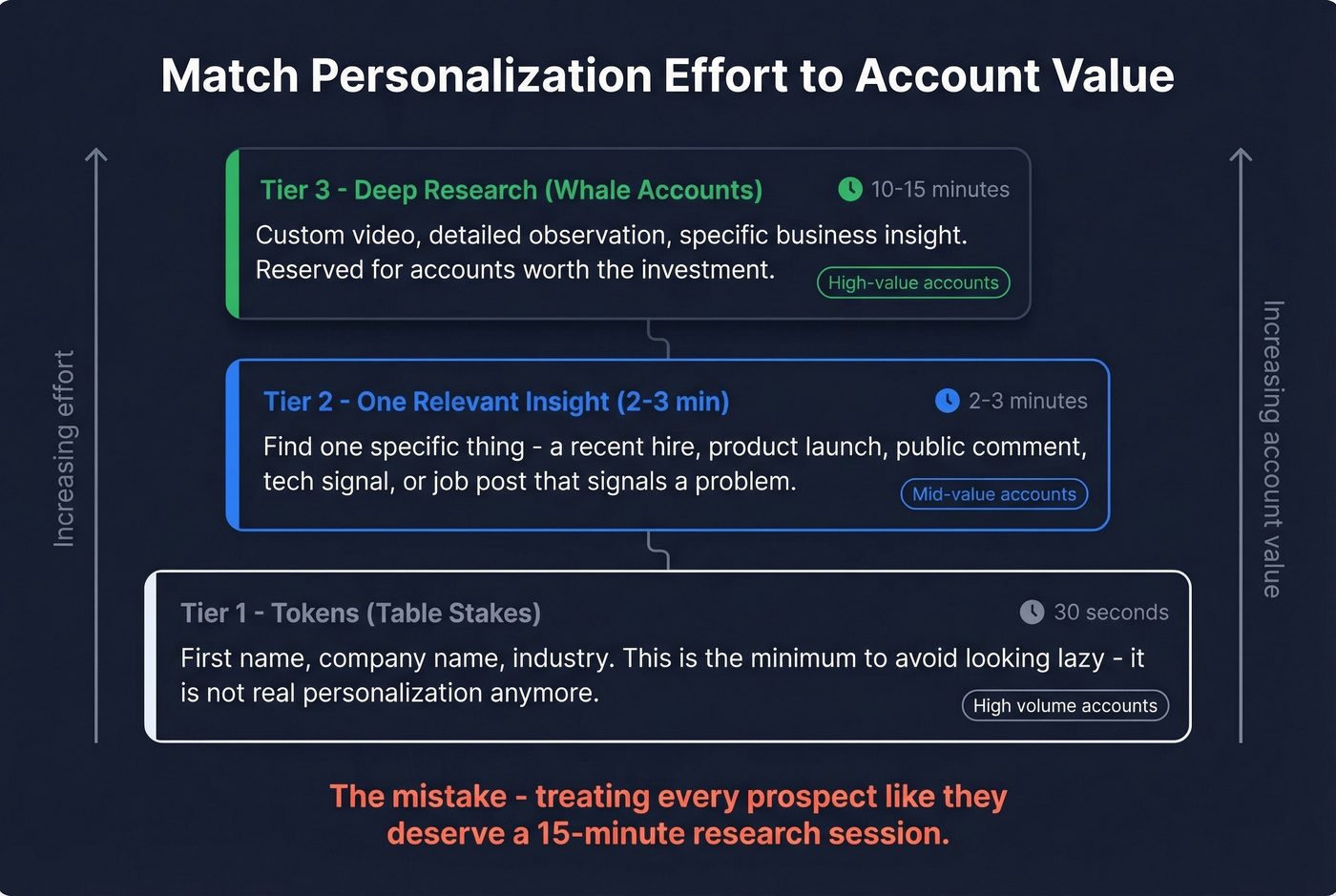
Match effort to account value:
Tier 1: Tokens (table stakes). First name, company name, industry. It's not personalization anymore; it's the minimum to avoid looking lazy.
Tier 2: One relevant insight (2-3 minutes). Find one specific thing: a recent hire, a product launch, a public comment, a tech signal, a job post that screams "we're about to have this problem." This is where replies jump, and it's still scalable if you stay disciplined.
In our experience, Tier 2 is the sweet spot for most outbound teams because it creates a real reason to reach out without turning your SDRs into part-time analysts. A practical target is about 2 hours of research per 100 prospects at this tier once your process is tight.
Tier 3: Deep personalization (10-15 minutes). Company strategy, priorities, internal initiatives, competitor moves, and a tailored point of view. Save it for the top 20 accounts where one meeting pays for the week. This is also where account-based selling starts to look less like a buzzword and more like a workflow.
The Scale Lab's checklist is a solid framework if you want a repeatable research process. (The Scale Lab guide)
One quick scenario we see a lot: you're going after 50 mid-market accounts with a $12k ACV, and your team spends a full day writing "perfect" openers for all 50. The result is usually worse than spending that same day building a clean list, verifying it, and writing 10 genuinely specific Tier 2 openers for the best-fit accounts while keeping the rest value-first and short.
Follow-Up Cadence Without Spam Risk
A single cold email had an 8.4% reply rate in the Belkins dataset, but follow-ups still matter because a lot of real replies come later. Cleverly reports that 60% of replies come after the second follow-up. (Cleverly best practices)
The trick is knowing when to stop.
- Day 1: Initial email (your strongest template)
- Day 3: Follow-Up #1 (new value)
- Day 7: Follow-Up #2 (social proof)
- Day 14: Break-up (close the loop)
That's four touches. Past that, you're usually trading a tiny chance of a reply for a very real hit to deliverability. Spam complaints climbed from 0.5% on email one to 1.6% by email four in the benchmark data, and reply rates drop hard as sequences drag on. If you want a deeper cadence breakdown, see cold email follow-up templates.
For exec targets, Outreach reports higher touch counts than for lower-level contacts, but those extra touches should be multi-channel: call, social, warm intros, events. Don't just send five more emails to the same inbox and call it a strategy. (Outreach resource)
Infrastructure That Makes Templates Work
We've watched teams obsess over copy while sending from unwarmed domains to unverified lists. It's like tuning a race car engine while the tires are bald.
A practitioner on r/Entrepreneur documented a rebuild after their reply rate decayed from 8% to 3% over 18 months. After 62 days of infrastructure fixes - not template changes - they got back to 6%. (thread)
Here's what actually matters:
Domains and volume. Spread volume across multiple sending domains and cap daily sends per domain. And never use your primary company domain for cold outreach. One bad week can drag your whole org into deliverability hell. Use this email velocity guide to set safe limits.
List hygiene (the highest-leverage fix). Get bounce rate under 2%. If you're at 5-10%, you're paying for sends that never land and training inbox providers to distrust you. If you’re troubleshooting, start with email bounce rate benchmarks and fixes.
This is also where tools like Prospeo fit naturally: we use it when we need verified emails at scale without playing CSV ping-pong. Prospeo runs a 5-step verification process that handles catch-all domains, removes spam traps and honeypots, and keeps data on a 7-day refresh cycle, which is a big deal when most databases drift for weeks. You can also pull 50+ data points per contact via enrichment, so your Tier 2 personalization doesn't require ten tabs and a prayer. If you’re comparing vendors, these data enrichment services are a good starting point.
Timing and length. Keep emails short, send in the recipient's timezone, and avoid heavy HTML. The more your email looks like a newsletter, the more filters treat it like one. For the full system, use this email deliverability guide.
Deliverability checklist (confirm this before you send anything):
- SPF, DKIM, and DMARC set up
- RFC 8058 one-click unsubscribe in headers
- Spam complaint rate under 0.3%
- Bounce rate under 2%
- Custom tracking domain (don't share one with other senders)
- Each domain warmed starting at 5-10 emails/day, ramping over 4-6 weeks
- No heavy HTML, multiple images, or more than one link per email
- Don't send from shared tracking domains
Here's a realistic monthly cost range for a working cold email stack:
| Layer | Typical tools | Cost/month |
|---|---|---|
| Data + verification | Prospeo (or similar) | ~$39-99 |
| Sending | Instantly or Smartlead | ~$30-100 |
| CRM | HubSpot Free or Close | ~$0-99 |
| Total | ~$70-300 |
That same r/Entrepreneur rebuild story pegged their stack around $420/month and credited it with 16 qualified leads per month. Even if your numbers are half as good, the economics still beat most paid channels.
Trigger-based templates only work when you can find the right person fast. Prospeo's 30+ filters - including job changes, funding events, and buyer intent across 15,000 topics - let you build hyper-targeted lists in minutes, not hours. At $0.01 per email, scaling precision outreach costs less than one bad bounce.
Stop guessing who to email. Start with data that connects.
How to A/B Test Your Templates (without fooling yourself)
Cold email A/B testing won't hit the 10,000-person sample sizes that make statisticians happy. Treat tests as directional, not definitive.
Litmus has a solid primer on email A/B testing methodology, and the core idea carries over: isolate one variable, run it long enough to smooth out day-of-week noise, then roll the winner out. (Litmus A/B testing guide)
A practical setup:
- Split evenly
- Aim for 100-200 prospects per variant
- Run 2-3 weeks
Test in this order:
- Subject lines (highest impact, easiest to isolate)
- Body copy (framework vs framework)
- CTA (soft question vs specific ask)
- Send time (morning vs evening, different days)
Don't test sender name, subject line, and body copy at the same time. You'll "learn" something, and it'll be wrong.
FAQ
What's a good cold email reply rate in 2026?
Across 16.5 million emails, the average reply rate was 5.8%. Above 6% puts you in the top half; above 8% is strong. Below 3% usually means deliverability or list quality needs fixing before you rewrite templates.
How many follow-ups should I send?
Two to three max. Past the fourth email, spam risk rises and reply rates drop. For execs, add calls and social touches instead of piling on more emails.
How long should a cold sales email be?
The 6-8 sentence range hit the best reply rates in the benchmark dataset, and staying under 200 words beats longer messages. Short (40-60 word) emails work great when the offer's specific. If you're writing 120 words, you'd better have a real observation.
Do I need to warm up my domain?
Yes. Start at 5-10 emails per day and ramp over 4-6 weeks. And don't use your primary company domain for cold outreach.
What's the cheapest way to verify emails before sending?
Use a verifier and keep bounce rate under 2%. Prospeo's free tier includes 75 verified emails per month, which is enough to test a new sequence without paying anything.