

How to Cold Email Potential Clients Without Landing in Spam
You send 500 cold emails. Two replies. One deliverability warning from Google. A Belkins analysis of 16.5 million cold emails found the average reply rate dropped to 5.8% - down 15% from the year before. Most cold emailing potential clients doesn't fail because the copy is bad. It fails because the infrastructure is broken before a prospect ever reads a word.
This is the full playbook for reaching prospects via cold email in 2026, from DNS records to follow-up cadence, built around real benchmarks and deliverability thresholds that actually hold up.
The Short Version
- Infrastructure first. Secondary domain, DNS authentication, 2-3 weeks of warm-up. Most cold email dies in spam folders, not inboxes.
- Verify every email before sending. Bounce rates above 5% torch your domain reputation.
- Write short, personalize with one real signal, cap follow-ups at 2-3. Six to eight sentences. Under 200 words. One clear ask.
Set Up Your Sending Infrastructure
Never send cold email from your primary business domain. One spam complaint spike and you've damaged the domain your entire company relies on for client communication, invoices, and support tickets. We've seen teams learn this the hard way - it's not a fun recovery.
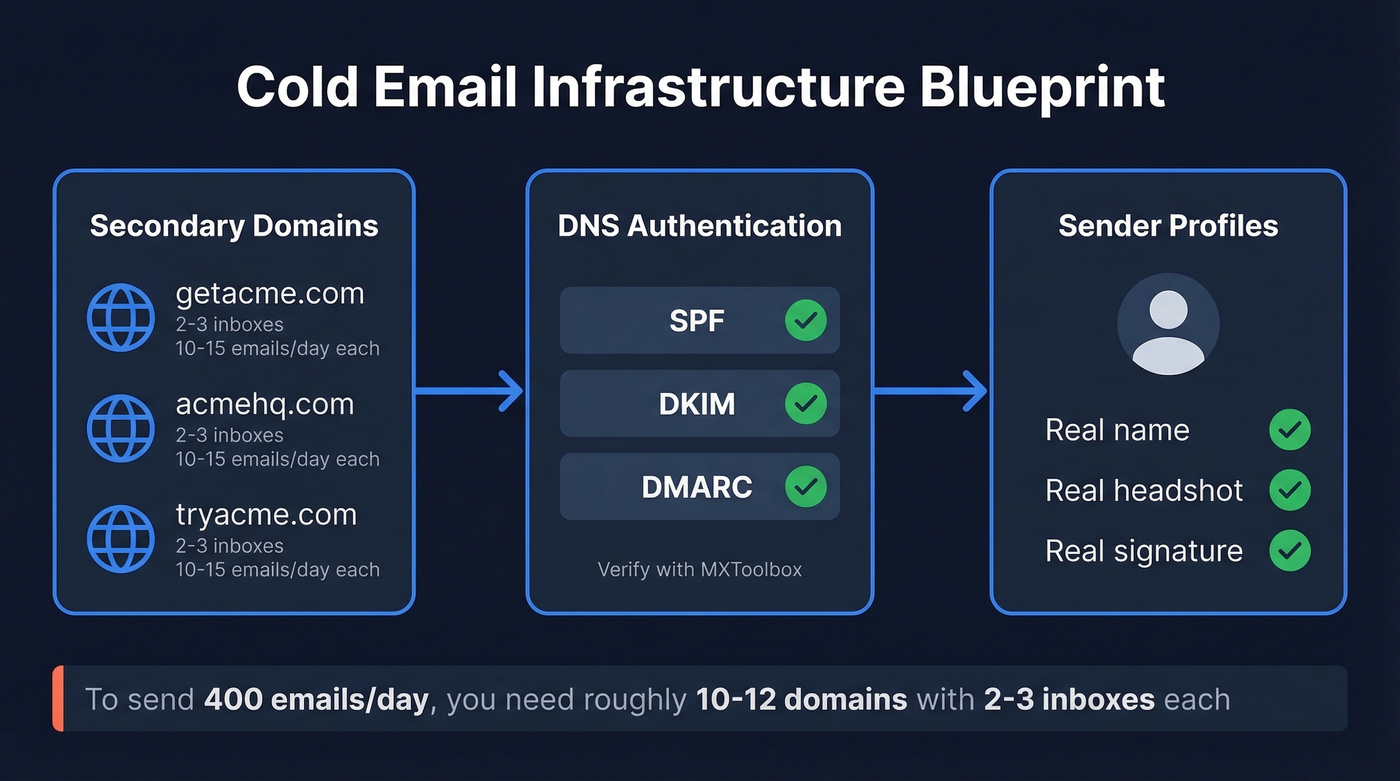
Buy secondary domains. Variants like "getacme.com" or "acmehq.com" work fine. Create 2-3 inboxes per domain and cap each at 10-15 emails per day, giving you roughly 30-45 sends per domain. Use Google Workspace or Microsoft 365 - free Gmail and Yahoo accounts get flagged fast.
Configure SPF, DKIM, and DMARC. These aren't optional. Run your domains through MXToolbox to verify everything resolves correctly. Use real sender profiles with real names, headshots, and signatures - fake-looking accounts trigger spam filters before your subject line even loads. If you want a deeper technical breakdown, follow an email deliverability guide and double-check your SPF record.
To send 400 emails a day, you need roughly 10-12 domains. That sounds like a lot. It is. But getting this infrastructure right is the non-negotiable first step if you want to reach prospects consistently.
Warm Up Your Domain
A brand-new domain has zero reputation. Sending 100 cold emails on day one is like walking into a bank with no ID and asking for a loan.
| Week | Daily Volume | Notes |
|---|---|---|
| 1 | 5-25 | Warm-up only, no cold |
| 2 | 25-50 | Still warm-up dominant |
| 3 | 50-75 | Mix in cold prospects |
| 4 | 75-100 | Stabilize, monitor metrics |
Gating metrics: Bounce rate above 3% during warm-up is a warning. Above 5%, stop immediately. Spam complaints must stay under 0.3% (Google recommends under 0.1%). Keep warm-up traffic at 30-40% of volume even after launching cold campaigns. If you're scaling volume, watch your email velocity and use email reputation tools to catch issues early.
Build a Verified Prospect List
The single biggest lever for cold email performance isn't your subject line. It's who you're emailing and whether that address is real.

Define your ICP: industry, job titles, company size, specific challenges your product solves, and readiness-to-buy indicators. Emailing 1-2 contacts per company yields a 7.8% reply rate versus 3.8% when you email 10+ people at the same org. That stat alone should reshape how you build lists. Precision beats volume every single time, and it's not close.
Here's the thing about list quality: stale data is the fastest way to blow past your bounce threshold and wreck a domain you spent three weeks warming up. We've tested multiple data providers, and the ones with weekly refresh cycles outperform monthly-refresh tools by a wide margin on bounce rates. Prospeo refreshes every 7 days and verifies at 98% accuracy, which is why we trust it for our own outbound. The free tier gives you 75 emails plus 100 Chrome extension credits per month to test before scaling. If you're comparing vendors, start with a shortlist of data enrichment services and email list providers.
Your target bounce rate on any campaign should be under 2%. If you creep past 3%, treat it as a warning. At 5%+, stop and fix your list.
How to Write a Cold Email to a Potential Client
Your from-line matters more than you think. "Sarah" feels personal. "Sarah at Acme" adds context without feeling corporate. Match formality to your audience - a VP of Engineering at a Series B startup expects a different tone than a procurement director at a Fortune 500.
Subject lines between 6-10 words hit a 21% open rate, and including numbers can boost opens by up to 113%. Keep subject lines under 45 characters so they render fully on mobile. A/B test two subject lines per campaign - it's the single easiest optimization most teams skip. For more ideas, pull from these cold email subject line examples or broader email subject line examples.
Let's be honest: if your average deal size is under $15k, you probably don't need a 12-touch, multichannel sequence with video thumbnails and custom landing pages. A tight 3-email sequence with one genuine personalization signal will outperform the overengineered approach every time. We've seen it repeatedly across dozens of campaigns.
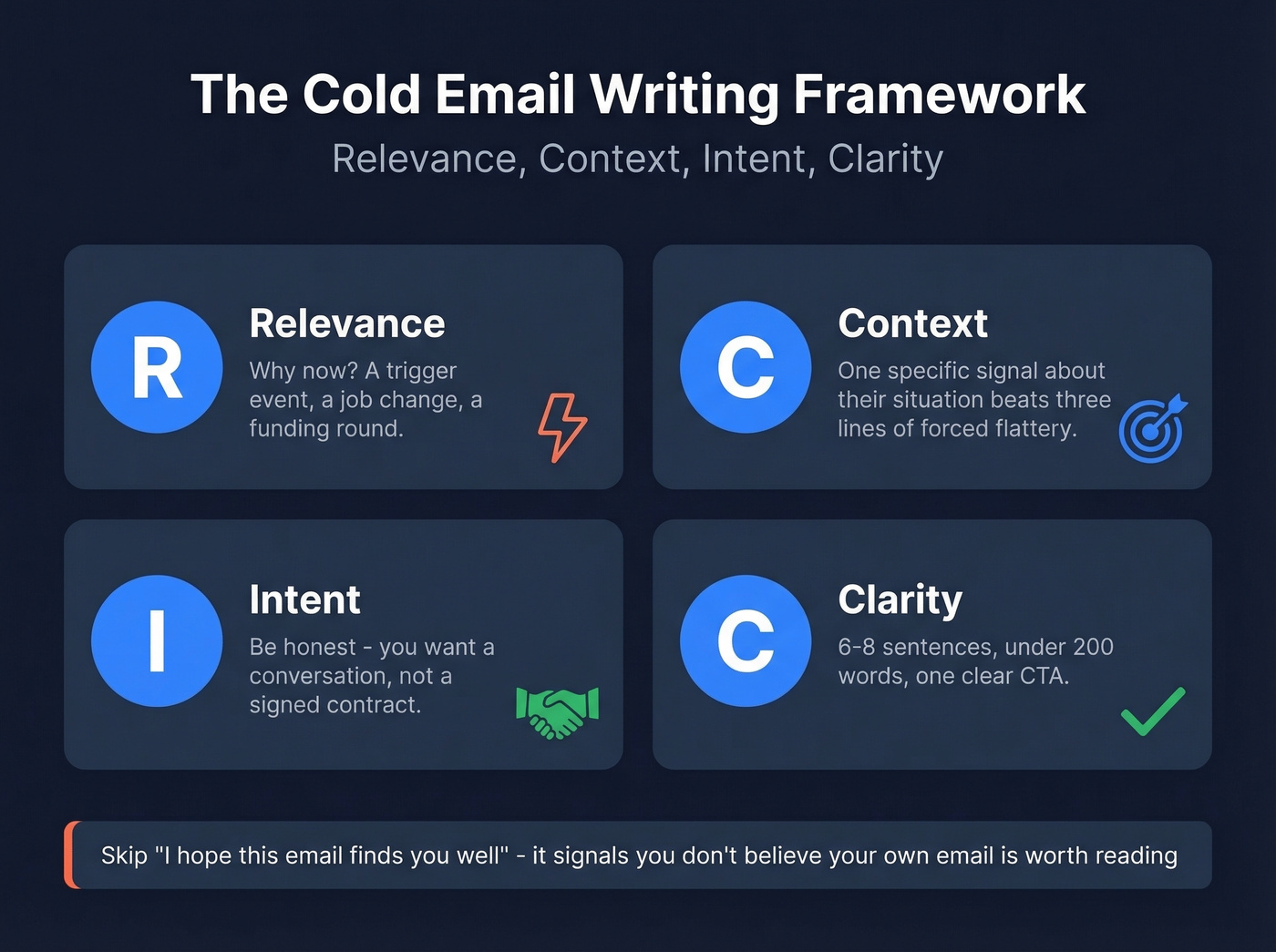
For the body, use the Relevance/Context/Intent/Clarity framework:
- Relevance: Why now? A trigger event, a job change, a funding round.
- Context: One specific signal about their situation beats three lines of forced flattery.
- Intent: Be honest - you want a conversation, not a signed contract.
- Clarity: Six to eight sentences, under 200 words, one clear CTA.
Don't lead with a heavy ask in the first email. Start with a low-friction question that makes it easy to say "yes," "no," or "not now." Skip "I hope this email finds you well" and "Sorry to bother you" - both signal you don't believe your own email is worth reading. If you want to tighten your messaging, use a proven email copywriting framework.
One more thing: give the prospect something useful. A specific observation about their homepage, a relevant benchmark from their industry, a tactical suggestion. The emails that earn replies offer a micro-insight, not just a pitch.

You just read that bounce rates above 5% torch your domain reputation. Prospeo's 5-step verification delivers 98% email accuracy with a 7-day refresh cycle - so the list you built last week is still accurate this week. Start with 75 free verified emails and see your bounce rate drop below 2%.
Stop warming up domains just to burn them on bad data.
Cold Email Templates That Get Replies
Template 1: Value-First Intro
Subject: {{trigger_event}} + {{company_name}}
Hi {{first_name}},
Saw that {{company_name}} just {{specific trigger}}. When that happens, most teams run into {{specific challenge your product solves}}.
We help {{similar companies}} solve that by {{one-sentence value prop}}. {{Customer name}} cut their {{metric}} by {{number}} in {{timeframe}}.
Worth a quick look, or not on your radar right now?
Template 2: Follow-Up (Day 3)
Subject: Re: {{original subject}}
Hi {{first_name}},
Wanted to bump this - I know inboxes are brutal. Short version: we help teams like {{company_name}} {{specific outcome}}.
Happy to share how if it's relevant. If not, no worries.
Template 3: The Before/After
Instead of a generic case study pitch, frame the entire email around a transformation your prospect can see themselves in:
Subject: {{similar company}} went from {{problem}} to {{result}}
Hi {{first_name}},
Six months ago, {{similar company}} was {{describe the "before" state - a problem your prospect likely shares}}. They changed {{one specific thing}} and hit {{result with numbers}}.
Given {{one personalization signal about the prospect}}, figured this might resonate. Want the breakdown?
Use one real personalization signal per email - a recent hire, a product launch, a podcast appearance. One genuine observation beats three generic compliments. These templates work whether you're sending a cold email to a potential client for the first time or re-engaging a prospect who went quiet months ago.
Follow Up Without Burning Your Domain
The first follow-up is the highest-leverage email you'll send. It can lift replies by up to 49% in strong campaigns. But returns diminish fast - the third email produces roughly 20% fewer responses than the first follow-up.
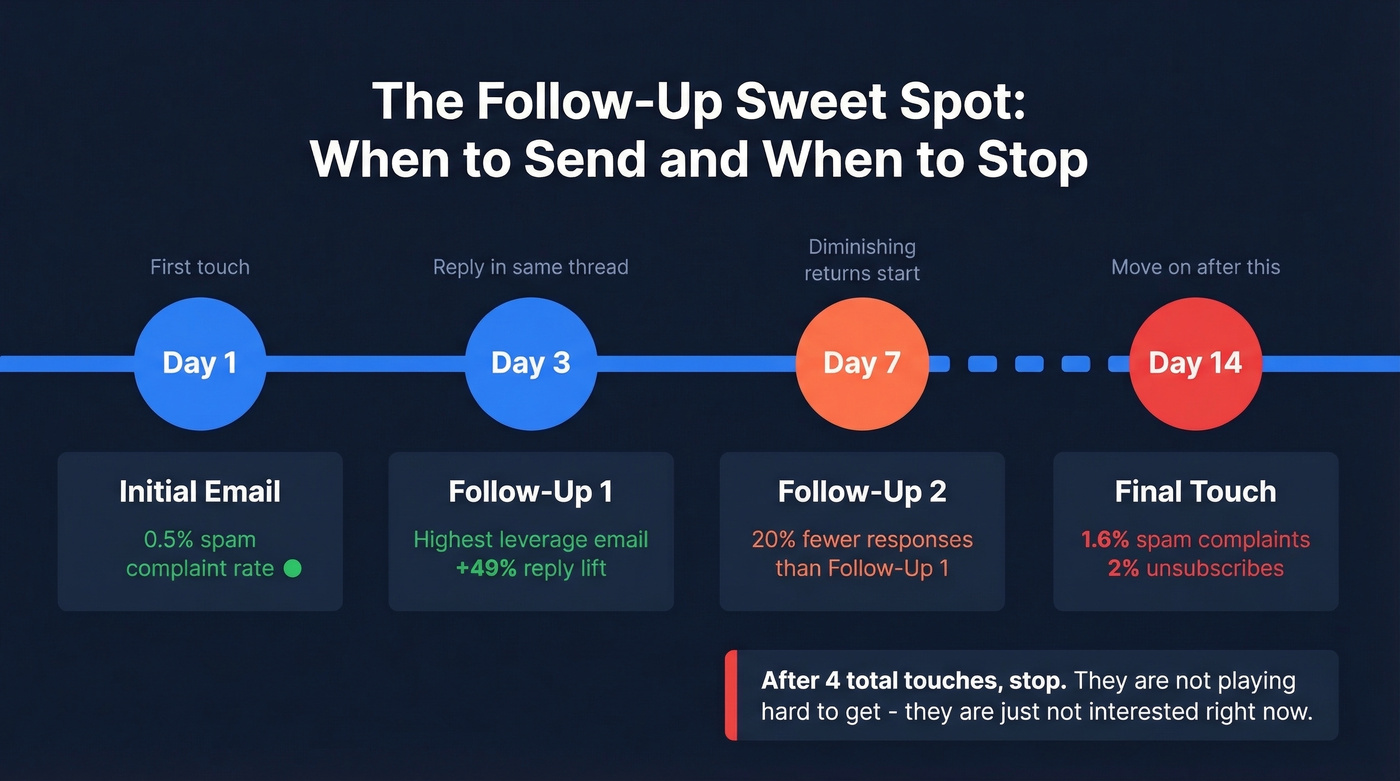
More importantly, the risk compounds. Spam complaints jump from 0.5% on the first email to 1.6% by the fourth. Unsubscribes hit 2% by round four. That's domain-damaging territory.
Cap your sequence at 2-3 follow-ups total. Space them at Day 3, Day 7, and around Day 14. After four total touches, move on. The prospect who didn't reply isn't playing hard to get - they're just not interested right now. If you need more options, borrow from these cold email follow-up templates.
Best Time to Send
Timing won't save a bad email, but it gives a good one an edge. Thursday pulls the highest reply rate at 6.87%, while Monday lags at 5.29%. The 8-11 PM window in the prospect's timezone hits 6.52% - counterintuitive, but evening sends land at the top of the inbox for the morning scan. The 8-10 AM window also performs well across most datasets.
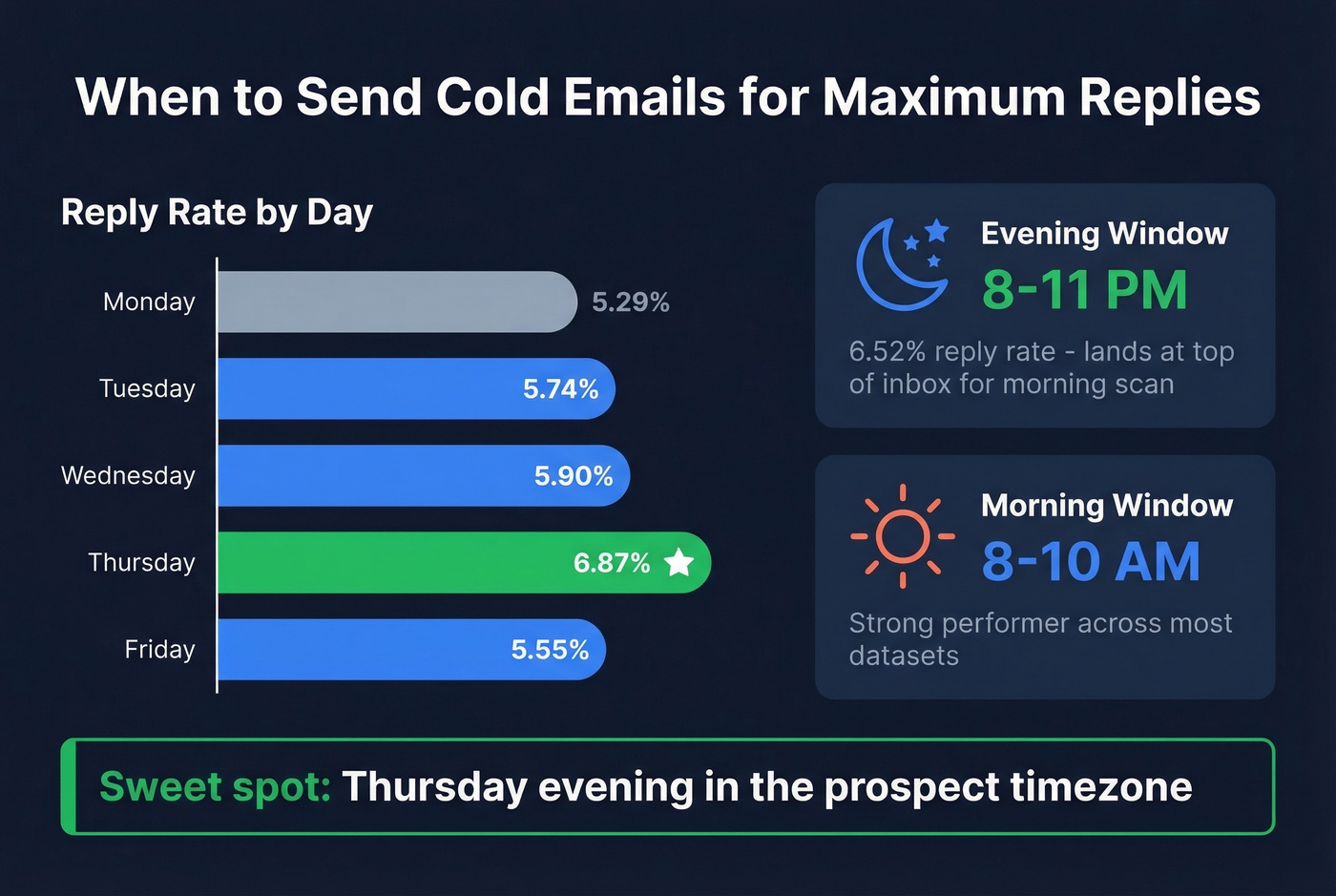
Thursday evening is the sweet spot. Most sending tools support timezone-based delivery - use it. (If you want the full dataset and testing plan, see best time to send cold emails.)
Stay Legal
CAN-SPAM (US)
Use accurate sender info, no deceptive subject lines, include a working unsubscribe link (honor opt-outs within 10 business days), and add a valid physical mailing address. Cold email is legal in the US under an opt-out model.
GDPR (EU/UK)
B2B cold email is permissible under legitimate interest (Article 6(1)(f)) - your outreach must be relevant to the prospect's professional role. Source data from lawful places, provide a clear opt-out, and maintain records of where you sourced each contact. GDPR doesn't ban cold B2B email. It requires a defensible reason for reaching out and immediate respect for opt-outs.
Recommended Tools
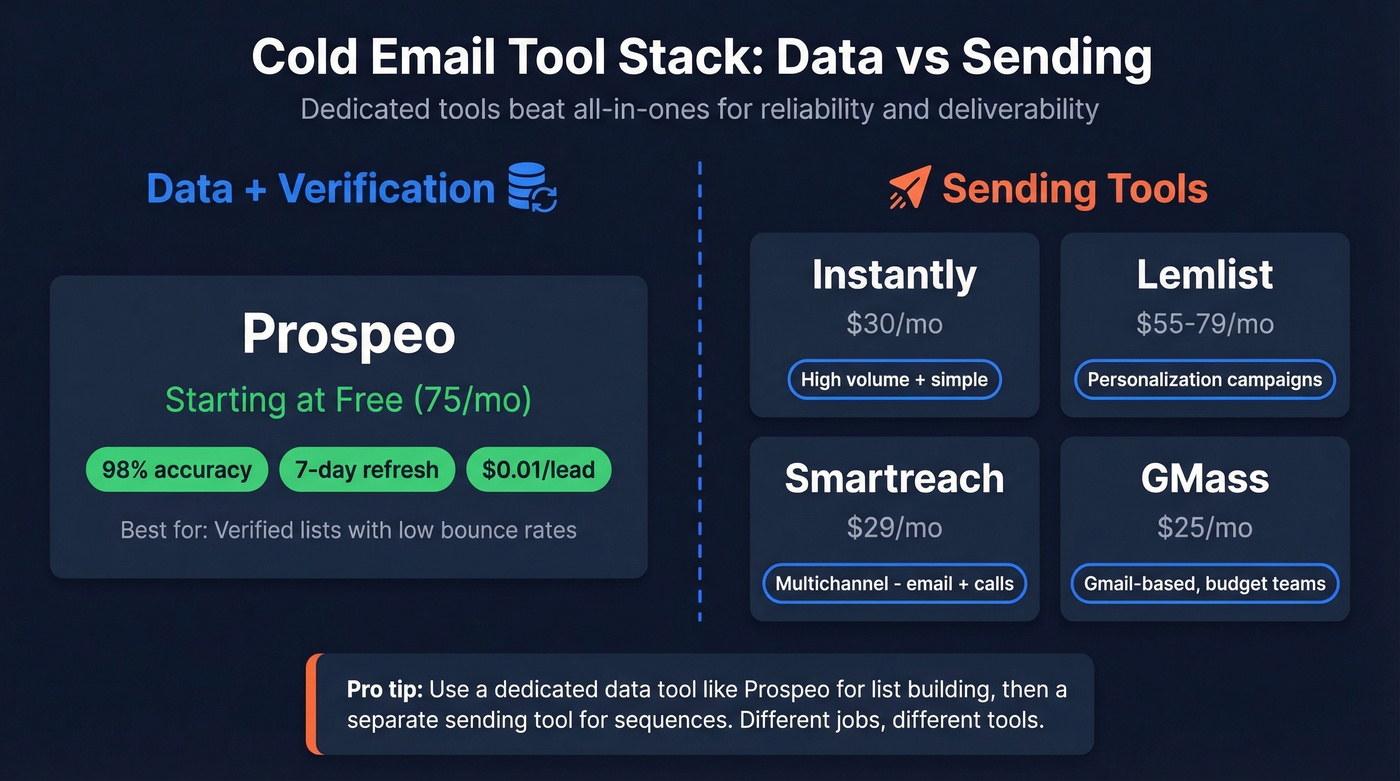
You need a data platform to build verified lists and a sending tool to run sequences. They're different jobs, and in our experience, dedicated tools beat all-in-ones for both reliability and deliverability.
| Tool | Category | Starting Price | Best For |
|---|---|---|---|
| Prospeo | Data + verification | Free (75/mo); ~$0.01/lead | Verified lists, low bounce |
| Instantly | Sending | ~$30/mo | High-volume, simplicity |
| Lemlist | Sending | ~$55-79/mo | Personalization campaigns |
| Apollo | All-in-one | Free tier; $59/mo per user paid | Database + sequences |
| Smartreach | Sending | ~$29/mo | Multichannel (email + calls) |
| GMass | Sending | $25/mo | Gmail-based, budget teams |
Skip Apollo if deliverability is your top concern - the consensus on r/coldemail is that its sending reputation gets mixed reviews, and we've heard the same from agency owners. Smartreach stands out for teams that want to layer in calls alongside email. For pure email volume with minimal setup, Instantly is hard to beat. If you're evaluating options, compare a few SDR tools before committing.
The article says emailing 1-2 contacts per company gets double the reply rate of spraying 10+. Prospeo's 30+ search filters - including buyer intent, job changes, and funding signals - let you find the exact decision-maker worth that one shot. At $0.01 per email, precision targeting costs less than a single wasted send on a bad list.
Find the right prospect the first time, every time.
FAQ
Is cold emailing potential clients legal?
Yes. In the US, cold email is legal under CAN-SPAM's opt-out model - include accurate sender info, a working unsubscribe link, and a physical address. In the EU, B2B outreach is permissible under GDPR's legitimate interest basis, provided it's relevant to the prospect's role and you offer a clear opt-out.
What's a good reply rate for cold email in 2026?
A 5-10% reply rate is solid for B2B cold email; 10-15% is excellent. The average across 16.5 million emails was 5.8%, so anything above that means your targeting and copy are working. Hyper-personalized micro-segments can hit 40%+, though that's aspirational for most teams.
How do I stop cold emails from going to spam?
Authenticate your domain with SPF, DKIM, and DMARC, then warm up for 2-3 weeks before sending cold. Keep bounce rates under 2% by verifying every address before it enters your sequence. Cap daily volume at 10-15 emails per inbox and maintain warm-up traffic at 30-40% of total sends.
How do I write a cold email without sounding spammy?
Focus on one genuine personalization signal - a recent funding round, a job change, a product launch - and tie it to a specific problem you solve. Keep the email under 200 words with a single, low-friction CTA. The goal is to start a conversation, not close a deal in the first touch.