

Cold Outbound: What Actually Works in 2026 (and What Doesn't)
Cold outbound still works. But a RevOps lead who ran 2,000 cold emails through Apollo last quarter didn't believe it - six replies, zero customers. He deleted the tool and posted about it on Reddit, convinced the channel was dead. He was wrong. His infrastructure was broken in at least four places, and the gap between teams doing it right and teams burning their domains has never been wider.
Most outbound guides hand you templates. This one starts with the infrastructure that makes templates actually land.
What You Need (Quick Version)
Outbound prospecting produces meetings when you fix three things: data quality, deliverability infrastructure, and channel mix. Volume isn't the lever anymore.
- Data: Verified emails and direct dials. A bounce rate above 2% will wreck your sender reputation faster than bad copy ever will. (If you want the exact mechanics, see bounce rate.)
- Deliverability: Separate domains, proper authentication, 21-day warmup, hard caps on sends per inbox. Skip any of this and Gmail routes you to spam.
- Channel mix: Email alone isn't enough. Cognism's recommended split is 55% phone, 30% social, 15% email.
Here's the thing: if your average deal size is under $10K, you probably don't need a $30K/year data platform. A $400/month stack with clean data and proper infrastructure will outperform a bloated enterprise tool with stale contacts.
What's Actually Happening in 2026
The numbers tell a clear story. Bridge Group data shows attempts per contact climbed from 7.3 in 2014 to 11.3 by 2022, while quality conversations per day dropped from 8 to 3.6. More effort, fewer results.
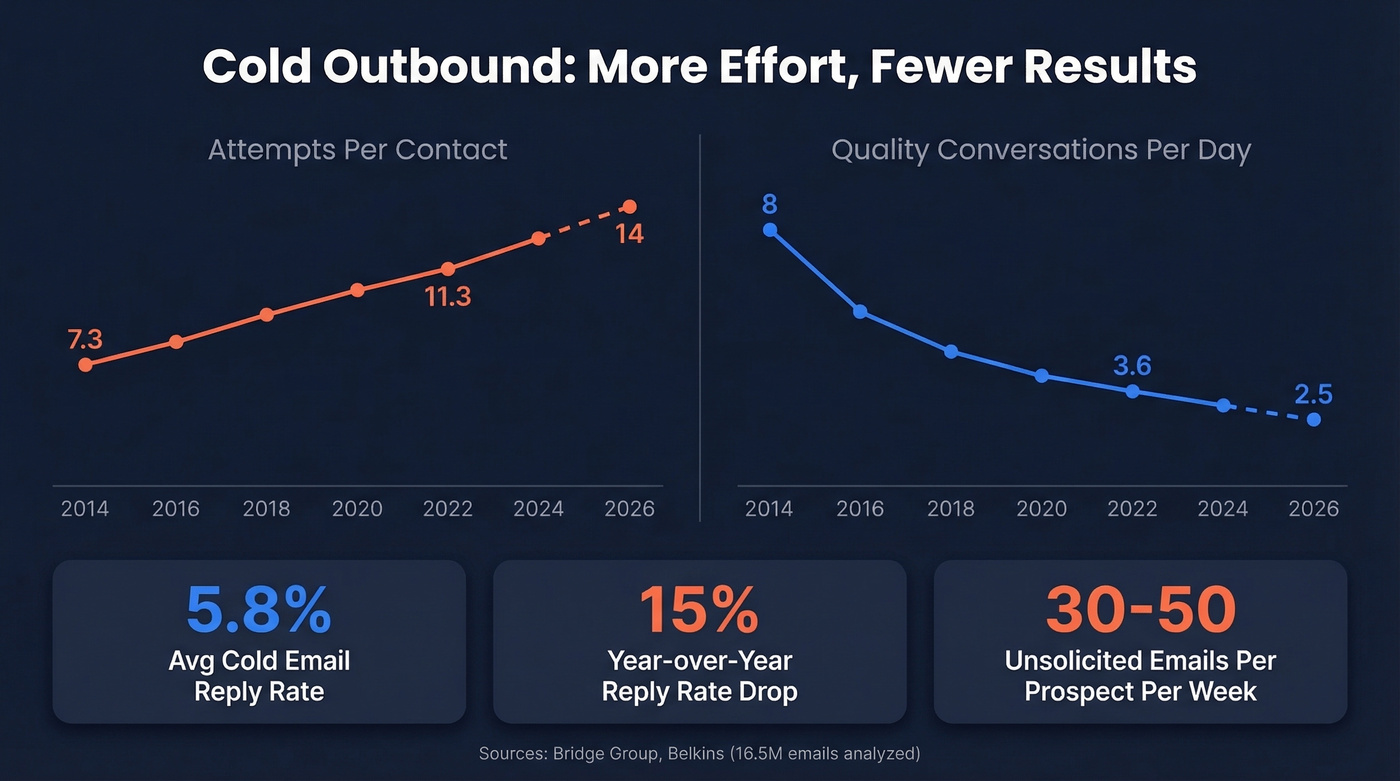
An analysis of 16.5 million cold emails by Belkins found the average reply rate sitting at 5.8% - down from 6.8% the year before, a 15% year-over-year drop. Reddit threads on r/SaaS and r/coldemail are full of founders reporting 2% reply rates and wondering if the channel is dead.
It isn't dead. It's been commoditized at the bottom. When every SDR has access to the same databases, the same sequencing tools, and the same "Quick question" subject lines, the default experience is noise - prospects get 30-50 unsolicited emails a week, and most are irrelevant, poorly targeted, and sent from domains with no reputation.
The teams still booking 40+ meetings a month aren't doing anything magical. They've invested in infrastructure that most teams skip: verified data, warmed domains, signal-based targeting, and multichannel cadences. The "Predictable Revenue" era of blasting 500 emails a day from a single domain is over, and what replaced it is more technical, more deliberate, and significantly more effective per touch.
Benchmarks by Channel
| Channel | Daily Activity | Response Rate | Meeting Conversion |
|---|---|---|---|
| Cold email | 60-80 sends | 5.8% reply avg | 30-50% of positive replies |
| Cold call | 400-750 dials | 5-12% connect | ~2 booked meetings/rep/day |
| Social | 50-100 touches | 3.4% overall reply | 1-3% of touches |
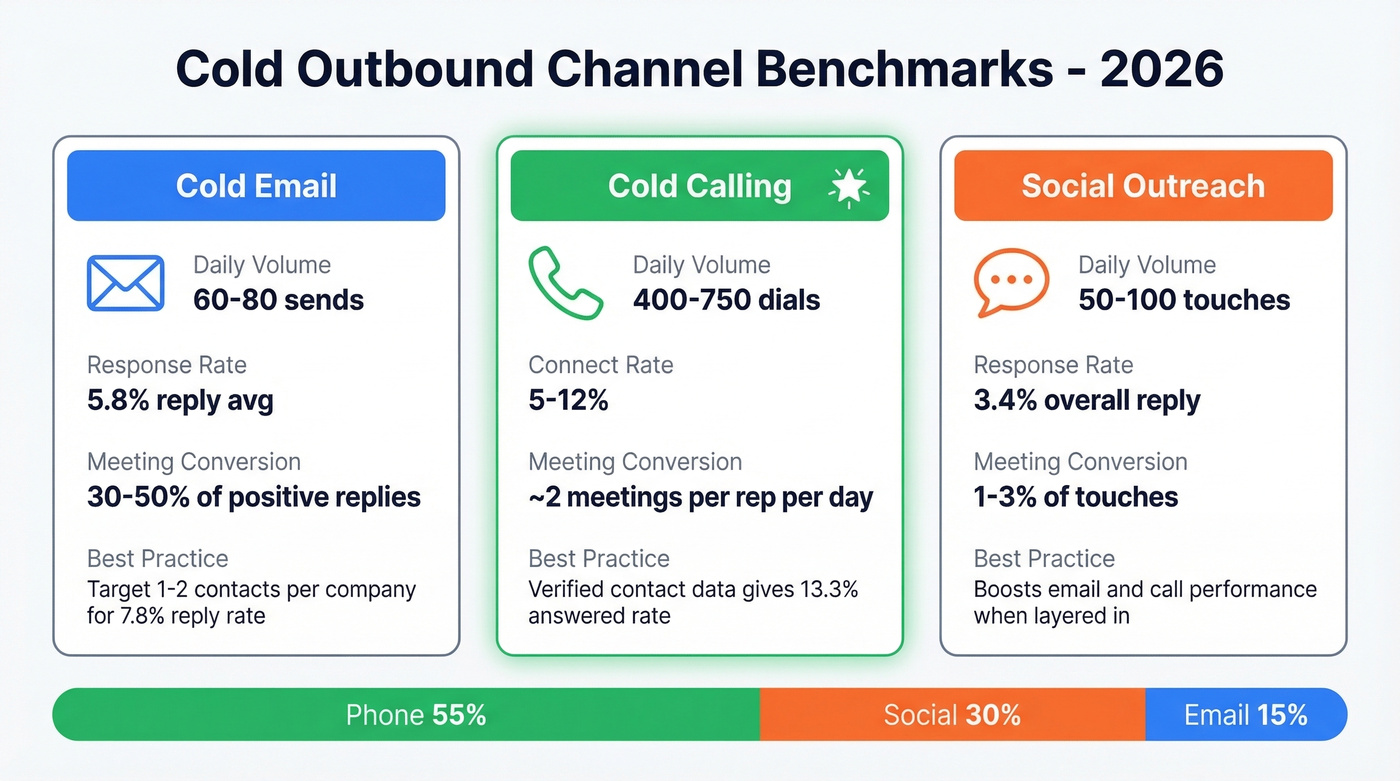
Email remains the highest-volume channel, but more sends produce diminishing returns. Campaigns targeting 1-2 contacts per company pulled a 7.8% reply rate, while campaigns blasting 10+ contacts at the same company dropped to 3.8%. (If you're building sequences, use this as a reference point for sequence management.)
Cold calling is where meetings actually get booked. Cognism's internal data shows a 13.3% answered rate when SDRs use verified contact data. The funnel math: 400-750 dials per day with a parallel dialer, 5-12% connect rates, 24% of connects becoming quality conversations, and 20% of those converting to meetings. Cognism also found AEs hitting 28% email reply rates on warm leads versus 9% for SDRs - reinforcing that signal quality matters more than volume. (If you're systematizing this, start with a cold calling system.)
Social outreach acts as connective tissue. One agency's August 2025 data showed 6,800 connection requests yielding 1,100 accepts at 16%, 230 replies at 21% of accepts, and a 3.4% overall reply rate. Not huge numbers alone, but social touches dramatically improve email and call performance when layered in.
We've seen the 55/30/15 phone/social/email split work consistently across mid-market B2B outreach teams. Email warms, social builds credibility, and calls convert.
Email Deliverability: The Foundation
This is the section most outbound guides skip, and it's the reason most programs fail. You can write the perfect email, target the perfect ICP, and still get zero replies if Gmail routes you to spam. Teams with proper authentication and warmup average 87% inbox placement. Without it, you're looking at 60-70% - sometimes as low as 40%. (For a deeper technical breakdown, see our email deliverability guide.)
The Compliance Baseline
Bulk sender rules from Google, Yahoo, and Microsoft require SPF, DKIM, and DMARC authentication, domain alignment, and one-click unsubscribe headers (RFC 8058). These aren't suggestions. Miss any of them and your deliverability craters immediately. (If you're unsure about alignment, start with DMARC alignment.)
The thresholds to stay under:
- Bounce rate: below 2% (pause the mailbox if you hit this)
- Spam complaints: below 0.3% on Gmail Postmaster
- Inbox placement: 80%+ on seed tests before you scale
Spam complaints climb from 0.5% on the first email to 1.6% by the fourth in a sequence. Multi-email drip campaigns are increasingly risky - you're burning reputation with every follow-up that doesn't add value. (If you need safer follow-ups, use these cold email follow-up templates.)
Infrastructure Checklist
Domains: Buy 3-5 secondary domains for outbound. Never send cold email from your primary domain. A practitioner on r/Entrepreneur shared how they went from 3 domains to 7, each sending a max of 26 emails per day, and watched their bounce rate drop from 11% to under 2%.
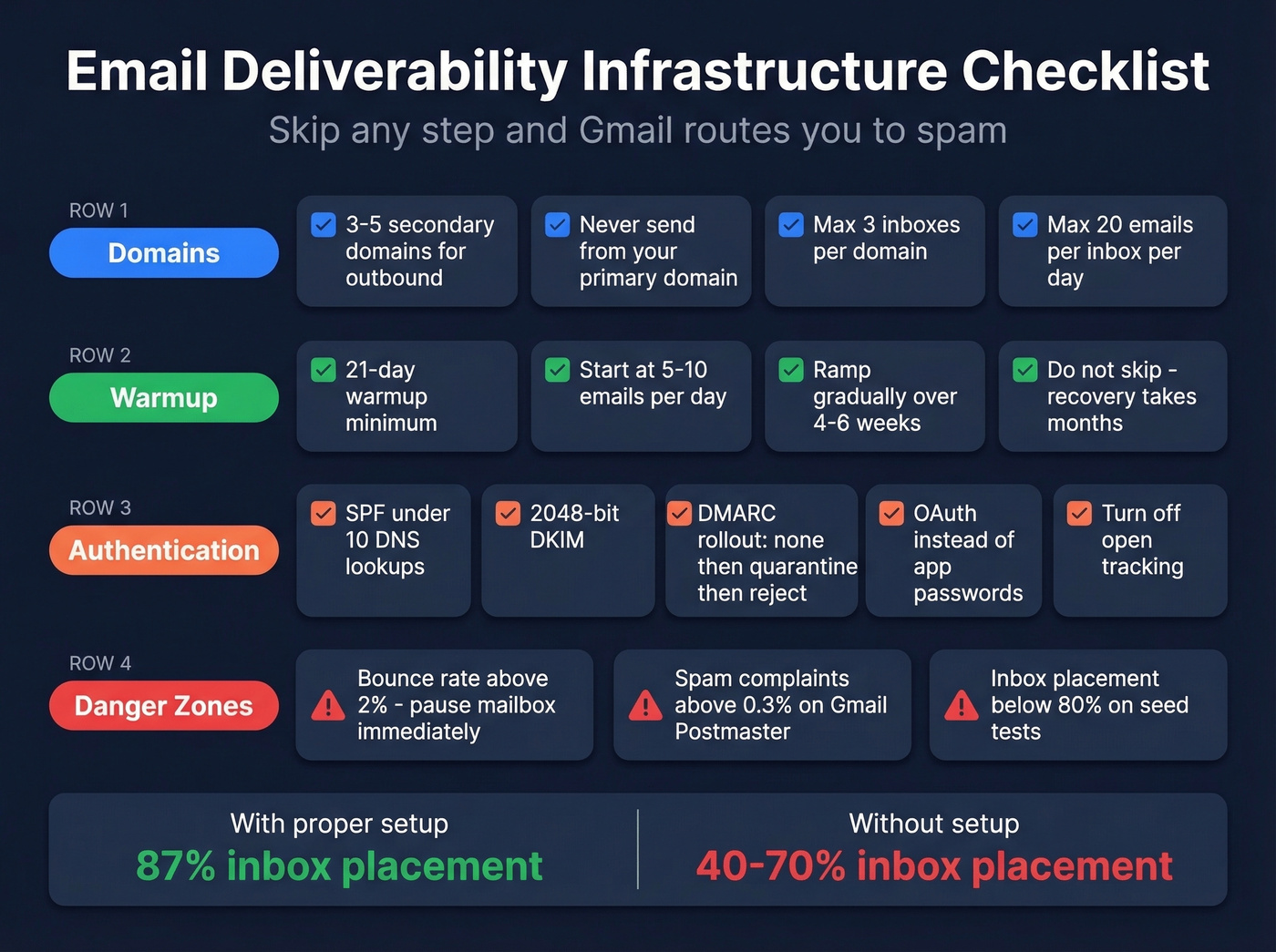
Warmup: New domains need a 21-day warmup starting at 5-10 emails per day, then ramping gradually over 4-6 weeks. Teams that skip warmup spend months recovering their sender reputation. (Tooling matters here - compare options in unlimited email warmup.)
Sending limits: Cap at 20 emails per inbox per day, no more than 3 inboxes per domain. These aren't conservative estimates - they're the hard caps that keep you out of spam. (More context: email velocity.)
Authentication: Roll out DMARC progressively: p=none then p=quarantine then p=reject. Use 2048-bit DKIM. Keep SPF under 10 DNS lookups. Use OAuth instead of app passwords. Check domains and IPs against blacklists biweekly, and turn off open tracking - it's a spam signal now.
Data Quality Is Deliverability
Before you send a single email, verify your list. A bounce rate above 2% tells Gmail you're a spammer faster than anything else. Stack Optimize built from $0 to $1M ARR using Prospeo's 5-step verification - catch-all handling, spam-trap removal, honeypot filtering - and maintained 94%+ deliverability, bounce under 3%, and zero domain flags across all clients. (If you’re cleaning lists at scale, see spam trap removal.)
Cold Email Playbook
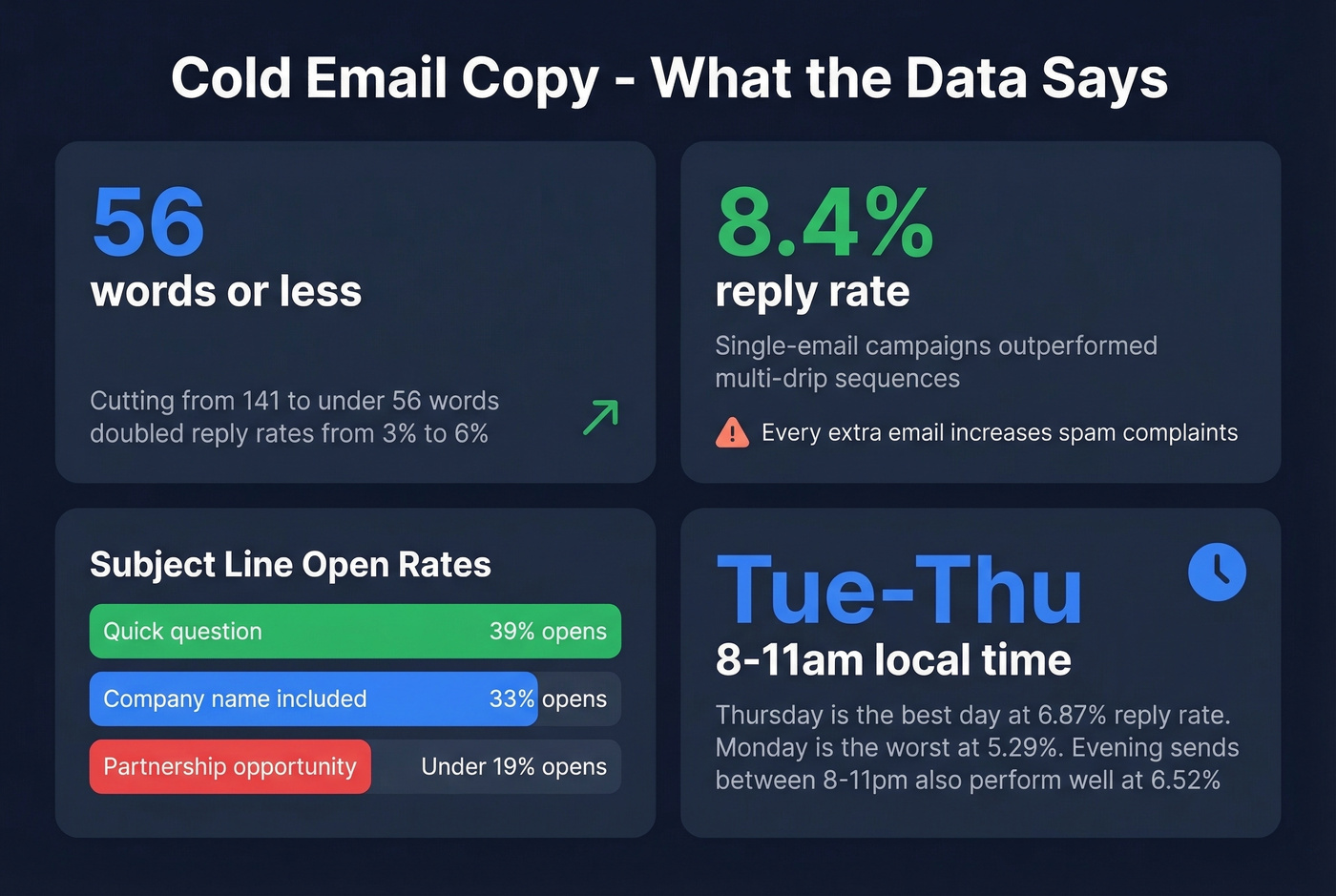
The Reddit practitioner who rebuilt their outbound program shared a number that stuck with us: they cut email length from 141 words to under 56 words and saw reply rates climb from 3% to 6% over 62 days. That tracks with the 16.5M email dataset, which found 6-8 sentence emails hit 6.9% reply rates.
What Works in Copy
Keep it short. One clear pain point, one relevant proof point, one ask. The PAS framework (Problem, Agitation, Solution) still works because it mirrors how buyers think: (If you want more structure, see email copywriting.)
Subject: Quick question
Hey {{firstName}},
Most {{title}}s at {{companySize}} companies tell us {{specific pain point}} eats 5-10 hours a week.
We helped [similar company] cut that by 60% in the first month.
Worth a 15-min call to see if it fits?
"Quick question" as a subject line pulled 39% opens in the practitioner's testing. Including the company name hit 33%. "Partnership opportunity" dropped below 19% - skip it. (Need more options? See cold email subject line examples.)
Timing and Frequency
Send Tuesday through Thursday, 8-11am in the recipient's timezone. Thursday produced the highest reply rate at 6.87%, while Monday was the worst at 5.29%. Evening sends between 8-11pm peaked at 6.52%.
Here's a counterintuitive finding: single-email campaigns outperformed multi-drip sequences, hitting 8.4% reply rates. Every additional email increased spam complaints and decreased replies. That doesn't mean you should never follow up - but your follow-ups need to add genuine value, not just "bumping this to the top of your inbox."

A bounce rate above 2% kills your sender reputation faster than bad copy. Prospeo's 5-step verification - catch-all handling, spam-trap removal, honeypot filtering - delivers 98% email accuracy on a 7-day refresh cycle. Stack Optimize used it to maintain 94%+ deliverability and zero domain flags while scaling to $1M ARR.
Stop burning domains. Start with data that actually verifies.
Cold Calling Playbook
The funnel math on cold calling is straightforward once you have the right numbers. Start with 400-750 dials per day using a parallel dialer, expect 5-12% connect rates giving you 30-60 live conversations, about 24% become quality conversations of 60+ seconds, and roughly 20% of those convert to meetings. Net result: ~2 booked meetings per rep per day. (If you're new to this channel, start with cold calling for beginners.)
Compliance You Can't Ignore
The FCC classified AI-generated voice calls as robocalls in 2024. Using AI voice without prior express written consent triggers TCPA penalties of $500-$1,500 per violation. The FTC reported 2M+ DNC complaints in 2023, and fines can exceed $50,000 per call under the Telemarketing Sales Rule.
The operational rules: call only between 8am-9pm local time, scrub against the national DNC registry every 31 days, honor internal DNC requests immediately, and document opt-outs for 5 years. States may have stricter windows. This isn't optional - it's the cost of doing business in the channel.
Building a 9-Day Multichannel Cadence
Single-channel outreach leaves meetings on the table. Combining channels produces 30-40% more replies than email alone. Here's a day-by-day cadence that layers all three:
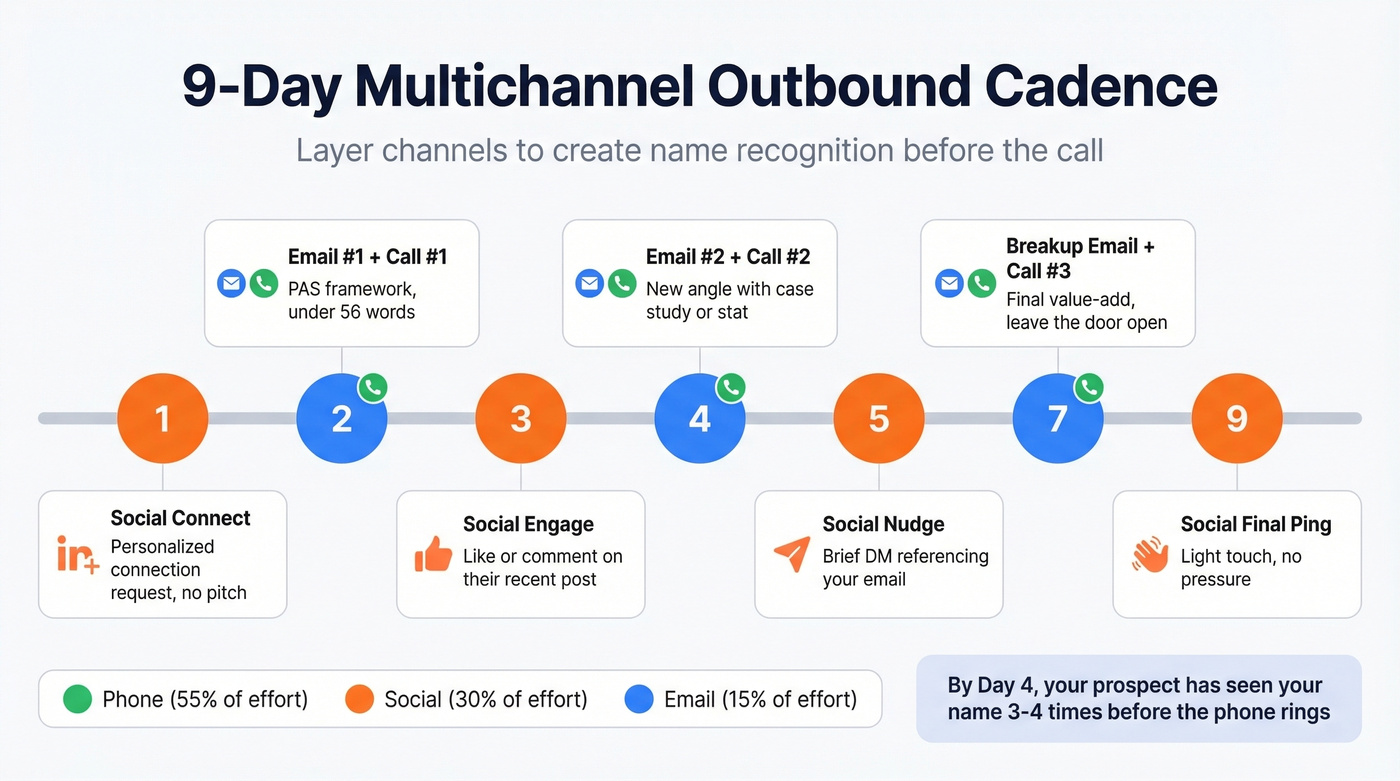
- Day 1: Social connect - personalized connection request, no pitch
- Day 2: Email #1 (PAS framework, under 56 words) + Call attempt #1
- Day 3: Social engage - like or comment on their recent post
- Day 4: Email #2 (new angle, case study or stat) + Call attempt #2
- Day 5: Social nudge - brief DM referencing your email
- Day 7: Breakup email + Call attempt #3
- Day 9: Social final ping - light touch, leave the door open
This maps to the 55/30/15 phone/social/email split. Calls on Days 2, 4, and 7 land when your email and social touches have already created name recognition - your prospect has seen your name two or three times before the phone rings. That familiarity is the difference between a hang-up and a conversation.
Signal-Based Targeting
The biggest shift in outbound over the last two years isn't tactical - it's philosophical. The old model treated outbound as a volume game. The new model treats it as a market intelligence system. You're not just booking calendar slots; you're learning which segments respond, which messages resonate, and which signals predict buying intent.
The signals that matter most: job changes (a new VP of Sales is rebuilding their stack in the first 90 days), tech stack triggers (a competitor's tool just appeared on their site), intent data showing they're actively researching your category, prior deal champions who moved companies, and funding events that unlock new budget. (To formalize this, use an ideal customer profile scoring rubric.)
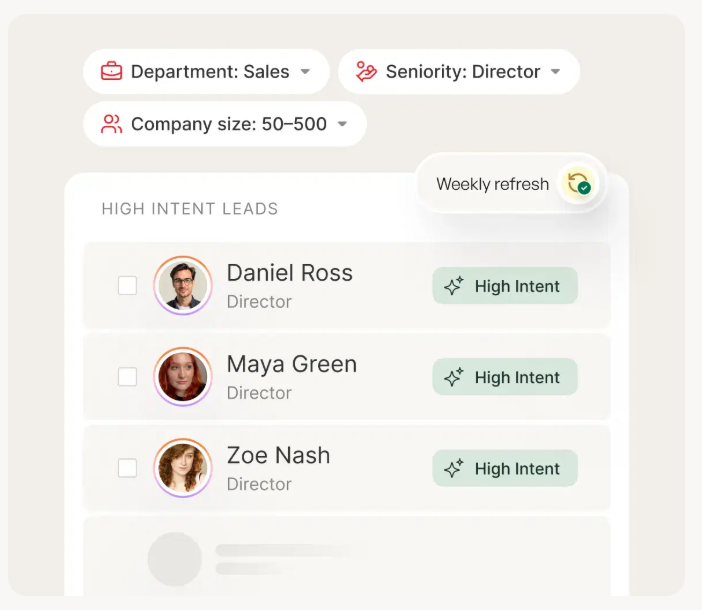
Let's be honest - if you're still building lists by job title and company size alone, you're competing with every other SDR who has the same filters. Here's how to operationalize signal-based targeting: set up a Slack alert for job changes in your ICP, and when a new VP of Sales starts at a target account, that's your Day 1 - not a random Tuesday. Layer intent data across your target accounts, filter for companies actively researching your category, then pull verified emails and direct dials for the right decision-makers in one workflow. Add a "Closed Lost - Nurture" stage to your CRM pipeline to keep timing-based opportunities alive instead of letting them die.
The Outbound Tech Stack
You need three tools: a data provider, a sequencer, and a CRM. Everything else is optional until you're booking 20+ meetings a month. (If you’re comparing categories, start with SDR tools.)
| Category | Tool | Starting Price | Key Strength |
|---|---|---|---|
| Data | Prospeo | Free tier, ~$39/mo paid | 98% email accuracy, 7-day refresh |
| Data | Apollo | Free tier, $49/mo paid | All-in-one prospecting |
| Sequencer | Instantly | $37/mo | Inbox rotation + warmup |
| Sequencer | Smartlead | $39/mo | Multi-inbox management |
| Sequencer | Lemlist | $63/mo | Image/video personalization |
| Sequencer | Reply.io | $49-$59/mo | Multichannel sequences |
| CRM | HubSpot | Free tier, ~$20/mo paid | Best free tier |
| CRM | Close | $9/mo | Built for outbound |
A solo operator's stack runs roughly $400-600/month. The Reddit practitioner who rebuilt their outbound program spent $420/month and generated 16 qualified leads per month. That's a strong ratio for B2B companies with deal sizes above $5K. Skip the enterprise platforms until your outbound engine is already producing - you don't need a $30K tool to book your first 20 meetings.
Cost-Per-Meeting Math
The formula is simple: Total Outbound Investment / Meetings Booked = Cost Per Meeting.
A realistic example: you're spending $944/month on data, sequencer, domains, warmup tools, and fractional SDR time, and you book 12 meetings. That's $78.67 per meeting. Compare that to paid acquisition where a single demo-request lead from Google Ads costs $150-400 in competitive B2B categories.
The practitioner spending $420/month and generating 16 leads hits an even better number: ~$26 per qualified lead. Even if only half convert to meetings, you're at $52 per meeting - well below what most teams pay through inbound channels. Your first month will be expensive per meeting because you're warming domains and testing messaging, but by month three the infrastructure is built and your cost per meeting drops significantly.
Mistakes That Kill Your Program
If your reply rates are below 3%, you're making at least three of these:
- Sending from your primary domain - one spam report and your company email is compromised
- Skipping domain warmup - 21 days minimum, no shortcuts
- Not verifying your list - bounce rates above 2% trigger spam filters
- Writing emails over 100 words - under 56 words consistently outperforms
- Too many follow-ups - 4+ emails spike complaints to 1.6%
- Missing an unsubscribe option - required by law, not optional
- Multiple CTAs in one email - one ask, one action
- Poor SPF/DKIM/DMARC setup - check with MXToolbox before you send anything
- Sending 50+ emails per inbox per day - cap at 20
- HTML-heavy emails with images - plain text wins for cold outreach
Look, most of these are infrastructure problems, not copywriting problems. Teams obsess over subject lines when their DMARC isn't even configured. Fix the foundation first.
Cold outbound in 2026 requires multichannel - email, phone, social. Prospeo gives you 143M+ verified emails and 125M+ verified mobile numbers with a 30% pickup rate, plus 30 filters including buyer intent and job change signals. All at $0.01/email - 90% cheaper than ZoomInfo.
Build the multichannel list that books 40+ meetings a month.
FAQ
What is cold outbound?
Cold outbound is reaching out to prospects who haven't expressed interest in your product - via email, phone, or social messaging. The goal is to start a conversation with someone who fits your ICP but doesn't know you yet. It's the opposite of inbound marketing, where leads come to you through content or ads.
Is cold outbound still legal?
Yes, but compliance rules are strict and getting stricter. CAN-SPAM requires unsubscribe options on every email. TCPA governs calling windows (8am-9pm) and DNC scrubbing every 31 days. The FCC classified AI-generated voice calls as robocalls in 2024, requiring prior written consent. GDPR applies to all EU contacts.
What's a good cold email reply rate in 2026?
The average is 5.8% based on a study of 16.5 million emails. Teams with verified data, proper deliverability setup, and targeted lists consistently hit 6-8%. Below 3% usually signals a data quality or infrastructure problem - not a copywriting problem.
How many cold emails should I send per day?
Cap at 20 emails per inbox per day, with no more than 3 inboxes per domain. New domains need a 21-day warmup starting at 5-10 sends per day, ramping gradually over 4-6 weeks. Higher volume doesn't mean more meetings - it means more spam complaints and lower deliverability across all your inboxes.
What's a good free tool to start with?
Prospeo's free tier includes 75 verified emails and 100 Chrome extension credits per month - enough to test your ICP and messaging before spending anything. Pair it with HubSpot's free CRM and a $37/month sequencer like Instantly, and you've got a functional outbound stack for under $40/month.