

How to Build a Cold Outreach Sequence That Gets Replies in 2026
A RevOps lead we know sent 217,000 cold emails in a single year. Reply rates started at 2.1%, then cratered to 0.7% as domains burned faster than the team could warm new ones. After switching to a multichannel cold outreach sequence with social touches layered in, reply rates climbed back to 12%. The difference wasn't better copy - it was better infrastructure, better data, and more channels.
Some founders have declared cold email dead after sending 2,000 emails and getting 6 replies. The channel isn't dead. The execution is. Reply rates dropped 15% between 2023 and 2024, and the teams still winning fixed three things in order: data quality, multichannel touches, and signal-based personalization. Copy comes last.
Hot take: If your average deal size is under $15k and you're spending $30k+/year on a data platform, you're probably over-tooled and under-verified. Cheaper, more accurate data plus a disciplined outbound sequence will outperform an expensive tech stack with dirty lists every time.
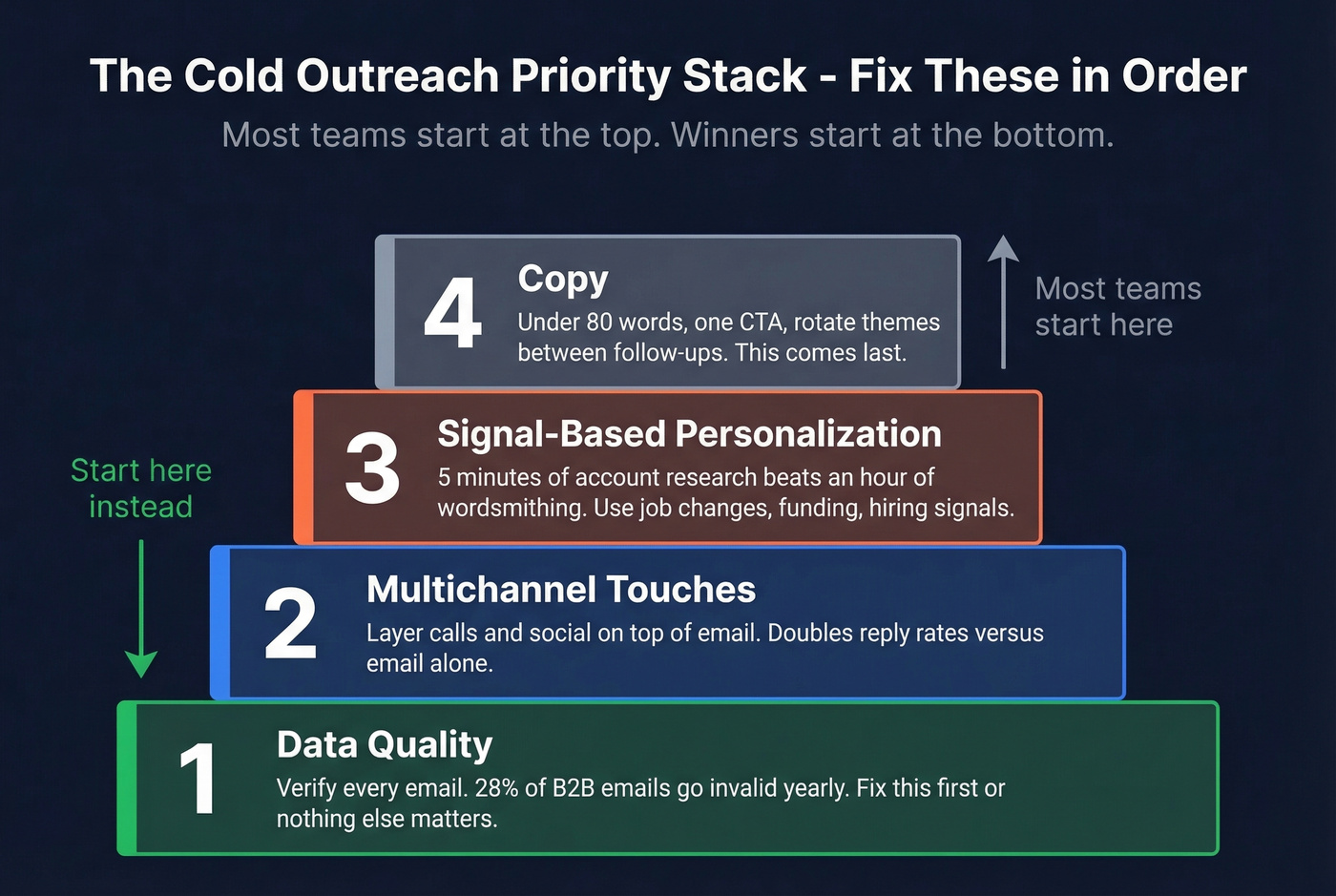
What You Need (Priority Stack)
- Data quality first. 28% of B2B emails go invalid every year. Verify every email before it enters your sequencer.
- Multichannel second. Layering calls and social touches on top of email can double reply rates.
- Signal-based personalization third. Five minutes of account research beats an hour of wordsmithing.
- Copy fourth. Keep it under 80 words, one CTA, and rotate themes between follow-ups.
2026 Cold Outreach Benchmarks
Here's what "normal" actually looks like right now:
| Metric | Average | Top Quartile | Source |
|---|---|---|---|
| Reply rate | 1-3.43% | 5.5-8% | Instantly, SaaS Consult |
| Open rate | 20-30% | 35-50% | SaaS Consult |
| Meeting booked | 0.3-0.8% | 1-2% | SaaS Consult |
| Bounce (target) | <2.8% | <2% | Outreach, SaaS Consult |
Operators treat 2-4% reply rates as a solid baseline at scale. Elite campaigns exceed 10% - that's the ceiling worth aiming for. Tuesday and Wednesday show peak reply rates, with Wednesday consistently the highest.
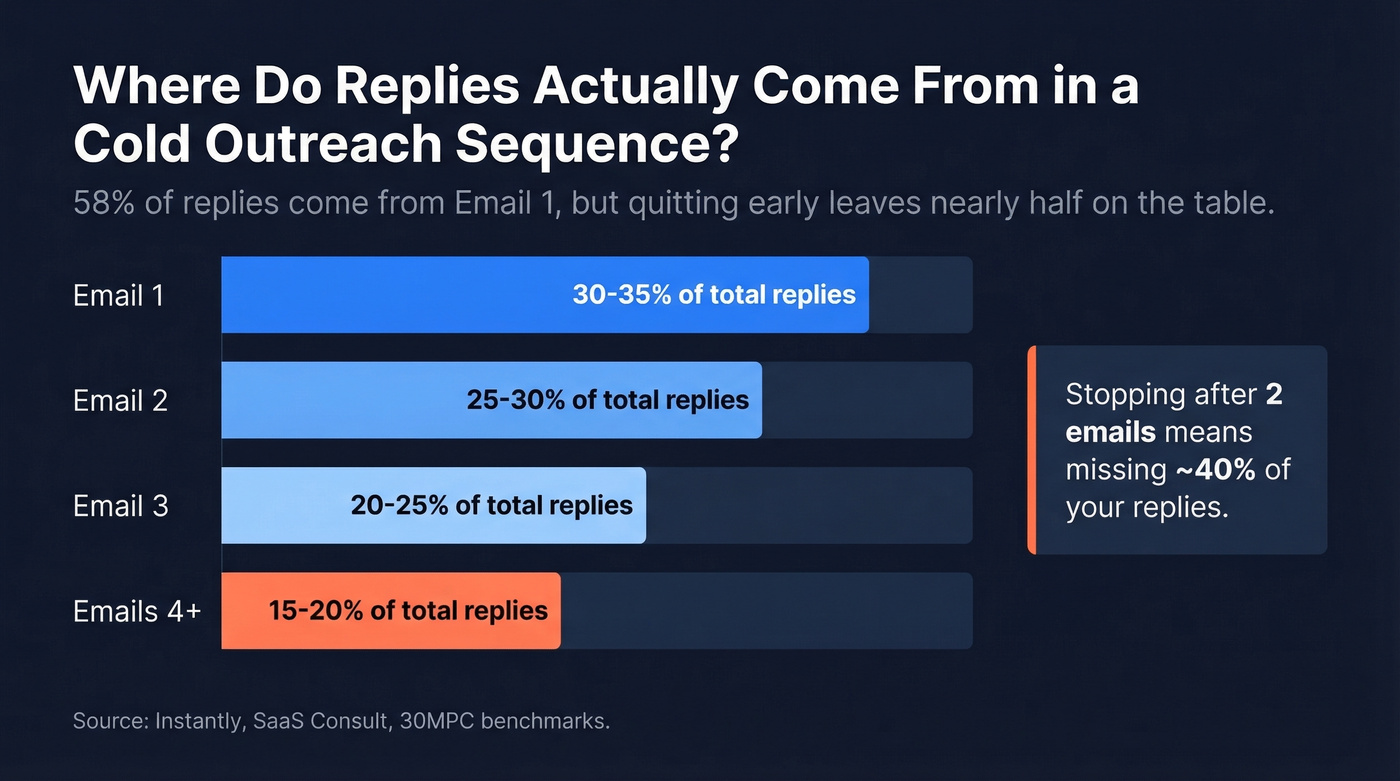
One stat that should change how you think about follow-ups: 58% of replies come from email one, but the remaining 42% trickle in across subsequent touches. The breakdown looks roughly like this - Email 1 drives 30-35% of total replies, Email 2 adds 25-30%, Email 3 contributes 20-25%, and Emails 4+ pick up the final 15-20%. Quitting after one or two sends means leaving nearly half your replies on the table.
If you want a deeper email-only version of this cadence, start with a B2B cold email sequence and then layer channels on top.
Multichannel Sequence Template
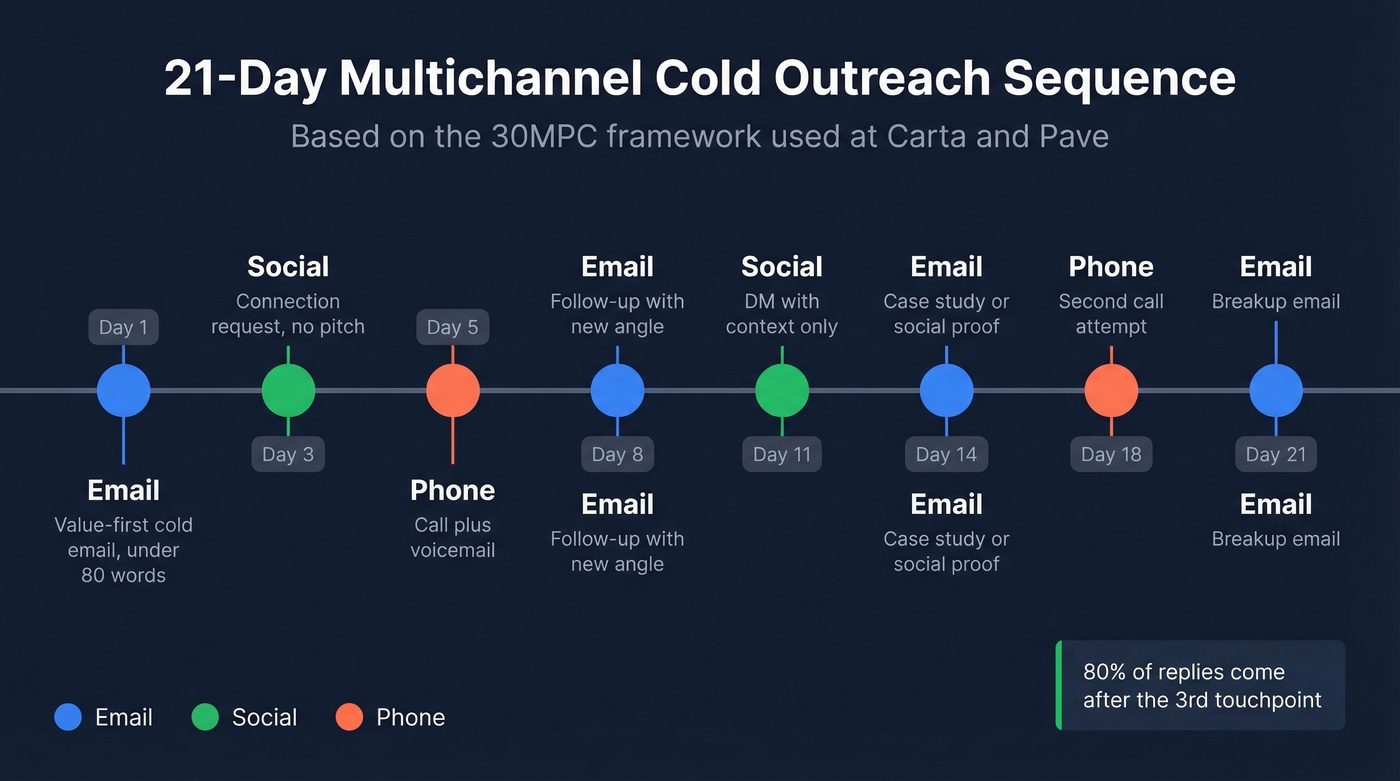
Here's a concrete 21-day cadence modeled on the 30MPC framework used at Carta and Pave:
| Day | Channel | Action |
|---|---|---|
| 1 | Value-first cold email (<80 words) | |
| 3 | Social | Connection request (no pitch) |
| 5 | Phone | Call + voicemail |
| 8 | Follow-up with new angle | |
| 11 | Social | Direct message (context only) |
| 14 | Case study or social proof | |
| 18 | Phone | Second call attempt |
| 21 | Breakup email |
About 80% of replies come after the third touchpoint. That's why single-channel email sequences die - reps give up before the math kicks in. Multichannel "buys" you more email touches by drawing attention back to the inbox through other channels. Analysis of 16.5M emails and 5M calls shows multichannel outreach drives 20% higher close rates and 25% shorter sales cycles versus email alone.
Tier your accounts and build a persona matrix. Map buyer personas against high-touch and low-touch sequences based on seniority and deal value. Tier A prospects (VP+ at target accounts) get the full multichannel treatment above. Tier B gets email plus one other channel. Tier C gets automated email only. Not every prospect deserves 14 manual touches - but your best ones absolutely do.
To tighten the rest of your outbound motion around this cadence, borrow a few sales prospecting techniques that scale without burning domains.

Your multichannel sequence means nothing if 28% of your emails bounce. Prospeo's 5-step verification and 7-day data refresh keep your list clean so every touchpoint in your cadence actually lands. Meritt cut bounce rates from 35% to under 4% - and tripled their pipeline.
Build your cold outreach sequence on data that doesn't bounce.
Fix Your Data Before Your Copy
Here's the thing: roughly 28% of B2B emails become invalid every year due to job changes alone. Most email finders only locate 70-80% of emails in a lead list. So before you've written a single subject line, a quarter of your list is already dead weight.
Bad emails bounce. Bounces tank your sender reputation. Tanked reputation means your good emails land in spam. It's a death spiral, and it happens fast - we've seen teams go from 94% deliverability to under 70% in two weeks because they skipped verification.
This is where verification earns its keep. Prospeo's 5-step verification process catches invalid addresses, spam traps, catch-all domains, and honeypots before they ever touch your sequencer. The 98% email accuracy rate and 7-day data refresh cycle mean you aren't working with stale records, and it plugs directly into Instantly, Smartlead, Lemlist, Outreach, and Salesloft.
If you're comparing vendors, this roundup of data enrichment services is a good place to sanity-check accuracy claims and pricing models.
Real results: Meritt went from a 35% bounce rate to under 4%. Stack Optimize built from $0 to $1M ARR with zero domain flags across all clients, maintaining 94%+ deliverability.
You just mapped out a 21-day multichannel sequence. Now fill it with verified contacts who actually exist. Prospeo gives you 300M+ profiles with 98% email accuracy and 125M+ direct dials - plus intent data across 15,000 topics so you're sequencing buyers who are already in-market.
Stop sequencing dead emails. Start reaching real buyers at $0.01 each.
Deliverability Checklist
- Secondary domains only. Never cold email from your primary domain. Period.
- SPF, DKIM, DMARC configured on every sending domain before you send a single email.
- Warmup 5-10 emails/day for 4-6 weeks before scaling. Keep warmup running after launch.
- Custom tracking domain (e.g., track.yourdomain.com) - shared tracking domains inherit other senders' bad reputation.
- Bounces under 2%, spam complaints under 0.3%. Hard thresholds enforced by Google, Yahoo, and Microsoft since 2025.
- Plain text emails, minimal links. Heavy HTML and images are spam triggers.
- Verify every email before sequencing - invalid addresses and spam traps are the fastest way to torch a domain.
- Include a one-click unsubscribe link. Required by bulk sender rules since 2025.
- Scaling math: 400 emails/day requires roughly 10-12 domains x 2-3 inboxes each x 10-15 emails per inbox per day. Plan your infrastructure before you plan your copy.
For a deeper technical breakdown, use this email deliverability guide alongside your checklist, and make sure you understand what a tracking domain is before you scale.
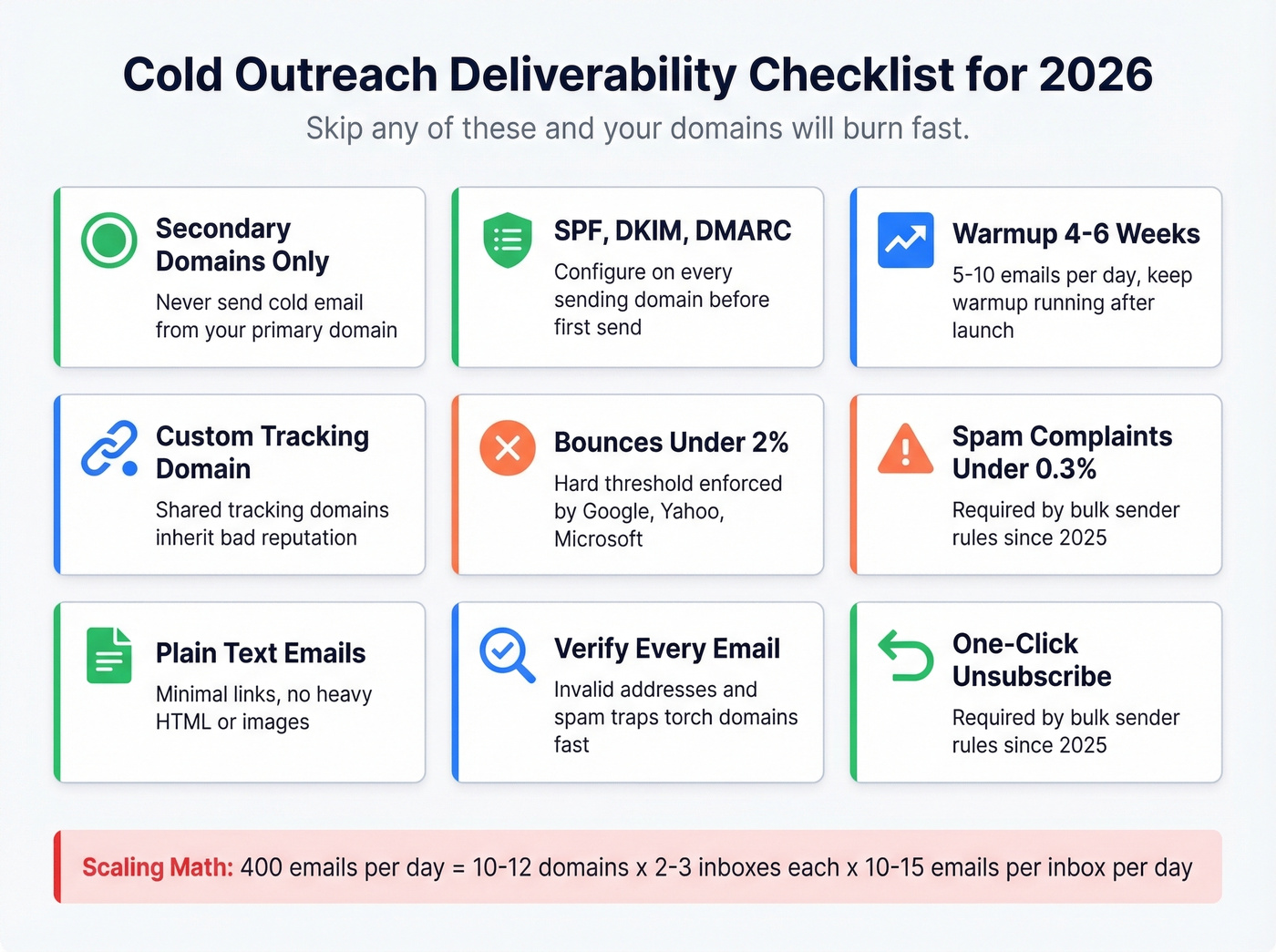
Skip this checklist at your own risk. We've watched agencies lose entire domain portfolios in a single week because they scaled sends before their authentication was locked down.
Copy That Gets Replies
Buyers receive 120+ sales emails per week. Your email is competing with 119 others, so keep it under 80 words with a single CTA. One ask per email, always.
The highest-leverage move isn't rewriting your opening line - it's spending five minutes on account research before you hit send. Job changes, funding rounds, hiring patterns, and earnings commentary yield 3-5x higher reply rates compared to generic templates. Instead of "Hi {{first_name}}, I noticed your company..." try referencing a specific signal: "Saw you're hiring 3 SDRs - usually means outbound is working but pipeline needs to scale." If your email smells like AI generated it from a CSV, it's getting deleted.
If you need fast iterations, pull from proven cold email subject line examples and keep a swipe file of emails that get responses.
Change your theme between follow-ups. Don't send the same angle four times with "just bumping this up." Each touch should introduce a new reason to reply - a different pain point, a case study, a relevant signal. The 30MPC principle of "sell one thing at a time" keeps your sequence from feeling like a broken record. The consensus on r/sales backs this up: reps who rotate angles between touches consistently report higher reply rates than those who just "check in."
When you’re ready to operationalize follow-ups, these cold email follow-up templates and sales follow-up templates make it easier to rotate angles without rewriting from scratch.
FAQ
How many emails should a cold outreach sequence have?
Four to seven email touchpoints based on Instantly's 2026 benchmarks. Within a multichannel sequence, aim for 10-14 total touches across email, phone, and social over 21-30 days. Beyond seven email-only touches, diminishing returns hit hard and you risk spam complaints.
What's a good cold email reply rate in 2026?
Average sits at 1-3.43%. Top-quartile campaigns hit 5.5-8%, and elite multichannel sequences exceed 10%. Below 2%, check your data quality and deliverability before rewriting copy - bad lists cause more low reply rates than bad subject lines.
Should I use email only or add calls and social?
Multichannel wins every time. Analysis of 16.5M emails and 5M calls shows 20% higher close rates and 25% shorter sales cycles versus email alone. At minimum, add one social touch between emails two and three for a meaningful lift.
What's the best free tool for verifying emails before sequencing?
Prospeo offers 75 free email credits per month with 98% accuracy and catch-all domain handling - enough to validate a starter list without burning domains. Hunter gives 25 free searches but caps enrichment. For teams running real volume, Prospeo's 5-step verification and native sequencer integrations make it the stronger free-tier option.
Fix the data. Add channels. Then worry about the copy. That's how you build a cold outreach sequence that actually books meetings in 2026.