

Cold Prospecting in 2026: Benchmarks, Sequences, and Tools That Actually Work
You send 500 cold emails on Monday. By Wednesday, 200 have bounced, 14 hit spam, and your domain reputation is circling the drain. Most cold prospecting guides tell you to rewrite your subject line. The real problem? Four out of ten contacts on your list were dead before you hit send.
This approach doesn't fail because of bad copy. It fails because of bad data. No amount of clever personalization rescues an email that never arrives. Fix the foundation first, then build the sequence on top.
The Short Version
Cold prospecting in 2026 comes down to verified data, a multi-channel sequence across email, phone, and social, and persistence across 5-7 touches. Most campaigns fail because the contact list is stale. Below: the benchmarks that matter, a ready-to-use 14-day sequence, and the mistakes quietly killing your pipeline.
What Is Cold Prospecting?
Cold prospecting is reaching out to people who don't know you - and have no prior relationship with your company - to generate an initial sales conversation. It combines email, phone, and social outreach into a coordinated effort to book meetings with potential buyers.
The distinction from warm and hot prospecting is straightforward. Cold leads have zero prior engagement with your brand. Warm leads have shown interest - downloaded a whitepaper, attended a webinar, subscribed to your newsletter. Hot leads are actively evaluating solutions. A simple scoring model makes this concrete: a pricing page visit is worth +25 points, a demo request +30, a webinar attendance +15. Once a lead crosses 75, they're hot. Below that, you're prospecting - and if they've never interacted with you at all, you're reaching out cold. That's where the real pipeline gets built.
2026 Benchmarks
Before you build a sequence, you need to know what "good" looks like. These numbers draw from Instantly's analysis of billions of cold emails, Sopro's dataset of 151 million outreach data points, and Outreach's survey of 500 revenue professionals.
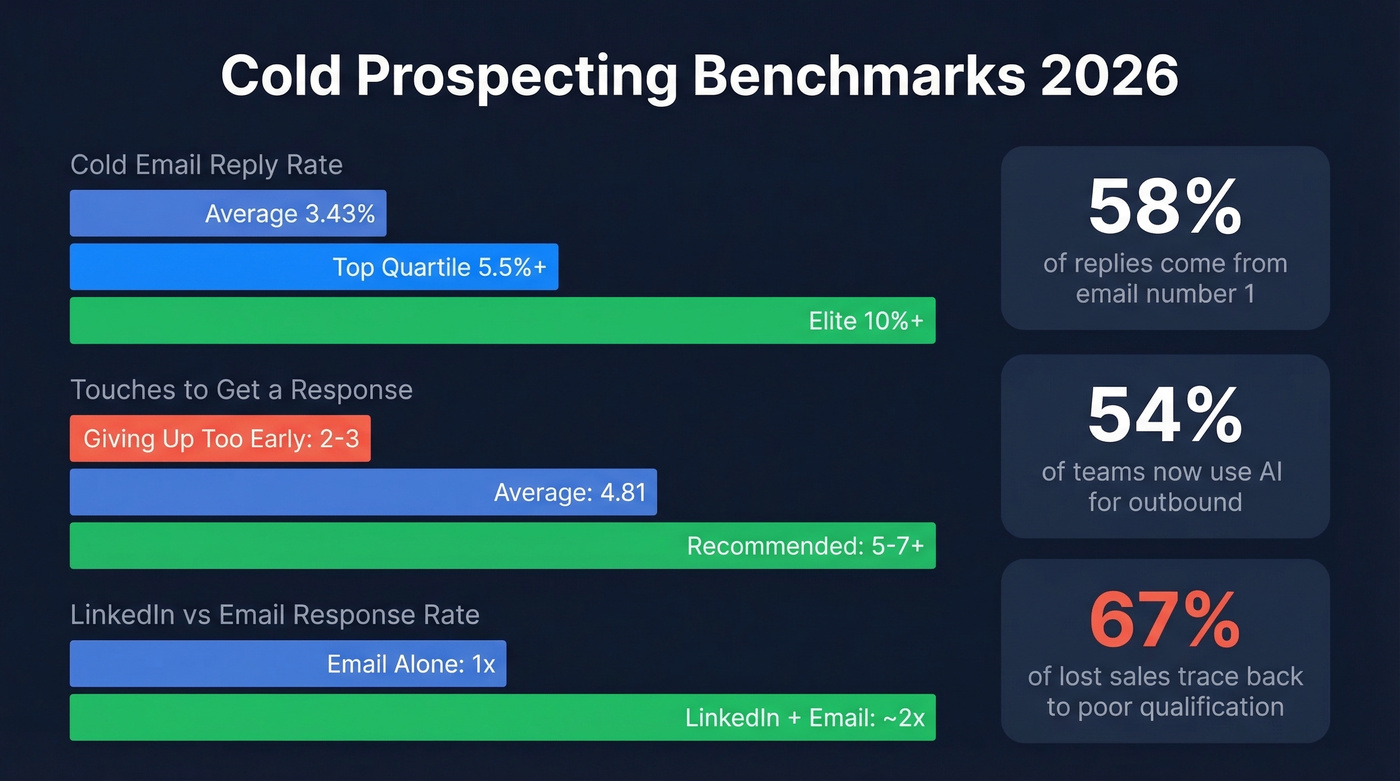
| Metric | Average | Top Quartile | Elite |
|---|---|---|---|
| Cold email reply rate | 3.43% | 5.5%+ | 10%+ |
| Touches to response | 4.81 | 5-7 range | 7+ |
| Replies from step 1 | 58% | - | - |
| LinkedIn vs email response | ~2x higher | - | - |
| Cold call to meeting | - | - | Up to 15% of conversations convert |
Two things jump out. First, 58% of all replies come from the first email in a sequence - your opener carries most of the weight. Second, the gap between average (3.43%) and elite (10%+) is nearly 3x, and that gap isn't explained by better subject lines. It's explained by better data, tighter targeting, and disciplined follow-up.
The touch count tells a consistent story across sources: 4.81 touches on average, with RAIN Group putting it at 7. If you're giving up after two emails, you're leaving pipeline on the table.
On the AI front, 54% of teams now use AI for personalized outbound emails, and 22% have fully replaced SDRs with AI agents. The teams still doing this entirely manually are at a growing disadvantage. Meanwhile, 43% of teams run hybrid inbound-outbound functions, meaning your outreach likely shares resources with inbound - making efficiency even more critical.
Here's the thing: if your average deal size sits below $10K, you probably don't need a $40K/year data platform or a 10-person SDR team. A solo founder with verified data, a solid sequence, and 3 hours a day can outperform a bloated outbound org running on stale lists. The math favors accuracy over volume every time.
Quick ROI Framework
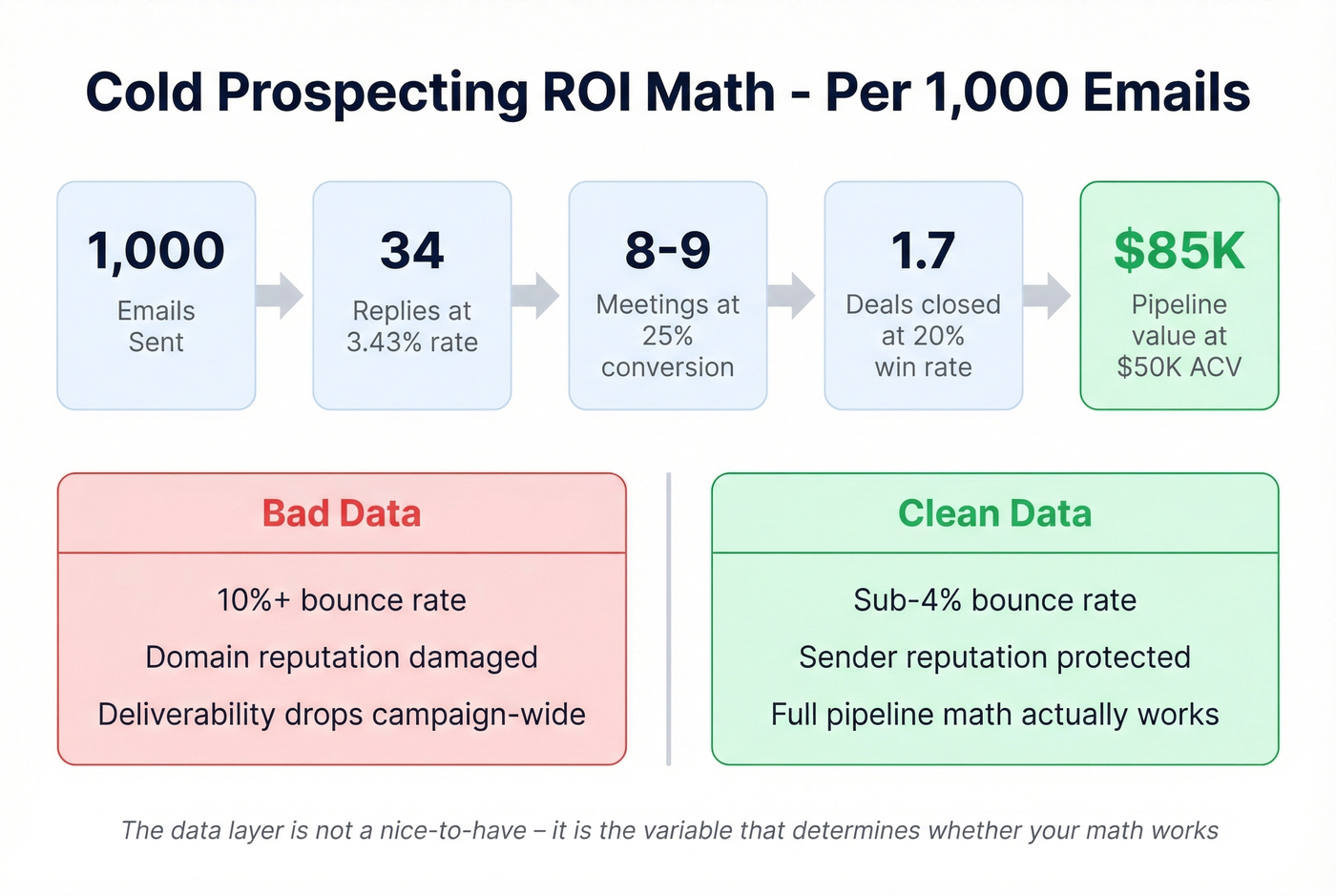
Run these numbers before you launch any campaign. 1,000 emails at a 3.43% reply rate yields 34 replies. At a 25% meeting conversion rate, that's 8-9 meetings. If your ACV is $50K with a 20% close rate, that's roughly $80-90K in pipeline per 1,000 emails sent. Now imagine those same 1,000 emails with a 10% bounce rate eating into your sender reputation versus a sub-4% bounce rate keeping deliverability clean. The data layer isn't a nice-to-have - it's the variable that determines whether your math works.
Three Channels That Work
Cold Email
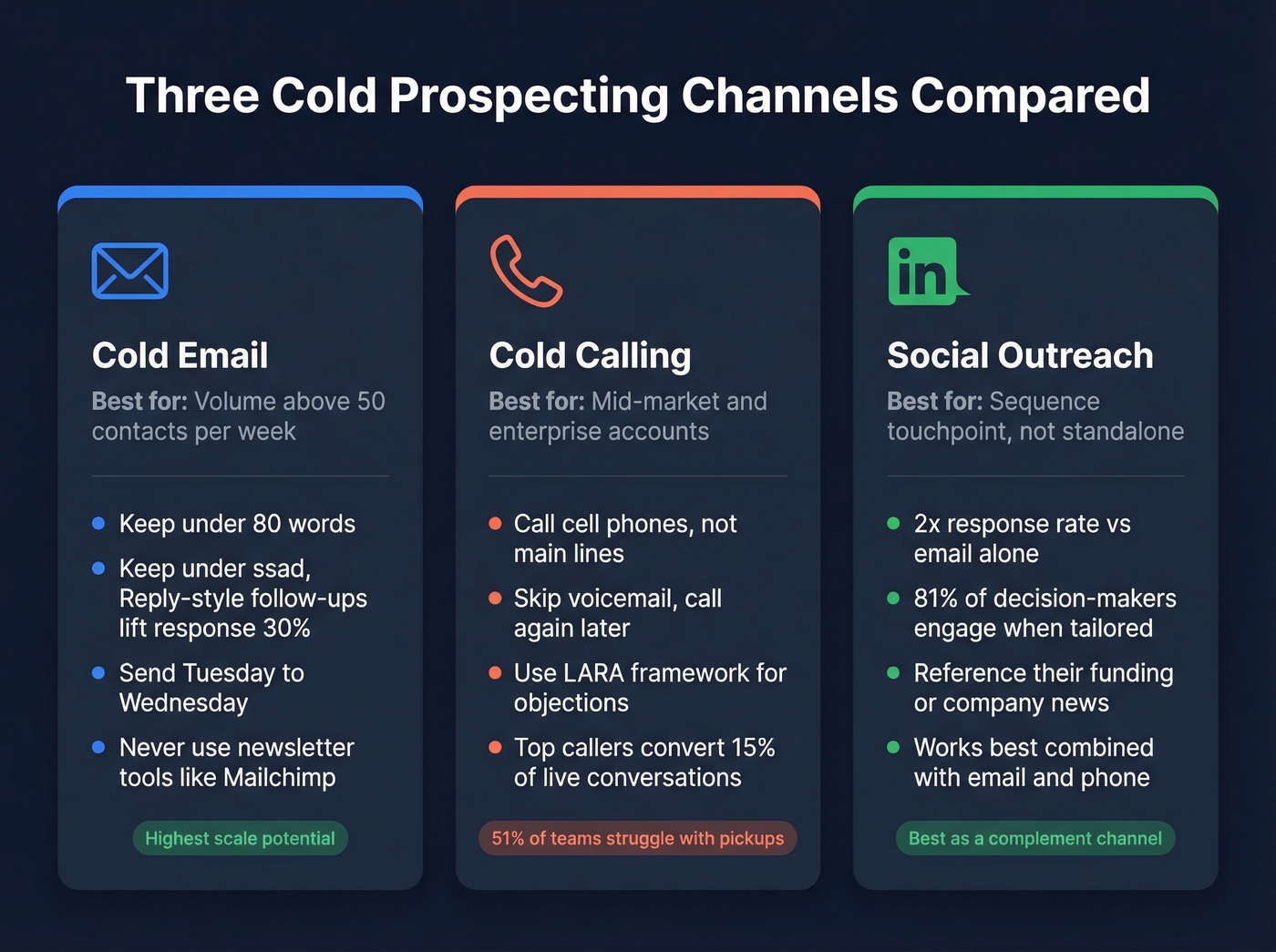
Use this if you're prospecting at any volume above 50 contacts per week. Email scales, it's measurable, and it's where most replies originate.
Skip this if you're only targeting C-suite at Fortune 500 companies - their inboxes are war zones, and phone or social will outperform.
Keep emails under 80 words. The best-performing campaigns are short, direct, and specific. Your step 2 email should feel like a casual reply, not a formal follow-up - that format outperforms by roughly 30%. Send Tuesday through Wednesday for peak reply rates. And never send cold outreach from newsletter tools like Mailchimp. They're built for marketing emails, not 1:1 prospecting, and they'll tank your deliverability.
Cold Calling
The phone isn't dead - 51% of sales teams just struggle to get prospects to pick up. The fix isn't better scripts. It's better numbers.
Calling main lines is a time sink. Phone trees, gatekeepers, and voicemail loops eat hours. Cell phones change the math entirely. One practitioner on r/techsales described calling the same number 30 times before connecting - and still booked the demo. The tactic: call frequently without leaving voicemails. You increase live connect odds without annoying the prospect.
When you do connect, don't pitch. Use a framework like LARA - Listen, Acknowledge, Respond, Ask - to handle objections naturally instead of sounding scripted. Top cold callers convert up to 15% of live conversations into meetings. Track your connect rate and meeting rate weekly; the pattern in your own data will tell you more than any benchmark.
This channel makes the most sense for mid-market and enterprise accounts where a live conversation moves deals faster than email threads. For smaller deal sizes, lean harder on email and social instead.
Social Outreach
Social outreach delivers roughly 2x the response rate compared to email alone - specifically on LinkedIn. But it works best as a sequence touchpoint, not a standalone channel. A connection request on Day 3, a thoughtful comment on their post on Day 7 - that's the play.
The data backs this up: 81% of decision-makers engage with outreach when it's tailored to their company or role. A generic connection request gets ignored. A message referencing their recent funding round or a specific challenge in their industry gets read.
One thread on r/SaaS captured the frustration well: teams using three or four disconnected tools for multi-channel outreach spend more time managing the stack than actually prospecting. We've seen this ourselves - the best setups keep the tool count low and the channels coordinated.

This article shows that 4 in 10 contacts are dead before you hit send. Prospeo's 7-day data refresh and 98% email accuracy keep your list alive - so your 1,000-email campaign hits 34+ real replies instead of 200 bounces and a wrecked domain.
Stop prospecting into the void. Start with data that actually delivers.
A 14-Day Outreach Sequence
This sequence is built on the benchmarks above: 4-7 touchpoints, multi-channel, with the heaviest lift on Day 1.
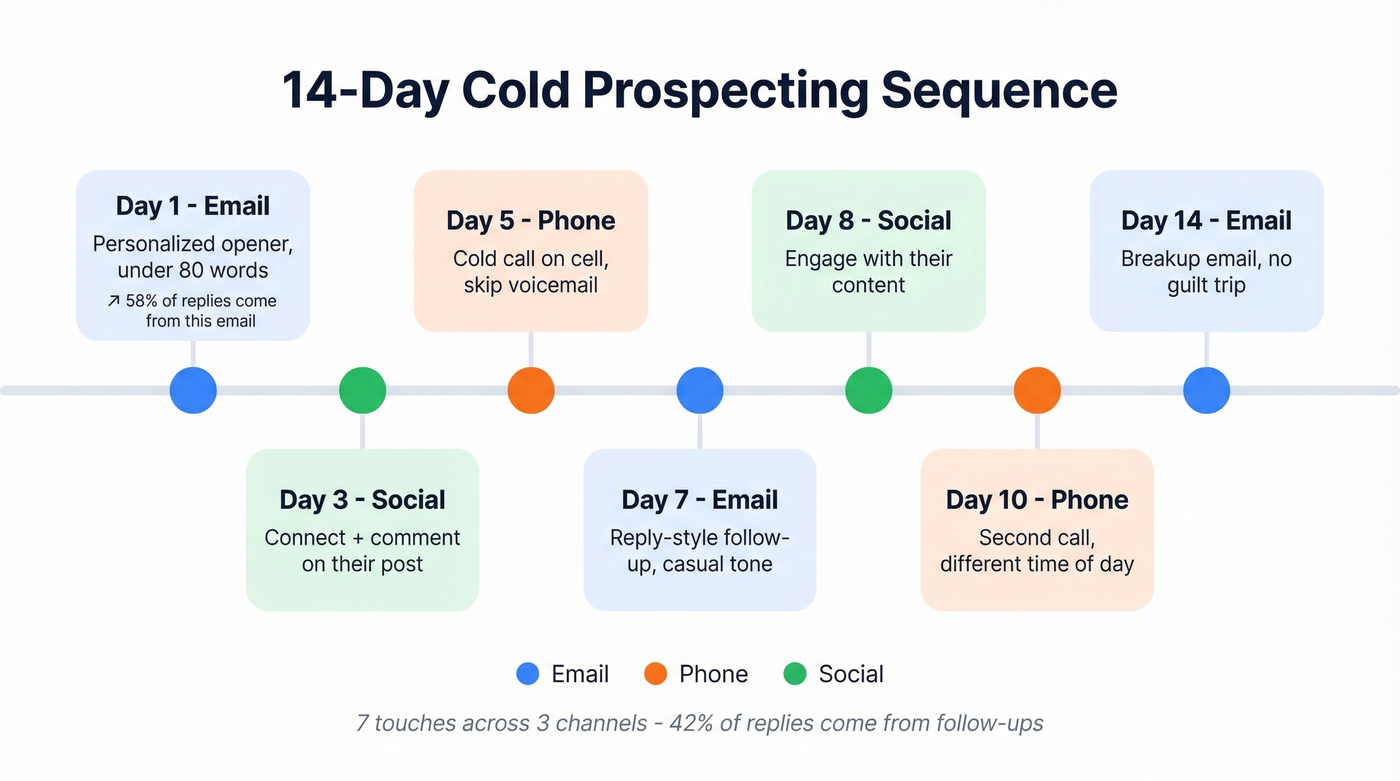
| Day | Channel | Action | Why This Day |
|---|---|---|---|
| 1 | Personalized opener, under 80 words | 58% of replies come from email #1 | |
| 3 | Social | Connect + comment on their post | Name recognition before the call |
| 5 | Phone | Cold call on cell, skip voicemail | They've seen your name twice already |
| 7 | Reply-style follow-up | Casual format lifts response ~30% | |
| 8 | Social | Engage with their content | Reinforces familiarity |
| 10 | Phone | Second call, different time | Varies the pattern |
| 14 | Breakup email, no guilt trip | Creates urgency, closes the loop |
Seven touches across three channels over two weeks. Under four touches and you're quitting early - 42% of replies come from follow-ups. Beyond seven, you hit diminishing returns unless each touch adds genuinely new value.
The compounding effect is what makes this work. By Day 5, your prospect has seen your name in their inbox and their social feed. When the phone rings, you're not a total stranger. That recognition is what makes multi-channel outperform any single channel by a wide margin.
Data Quality: The Real Foundation
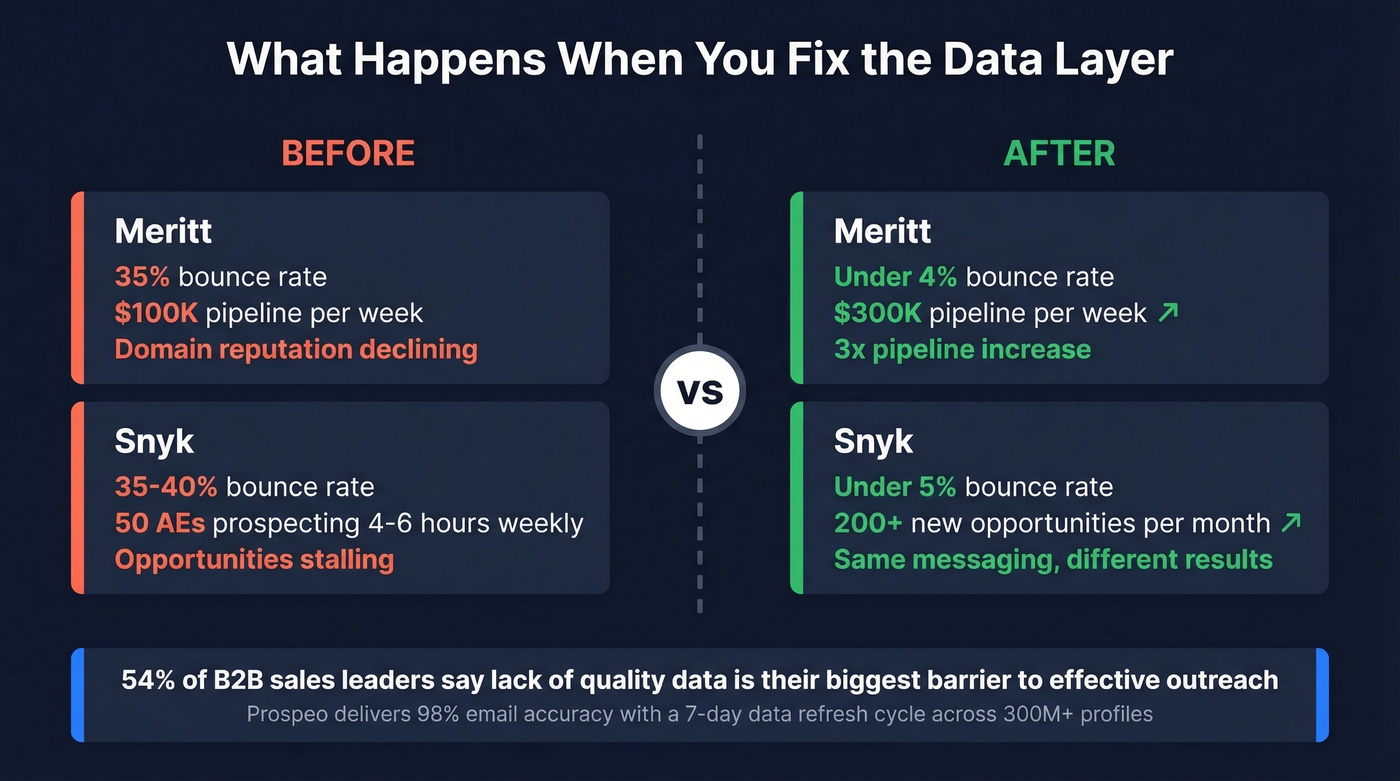
Let's be honest about something. 67% of lost sales trace back to a failure to qualify properly, and that problem starts at the prospecting stage. Meanwhile, 54% of B2B sales leaders say lack of quality data is their biggest barrier to effective outreach. Not messaging. Not timing. Data.
We've seen this pattern repeatedly: a team invests in a slick sequencing tool, writes great copy, builds a thoughtful cadence - and then feeds it a list where a third of the emails bounce. The domain takes a hit. Deliverability drops. The whole campaign is poisoned, and the team blames the copy.
Look at what happens when you fix the data layer. Meritt went from a 35% bounce rate to under 4% after switching their data source. Pipeline tripled from $100K to $300K per week. Snyk - with 50 AEs prospecting 4-6 hours per week - dropped bounce rates from 35-40% to under 5% and generated 200+ new opportunities per month. The messaging didn't change. The data did.
Prospeo's 98% email accuracy and 7-day data refresh cycle across 300M+ professional profiles is the kind of foundation that makes the rest of your stack actually work.
How to Approach a Cold Prospect
These are the errors we see killing campaigns over and over - and the principles that separate successful outreach from wasted effort:
- Using only one channel. Email-only prospecting leaves 40-60% of potential responses on the table. Add phone and social. See sales prospecting techniques for more multi-channel plays.
- Sending from newsletter tools. Mailchimp, Constant Contact, and similar platforms aren't built for cold outreach. They'll wreck your sender reputation. If you're troubleshooting this, start with an email deliverability guide.
- Not researching prospects. Two to three minutes per prospect is the minimum. Check their role, recent company news, and industry context before you write a word. This is where personalized outreach actually pays off.
- Pitching too early. Your first touch should earn a conversation, not close a deal. Lead with relevance, not features. If you need structure, borrow from sample elevator pitches.
- Giving up after 2-3 touches. You need 5-7 touches. Some prospects respond on the 13th. Use these sales follow-up templates to keep momentum without sounding robotic.
- Ignoring deliverability setup. If you haven't configured SPF, DKIM, and DMARC, your emails are landing in spam. Full stop. Use SPF record examples and a DMARC alignment checklist to validate your setup.
- Using outdated contact data. People change jobs, companies get acquired, emails go dead. If your data is more than a few weeks old, you're gambling with every send. If you're cleaning lists, start with email bounce rate benchmarks and fixes.
Compliance Essentials
Cold prospecting without compliance isn't bold - it's expensive.
CAN-SPAM violations carry fines up to $50,120 per email. Every cold email must include a valid sender identity, physical address, truthful subject line, and a working unsubscribe link. Honor opt-outs within 10 business days.
GDPR fines reach EUR 20M or 4% of global annual revenue, whichever is higher. In 2026, regulators are increasingly scrutinizing AI-enriched data sources - how you sourced and personalized contact data matters. CCPA penalties hit $7,500 per intentional violation, with mandatory disclosure requirements and opt-out mechanisms for California residents.
The technical baseline is non-negotiable: SPF, DKIM, and DMARC authentication on every sending domain. Major providers like Google and Microsoft require it. Without these records, your emails don't reach inboxes regardless of content quality. The upside? Compliant campaigns see 38% higher open rates and 68% higher click-through rates. Good compliance hygiene is a performance advantage, not just risk mitigation.
Tools for Cold Prospecting
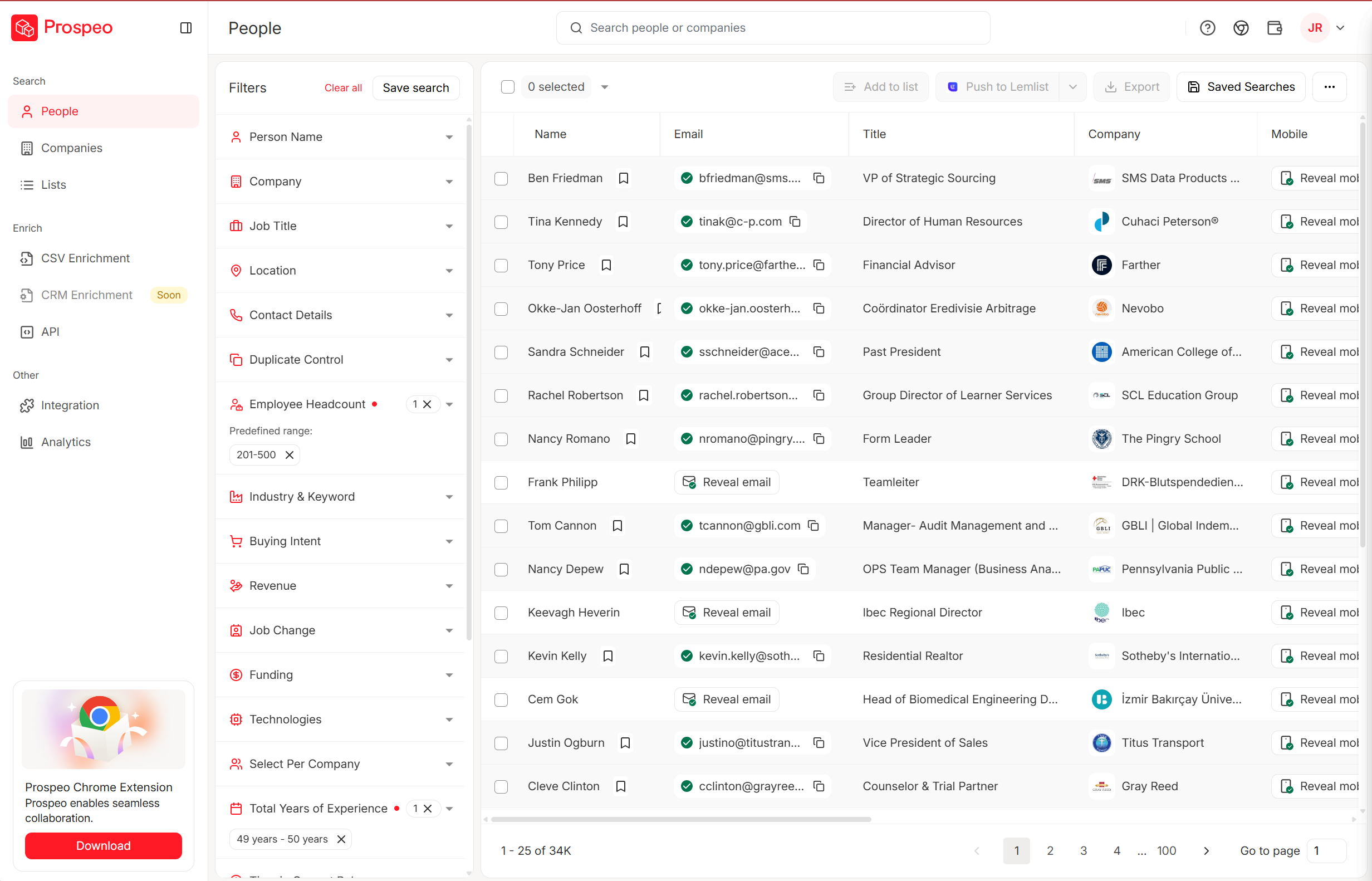
You don't need ten tools. You need a data layer, a sending layer, and a CRM. Whether you're an SDR breaking into a new territory or a founder running outbound solo, the stack below covers it.
| Tool | What It Does | Starting Price | Best For |
|---|---|---|---|
| Prospeo | Verified emails + mobiles | Free (75 emails/mo); ~$0.01/email | Data accuracy, no contracts |
| Instantly | Cold email at scale | $37/mo | High-volume sending + warm-up |
| Apollo | Prospecting + sequences | Free; $49/user/mo | All-in-one for mid-market |
| Lemlist | Email + personalization | $55/user/mo | Creative campaigns |
| ZoomInfo | Enterprise B2B data | ~$15,000/yr+ | Large teams with budget |
| HubSpot | CRM + tracking | Free tier | Pipeline management |
Instantly handles the sending side well - automated warm-up, inbox rotation, and solid deliverability tools at $37/month. Apollo works if you want prospecting and sequences in one platform, though in our experience its email accuracy doesn't match dedicated data tools. ZoomInfo is the enterprise default, but a 10-seat contract with mobile numbers can run $40-60K/year - hard to justify unless you're running a large outbound org.
Some teams also use a cold canvas approach - systematically working through every account in a defined territory - which makes verified mobile numbers especially valuable for phone-heavy workflows. If you're evaluating your stack, start with a shortlist of SDR tools and compare options for data enrichment services.
Cold prospecting across email, phone, and social only works when every channel has real contact data behind it. Prospeo gives you 143M+ verified emails and 125M+ verified mobiles with a 30% pickup rate - at $0.01 per email, no contracts.
Build the multi-channel sequence. We'll give you the numbers that connect.
FAQ
What's the difference between cold prospecting and cold calling?
Cold calling is one tactic within cold prospecting. Cold prospecting is the full strategy - email, phone, and social outreach coordinated across 5-7 touches to book meetings with people who don't know you. Think of cold calling as a single channel; cold prospecting is the multi-channel campaign that includes it.
How many touches does it take to book a meeting?
Research consistently shows 5-7 touches across multiple channels. The average is 4.81 touches; RAIN Group puts it at 7. Persistence matters more than perfection - 42% of replies come after the first email.
Is cold prospecting still effective in 2026?
Yes. Average reply rates sit at 3.43%, while elite campaigns hit 10%+. The 3x gap comes down to data quality, multi-channel execution, and follow-up discipline. Teams using verified data alongside 5-7 touch sequences are building more pipeline than ever.
How should startups approach outbound on a limited budget?
Start with a narrow ICP, verify emails with a free or low-cost tool, and run a lean multi-channel sequence yourself. A founder who spends three focused hours a day on outreach can generate enough pipeline to hit early revenue targets without hiring a full SDR team - precision beats volume at every deal size.