

B2B Cold Sales Email Templates That Actually Get Replies
The average cold email pulls a 3.43% reply rate. Generic templates - the ones with {first_name} and a paragraph about your company - sit under 1.5%. That gap is where revenue lives. A strong B2B cold sales email template closes it with short copy, signal-based personalization, and proper infrastructure.
Most template roundups stop at copy. This one covers deliverability setup and compliance - the parts that actually determine whether your templates reach inboxes. Below are seven templates, the data behind them, and the sending infrastructure to make them work.
What Makes a B2B Cold Email Work
Your prospect gets 10-15 cold emails a day. Yours needs to earn a reply in under 30 seconds. Five things separate emails that convert from ones that get archived:
- One idea per email. One problem, one angle, one ask.
- Under 80 words. Instantly's benchmark data backs this up. We've seen teams triple reply rates just by cutting below 80 words.
- 5-6 short sentences. If a sentence needs a comma splice to survive, split it.
- Specific social proof. "We helped a Series B fintech cut churn 22%" beats "trusted by hundreds of companies."
- A low-friction CTA. "Worth a 15-min call?" works. "Let me know when you're free for a demo" doesn't.
If you want more structure beyond templates, start with proven sales prospecting techniques and build your outreach around repeatable signals.
Subject Lines: What the Data Says
Belkins analyzed 5.5 million emails and the findings are clear. Keep subject lines to 2-4 words - that length hit a 46% open rate. Performance drops steadily past seven words.
If you need more options to test, pull from these cold email subject line examples and keep your experiments tight (one variable at a time).
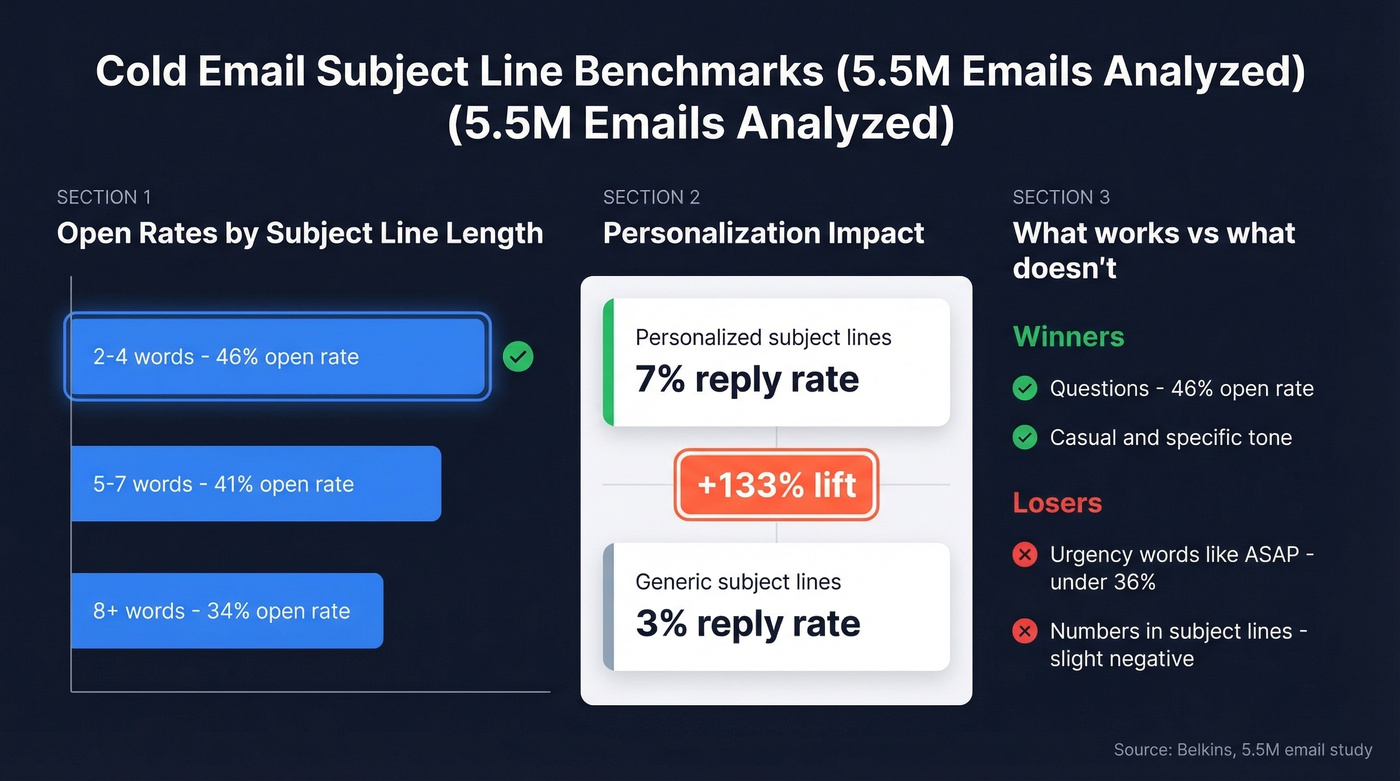
Personalized subject lines pulled a 7% reply rate versus 3% without. That's a 133% lift. Questions performed best for opens at 46%, while numbers in subject lines actually hurt slightly, which contradicts what most people assume.
The biggest takeaway: avoid urgency and hype. Words like "ASAP" pulled opens below 36%. Casual and specific beats salesy every time.
7 Templates for Every Scenario
You don't need 20 templates. You need seven that cover every outbound situation, and each one below is under 80 words. Copy the structure, swap the brackets, send.
If you're building a full cadence, pair these with a complete B2B cold email sequence so your follow-ups feel intentional, not random.
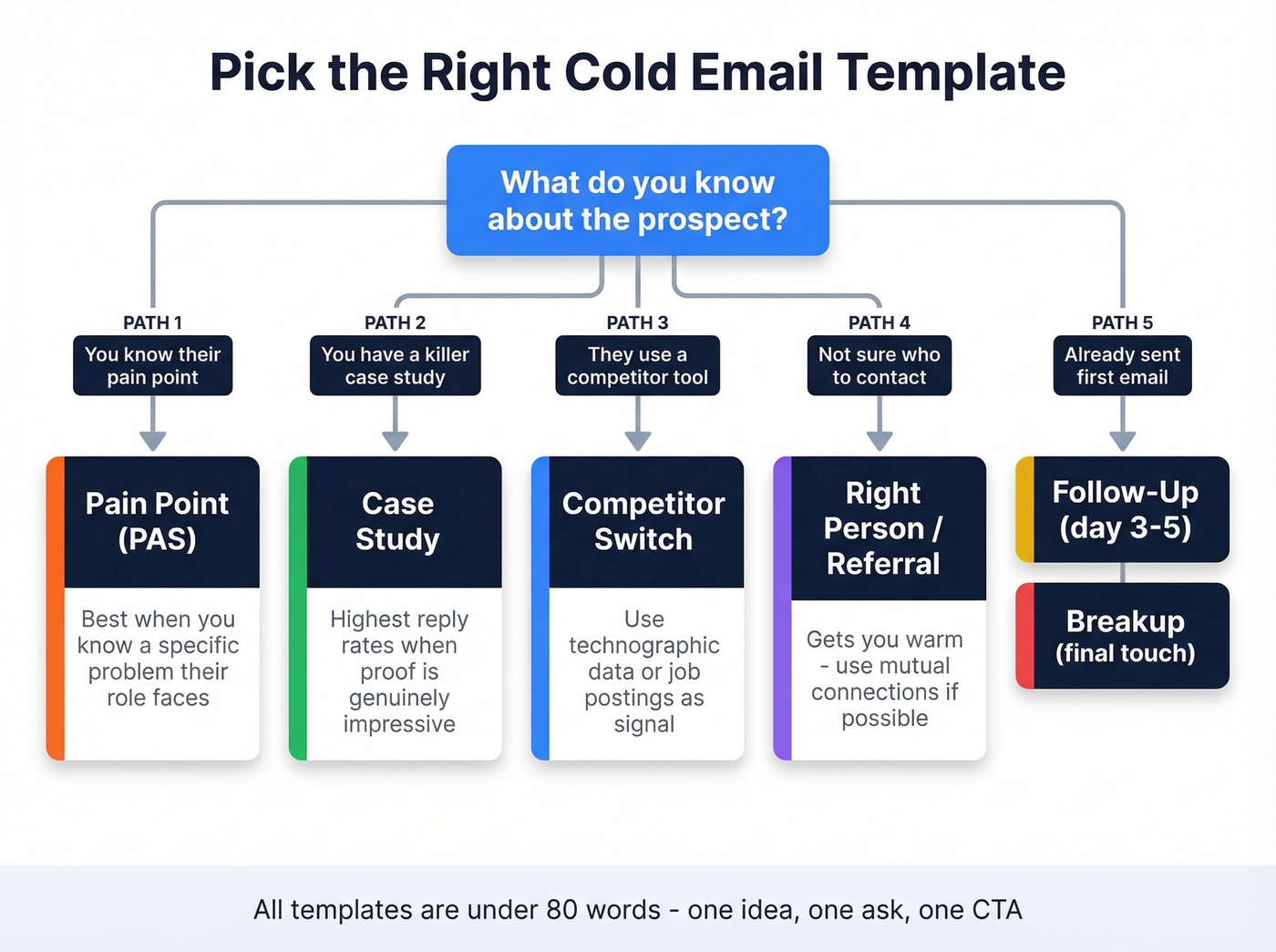
Pain Point (PAS Framework)
Use when you know a specific problem the prospect's role typically faces.
Subject: {{pain_point}} fix?
Hi {{first_name}},
Most {{title}}s at {{industry}} companies tell us {{specific_pain_point}} eats 5+ hours a week.
We built {{product}} to cut that in half. {{Similar_company}} reduced {{metric}} by {{number}}% in 60 days.
Worth a quick call this week?
{{Your name}}
Case Study
Use when you have a quantified result from a similar company. In our experience, this template pulls the highest reply rates when the proof point is genuinely impressive.
Subject: How {{similar_company}} hit {{result}}
Hi {{first_name}},
{{Similar_company}} was dealing with {{problem}} - same challenge most {{industry}} teams face. After switching to {{product}}, they saw {{specific_result}} within {{timeframe}}.
Happy to share the breakdown if you're tackling something similar.
{{Your name}}
Competitor Switch
Use when you can see the prospect runs a competitor via technographic data or job postings. Present this as a comparison, not an attack - acknowledge what their current tool does well, then show where yours wins, backed by proof from someone who switched.
Subject: {{competitor}} alternative
Hi {{first_name}},
Noticed your team uses {{competitor}}. A few {{industry}} companies have moved to us recently - mostly because of {{specific_differentiator}}.
{{Company_name}} made the switch and saw {{result}}.
Open to a 15-min comparison?
{{Your name}}
Right-Person / Referral
These two templates serve the same purpose - getting warm. Use the first when you're unsure you have the right contact, the second when you have a mutual connection.
Right-Person:
Subject: Quick question - "I'm trying to reach whoever handles {{function}} at {{company}}. We help {{type_of_company}} with {{one_line_value_prop}}. Is that you, or should I reach out to someone else?"
Referral:
Subject: {{mutual_connection}} suggested I reach out - "{{Mutual_connection}} mentioned you're working on {{initiative}}. We helped their team with something similar - {{specific_result}}. Worth 15 minutes?"
Follow-Up
Send 3-5 days after your first email. Add new value - never just "bump" the thread.
Subject: Re: {{original_subject}}
Hi {{first_name}},
Wanted to share something relevant - we just published a breakdown of how {{similar_company}} solved {{problem}}.
Thought it might be useful regardless of whether we chat. Still open to a quick call if the timing works.
{{Your name}}
If you want more variations, use these cold email follow-up templates to keep each touchpoint fresh.
Breakup
Final touch in your sequence. Low pressure, leaves the door open. This one pulls more replies than most people expect - the release of pressure actually triggers action.
Subject: Should I close the loop? - "I've reached out a few times and don't want to be a pest. If {{problem}} becomes a priority, I'm here. Otherwise, I'll stop filling your inbox. Either way - good luck with {{initiative}}."

Every template above depends on one thing: reaching a real inbox. Prospeo's 98% email accuracy and 7-day data refresh mean your cold emails hit verified addresses, not dead ends. Teams using Prospeo see bounce rates drop below 4% - the difference between a campaign that books meetings and one that burns your domain.
Stop writing perfect cold emails to wrong addresses.
Follow-Up Sequence: 42% of Replies
Here's the thing: 58% of replies come from the first email, which means 42% come from follow-ups. And 70% of salespeople stop after one email. That's a massive gap you can exploit just by showing up again.
To go deeper on timing and touchpoints, see our guide on the importance of follow-up in sales.
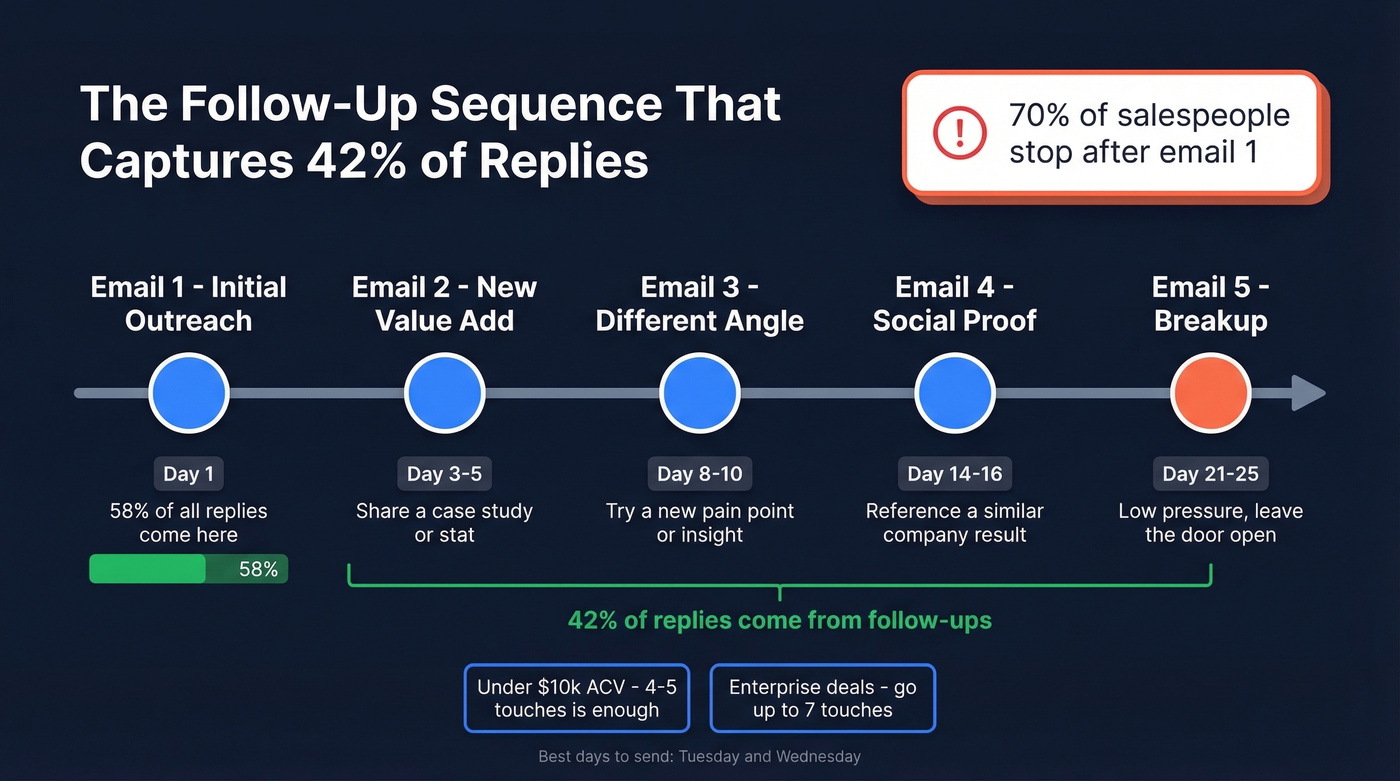
The sweet spot is 4-7 touchpoints. Each one adds something new - a case study, a stat, a different angle. Tuesday and Wednesday consistently produce the highest reply rates.
If you're optimizing send windows, use the data-backed best time to send cold emails benchmarks as your baseline.
If your deal size is under $10k ACV, you probably don't need more than 5 touches. Save the 7-touch sequences for enterprise deals where the payoff justifies the persistence.
Personalization at Scale
If your personalization is {first_name} and {company_name}, you're writing spam with extra steps. Practitioners on r/SaaS who've cracked this report roughly 3x response lifts from signal-based personalization.
You need the signal first. Look for intent triggers like job changes, funding rounds, and technographic shifts - the kind of data points that make a first line feel researched instead of templated. Prospeo's 30+ search filters surface exactly these signals on a 7-day refresh cycle, so you're acting on current data rather than something six weeks stale. Feed that trigger into an AI model for a custom opener, merge it as a variable, and send.
If you’re formalizing this, start with identifying buying signals and build a repeatable scoring system.
Let's be honest: most "personalized at scale" workflows fail because the underlying data is garbage. Fix the data layer and the copy almost writes itself.
Deliverability Checklist
Great templates are worthless if they land in spam. We've watched teams burn through domains in weeks because they skipped this part.
For a deeper technical walkthrough, use this email deliverability guide alongside the checklist below.
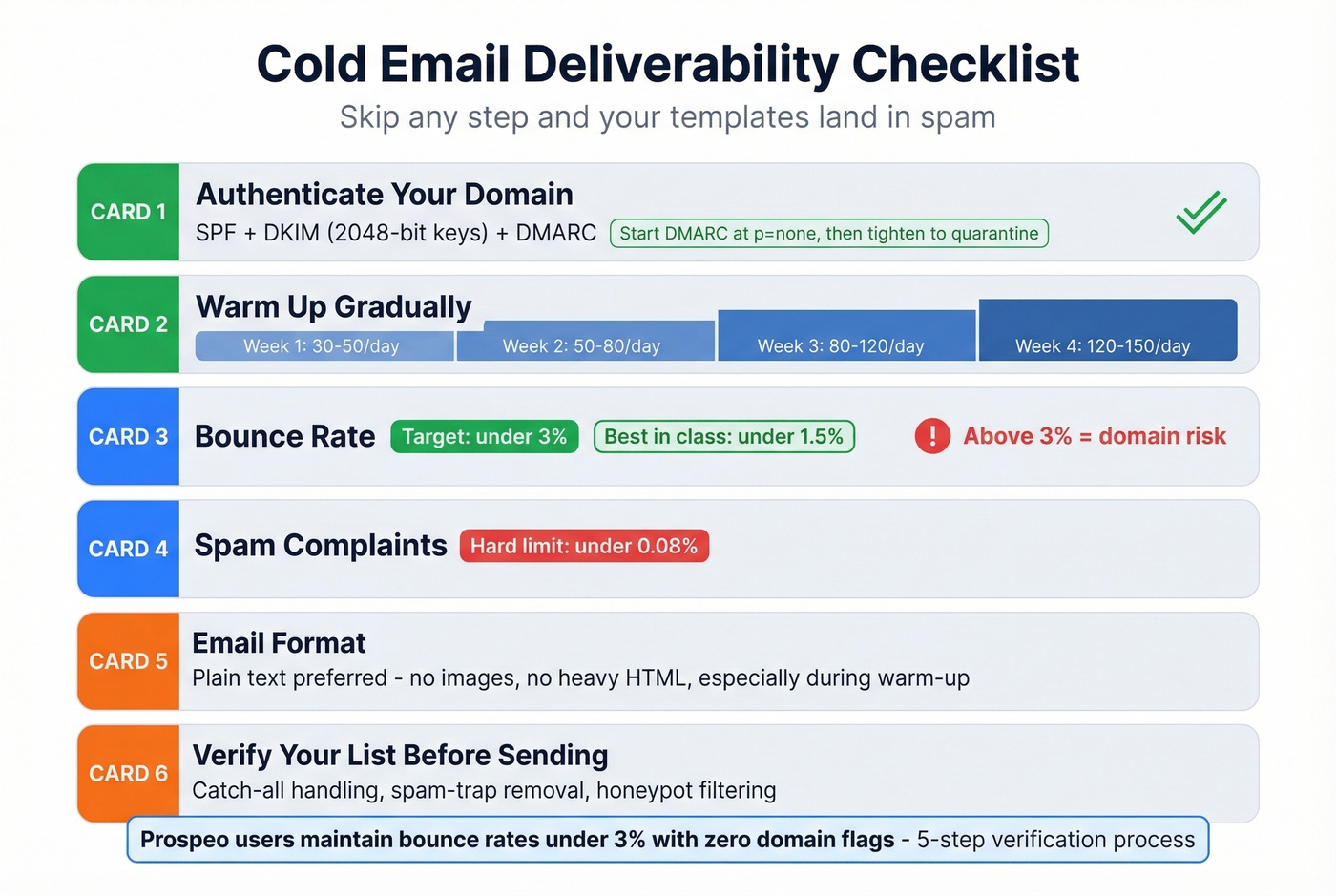
- Authenticate your domain. Set up SPF, DKIM, and DMARC. Start DMARC at
p=none, then tighten to quarantine. Use 2048-bit DKIM keys. If you need help validating setup, follow how to verify DKIM is working. - Warm up gradually. Week 1: 30-50 emails/day. Week 2: 50-80. Week 3: 80-120. Week 4: 120-150 - only if metrics stay clean.
- Bounce rate under 3%. Best-in-class teams stay under 1.5%. (More detail: email bounce rate.)
- Spam complaints under 0.08%. Hard threshold.
- Plain text preferred. No images, no heavy HTML, especially during warm-up.
- Verify your list before sending. This is non-negotiable. Stack Optimize built their agency from $0 to $1M ARR by running every list through Prospeo's 5-step verification - catch-all handling, spam-trap removal, honeypot filtering - and maintained bounce rates under 3% with zero domain flags across all clients.
Skip verification and you're gambling your sender reputation on every campaign. Don't.

Signal-based personalization starts with signal-based data. Prospeo's 30+ search filters surface job changes, funding rounds, technographic shifts, and buyer intent across 15,000 topics - refreshed every 7 days. Feed real triggers into your templates instead of guessing.
Get the intent signals that make your first line actually land.
Legal Compliance
Cold email is legal, but the rules are specific. CAN-SPAM requires a physical mailing address, opt-out honoring within 30 days, and truthful subject lines - penalties run $51,744-$53,088 per non-compliant message. Never use deceptive "Re:" lines. GDPR allows B2B outreach under legitimate interest per Art. 6(1)(f), but you need a documented Legitimate Interest Assessment. CASL in Canada is consent-first with limited implied consent for B2B.
Real talk: enforcement targets systems at scale, not one-off emails. But maintaining suppression lists and honoring opt-outs quickly is where most teams slip up - and it's the easiest thing to automate.
FAQ
What reply rate should I expect?
The overall average cold email reply rate is 3.43%. Well-targeted B2B SaaS campaigns hit 4-9%, and top 10% performers exceed 10%. Below 2% signals your targeting, list quality, or copy needs work before you scale volume.
How many follow-ups should I send?
Four to seven touchpoints is the proven range - 42% of replies come from follow-ups, not the first email. Each touch must add new value: a different angle, a case study, or a relevant insight. Never just "bump."
How do I keep cold emails out of spam?
Set up SPF, DKIM, and DMARC authentication, then warm up mailboxes over 3-4 weeks. Verify your list to eliminate bounces and spam traps - keeping bounce rates under 3% and spam complaints under 0.08% is the baseline for healthy deliverability.
What's the best time to send B2B cold emails?
Tuesday and Wednesday mornings consistently produce the highest open and reply rates across most benchmarks. That said, test your specific audience - some industries respond better on Thursday afternoons. The key is consistency: pick a window, measure it, and iterate.