

Company Data: Types, Sources, and Providers for 2026
Your VP of Sales asks for a target account list by Friday. You open the CRM, and it's a graveyard - half the contacts have bounced, revenue figures are two years old, and the "decision makers" column is full of people who left their companies months ago. You're not alone. 28% of B2B email addresses go stale every year, and poor data quality costs organizations an average of $12.9 million annually.
Company data is the foundation of every outbound motion, every ABM play, every territory plan. When it's wrong, everything downstream breaks - sequences bounce, reps waste hours, and pipeline forecasts become fiction.
Quick Recommendations
If you need public company filings, start with SEC EDGAR - it's free. For private company intelligence like funding rounds, investors, and org charts, Crunchbase covers it from around $49/mo. If you need verified contact data attached to accurate firmographics - emails, direct dials, intent signals, technographics - Prospeo gives you 300M+ profiles with 98% email accuracy and a 7-day refresh cycle. Start free, no sales call required.
What Is Company Data?
Company data is any structured information that describes a business entity - its identity, operations, financials, technology, people, and market position. Datarade defines it broadly as encompassing company profiles, industry classification, financials, ownership, leadership, and employee data.
The term serves Wall Street analysts running due diligence and SDRs building prospect lists in equal measure. The underlying categories are the same; the use cases diverge. A private equity associate cares about revenue multiples and board composition. A sales rep cares about headcount growth, tech stack, and whether the VP of Marketing has a verified email. Both need accurate business intelligence - they just need different slices of it.
88% of B2B marketers use third-party firmographic data to power their go-to-market efforts. It's not a nice-to-have. It's infrastructure.
Types of Company Data
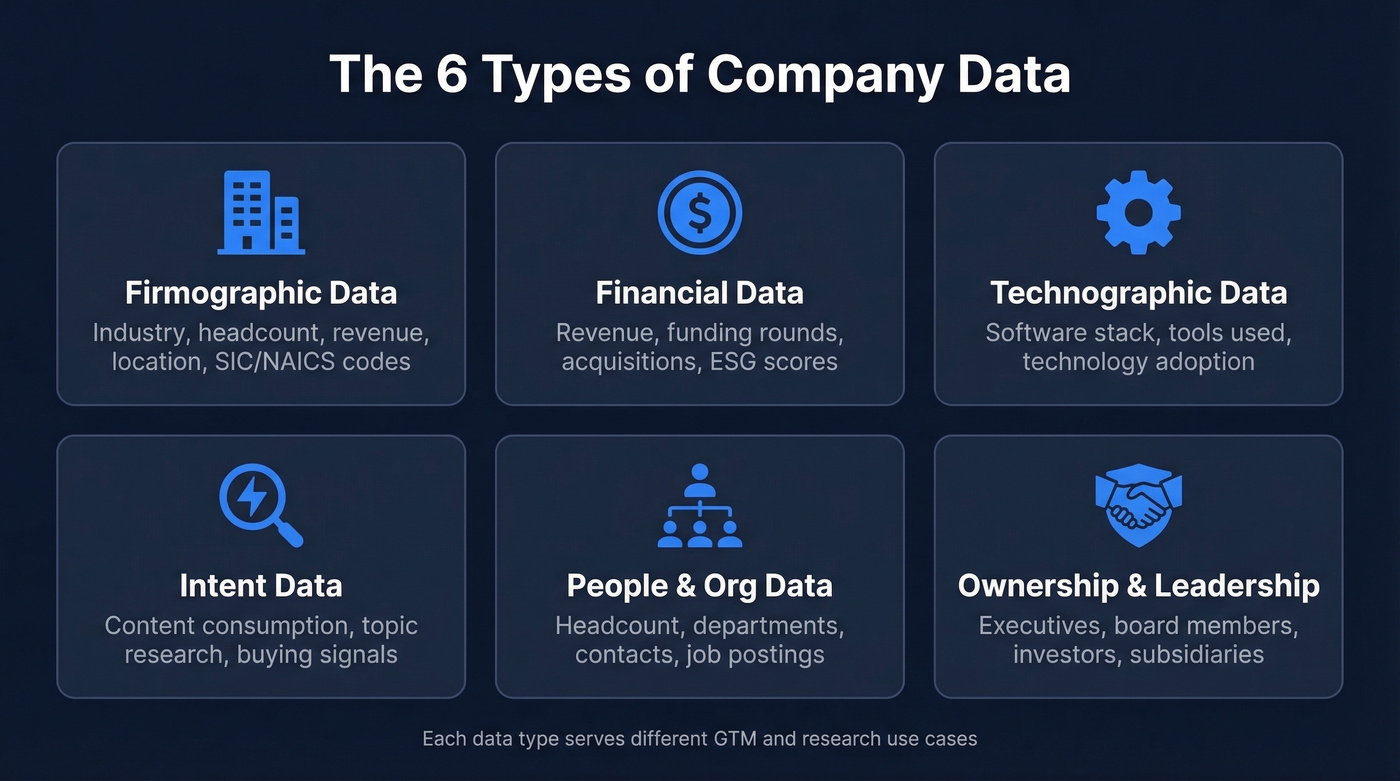
Firmographic Data
Firmographics are the B2B equivalent of demographics - the attributes that define a company's identity and structure. The eight core firmographic data points include employee count, revenue, industry via SIC/NAICS codes, location, tech stack overlap, growth trajectory, funding and ownership status, and organizational structure. These are the building blocks of any ICP definition. Without accurate firmographics, you can't segment, you can't score, and you can't route leads to the right rep.
Financial Data
Financial data covers revenue, profitability, funding rounds, acquisitions, and debt. For public companies, SEC filings and annual reports make this straightforward - the data is regulated, standardized, and free. Private companies are a different story. Financial data there is estimated, modeled, or self-reported, and providers like Crunchbase and PitchBook fill the gap with numbers that are directional rather than audited. ESG scores and sustainability metrics are an emerging subcategory here, particularly for institutional investors and enterprise procurement teams evaluating vendor risk.
Technographic Data
Technographic data tells you what software a company runs. BuiltWith, which starts at $295/mo, is the classic example - it crawls websites and detects technology stacks. The practical use case is targeting: if you sell a Marketo alternative, you want a list of every company running Marketo. That turns a generic prospect list into a competitive displacement campaign. (If you’re building around this dataset type, see our guide to technographics.)
Intent Data
Intent data captures buying signals from content consumption - which companies are actively researching topics related to your product. Bombora is a leading provider, tracking thousands of intent topics across a co-op of B2B publishers. This is the fastest-growing category in B2B data because it answers the question every sales team asks: "Who's actually in-market right now?" For a deeper breakdown, see contact-level intent data.
People & Org Data
Headcount, org structure, department breakdowns, decision-maker contacts, and job postings as hiring signals. This is where organizational records and contact data intersect. A company's headcount growth rate tells you they're scaling; their open job postings tell you where they're investing. The quality of the contact data attached to these records - verified emails, direct dials - determines whether your reps can actually reach anyone.
Employee review sentiment on platforms like Glassdoor and G2 also functions as a signal for company health and culture, though few providers aggregate it systematically yet.
Ownership & Leadership
Executive profiles, board composition, investor relationships, and parent-subsidiary structures. This matters for due diligence, ABM multi-threading, and understanding who actually makes buying decisions. Knowing that a target account just brought on a new CRO from a company that used your product? That's the kind of signal that closes deals.
Public vs. Private Sources
Public company data is regulated, accessible, and standardized. SEC EDGAR gives you filings for free. Companies House covers UK businesses. OpenCorporates aggregates legal entity records globally. If you need basic firmographics on publicly traded companies, you can get surprisingly far without spending a dollar.
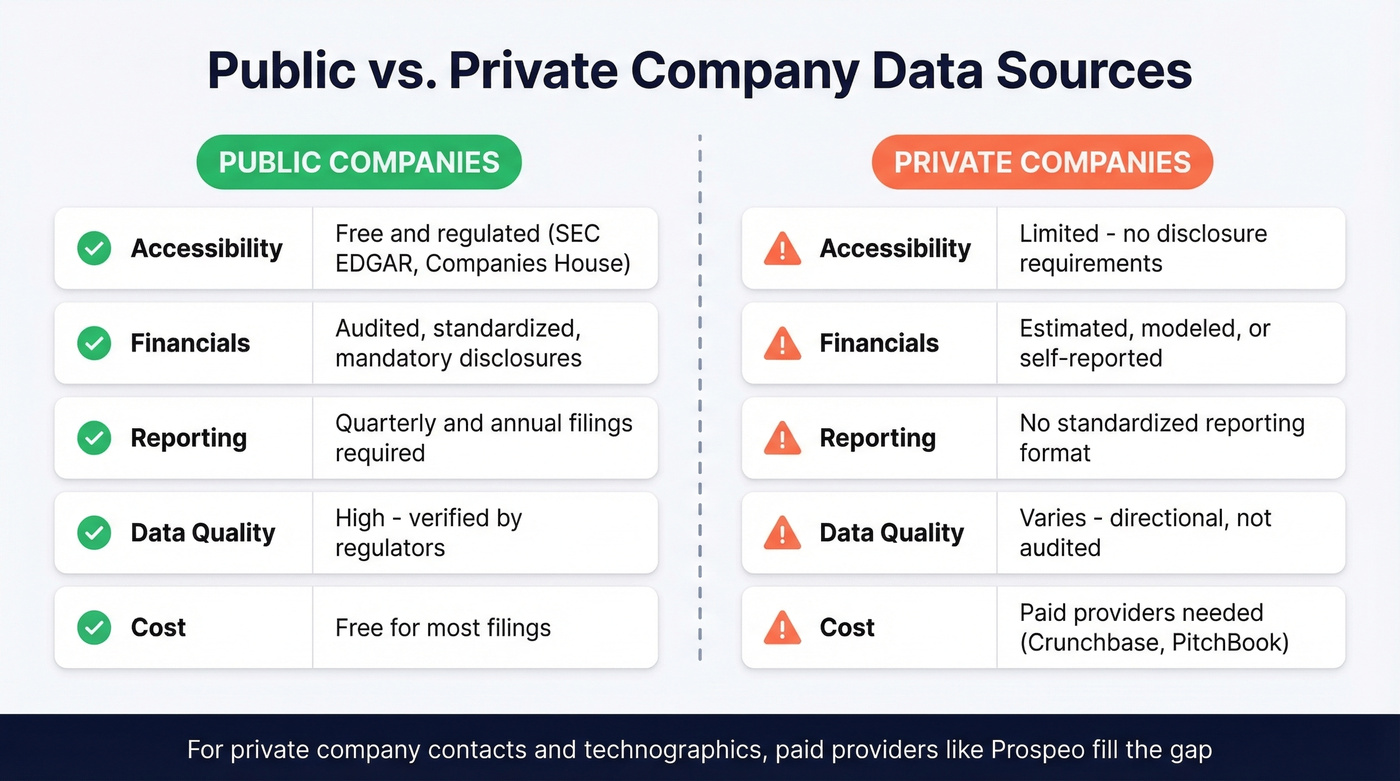
Private company data is a different animal entirely. Crunchbase identifies four reasons it's hard to get: limited disclosure requirements, confidentiality concerns, no standardized reporting, and restricted access. Revenue figures for private companies are estimates. Headcount numbers come from scraped profiles and job postings. Funding data depends on voluntary disclosure. For private company intelligence, Crunchbase at around $49/mo and PrivCo cover funding, investors, and executive profiles. BuiltWith adds technographic depth. But free sources hit a wall fast once you need contacts, technographics, or intent signals - and that's where paid providers earn their keep. (If you’re enriching from a website list, company data enrichment from domains is the fastest workflow.)
Top Company Data Providers
| Provider | Best For | Coverage | Data Quality | Starting Price |
|---|---|---|---|---|
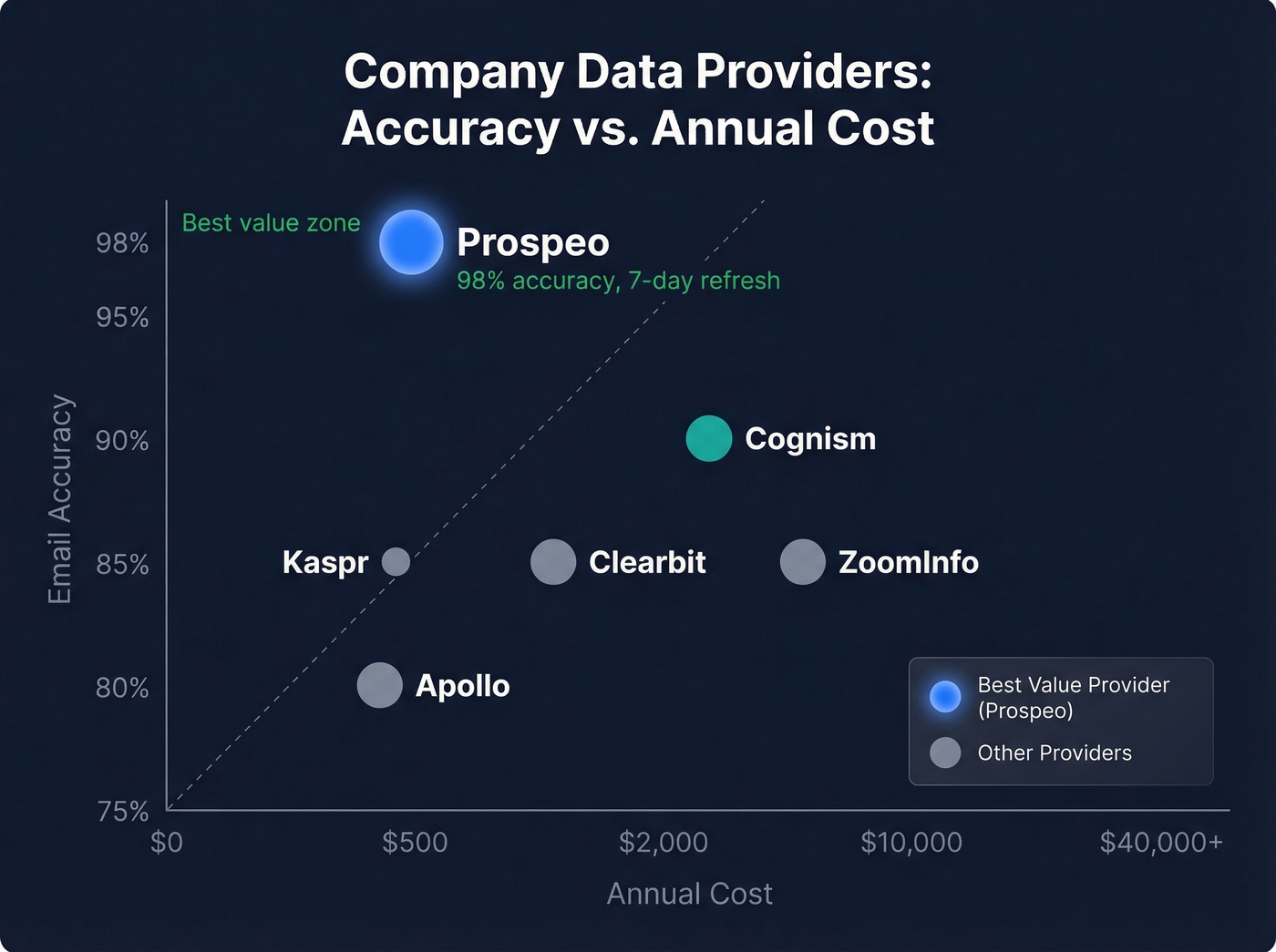
| Prospeo | Verified contacts + freshness | 300M+ profiles | 98% accuracy / 7-day refresh | ~$0.01/email (free tier) |
| Apollo | Free tier + all-in-one | Large contact database | ~80% accuracy | Free / $59/user/mo |
| Cognism | European coverage + GDPR | Strong EMEA coverage | ~90% accuracy | ~$1,000-$3,000/mo |
| ZoomInfo | Enterprise sales intel | Enterprise-scale | ~85% accuracy | $15,000-$40,000+/yr |
| Clearbit (Breeze) | HubSpot enrichment | Enrichment dataset | ~85% accuracy | $30-$700/mo |
| Crunchbase | Private company intel | Private company database | N/A | ~$49/mo |
| Coresignal | Raw data via API | 67M+ companies | N/A | $49/mo |
| Kaspr | Budget European contacts | 120M+ EU contacts | ~85% accuracy | $49/user/mo (free tier) |
| D&B | Credit risk + legacy | Large business registry | Varies | $49/mo (300 credits) |
For B2B Sales & Marketing

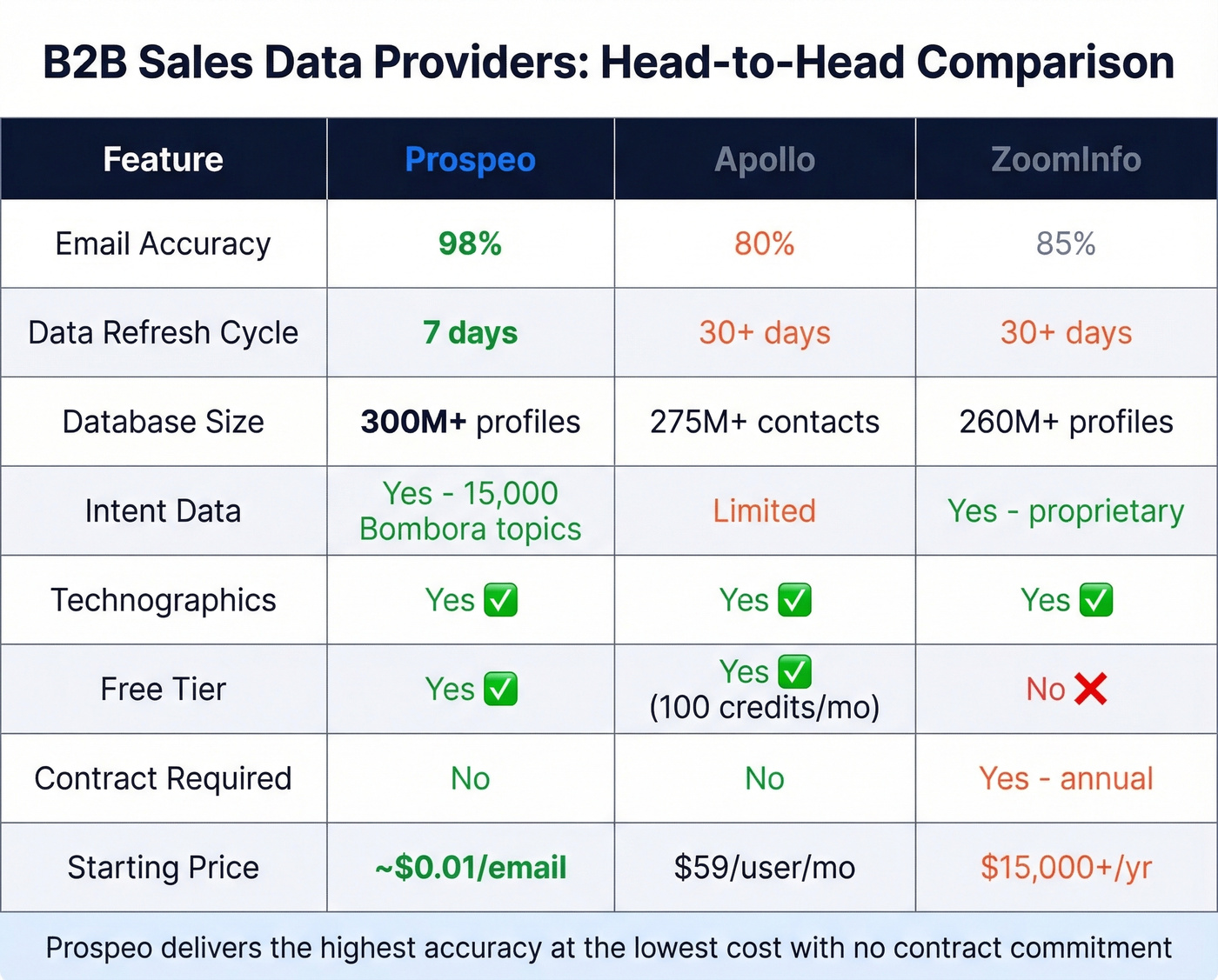
Prospeo is the strongest option on this list if your primary need is verified contact data attached to accurate company records - and you don't want to sign a $15K annual contract to get it. The database covers 300M+ professional profiles, 143M+ verified emails, and 125M+ verified mobile numbers. Email accuracy is 98%, and the entire database refreshes every 7 days - roughly 6x faster than the industry average. You get 30+ search filters including buyer intent across 15,000 Bombora topics, technographics, job change signals, headcount growth, and funding data. Pricing is credit-based at roughly $0.01 per email, with a free tier to test before committing. No contracts, no sales calls, self-serve from day one. (If you’re comparing options, see our roundup of the best B2B databases.)
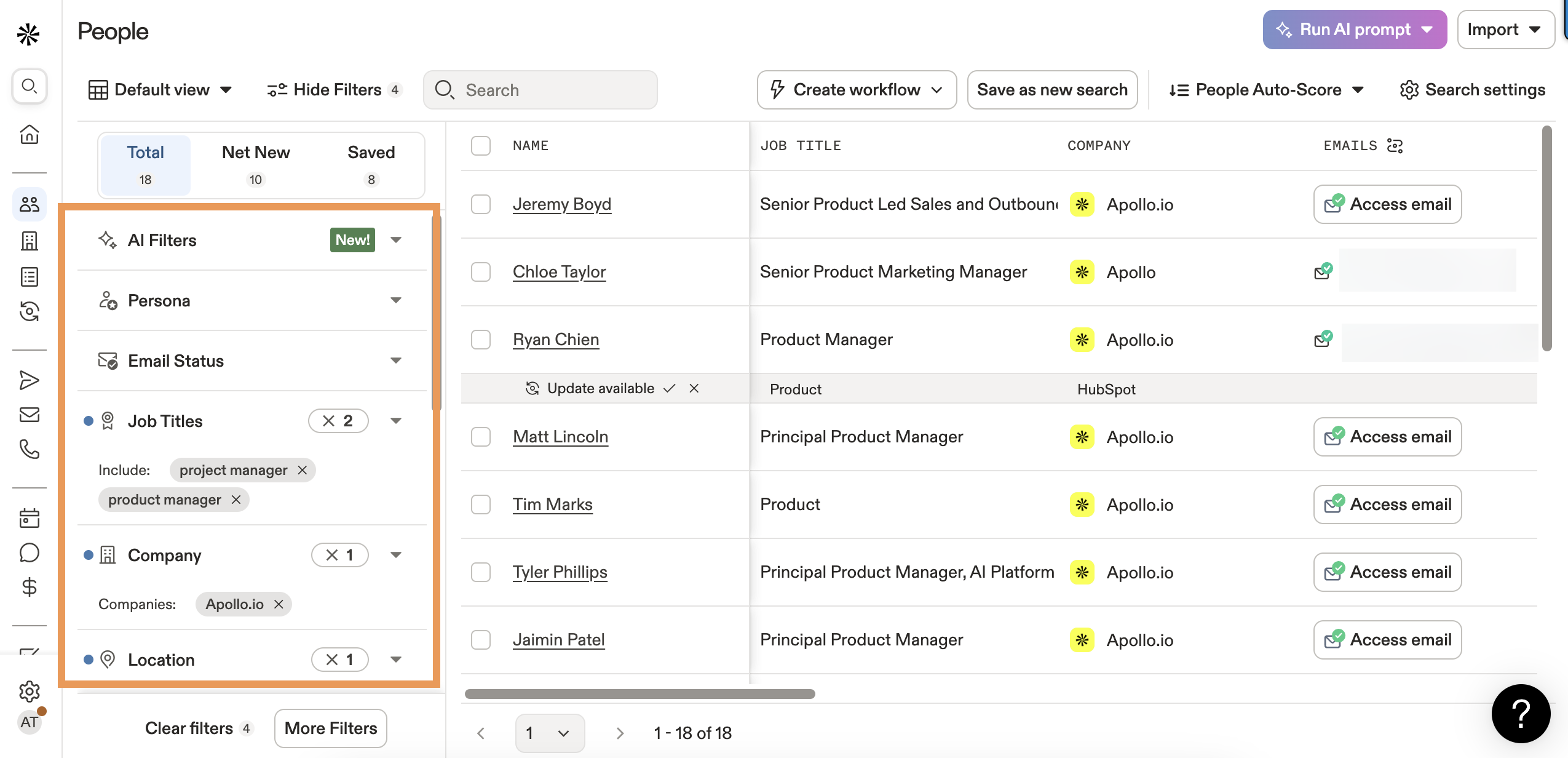
Apollo is the obvious starting point for early-stage teams who need a free tier and an all-in-one platform. The free plan gives you 100 email credits per month, and paid plans run $59-$149/user/mo depending on the tier. The built-in sequencer is genuinely useful. The tradeoff: accuracy. In a 1,000-enrichment test, Apollo's email accuracy came in at 80%, and data freshness lags behind weekly-refresh providers. One lead-gen practitioner on Reddit summed it up - they'd tried Apollo and Crunchbase and "haven't been too impressed" with how current the data was. Use Apollo if you're bootstrapping. Skip it if deliverability is your top concern. (If you’re shopping specifically for enrichment, start with data enrichment tools.)
Cognism wins for European data and compliance. They check fifteen DNC lists before surfacing a phone number, which matters enormously if your reps are dialing into the UK or DACH region. Customer-reported accuracy runs above 90% for US data. Pricing typically lands between $1,000-$3,000/mo for small teams. ZoomInfo still beats Cognism on US database depth and workflow breadth, but Cognism wins on EMEA coverage and regulatory peace of mind. For teams that only need European contacts on a tighter budget, Kaspr at $49/user/mo with a free plan and 120M+ European contacts is worth evaluating as a lighter alternative. (If Cognism is on your shortlist, see cognism-vs-prospeo.)
Here's the thing about ZoomInfo: it's still the best all-in-one enterprise platform. But most teams don't need all-in-one. The database is deep, the intent data is strong, and the platform covers everything from prospecting to conversation intelligence. But a mid-market contract runs $15,000-$40,000+/year, and we've seen teams realize they're paying for modules they never activate. If you're a 10-person sales team, ZoomInfo is almost certainly overkill.
Clearbit, now Breeze Intelligence by HubSpot, makes sense if you're already deep in the HubSpot ecosystem. Credit packs run $30-$700/mo. The enrichment is solid for website visitor identification and form shortening. Outside of HubSpot, the value proposition thins out quickly.
For Financial Research
Crunchbase is the go-to for private company intelligence - funding rounds, acquisitions, investor networks, and executive profiles. Plans start around $49/mo billed annually. It doesn't provide contact data, so think of it as a research layer rather than a prospecting tool.
PitchBook serves PE/VC deal flow and private market analytics. Enterprise pricing runs $20,000-$50,000+/year. We haven't tested PitchBook deeply enough to recommend it for sales use cases, but for financial due diligence and market mapping, it's the gold standard.
For Raw Data & API Access
Coresignal delivers 300+ data points per company profile via an Elasticsearch-compatible API, covering 67M+ companies. At $49/mo, it's built for data teams and developers who want to build custom enrichment pipelines rather than use a GUI. Bold Data (CompanyData.com) is another option in this space, covering 303M+ companies and 287M contacts with real-time updates, starting around EUR425/mo. Both are better suited for engineering-led workflows than for sales reps who need a search interface. (If you’re building automated checks into your stack, data validation automation is the missing layer.)

Stale company data costs organizations $12.9M a year. Prospeo's 7-day refresh cycle keeps firmographics, contacts, and technographics current across 300M+ profiles - with 98% email accuracy and 30+ filters to slice by intent, headcount growth, funding, and tech stack.
Stop building pipeline on a data graveyard. Start free today.
How to Evaluate a Provider
Datarade's evaluation framework covers the right criteria. Here's the checklist, compressed:
- Accuracy - what's their verified email deliverability rate? Ask for methodology.
- Coverage - how many companies and contacts, and in which geographies?
- Timeliness - how often do they refresh records? Weekly, monthly, quarterly?
- Pricing model - per-seat, per-credit, per-record, or platform fee?
- Reliability - do they have uptime SLAs and consistent data schemas?
- Historical data - can you access past snapshots for trend analysis?
- Data formats - CSV, JSON, API, CRM-native? Match your stack.
- API capabilities - rate limits, enrichment endpoints, webhook support.
- Delivery methods - real-time API, batch export, direct CRM sync?
- Compliance - GDPR, CCPA, SOC 2, DPA availability, opt-out enforcement.
If a provider won't publish pricing or show you accuracy methodology, that tells you everything about how they view the buyer relationship.
The Freshness Problem
Let's be honest: the biggest mistake isn't choosing the wrong provider - it's not having a freshness strategy. That 28% annual email decay rate means roughly a quarter of your database is dead weight by year's end. Firmographic attributes shift even faster during growth periods - headcount, tech stack, and revenue can change quarter to quarter.
Most B2B data providers refresh around a 6-week cycle. That's the industry average, and it's not fast enough for teams running high-volume outbound. The staleness complaint is one of the most common frustrations in B2B communities - practitioners on r/sales and r/b2bmarketing regularly report that records from monthly-refresh providers are already outdated by the time they hit a sequence. Snyk's sales team experienced this firsthand: bounce rates sat at 35-40% before they switched providers. After moving to a weekly-refresh source, bounces dropped under 5%, and AE-sourced pipeline jumped 180%.
One way to mitigate decay is a multi-source strategy - cross-referencing records from two or more providers so that gaps in one dataset get filled by another. This waterfall approach catches stale records faster and gives your team higher confidence in the data feeding their sequences.
If your provider can't tell you their refresh cadence in a straight answer, that's a red flag. Ask. Then verify by running a sample batch through an independent email verifier tool.
Compliance Basics
This isn't a legal guide, but every buyer of business intelligence needs baseline awareness. The regulations that matter most: GDPR in the EU, CCPA in California, SOX for financial reporting, and the emerging EU Data Governance Act for cross-border data sharing.
Core compliance activities to evaluate in any provider include access controls, encryption at rest and in transit, monitoring and audit trails, incident response procedures, and documentation. Cognism's fifteen DNC list checks set a useful benchmark for what "compliance-first" looks like in practice. (For a deeper checklist, see B2B compliance.)
Before you sign with any provider, ask three questions: Are you GDPR compliant? How do you handle opt-outs? Can you provide a Data Processing Agreement? If the answer to any of those is vague, walk away.
Benefits for Go-to-Market Teams
Understanding the benefits of reliable company data helps justify the investment to leadership and ensures your team actually uses the data once it's in the CRM.
- Sharper ICP targeting - accurate firmographics let you filter by revenue, headcount, industry, and tech stack so reps only work accounts that match your ideal profile.
- Higher deliverability - verified emails and direct dials mean fewer bounces, better sender reputation, and more conversations per rep per day.
- Faster sales cycles - intent signals and job-change alerts tell reps when to reach out, not just who to reach out to, compressing the time from first touch to closed deal.
- Better territory planning - enriched records give RevOps clean segmentation data for balanced, quota-aligned territories.
- Downstream AI readiness - predictive lead scoring, automated ICP matching, and intent-based routing all depend on accurate, current records. Garbage in, garbage out applies doubly when you're training models on your CRM data.
Putting It All to Work
You've chosen a provider. Now what?
Start by uploading a CSV of your existing accounts or connecting your CRM directly. Enrich those records with firmographic, technographic, and contact data - a good provider returns 50+ data points per record. Before you send a single email, verify the list. Bounced emails tank your domain reputation, and recovering from that takes weeks.
Then set up a refresh cadence. Quarterly is the minimum. Monthly is better. Weekly is ideal if your provider supports it. Clean, current records also feed downstream AI workflows - predictive lead scoring, automated ICP matching, and intent-based routing all improve when the underlying data is fresh and complete.
The delivery method matters too. Real-time API enrichment works for inbound lead routing - enrich the form fill before it hits your CRM. Batch CSV uploads work for list building. Direct CRM integrations with Salesforce or HubSpot work for ongoing hygiene. Some teams run a waterfall approach, using a primary provider and backfilling gaps with a secondary source. That's smart, but start with one provider and measure before you add complexity. (If you’re systematizing outbound, pair this with B2B prospecting strategies.)
Free sources cover the basics, but they hit a wall the moment you need verified emails, direct dials, or intent signals attached to company records. Prospeo combines firmographics, technographics, and 15,000 Bombora intent topics with 143M+ verified emails at ~$0.01 each - no contracts, no sales calls.
Every company data point you need, verified and enriched in one platform.
FAQ
What's the difference between company data and contact data?
Company data describes the organization - industry, revenue, headcount, tech stack, funding stage. Contact data describes individuals within that organization - name, title, verified email, direct dial. The best providers deliver both together so you can target the right person at the right company without stitching multiple tools together.
Where can I find free company data?
SEC EDGAR covers public filings, OpenCorporates provides legal entity records, Companies House handles UK businesses, and the U.S. Census Bureau's SUSB program offers establishment-level data by geography and industry. These cover basic firmographics but lack contacts, technographics, and intent signals.
How often do business records go stale?
Roughly 28% of B2B email addresses become invalid every year, and firmographic attributes like headcount and tech stack shift even faster during growth periods. Quarterly refresh is the minimum viable cadence; weekly refresh is ideal for high-volume outbound teams.
How much do providers typically charge?
Free sources cover basic public records. Paid providers range from ~$49/month for Crunchbase and Coresignal up to $15,000-$40,000+/year for ZoomInfo and PitchBook. Credit-based pricing around $0.01/email is often the most cost-efficient model for sales teams needing verified contacts without an enterprise contract.
What is firmographic data?
Firmographic data is the B2B equivalent of demographics - attributes describing a company's identity and structure. Core fields include employee count, revenue, industry classification via SIC/NAICS codes, location, funding stage, tech stack, growth trajectory, and organizational structure. It forms the foundation of ICP definition and lead scoring.