

Company Leads: Strategy, Tools, and Real Pricing for 2026
A RevOps lead we know ran a bake-off last quarter across three contact databases. The "biggest" database created 4,000 duplicate contacts in Salesforce within five days. The cheapest one had better phone connect rates and half the bounce rate. Company leads aren't a volume game - they're a quality game, and most teams learn that the expensive way.
Organizations generate 1,877 leads monthly on average, and 80% never convert. Picture the SDR who burned through 500 emails last Tuesday and watched 200 bounce, torching the domain in the process. The fix isn't more leads. It's better ones.
Your starter stack for under $200/month: Prospeo's free tier for 75 verified emails/month, Apollo's free plan for supplemental contacts, and HubSpot's free CRM (paid plans start at $15/month billed annually when you need them). Full tool breakdown in the tech stack section.
What Are Company Leads?
A company lead is different from a contact. A contact is a person - Sarah Chen, VP of Marketing at Acme Corp. A company lead is the account itself: Acme Corp fits your ICP based on industry, headcount, tech stack, funding stage, or some combination.
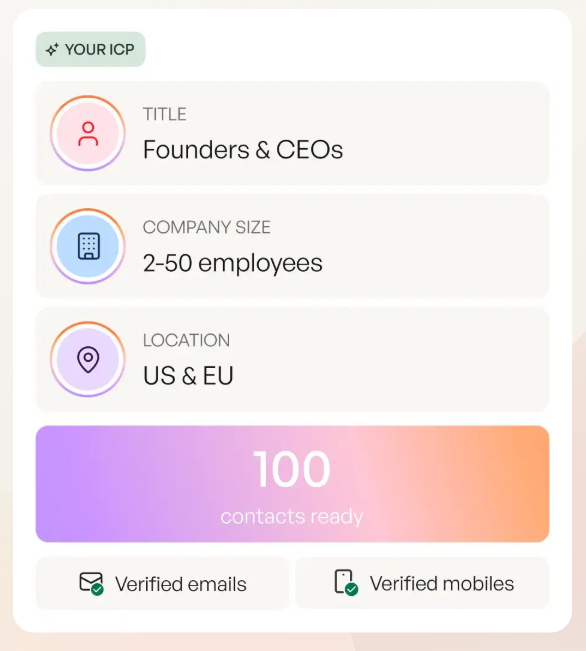
The distinction matters because B2B purchases now involve 8-13 decision-makers on average. Selling to one champion and hoping they'll carry the deal internally doesn't work anymore. You need account-level targeting: identify the right company first, then multi-thread into the right people within it. Map the buying committee by function - economic buyer, technical evaluator, end user, champion - and build separate messaging for each role. That's how deals actually close in 2026. Gathering business contacts at the account level, rather than chasing individual names, is what separates teams that build pipeline from teams that build spreadsheets.
Not all leads are equal, either. Marketing-qualified leads hit a scoring threshold based on engagement. Sales-qualified leads have been vetted by a human and show real buying intent. Product-qualified leads have used your product and exhibited behavior signaling readiness to buy. Most teams over-index on MQLs because they're easy to count, then wonder why pipeline doesn't follow.
How to Generate Company Leads
No single channel works for everyone. The best teams run three or four of these simultaneously.
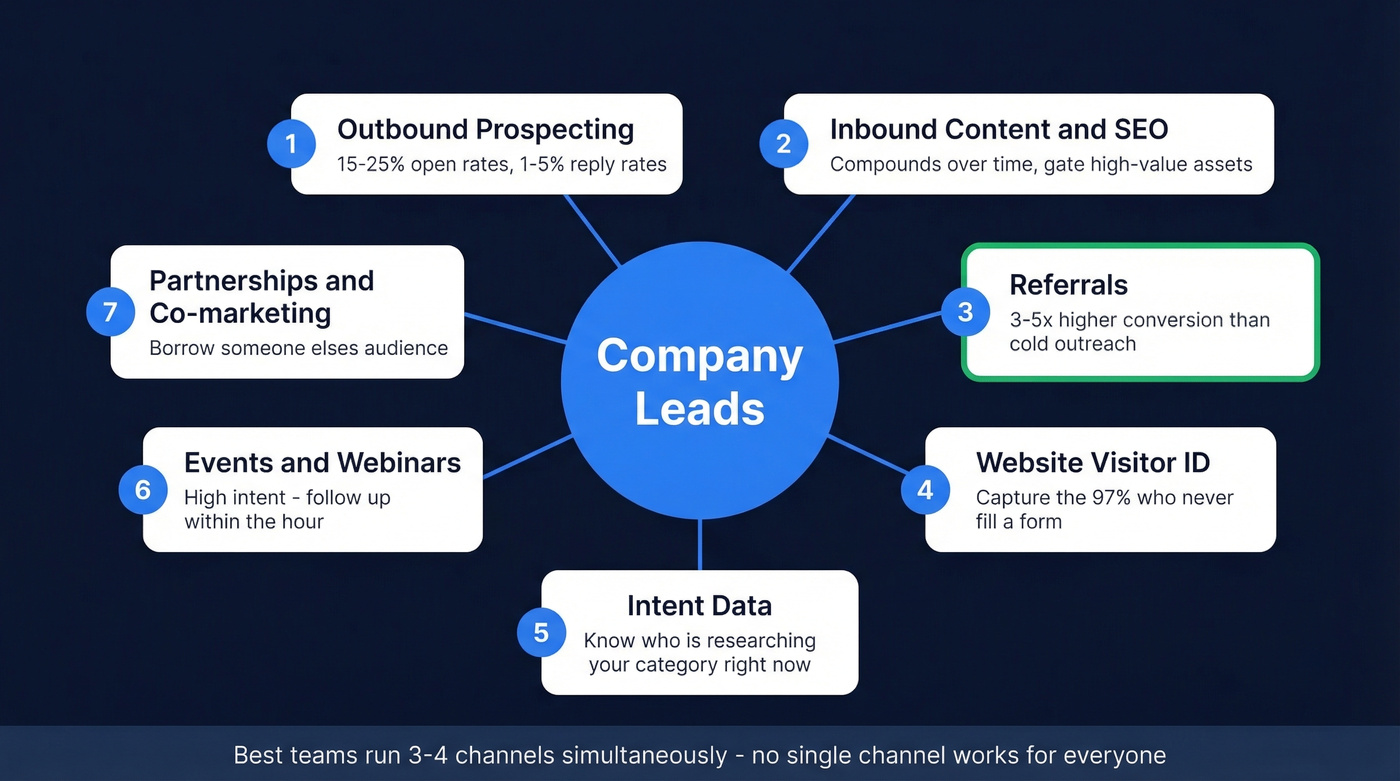
Outbound prospecting is the fastest path to pipeline. Pull a filtered list from a contact database, verify the emails, run a cold sequence. Cold email benchmarks sit at 15-25% open rates and 1-5% reply rates when targeting is tight. The math: 1,000 verified contacts at a 3% reply rate gives you 30 conversations.
Inbound content and SEO takes longer but compounds. Gate the high-value stuff like calculators and benchmark reports, leave awareness content open. If you want a tighter system, start with B2B content marketing fundamentals.
Referrals remain the highest-converting B2B channel. A warm intro from a current customer converts at 3-5x the rate of a cold touch. Build a referral program, even an informal one.
Website visitor identification tools like Leadfeeder reveal which companies browse your site when nobody fills out a form. Social traffic from LinkedIn converts to leads at just 2.74%, meaning most traffic leaves anonymously. Visitor ID closes that gap.
Intent data signals which companies are actively researching topics related to your product right now, not six months ago. Layer intent on top of firmographic filters and your outbound hit rate jumps. A practical way to operationalize this is intent based segmentation.
Events and webinars generate high-intent leads because attendees self-select. Follow up within the hour, not the week - conversion drops dramatically after 24 hours.
Partnerships and co-marketing let you borrow someone else's audience through joint webinars, co-authored reports, and integration partnerships.
Pipeline Math: Work Backward From Revenue
Here's the thing most teams skip. Stop thinking "how many leads do we need?" and start with your revenue target.
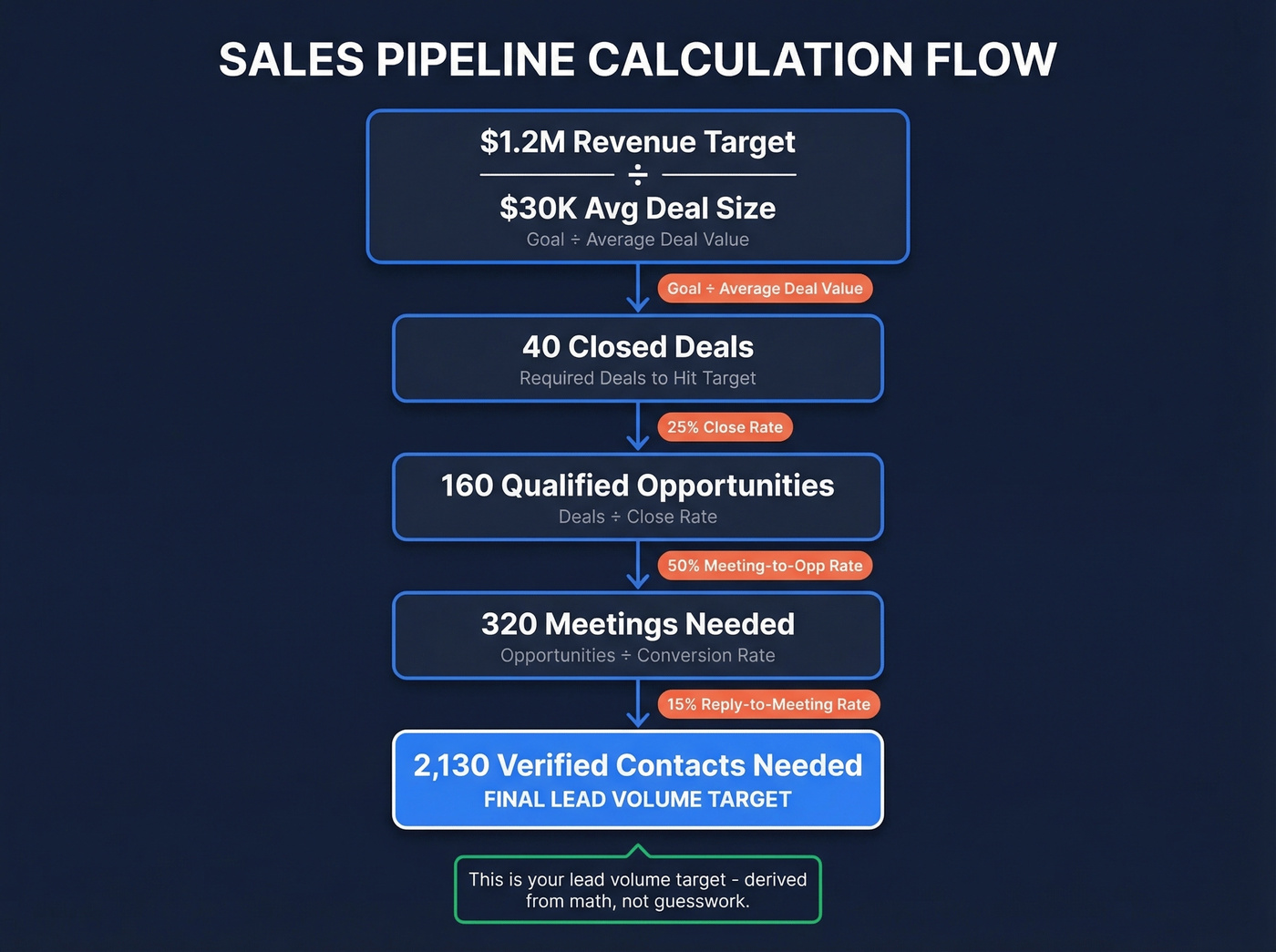
Revenue target / average deal size = deals needed. If you're targeting $1.2M in new ARR and your average deal is $30K, you need 40 closed deals.
Deals needed / close rate = opportunities needed. At a 25% close rate, that's 160 qualified opportunities.
Opportunities / reply-to-meeting rate = contacts needed. If 15% of replies convert to meetings and 50% of meetings become opportunities, you need roughly 2,130 verified contacts to hit your number.
That's your lead volume target, derived from math instead of guesswork. Every team should have this calculation on a whiteboard somewhere. If you want to pressure-test the funnel, use funnel metrics to spot where it’s leaking.
The Tech Stack for Company Leads
Think of your stack in six categories: contact databases, email finders and verification, sales engagement, inbound capture, visitor identification, and CRM. Start with a database and verification. Those two determine whether everything downstream works or falls apart.
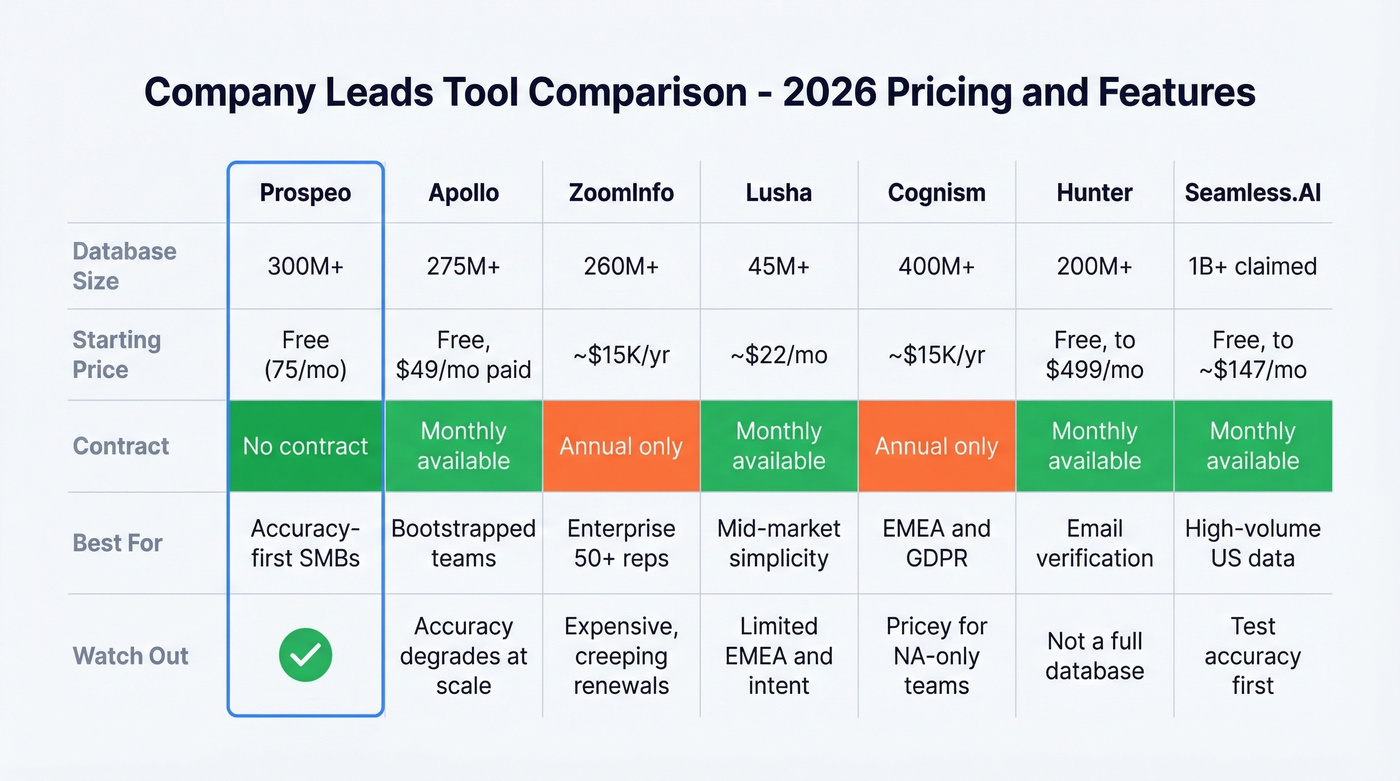
| Tool | Database Size | Starting Price | Contract | Best For |
|---|---|---|---|---|
| Prospeo | 300M+ profiles | Free (75 emails/mo); ~$0.01/email | No contract | Accuracy-first SMBs |
| Apollo | 275M+ contacts | Free; paid from $49/mo | Monthly available | Bootstrapped teams |
| ZoomInfo | 260M+ profiles | ~$15K/yr | Annual, 2-3 seat minimums | Enterprise 50+ reps |
| Lusha | 45M+ contacts | ~$22.45/mo | Monthly available | Mid-market simplicity |
| Cognism | 400M+ contacts | Custom (~$15K platform + per-user) | Annual | EMEA / GDPR |
| Hunter | 200M+ emails | Free; paid to $499/mo | Monthly available | Email finding + verification |
| Seamless.AI | 1B+ claimed | Free; paid to ~$147/mo | Monthly available | High-volume US data |
Prospeo
Prospeo covers 300M+ professional profiles with 98% email accuracy and 125M+ verified mobile numbers with a 30% pickup rate on outbound dials. The platform runs a 7-day data refresh cycle - the industry average is 6 weeks. The 30+ search filters include intent data tracking 15,000 topics powered by Bombora, technographics, job changes, headcount growth, and funding signals. Pricing is credit-based and transparent: roughly $0.01 per email, 10 credits per mobile number. The free tier gives you 75 emails and 100 Chrome extension credits per month. No contracts, no sales calls required.

Snyk's 50-person AE team was running 35-40% bounce rates before switching. After moving to Prospeo, bounces dropped under 5%, AE-sourced pipeline jumped 180%, and they now generate 200+ new opportunities per month.
Apollo
Apollo is the obvious starting point for bootstrapped teams. The free tier is genuinely useful - real search, sequencing, and limited credits. Paid plans run $49/mo (Basic), $79/mo (Professional), and $119/mo (Organization) on annual billing. Extra credits cost $0.20 each and expire at the end of your billing cycle.
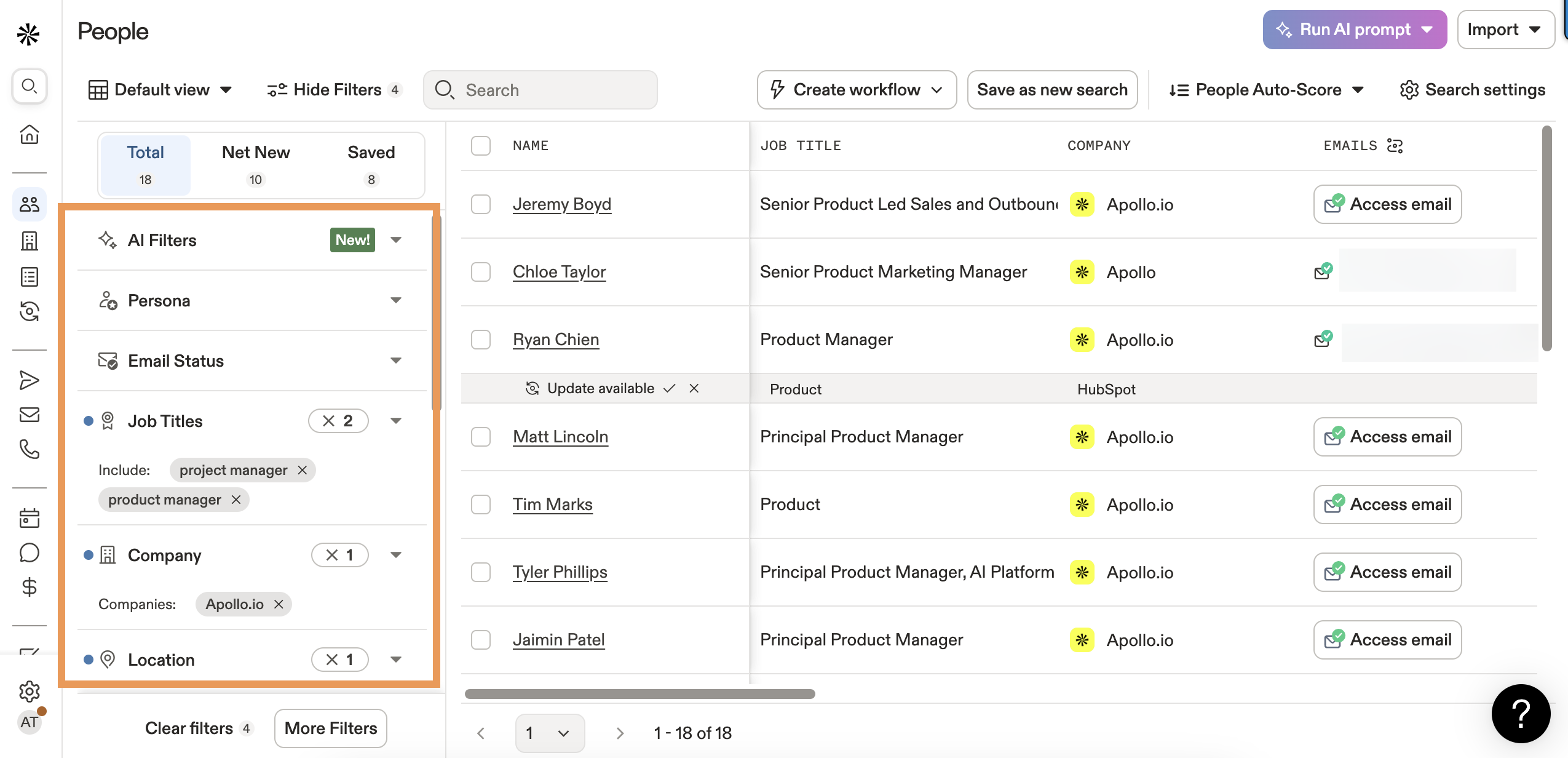
The database covers 275M+ contacts, and the built-in sequencer means you can prospect and outreach from one tool. The tradeoff: email accuracy degrades at scale. We've seen bounce rates climb past 15% on larger pulls, which means you'll want a verification layer on top. Apollo plus a dedicated verification tool beats Apollo alone. If you’re building repeatable outbound, pair this with a B2B cold email sequence that’s designed for deliverability.
ZoomInfo
ZoomInfo is the enterprise default, and it earns that position with 260M+ profiles, deep US coverage, and a broad feature set spanning intent data, chat, and workflow automation. Professional tier runs ~$15K-$18K/year. Advanced hits $25K-$28K. Elite pushes past $40K. Annual contracts, 2-3 seat minimums, and renewals that creep up 10-20% year over year.
Look, ZoomInfo is still the best all-in-one platform. But most teams don't need all-in-one. If you're a 10-person team where four reps actually use the search bar, you're lighting money on fire. Finance will eventually ask why you're paying $30K/year for a database only four reps touch. Have an answer ready.
Lusha
Use this if you need a simple, affordable database for a mid-market team that doesn't want to negotiate enterprise contracts. Lusha covers 45M+ contacts with a clean UI, starting at ~$22.45/month on annual billing. Paid tiers run $29-$99/month. Skip this if you need deep EMEA coverage or intent data - you'll outgrow it fast.
Cognism
Selling into Germany and your legal team won't sign off on a non-GDPR provider? Cognism is your shortlist. The database runs 400M+ contacts with strong EMEA mobile coverage and built-in compliance workflows. Pricing follows an enterprise model: Grow tier is ~$15K platform fee plus $1,500/user/year, Elevate is ~$25K plus $2,500/user/year. Annual contracts. For North America-focused teams, you'll pay European-compliance premiums for a database that's weaker stateside than Apollo or ZoomInfo.
Hunter, Seamless.AI, Instantly, and Leadfeeder
Hunter is a specialist: it finds and verifies professional emails. Free tier available, paid plans scale to $499/month. If you already have a contact database and just need verification, Hunter is lightweight and reliable.
Seamless.AI claims 1B+ contacts, the largest number in the space. Database size means nothing if accuracy is poor, so test before committing. Free tier available, paid plans to ~$147/month.
Instantly combines outreach infrastructure with a growing contact database - email warmup, sending, inbox rotation. More of a sending platform than a data platform. Paid plans from ~$30/month scaling with sending volume and mailbox count.
Leadfeeder identifies which companies visit your website when nobody fills out a form. Free Lite tier available, paid plans from $99/month on annual billing. Pair it with a contact database to turn anonymous traffic into actionable outreach lists.

Your pipeline math only works if the contacts are real. Prospeo's 300M+ profiles refresh every 7 days - not 6 weeks - so your 2,130-contact target actually connects to real buyers. 98% email accuracy means under 4% bounce rates, not 35%.
Run your pipeline math on data that doesn't destroy your domain.
Why Data Quality Beats Volume
B2B contact data decays roughly 2-3% per month. That's ~30% of your database going stale every year. If you're not verifying before outreach, you're burning your domain. To diagnose and fix the downstream impact, track email bounce rate by list source and list age.
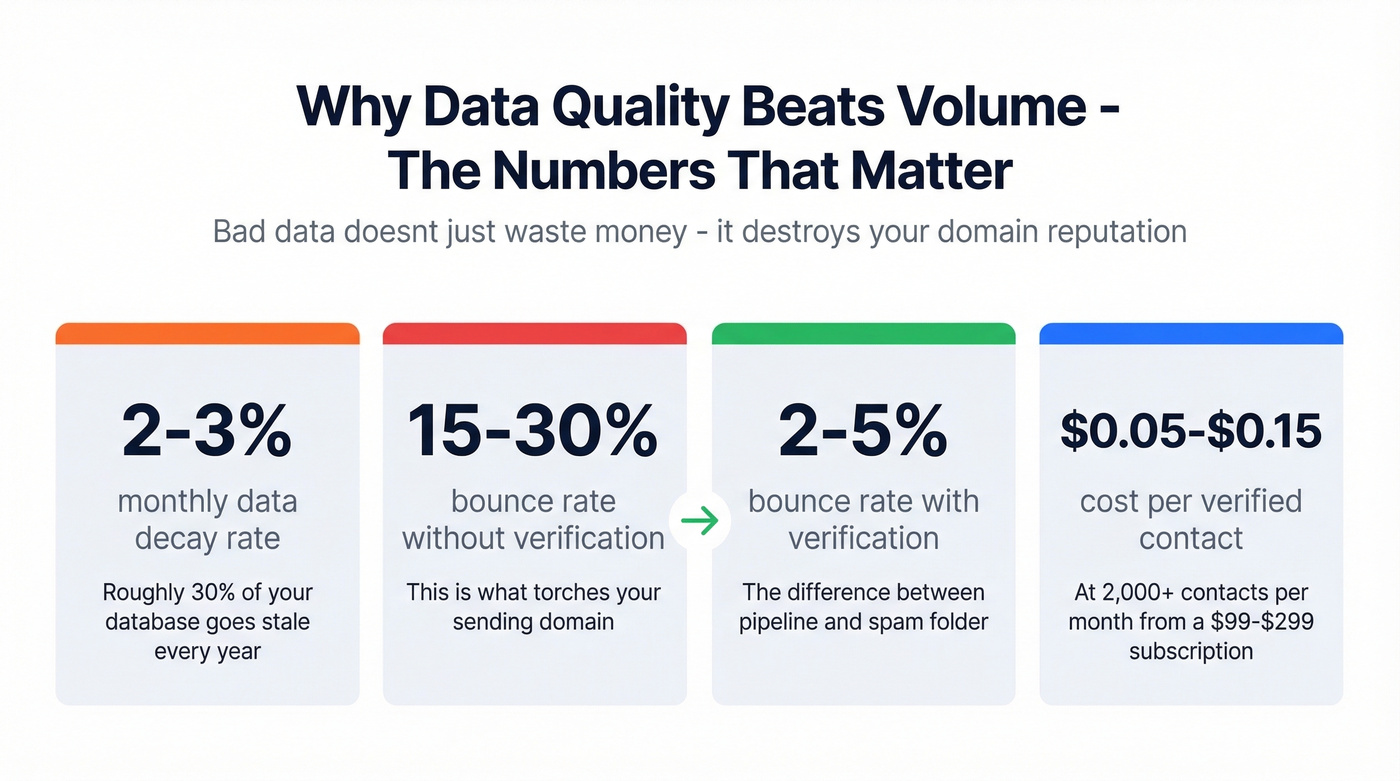
The economics are straightforward. Email verification reduces bounce rates from 15-30% down to 2-5%. A database subscription averaging $99-$299/month can yield a cost of $0.05-$0.15 per contact when you're extracting 2,000+ contacts monthly. But that per-contact cost doubles or triples when half your list bounces, because you're paying for contacts you can never reach and damaging your sender reputation in the process.
The Meritt team saw their bounce rate drop from 35% to under 4% after switching data providers, and their pipeline tripled from $100K to $300K per week. That's a 3x pipeline increase from changing one vendor.
The sexiest database in the world is worthless if 20% of the emails bounce. Verification isn't optional - it's the foundation. If you need a deeper stack view, compare data enrichment services alongside verification.
Snyk's 50 AEs cut bounce rates from 35% to under 5% and added 200+ opportunities per month. Stack Optimize built to $1M ARR with zero domain flags. The difference wasn't volume - it was 98% verified company leads at $0.01 each.
Stop paying $1/lead for data that bounces. Start at $0.01.
Benchmarks: What Good Looks Like
Before you optimize, you need to know what normal looks like. Ruler Analytics analyzed 100M+ data points across 14 industries and found the average qualified lead conversion rate is 2.9%. Forms convert at 1.7%, phone calls at 1.2%. And 67% of customers now prefer self-service over talking to a rep, which means your digital conversion paths matter more than ever.
| Metric | Benchmark |
|---|---|
| Qualified lead rate | 2.9% avg |
| Form conversion | 1.7% avg |
| Call conversion | 1.2% avg |
| Cold email opens | 15-25% |
| Cold email replies | 1-5% |
91% of B2B marketers rank lead generation as their top priority, yet most teams can't tell you their actual conversion rate by channel. If you're running cold email and don't know your reply rate within a tenth of a percent, you're flying blind. Measure by channel, measure by segment, measure weekly. Monthly reporting is too slow to catch a deliverability problem before it tanks your domain. For more context, see average B2B lead conversion rate.
A 2% cold email reply rate is actually solid if the targeting is right. Two percent on 1,000 verified contacts is 20 conversations. At a 25% meeting-to-opportunity rate, that's five deals in the pipe.
Mistakes That Kill Your Pipeline
Buying volume over quality. A list of 10,000 contacts with no ICP filter is a liability, not an asset. Fifty verified leads at the right companies outperform five thousand random ones. Use an ideal customer profile to keep list pulls honest.
Slow follow-up. Conversion chance drops dramatically if you wait longer than an hour. After 24 hours, the opportunity is effectively dead. Build automation that alerts sales the moment intent appears.
Vanity metrics. Page views, whitepaper downloads, webinar registrations - none of these are pipeline. Track conversations, qualified opportunities, and revenue. If your marketing dashboard doesn't connect to your CRM, you're measuring the wrong things.
No segmentation. Sending the same message to a CFO and a DevOps lead is lazy and it shows. Role-based messaging consistently outperforms generic outreach by 2-3x on reply rates.
Treating lead gen as a campaign. Generating company leads isn't a Q1 initiative. It's an operating system. Teams that run it as a continuous process build compounding pipeline. Teams that run it in bursts get feast-or-famine results.
Compliance Before Outreach
The penalties are real and they're per-violation, which means a single bad campaign can get expensive fast.
CAN-SPAM requires accurate headers, non-deceptive subject lines, a physical mailing address, clear opt-out, and honoring opt-out requests within 10 business days. Penalties run up to $43,280 per violation.
TCPA mandates prior express consent for robocalls to cell phones and written consent for texting. Penalties are $500-$1,500 per violation. Scrub against the National Do Not Call registry monthly.
GDPR applies to business emails if they identify a person, which most B2B emails do. Fines can reach EUR 20M or 4% of global revenue. Choose GDPR-compliant data providers and maintain a documented lawful basis for processing.
CCPA/CPRA carries $2,500 per violation, $7,500 for intentional violations. B2B exemptions have narrowed significantly.
Your practical checklist: authenticate your email domain (SPF, DKIM, DMARC), include opt-out in every message, track consent at the contact level, scrub DNC lists before calling, and document everything.
What's Working in 2026
First-party data is king. Teams that build their own contact databases through inbound, events, and product usage are outperforming those relying solely on purchased lists. The purchased list is a starting point, not the whole strategy.
AI is augmenting targeting and personalization, not replacing human judgment. The best teams use AI to score accounts and prioritize outreach timing, then have humans refine the message and make the call.
ABM has evolved from a buzzword into an operating system. The winning framework: tier accounts by fit plus intent, run 90-day sprints across sales and marketing, and measure by pipeline generated per account. Do this now: pick your top 25 accounts by intent signal, assign each one an owner across sales and marketing, and run a 90-day coordinated play. Let's be honest - twelve-step, six-week email sequences now get flagged as spam. Keep it to three touches over one to two weeks, ~100-120 words per email, with SPF, DKIM, and DMARC fully configured.
FAQ
What's the difference between a company lead and a contact?
A company lead is an account-level opportunity - the organization matches your ICP based on firmographic and intent criteria. A contact is an individual person within that company you can reach via email or phone. You need both: identify the right company first, then multi-thread into the right people inside it.
How much does a lead database cost?
Free tiers exist at Prospeo (75 emails/month) and Apollo. Mid-market tools run $29-$149/month per user. Enterprise platforms like ZoomInfo start at ~$15K/year with annual contracts and seat minimums. Budget $50-$200/month for a solid SMB stack, $15K-$40K/year for enterprise.
How do I verify lead data accuracy?
Run a verification check before every outreach campaign. If your bounce rate exceeds 5%, your data source has a quality problem. Track bounce rates by provider and by list age - data older than 30 days without a refresh is already degrading.
Is cold emailing B2B leads legal?
Yes, in most jurisdictions for B2B, provided you comply with CAN-SPAM, GDPR, and include functioning opt-out mechanisms. The key requirements are consent tracking, accurate sender information, and honoring unsubscribe requests within 10 business days.
How many leads should my team generate monthly?
Work backward from your revenue target using pipeline math. Divide your ARR goal by average deal size, then by close rate and meeting conversion rate to find the verified contacts you need. A well-targeted list of 500 verified contacts at companies showing buyer intent outperforms 5,000 unverified names every time.