

7 Connection Email Templates That Actually Get Replies
Up to 80% of jobs are filled through personal connections - not applications, not recruiter InMails. Most of those connections start with a single email that either gets a reply or gets archived. The difference? About 90 seconds spent personalizing one detail. Having the right connection email template turns that 90 seconds into a conversation.
The 4 rules:
- Keep it under 125 words
- Personalize one specific detail (not just their name)
- Make a concrete ask with a time constraint
- Follow up once after 3-4 days
What Makes a Great Connection Email
The optimal cold email length is 50-125 words. Two scrolls or fewer on mobile. Emails beating this threshold get noticeably fewer replies - you're writing for yourself at that point, not for them.
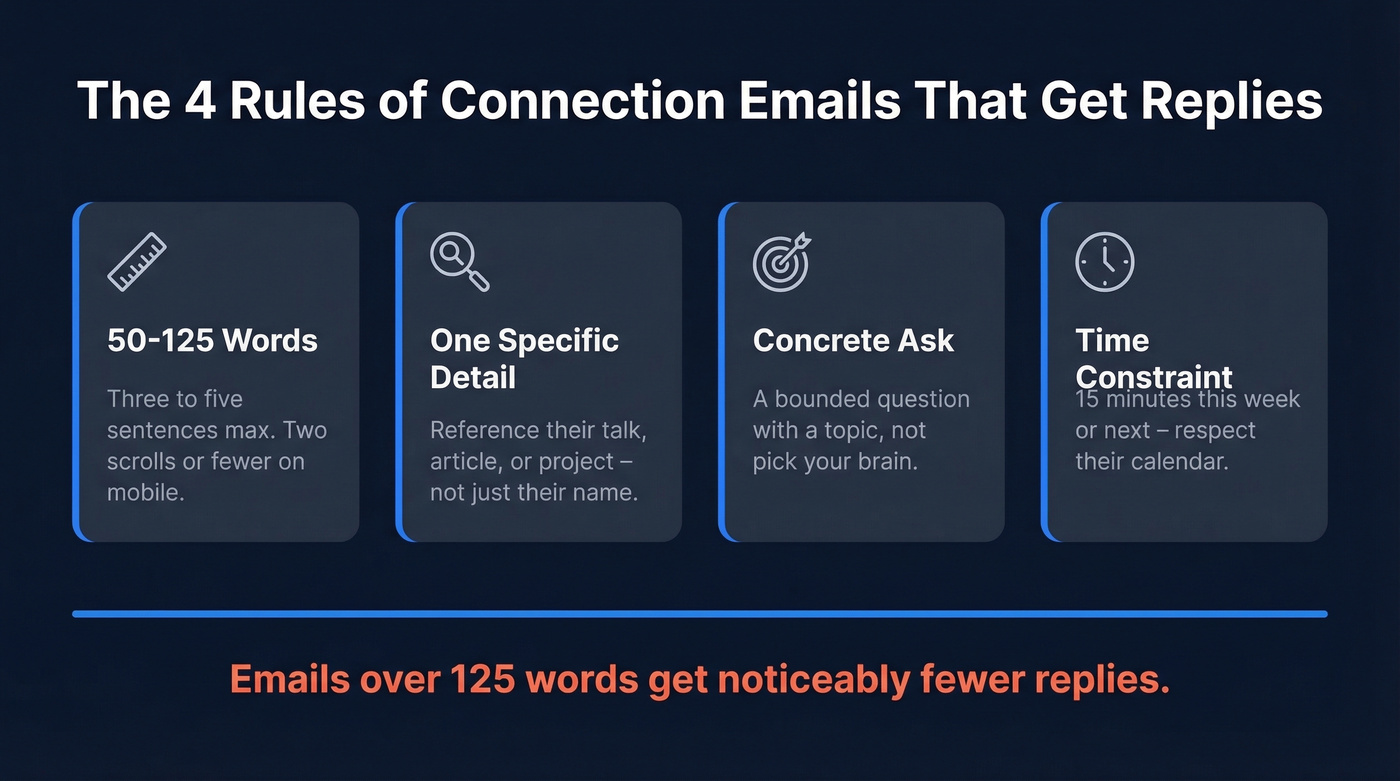
Four principles separate replies from deletions:
Short and scannable. Three to five sentences. That's it.
One personalized detail. "I loved your work" is generic. "Your talk on career pivots at [Conference] changed how I think about my next move" is specific. Cold emails often get better response rates than LinkedIn messages for networking, and email gives you room to prove you did your homework. If you want a deeper breakdown, start with this guide on writing a connection email.
A concrete ask. Never say "pick your brain." Ask a specific question: "Would you be open to a 15-minute call about how you structured your first SDR team?" (More examples: email call to action.)
A time constraint. "15 minutes this week or next" signals you respect their calendar. If you're building a multi-touch approach, a simple B2B cold email sequence helps you stay consistent without spamming.
7 Networking Email Templates
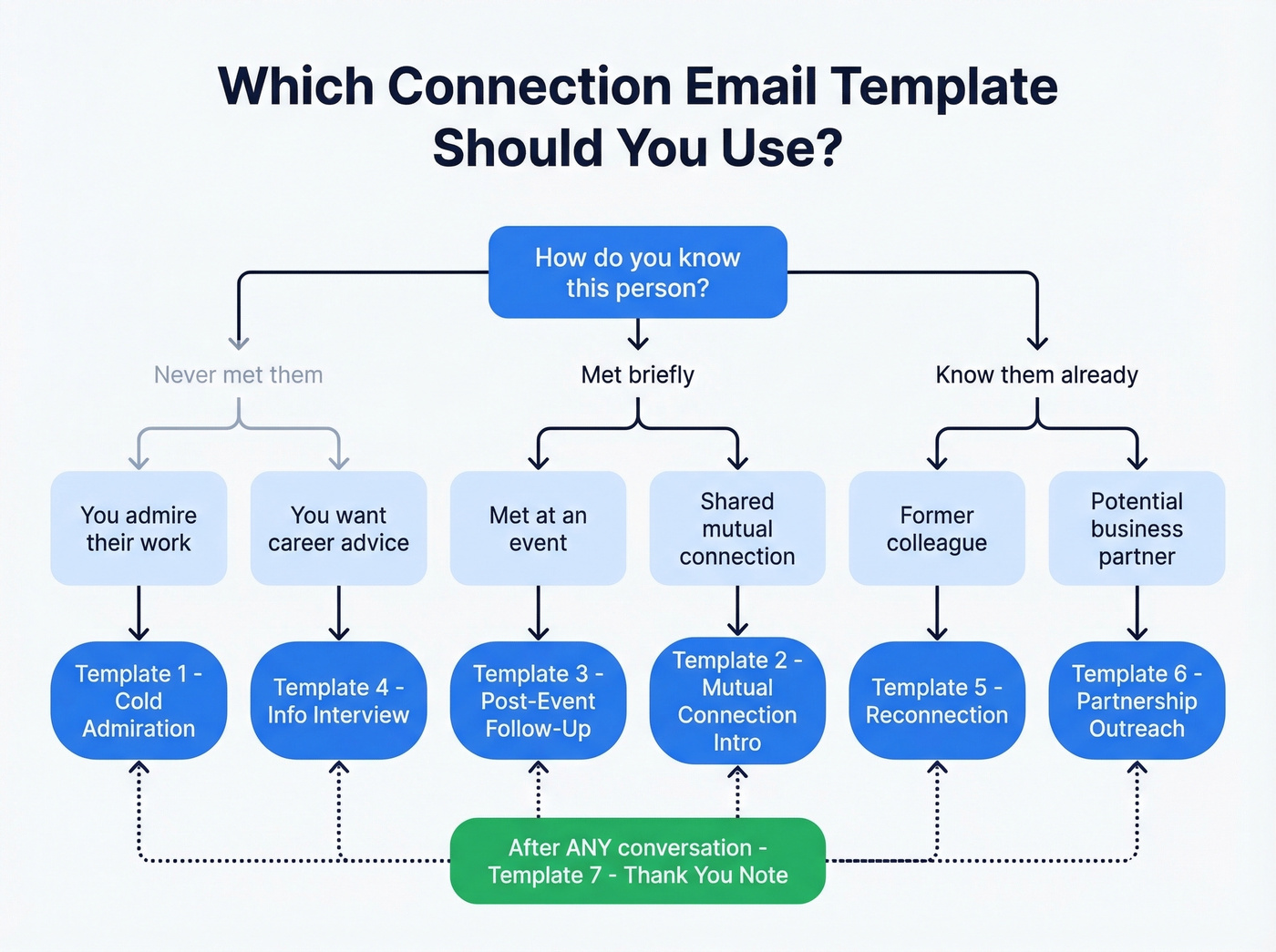
1. Cold Outreach to Someone You Admire
Subject: Your [specific work/talk/article] - quick question
Hi [Name],
I'm [Your Name], [role] at [Company]. Your [specific piece of work] stuck with me - particularly [specific detail].
I'm working on something similar and would love to ask one question about [topic]. Would you have 15 minutes this week or next?
[Your Name]
Here's what this looks like filled in:
Hi Sarah,
I'm James Carter, a product manager at Relay. Your breakdown of usage-based pricing at SaaStr stuck with me - particularly the bit about free-tier conversion cliffs.
I'm restructuring our own free tier and would love to ask one question about how you measured activation. Would you have 15 minutes this week or next?
James
The filled-in version works because it proves you actually consumed their work. Generic admiration gets deleted; specific references get replies. If you want more structure for personalization, see personalized outreach.
2. Mutual Connection Intro
Subject: [Mutual Connection] suggested I reach out
Hi [Name],
[Mutual Connection] mentioned you'd be great to talk to about [topic]. I'm [Your Name] - I [one-line context].
Would you be open to a 15-minute call next week?
[Your Name]
Name the mutual connection in the first sentence. It does the trust-building for you. For more options, browse these prospecting email subject lines.
3. Post-Event Follow-Up
Subject: Great meeting you at [Event]
Hi [Name],
Enjoyed our conversation at [Event] about [topic]. Your point about [detail] got me thinking.
Would love to continue - free for a quick call next week?
[Your Name]
Send this the same day or within 24 hours while the event is still fresh. They'll remember the conversation faster than they'll remember your name.
4. Informational Interview Request
Subject: 15 min on [their expertise]?
Hi [Name],
I'm [Your Name], currently [your situation]. Your path from [A] to [B] stands out.
Would you have 15 minutes for a call? I have Two specific questions about [topic] - I'll keep it tight.
[Your Name]
"Two specific questions" signals preparation. "I'll keep it tight" removes the fear of an hour-long ramble.
5. Reconnecting With a Former Colleague
Subject: Been a while - how's [new role]?
Hi [Name],
Saw you moved to [Company] - congrats. Great fit given your work on [project you did together].
I'm [one line on what you're doing]. Would love to catch up - 15 minutes sometime?
[Your Name]
This one's underrated. Former colleagues are the warmest "cold" outreach you can send, and most people never bother. A two-sentence email referencing a shared project does more trust-building than any LinkedIn endorsement.
6. Reaching Out to a Potential Partner
Subject: [Your Co] + [Their Co] - potential fit?
Hi [Name],
I run [role] at [Your Company]. I see natural overlap with what you're doing at [Their Company] around [area].
Would you be open to 20 minutes to explore whether there's something worth building together?
[Your Name]
Filled-in version:
Hi Marcus,
I run partnerships at Trellis. I see natural overlap with what you're doing at Canopy around SMB onboarding - we keep hearing the same pain points from the same customers.
Would you be open to 20 minutes to explore whether there's something worth building together?
Alex
"Something worth building together" frames it as mutual upside, not a favor.
7. Thank-You Note After a Conversation
Subject: Thanks for the time today
Hi [Name],
Really appreciated the conversation. Your advice on [specific takeaway] was exactly what I needed. I'm going to [specific action you'll take].
I'll keep you posted on how it goes.
[Your Name]
Send within 24 hours. Naming a specific takeaway and a concrete next step proves you actually listened - and keeps the door open for future contact.
Opening Lines That Get Read
Personalized subject lines lift open rates by 22-36%. The easiest personalization is naming a mutual connection or referencing something specific. But the opening line matters just as much - it's what shows in the preview pane and determines whether someone actually clicks.
| Subject Line | Scenario | Why It Works |
|---|---|---|
| [Mutual Name] suggested I reach out | Warm intro | Borrowed trust |
| Your [talk/article] - quick question | Cold admiration | Specific, curious |
| Great meeting you at [Event] | Post-event | Triggers memory |
| 15 min on [their expertise]? | Info interview | Clear time ask |
| Been a while - how's [Company]? | Reconnection | Casual, warm |
| [Your Co] + [Their Co] - quick idea | Partnership | Mutual benefit |
| Thanks for today | Thank-you | Simple, expected |
| Following up - [topic] | Follow-up | Context reminder |

Your connection email template is useless if it bounces. Prospeo finds and verifies professional emails across 300M+ profiles with 98% accuracy - so your carefully personalized outreach actually lands in the inbox, not the void.
Stop crafting perfect emails to wrong addresses. Verify first.
When to Send + Follow-Up Cadence
Tuesday and Thursday tend to perform best, with strong windows around 9:30-11:00am and 1:30-3:00pm. Avoid Fridays and weekends - your email gets buried under the Monday pile. For a data-backed timing breakdown, see best time to send cold emails.
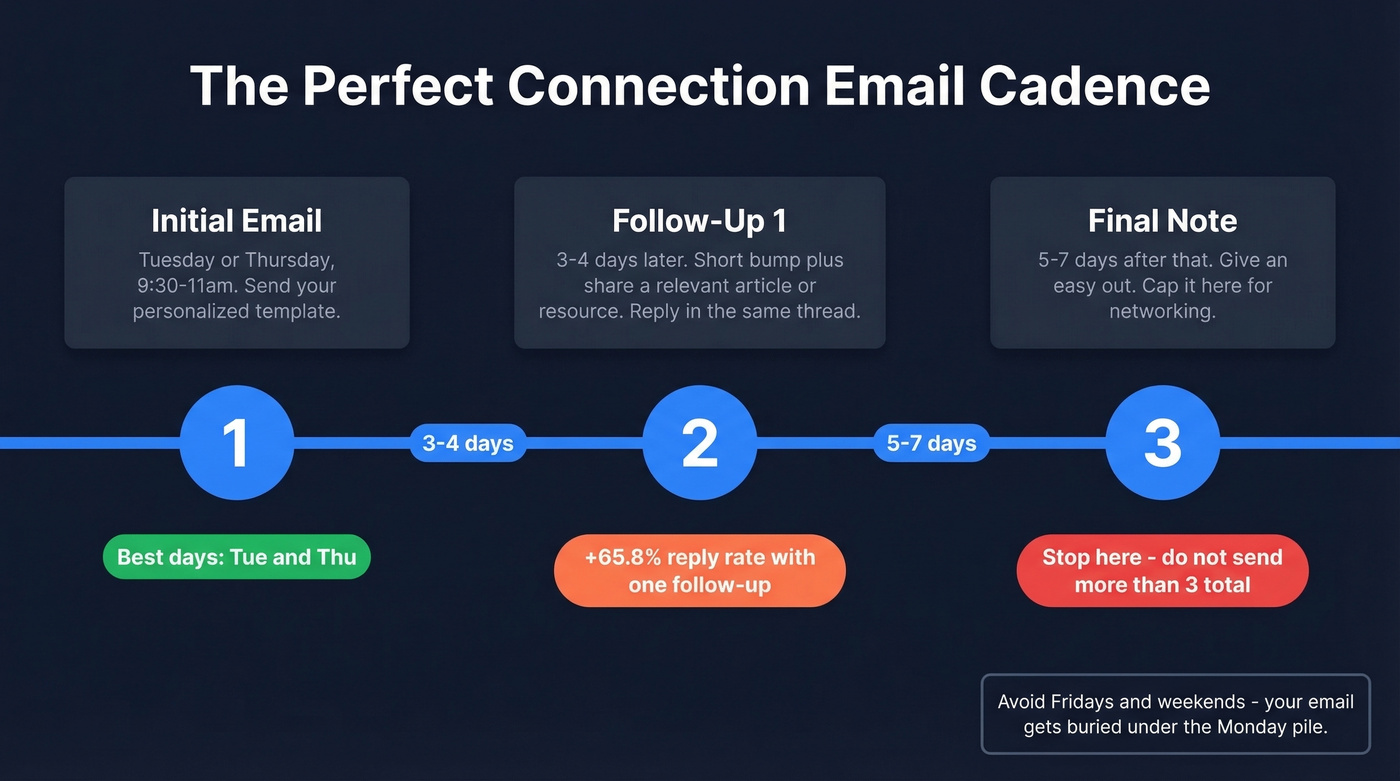
Here's the thing: one follow-up increases replies by 65.8% according to a Backlinko analysis of 12 million emails. But for networking, cap it at three total emails. You're building a relationship, not running a sales sequence. Expect a 7-10% reply rate on cold networking emails - strong personalization can push that above 20%. If you need ready-to-send bumps, use these sales follow-up templates.
| Touchpoint | Timing | What to Say |
|---|---|---|
| Email 1 | Tuesday or Thursday AM | Your template |
| Follow-up 1 | 3-4 days later | Short bump + share a relevant article or resource |
| Follow-up 2 | 5-7 days after that | Final note, easy out |
Follow-up emails outperform initial outreach when they add something useful - a relevant article, a podcast episode, a mutual connection's recent post. Don't just bump; give them a reason to engage. Always reply to your original thread so they have context without searching. One practitioner who networked into commercial real estate emphasized on Reddit that in-thread follow-ups consistently outperformed sending fresh emails.
Find and Verify the Email First
You've got the template. Now you need the right address.
Sending to an unverified email is worse than not sending at all - bounce rates above 5% damage your sender reputation and can get your domain flagged. We've seen people craft perfect connection emails only to waste them on dead addresses or, worse, spam traps that torch their deliverability for months. If you want the deeper mechanics, read the email deliverability guide and these email bounce rate benchmarks.
One approach is inferring corporate email formats from publicly listed addresses on a company's website. If you find john.smith@company.com, try firstname.lastname for your contact. But guessing formats is slow and unreliable, especially at companies with inconsistent naming conventions. Paste a URL into Prospeo's Email Finder and get a verified email in seconds - 98% accuracy, with a free tier that covers 75 verified emails per month. More than enough for a networking outreach campaign.
Personalizing connection emails means knowing who you're reaching. Prospeo's Chrome extension gives you 40+ data points per contact - job title, company, verified email - right from their profile. One click, no guessing.
Get the context you need to personalize every outreach in seconds.
5 Mistakes That Kill Replies
The biggest killer isn't bad writing - it's length. Over 150 words and you've lost them. I've watched people craft beautifully written three-paragraph emails that never get opened past the preview pane. Edit ruthlessly. Cut every sentence that doesn't earn its spot. If you want a tighter framework, this email copywriting guide helps.
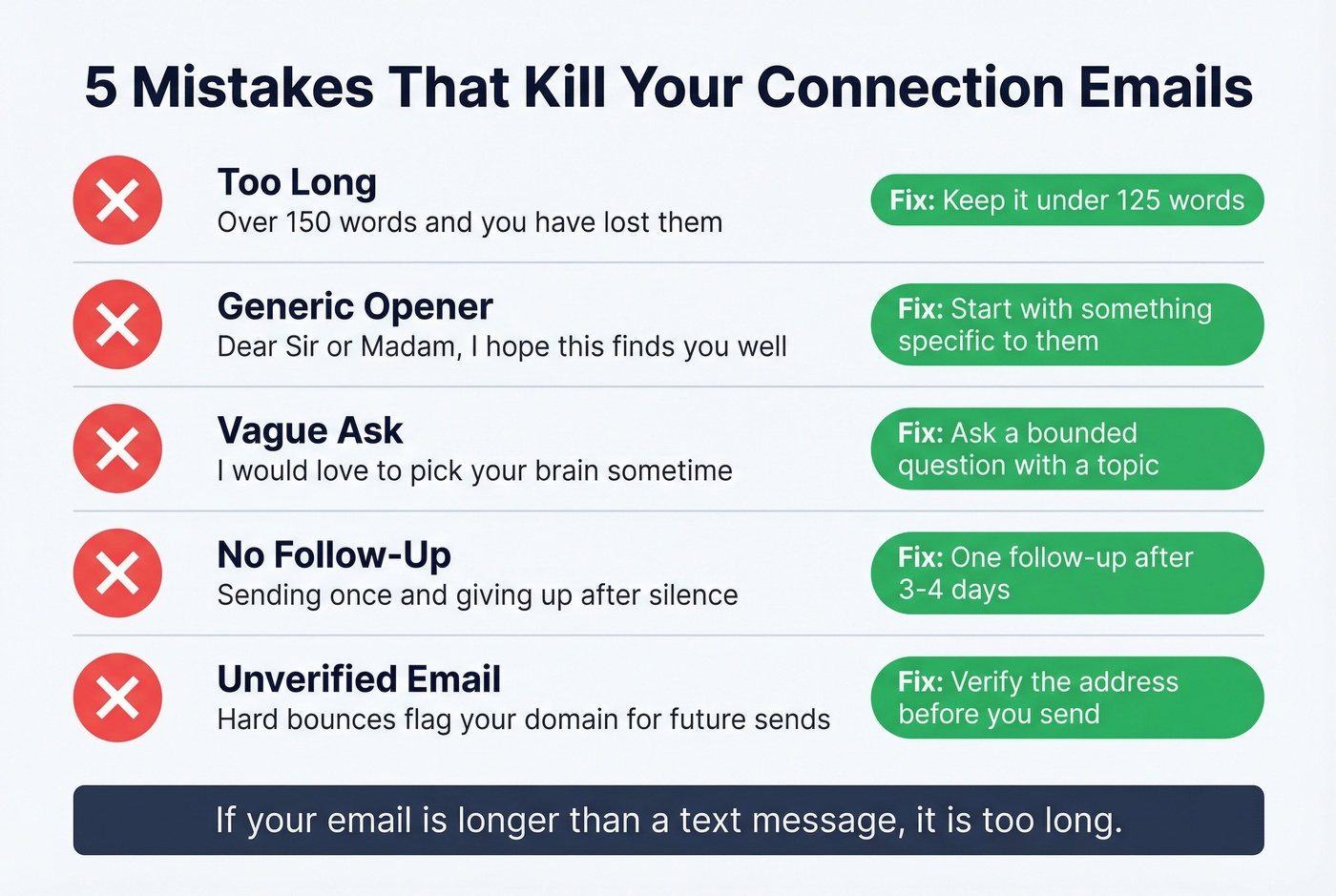
Generic openers are the second-fastest way to the trash. "Dear Sir or Madam" and "I hope this finds you well" signal a mass email. Start with something specific to them - always.
Third, vague asks. "I'd love to pick your brain" puts all the cognitive work on the recipient. Replace it with a bounded question tied to their expertise. Fourth, skipping the follow-up entirely. Most people aren't ignoring you - they're busy. One follow-up 3-4 days later is expected, not annoying. Fifth, sending to an unverified address. Repeated hard bounces flag your domain and make every future email less likely to land.
Let's be honest: if your connection email is longer than a text message, it's too long. The best networking emails we've seen read like something you'd tap out on your phone - direct, human, and done in under 60 seconds.
FAQ
What makes a good connection email template?
A strong template is 50-125 words with one personalized detail, a specific ask, and a time constraint like "15 minutes this week." That four-part formula consistently outperforms longer, vaguer outreach across every scenario we've tested.
Should I follow up if I don't hear back?
Yes - one follow-up after 3-4 days lifts reply rates by 65.8%. Keep it to two sentences, add something useful like a relevant article, and give them an easy out. Cap networking sequences at three total emails.
How do I write a networking email that doesn't feel pushy?
Lead with something specific about the recipient's work, keep the ask small and time-bounded, and make it easy to say no. Stating exactly what you need and how long it'll take respects their calendar and removes pressure.
How do I find someone's professional email for free?
Use an email finder tool - paste a profile URL, get a verified address. Prospeo's free tier covers 75 verified emails per month at 98% accuracy, which handles most networking campaigns without spending a dollar.