

Consultative Selling vs Solution Selling: What Actually Works in 2026
A rep on r/sales shared this gem: they sat through six hours of consultative selling training, got on a call, asked "What's keeping you up at night regarding your current solution?" - and the prospect immediately fired back, "Are you reading from a script?" Then hung up.
That's the gap at the heart of the consultative selling vs solution selling debate. 96% of prospects research your company before they pick up the phone, 71% prefer independent research over talking to a rep, and 73% actively avoid sellers who send irrelevant outreach. The framework you choose matters less than how human you sound using it.
The Quick Version
- Deals under $10K with clear problem/solution fit: Solution selling. Move fast.
- Deals $50K+ with multiple stakeholders: Consultative selling. Invest in discovery.
- Enterprise deals $100K+ where the buyer thinks they already know the answer: Challenger approach.
- Most teams: A hybrid - start consultative, shift to solution when pain is clear.
What Each Approach Actually Means
Consultative selling traces back to the 1970s and Mack Hanan's book Consultative Selling. You're an advisor first, a seller second. You diagnose the buyer's full business situation - sometimes recommending a competitor if that's genuinely the better fit. The relationship outlasts any single deal.
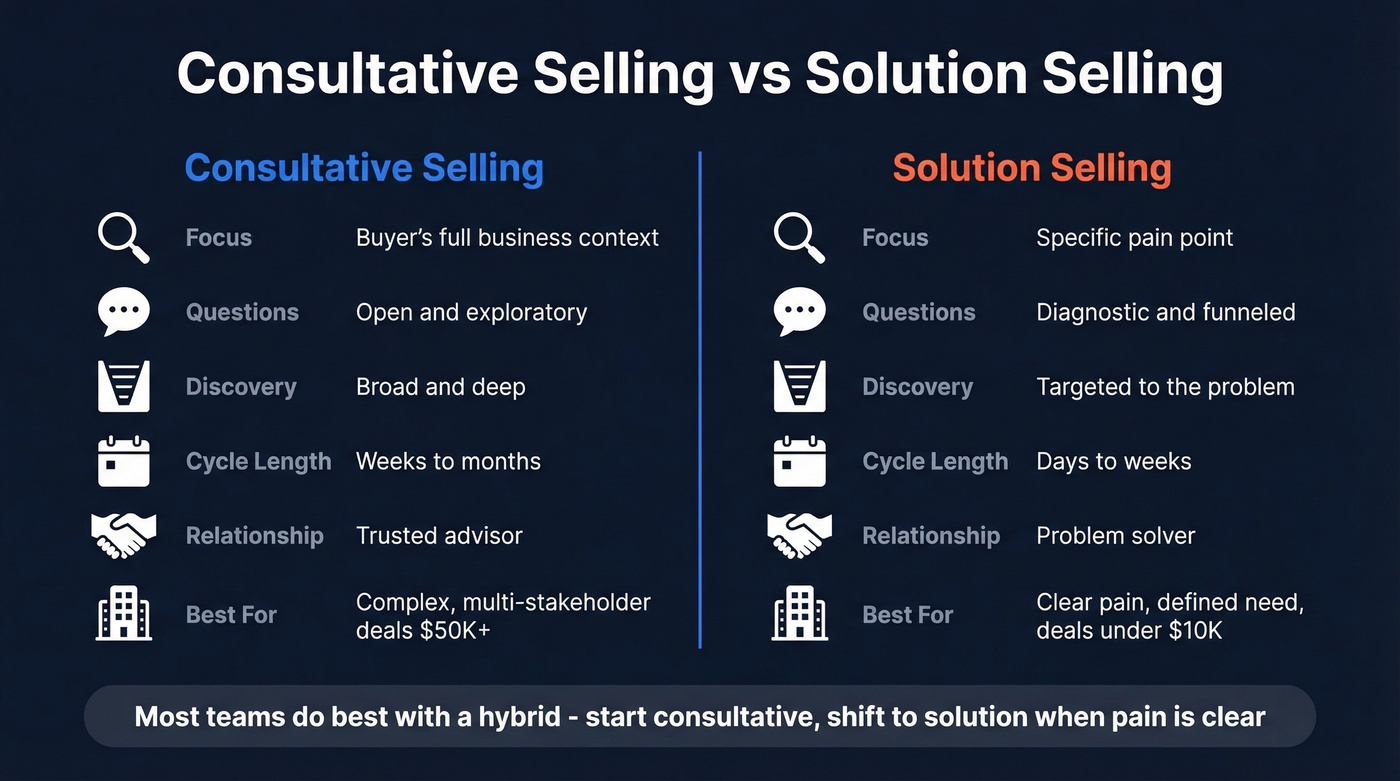
Solution selling developed in the 1980s. It's more focused: diagnose a specific pain, then map your product's capabilities to that pain. You're still asking questions, but they funnel toward your offering. When comparing solution selling vs consultative selling, think of solution selling as a subset - narrower scope, same DNA.
A Demand Gen 2020 B2B Buyer Behavior Study found the top two reasons buyers choose a vendor: "demonstrated strong knowledge of the solution and the business landscape" and "demonstrated a strong understanding of the company and their needs." Both approaches target those marks. They just go about it differently.
| Dimension | Consultative Selling | Solution Selling |
|---|---|---|
| Primary focus | Buyer's full business | Specific pain point |
| Questioning style | Open, exploratory | Diagnostic, funneled |
| Discovery depth | Broad | Targeted problem |
| Typical cycle | Longer - weeks to months | Shorter - days to weeks |
| Relationship goal | Trusted advisor | Problem solver |
| Best for | Complex, multi-stakeholder | Clear pain, defined need |
When to Use Each Approach
Win-rate benchmarks by deal size tell a clear story about where discovery depth pays off:
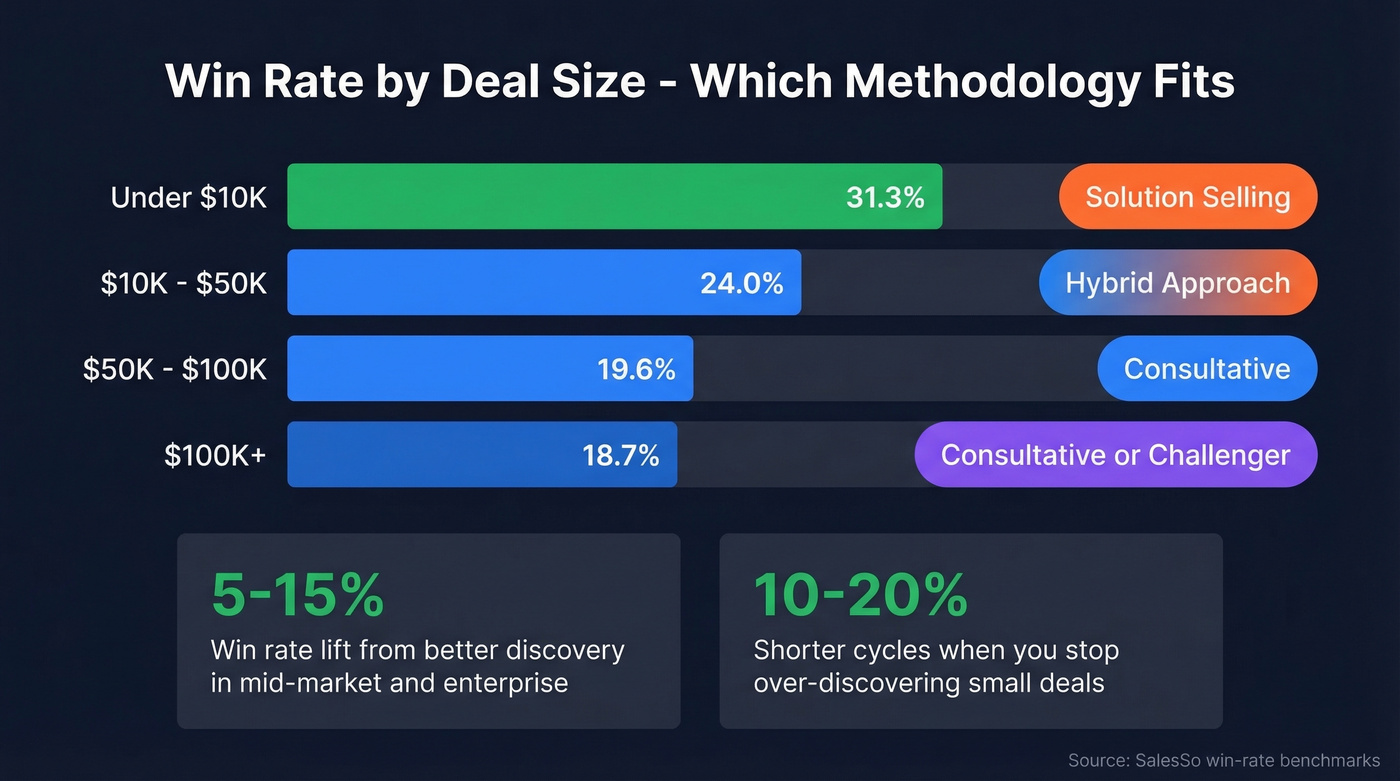
| Deal Size | Avg Win Rate | Best Approach |
|---|---|---|
| Under $10K | 31.3% | Solution selling |
| $10K-$50K | 24.0% | Hybrid |
| $50K-$100K | 19.6% | Consultative |
| $100K+ | 18.7% | Consultative/Challenger |
Win rates also vary by lead source: referrals close at 40-60%, inbound at 30-50%, outbound at 10-25%. Consultative selling works best when you've already earned some trust. Cold outbound often demands a faster, more solution-oriented hook just to earn the next meeting (see sales prospecting techniques that fit each motion).
81% of revenue leaders say their team's deals are more complex than ever. Expect a 5-15% win-rate lift in mid-market and enterprise segments when teams tighten qualification and improve discovery quality, and 10-20% shorter cycles when they stop running enterprise-grade discovery on four-figure deals.
Here's the thing: if your VP says "be more consultative" but your average deal is $8K and you need 15 closes a month, running 45-minute discovery calls isn't consultative - it's inefficient. Match your methodology to your math. That single principle will outperform any framework.
Is Solution Selling Dead?
The argument goes like this: when buyers can compare dozens of near-identical products online before talking to a rep, a pitch built around features-mapped-to-pain feels redundant. Commoditization erodes the differentiation that solution selling depends on - Anthony Iannarino at TheSalesBlog has made this case repeatedly.
The Gartner stat that gets cited everywhere: nearly 60% of the purchasing process is complete before a buyer considers talking to a rep. If that's true, showing up with "let me understand your pain and map it to our product" is arriving late to your own party. As Reddit threads in r/sales frequently point out, buyers now walk into calls with more product knowledge than most junior reps.
But solution selling isn't dead - it's insufficient alone for complex deals.
For a $7K SaaS contract with a clear use case, a tight solution-selling motion - diagnose, demo, close - still works beautifully. The methodology breaks down when deals involve multiple stakeholders, long timelines, and buyers who've already Googled your competitor's pricing page.
Iannarino recommends an "executive briefing" opener as the modern replacement: ask permission to share trends, lead with "here's what we're seeing work," then frame the competitive gap. It's solution selling dressed in consultative clothing - and it works because it leads with insight, not interrogation.

Step 1 of your discovery framework says "do five-minute homework." Prospeo makes that homework effortless - 30+ filters including buyer intent, tech stack, funding, and headcount growth give you the hypotheses before the call even starts.
Show up to discovery calls with insights, not generic questions.
Beyond Both: Challenger and SPIN
These aren't competing religions. They're tools in the same toolbox.
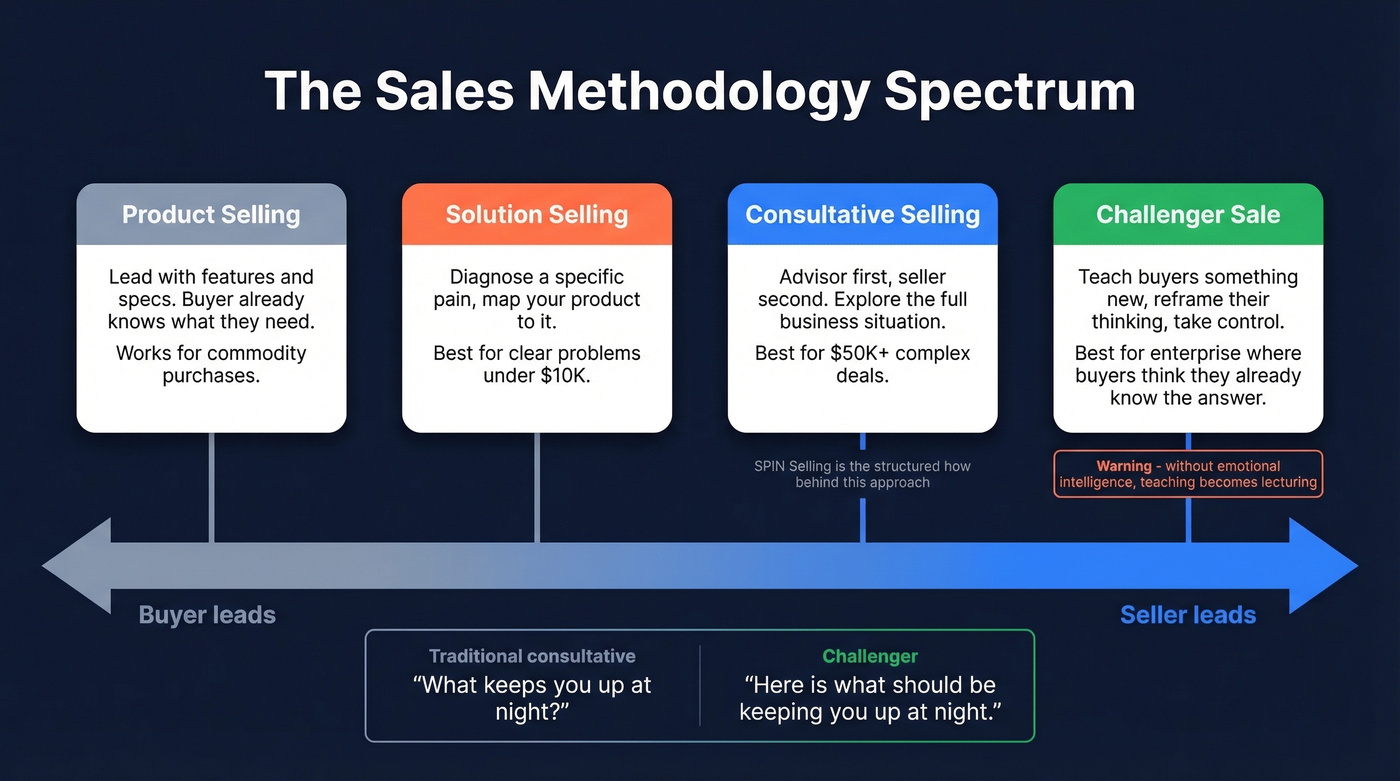
SPIN Selling is the research heavyweight: Neil Rackham's team analyzed 35,000+ sales calls across 20+ countries over 12 years. The Situation-Problem-Implication-Need-payoff framework is structured consultative selling with a repeatable questioning sequence. Think of SPIN as the "how" behind consultative selling's "why." (If you want a more tactical bank of prompts, see our guide to discovery questions.)
The Challenger Sale came from CEB's research across 6,000+ reps. Top performers don't just listen and respond - they teach buyers something new, tailor the message to each stakeholder, and take control of the commercial conversation. Xerox reported a 17% increase in sales and $65M in contract value after implementing Challenger principles.
The contrast is sharp:
Traditional consultative: "What keeps you up at night?" Challenger: "Here's what should be keeping you up at night."
One follows the buyer's framing. The other reframes. But Challenger has a failure mode that doesn't get enough airtime. We've seen reps adopt Challenger language and come across as arrogant - misidentifying pain points and eroding trust faster than any methodology can rebuild it. Without emotional intelligence, "teaching" becomes lecturing and "taking control" becomes being pushy.
Discovery Framework (Sans Script)
This four-step discovery flow works across methodologies. Use it as a skeleton, not a straitjacket.
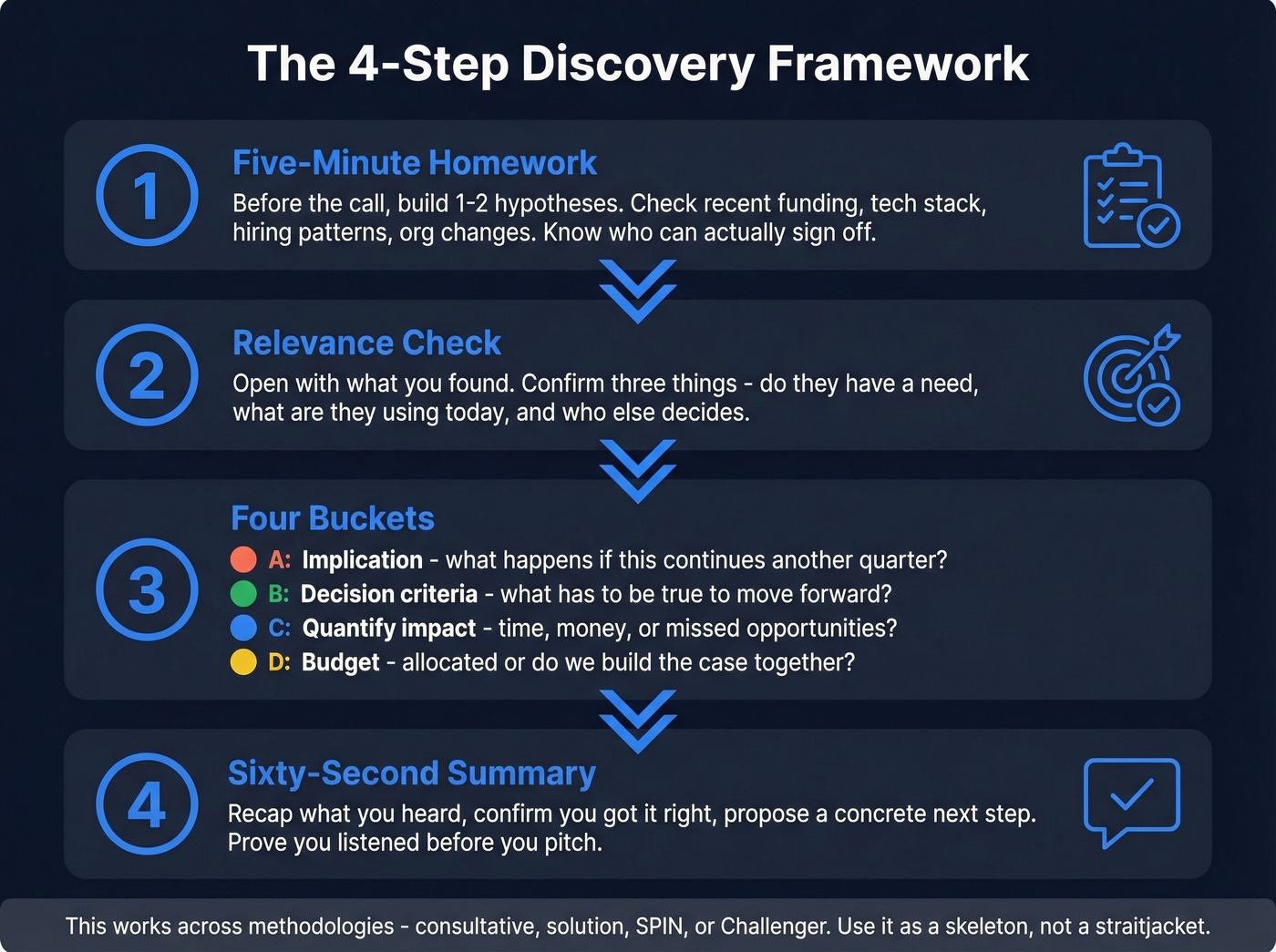
Step 1: Five-minute homework. Before the call, arrive with one or two hypotheses about the prospect's situation. Check recent funding, tech stack, hiring patterns, org changes. Tools like Prospeo with 30+ search filters - including seniority, department headcount, and technographics - help you build a buying-committee list fast so you're not burning your best questions on someone who can't sign off (more on firmographic and technographic data).
Step 2: Relevance check. Open with something like: "I did a quick look - teams like yours typically care most about X and Y. What triggered you to take this call?" Confirm three things: Do they have a need? What are they using today? Who else would be involved in deciding? (This is also where a lightweight lead scoring model helps.)
Step 3: Four buckets. Explore process, decision criteria, risk/constraints, and commercial reality:
- Implication: "If that problem continues another quarter, what's the downstream impact?"
- Decision criteria: "What are the three things that have to be true for you to move forward?"
- Quantify impact: "In time, money, or missed opportunities - what's this costing you?"
- Budget: "Is there budget allocated, or would we need to build the case together?"
Step 4: Sixty-second summary. Recap what you heard, confirm you got it right, propose a concrete next step. This is where most reps drop the ball - they rush to the pitch instead of proving they actually listened. (If you need a tighter close-out, borrow from these steps to close a sale.)
Why These Approaches Fail
Every methodology shares the same failure modes. In our experience, the talk-to-listen ratio is the single fastest diagnostic for a struggling rep.
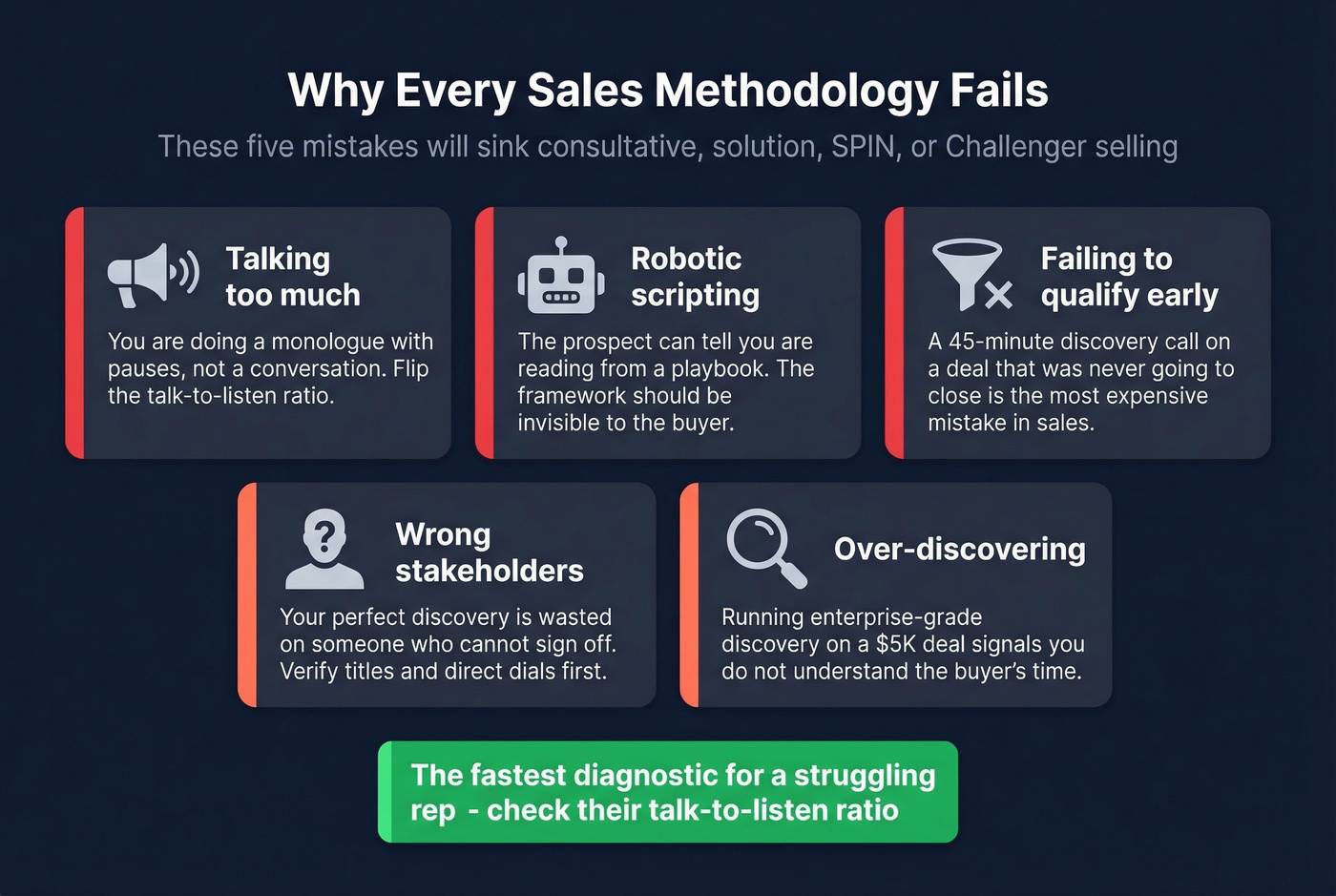
You're doing most of the talking. That's not consultative - it's a monologue with pauses. Flip the ratio. You're executing the script robotically. Remember the Reddit rep who got hung up on? Their desk neighbor - who "just talked like a normal human being" - was closing deals. The framework should be invisible to the buyer.
You're failing to qualify early. A 45-minute discovery call on a deal that was never going to close is the most expensive mistake in sales. Skip the deep discovery if the prospect can't articulate a problem worth solving in the first five minutes. (If your team needs a system, start with sales process optimization.)
Then there's the methodology-killer nobody wants to admit: you're pitching to the wrong stakeholders. Verify job titles and direct dials before your first call so your framework reaches the economic buyer, not the intern who filled out the form (see MEDDPICC economic buyer). And finally, you're over-discovering - running enterprise-grade discovery on a $5K deal signals you don't understand the buyer's time constraints.
Consultative vs Product Selling
While the consultative vs solution selling comparison gets most of the attention, the gap between consultative selling and product selling is even wider. Product selling leads with features, specs, and pricing - the rep's job is to present and persuade. It works for commodity purchases where the buyer already knows what they need and just wants the best deal.
For anything involving organizational change or multiple decision-makers, product selling falls flat because it skips the diagnosis entirely. If your team is still defaulting to product-led pitches in complex deals, the shift to consultative discovery will feel dramatic - and the results usually follow (especially in enterprise B2B sales).
The Hybrid That Works
Start consultative: build trust, understand the situation, earn the right to go deeper. When specific pain emerges, shift to solution mode - map that pain to your product with precision. Maintain the advisor posture throughout, even when you're closing.
Let's be honest: we've watched teams agonize over methodology selection when the real issue was data quality and qualification discipline. Close's sales team has a great example - they'll recommend a competing CRM when it's genuinely a better fit. That honesty pays off long-term via referrals and return buyers. That's consultative integrity powering long-term pipeline (and it’s easier to operationalize with solid contact management software).
Stop debating frameworks. Whether you lean consultative selling or solution selling, the real question is: can your reps have a human conversation? If they can, any methodology works. If they can't, no methodology saves them.
Consultative or solution selling - neither works if your emails bounce. Prospeo delivers 98% email accuracy with a 7-day data refresh cycle, so your outreach actually lands with the stakeholders who matter. At $0.01 per email, bad data is no longer an excuse.
Stop perfecting your methodology while sending emails to dead inboxes.
FAQ
Can you combine consultative and solution selling?
Yes, and most high-performing teams do exactly that. Start consultative to diagnose pain across the buyer's business, then shift to solution selling to map specific capabilities to that pain. This hybrid consistently outperforms either approach alone in the $10K-$100K deal range.
Which B2B sales methodology has the highest win rate?
No single methodology wins universally. Complex $100K+ deals benefit from consultative or Challenger approaches (18-20% win rates). Transactional deals under $10K close faster with solution selling (~31% win rate). Execution and qualification discipline beat framework selection every time.
How do I identify the right decision-maker before discovery?
Use a B2B data platform to verify job titles, direct dials, and emails before your call block. Reaching the economic buyer - not the form-filler - is the single biggest prerequisite for any methodology to work. With 30+ search filters covering seniority, department headcount, and technographics, you can map the full buying committee in minutes.
What's the difference between SPIN selling and consultative selling?
SPIN Selling is the structured execution layer for consultative selling. Neil Rackham's Situation-Problem-Implication-Need-payoff framework gives reps a repeatable questioning sequence, while consultative selling is the broader philosophy of acting as a trusted advisor. Think of SPIN as the "how" and consultative as the "why."