

Consulting Sales Pitch: A 7-Part Framework for 2026
You just lost a consulting sales pitch you thought you'd win. The credentials were right, the price was competitive, and the client went with a smaller firm that "got it" more. One buyer on r/Entrepreneur put it bluntly: "1 out of 100 are genuine & good." The average B2B proposal wins about 45% of the time. Top performers hit 60%+. That gap isn't about charisma - it's structural. Fix the structure and the numbers move.
Stop trying to make your pitch compelling. Make it specific. Specificity is the most underrated skill in consulting sales.
Why Most Consulting Pitches Fail
Three reasons, all fixable.
They're generic. Fewer than 30% of pitches are truly customized. If your audience can swap your logo with another firm's and the deck still works, you've already lost.
They ignore the room. B2B buying decisions involve 5-11 stakeholders. Your deck needs to arm your internal champion with ammunition to sell you to colleagues who'll never meet you. Investors now spend 24% less time reviewing pitch decks than they did two years ago, so every slide has to earn its place.
They lead with credentials instead of problems. Nobody cares about your 15-year track record. As a Big 4 consultant told LexisNexis: "Great pitching is all about telling a story that connects with the client."
The 7-Part Framework
Keep it to 10-12 slides. Lead each slide with a standalone sentence title that delivers the key takeaway - the Pyramid Principle. If a stakeholder only reads your slide headers, they should understand your entire argument.
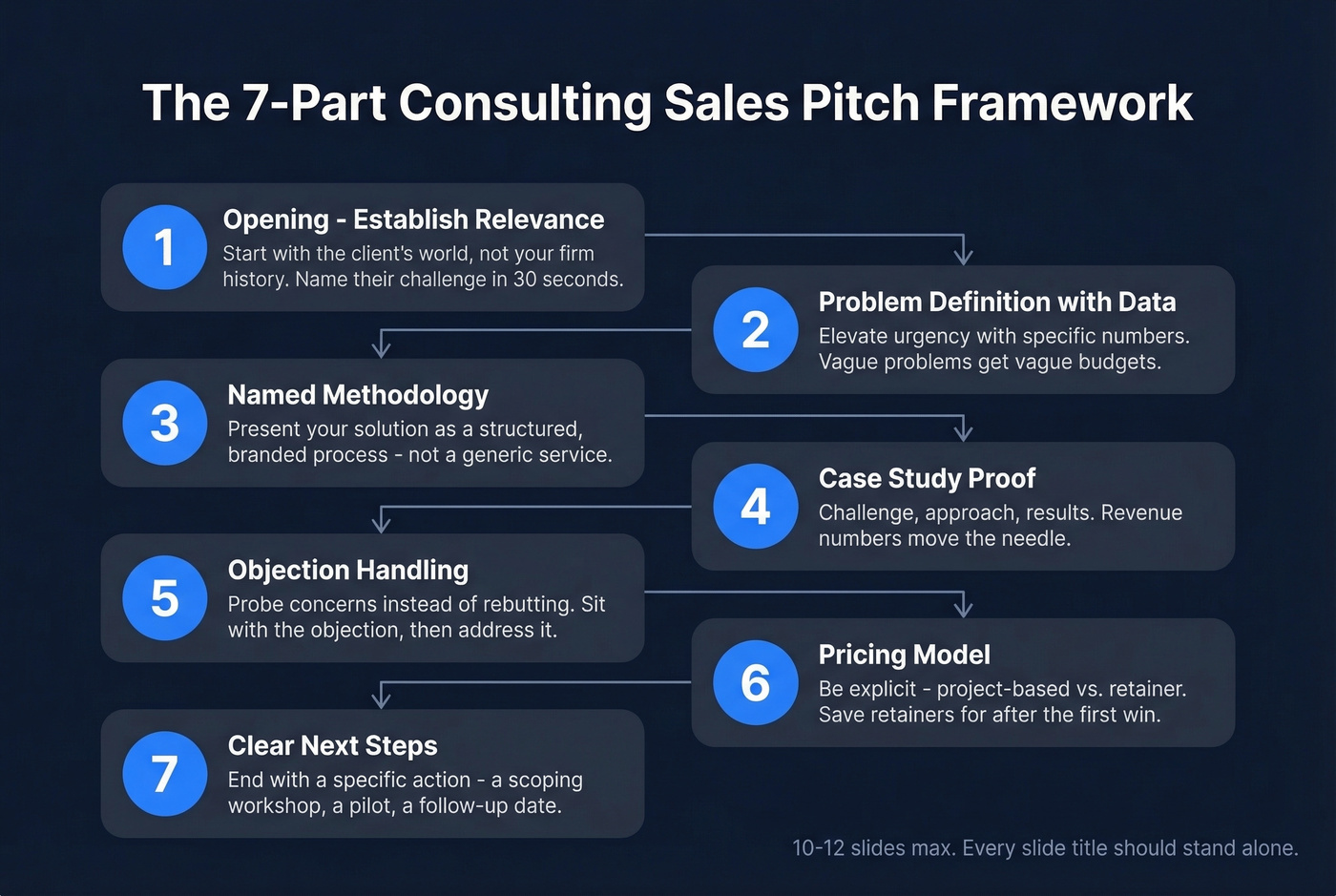
1. Opening - establish relevance. Open with the client's world, not your firm's history. Name their challenge in the first 30 seconds.
2. Problem definition with data. Elevate urgency. "Retailers that fail to increase repeat purchases see acquisition costs rise 30% annually" beats "retention is important."
3. Named methodology. Present your solution as a structured, named process. "Our 4-Phase Integration Accelerator" beats "we offer ERP consulting."
4. Case study proof. Challenge, approach, results - with measurable outcomes. Revenue numbers move the needle; vague testimonials don't.
5. Objection handling. Anticipate budget, timeline, and internal capability concerns, then probe them rather than rebutting. The best consultants sit with objections, asking "what specifically concerns you about the timeline?" instead of rushing to reassure. Link market shifts to regulatory pressure, competitive dynamics, or macro trends when they're relevant to the objection. (If you want a tighter system for handling pushback, see How to Reduce Sales Objection Rate.)
6. Pricing model. Be explicit about project-based vs. retainer. Only 13% of consultants use monthly retainers - and for good reason. Retainers work best after a successful first engagement. Don't propose one on a first pitch.
7. Clear next steps. End with a specific action: a scoping workshop, a pilot, a follow-up with the full buying committee. "Let's stay in touch" isn't a next step. (If your team struggles here, borrow a few steps to close a sale.)
Boutique Beats Big Four on a EUR3M Deal
Here's what specificity looks like in practice. A boutique firm won a ~EUR3M post-merger ERP integration project at a global pharmaceutical company - beating Big Four competitors despite being EUR180,000 over budget.
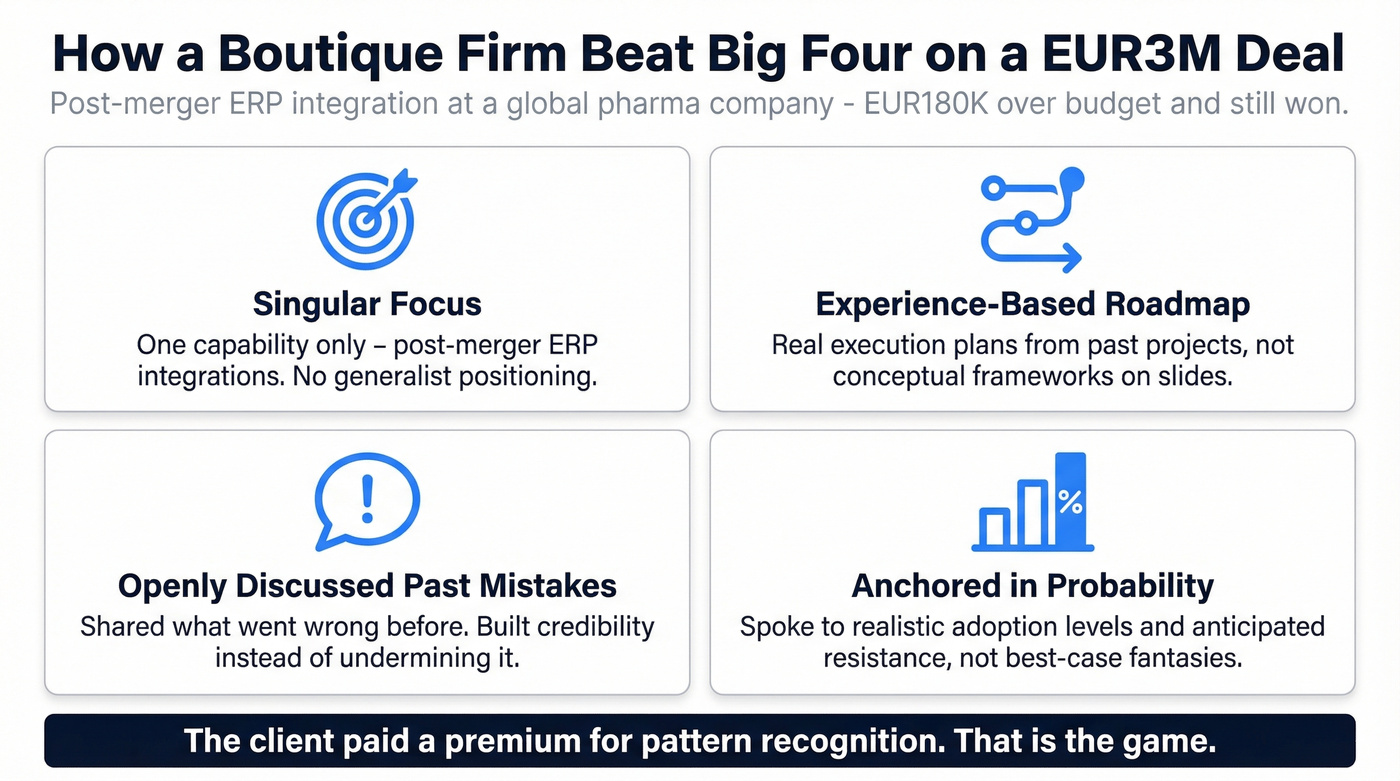
How? Four principles, documented by Luk Smeyers. Singular focus on one capability: post-merger ERP integrations, nothing else. An experience-based execution roadmap, not a conceptual framework on a slide. Open discussion of past mistakes during the pitch, which built credibility instead of undermining it. And every conversation anchored in probability rather than hope, speaking to realistic adoption levels and anticipated resistance.
The client paid a premium for pattern recognition. That's the game.

Your consulting pitch is only as good as your prep. Prospeo gives you 300M+ professional profiles with 30+ filters - job title, seniority, department, company size - so you can identify every stakeholder on the buying committee before you walk in. At 98% email accuracy and $0.01 per email, sloppy prospect research stops being an excuse.
Stop pitching gatekeepers. Find every decision-maker before the meeting.
Run SPIN Discovery Before You Pitch
Here's the thing: most consultants pitch after a single discovery call. That's not enough. Neil Rackham's research across 35,000+ sales calls in 23 countries showed SPIN questioning drives a 17% boost in sales productivity. Enterprise consulting engagements often close in 3-6 months - you have time to do discovery right. (For more options beyond SPIN, use these discovery questions.)
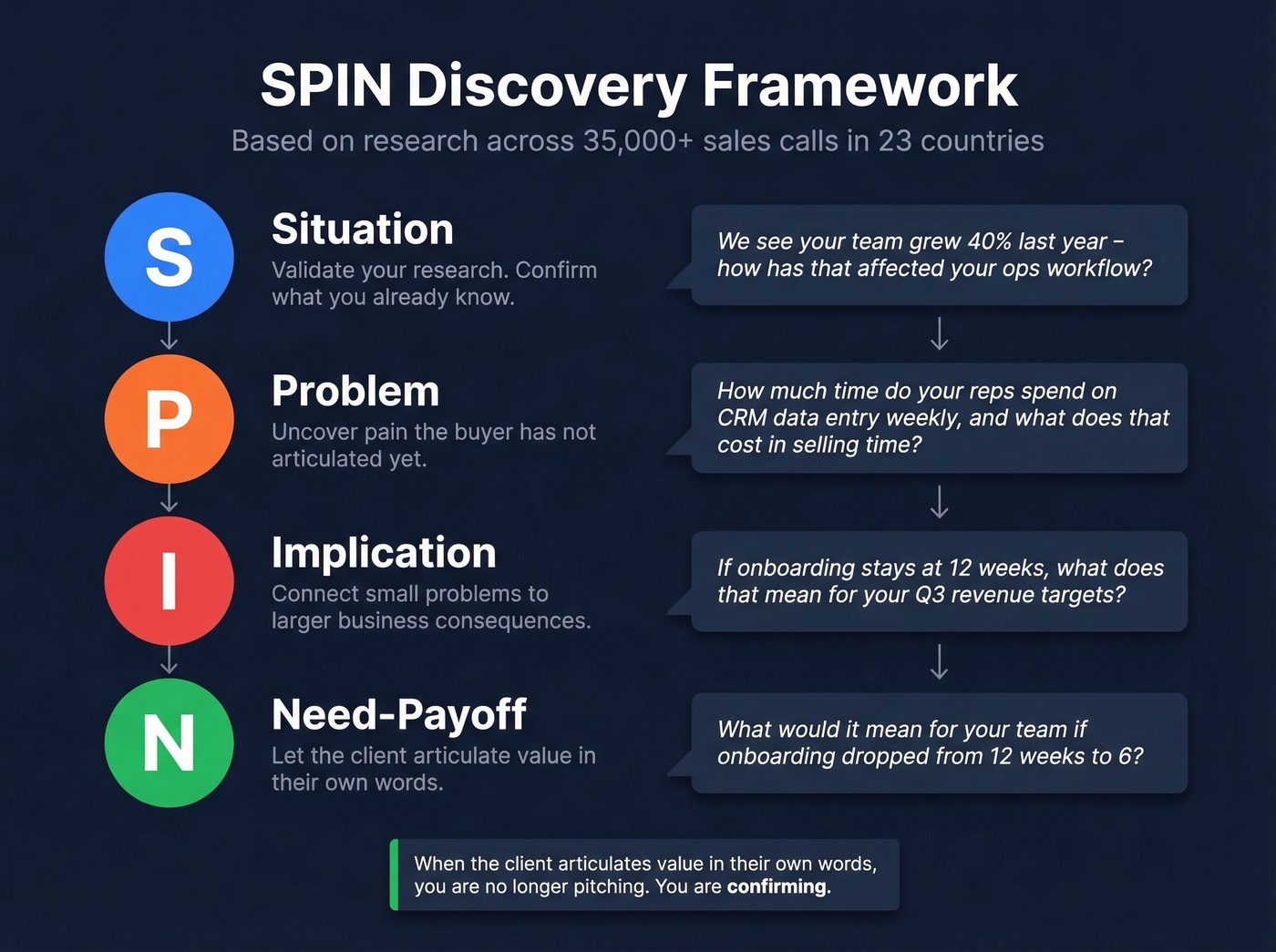
Situation questions validate your research. You should already know the basics before you walk in. Use these to confirm, never to start from scratch.
Problem questions uncover pain the buyer hasn't articulated. Skip "Is manually updating the CRM a problem?" and ask "How much time do your reps spend on CRM data entry weekly, and what does that cost in selling time?"
Implication questions connect small problems to larger consequences. Use these when the buyer acknowledges a problem but hasn't felt its full weight.
Need-payoff questions are where the pitch starts selling itself: "What would it mean for your team if onboarding dropped from 12 weeks to 6?" When the client articulates value in their own words, you're no longer pitching. You're confirming.
5 Mistakes That Kill Your Pitch
1. Scheduling the proposal too soon. Pitching after a 15-minute phone call is malpractice. Organizations lose an average of $725K per year to abandoned RFPs. Bad timing is expensive. (If you need a tighter structure for the call itself, use a Discovery Call Script PDF.)
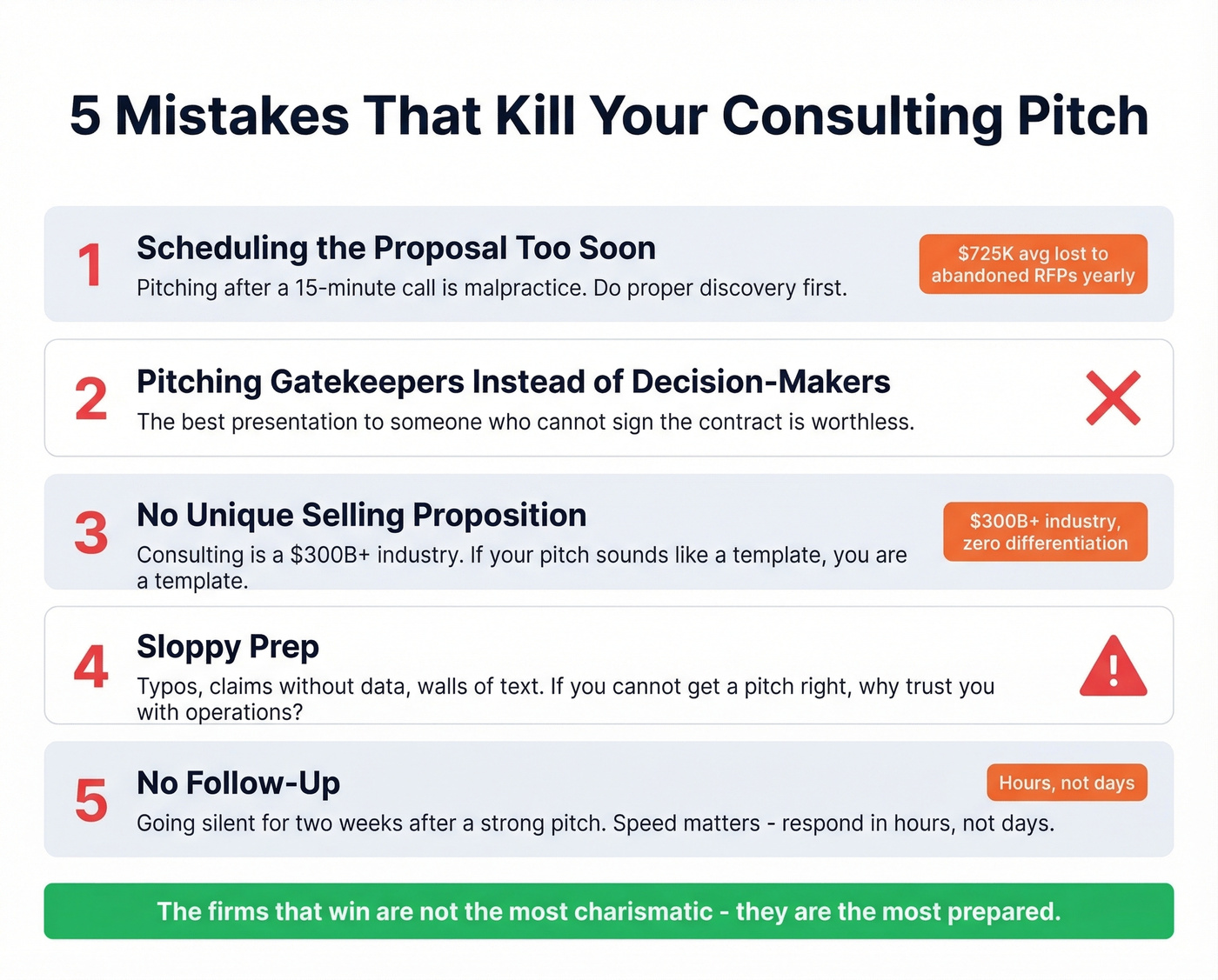
2. Pitching gatekeepers instead of decision-makers. You can deliver the best presentation of your career to someone who can't sign the contract, and it won't matter. Verify you're reaching the actual decision-maker before you walk in. (This is where account-based selling best practices help.)
3. No USP. Consulting is a $300B+ global industry. A Reddit user on r/Entrepreneur described the typical bad pitch: "I'm a Shopify expert, your store looks great but I noticed some opportunities..." That's not a pitch. That's a template. Pick a lane. (If you need positioning language, start with B2B brand positioning.)
4. Sloppy prep. Typos, claims without data, walls of text. If you can't get a pitch right, why would a client trust you with their operations? In our experience, the firms that win consistently aren't the most charismatic - they're the most prepared. (Build a repeatable system with data-driven selling.)
5. No follow-up. We've seen teams deliver strong pitches and then go silent for two weeks. Speed matters in B2B sales - responding within hours, not days, improves your odds dramatically. (Use these sales follow-up templates to stay consistent.)
Map the Buying Committee Before You Present
Let's be honest: most consultants walk into a pitch knowing one person's name. That's a problem when 5-11 stakeholders influence the decision. Before you present, map every person who'll weigh in - their title, their department, their likely objections. Prospeo's database covers 300M+ professionals with 98% email accuracy and 30+ filters for job title, seniority, department, and company size, so you can identify the full buying committee before you ever book the meeting. (If you're building a broader outbound motion, pair this with sales prospecting techniques.)

SPIN discovery requires knowing who you're talking to. Prospeo's database refreshes every 7 days - not every 6 weeks like competitors - so you're never pitching with stale org charts. Map 5-11 stakeholders, verify direct emails, and arm your champion with the right intel to sell you internally.
The firms that win aren't the most charismatic - they're the most prepared.
FAQ
How long should a consulting pitch deck be?
Aim for 10-12 slides covering problem, methodology, proof, pricing, and next steps. Cut anything that doesn't directly advance the client's buying decision - filler slides signal weak thinking.
What's a good consulting proposal win rate?
The average is 45%, and 4% of firms report win rates below 10%. Top performers hit 60%+. If you're below 35%, fix your pitch structure and stakeholder mapping before worrying about delivery.
How do I differentiate my consulting sales pitch?
Lead with a named methodology and industry-specific case studies instead of generic credentials. Your pitch lands when it demonstrates pattern recognition - showing the prospect you've solved their exact problem before, with measurable results to prove it.
How do I find the right person to pitch at a company?
Use a B2B data platform to identify decision-makers by title, department, and seniority, then verify their email before outreach. Skipping the gatekeeper and pitching the signer is half the battle.