

The Contact Rate Formula Every Sales Team Gets Wrong
Five hundred dials. Two meetings. Your SDR manager pulls up the dashboard, stares at the numbers, and asks the question nobody wants to answer: "Didn't contact rates used to be 15-20%?" They did. They aren't anymore. And if you're still plugging the same contact rate formula from 2019 into your pipeline capacity model, your forecast is fiction.
The Formula (Quick Version)
Contact Rate = (Live Conversations / Total Leads Contacted) x 100
A "live conversation" means a real human picked up and engaged. Voicemails, gatekeepers, IVR systems, and hang-ups don't count.
The 2026 benchmark range: 3-10% connect/answer rate for cold calls, roughly 1-5% reply rate for cold email. Three levers move this number: data quality, timing, and multi-touch warming. Everything else is noise.
What Is Contact Rate?
Contact rate measures how often your outreach results in a meaningful live conversation. It's not about whether a phone rang or an email landed in an inbox - it's about whether you actually talked to someone.
If you dial 200 leads in a week and have 14 real conversations, your rate is 7%. The key word is "real." A gatekeeper who says "he's not available" doesn't count. A voicemail doesn't count. A three-second hang-up doesn't count. This metric measures engagement quality, not just reachability, and it's the number most closely linked to meetings and revenue. You can have a decent connection rate and a terrible contact rate if most of your "connections" are voicemails and wrong numbers.
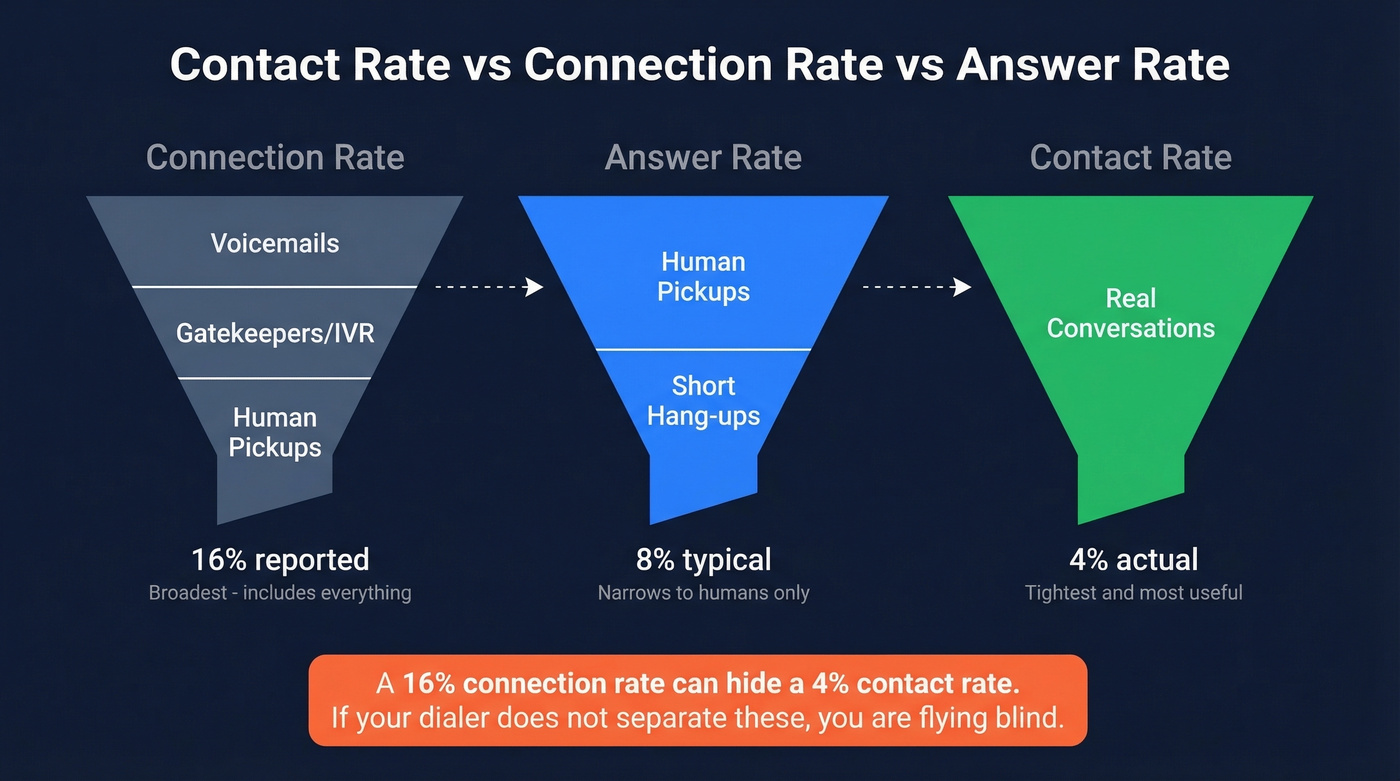
Contact Rate vs Connection Rate
These three metrics get used interchangeably, and that's a problem. They measure different things, and the gap between them can wreck your forecasting.
| Metric | What It Counts | Formula |
|---|---|---|
| Contact Rate | Live human conversations | Conversations / Leads x 100 |
| Connection Rate | Any answered call (VM, IVR, human) | Answered / Calls x 100 |
| Answer Rate | Human pickups only | Human Pickups / Calls x 100 |
Connection rate is the broadest - it includes voicemails, gatekeepers, and IVR systems. Answer rate narrows to human pickups but doesn't filter for conversation quality. Contact rate is the tightest and most useful: it only counts conversations where you actually spoke with your target.
Here's the thing. A team might report a 16% connection rate that sounds healthy, but when you strip out voicemails and gatekeepers, the actual live-conversation rate is 4%. If your dialer doesn't separate these dispositions - what Heartbeat.ai's framework calls proper disposition mapping - you're flying blind. We've seen teams celebrate "improving connect rates" while their pipeline stayed flat, because the extra connections were all voicemail boxes.
Calculating by Channel
Phone
Phone Contact Rate = (Live Conversations / Total Leads Dialed) x 100
The denominator is leads, not dials. If you call the same person three times and connect once, that's one conversation against one lead - not one out of three. A dataset of 204,000+ cold calls from Cognism shows it takes an average of 3 attempts to reach a prospect, with 93% of conversations happening by the third call and 98% by the fifth.
Email doesn't have a "contact rate" in the traditional sense, but reply rate serves as the closest analog:
Email Contact Rate (Reply Rate) = (Replies / Total Emails Delivered) x 100
Aggregated data from 14.3 billion cold email sends shows a clear funnel: ~42% open rate, ~3% reply rate, ~1% meetings booked, and ~7.5% bounce rate. Martal's platform-wide data puts the reply rate at 3.43% for 2025-2026.
One detail most teams miss: ~17% of cold emails never reach the inbox at all. If you're calculating reply rate against total sends instead of total delivered, you're understating your engagement rate and overstating your deliverability problem. (If bounces are spiking, start with email cleaning and a quick email bounce test.)
Blended Example
Say your team dials 150 leads and emails 300 in a week. You get 9 live phone conversations and 12 email replies. Your phone contact rate is 6%, your email contact rate is 4%, and your blended rate across 450 unique leads is 4.7%. Track them separately. The levers to improve each are different.

You just saw the math: data decay kills contact rates. Prospeo refreshes 300M+ profiles every 7 days - not every 6 weeks like competitors. With 98% email accuracy and 125M+ verified mobiles hitting a 30% pickup rate, your denominator finally works for you.
Stop dialing dead numbers. Start connecting with verified contacts.
2026 Benchmarks
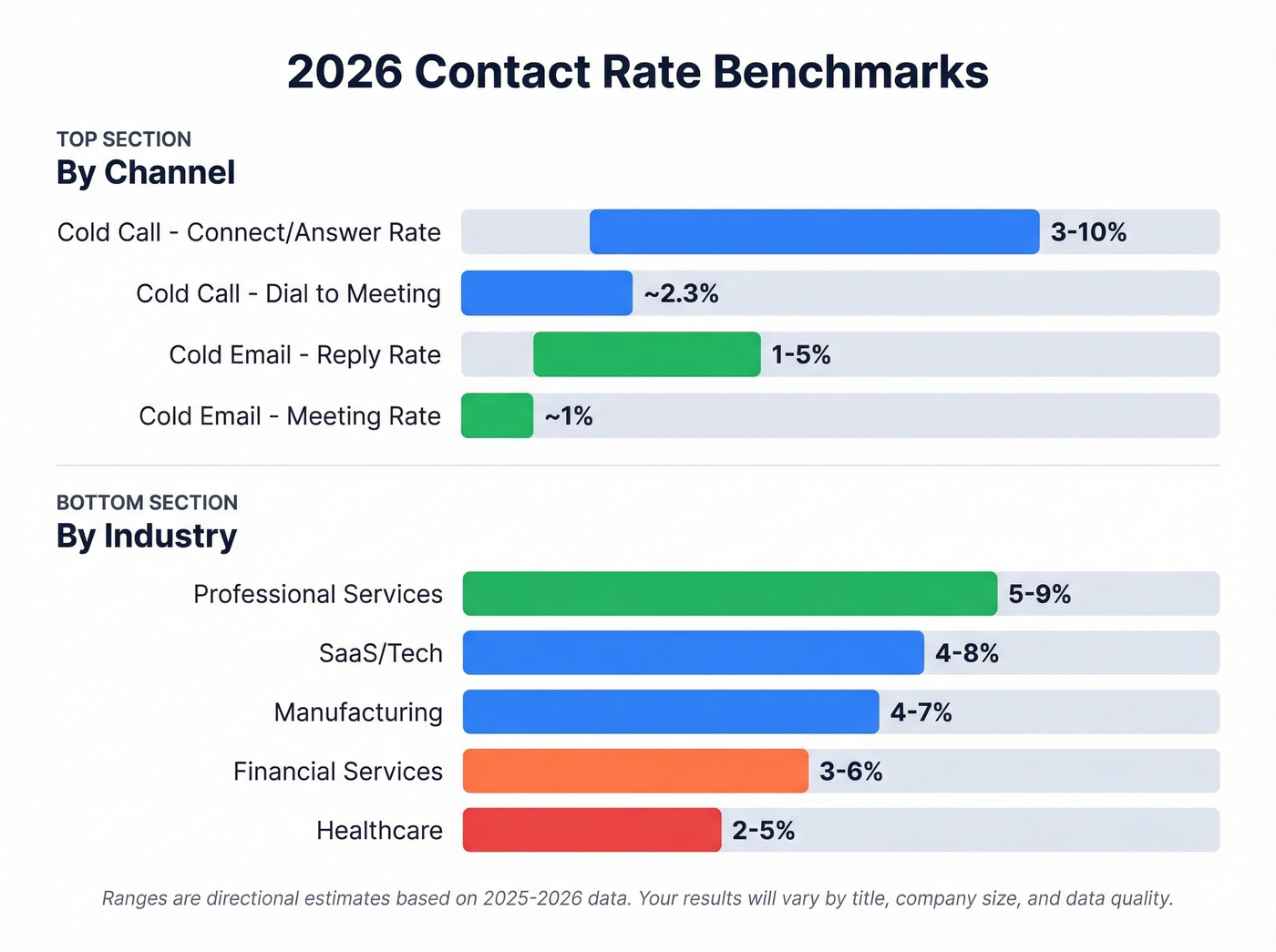
The old 15-20% benchmark is dead. Here's what the data actually shows:
| Channel | Metric | Range |
|---|---|---|
| Cold Call | Dial-to-Meeting (Success Rate) | ~2.3% |
| Cold Call | Connect/Answer Rate | 3-10% |
| Cold Email | Reply Rate | 1-5% |
| Cold Email | Meeting Rate | ~1% |
Regional splits from the 204K-call dataset are revealing: UK teams hit 8% success rate, Europe 6%, and the US 6%.
These numbers also shift by vertical. Based on practitioner reports and industry data, here are directional estimates:
| Industry | Estimated Contact Rate |
|---|---|
| SaaS / Tech | 4-8% |
| Financial Services | 3-6% |
| Healthcare | 2-5% |
| Professional Services | 5-9% |
| Manufacturing | 4-7% |
These are directional ranges, not gospel. Your mileage will vary by title, company size, and data quality.
On Reddit, the decline is visceral. A veteran cold caller with ~20 years of experience reported going from a consistent ~10% pickup rate to "1-2 pickups a week" on 40-50 daily dials. That's not a dip. That's a structural shift.
Why Contact Rates Are Declining
Three forces are compounding, and none of them are going away.
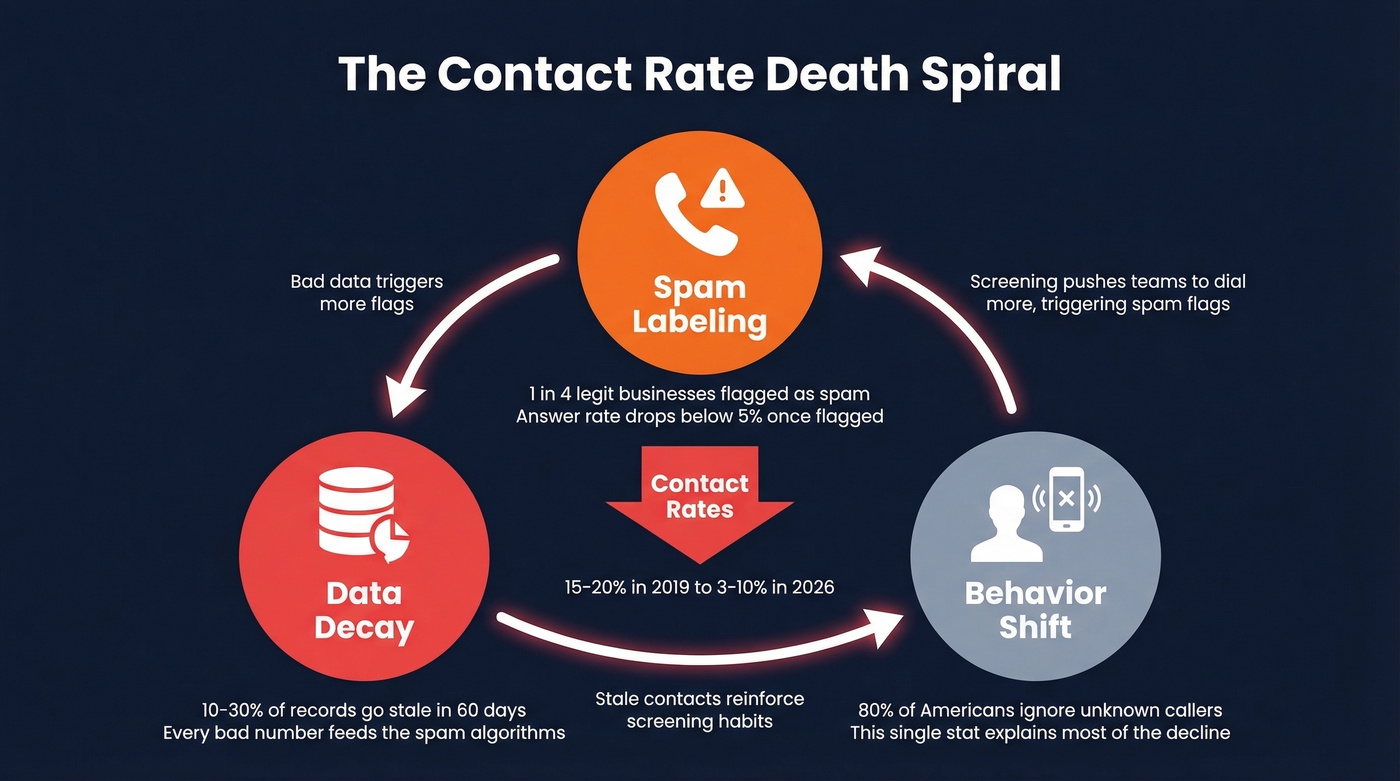
Spam labeling is the biggest culprit. One in four legitimate businesses are incorrectly labeled as spam by carrier algorithms. Once flagged, your answer rate drops below 5%. Numeracle processed 161,440+ spam label remediations in 2025 - a 44% increase year-over-year - and now protects over 1,032,800 phone numbers. Number rotation, the common "fix," often triggers more flags because carriers watch for high-volume, short-duration call patterns. (If this is hitting you, start with caller ID reputation.)
Data decay compounds the problem. People change jobs, get new numbers, switch companies. If your list is 60 days old, expect 10-30% of records to be stale. Every bad number you dial lowers your answer rate, which feeds the spam-labeling algorithms, which lowers your answer rate further. It's a death spiral. (This is also why calling lists need constant refresh.)
Behavior shift seals it. 80% of Americans don't answer calls from unknown numbers. That single stat explains most of the decline.
Let's be honest: everyone obsesses over dialing volume. The real metric is dials-per-connect. If your data is garbage, more dials just means more wasted hours. Fix the denominator before you scale the numerator.
How to Improve Your Contact Rate
Quick checklist, then the detail on each lever:
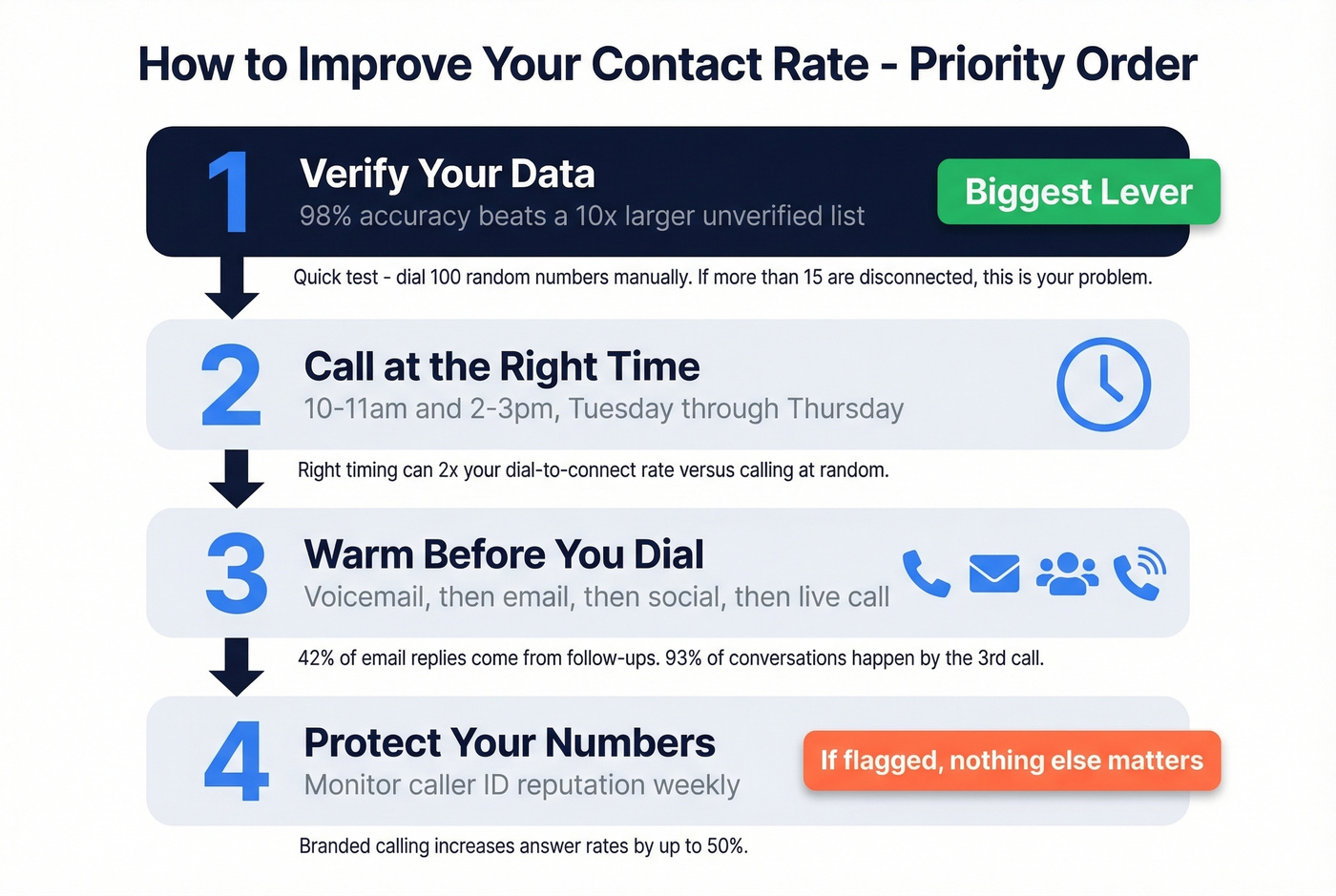
- Verify your data - 98% accuracy beats a 10x larger unverified list
- Call at the right time - 10-11am and 2-3pm, Tuesday through Thursday
- Warm before you dial - voicemail, email, social, then live call
- Protect your numbers - monitor caller ID reputation weekly
Data Quality
This is the single biggest lever, and the one most teams underinvest in. We've seen the pattern over and over: teams blame reps, scripts, and timing when the real problem is that 30% of their numbers are disconnected.
Prospeo's database covers 300M+ professional profiles with 125M+ verified mobiles that deliver a 30% pickup rate across all regions, refreshed on a 7-day cycle versus the 6-week industry average. Meritt tripled pipeline from $100K to $300K/week after switching, with bounce rates dropping from 35% to under 4%.
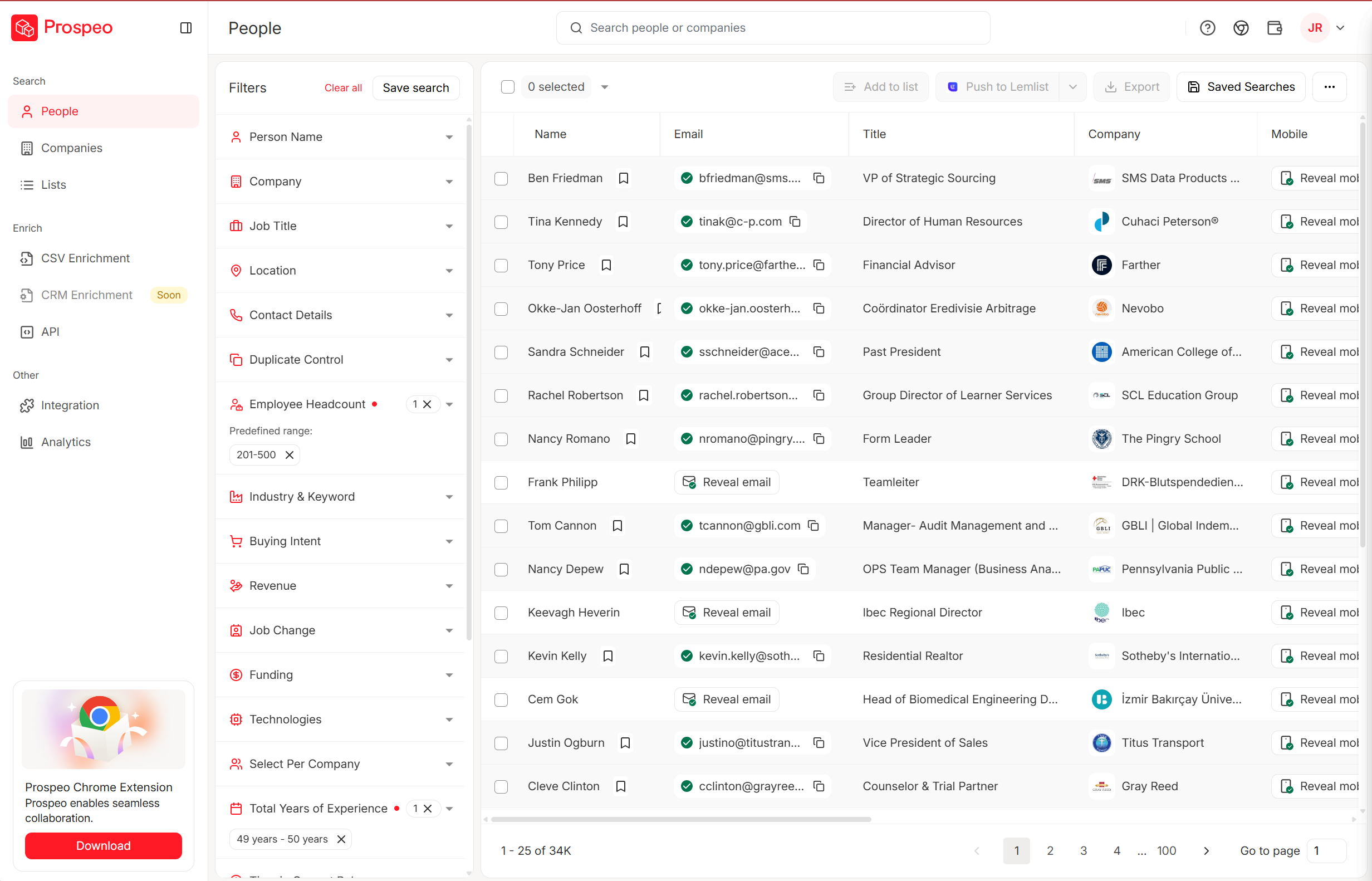
Skip this step if you're confident your data is fresh and verified. But in our experience, most teams who think their data is "fine" haven't audited it in months. Run a quick test: pull 100 random numbers from your list and dial them manually. If more than 15 are disconnected, you've found your problem.
Timing
The 204K-call dataset is clear: 10-11am and 2-3pm are the best windows. Tuesday is the best day for booking meetings. Friday is the worst for conversions but decent for relationship-building calls. These aren't marginal differences - calling at the right time can double your dial-to-connect rate versus calling at random. (For a deeper breakdown, see best time to cold call B2B.)
Multi-Touch Warming
Design your sequences assuming the first live call won't happen. A Reddit practitioner laid out the playbook: voicemail drop, then email, then social touch, then live dial. By the time you call, the prospect has seen your name two or three times. You're no longer a completely unknown number.
Follow-ups matter more than most reps realize. 42% of all email campaign replies come from follow-ups, yet 48% of reps never send a second message. And per Cognism's dataset, 93% of conversations happen by the 3rd call attempt. The reps who quit after one touch are leaving most of their pipeline on the table. (If your sequences are ad hoc, use a real cadence.)
Number Reputation
Monitor your caller ID reputation actively. If your numbers are flagged as spam, nothing else matters - your connect rate will sit below 5% regardless of data quality or timing. Branded calling increases answer rates by up to 50% versus unbranded calls. It's worth the investment.
The article makes it clear: more dials on bad data just accelerates the spam-label death spiral. Prospeo's 5-step verification and 7-day refresh cycle mean fewer bounces, fewer flags, and more live conversations - at $0.01 per email.
Fix the denominator before you scale the numerator.
How to Measure Correctly
Your data is lying to you if your dispositions aren't granular. Every call outcome should fall into one of these buckets:
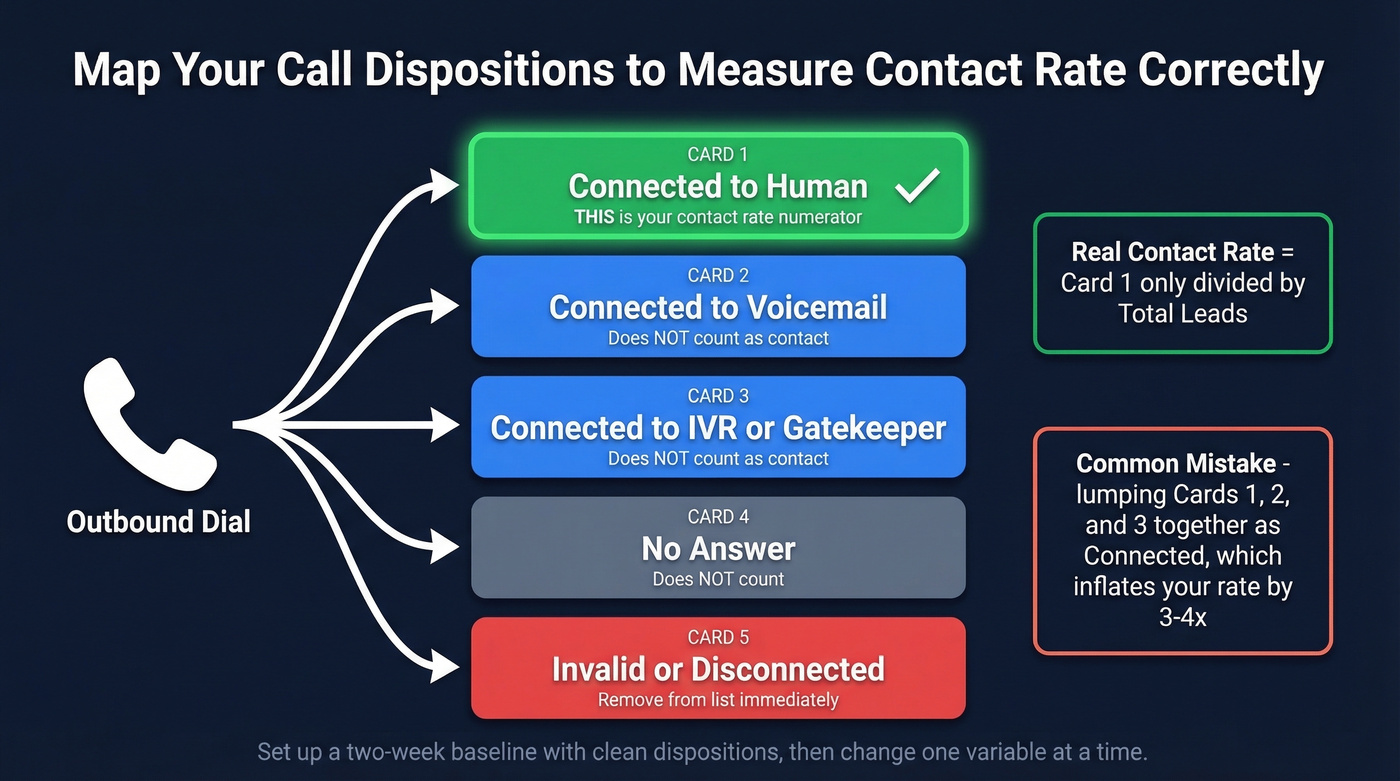
- Connected-to-human - this is your contact rate numerator
- Connected-to-voicemail
- Connected-to-IVR/gatekeeper
- No answer
- Invalid/disconnected
If your dialer lumps voicemails and human pickups into the same "connected" bucket, you can't calculate a real rate. Set up a two-week baseline with clean dispositions, then change one variable at a time - data source, call time, sequence structure - and measure the impact. Anything less is guessing. (If you need a clean setup, start with what is call disposition.)
Other Meanings of "Contact Rate"
If you landed here from a customer service search, the formula is different. Repeat contact rate measures how often customers reach out multiple times about the same issue:
Repeat Contact Rate = (Customers with Multiple Contacts / Total Unique Customers) x 100
SaaS companies typically see 8-15%, e-commerce runs 12-20%. Lower is better - a high repeat contact rate means you're not resolving issues on first touch.
And for the baseball fans who somehow ended up here: contact rate measures how often a batter makes contact when they swing. Different sport, same math.
FAQ
What is the contact rate formula?
Contact Rate = (Live Conversations / Total Leads Contacted) x 100. "Live conversations" means a real human picked up and engaged - voicemails, gatekeepers, and hang-ups are excluded from the numerator.
What's a good contact rate for cold calling in 2026?
For most B2B teams, a good rate falls in the 3-10% connect range, while dial-to-meeting averages around 2.3% based on a 204,000+ call dataset. Teams combining verified direct dials with optimized call timing consistently outperform those dialing stale lists at random hours.
How many calls does it take to reach a prospect?
Three attempts on average. 93% of conversations happen by the third call and 98% by the fifth. Most reps give up after one or two attempts - right before the payoff.
What's the difference between contact rate and connection rate?
Contact rate counts only live human conversations where the prospect engaged. Connection rate includes voicemails, gatekeepers, and IVR pickups. A team can have a 15% connection rate and a 4% contact rate - the gap destroys forecasts.
How does better data improve contact rates?
Verified direct dials eliminate wasted attempts on disconnected numbers. Fresher data means fewer dead numbers dragging down your metrics and triggering spam flags. When Meritt switched to verified contacts, their connect rate tripled to 20-25% and bounce rates dropped from 35% to under 4%.