

How to Build a Contact Sequence That Actually Books Meetings
If you send 5,000 emails a month and 2.8% bounce, that's 140 dead sends chipping away at your domain reputation before a single prospect reads your pitch. The sequence itself might be brilliant - but the data underneath it determines whether anyone actually sees it.
Here's what a contact sequence is, what the benchmarks look like in 2026, and how to build one that converts instead of burning your sender score.
The Quick Version
A contact sequence is a planned, multi-step outreach cadence across email, phone, and social. The sweet spot is 4-7 email touches, or 10-14 total touches when you layer in calls and social. The average reply rate at 3.43% sits at 3.43%; top performers push past 10%. The silent killer isn't bad copy - it's bad data. Verify every contact before loading them into any sequence.
What Is a Contact Sequence?
A contact sequence is a structured series of outreach steps - emails, calls, social touches, tasks - designed to move a specific prospect toward a conversation. It's a repeatable, multi-channel playbook that coordinates every touchpoint with a single buyer. Unlike marketing automation, sequences are sales-driven, prospect-level, and multi-channel. They stop when the prospect replies.
The terminology gets muddled fast, so here's the breakdown:
Sequence - sales-driven, multi-channel, tied to individual prospects. A rep enrolls a contact, and the sequence fires steps in order until the prospect replies or the sequence ends. Think Outreach, Apollo, Salesloft.
Drip campaign - marketing-driven, email-only, triggered by behavior like downloading a whitepaper or visiting a pricing page. Drips follow a preset path regardless of individual engagement. Think HubSpot workflows, Marketo.
Email campaign - a one-time broadcast to a segment. Newsletters, product announcements, event invitations. No sequential logic, no branching.
The distinction matters for your workflow: sequences demand clean, verified contact data at the individual level. You're not blasting a segment - you're coordinating engagement against a specific person. Bad data doesn't just lower your open rate; it actively damages your domain.
Benchmarks You Should Know
The numbers are lower than you'd hope. That's exactly why sequence design matters.
Platform-wide email averages:
| Metric | Average |
|---|---|
| Open rate | 27.2% |
| Reply rate | 2.9% |
| Bounce rate | 2.8% |
| Opt-out rate | 1.1% |
Instantly's 2026 benchmark report - analyzing billions of cold email interactions - puts the average reply rate at 3.43%, with elite performers exceeding 10%.
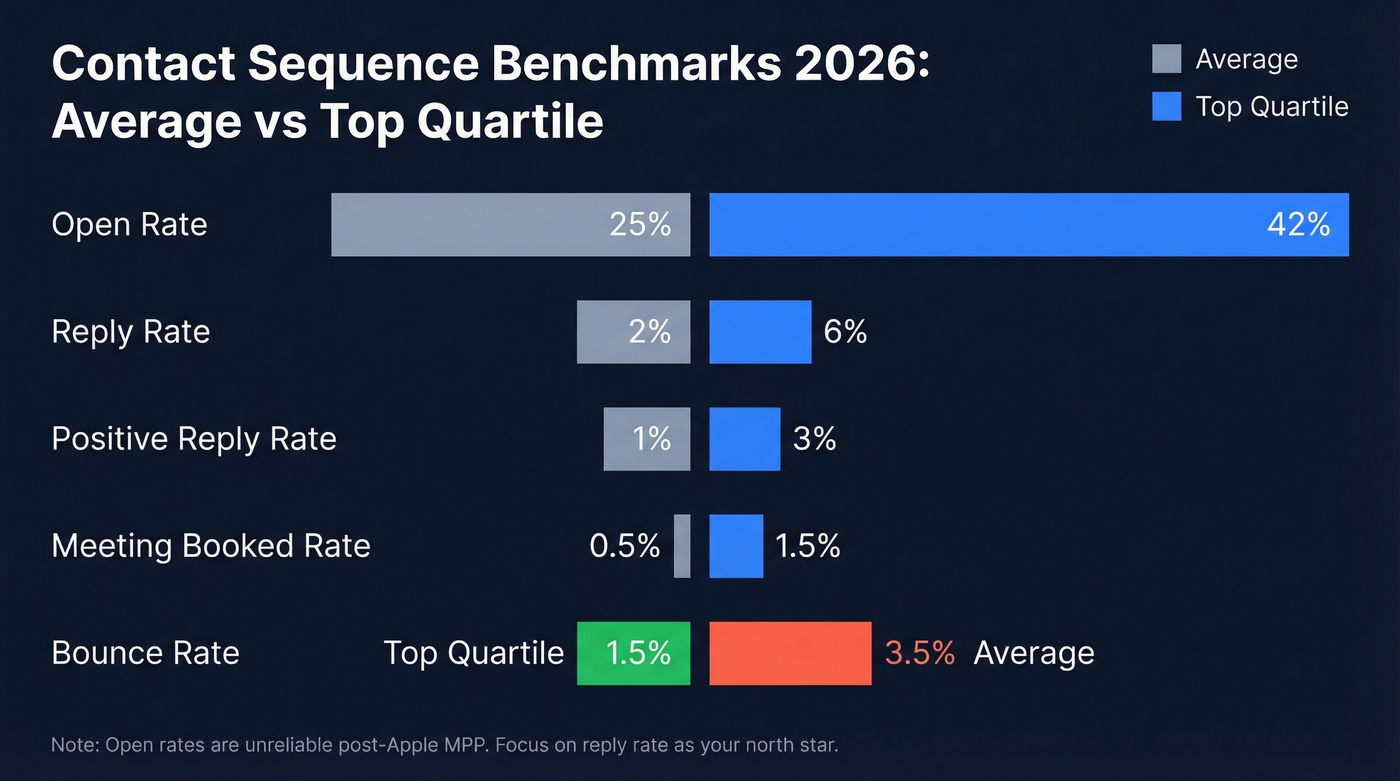
SaaS benchmark ranges (2026):
| Metric | Average | Top Quartile |
|---|---|---|
| Open rate | 20-30% | 35-50% |
| Reply rate | 1-3% | 4-8% |
| Positive reply | 0.5-1.5% | 2-4% |
| Meeting booked | 0.3-0.8% | 1-2% |
| Bounce rate | 2-5% | <2% |
A note on open rates: Post-Apple MPP, they're unreliable. Apple's Mail Privacy Protection pre-loads tracking pixels, inflating opens across the board. Prioritize reply rate and positive reply rate as your north-star metrics. If your open rate looks suspiciously good, it probably is.
Channel-specific benchmarks:
Most teams obsess over email metrics and ignore the rest of their multi-channel cadence. Here's what the other channels actually look like:
| Channel | Metric | Benchmark |
|---|---|---|
| Cold calling | Connect rate | 5.79% |
| Cold calling | Quality conversation rate | 24.22% |
| Cold calling | Meetings per SDR/week | ~11 |
| Connection acceptance | 16% | |
| Overall reply rate | 3.4% |
The cold calling data is the most underrated insight here: SDRs averaging ~11 meetings per week are doing it through disciplined call blocks, not email volume. If your team isn't hitting those numbers, the problem is usually call reluctance or bad phone data - not the channel itself.
Expected outcomes by sequence type:
| Sequence Type | Reply Rate | Meeting Rate |
|---|---|---|
| Cold outbound | 8-15% | 1-3% |
| Warm inbound | 20-30% | 8-12% |
| Customer expansion | 25-40% | 15-20% |
| Win-back/nurture | 10-18% | 2-5% |
If your cold outbound reply rate is below 8%, the problem is usually data quality or targeting - not your email copy. We've watched teams rewrite emails for weeks when the real issue was a big chunk of their list bouncing on send.
How Many Steps Do You Need?
The data is clear: 4-7 email touches is the sweet spot, and Outreach recommends a minimum of five steps for a successful sequence. Fewer than four and you're leaving replies on the table. More than seven shows diminishing returns unless each touch genuinely adds new value.
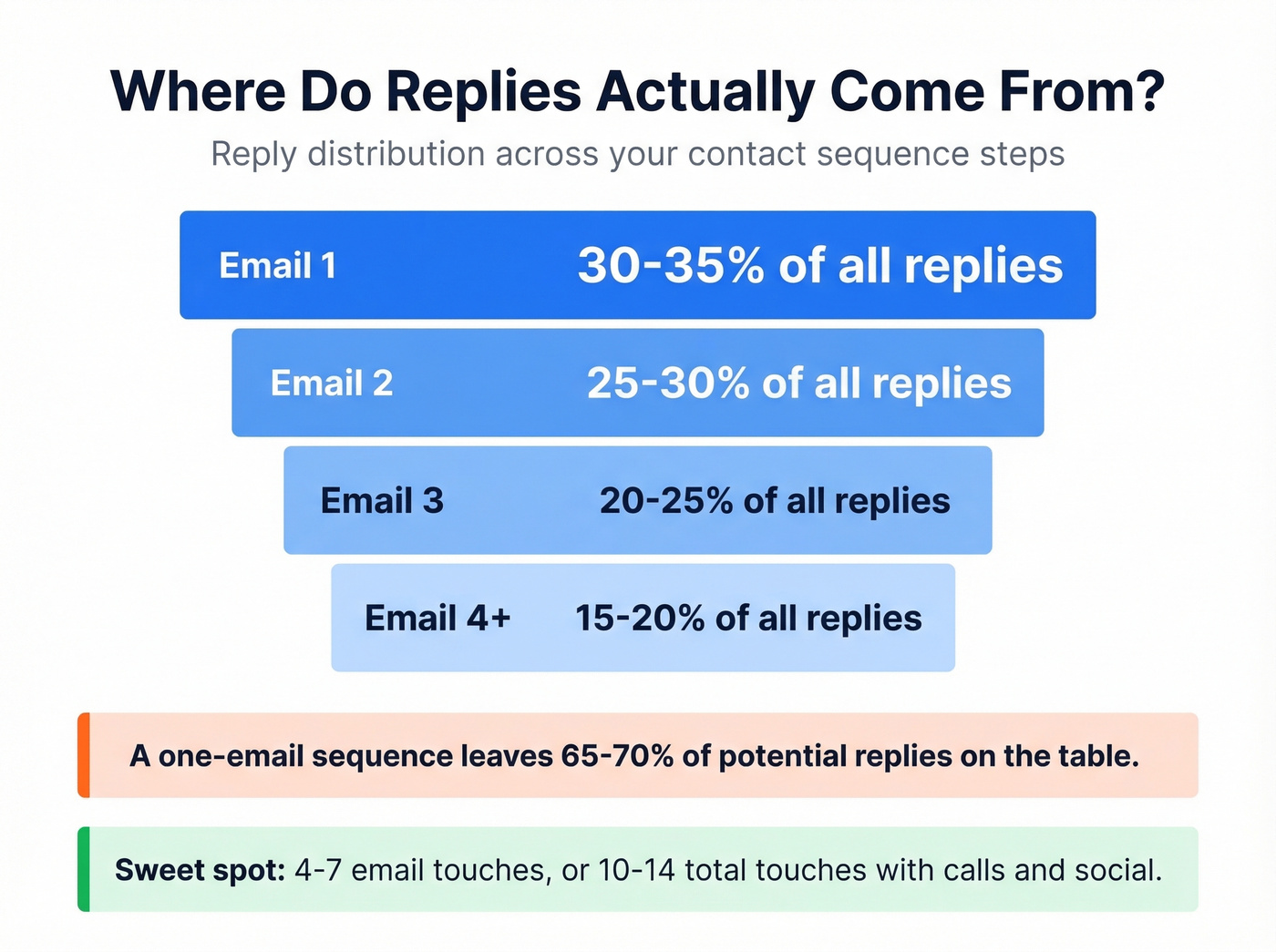
The replies-by-stage model breaks down like this:
- Email 1: 30-35% of total replies
- Email 2: 25-30%
- Email 3: 20-25%
- Email 4+: 15-20%
A one-email "sequence" leaves 65-70% of potential replies untouched. Instantly's data shows 58% of replies come from step 1 across all sequence types - the discrepancy reflects different methodologies, but the takeaway is the same: follow-ups matter enormously.
For high-value accounts, stretch to 10-14 total touches over 30 days when you layer in calls and social. Multi-channel sequences generate 2-3x more responses than email-only, and mixing email with social touches specifically improves positive reply rate by 15-25% versus email alone.
A useful heuristic: if your last step still pulls a >3% reply rate, the sequence isn't long enough. Add another step.
Here's the thing, though: before you add more steps, fix step 1. If your first email isn't pulling at least 30% of your total replies, adding a sixth follow-up won't save you.

Bad data is the silent killer of contact sequences. Prospeo's 300M+ profiles are verified on a 7-day refresh cycle - not the 6-week industry average - so your sequence hits real inboxes from step 1 through step 7.
Stop rewriting emails when the real problem is your data.
How to Build a Sales Outreach Sequence
Step 1: Build a verified contact list. This is where most sequences fail before they start. Pull verified contacts filtered by job title, industry, company size, tech stack, and buyer intent signals - companies actively researching topics related to your solution. Starting with 98% verified emails makes it much easier to keep your bounce rate under 2% from day one. Prospeo's database lets you filter across 30+ dimensions including intent data, then export directly to your sequencing tool.
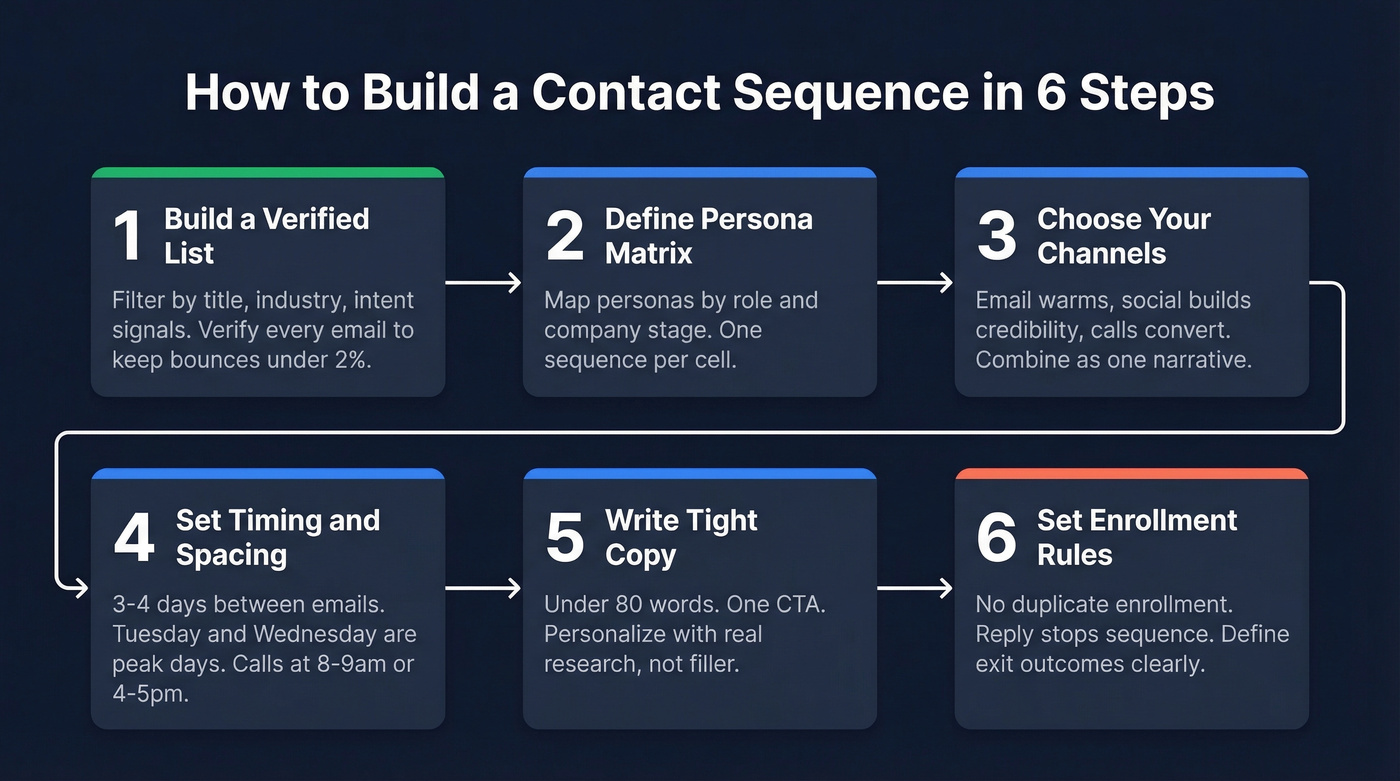
Step 2: Define your persona matrix. Map personas across columns and intensity across rows. A VP of Sales at a Series B company gets a different sequence than a Director of Marketing at an enterprise. Create a sequence for each cell in the matrix.
Step 3: Choose your channels. Email is the backbone, but phone and social multiply your results. Email warms, social builds credibility, calls convert. Don't treat them as separate plays - combine them as one narrative.
Step 4: Set timing and spacing. Space emails 3-4 days apart. Tuesday and Wednesday are peak days, with Wednesday pulling the highest reply rates. For calls, the best windows are 8-9am and 4-5pm local time.
Step 5: Write tight copy. Best-performing campaigns keep emails under 80 words. One CTA per email. Personalize the first line with something specific enough that the prospect knows you did actual research - a recent hire, a tech stack signal, a public initiative. Not "I saw your company is growing" filler. If you need a swipe file, start with these subject lines and follow-up templates.
Step 6: Set enrollment rules. Prevent duplicate enrollment across sequences. Configure reply-stops-sequence logic. Set bounce handling to automatically pause contacts. One operational detail teams miss: define your exit outcomes clearly - a contact should exit as "replied," "bounced," "opted out," or "sequence completed." Never left in limbo. Also decide on enrollment entry points upfront: will reps enroll manually, or will contacts flow in from a CRM trigger? (If you're rolling out a new platform, use a structured implementation plan.)
Review sequences monthly or quarterly. Do a complete overhaul every six months. They decay faster than most teams realize.
Templates That Work in 2026
The 4-Email Cold Sequence
Four touches over two weeks, each with a distinct purpose. This is the minimum viable outreach cadence.
- Email 1 (Day 1): Trigger + value prop. Reference something specific - a job posting, a funding round, a tech stack signal. End with a single, low-friction CTA.
- Email 2 (Day 3-4): Social proof. A customer result, a relevant case study, a metric that mirrors their situation.
- Email 3 (Day 7-8): Resource or offer. Share something useful - a benchmark report, a relevant template, a free audit.
- Email 4 (Day 14): Breakup. Professional, clear yes/no. "If this isn't a priority right now, no worries - just let me know and I'll close the loop."
Keep each email under 80 words. A/B test subject lines weekly.
The 14-Day Multi-Channel Sequence
This is where reply rates start climbing. Eight touches across three channels:
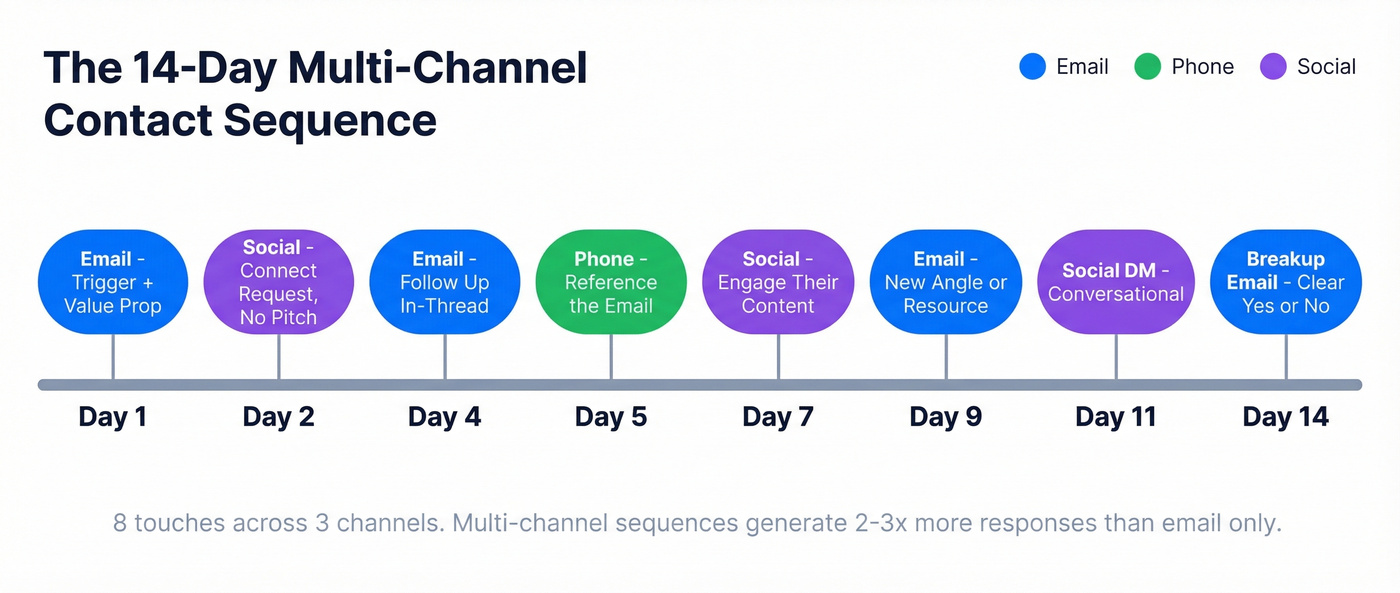
- Day 1: Email - trigger + value prop
- Day 2: Social connect request, no pitch
- Day 4: Email follow-up, reply in-thread
- Day 5: Phone call referencing the email
- Day 7: Social engagement on their content, no pitch
- Day 9: Email with a new angle or resource
- Day 11: Social DM, conversational
- Day 14: Breakup email, clear yes/no
Two things that surprise people: blank connection requests often outperform personalized notes, and the first social touch should never be a pitch. Build familiarity before you sell.
The 30-Day Account Sequence
For strategic accounts, 10-14 touches over 30 days following the 30MPC framework: sell one thing at a time.
- Days 1-3: Theme 1 - core problem. Email Day 1, call Day 2, social engage Day 3.
- Days 7-10: Theme 1 follow-up. Email Day 7, call Day 8, email Day 10 with new proof point.
- Days 14-17: Theme 2 - new angle. Fresh subject line, new thread. Email Day 14, call Day 15, email Day 17.
- Days 21-24: Theme 2 follow-up. Email Day 21, social DM Day 23.
- Days 28-30: Breakup. Email Day 28, final call Day 30.
When you switch themes, change your subject line - don't reply in the same thread. Phase out social touches by theme 2 and calls by the breakup phase. The breakup email should give a clear reason to respond, not a passive-aggressive "guess you're not interested."
Mistakes That Kill Your Sequence
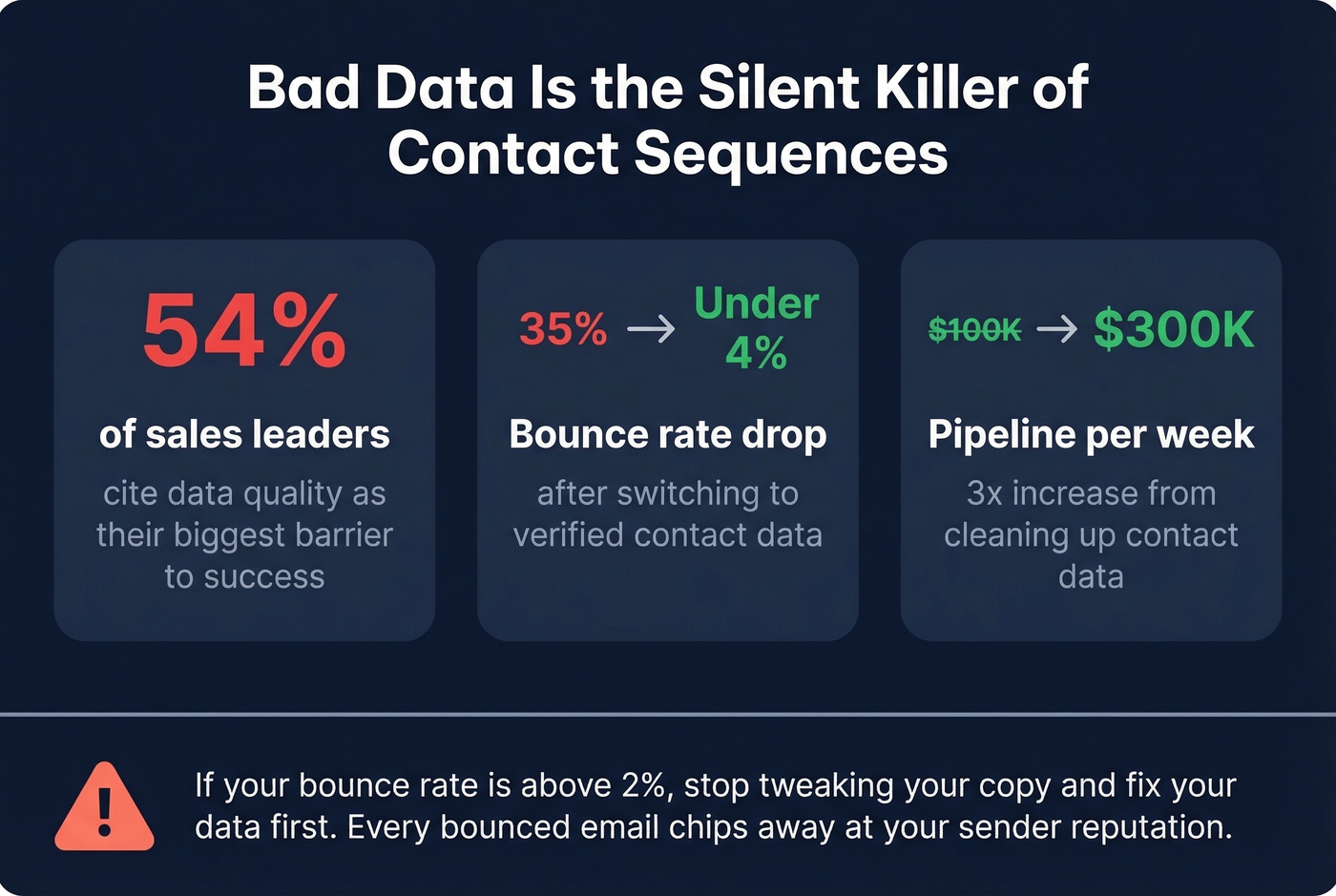
1. Sending to unverified contacts. 54% of sales leaders cite data quality as their biggest barrier to success. Verify every email before enrollment. Meritt's bounce rate dropped from 35% to under 4% after switching to verified data - and their pipeline tripled from $100K to $300K per week. If you're troubleshooting deliverability, start with bounce mechanics and thresholds in this email bounce rate guide.
2. Running email-only sequences. Multi-channel gets 2-3x more responses. Add calls and social to break through.
3. Too many CTAs. Every email needs exactly one clear ask. "Would a 15-minute call next Tuesday work?" beats "Check out our blog, watch this webinar, and let me know if you want a demo." For examples, use these email call to action rules.
4. Generic copy. Segmented campaigns get 75% more clicks than non-segmented ones. Reference a prospect's specific tech stack, a recent hire, or a public initiative.
5. Skipping domain warm-up. New sending domains need 4-6 weeks of warm-up. Keep volume under 50 emails per day per domain until your reputation is established. Use a dedicated email deliverability checklist and track safe email velocity as you ramp.
6. Editing live sequences. Don't modify a sequence while prospects are moving through it. Clone it, archive the old one, and enroll new contacts in the updated version.
7. Ignoring bounce rate. If your bounce rate exceeds 10%, you've got a domain reputation issue, not just a data problem. Keep bounces under 2%.
8. No A/B testing. Test subject lines, CTAs, email length, and send times weekly. The teams hitting 10%+ reply rates aren't lucky - they're iterating constantly.
Let's be honest: most teams spend 80% of their optimization time on email copy and 20% on data quality. Flip that ratio. In our experience running outbound for dozens of B2B teams, clean data with mediocre copy outperforms brilliant copy sent to a dirty list every single time. If your average deal size is modest, skip the 14-step sequence - you need a 4-email sequence with 98% deliverability.
Step 1 of every high-converting sequence is a verified list. Prospeo gives you 30+ filters - buyer intent, tech stack, headcount growth, funding - plus 98% email accuracy at $0.01/lead. Export directly to Outreach, Instantly, or Salesloft.
Build the list that makes your sequence actually work.
Best Tools for Sequencing
The sequencing tool matters less than the data feeding it. Here's what's worth your time in 2026:
| Tool | Best For | Starting Price | Key Feature |
|---|---|---|---|
| Prospeo | Verified contact data | Free; ~$0.01/email | 98% accuracy, 7-day refresh |
| Apollo | All-in-one prospecting | Free; ~$49-99/mo per user | Database + sequencer |
| Instantly | Scaling cold email | ~$30-97/mo | High-volume sending with multiple inboxes |
| Outreach | Enterprise, 10+ SDRs | ~$100-200/user/mo | Governance, reporting |
| Salesloft | Enterprise teams | ~$100-200/user/mo | Revenue workflow engine |
| HubSpot Sequences | HubSpot CRM users | ~$90+/seat/mo (Sales Hub) | Native CRM integration |
| Lemlist | Personalization-heavy | ~$39-99/mo | Image/video personalization |
| Smartlead | Agency-scale outreach | ~$39-94/mo | Multi-inbox sending at scale |

Apollo is the best all-in-one option if you want database and sequencer in a single platform. For pure cold email volume, Instantly is hard to beat for the price. If you've got fewer than 10 SDRs, Outreach and Salesloft are overkill - powerful governance, but you're paying enterprise prices for features you won't use yet.
HubSpot users frequently run into workflow headaches managing contacts across multiple sequences, so plan your enrollment rules carefully if you go that route. The consensus on r/sales is that most teams are better off pairing a dedicated data provider with a purpose-built sequencer rather than relying on an all-in-one to do both well. If you're evaluating your stack, compare broader SDR tools and contact management software before you commit.
One thing we've noticed: teams that separate their data layer from their sequencing layer tend to iterate faster, because they can swap tools without rebuilding their entire contact pipeline.
FAQ
What is a contact sequence?
A contact sequence is a structured, multi-step outreach cadence - emails, calls, social touches - designed to move a prospect toward a conversation. It's sales-driven, tied to individual contacts, and stops when the prospect replies. In a CRM or sales engagement platform, it refers to this same coordinated series of touchpoints.
How is a sequence different from a drip campaign?
A sequence is sales-driven, multi-channel, and stops when the prospect replies. A drip campaign is marketing-driven, email-only, and follows a preset path regardless of engagement. Sequences target individual buyers; drips target segments.
How many emails should a cold sequence have?
Four to seven emails based on platform-scale data from Instantly's 2026 benchmark report. Fewer than four leaves 65-70% of potential replies untouched; more than seven hits diminishing returns unless each step introduces a genuinely new angle.
What tools help with contact verification before sequencing?
Prospeo verifies emails in real time at 98% accuracy with a 7-day data refresh cycle, making it a strong option for pre-sequence verification. Apollo and Instantly also include basic verification, but teams running high-volume outbound often layer in a dedicated verification tool to keep bounce rates under 2%.
What's a good reply rate for cold outbound?
The average cold email reply rate is 3.43%. Top performers exceed 10%. For a well-built cold outbound sequence, 8% is a solid baseline, and 12%+ is worth optimizing toward.