

CRM Deduplication: Costs, Fixes, and Prevention
You pull up the pipeline report on Monday morning and the same company appears four times - each with a different owner, a different deal stage, and a different forecast number. Your pipeline is inflated by 20%, your reps are stepping on each other, and your VP of Sales is making decisions based on fiction. Those duplicate CRM records are silently wrecking your forecasting, and CRM deduplication is the only way to stop the bleeding.
The old SiriusDecisions rule still holds: it costs $1 to verify a record at entry, $10 to cleanse it later, and $100 if you do nothing. Most teams are paying the $100.
What You Need (Quick Version)
- Under 500 duplicates? Use your CRM's native merge tools. Tedious, but included in your plan.
- 500-10,000+ duplicates? Get a dedicated tool. Dedupely for HubSpot, Cloudingo for Salesforce.
- Want to stop duplicates from coming back? Verify data before it enters your CRM. Prospeo catches invalid and duplicate emails at ~$0.01/email - orders of magnitude cheaper than cleaning up after the fact.
What Duplicate Records Actually Cost
Take a CRM with 50,000 contacts and a 10% duplicate rate - conservative, since rates of 10-30% are common without active governance. That's 5,000 duplicate records. At $96 per duplicate to investigate, merge, and fix downstream data, you're looking at $480,000 in cleanup costs.
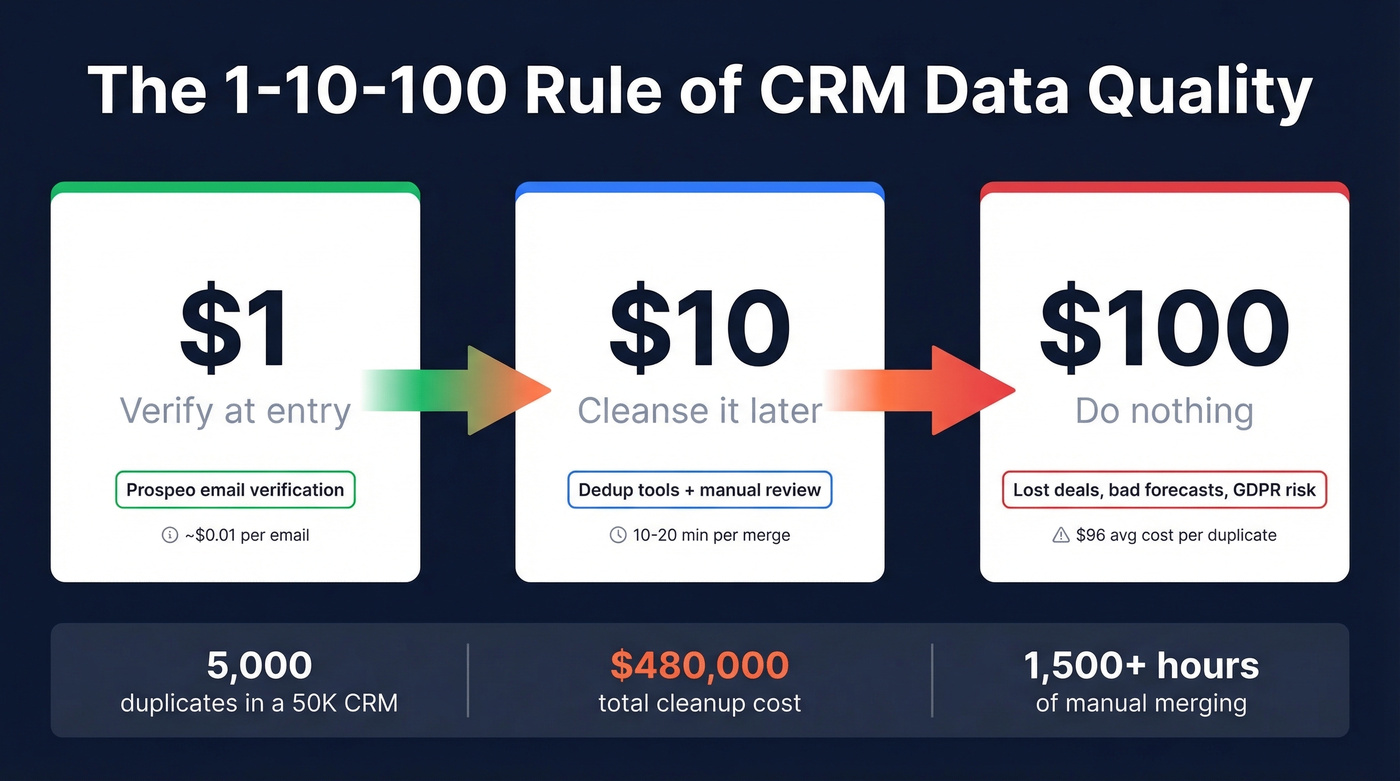
Salesforce limits merges to 3 records at a time, and each merge takes 10-20 minutes when you account for field comparison, master record selection, and activity reassignment. Ten thousand duplicates equals 1,500+ hours of manual work - nearly a full-time headcount for a year, doing nothing but merging records. Sales reps waste roughly 550 hours per year per rep dealing with inaccurate data, and duplicates are a major contributor.
Poor data quality costs U.S. businesses $3.1 trillion annually. The average organization loses $13 million per year. Duplicates aren't the only contributor, but they're the one your sales team complains about every Monday. And here's a risk most teams overlook: if a contact opts out on one record but your reps are working the duplicate, you can violate GDPR. (If you need a broader framework, start with a CRM data audit and a CRM data governance owner.)
Quick benchmark: Under 2% duplicates? You're in good shape. 5-10%? Time to act. Over 25%? Your reports are unreliable.
Why Duplicates Keep Coming Back
Here's a workflow we see constantly: a rep finds a prospect on professional profiles, enriches them through Apollo, and pushes the contact into HubSpot. Another rep does the same thing a week later with a slightly different email or job title. Now you've got two contacts, two companies, and two deals - all for the same person.
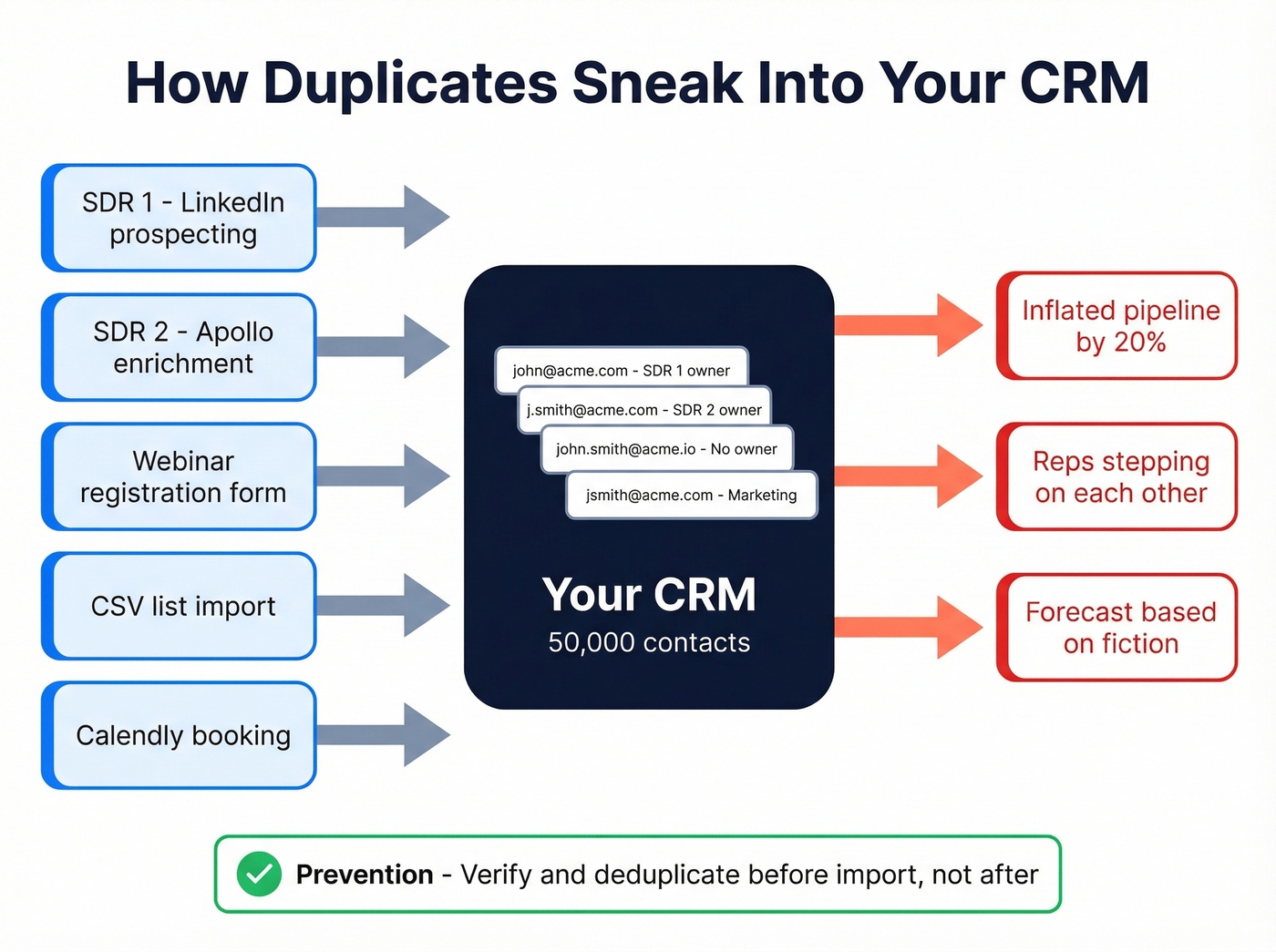
Multiply that across a 10-person SDR team running daily imports, and you've got a duplicate factory. List imports, form submissions, webinar registrations, Calendly bookings, CRM-to-CRM migrations - every integration point is a potential duplicate source. Without active dedup rules, duplicate rates between 10-30% are the norm. The problem compounds with every new data source you connect. (This is also why CRM data entry standards matter more than most teams think.)

Every duplicate starts with bad data entering your CRM. Prospeo's 5-step email verification catches invalid and duplicate contacts before import - at 98% accuracy and ~$0.01/email. That's $1 to prevent what costs $100 to fix later.
Clean your pipeline at the source, not after the damage is done.
Best Dedup Tools in 2026
HubSpot
Among HubSpot users, the picks are pretty consistent.
Dedupely is the popular choice: strong matching logic, updated UI, and pricing that starts at $19/mo for up to 30,000 records. All plans include unlimited users and unlimited deduplication. It's one of the fastest ways to deduplicate contacts in bulk.
Insycle is the power tool. It runs $1.25/1,000 records on the Starter plan, which works out to roughly $63/mo for a 50K-record database, supports multiple modules beyond dedup, and holds SOC 2 Type II certification. The tradeoff is a steeper learning curve - we've found it takes most RevOps teams a week or two to feel comfortable with the rule builder, but the flexibility pays off for complex databases with messy field structures.
For teams that want more control while staying inside the HubSpot UI, Koalify is a common pick with mid-market pricing similar to Insycle based on record volume.
One CRM admin on Reddit summed up the sentiment well: they're "not a huge fan of any of [HubSpot's] add-ons" for data quality. That tracks with our experience too.
Salesforce
Cloudingo is the workhorse. Cloudingo charges $2,500/year for Standard, $6,000/year for Professional, which adds undo and restore - worth it for bulk operations. Priced per Salesforce org, not per user, with a $100/100K records overage above 300,000 records.
DataGroomr is the budget pick at $199/year for Micro, carrying a 4.8/5 on G2 with users praising its ability to catch duplicates Salesforce misses. If you're a small team that doesn't need enterprise-grade merge automation, start here.
No Duplicates starts from $240/year and offers 24+ auto-merge strategies with fuzzy matching algorithms like Jaro-Winkler and Levenshtein.
Compliance-Sensitive Teams
WinPure offers on-premises deduplication for teams that can't send data to external APIs - common in healthcare, finance, and government. Pricing starts around $2,000/year for small teams.
Architecture matters here: native Salesforce apps keep data inside your org, while API-based tools move data externally. If your compliance team has opinions about data residency, ask before you buy.
Master Record Selection
Finding duplicates is the easy part. Resolving them is where things get complicated.
When two records for the same person have different phone numbers, different deal owners, and different activity histories, you need field-level survivorship rules - keep the most recent phone number, the earliest creation date, the owner with the open deal. Dedupely, Insycle, and Cloudingo all support survivorship-style merge rules. Skip any tool that doesn't offer this. Without it, you'll spend more time on manual field comparison than you saved on detection.
Pricing Comparison
| Tool | CRM | Starting Price | Model | Best For |
|---|---|---|---|---|
| Dedupely | HubSpot/Salesforce/Pipedrive | $19/mo | Per record count | Simple HubSpot dedup |
| Insycle | HubSpot/Salesforce | ~$63/mo (50K records) | Per 1K records | HubSpot power users |
| Koalify | HubSpot | ~$50-80/mo (est.) | Custom | HubSpot-native workflow |
| Cloudingo | Salesforce | $2,500/yr | Per org | Mid-market Salesforce teams |
| DataGroomr | Salesforce | $199/yr | Tiered annual | Budget Salesforce teams |
| No Duplicates | Salesforce | $240/yr | Tiered annual | Auto-merge heavy workflows |
| WinPure | Any / On-prem | ~$2,000/yr | Per org | Compliance-first teams |
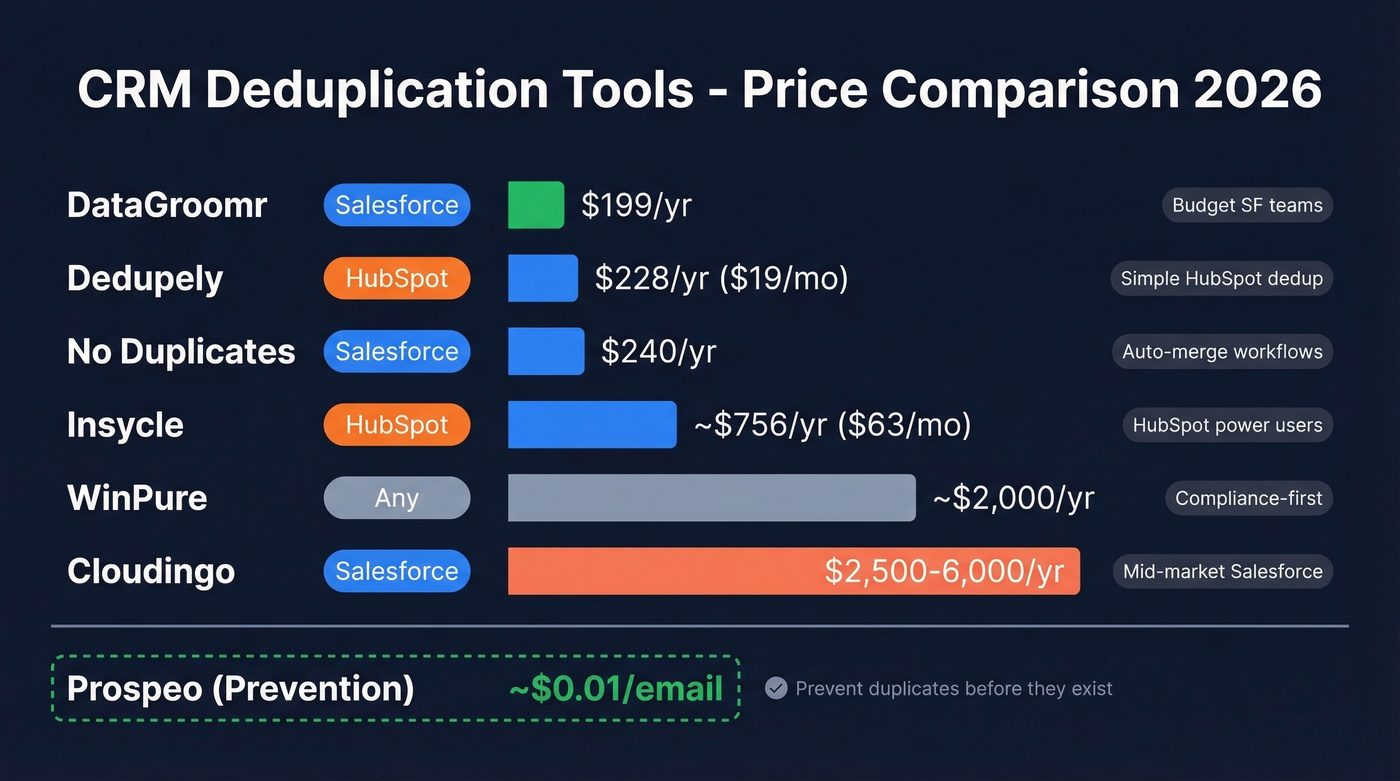
Cloudingo charges $100 per 100K records above 300K. Insycle offers a 20% discount on annual billing.
Why Native CRM Tools Fall Short
Use native tools if you've got a small database, simple duplicates on exact email matches, and time to merge manually.
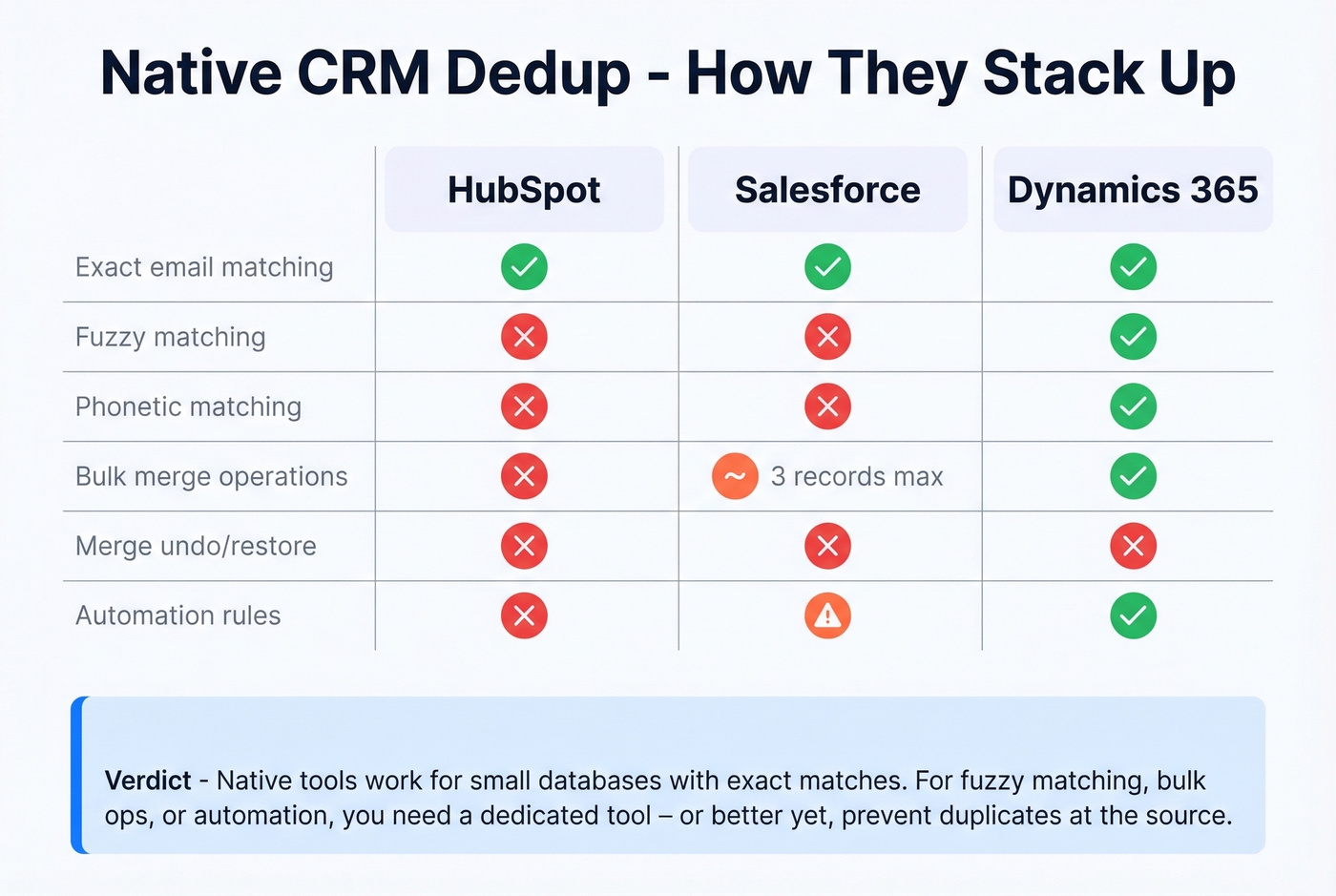
Skip native tools if you need fuzzy matching, bulk operations, or automation. HubSpot's built-in dedup is improving but still lags behind third-party tools. Salesforce's 3-record merge limit makes bulk cleanup impractical - trying to merge contacts one by one is a recipe for burnout. (If you're specifically on Salesforce, this pairs well with a dedicated Salesforce deduplication workflow and ongoing Salesforce data cleansing.)
Dynamics 365 is the most capable natively. It supports exact match, fuzzy match, and phonetic matching, but test rules in a sandbox before running bulk merges on production data.
Here's the thing: most teams with deal sizes under $15K don't need a dedicated dedup tool at all. They need to stop creating duplicates. A $99/mo subscription treating a problem you could prevent for a penny per record is the RevOps equivalent of buying a mop instead of fixing the leak. (This is a classic CRM limitations problem: the tool can't save bad inputs.)
How to Prevent Duplicates at the Source
Quarterly manual cleanups are treating symptoms. The disease is bad data entering your CRM in the first place. (If you want a checklist, start with CRM data hygiene best practices.)
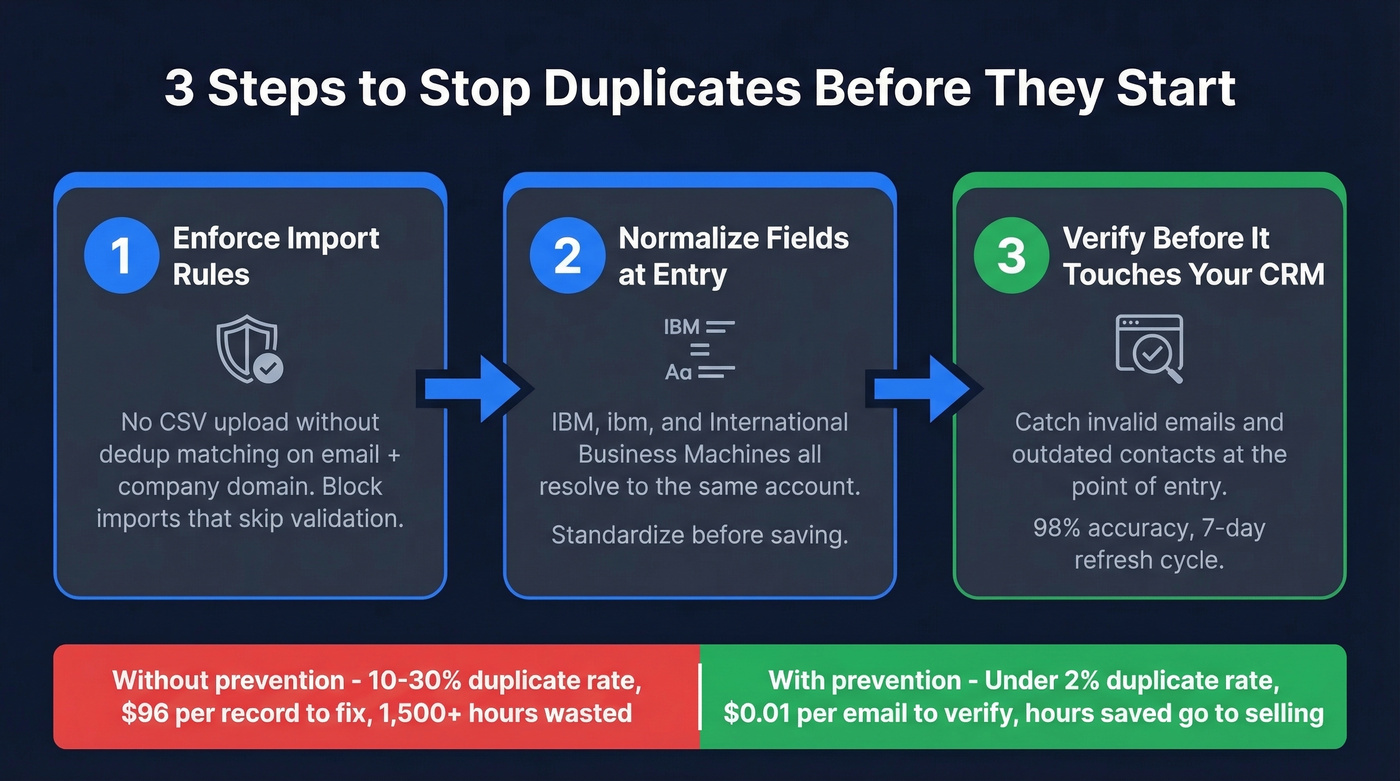
Real prevention means three things. First, enforce import rules - no CSV upload without dedup matching on email plus company domain. Second, normalize fields at entry so "IBM," "ibm," and "International Business Machines" resolve to the same account. Third, verify contact data before it ever touches your CRM.
That third piece is where most teams have a gap. We've seen 10-person SDR teams generate thousands of duplicates in a single quarter simply because nobody verified data at the point of entry. Prospeo verifies emails at 98% accuracy with a 7-day refresh cycle, catching invalid addresses and outdated contacts before they create duplicates downstream. At ~$0.01/email, verification costs a penny per record - compared to the $10-$100 you'll spend cleaning up later. It also features automatic duplicate removal across searches, so the same contact won't enter your pipeline twice from separate prospecting sessions. (If you're evaluating options, compare advanced email verifiers and the broader set of email lookup tools.)

Your SDRs enriching the same prospect from different sources is a duplicate factory. Prospeo's CRM enrichment returns 50+ data points per contact at a 92% match rate - with automatic deduplication built into every search and export.
Stop merging records. Start preventing them at $0.01 per email.
FAQ
How often should I run deduplication?
Weekly automated scans for high-volume CRMs handling 10K+ new records per month. Monthly manual reviews for smaller databases. The key is catching duplicates within 24 hours - the longer they sit, the more they corrupt reports and territory assignments.
Can I undo a bad merge?
Cloudingo Professional includes undo and restore. Most native CRM merges have no true undo - always export a full backup before bulk operations. Insycle also supports pre-merge snapshots on paid plans.
What's the cheapest way to fix duplicate contacts?
Verify contact data before import. At ~$0.01/email, pre-import verification is orders of magnitude cheaper than deduplicating after the fact. Pair it with enforced import rules and field normalization. If you already have thousands of duplicates, start with Dedupely at $19/mo or DataGroomr at $199/yr to clear the backlog, then shift budget toward prevention.
Which tool works across multiple CRMs?
Dedupely supports HubSpot, Salesforce, and Pipedrive from a single account - the most cross-platform option at its price point. Insycle covers HubSpot and Salesforce. For anything beyond those, WinPure handles any database via on-premises deployment, starting around $2,000/year.