

CRM Funnel Stages: What to Configure, What to Expect, and What Breaks Your Forecast
Fewer than 20% of sales leaders rate their forecast accuracy as "predictable." That's not a data problem or a market problem - it's a stage problem. Misconfigured CRM funnel stages are the root cause. Your VP of Sales is staring at a pipeline report right now, and the numbers are lying to her because the funnel underneath was never set up properly.
The Short Version
- Use 5-7 stages. Lead, MQL, SQL, Opportunity, Proposal, Negotiation, Closed Won/Lost.
- Define exit criteria for every stage - not just names. A stage without a verifiable exit action is a stage reps interpret differently, and that kills your forecast.
- Your funnel metrics are only as good as your CRM data. If 30% of your contact records have bounced emails, your conversion rates are fiction.
CRM Funnel vs. Pipeline
A funnel tracks the buyer's journey and where volume drops off. A pipeline tracks the seller's deals, their value, and their velocity.
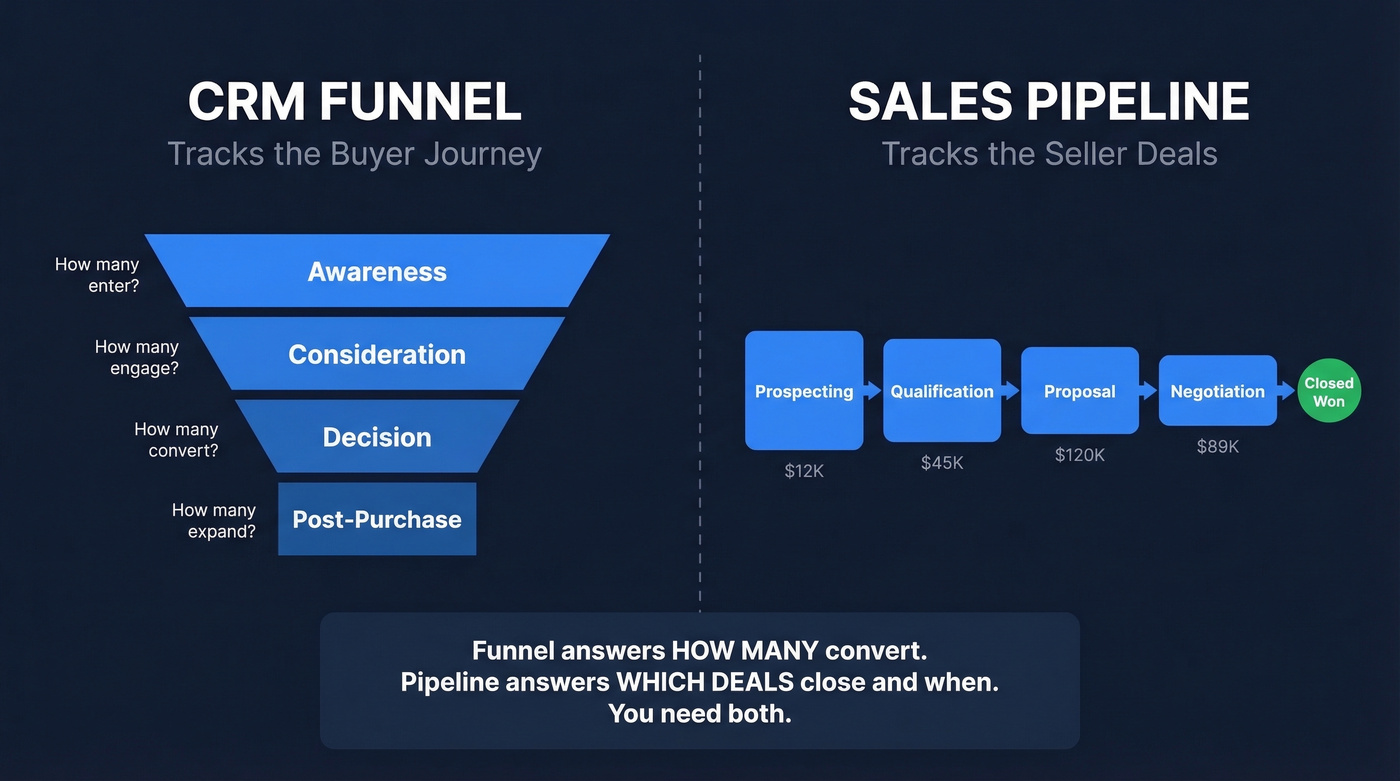
| Funnel Stage (Buyer) | Pipeline Stage (Seller) |
|---|---|
| Awareness | Prospecting |
| Consideration | Qualification / Discovery |
| Decision | Proposal / Negotiation |
| Post-purchase | Expansion / Renewal |
The funnel tells you how many prospects convert. The pipeline tells you which deals will close and when. Your CRM needs both views configured correctly, or you're guessing on one axis. Structured pipeline management improves forecast accuracy by up to 20% - that's the payoff for getting this right. If you want to go deeper on what to monitor, track pipeline health alongside stage definitions.
The 7 Stages That Matter
Harvard Business Review research found that companies with a defined pipeline process grow revenue up to 18% faster than those winging it. Here's what each stage means and what triggers the transition out of it.
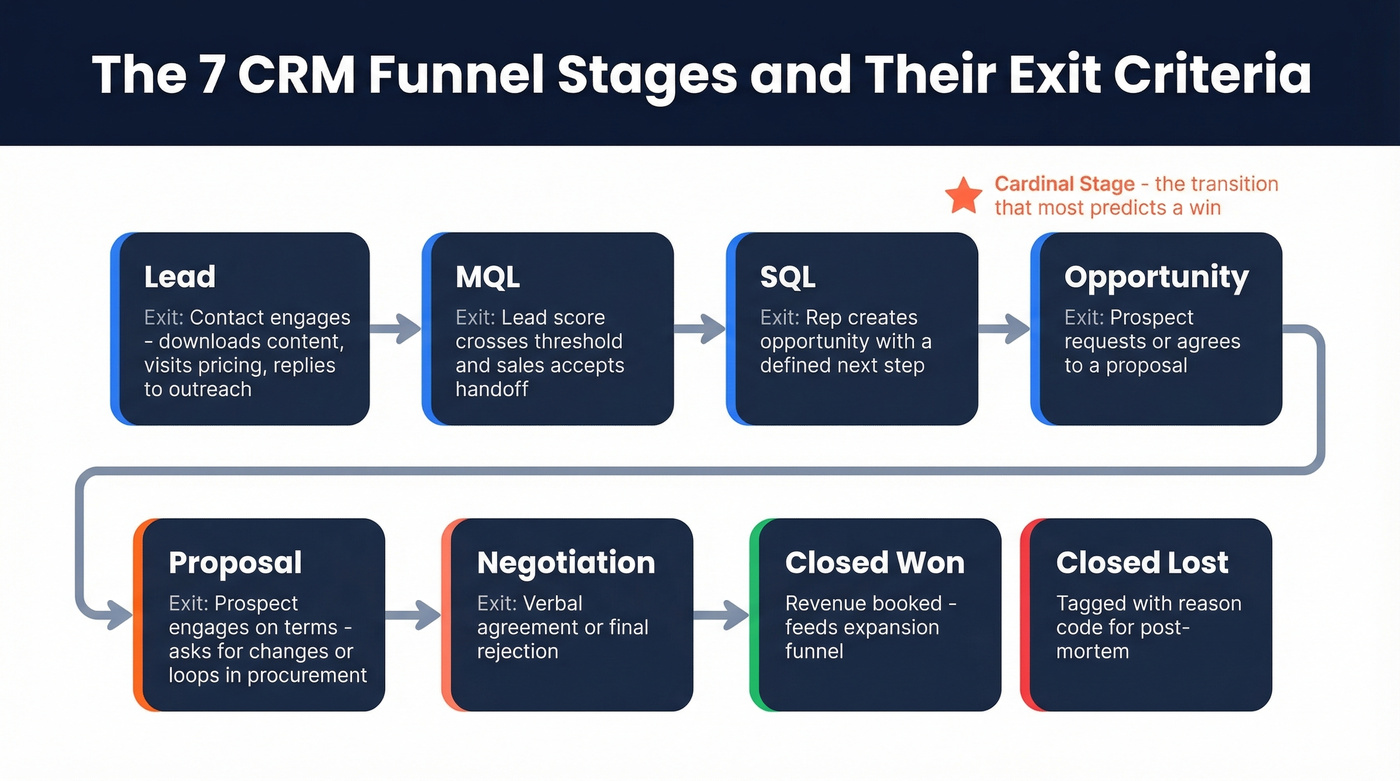
1. Lead. A name in the system. Exits when: the contact engages - downloads content, visits a pricing page, replies to outreach.
2. MQL (Marketing Qualified Lead). Marketing says this person fits the ICP and has shown intent. Exits when: lead score crosses the threshold and sales accepts the handoff. A common mistake here is setting the scoring threshold too low. If more than 40% of MQLs get rejected by sales, your scoring model needs recalibration (see lead scoring).
3. SQL (Sales Qualified Lead). A rep has confirmed budget, authority, need, or timeline. Exits when: the rep creates an opportunity with a defined next step. Use required fields in your CRM at this stage to force reps to log qualification criteria - it prevents garbage data downstream. If you need a tighter framework, use MEDDIC sales qualification.
4. Opportunity. An active deal with a real buying process underway. Exits when: the prospect requests or agrees to a proposal.
5. Proposal. Pricing and scope are on the table. Exits when: the prospect engages on terms - asks for changes, loops in procurement, or pushes back on pricing.
6. Negotiation. Terms, pricing, or legal are being worked. Exits when: verbal agreement or final rejection. (If you want to sharpen this stage, use an anchor in negotiation to control the range.)
7. Closed Won / Closed Lost. Terminal stage. Won = revenue, and it feeds into an expansion funnel - renewal, upsell, and referral stages that many teams configure as a separate pipeline. Lost = tagged with a reason code for post-mortem analysis.
Every exit criterion should be a verifiable action, not a gut feeling. "Prospect seems interested" isn't an exit criterion. "Prospect booked a discovery call" is.
Here's the thing: identify your cardinal stage - the single transition that most predicts a win. In SaaS, it's usually the demo. Focus your coaching and resources on getting deals past that point, because that's where the math changes. If you need a tighter process around that moment, use a product demo checklist.

Every exit criterion you just defined depends on reaching real buyers at real email addresses. If 30% of your contacts bounce, your stage-to-stage conversion rates are fiction. Prospeo's 98% email accuracy and 7-day data refresh cycle mean the leads entering your funnel are actually reachable - so your MQL-to-SQL and SQL-to-Opp numbers reflect reality, not decay.
Stop forecasting on stale data. Start with contacts that convert.
Benchmark Conversion Rates
FirstPageSage's benchmark report shows these stage-to-stage conversion rates:
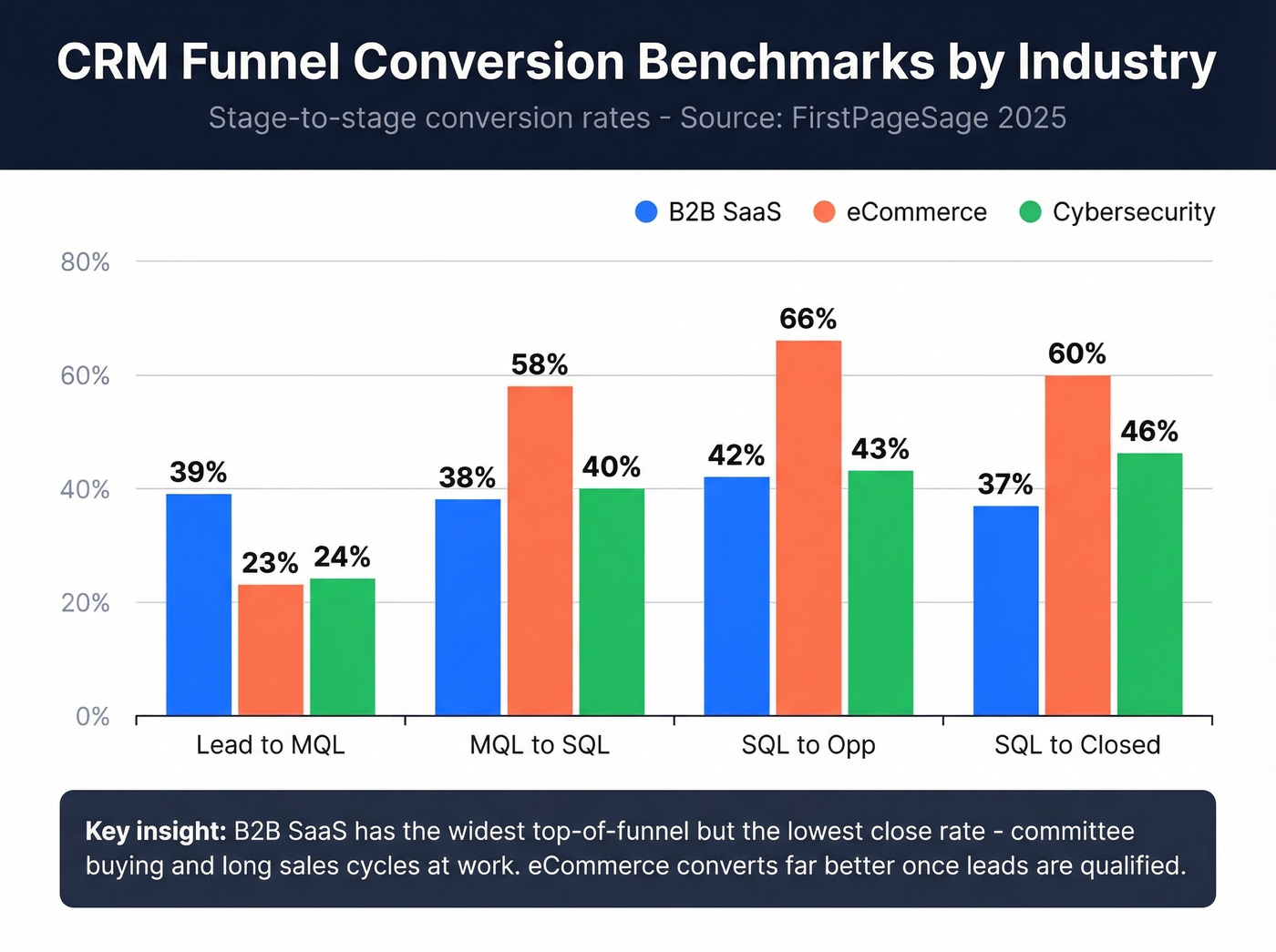
| Industry | Lead to MQL | MQL to SQL | SQL to Opp | SQL to Closed |
|---|---|---|---|---|
| B2B SaaS | 39% | 38% | 42% | 37% |
| eCommerce | 23% | 58% | 66% | 60% |
| Cybersecurity | 24% | 40% | 43% | 46% |
B2B SaaS has the widest top-of-funnel but the lowest close rate - that's committee buying and long sales cycles at work. eCommerce converts far better once leads are qualified, which tracks with shorter decision timelines.
If your numbers are dramatically below these benchmarks at any single stage, that's your leak. We've found that tracking median days-in-stage alongside conversion rates reveals even more (see funnel metrics). If deals stall longer than 2x your median at any stage, they're probably dead. Move them to Lost or create an SLA alert so they don't rot in your pipeline and inflate your weighted forecast.
Platform Defaults
HubSpot Lifecycle Stages
HubSpot ships with seven lifecycle stages: Subscriber, Lead, MQL, SQL, Opportunity, Customer, Evangelist. The critical thing to know is that HubSpot's automation only moves lifecycle stages forward. Moving a contact backward requires clearing the value first, which breaks most workflows if you don't plan for it.
SQL isn't granular enough on its own - HubSpot stores sub-stages in the Lead Status property, which is where reps actually track outreach activity. Don't confuse lifecycle stage with lead status; they serve different purposes (full lead status setup matters here).
Creating the Lead Object at Lifecycle = Lead (HubSpot's standard play) floods reps with hundreds of unqualified names. This is one of the most common complaints on r/hubspot, and for good reason. We've seen teams get much better results creating the Lead Object at SQL, when a rep is actually assigned and outreach begins.
Salesforce Opportunity Stages
Salesforce defaults to: Prospecting, Qualification, Needs Analysis, Value Proposition, Decision Makers, Proposal/Price Quote, Negotiation/Review, and Closed Won/Closed Lost. Customize them via Setup, then Object Manager, then Opportunity, then Fields & Relationships, then Stage.
Each stage has a default probability - Prospecting = 10%, Negotiation/Review = 90% - and the probability on an opportunity can be edited per deal. Forecast Categories group stages into summary buckets (Pipeline, Best Case, Commit, Closed), which is how most sales leaders actually consume the data. If your stage probabilities don't reflect reality, your weighted pipeline is meaningless. Audit these quarterly. If you're evaluating tooling, compare sales forecasting solutions before you rebuild your process.
Five Mistakes That Break Your Funnel
1. Too many stages. More than seven creates confusion. Reps stop updating because they can't remember the difference between stage 4 and stage 5. Use stage-to-stage movement data to diagnose this - if deals consistently skip a stage, that stage is redundant. Delete it.
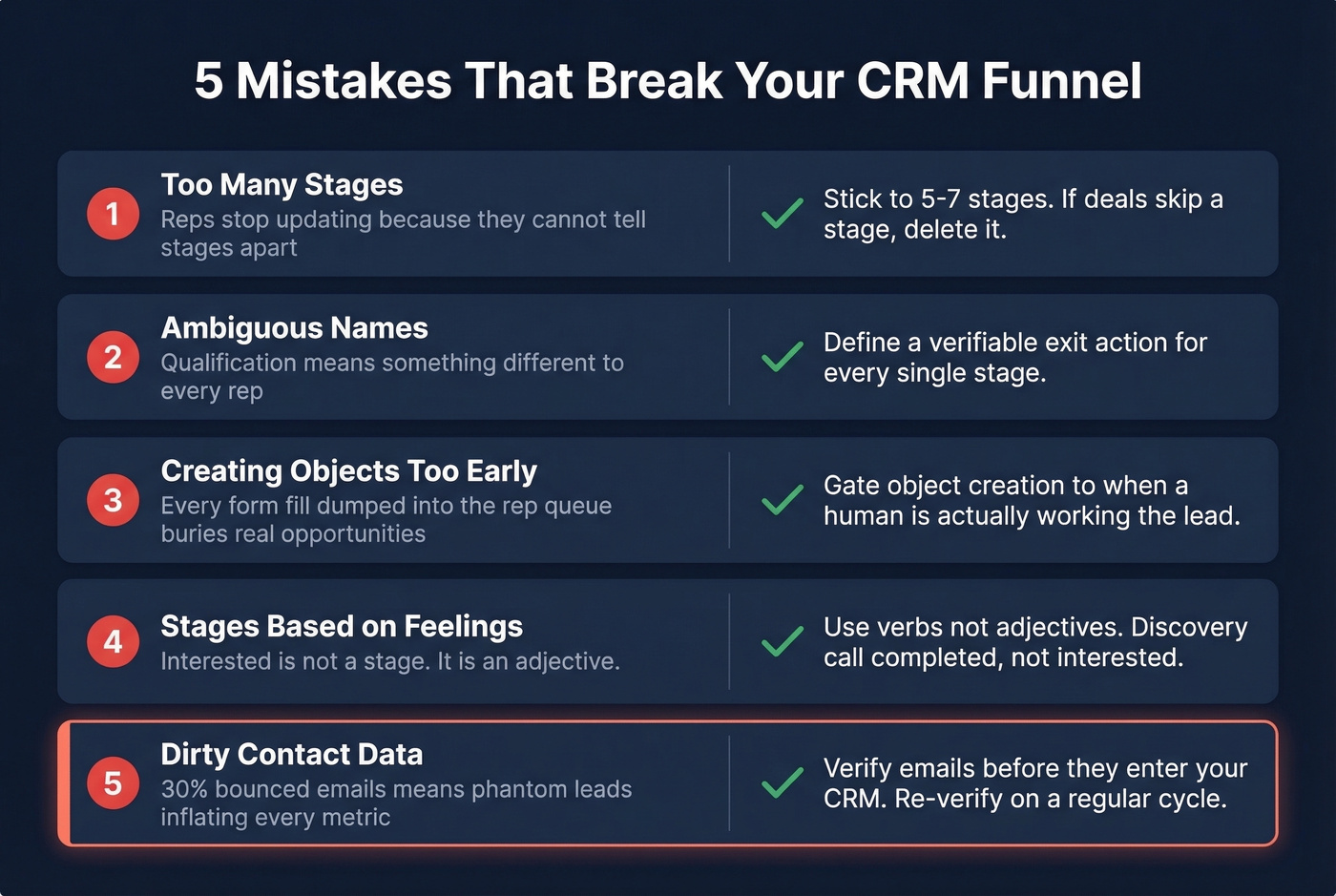
2. Ambiguous names without exit criteria. "Qualification" means something different to every rep on your team. Define the verifiable action that moves a deal forward, or watch your forecast drift.
3. Creating CRM objects too early. Dumping every inbound form fill into the rep queue buries real opportunities under noise. Gate object creation to the point where a human is actually working the lead. If you need a cleaner system end-to-end, map it as a lead generation workflow.
4. Stages based on feelings, not actions. "Interested" isn't a stage. "Discovery call completed" is. Use verbs, not adjectives. If a rep can't prove a deal belongs in a stage, the stage is broken.
5. Dirty contact data polluting funnel metrics. This is the one nobody talks about, and in our experience it's the silent killer behind most broken forecasts. If 30% of your emails bounce, those aren't real leads - they're phantom records inflating your top-of-funnel and corrupting every conversion rate downstream. Prospeo's CRM enrichment returns verified emails at 98% accuracy on a 7-day refresh cycle, integrating natively with HubSpot and Salesforce. With an 83% enrichment match rate and 50+ data points per contact, your funnel metrics reflect reality instead of bounced addresses. If you're comparing vendors, start with data enrichment services and then decide what to automate.

Let's be honest: most teams obsess over adding stages when they should be obsessing over data quality. A 5-stage funnel with clean data will outforecast a 10-stage funnel built on bounced emails every single time. If you're seeing deliverability issues, start by fixing your email bounce rate.
You've configured the stages. You've set exit criteria. Now fill the top of your funnel with contacts that won't rot in your pipeline. Prospeo gives you 300M+ profiles with 30+ filters - buyer intent, technographics, headcount growth, funding - so every lead entering Stage 1 already matches your ICP. At $0.01 per email, bad data isn't a budget problem anymore. It's a choice.
Build a pipeline that matches your funnel - not one that breaks it.
CRM Funnel Stages FAQ
How many stages should I configure?
Five to seven for most B2B teams. Fewer than five hides where deals stall; more than seven causes reps to skip updates entirely. If you can't explain why a stage exists with a specific exit action, remove it.
What's the difference between a funnel and a pipeline?
A funnel tracks buyer volume and drop-off at each stage - it answers "how many convert?" A pipeline tracks individual deals, their dollar value, and velocity through seller-defined stages - it answers "which deals close when?" You need both views in your CRM.
How do I keep funnel data accurate?
Verify contact data before it enters your CRM. Bounced emails create phantom leads that inflate every conversion metric. Run enrichment workflows on new records as they're created, and re-verify existing records on a regular cycle so stale data doesn't accumulate.
What's a good Lead-to-MQL conversion rate?
In B2B SaaS, 39% is the benchmark per FirstPageSage's data. If you're below 25%, your lead sources or ICP definition likely need tightening. If you're above 50%, your MQL threshold may be too loose - check your SQL acceptance rate to confirm.