

Customer Profile Examples You Can Actually Copy (B2B + B2C)
Most "customer profile example" articles hand you empty boxes labeled "Industry," "Pain Points," and "Goals" - then leave you to figure out the rest. That's not helpful. Here are seven filled-in profiles you can steal, adapt, and put to work this week.
The Short Version
- A customer profile isn't a blank template. It's a filled-in document with real numbers. Scroll to the B2B or B2C examples below and adapt them.
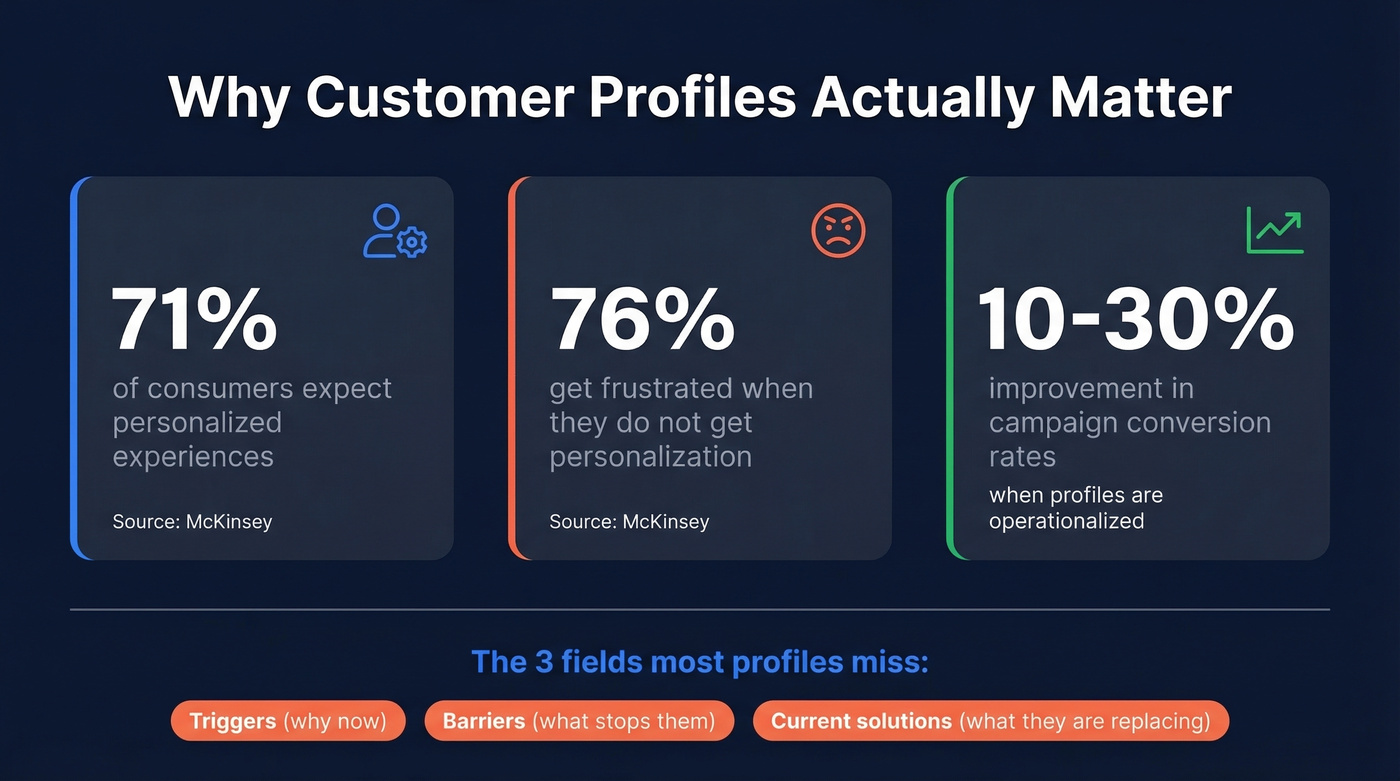
- The three fields most profiles miss: triggers (why now), barriers (what stops them), and current solutions (what they're replacing). Without these, your profile is decoration.
- You don't need 15 profiles. Two to three that are specific enough to change how your team sells will outperform a library of vague ones every time.
What Is a Customer Profile?
A customer profile is a data-backed document describing your real or ideal customer - not a fictional character sketch with a stock photo and a made-up name. It captures firmographics for B2B or demographics for B2C, behavioral patterns, buying triggers, and the specific context that makes someone a good fit for what you sell.
Why bother? 71% of consumers expect personalized experiences, and 76% get frustrated when they don't get them. Teams that operationalize customer profiles see 10-30% improvement in campaign conversion rates. A customer profile is the document that makes personalization operational - shared across sales, marketing, and customer success so everyone targets the same people the same way.
Profile vs. Persona vs. ICP
These three terms get swapped around constantly, and it causes real confusion. Here's the cleanest way to think about it: ICPs tell you which companies are worth speaking to. Personas tell you who you're speaking to. A filled-in profile document captures either or both.
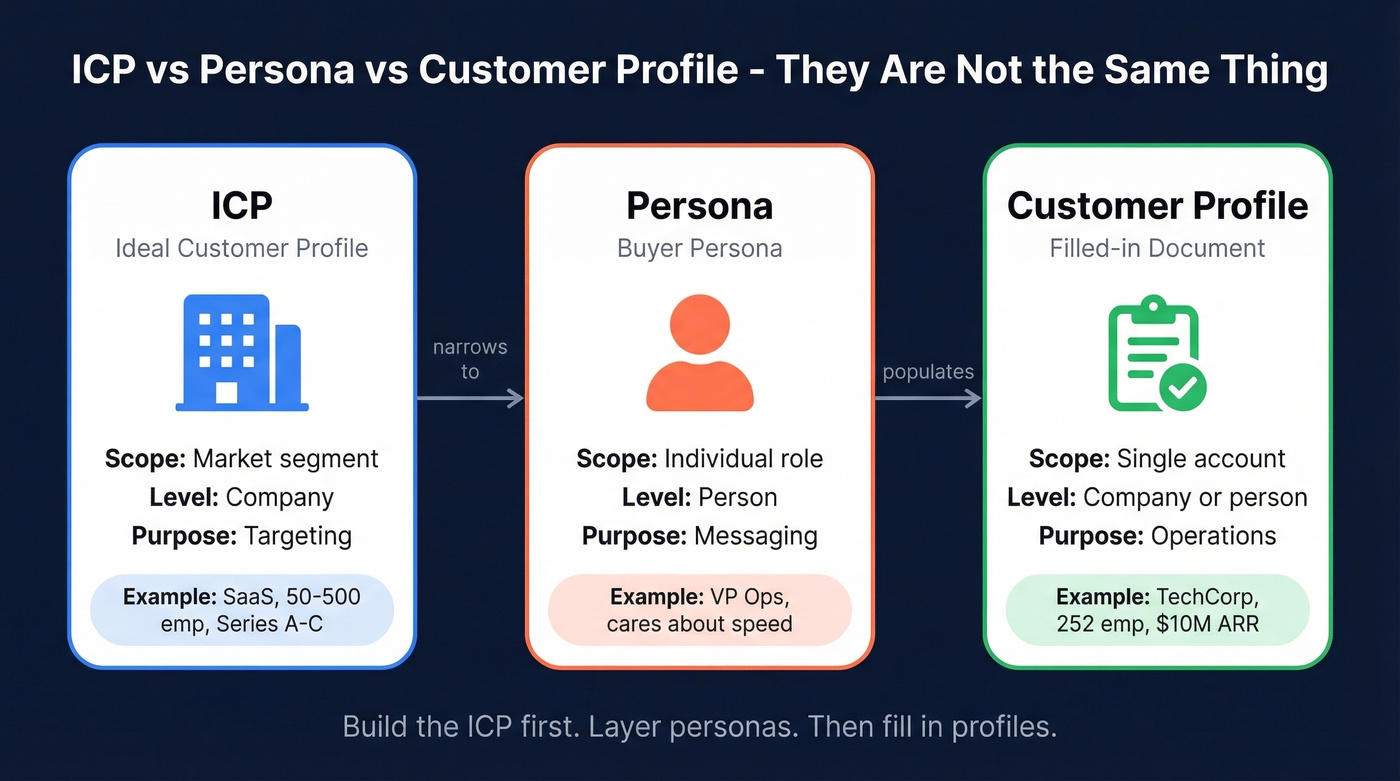
| Scope | Level | Purpose | Example | |
|---|---|---|---|---|
| ICP | Market segment | Company | Targeting | SaaS, 50-500 emp, Series A-C |
| Buyer Persona | Individual role | Person | Messaging | VP Ops, cares about speed |
| Customer Profile | Single account | Company or person | Operations | TechCorp, 252 emp, $10M ARR |
Your ICP defines the pond you're fishing in - like Zapier targeting fast-growing companies with 50-500 employees using 5+ disconnected tools. Personas define the individual fish. A customer profile is the detailed record you build once you've caught one or want to catch a specific one.
Build the ICP first. Then layer personas on top. The seven examples below show you what the finished product looks like. If you want a ready-to-use framework, start with an Ideal Customer Profile Template and adapt it to your segments.
What to Include in Every Profile
| B2B Fields | B2C Fields |
|---|---|
| Industry / sub-industry | Age, gender, location |
| Employee count, revenue | Income, education, occupation |
| Funding stage, location | Values, lifestyle, interests |
| Tech stack / technographics | Behavioral data - browsing, purchase |
| Buying committee + roles | Purchase history, AOV, frequency |
| Triggers - why now | Preferred channels |
| Barriers - what stops them | Loyalty indicators like NPS, repeat rate |
| Current solutions / alternatives | Current solutions / alternatives |
| Qualification criteria | Triggers - seasonal, life events |
| Disqualification criteria | Disqualification criteria |
| Success metrics / KPIs | Retargeting actions |
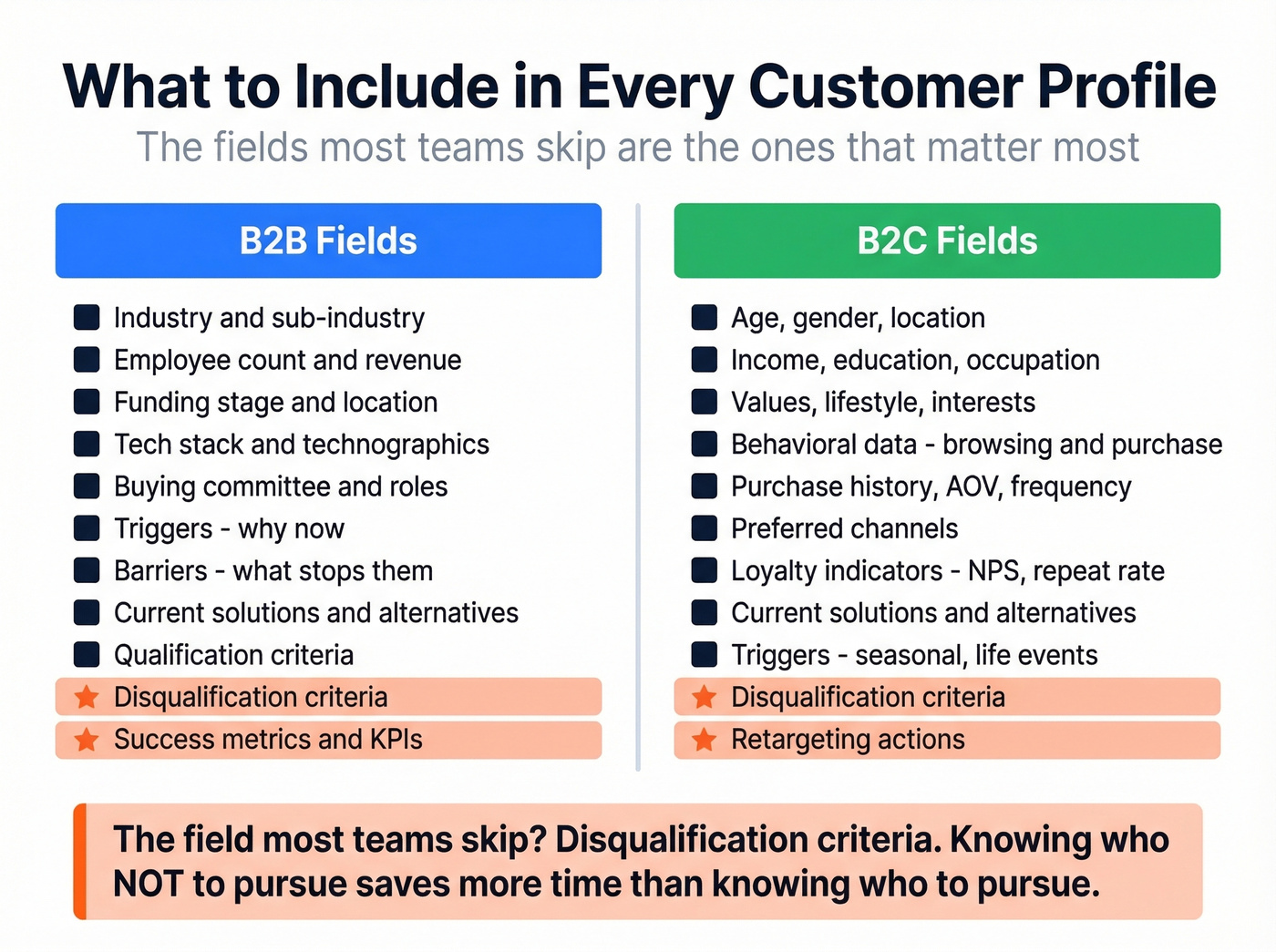
The field most teams skip? Disqualification criteria. Knowing who not to pursue saves more time than knowing who to pursue. If a prospect has no budget authority, uses a competitor with a 3-year lock-in, or operates in a vertical you can't serve - write that down. Practitioners on r/ProductMarketing consistently emphasize that technographics and disqualification criteria are the fields that separate useful profiles from decorative ones.

You just saw what a filled-in customer profile looks like. Now fill yours with real contact data. Prospeo gives you 30+ filters - intent signals, technographics, funding stage, headcount growth - to build profiles backed by 300M+ verified records, not guesswork.
Stop decorating templates. Start filling them with data that converts.
7 Customer Profile Examples
If you want blank templates to fill in yourself, Smartsheet offers free downloadable versions in Excel, Word, and Google Docs. But first, see what a completed sample actually looks like when every field is populated with real operational data.
1. B2B Mid-Market SaaS
This is the centerpiece. Not a blank template - a filled-in profile with real operational data you can adapt.
| Field | Data |
|---|---|
| Company | TechCorp (anonymized) |
| Industry | Project management software |
| Headquarters | San Francisco, CA |
| Employees | 252 |
| Annual revenue | $10M ARR |
| Funding stage | Series B |
| Tech stack | Jira, Slack, AWS, Salesforce |
| Current solution | Legacy PM tool (on-prem) |
| Trigger | "Our legacy system was slowing down project delivery" |
| Barrier | Security review required; 90-day procurement cycle |
| Intent signals | Researching "project management migration," evaluating 2 competitors, hired new VP Ops last quarter |
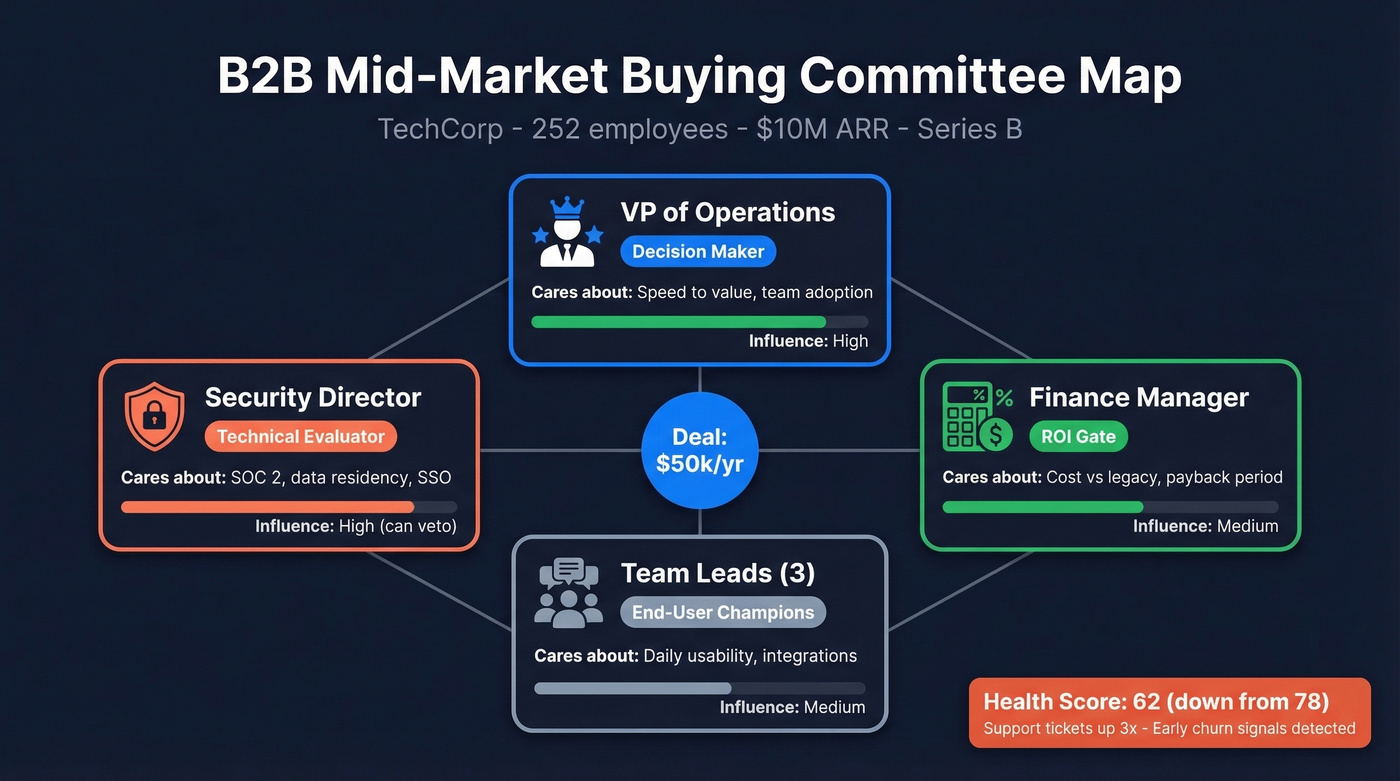
Buying Committee:
| Role | Person | What They Care About |
|---|---|---|
| Decision maker | VP of Operations | Speed to value, team adoption |
| Technical evaluator | Security Director | SOC 2, data residency, SSO |
| ROI gate | Finance Manager | Cost vs. legacy, payback period |
| End-user champion | Team leads (3) | Daily usability, integrations |
Health & Renewal Signals: Contract value $50k/year, annual renewal in Q4, health score 62 (down from 78), support tickets up 3x last quarter.
The health score drop and ticket spike are early churn signals. The buying committee map tells reps who to multi-thread. The trigger and barrier fields explain why they bought and what almost stopped them. This is the format we recommend for any mid-market deal - it gives every team something to act on. If you're selling into larger accounts, the enterprise B2B sales motion changes the profile fields you prioritize.
2. B2C Ecommerce Profile
Here's a filled-in B2C profile for a "Frequent Shopper" archetype at an online fashion retailer:
| Field | Data |
|---|---|
| Name | Sarah M. (composite) |
| Age | 32 |
| Location | Austin, TX |
| Income | $75k-$95k |
| Occupation | Marketing manager |
| Psychographics | Values convenience, sustainability-conscious, follows fashion influencers |
| Preferred channels | Instagram, email, mobile app |
| Purchase frequency | 2-3x per month |
| Average order value | $85 |
| Loyalty status | Mid-tier rewards member |
| Current behavior | Buys often but doesn't refer friends or leave reviews |
| Trigger | Seasonal drops, flash sales, new arrivals emails |
| Retargeting action | Personalized recommendations + omnichannel convenience |
The key insight: Sarah buys frequently but isn't an advocate. The profile tells your marketing team to push referral programs and review incentives - not more discount codes.
3. B2B Early-Stage Startup
| Field | Data |
|---|---|
| Company | CloudSync (anonymized) |
| Industry | Data integration / iPaaS |
| Headquarters | Remote-first, US entity |
| Employees | 38 |
| Annual revenue | $1.2M ARR |
| Funding stage | Seed |
| Tech stack | HubSpot, Notion, Vercel, Stripe |
| Current solution | Manual CSV imports + Zapier workarounds |
| Trigger | Hired first RevOps lead, needs to scale without adding headcount |
| Barrier | Founder-led buying; no formal procurement process, but slow to commit |
| Disqualification | No budget above $500/month for tooling; pre-revenue startups |
Startups buy differently than mid-market companies. The decision maker is usually the founder or a single department lead. There's no buying committee to multi-thread - you're selling one person who moves fast but gets distracted faster. If your average deal size stays in the low four figures, this profile type probably represents your bread and butter.
4. B2B Enterprise (Healthcare)
| Field | Data |
|---|---|
| Company | MedSecure Health Systems (anonymized) |
| Industry | Healthcare IT / hospital networks |
| Headquarters | Chicago, IL |
| Employees | 4,200 |
| Annual revenue | $380M |
| Tech stack | Epic EHR, ServiceNow, Azure, Workday |
| Current solution | In-house built patient engagement platform |
| Trigger | CMS interoperability mandate deadline; board-level digital transformation initiative |
| Barrier | 12-18 month procurement cycle, HIPAA compliance review, requires on-prem deployment option |
| Disqualification | Organizations without dedicated IT security team; facilities under 500 beds |
Enterprise healthcare deals are a different animal entirely. The procurement cycle alone can outlast your fiscal year. We've seen teams burn six months of pipeline on hospital systems that never had the IT infrastructure to implement. The disqualification criteria here aren't optional - they're survival.
5. B2C Subscription Service
| Field | Data |
|---|---|
| Name | Marcus T. (composite) |
| Age | 28 |
| Location | Denver, CO |
| Income | $55k-$70k |
| Occupation | Software developer |
| Psychographics | Convenience-driven, health-conscious, dislikes grocery shopping |
| Preferred channels | YouTube, Reddit, podcast ads |
| Subscription type | Weekly meal kit, $65/week |
| Tenure | 4 months |
| Churn risk | Medium - skipped 2 of last 4 weeks |
| Trigger | New Year health resolution + coworker referral |
| Retention action | Flexible skip policy messaging + recipe variety expansion |
Marcus is the subscriber who's quietly disengaging. The skip pattern is the leading indicator. Most subscription companies over-invest in acquisition and under-invest in reading signals like this one. A profile that captures churn risk alongside demographics is worth ten that don't. If you want to go deeper on retention signals, use a simple churn analysis framework alongside your profiles.
6. B2C Retail Archetypes
Not every B2C team needs a deep profile for each customer. Sometimes you need a quick segmentation framework:
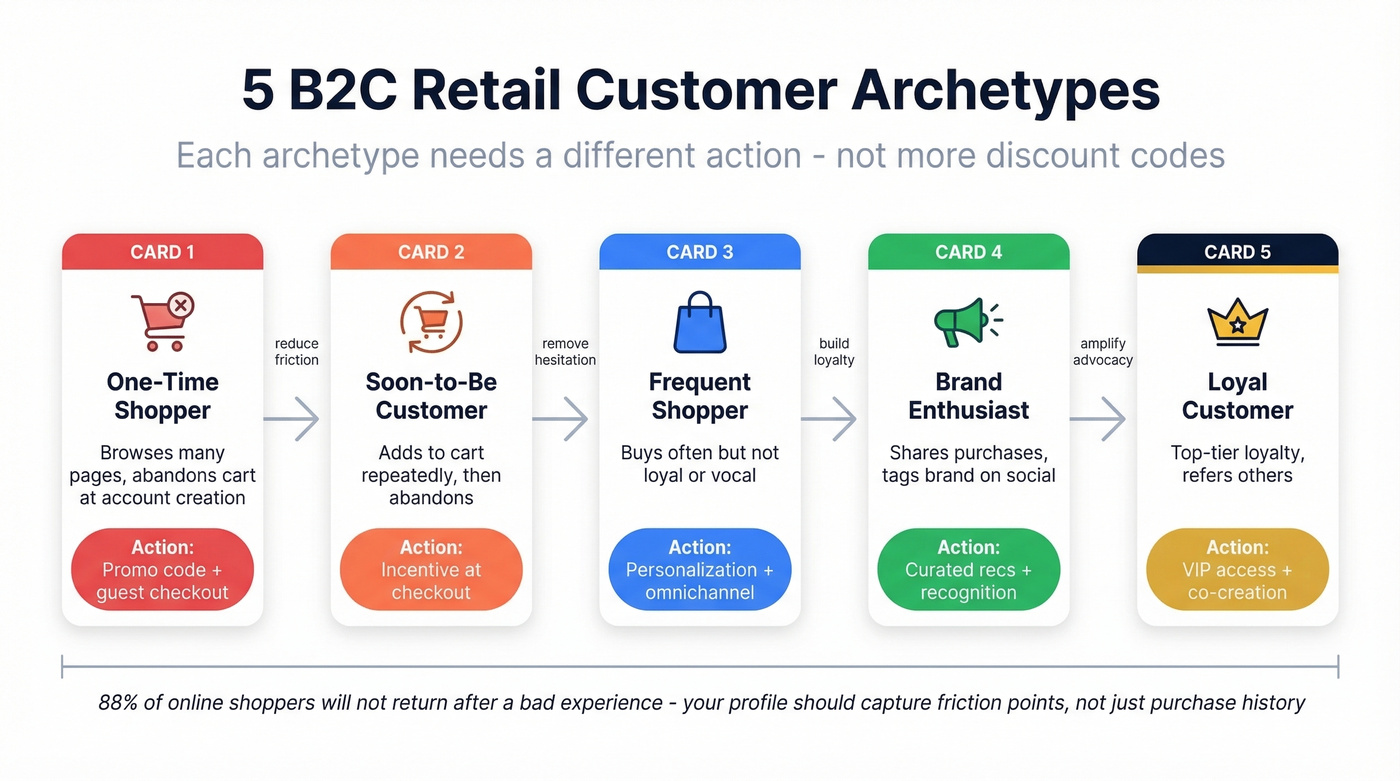
| Archetype | Behavior Pattern | Retargeting Action |
|---|---|---|
| One-time shopper | Browses many pages, abandons cart at account creation | Promo code + guest checkout |
| Soon-to-be customer | Adds to cart repeatedly, then abandons | Incentive at checkout |
| Frequent shopper | Buys often, not loyal or vocal | Omnichannel convenience + personalization |
| Brand enthusiast | Shares purchases, tags brand on social | Curated recommendations + recognition |
| Loyal customer | Top-tier loyalty, refers others | VIP access, early drops, co-creation |
Here's the thing: 88% of online shoppers won't return after a bad UX. Your profile should capture friction points, not just purchase history.
7. B2B Buying Committee Map
Mid-market B2B deals typically involve 6-10 stakeholders. If your profile doesn't map the buying committee, your reps are flying blind.
| Role | Responsibility | What They Care About |
|---|---|---|
| Economic buyer | Signs the check, owns budget | ROI, payback period, total cost |
| Technical evaluator | Assesses fit with existing stack | Security, integrations, scalability |
| End user | Uses the product daily | Ease of use, time savings, reliability |
| Internal champion | Advocates internally, drives adoption | Career impact, vendor responsiveness |
The champion is the role most profiles miss entirely. In our experience, the buying committee map is the single most valuable section of any B2B profile. Without an internal champion, deals stall in committee - sometimes permanently. Your profile should identify who this person is and what makes them look good internally. If you want a qualification lens for these roles, map them to MEDDPICC economic buyer and champion criteria.
How to Score and Prioritize
Building profiles is step one. Scoring them is what makes them operational. Here's a copy-paste ICP scoring rubric:
| Attribute | Weight | Tier A (3 pts) | Tier B (2 pts) | Tier C (1 pt) |
|---|---|---|---|---|
| Industry | 25% | Target vertical | Adjacent vertical | Non-target |
| Employee count | 20% | 100-500 | 50-99 or 501-1000 | <50 or >1000 |
| Tech stack fit | 20% | Uses 2+ complementary tools | Uses 1 | Uses none |
| Buying signal | 20% | Active intent + trigger event | Passive research | No signal |
| Budget authority | 15% | Confirmed | Likely | Unknown |
Scoring tiers:
| Tier | Score Range | Action |
|---|---|---|
| Tier A | 80-100 | Prioritize aggressively |
| Tier B | 50-79 | Worth pursuing with caveats |
| Tier C | 0-49 | Deprioritize or disqualify |
Tier A accounts convert 1.5-2x more than Tier B and close 15-20% faster. That's the whole point of scoring - concentrating effort where it pays off.
One distinction worth keeping straight: ICP scoring measures account fit, while lead scoring measures contact engagement. They're complementary, not interchangeable. A Tier A account with a disengaged contact still needs nurturing. A Tier C account with a highly engaged contact is still a bad fit. The best scoring models layer in intent data - topic research spikes, competitor evaluations, hiring signals - so Tier A reflects active in-market interest, not just firmographic fit.
Build a Profile in 5 Steps
Expect 1-2 weeks for a first version using existing CRM data and customer interviews.
Step 1: Mine Your CRM
Start with your closed-won accounts from the last 12-18 months. Look for common traits: industry clusters, company size ranges, tech stack overlaps, deal size patterns. Your best customers are the blueprint for your profile. If you don't have enough data, start with your top 10 accounts and work outward.
Step 2: Interview 8-12 Customers
CRM data tells you what happened. Interviews tell you why. Talk to 8-12 customers per segment - that's enough to reach pattern saturation without drowning in transcripts. Structure your interviews around the trigger-barrier-journey-post-purchase framework, inspired by Adele Revella's buyer research methodology. Ask what changed that made them start looking, what almost stopped them from buying, who else was involved in the decision, and what surprised them after implementation.
Step 3: Layer in Intent Data
Firmographics and interviews give you a static snapshot. Intent data makes it dynamic. Look for topic research spikes, competitor evaluation signals, hiring for relevant roles, and tech stack changes. These signals tell you not just who fits your profile, but who's actively in-market right now. For a practical way to operationalize those signals, see identifying buying signals.
To populate firmographic and contact data at scale, tools like Prospeo let you apply 30+ search filters covering buyer intent, technographics, headcount growth, and funding stage - so you can go from "here's our ideal customer" to a verified list of matching accounts with 98%-accurate emails. Data refreshes every 7 days, which means profiles stay current rather than decaying the moment you build them.
Step 4: Build the Document
Use the field checklist from the section above. Fill it in like the B2B and B2C examples - with real numbers, real roles, real quotes. A profile with "mid-size companies in tech" is useless. A profile with "150-400 employees, Series B-C, using Jira and Slack, with a VP Ops who cares about delivery speed" is actionable.
Step 5: Validate Quarterly
Compare your Tier A conversion rates against Tier B and C every quarter. If the gap is shrinking, your profile criteria need tightening. If certain fields don't predict outcomes, drop them. Profiles aren't static documents - they're hypotheses that need testing.
Your buying committee maps are only useful if you can actually reach every person on them. Prospeo delivers 98% accurate emails and 125M+ verified mobile numbers - so your customer profiles turn into booked meetings, not filed-away documents.
Turn every profile into a pipeline opportunity for $0.01 per email.
5 Profile Mistakes That Waste Time
1. Building "fairytale personas" without talking to customers. The r/b2bmarketing crowd has a term for this: profiles that "collect dust" because they were built in a conference room using assumptions instead of data. If your sales team hasn't validated the profile, it's fiction.
2. Using B2C demographics for B2B profiles. If your B2B profile includes "enjoys hiking on weekends," you've built a dating profile, not a targeting document. B2B profiles need firmographics, buying committee roles, and procurement context - not hobbies.
3. Ignoring profitability. Resonance doesn't equal profit. A segment might love your product but churn in 3 months or cost 4x more to support. Map LTV, CAC, and repeat purchase rates before finalizing your profiles. The benchmark: LTV should be at least 3x CAC. If it's not, that segment isn't as "ideal" as it looks. (If you need a refresher on CAC math, see cost to acquire customer.)
4. Skipping disqualification criteria. We've seen teams waste entire quarters chasing accounts that were never going to close - wrong industry, no budget authority, locked into a competitor contract. A profile without disqualification criteria lets bad-fit leads eat pipeline resources unchecked.
5. Treating profiles as static. No quarterly refresh, no intent signals, no validation against actual conversion data. Markets shift. Buying committees change. A profile built 18 months ago is a historical document, not a targeting tool.
Data Compliance in 2026
New US state privacy laws effective January 1, 2026 - Indiana, Kentucky, and Rhode Island all have comprehensive privacy laws in effect. CCPA rules broadened "sensitive personal information" to include neural data and data from minors under 16.
Enforcement is real. Tractor Supply was hit with a $1.35M fine for a non-functional opt-out webform. "Privacy theater" - having the forms without the functionality - doesn't cut it anymore. Honor Global Privacy Control signals.
On the transatlantic side, EU-UK adequacy was renewed in December 2025 through December 2031, so cross-border data flows remain stable for now.
Let's be blunt about what this means for profiling: first-party data - what you collect directly from customers - is the safest and most valuable foundation. Companies using first-party data for targeting see a 68% increase in CLV. Build your profiles on data you own, supplement carefully, and document your consent chain.
FAQ
How many profiles do I need?
Two to three well-defined profiles beat fifteen vague ones. Start with your highest-revenue segment and your fastest-growing segment. Add more only when your team can operationally act on them differently - otherwise they're shelf-ware.
What's the difference between a profile and a buyer persona?
A customer profile defines the company or account type worth targeting - firmographics, revenue, tech stack, disqualification criteria. A buyer persona defines the individual person within that account. Build the profile first, then layer personas on top for messaging.
How often should I update profiles?
Quarterly at minimum. Compare Tier A conversion rates against Tier B and C each cycle. If the gap is shrinking, your criteria need tightening. Intent data platforms should feed updates continuously between formal reviews.
What's the fastest way to populate a B2B profile with real data?
Start with your CRM's closed-won accounts to identify patterns, then use a B2B data platform to enrich firmographics, technographics, and verified contact data at scale. With the right filters and a fast refresh cycle, you can match accounts to your ICP criteria in minutes rather than weeks.
Can I use the same profile for marketing and sales?
Yes, but format it differently. Marketing needs psychographics and channel preferences for campaign targeting. Sales needs buying committee roles, budget cycles, and disqualification criteria for deal qualification. Same underlying data, different operational views.