

Data Cleansing vs Data Enrichment: What's the Difference and Which Comes First?
Your CRM started spotless. A year later, roughly 22-25% of B2B contact data has decayed, a handful of companies have rebranded, and your segmentation is quietly falling apart. A Monte Carlo study found that data professionals spend about 40% of their workday just dealing with quality issues. The fix involves two processes people constantly mix up: data cleansing and data enrichment.
They're not the same thing. And the order you tackle them in matters more than most teams realize.
The Key Differences in 30 Seconds
| Data Cleansing | Data Enrichment | |
|---|---|---|
| Purpose | Fix what's broken | Fill what's missing |
| Focus | Accuracy & consistency | Depth & completeness |
| Timing | Before enrichment | After cleansing |
| Outcome | Fewer errors, no dupes | Richer profiles |
| Frequency | Quarterly minimum | Ongoing / triggered |
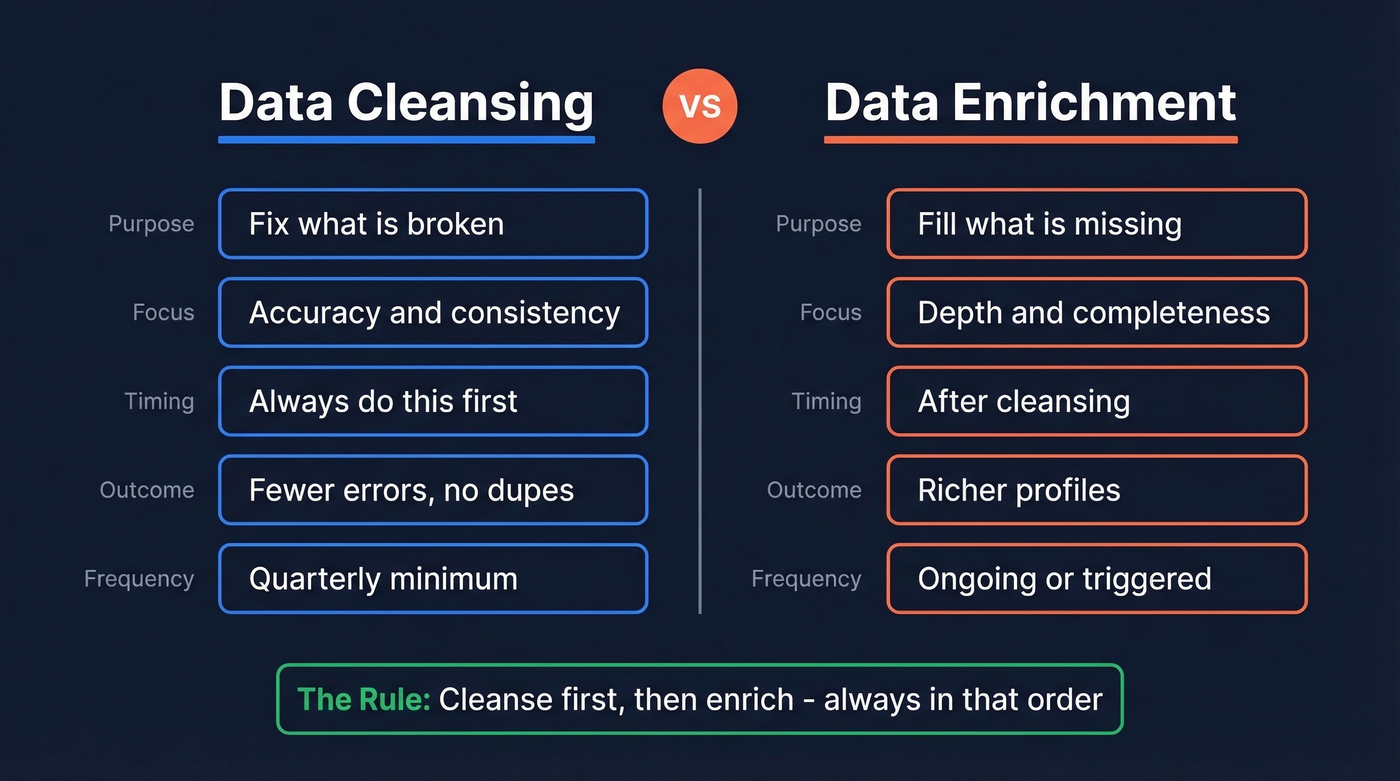
The one-line verdict: cleanse first, then enrich - always in that order. Enriching dirty data just makes your mess more expensive.
What Is Data Cleansing?
Data cleansing means detecting and correcting (or removing) corrupt, inaccurate, and outdated records. It's subtraction, not addition - making what you already have trustworthy.
Deduplication merges or removes duplicate contacts using exact and fuzzy matching. Standardization normalizes formats so "VP Sales," "VP of Sales," and "Vice President, Sales" all resolve to one value (more on data standardization if you want the deeper playbook). Validation confirms emails are deliverable, phone numbers are active, and addresses exist. And purging dead records means removing contacts who've left companies or bounced repeatedly.
Think of it like cleaning out a garage before you buy new shelving. No point organizing junk.
What Is Data Enrichment?
Data enrichment enhances existing records with additional information from external sources. You're taking a name-and-email skeleton and turning it into a complete profile.
Verified emails and direct dials are the two data points reps care about most. Firmographics like company size, revenue, and industry round out the account picture (see our full guide to firmographics). Technographics reveal what software a company runs - useful for competitive displacement plays. Intent signals show whether an account is actively researching topics related to your product, which can dramatically shorten sales cycles when the timing is right (here’s how teams operationalize B2B intent signals).
Enrichment match quality typically ranges from 70-95% depending on the provider. That gap matters enormously at scale.
The Real Cost of Bad Data
Here's the stat that should bother you: reps spend 20-30% of their time on non-selling data tasks, per Salesforce's State of Sales report. That's your most expensive employees doing data janitorial work.
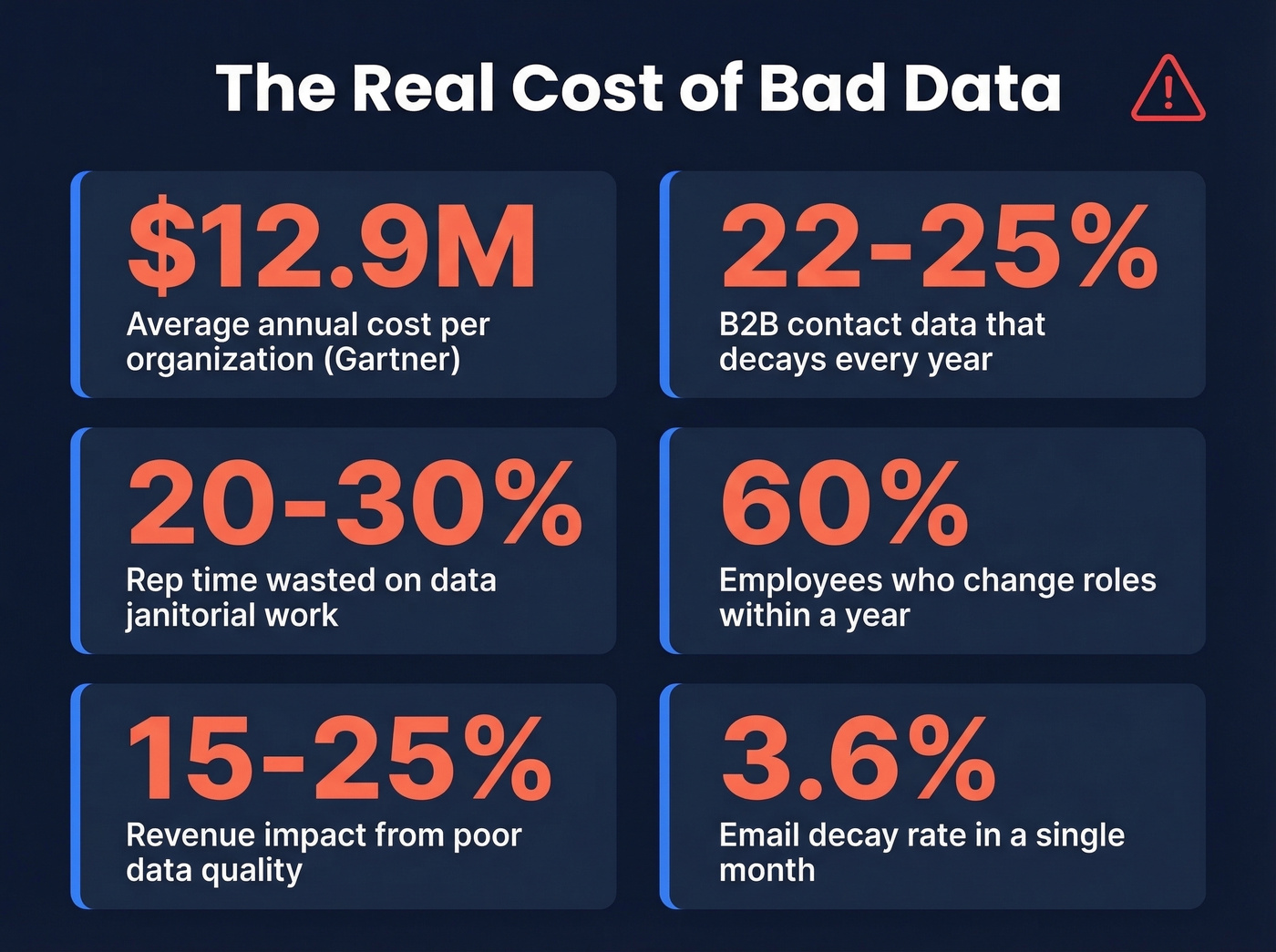
Gartner pegs the [average cost at $12.9M](https://www.gartner.com/en/data-analytics/topics/data-quality) per organization per year. Research from MIT Sloan and Cork University Business School puts the revenue impact at 15-25% annually. SMBs aren't immune either - bad data costs smaller companies $203k-$732k/year, and mid-market orgs $965k-$3.51M/year when you add up bounced emails, wasted rep time, and missed opportunities.
B2B contact data decays at 22-25% per year. Up to 60% of employees change roles within a given year. RevenueBase tracked a 3.6% email decay rate in a single month - about double the historical average.


You just read that bad data costs $12.9M per year and decays at 25% annually. Prospeo refreshes every 7 days - not every 6 weeks - so enrichment doesn't re-contaminate your CRM. 98% email accuracy, 92% API match rate, 50+ data points per contact.
Stop enriching dirty data. Start with a source that stays clean.
Cleanse First, Then Enrich
We've seen companies dump thousands into enrichment only to discover they were appending fresh data to duplicate records and contacts who left two years ago. The order isn't optional.
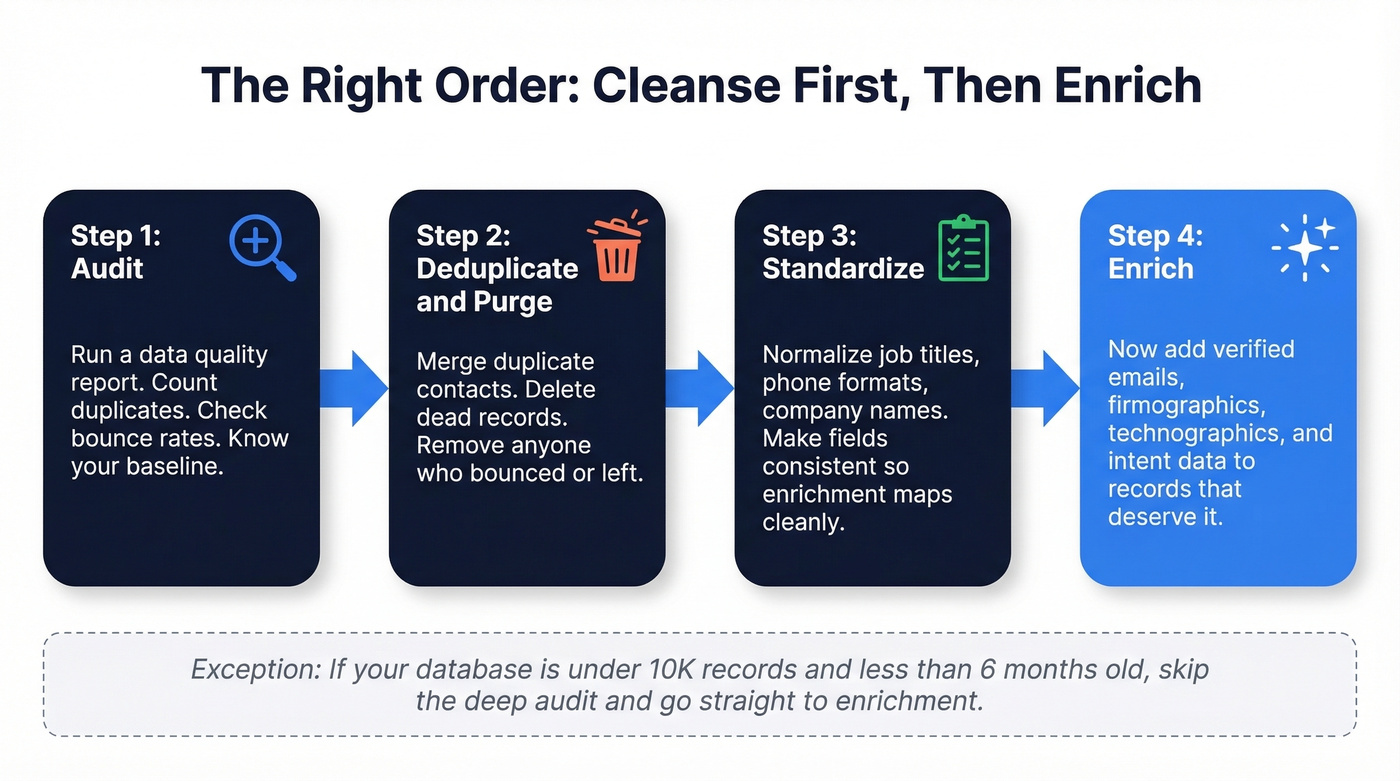
Step 1: Audit. Run a data quality report. How many duplicates? What's your bounce rate? If you don't know these numbers, that's your answer - you need cleansing (use this CRM data quality checklist as a baseline).
Step 2: Deduplicate and purge. Merge dupes, delete dead records. One Reddit thread from an enterprise team managing 40+ subsidiaries described contacts untouched for 5+ years sitting in their CRM. If that's you, cleansing is step one - no question.
Step 3: Standardize. Normalize fields so enrichment data maps cleanly. This is the boring step everyone skips, and it's the one that causes the most downstream headaches.
Step 4: Enrich what remains. Now you're adding verified data to records that actually deserve it (if you want the full workflow, see how to enrich CRM data).
One contrarian note: if your database is under 10K records and less than six months old, skip the deep cleansing audit. You probably don't have enough rot to justify it yet. Go straight to enrichment.
Common Enrichment Challenges
Even after cleansing, enrichment isn't plug-and-play.
The most common issue we hear about is low match rates. Providers promise 95% coverage but deliver 70%. Inconsistent field mapping between your CRM and the enrichment source creates another layer of friction - job titles that don't map, company names that don't resolve, phone formats that break your dialer. And then there's stale data that was "enriched" with information already months out of date, which defeats the entire purpose.
These problems compound across geographies. Provider coverage for EMEA or APAC contacts tends to lag behind North American data by 10-20 percentage points. The consensus on r/sales is that most providers oversell their international coverage. Understanding these gaps upfront saves you from overpaying for coverage that doesn't actually exist.
When to Prioritize Which
Prioritize cleansing if your bounce rate is above 5%, more than 15% of records haven't been updated in 12+ months, or duplicate records keep showing up in reports and sequences (this is exactly what a CRM data cleaning sprint is for).
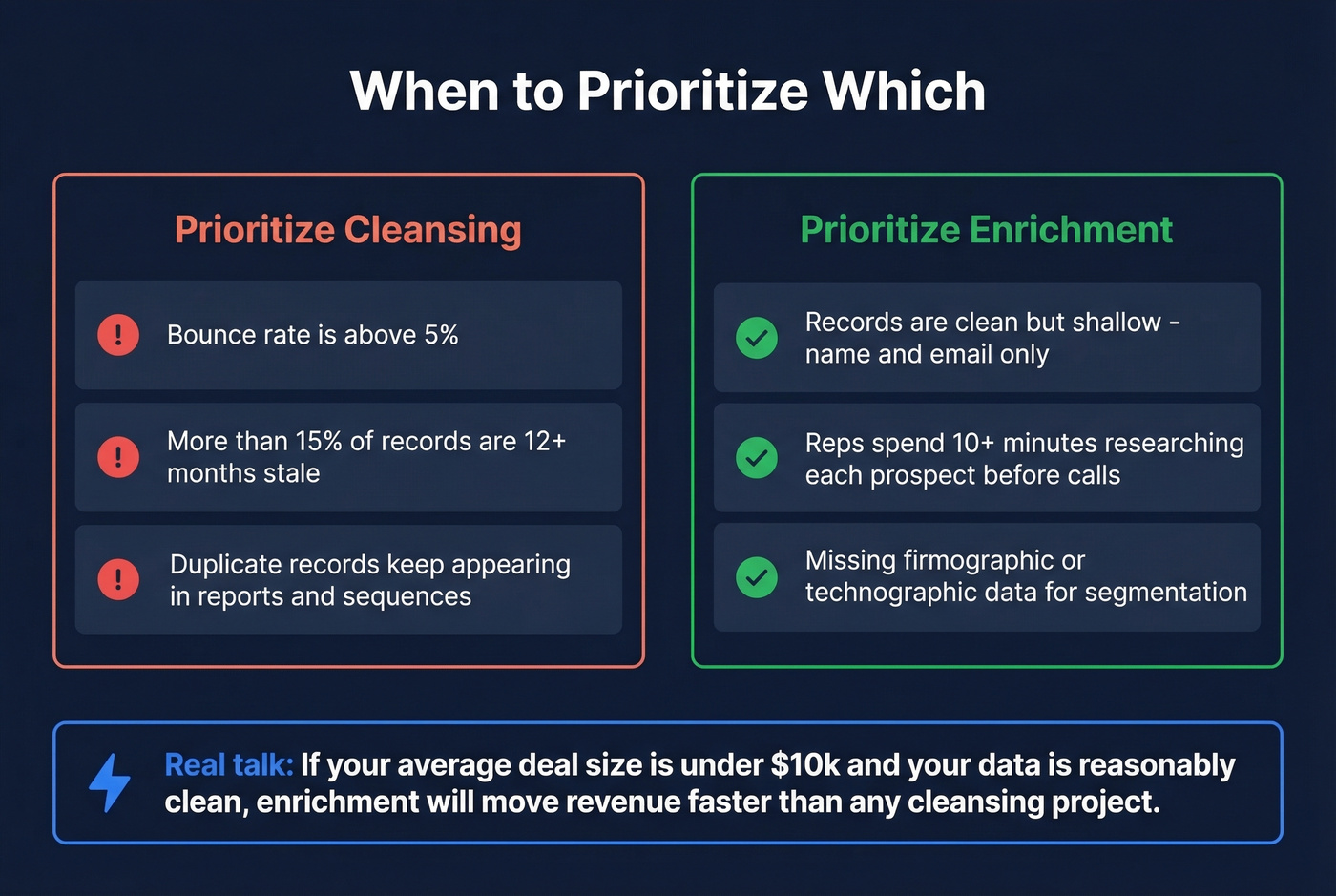
Prioritize enrichment if your records are clean but shallow - name and email only, nothing else. If reps spend more than 10 minutes researching each prospect before a call, enrichment pays for itself immediately. Same goes for teams missing firmographic or technographic data for segmentation (a quick scan of B2B technographics helps define what to append).
Let's be honest: if your average deal size is under $10k and your database is reasonably clean, enrichment will move revenue faster than any cleansing project. Most teams over-invest in hygiene and under-invest in the data that actually helps reps close.
Tools Worth Knowing
ZoomInfo starts around $14,995/year, with many mid-market contracts landing in the $25k-$60k range. If you're a 200-person sales org with budget, it works. For everyone else, it's overkill.
Apollo bundles enrichment into its prospecting platform with a free tier of 100 credits/month and paid plans starting at $49/user/month. Good if you already run sequences there, though email accuracy sits around 79% - which means roughly one in five emails bounces.
HubSpot Data Quality handles basic deduplication and formatting, included with certain HubSpot subscriptions. Convenient but not a replacement for dedicated enrichment.
For the enrichment step specifically, Prospeo delivers 98% email accuracy, 50+ data points per contact, and a 7-day refresh cycle that keeps records from going stale. That refresh cadence matters when you're comparing cleansing vs enrichment workflows: most providers refresh every 4-6 weeks, meaning your "enriched" data is already decaying before your next cleansing cycle. Pricing runs about $0.01 per email with a free tier to test - a fraction of what ZoomInfo charges for comparable data (if you’re comparing vendors, start with these data enrichment tools for sales).
Most enrichment tools promise 95% coverage and deliver 70%. Prospeo's enrichment returns contact data on 83% of leads with 98% verified email accuracy - at $0.01 per email. No contracts, no sales calls, no stale records.
Cleanse less when your enrichment source actually verifies its data.
FAQ
How often should you cleanse your CRM data?
Quarterly at minimum, monthly if you're running high-volume outbound. With 22-25% annual decay, roughly 5-6% of records go stale every quarter. Set a calendar reminder. Most teams let this slip until bounce rates force their hand, and by then the damage to sender reputation is already done.
Can one tool handle both cleansing and enrichment?
Some platforms combine both - HubSpot and Apollo have native data quality features alongside enrichment. In our experience, most teams get better results pairing a CRM-native cleansing tool with a specialized enrichment provider, since dedicated tools tend to have higher match rates and fresher data than all-in-one platforms.
What's a good enrichment match rate?
70-80% is average across most providers. 90%+ is excellent and worth paying for. Below 80%, the manual cleanup work often outweighs the time savings. Test any provider against a sample of your actual records before committing - don't trust the number on their marketing page.