

B2B Intent Signals: What They Cost, Where They Fail, and How to Actually Use Them
The B2B intent data market hit $4.49B in 2026, growing at 16.6% CAGR. Ninety-one percent of B2B marketers use intent data to prioritize accounts. Only 24% report exceptional ROI.
That gap isn't a data problem - it's an activation problem. Most teams make it worse by spending five-to-six figures on intent signals they can't operationalize.
The Short Version
- First-party signals (free): Website visits, CRM engagement, product usage. You already have these. Use them first.
- Second-party intent (~$10K+/year): G2 Buyer Intent, TrustRadius - validated buying behavior on review sites. Deals with G2 signals run 2x larger than average.
- Third-party providers: Bombora (~$25K+/year), 6sense (~$35K+/year), Demandbase (~$40K+/year). Add these only after you can operationalize the first two tiers.
- Contact-level activation: Most intent tools deliver account-level data. You still need verified decision-maker emails and direct dials to act on them.
What Are B2B Intent Signals?
Intent signals are behavioral data points suggesting a company or individual is actively researching a solution in your category. Someone downloading a whitepaper isn't the same as a buying committee comparing your product against three competitors on G2 - and your scoring model should reflect that difference.
The core distinction is between first-party signals (actions on your own properties) and third-party signals (actions across the broader web). Both matter. Neither is sufficient alone. Understanding buyer intent data is what separates teams that hit quota from those chasing cold lists.
Types of Buyer Intent Signals
| Signal Type | Example | Source | Fidelity |
|---|---|---|---|
| Engagement | Pricing page visit, demo request | First-party | Highest |
| Review-site | G2 comparison, profile views | Second-party | High |
| Research/topic surge | Spike in content consumption | Third-party co-op | Medium |
| Relationship/job change | Champion moves to new company | CRM tracking, job postings | Medium |
| Technographic | New tool adoption, stack changes | Web scraping, job postings | Medium |
| Hiring/company | VP Sales hire, funding round | Public filings, job boards | Medium-low |
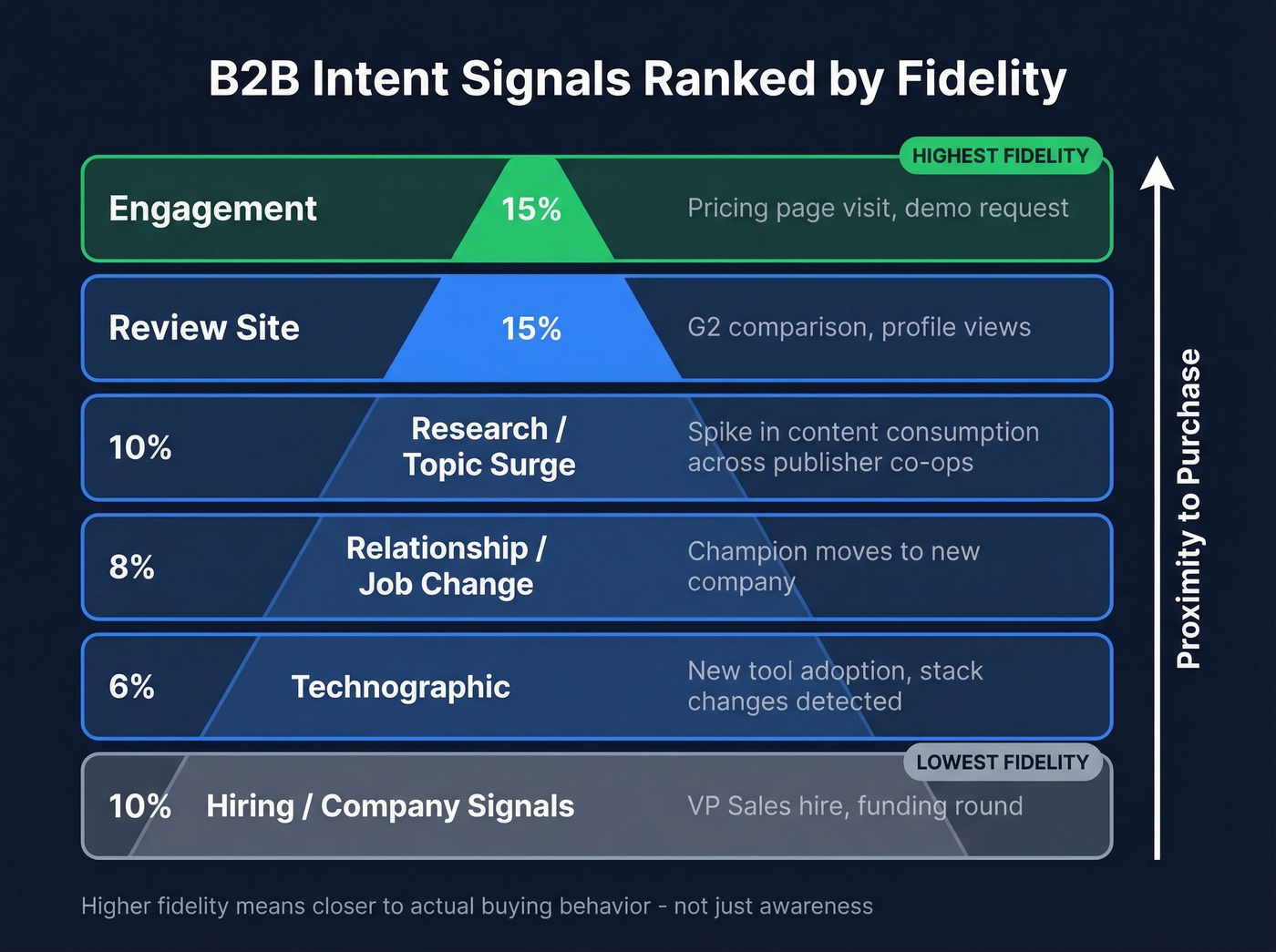
Fidelity rankings reflect proximity to purchase behavior. Direct engagement on your property is highest because the prospect chose to visit you; third-party topic surges are noisiest because they aggregate across publishers with no guarantee the reader has any buying authority.
The relationship signal row is underrated. When a champion who bought your product changes companies, that's one of the strongest buying signals available - yet most teams ignore it entirely. Tools like UserGems specialize here, and it's worth layering into any scoring model. (If you want to go deeper on this motion, see our guide to job change signals.)
Dreamdata's benchmark analysis found that 12% of closed-won deals had a G2 intent signal in the buyer journey, and those deals were 2x larger than average. That's a concrete, revenue-correlated signal - not a vague topic surge.
Where Intent Data Comes From
First-party signals come from your own properties: website, product, CRM. Second-party signals come from review platforms like G2. The two dominant third-party models work very differently.
Bombora runs a co-op of ~5,000 publisher sites, tracking 17B interactions monthly across 14,000+ topics. It's English-only, updates weekly, and doesn't retain historical data. Think of it as a consensus signal - when a company's employees read more about "endpoint security" than their baseline, Bombora flags the surge.
Demandbase takes a different approach: bidstream-sourced native intent across ~3M sites, processing 1T+ interactions per month, covering 575,000+ topics in 133 languages with one year of historical data. The coverage is broader, but bidstream data carries its own noise problems that teams need to filter for.
Account-Level vs. Contact-Level: The Gap That Kills Programs
Here's the thing both models share: neither delivers contact-level intent. They tell you which companies are surging. They don't tell you who to call.
That gap is where most intent programs stall. Account-level insights are valuable for prioritization, but sales reps need names, titles, and verified contact information to actually book meetings. We've watched teams spend $50K on Bombora licenses and then have SDRs manually searching for contacts on free tools. Bridging account-level and contact-level data is the single biggest operational bottleneck in intent-driven outreach. (More on this in our breakdown of contact-level intent.)

Intent data tells you which companies are in-market. Prospeo closes the gap to contact-level action. Layer Bombora intent signals across 15,000 topics with 300M+ profiles, 98% verified emails, and 125M+ direct dials - all refreshed every 7 days.
Stop paying for intent signals you can't act on.
What Intent Data Costs
| Provider | Annual Range | What You Get |
|---|---|---|
| ZoomInfo Streaming Intent | $7.2K-$36K | ZoomInfo platform bundle |
| G2 Buyer Intent | $10K-$87K+ | Review-site signals (add-on) |
| Bombora | $25K-$80K | Co-op topic surge data |
| 6sense | $35K-$150K+ | Intent + predictive + ABM |
| Demandbase | $40K-$120K | Intent + ABM platform |
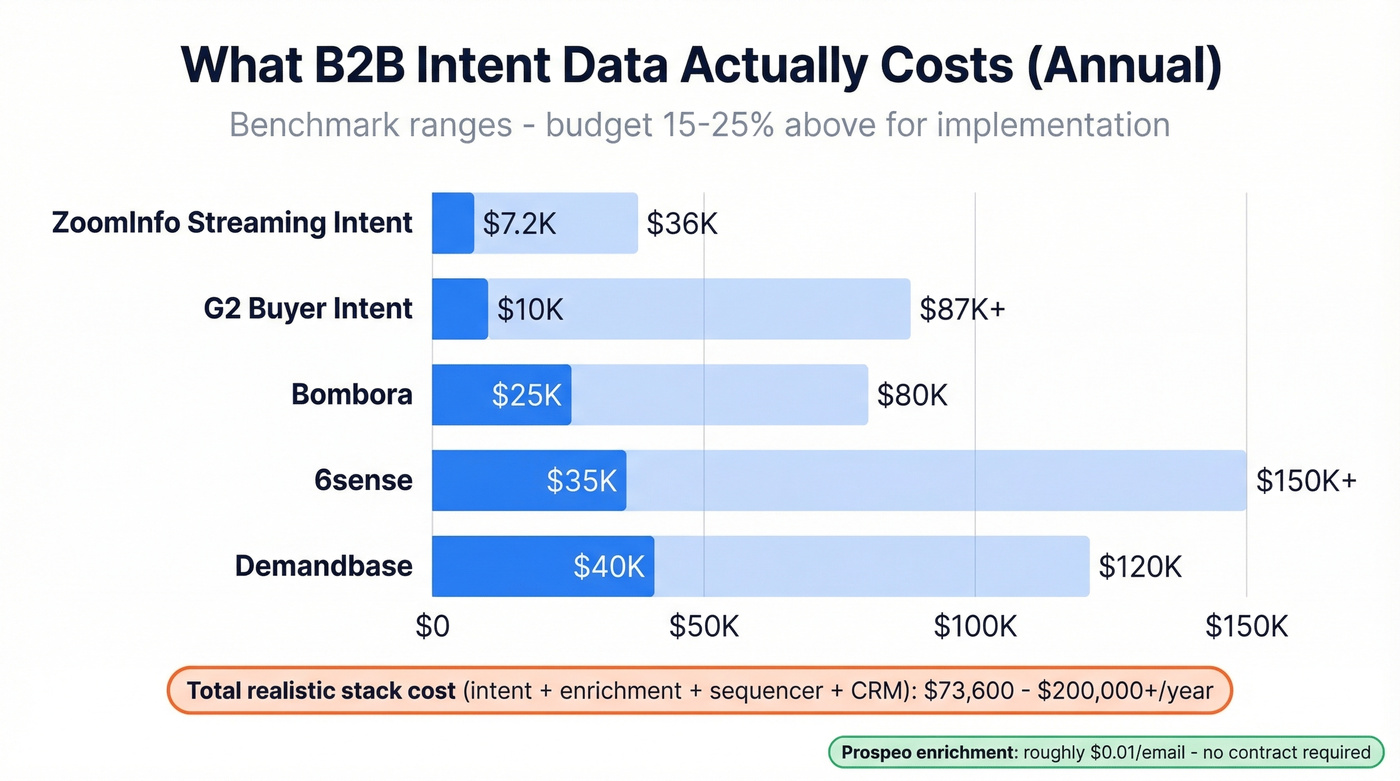
These are benchmark ranges from SalesMotion, not list prices. Budget 15-25% above the quoted license for implementation, topic configuration, and CRM integration. We've seen total realistic stack costs - intent platform plus contact enrichment, sequencer, dialer, and CRM integration - run $73,600-$200,000+/year.
If your average contract value is under $15K, you probably don't need a $50K+ intent platform. Start with first-party signals and G2, enrich surging accounts with a self-serve tool like Prospeo at ~$0.01/email, and prove the workflow before writing a six-figure check. (If you're evaluating vendors, start with accuracy-first comparisons of the best B2B databases and the best data enrichment tools.)
A Practical Scoring Framework
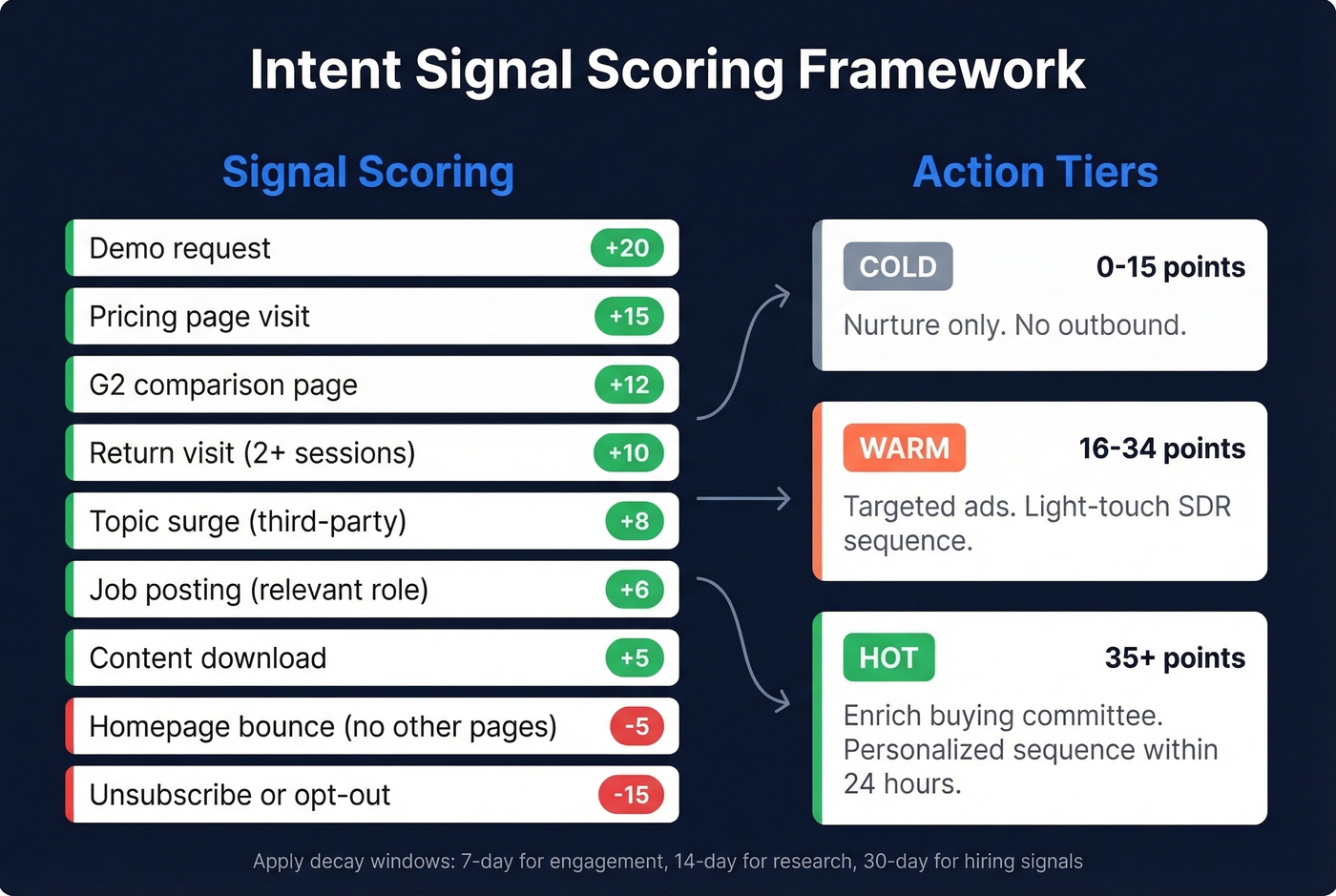
Most intent vendors don't give you a scoring model. They hand you raw signals and expect you to figure it out. Here's an operator-friendly template we've refined across dozens of implementations:
| Signal | Points | Decay |
|---|---|---|
| Demo request | +20 | 7 days |
| Pricing page visit | +15 | 7 days |
| G2 comparison page | +12 | 14 days |
| Return visit (2+ sessions) | +10 | 7 days |
| Topic surge (third-party) | +8 | 14 days |
| Job posting (relevant role) | +6 | 30 days |
| Content download | +5 | 30 days |
| Homepage bounce (no other pages) | -5 | 7 days |
| Unsubscribe / opt-out | -15 | 90 days |
Negative scoring is the row most teams skip - and it's the one that saves your SDRs the most time. A homepage bounce with no follow-up page views is noise, not intent.
| Tier | Points | Action |
|---|---|---|
| Cold | 0-15 | Nurture only. No outbound. |
| Warm | 16-34 | Targeted ads. Light-touch SDR sequence. |
| Hot | 35+ | Enrich buying committee, personalized sequence within 24 hours. |
Decay matters more than most teams realize. In our experience, teams that skip decay windows waste 30-40% of SDR capacity chasing accounts that spiked three months ago and have already signed with a competitor. Layering role-based filters - job title and seniority alongside surge data - further sharpens prioritization so reps focus on the right people at the right accounts. (If you're building this in RevOps, a clean RevOps tech stack makes the workflow far easier to maintain.)
7 Mistakes That Kill Intent Data ROI
These map directly to Forrester's analysis of the most common intent data failures:
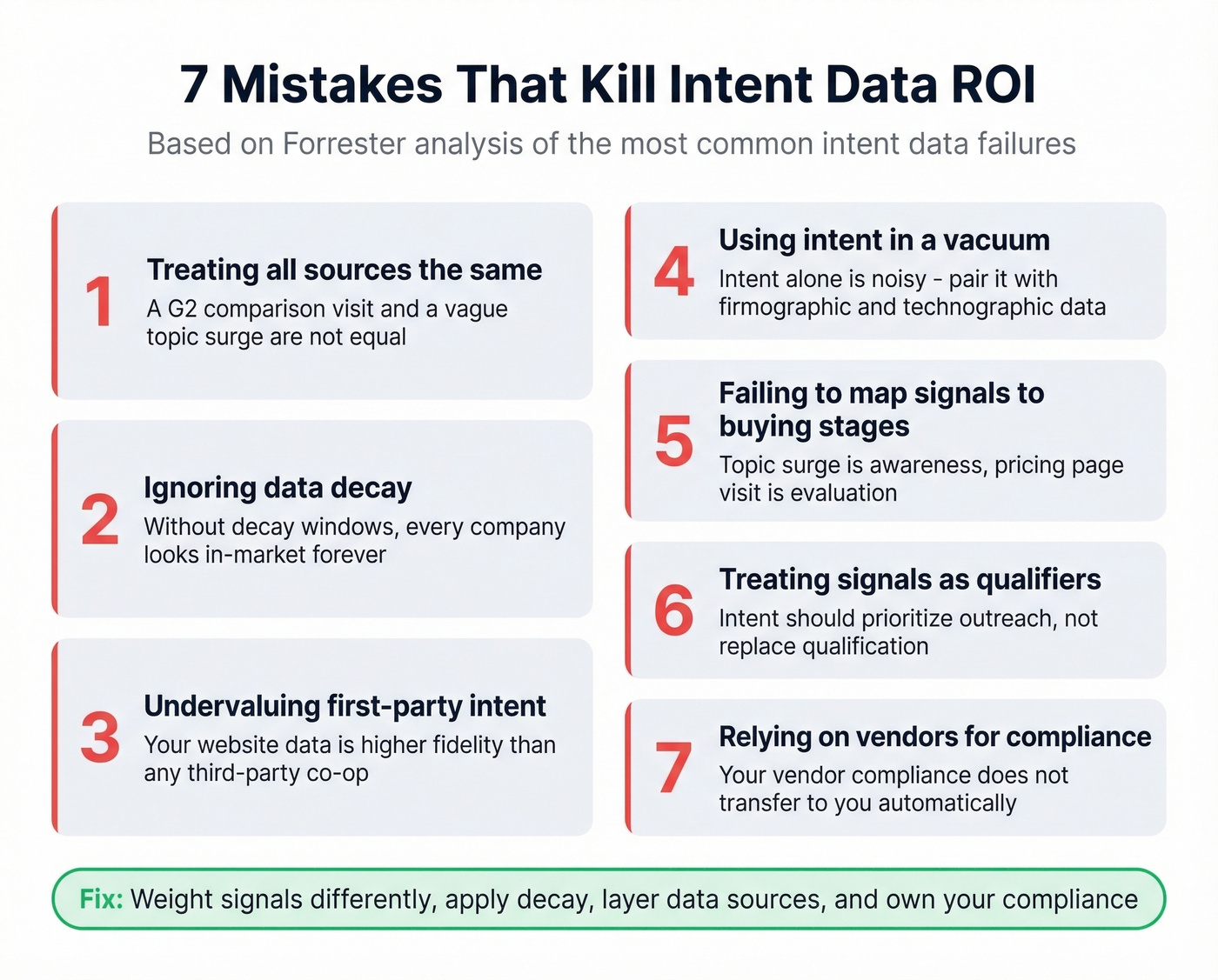
- Treating all sources the same. A G2 comparison visit and a vague topic surge aren't equal. Weight them differently.
- Ignoring data decay. Without decay windows, every company that ever researched your category looks in-market forever.
- Undervaluing first-party intent. Your website analytics and product usage data are higher-fidelity than any third-party co-op. They're also free.
- Using intent in a vacuum. Intent paired with technographic and firmographic data is predictive. Intent alone is noisy. (If you’re new to this layer, start with a clear definition of technographics.)
- Failing to map signals to buying stages. A topic surge is early awareness; a pricing page visit is late evaluation. Treat them identically and you'll send the wrong message at the wrong time.
- Treating signals as qualifiers. Intent should prioritize and sequence outreach, not replace qualification conversations. (A lightweight deal qualification framework helps here.)
- Relying on vendors for compliance. Your vendor's compliance doesn't transfer to you automatically. You still need a lawful basis under GDPR or CCPA. (Use a real B2B compliance checklist, not vendor slides.)
Let's be honest: the consensus on r/sales is that most intent data feels like expensive noise. That skepticism is healthy. If your vendor can't show you signal URLs or explain where the data originates, find one who can. Practitioners want proof that signals correlate with closed-won deals for their specific ICP, not just topic surge scores on a dashboard.
Activating Intent Signals for Sales
Your intent platform flags 12 surging accounts. Your SDRs fire off emails to info@ addresses. Zero replies. The intent data "didn't work."
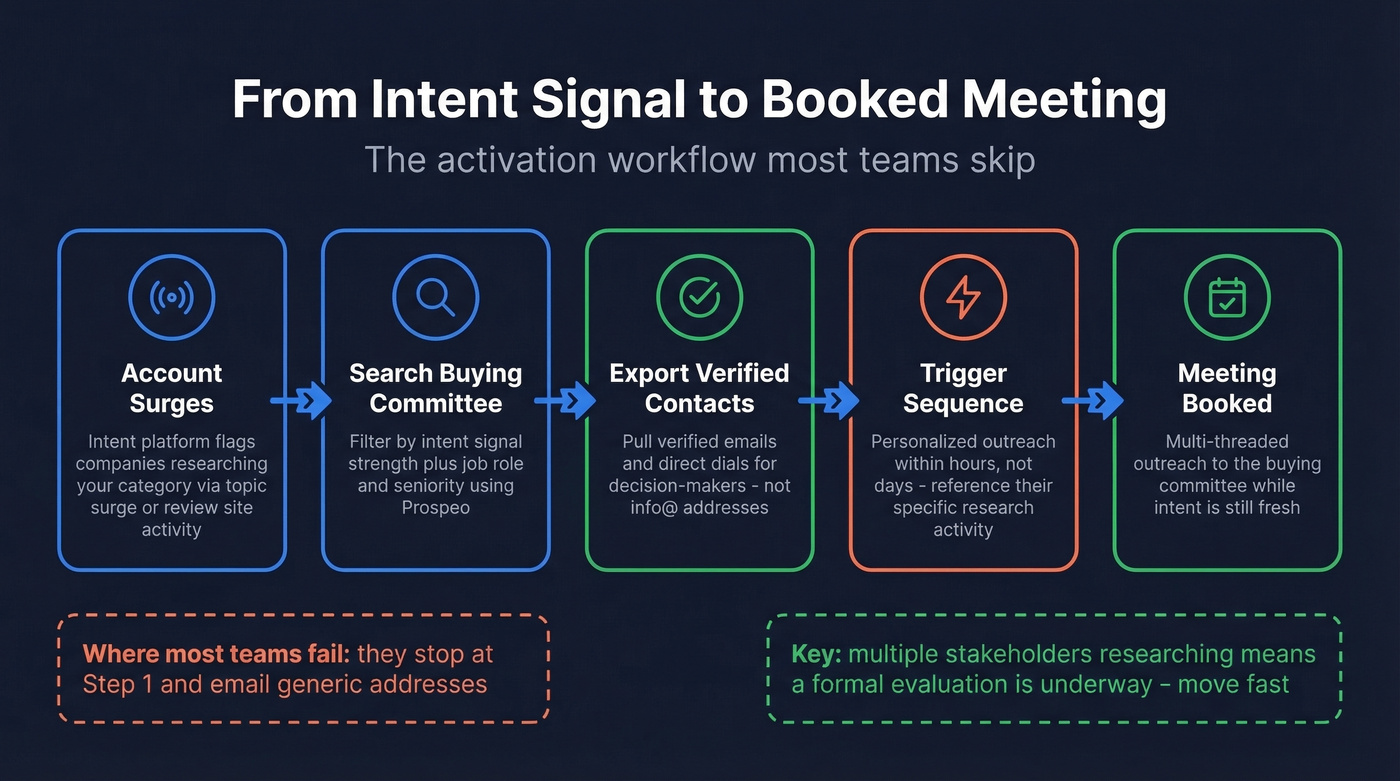
The data worked fine. The activation didn't.
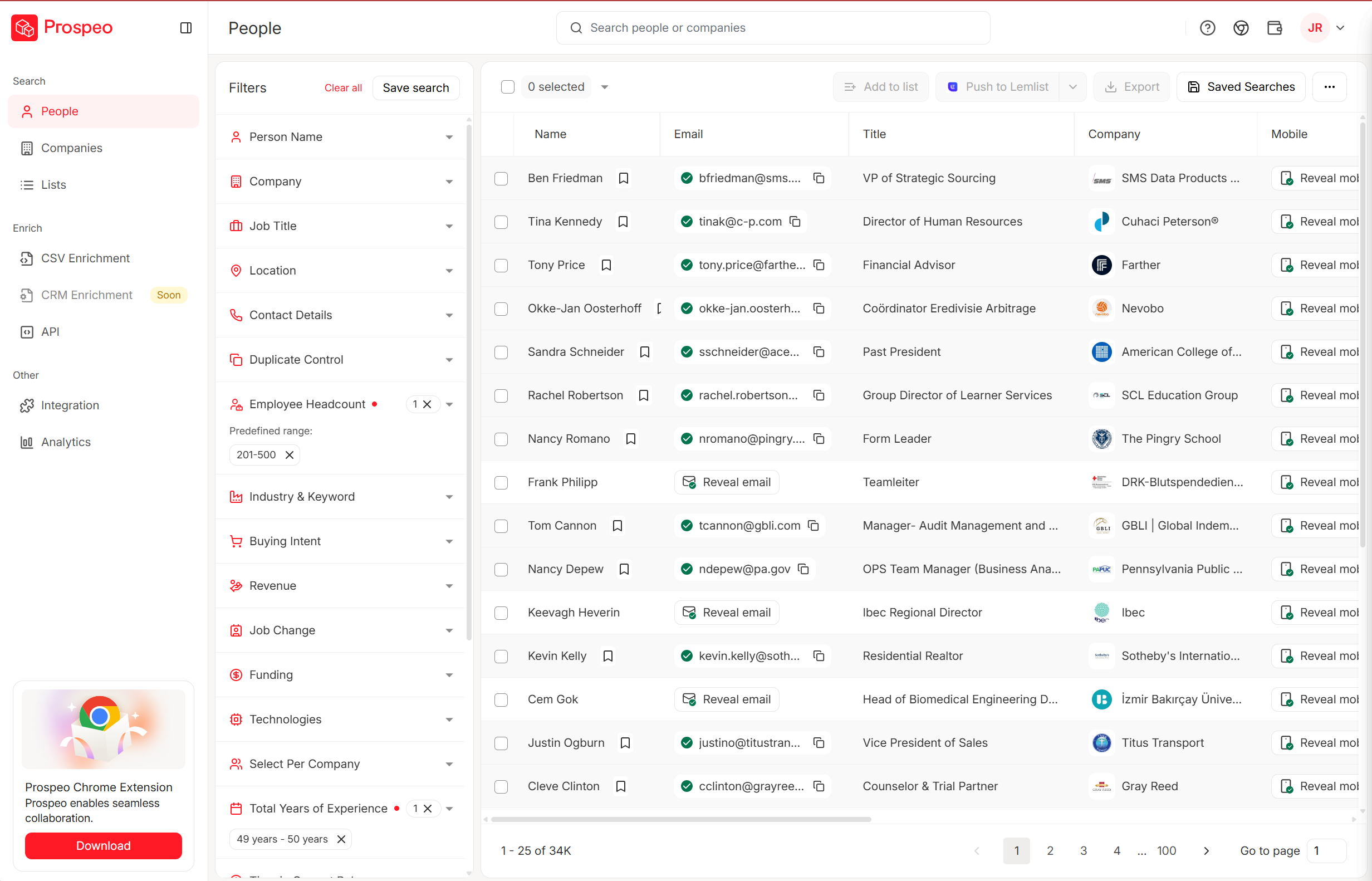
Every major intent platform - Bombora, 6sense, Demandbase - delivers account-level data. None deliver verified contact data for the buying committee. That's where you need an enrichment layer. Prospeo tracks 15,000 intent topics via Bombora, so you can filter by signal strength and job role in a single search, then export verified emails and direct dials for the actual decision-makers. (If you’re pressure-testing data quality, compare options in our guide to the best verified contact databases.)
The workflow looks like this: account surges in your intent platform, you search the buying committee with intent + role filters, export verified emails and direct dials, then trigger your sequence within hours - not days. When multiple stakeholders at the same company show group-level research activity across several departments, that's a strong indicator a formal evaluation is underway. Move fast. (To tighten execution, standardize your sales outreach strategy and sequence rules.)
One more thing worth flagging: intent data isn't just for net-new pipeline. Teams using it for churn prediction - monitoring when existing customers start researching competitors - report catching at-risk accounts weeks before renewal conversations. Layer customer success alerts on top of the same scoring framework and you've got an early warning system that pays for itself. (If retention is a priority, pair this with a playbook on how to prevent churn.)
You don't need a $50K platform to operationalize intent. Prospeo gives you verified buying committee contacts at ~$0.01/email with 30+ filters including intent, technographics, job changes, and headcount growth - no contracts, no sales calls.
Enrich surging accounts with contacts that actually connect.
Privacy and Compliance Essentials
88% of advertisers say privacy regulations impact their ability to deliver personalized outreach. Skip this section at your own risk - here are the non-negotiables:
- GDPR: Requires explicit consent or legitimate interest, data minimization, and clear privacy notices.
- CCPA/CPRA: Mandate opt-out mechanisms and disclosure of data categories shared with third parties.
- Double opt-in: Best practice for email-based activation - simple forms, clear value exchange.
- Vendor transparency: Demand your intent provider disclose data sources and provide signal URLs. If they won't, that's a red flag.
FAQ
Do intent signals actually predict closed deals?
They correlate but don't predict alone. Dreamdata found G2-influenced deals averaged 2x larger deal values. You need multi-touch attribution to see this - single-touch models systematically undercount intent signal influence. Layer firmographic and technographic filters to improve predictive accuracy.
What's the difference between account-level and contact-level intent?
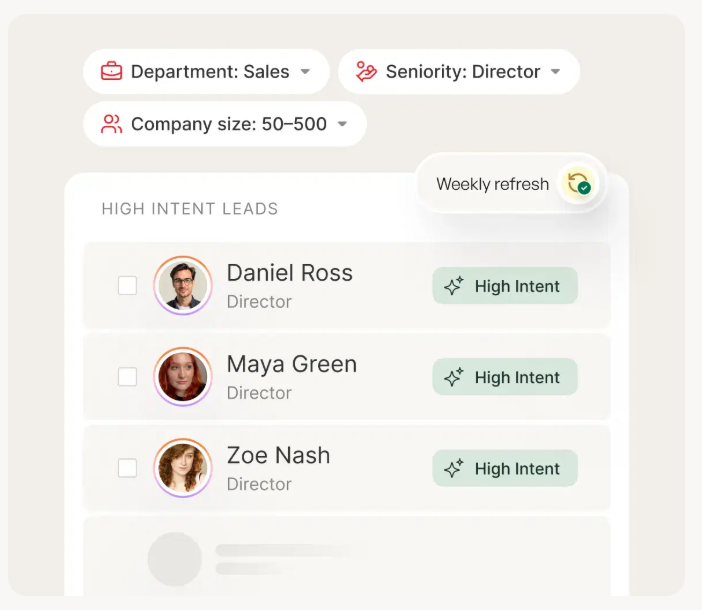
Account-level intent tells you a company is researching your category - useful for prioritizing which accounts to pursue. Contact-level intent ties research activity to specific individuals, giving reps a name and role. Most third-party providers only offer account-level data, so you need an enrichment tool to bridge the gap with verified emails and direct dials.
Can you build an intent program without a $25K+ platform?
Yes. Start with first-party signals - website analytics, CRM scoring, product usage. Layer in G2 Buyer Intent (~$10K/year) when you're ready. Enrich surging accounts with self-serve tools at a fraction of enterprise pricing. Add Bombora or 6sense only after you've proven you can act on cheaper tiers.
How fast should you act on a hot signal?
Within hours, not days. Speed-to-lead data consistently shows response times under 5 minutes convert at dramatically higher rates. Set up Slack alerts or real-time routing so hot signals trigger immediate SDR action, not a next-morning CSV export.