

Deal Progression: How to Structure, Measure, and Fix Your Pipeline
The enterprise buyer who loved your demo three months ago just asked you to "circle back in a few weeks." Again. Your CRM says the deal is in "Proposal" stage. Your gut says it's dead. That gap between CRM fiction and reality is what happens when deal progression runs on rep optimism instead of objective criteria.
The Short Version
- 5-7 stages with objective exit criteria tied to your sales methodology. Every stage transition requires buyer-side evidence, not a button click.
- Benchmark everything. Deals over $60K average around 180 days to close. 40-60% of pipeline is lost to "no decision" - not competitors.
- Diagnose stalls with deal age + MAPs. Flag deals exceeding 1.5x average time-in-stage. Mutual Action Plans drive a 26% higher win rate.
What Is Deal Progression?
Deal progression is the structured movement of an opportunity through defined pipeline stages, from first qualified conversation to closed-won or closed-lost. It's the operational backbone governing your forecast accuracy, coaching conversations, and resource allocation.
When progression criteria are vague, your pipeline becomes a wish list. When they're objective, it becomes a planning tool. That's the whole game.
Why Your 2020-Era Pipeline Stages Don't Work Anymore
Three stats tell the story. 89% of B2B buyers had a deal stall in the past year. 84% of reps missed quota. And buying committees now involve 6-10 people.
Buyers spend only 17% of their buying time meeting with potential suppliers. The other 83% happens in channels you don't control - internal Slack threads, peer reviews, analyst reports, group chats you'll never see. Meanwhile, 80% of B2B sales interactions occur in digital channels. If your deal stages assume a linear, seller-driven process, you're measuring a reality that no longer exists.
Common Deal Stages
Most B2B teams land somewhere between 5 and 9 stages. The "7 stages, give or take two" rule holds up well in practice. One thread on r/sales lays out a clean board: Demo Booked, Demo Completed, Proposal Stage, Contract Sent, Signature Received, Closed Won.
Here's a typical framework with probabilities mapped to HubSpot's defaults so you get a sane starting point for weighted pipeline:
| Stage | Key Activity | Exit Criteria | Probability |
|---|---|---|---|
| Qualification | Confirm fit + pain | Budget + authority verified | 20% |
| Discovery | Map needs + stakeholders | Economic buyer identified | 40% |
| Proposal | Present solution + pricing | Proposal reviewed and approved | 60% |
| Negotiation | Terms + procurement | Legal/procurement engaged | 80% |
| Contract Sent | Final signatures | Signed agreement + start date | 90% |
| Closed Won | Handoff to CS | - | 100% |
Some teams add a Post-Close/Onboarding stage to track handoff quality and upsell pipeline. If your net revenue retention matters - and it should - this stage pays for itself in visibility.
Calibrate probabilities against your actual conversion data after two quarters. Don't treat these as gospel.

40-60% of pipeline dies to "no decision" - often because reps are single-threaded on a contact who's gone quiet or left the company. Prospeo's 300M+ profiles with 30+ filters let you multi-thread into every account, finding economic buyers and champions with 98% verified emails.
Stop losing deals to contacts who ghosted. Find every stakeholder in the buying committee.
Exit Criteria Teams Can Actually Enforce
Here's the thing: if your reps can advance a deal by clicking a button without proving anything changed on the buyer's side, your pipeline is fiction. 55% of sales leaders attribute lost revenue directly to undefined sales processes.
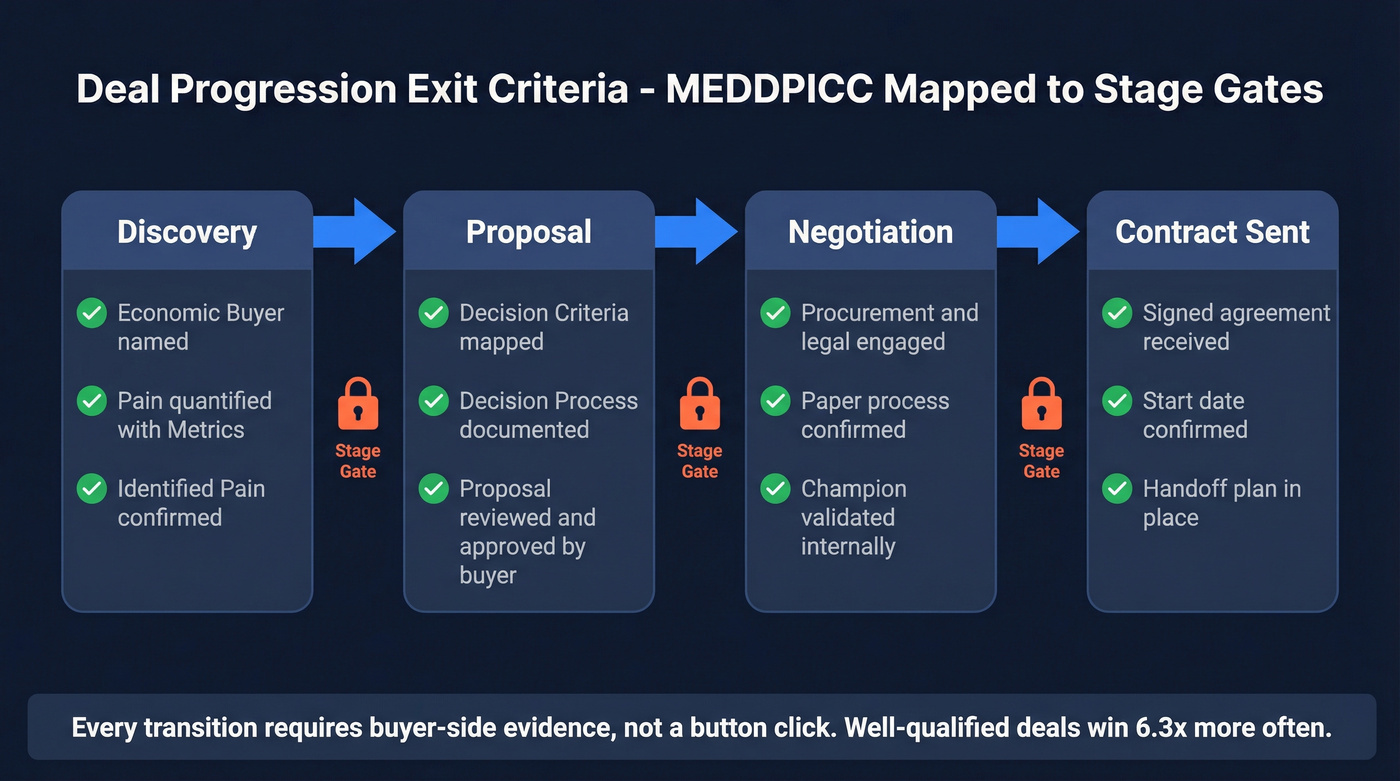
The fix is mapping your sales methodology to stage gates. Using MEDDPICC as the framework:
- Discovery to Proposal: Confirm the Economic Buyer and pain (Metrics + Economic Buyer + Identified Pain). If the rep can't name the person who signs the check, the deal doesn't move. (If you need a tighter definition, start with Economic Buyer.)
- Proposal to Negotiation: Decision Process and Decision Criteria are mapped. The buyer has reviewed and approved the proposal - not just received it.
- Negotiation to Contract: Procurement and legal are actively engaged. Paper process is confirmed.
Enterprise reps in new markets regularly see 9-12 month cycles. Without objective stage gates, they can't distinguish a slow deal from a dead one. For SMB with shorter cycles, BANT works fine. The principle is the same: every transition requires evidence, not vibes. Well-qualified deals win 6.3x more often than poorly qualified ones.
Benchmarks That Matter
Cycle length sets expectations for everything else.
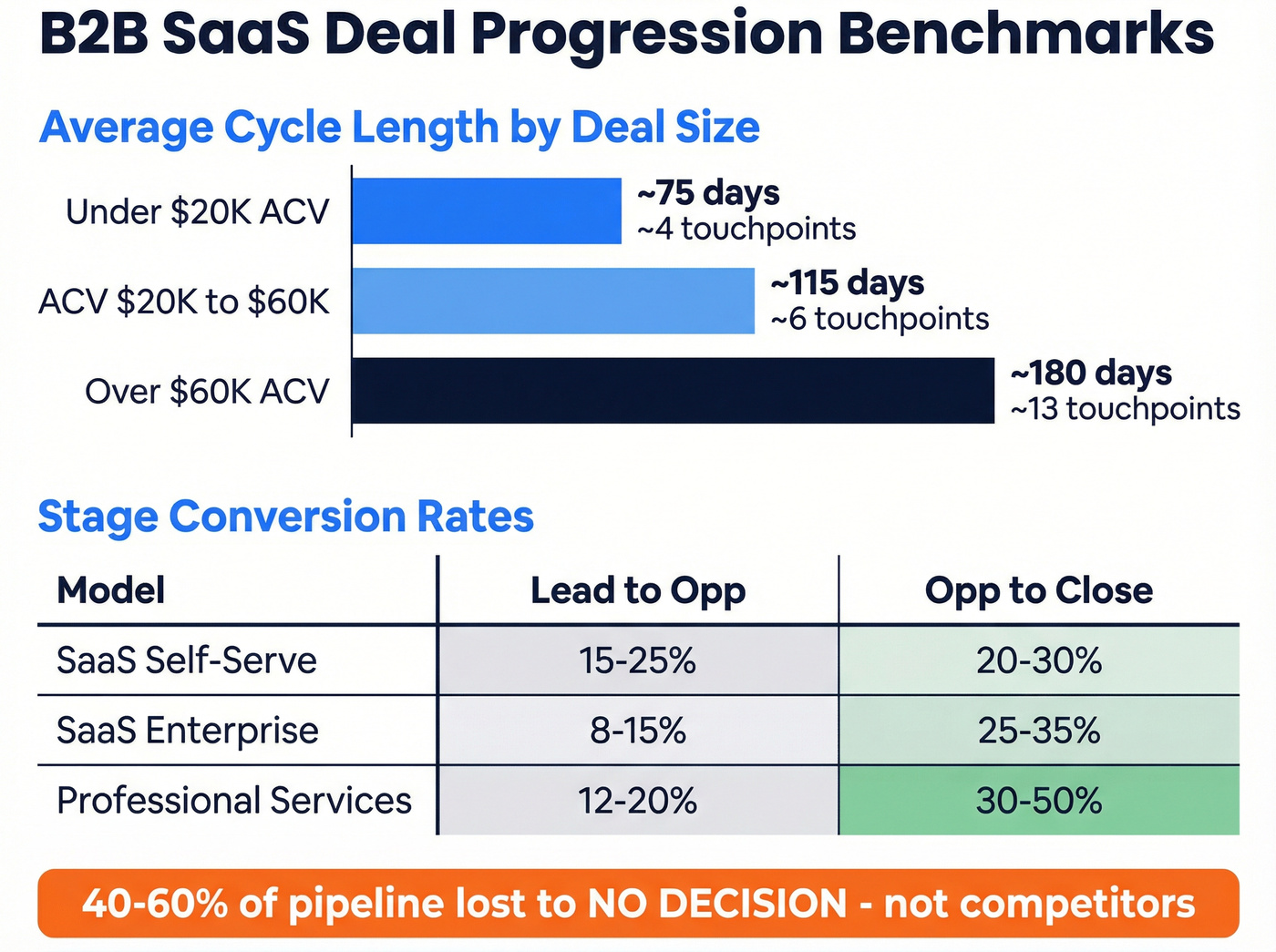
| ACV Tier | Avg. Cycle Length | Human Touchpoints |
|---|---|---|
| < $20K | ~75 days | ~4 |
| $20K-$60K | ~115 days | ~6 |
| > $60K | ~180 days | ~13 |
Stage conversion benchmarks vary by model:
| Model | Lead to Opp | Opp to Close | Overall |
|---|---|---|---|
| SaaS B2B (self-serve) | 15-25% | 20-30% | 3-7% |
| SaaS B2B (enterprise) | 8-15% | 25-35% | 2-5% |
| Professional services | 12-20% | 30-50% | 4-10% |
To quantify pipeline velocity, use the standard formula: Sales Velocity = (Opportunities x Avg Deal Size x Win Rate) / Cycle Length. A worked example: 100 opps x $10K x 0.20 / 50 days = $4,000/day in pipeline throughput. That single number tells you more about pipeline health than any stage-by-stage report (and it pairs well with a broader pipeline health view).
Now here's the stat that should haunt every sales leader: 40-60% of deals are lost to "no decision". Not to a competitor. To inertia. Your progression framework needs to account for that reality.
Let's be honest - most teams don't have a "closing" problem. They have a qualification problem wearing a closing costume. If half your pipeline dies to inertia, your stage-one criteria are too loose.
Why Deals Stall (and How to Fix Them)
Four root causes drive most stalls:
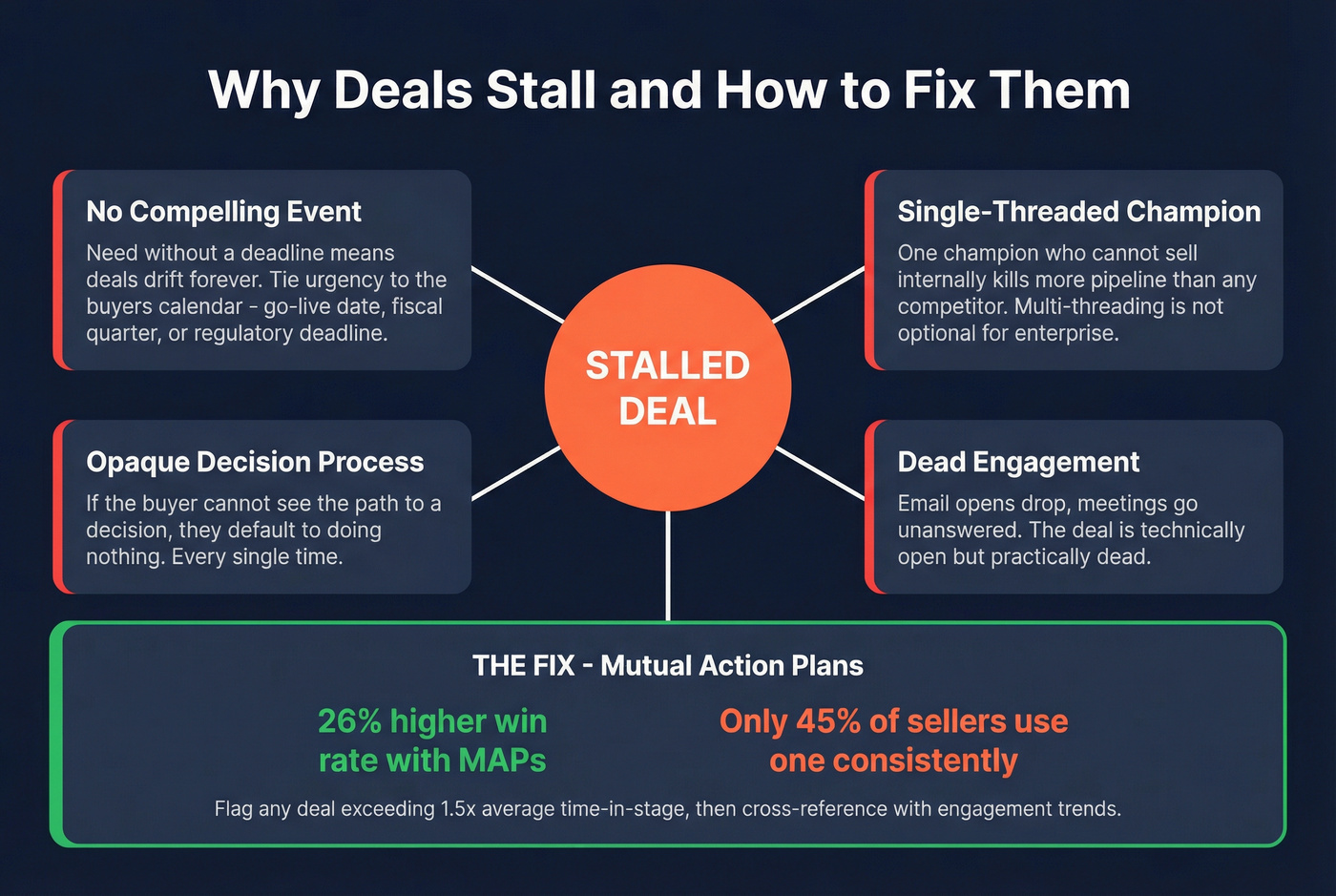
No compelling event. Need without a deadline means deals drift. Tie urgency to the buyer's calendar - a go-live date, fiscal quarter, or regulatory deadline.
Single-threaded champion. Multi-threading isn't optional for enterprise deals. One champion who can't sell internally kills more pipeline than any competitor ever will. (If you're building this motion, start with account-based selling.)
Opaque process. If the buyer can't see the path to a decision, they default to doing nothing. Every time.
Dead engagement. Email opens drop, meetings go unanswered. The deal is technically "open" but practically dead - and sometimes the contact has simply left the company or changed roles without anyone noticing.
The diagnostic is straightforward: flag any deal exceeding 1.5x the average time-in-stage, then cross-reference with engagement trends. If both are declining, intervene or disqualify. When a deal isn't ready for stage advancement, forcing it forward only inflates your pipeline with fiction.
The primary fix? Mutual Action Plans. Deals where AEs use a MAP show a 26% higher win rate, yet only 45% of sellers consistently use one. 77% of buyers say B2B buying is "too complex" - a MAP simplifies it with a shared timeline, milestones, and owners. We've all seen the classic enterprise stall on r/sales: the buyer loves the product, asks you to reach back out in a few weeks, and the deal becomes a months-long friendly back-and-forth that never closes. A MAP prevents this by making "what happens next" explicit from day one.
CRM Implementation Tips
Stop obsessing over adding more stages. Start obsessing over enforcing the ones you have.
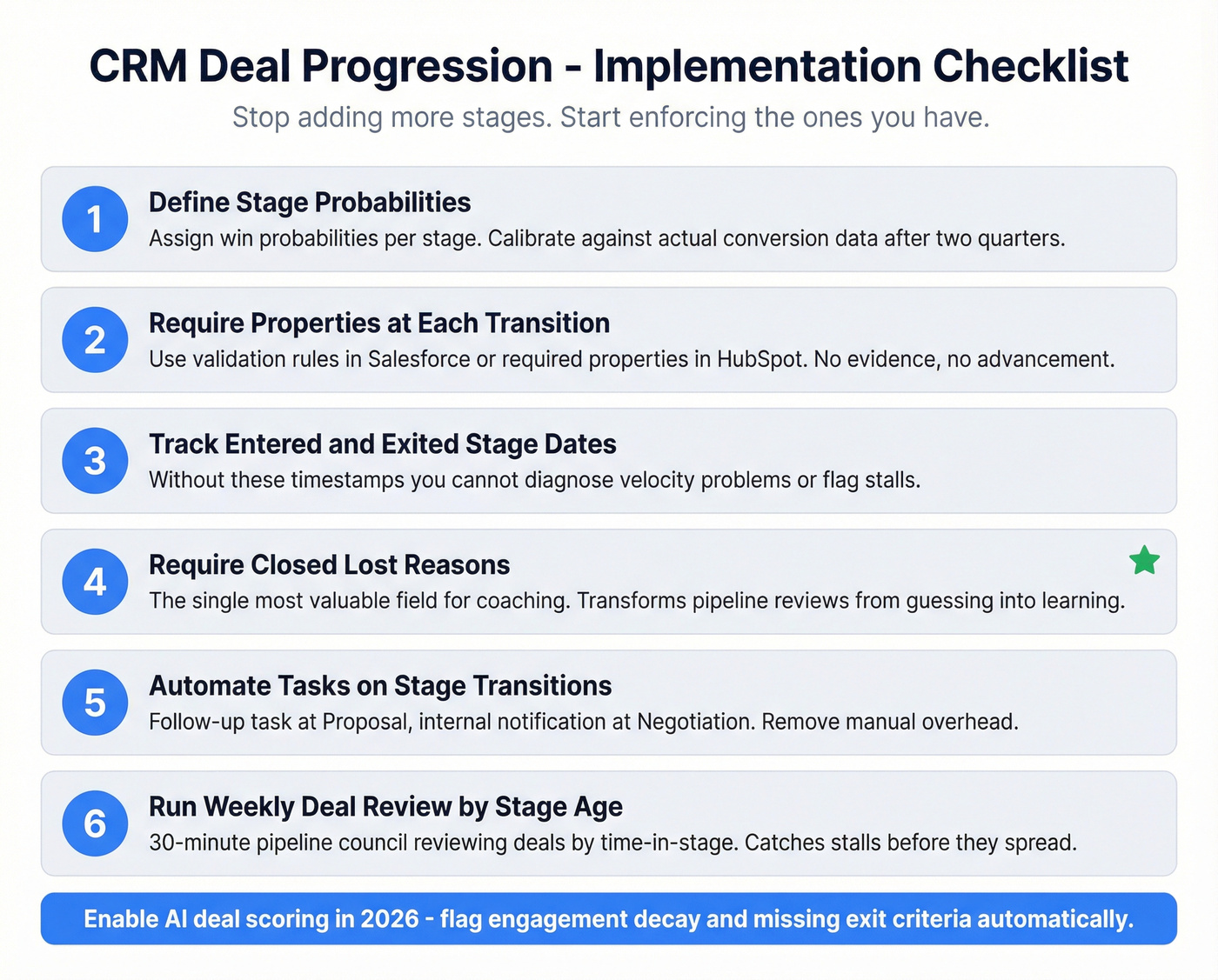
In HubSpot, go to Settings, Objects, Deals, Pipelines. Define stages, assign probabilities, and require properties at each transition. Require a Closed Lost reason - it's the single most valuable field for coaching and we've found it transforms pipeline reviews from guessing games into actual learning sessions.
In Salesforce, use validation rules to enforce required fields before stage advancement. Enable Path to surface per-stage guidance directly in the opportunity record.
Track Entered Stage Date and Exited Stage Date to measure time-in-stage. Without these, you can't diagnose velocity problems. Automate task creation on stage transitions - a follow-up task at "Proposal," an internal notification at "Negotiation." (If you need messaging that actually gets replies, keep sales follow-up templates handy.)
Establish a weekly deal review cadence with cross-functional stakeholders. A 30-minute pipeline council that reviews deals by stage age catches stalls before they spread. In our experience, the teams that run these religiously are the ones whose forecasts actually hold up at quarter-end. (This is also where sales operations metrics make reviews objective.)
If your CRM supports AI-powered deal scoring, turn it on. There's no reason in 2026 to manually guess which deals are at risk when your system can flag engagement decay and missing exit criteria automatically. If you're evaluating tooling, start with sales forecasting solutions.
The Data Problem Quietly Killing Your Pipeline
The biggest threat to healthy deal progression isn't your sales process - it's your data. When a meaningful chunk of your outbound emails bounce, your pipeline fills up with unreachable contacts, fake follow-ups, and deals that look "stalled" but are really just disconnected.
This is where contact data quality stops being a nice-to-have. Prospeo's 98% email accuracy and 7-day data refresh cycle mean far more of your CRM opportunities represent reachable humans, not dead inboxes. You can re-verify stale contacts in bulk before writing off a deal as lost. Pair that with a CRM enrichment workflow and you catch phantom pipeline before it corrupts your forecast. (If you're comparing vendors, see data enrichment services.)

Your exit criteria demand buyer-side evidence, but stale data makes that impossible. Prospeo refreshes every 7 days - not 6 weeks - so you know when champions change roles, new budget holders arrive, or org charts shift mid-cycle. 92% enrichment match rate across your CRM.
Dead data kills deal progression faster than any competitor. Fix it at the source.
FAQ
What's the difference between deal stages and a sales cycle?
Stages are discrete milestones within a cycle; the sales cycle is total elapsed time from first qualified touch to close. The same six stages can span 75 days for a $15K deal or 180+ days for a $60K+ enterprise opportunity. Think of stages as checkpoints confirming real buyer commitment, while the cycle measures the clock.
How many deal stages should I have?
Five to seven for most B2B teams. Fewer than five hides where deals actually stall; more than nine creates friction without adding diagnostic clarity. Start with six, then split or merge stages after two quarters of conversion data. Skip this advice if you're running a transactional sales motion with sub-$5K deals - three or four stages are plenty there.
How do I handle deals stuck in one stage too long?
Flag anything exceeding 1.5x average time-in-stage. Verify contacts are still reachable, confirm the right stakeholder is engaged, and check for a compelling event. Sometimes a "stalled" deal is just a bounced email away from reactivation - we've seen teams revive 10-15% of "dead" pipeline just by re-verifying contact data.
What tools help track deal progression automatically?
CRMs like HubSpot and Salesforce handle stage management natively - use validation rules and required fields to enforce exit criteria. Layer in deal intelligence platforms like Salesloft or Gong for engagement signals. For contact accuracy, Prospeo's CRM enrichment returns 50+ data points per contact at a 92% match rate, ensuring the people in your pipeline are still reachable.