

Deal Sourcing for Private Equity Firms: The 2026 Playbook
A RevOps lead at a lower middle-market fund told us last quarter that 70% of his week was building lists, finding emails, and sending cold outreach that gets ignored. That's not sourcing. That's data entry with a finance salary.
Deal sourcing for private equity firms has always been competitive, but the math is getting worse. With $1.2 trillion in buyout dry powder - nearly a quarter of it sitting for four or more years - every fund is hunting the same founder-owned businesses. The firms that win aren't smarter about deal evaluation. They're faster and more systematic about sourcing.
The Short Version
- Proprietary outreach beats auction-heavy intermediated flow on returns. Build a 500-1,000 company target list within a tight thesis, then work it systematically.
- The contact data layer is where most sourcing workflows break. Use a tool like Prospeo to get verified emails and direct dials instead of Googling for days.
- You need exactly 4 tools that connect: one company database, one contact data platform, one CRM, one outreach tool. That's it.
- Track funnel conversion at every stage. Expect roughly 1-2 closed deals per 80-100 opportunities screened.
Why Sourcing Is Harder Than Ever
The macro picture looks deceptively healthy. 2024 buyout investment value hit $602 billion, up 37% year-over-year. But the numbers underneath are rougher - April 2025 deal value dropped 24% below the Q1 monthly average, with deal count falling 22%. Even liquidity is being manufactured: 30% of buyout-portfolio companies have had some liquidity event, with $410B raised through minority stakes, dividend recaps, secondaries, and NAV loans.
McKinsey's 2026 private markets review frames the environment bluntly. The prior tailwinds - declining rates, multiple expansion, abundant leverage - have passed. Alpha now comes from discipline on entry multiples, operational value creation, and smarter sourcing.
That last piece is where most firms underinvest. They'll spend $50K on PitchBook and $80K on DealCloud, then have an associate manually Googling CEO email addresses.
What PE Deal Sourcing Really Means
Firms screen roughly 80-100 opportunities for every closed deal. That ratio defines what this process actually is - not a concept, but an operational engine that needs to generate qualified opportunities consistently, not in bursts when a banker sends a teaser, but as a steady, repeatable pipeline.
The firms that treat sourcing like a sales function - with metrics, cadences, and tooling - outperform those that treat it like networking. If your target EBITDA sits above $10M and you're still relying on banker relationships for 80%+ of your deal flow, you're overpaying for every acquisition.
The 4 Sourcing Channels
| Channel | Best For | Key Limitation |
|---|---|---|
| Intermediated | Larger deals, auction processes | Competitive; lower returns |
| Proprietary outreach | Founder-owned, off-market | Time-intensive to build |
| Network-driven | Portfolio referrals, bolt-on intros | Doesn't scale predictably |
| Inbound | Brand-driven deal flow | Requires years of reputation |
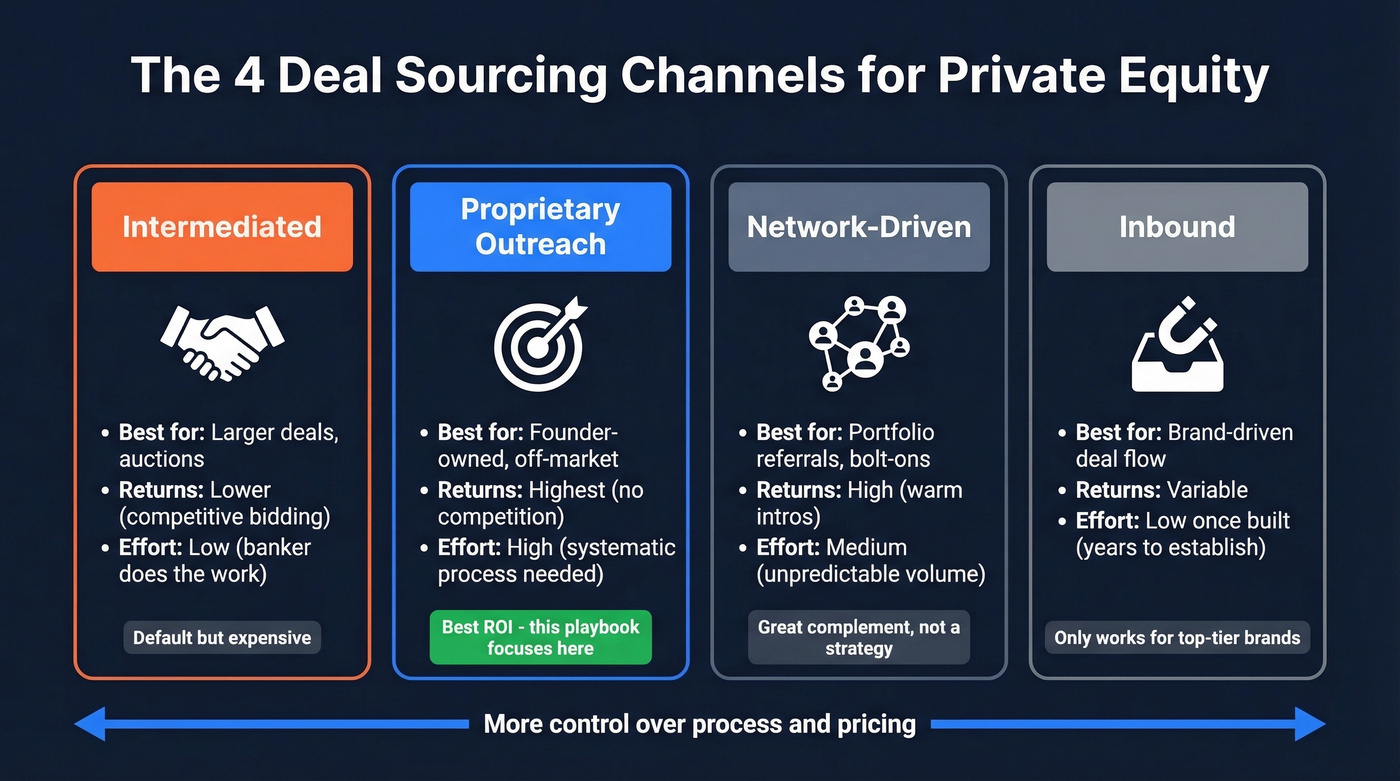
Intermediated deals - banker-led auctions - remain the default. They're efficient for larger transactions, but you're competing against every other fund that received the same teaser. Bain's 2026 PE report cites Sutton Place Strategies data showing a typical firm sees only about 18% of intermediated deals relevant to its strategy. That means 82% of opportunities never even enter your process.
Proactive proprietary sourcing - direct-to-owner contact without an intermediary - is where the best returns live. It's also the hardest to execute consistently. The rest of this playbook focuses here.
Network-driven sourcing through portfolio company referrals, conference relationships, and advisory board intros produces high-quality but unpredictable deal flow. Some firms formalize this well: EQT runs an experts-on-call network, Temasek maintains a dedicated executive network. For most funds, though, it's a complement, not a strategy.
Inbound works for firms with strong brands - think Berkshire, Vista, Thoma Bravo. For everyone else, waiting for the phone to ring isn't a plan.

Your associates are spending 70% of their week hunting for founder contact data. Upload your target company list to Prospeo and get verified emails and direct dials back - 83% match rate, 98% email accuracy, refreshed every 7 days. At $0.01 per email, that's less than your team's coffee budget.
Turn your 800-company target list into a live outreach pipeline in minutes.
How to Run Proprietary Outreach
This is where that RevOps lead's frustration lives - and where the right process turns 70% wasted time into a repeatable pipeline.
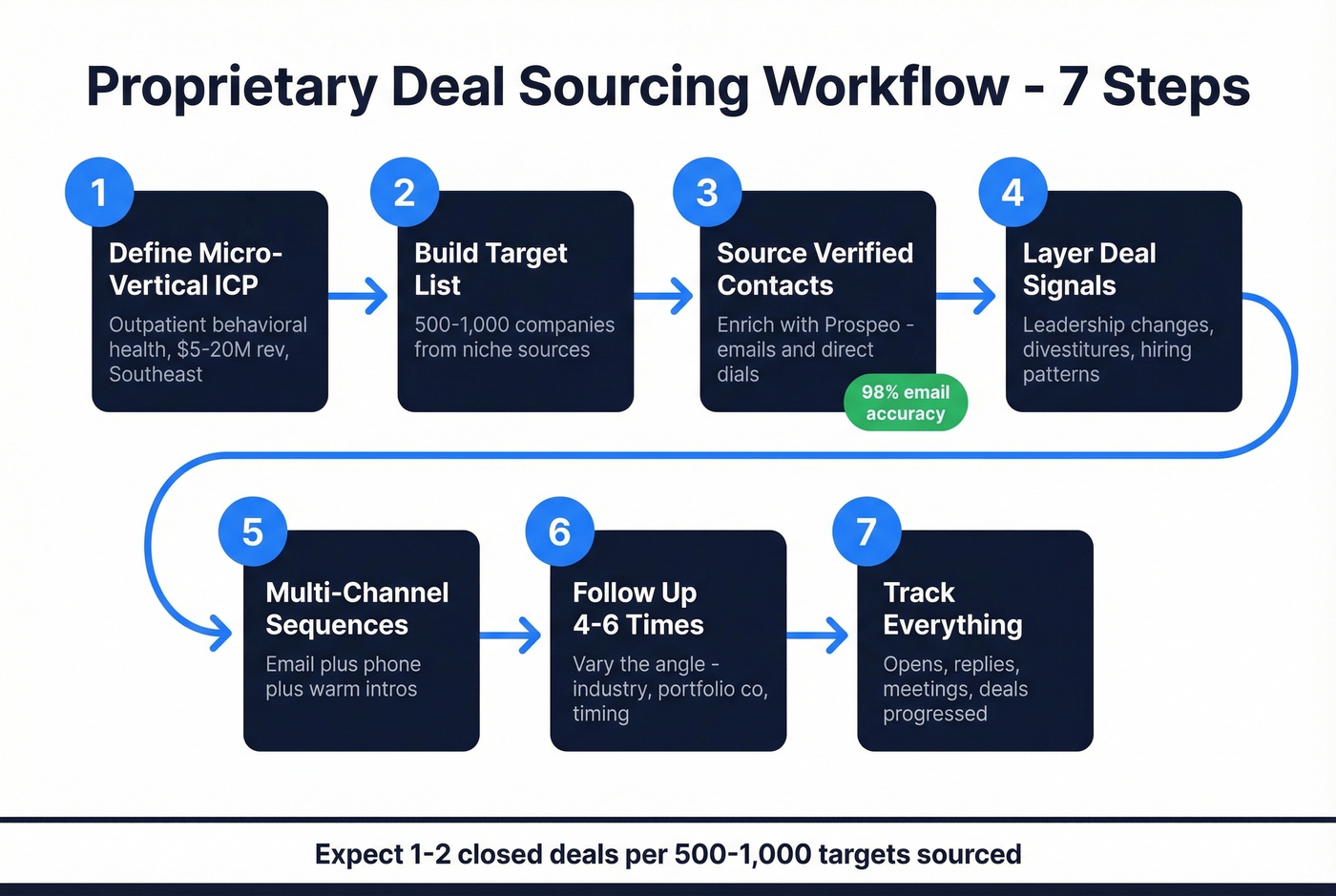
Step 1: Define Your Micro-Vertical ICP
Your investment thesis needs to translate into a sourceable target universe. "Lower middle-market healthcare services" isn't specific enough. "Outpatient behavioral health clinics with $5-20M revenue in the Southeast" is.
The tighter your micro-vertical definition, the more relevant your outreach and the higher your conversion rates. Targeting at this level of specificity - by geography, sub-sector, and revenue band - is what separates productive sourcing from generic spray-and-pray.
Step 2: Build a Target List
Start with public and niche sources: Secretary of State filings, industry association directories, SBA 504 loan records, local business journals. Layer in platforms like Grata or SourceScrub for broader coverage of private companies that PitchBook undercounts. Aim for 500-1,000 targets within your thesis - large enough to generate pipeline, small enough to work systematically.
Step 3: Source Verified Contact Data
You've got a beautiful target list of 800 companies. Now how do you actually reach the founder or CEO?
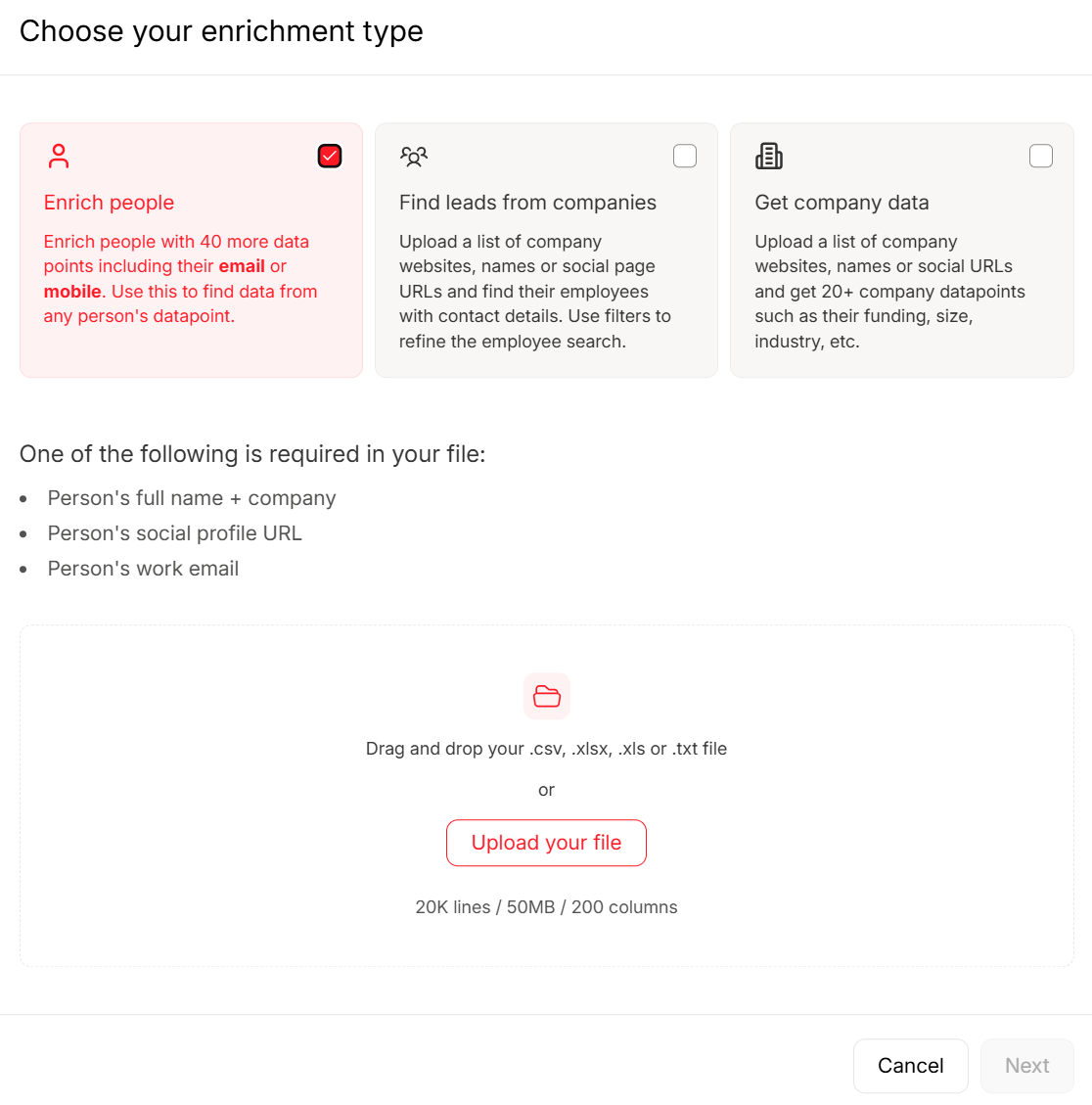
This is where most workflows fall apart. Prospeo handles this step cleanly - upload your target list as a CSV, and the enrichment engine returns verified emails and mobile numbers. With an 83% enrichment match rate and 98% email accuracy on a 7-day refresh cycle, you're not emailing addresses that went stale three months ago. At roughly $0.01 per verified email with a free tier to start, it's a fraction of what PE-specific platforms charge for contact data, and you don't need to sit through a sales demo to get started.
Step 4: Layer in Deal Signals
Raw contact data gets you to the founder. Deal signals tell you when to reach out. Monitor for leadership changes (a new CFO often signals exit planning), recent divestitures, job postings that suggest growth or distress, and regulatory shifts that create consolidation pressure. Tools like Grata and SourceScrub surface some of these signals automatically. The best outreach hits a founder's inbox the week they start thinking about succession - not six months after they've already hired a banker.
Step 5: Design Multi-Channel Sequences
Email alone won't cut it for reaching business owners. Combine email with phone calls and warm intros where possible. Keep messaging short, personal, and founder-focused. Frame the conversation around the owner's goals - their employees, their legacy, their liquidity - not your fund's platform strategy or buy-and-build thesis.
Step 6: Follow Up 4-6 Times
Most deals don't come from the first touch.
Build modular messaging blocks that vary the angle across 4-6 follow-ups: one about the owner's industry, one about a relevant portfolio company, one about timing and succession planning. Discipline here separates productive origination from the "send one email and forget" approach that plagues most PE teams. For messaging ideas, borrow from proven sales follow-up templates.
Step 7: Track Everything
Emails sent, open rates, reply rates, meetings booked, deals progressed. If you can't measure it, you can't improve it. Iterate on subject lines, segments, and timing based on real data. If you want a clean measurement framework, use standard funnel metrics to keep stages consistent.
PE deal sourcing breaks at the contact data layer. Stale emails mean bounced outreach, burned domains, and founders you never reach. Prospeo's 7-day refresh cycle and 125M+ verified mobile numbers give your team direct lines to decision-makers - no banker intermediary, no guessing.
Reach founders directly before they hire a banker.
What a Real Sourcing Funnel Looks Like
One Reddit practitioner at a firm with EUR800M AUM described their process: 150+ hours per month on sourcing, targeting 5-20M enterprise value platform deals. Their funnel runs roughly 50 meetings per month, narrowing to 15 interesting companies, 3 entering due diligence, and 1-2 closed deals. Their tools: PitchBook, Crunchbase, Orbis. They described the process as "manual and not automated."
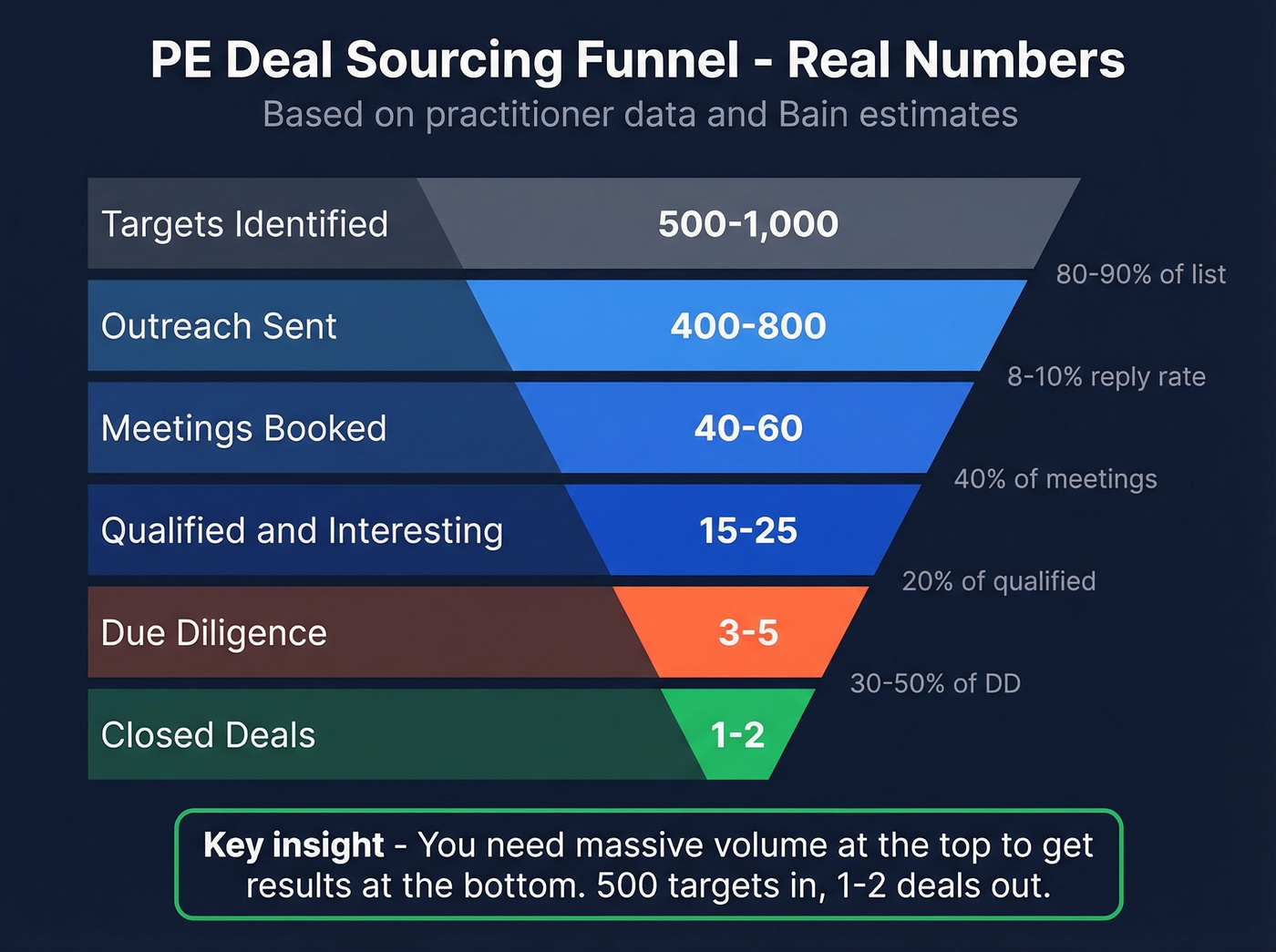
That funnel math aligns with Bain's broader estimates: for every 100 potential targets that enter the funnel, only 1 or 2 result in a closed deal.
| Stage | Volume | Conversion |
|---|---|---|
| Targets identified | 500-1,000 | - |
| Outreach sent | 400-800 | 80-90% of list |
| Meetings booked | 40-60 | ~8-10% reply rate |
| Interesting / qualified | 15-25 | ~40% of meetings |
| DD initiated | 3-5 | ~20% of qualified |
| Closed deals | 1-2 | ~30-50% of DD |
These numbers vary by thesis, deal size, and geography, but the shape of the funnel is remarkably consistent across firms we've talked to. You need volume at the top to get results at the bottom.
5 Mistakes That Kill Your Pipeline
1. Diffuse targeting. Your thesis says "healthcare services" but your target list includes everything from dental practices to home health agencies to medical device distributors. When the ICP is too broad, outreach feels generic and conversion craters. If you need a tighter definition, start with an ideal customer profile scoring rubric.
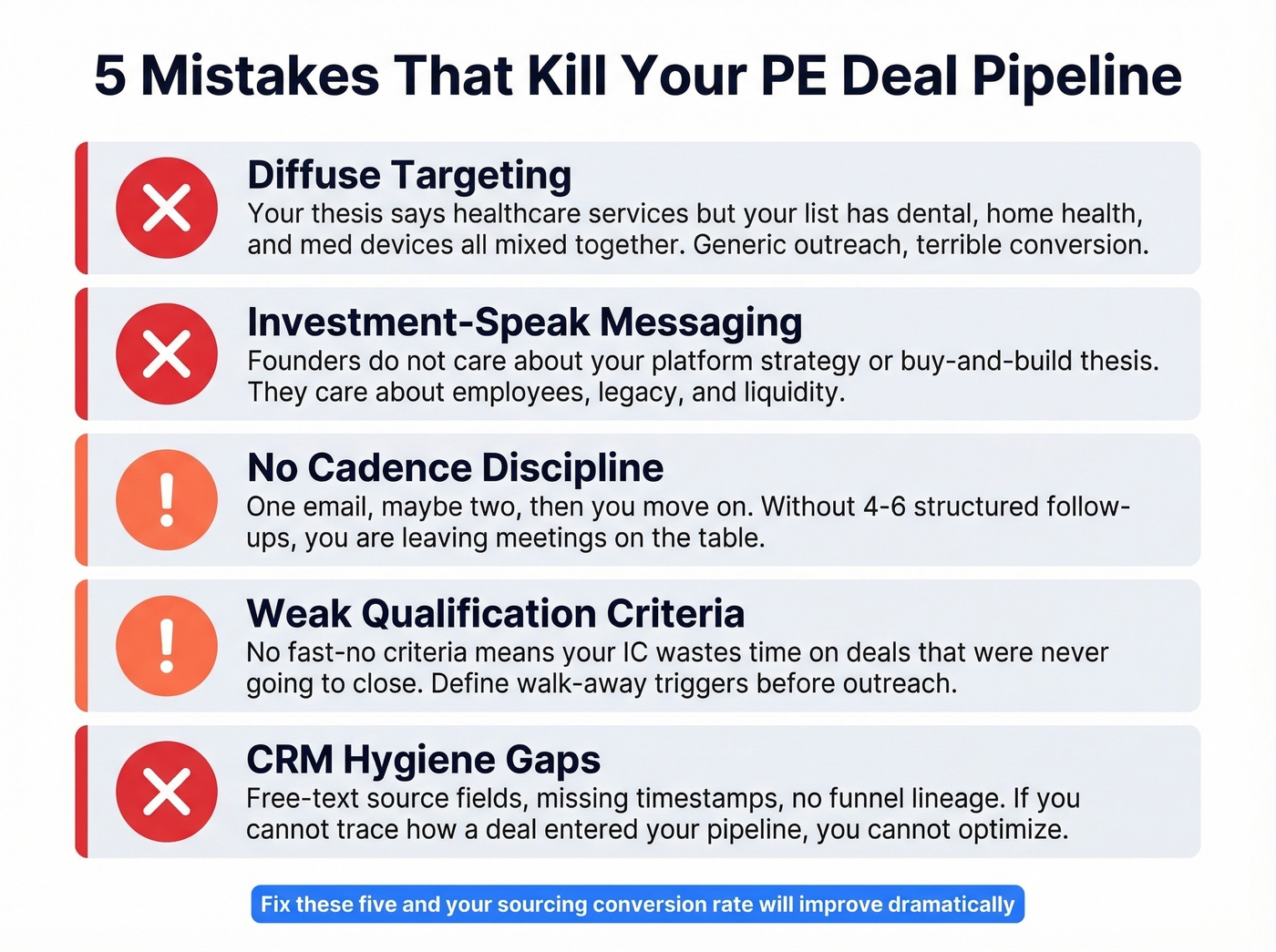
2. Investment-speak messaging. Founders don't care about your "platform strategy" or "buy-and-build thesis." They care about their employees, their legacy, and their liquidity. If your first email reads like an IC memo, it's getting deleted. If your team needs a refresher on writing outreach that converts, use these sales prospecting techniques.
3. No cadence discipline. Here's the thing - most firms send one email, maybe two, then move on. Without standardized follow-up sequences and SLAs for response times, you're leaving meetings on the table. The Umbrex origination framework calls this out as one of the most common failure modes.
4. Weak qualification criteria. Without clear "fast no" criteria, your investment committee wastes time on deals that were never going to close. Define your walk-away triggers early - revenue floor, EBITDA margin threshold, owner age, geographic limits - and enforce them before outreach begins, not after you've already booked the meeting.
5. CRM hygiene gaps. Free-text source fields, missing timestamps, no funnel lineage from teaser to NDA to CIM to LOI. If you can't trace how a deal entered your pipeline and how it progressed, you can't optimize the process. Attribution matters as much in PE origination as it does in marketing. If you're standardizing your system, start by aligning on examples of a CRM and the fields you actually need.
Build Your Tech Stack
You don't need 10 tools. You need 3-4 that actually connect. Most PE teams over-invest in databases and under-invest in the contact data and outreach layers that actually generate meetings.

Company Databases
PitchBook ($20K-60K/year) is the default, but it undercounts private, founder-owned businesses - exactly the targets most proprietary sourcing programs pursue. Grata ($15K-40K/year) and SourceScrub ($10K-30K/year; 15M+ company profiles) are purpose-built for finding private companies by industry, geography, and financial profile. Orbis is widely used for international company coverage at enterprise-level pricing that varies by module and geography. Inven's 430M+ professionals database is massive, though users report roughly 50/50 accuracy on revenue data.
Contact Data
This is the layer most PE sourcing stacks skip entirely - and it's the one that determines whether your outreach actually reaches anyone. Prospeo stands out here for a specific reason: transparent, self-serve pricing in a category dominated by "call us for a quote" enterprise sales processes. Native integrations with Salesforce, HubSpot, Smartlead, Instantly, Lemlist, Clay, Zapier, and Make mean the data flows directly into your existing stack without manual CSV juggling. If you're comparing vendors, start with this overview of data enrichment services.
CRM
DealCloud from Intapp ($30K-100K+/year) dominates for multi-stage pipeline management, IC-gate workflows, and reporting discipline. Affinity ($2K-4K/month) wins on relationship intelligence - it mines email and calendar data to surface your firm's network connections to a target. Dynamo ($20K-50K/year) sits in the middle. Navatar is Salesforce-native, adding a PE-specific layer on top of your existing Salesforce licensing. Juniper Square makes sense when your CRM needs extend into LP/IR workflows, with pricing that scales by AUM and LP count.
Outreach and Intermediary Tools
For sequencing, pick whichever tool your team prefers - Smartlead, Instantly, and Lemlist all run $30-300/month and handle multi-step email campaigns well. The key is that verified contact data flows directly into your sending tool without manual exports. If you're building a modern outbound motion, use a dedicated SDR tool to keep sequences, tasks, and reporting in one place.
On the intermediary side, Axial connects PE firms with advisor-represented deal flow in the lower middle market. DealSuite focuses on EU and cross-border M&A with a network of 1,500+ companies active in M&A. These supplement proprietary outreach - they don't replace it. Some firms also use intermediary platforms for prospecting banks and other financial advisors who represent sell-side mandates in their target sectors.
For firms that want to outsource sourcing entirely, managed origination services handle list building, outreach, and meeting setting at $5K-15K/month. Viable for lean teams, but you lose control over messaging and relationship quality. Skip this if you're building a long-term proprietary sourcing advantage - the whole point is owning the relationships.
| Category | Top Tools | Price Range | Best For |
|---|---|---|---|
| Company database | PitchBook, Grata, SourceScrub | $10K-60K/yr | Target identification |
| Contact data | Prospeo | Free-$0.01/email | Verified emails + mobiles |
| CRM | DealCloud, Affinity, Dynamo | $24K-100K+/yr | Pipeline + relationships |
| Outreach | Smartlead, Instantly, Lemlist | $30-300/mo | Sequenced campaigns |
| Intermediary | Axial, DealSuite | Varies | Advisor deal flow |
| Managed services | Various | $5K-15K/mo | Outsourced origination |
AI in PE Sourcing - What's Real
49% of dealmakers now use AI tools nearly every day, per a SourceScrub survey cited by Grata. That tracks with what we're seeing in practice. The concrete use cases that actually work: thesis validation against large datasets, automated target screening based on financial and firmographic criteria, and deal signal monitoring for leadership changes, revenue milestones, and regulatory events. (If you're operationalizing signals, this guide on how to track sales triggers maps well to PE sourcing.)
What AI can't do: build the relationship with a 62-year-old founder who's thinking about succession for the first time. It can't read seller motivation in a phone call. It can't navigate the emotional complexity of a family business transition.
Let's be honest about where the real edge is. The firms winning proprietary deals in 2026 aren't the ones with the fanciest AI screening tools. They're the ones that use technology to narrow 10,000 companies to 500, then apply human judgment and relationship skills to convert those 500 into meetings and management buyouts. Most PE firms would get more ROI from hiring one dedicated sourcing associate with good outreach instincts than from any six-figure AI platform.
FAQ
What is deal sourcing for private equity firms?
Deal sourcing is the systematic process of identifying, qualifying, and initiating contact with acquisition targets that fit a fund's investment thesis. It spans four channels - proprietary outreach, intermediary relationships, network referrals, and inbound interest - and converts raw opportunities into closed transactions through a disciplined funnel.
How many deals does a PE firm screen per investment?
Firms typically review 80-100 opportunities for every closed deal. One practitioner at an EUR800M AUM firm reports roughly 50 meetings per month yielding 15 qualified companies, 3 entering due diligence, and 1-2 closed transactions. The exact ratio depends on deal size and thesis specificity.
What tools do PE firms use for sourcing?
Four core layers: a company database like PitchBook, Grata, or SourceScrub for target identification; a contact data platform like Prospeo for verified emails and mobile numbers at $0.01/lead; a CRM like DealCloud or Affinity for pipeline management; and outreach automation through Smartlead, Instantly, or Lemlist.
How do you measure sourcing effectiveness?
Track funnel conversion at every stage: targets identified, outreach sent, meetings booked, due diligence initiated, LOIs submitted, and deals closed. Also measure source attribution - what percentage of closed deals came from proprietary outreach versus intermediated flow - and cost per closed deal by channel. The firms that measure rigorously improve fastest.
What's the biggest mistake in PE deal origination?
Diffuse targeting. Firms that define their thesis as "healthcare services" instead of a specific sub-sector, revenue band, and geography produce generic outreach that converts at a fraction of the rate. Tighten your ICP to 500-1,000 companies and work the list systematically.