

Demand Generation Solutions: What They Cost, What Works, and What to Skip in 2026
The average B2B company runs 12-20 martech tools. A third of teams admit they aren't using their full stack capabilities. That's not a stack - it's a graveyard of annual contracts.
Here's how to pick the right demand generation solutions and build an engine that actually produces pipeline, with real pricing so you can skip the "let's hop on a call" dance.
What Demand Gen Actually Does
Demand generation is the full-funnel engine that creates awareness, builds trust, and converts interest into qualified pipeline. It's not lead gen. Lead gen captures contact info from people who already raised their hand. Demand gen is the reason they raised it.
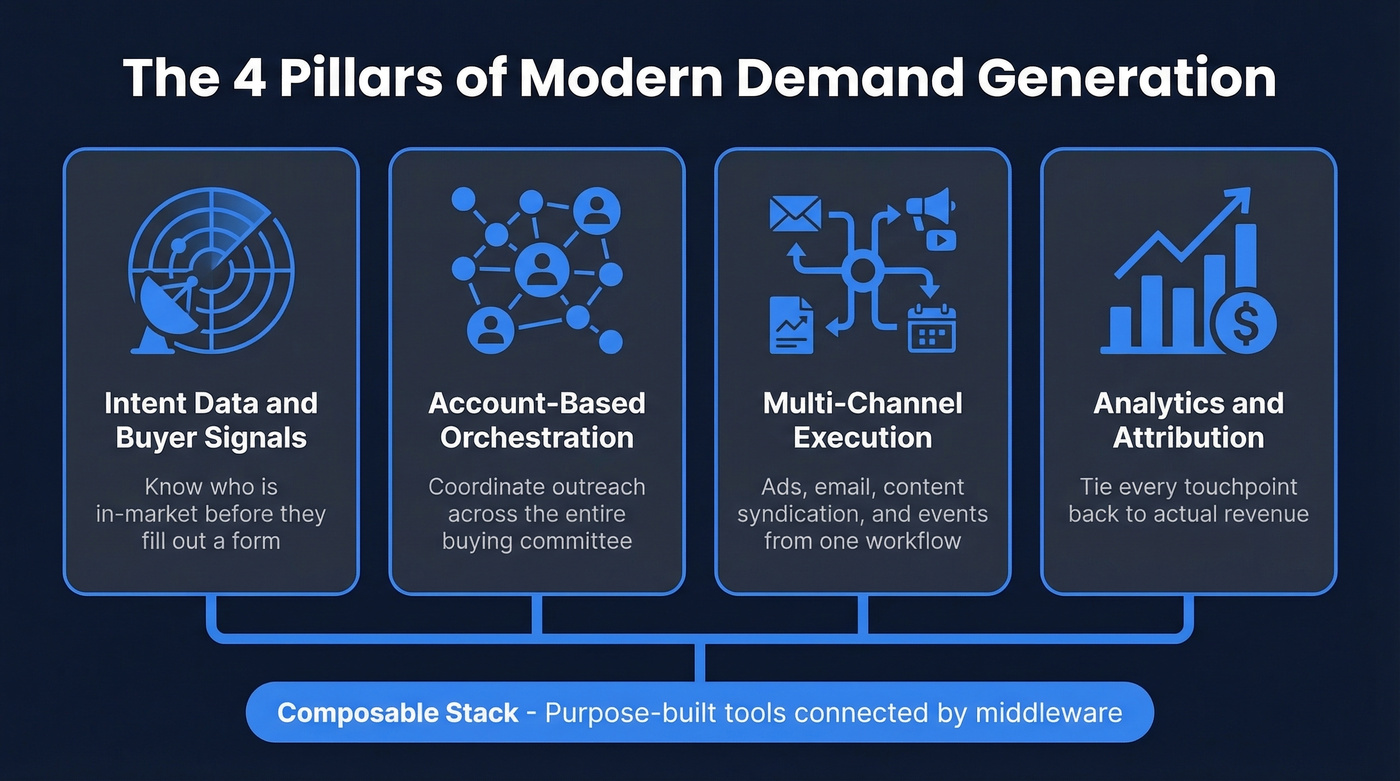
Modern platforms in this space cluster around four capabilities:
- Intent data and buyer signals tell you who's in-market before they fill out a form.
- Account-based orchestration coordinates outreach across an entire buying committee.
- Multi-channel execution covers ads, email, content syndication, and events from a single workflow.
- Analytics and attribution tie it back to revenue.
No single tool does all four well. The best stacks are composable - purpose-built tools connected by a middleware layer.
What You Need (Quick Version)
| Company Stage | Core Stack | Annual Cost |
|---|---|---|
| Startup (<$5M ARR) | HubSpot Free/Pro + verified data + G2 Buyer Intent | ~$15K-$25K/yr |
| Mid-market ($5M-$50M) | HubSpot Enterprise or Marketo + Prospeo + Bombora | ~$50K-$100K/yr |
| Enterprise ($50M+) | 6sense or Demandbase + dedicated enrichment + attribution | ~$150K-$400K+/yr |
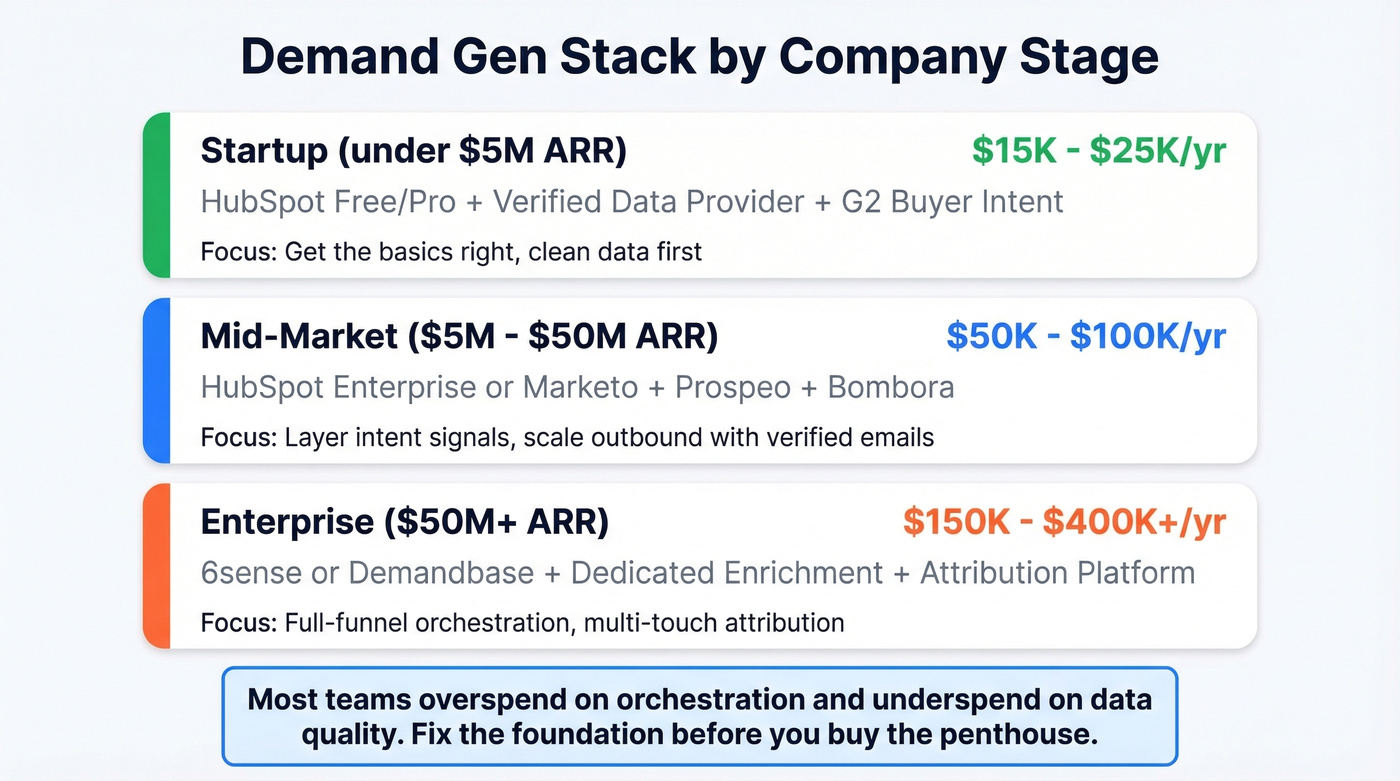
Here's the thing: most teams overspend on orchestration and underspend on data quality. A $150K ABM platform is worthless if 30% of your emails bounce. Fix the foundation before you buy the penthouse.

You just read it: a $150K ABM platform is worthless if 30% of your emails bounce. Prospeo gives you 300M+ profiles with 98% email accuracy, a 7-day refresh cycle, and intent data across 15,000 topics - for roughly $0.01 per lead. No annual contracts. No sales calls.
Stop overspending on orchestration and underspending on the data that powers it.
The State of Demand Gen in 2026
The martech market hit $6.65B in 2024 and is projected to reach $15.58B by 2030 at a 15.3% CAGR. Nearly 47% of marketing orgs now allocate 20-40% of their total budget to technology. CDPs are the fastest-growing category at 35% CAGR, and conversational marketing platforms are seeing 28% year-over-year growth.
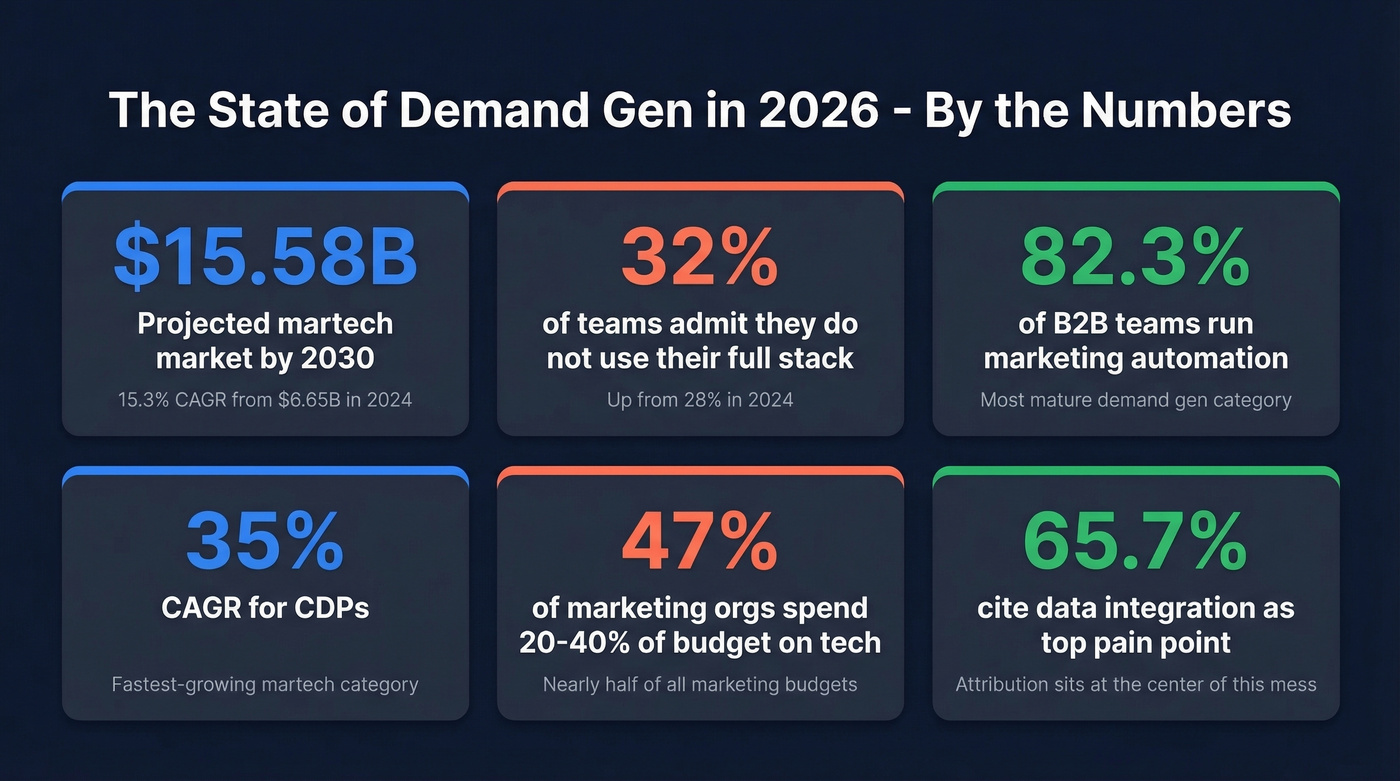
The uncomfortable truth: 32% of teams admit they don't use their full stack capabilities. That number was 28% in 2024. We're buying faster than we're adopting.
AI Overviews are also reshaping content strategy - the teams winning right now publish structured, authoritative content that LLMs can parse alongside the in-depth pieces humans actually read. If you're not building for both audiences, your organic traffic will erode.
B2B Demand Gen Tools by Category
Intent Data Providers
Intent data tells you which accounts are actively researching topics related to your product. Two distinctions matter. First, account-level signals ("someone at Acme viewed cloud security content") versus contact-level intent tied to specific individuals. Second, first-party intent from your own website visitors versus third-party intent from providers like Bombora and G2 that track behavior across publisher networks.
Third-party intent gives you reach; first-party intent gives you accuracy. You want both.
| Provider | Annual Range | Signal Type | Best For |
|---|---|---|---|
| Bombora | $25K-$80K | Account-level | Broadest topic coverage |
| 6sense | $35K-$150K+ | Account-level | Enterprise full-funnel |
| Demandbase | $40K-$120K | Account-level | Ads + intent combo |
| ZoomInfo Streaming | $7.2K-$36K | Account-level | Budget-conscious teams |
| G2 Buyer Intent | $10K-$87K+ | Account-level | Software companies |
| Leadfeeder | $99/mo and up | First-party | Website visitor ID |
Budget 15-25% above the quoted license price for implementation, topic configuration, and integration work. That rule applies to every category in this article, not just intent data.
We've seen teams buy 6sense expecting magic, then realize it takes 3-6 months before the platform delivers real value. If you need signals this quarter and not next year, start with Leadfeeder or G2.
ABM Platforms
71% of organizations run some form of ABM program. But there's a massive gap between "we tag target accounts in HubSpot" and "we run a full Demandbase deployment with programmatic ads and orchestrated plays."
| Platform | Annual Range | Best For |
|---|---|---|
| RollWorks | $12K-$50K | SMB/mid-market entry |
| Terminus | $18K-$87K | Display-heavy ABM |
| HubSpot ABM | ~$43.2K/yr | HubSpot-native teams |
| 6sense | $60K-$300K+ | Enterprise, full-funnel |
| Demandbase | $24K-$300K+ | Enterprise, ads + intent |
If your annual revenue is under $10M, skip the $60K+ ABM platform. It's like driving a Ferrari to the grocery store. RollWorks or HubSpot's built-in ABM features will cover you until your target account list and sales team justify the orchestration layer.
Marketing Automation
This is the most mature category - 82.3% of B2B teams already run marketing automation - and the pricing is the most transparent.
| Platform | Monthly Price | Contact Limits |
|---|---|---|
| HubSpot Pro | $890/mo | 2,000 contacts |
| HubSpot Enterprise | $3,600/mo | 10,000 contacts |
| Marketo Engage | ~$1,250-$15K/mo | Varies by tier |
| Pardot (Salesforce) | ~$1,250-$4K/mo | Varies by tier |
HubSpot is the default for a reason: easiest to implement, free CRM tools included. The catch is that costs scale fast with database size, and attribution reporting requires Enterprise. Marketo is more powerful for complex nurture workflows but takes a dedicated admin. I've seen mid-market teams burn $40K on Marketo only to use it as a glorified email sender. If you don't have a marketing ops person, stick with HubSpot.
Data Enrichment and Verification
This is the layer that determines whether everything downstream actually works. Bad emails kill domain reputation, tank deliverability, and undermine every tactic you're running. It's the most frustrating problem in demand gen because it's invisible until your campaigns are already failing.
Prospeo covers 300M+ professional profiles with 98% email accuracy and a 7-day data refresh cycle - the industry average is six weeks. Pricing works out to roughly $0.01 per lead, compared to ~$1/lead at enterprise providers like ZoomInfo. That's a 90% cost reduction with self-serve onboarding and no annual contracts.
The proof point worth knowing: Snyk's 50-person AE team was running bounce rates of 35-40% before switching their data provider. After the move, bounces dropped under 5%, AE-sourced pipeline jumped 180%, and they're generating 200+ new opportunities per month.

Snyk cut bounce rates from 35% to under 5% and grew AE-sourced pipeline 180%. Stack Optimize built a $1M agency with sub-3% bounce rates across every client. The difference wasn't a bigger martech stack - it was verified data refreshed every 7 days, not every 6 weeks.
Replace your most expensive demand gen tool with your most accurate one.
CRM, Routing, and Middleware
Instead of buying monolithic platforms, the best teams connect purpose-built tools through a logic layer. Clay ($149/mo and up, rated 4.9/5 on G2) handles enrichment workflows and data routing. Zapier ($20-$100/mo) and Make ($9-$29/mo) connect everything else. Chili Piper ($25-$35/user/mo) handles lead routing and meeting scheduling - near-essential for inbound-heavy teams.
This layer is where composable stacks come together. If your CRM, enrichment tool, and sequencer can't talk to each other through middleware, you'll spend more time on manual data entry than on actual selling.
Analytics and Attribution
Let's be honest: attribution is theoretically important and practically broken at most companies. 65.7% of organizations cite data integration difficulties as a top pain point, and attribution sits right at the center of that mess.
GA4 is table stakes. Beyond that, HockeyStack (~$25K-$60K/yr) and Dreamdata (~$10K-$40K/yr) attempt multi-touch attribution. For teams spending under $50K on total tooling, GA4 plus disciplined UTM tagging will get you 80% of the way there. The teams that get attribution right usually have a dedicated RevOps person wiring it together - the tool alone won't save you.
Five Mistakes That Waste Your Budget
Chasing MQLs instead of revenue. MQLs are a vanity metric if they don't convert to pipeline. Align your demand gen metrics to revenue outcomes, not form fills. (If you need benchmarks, start with lead conversion rate and work backward.)
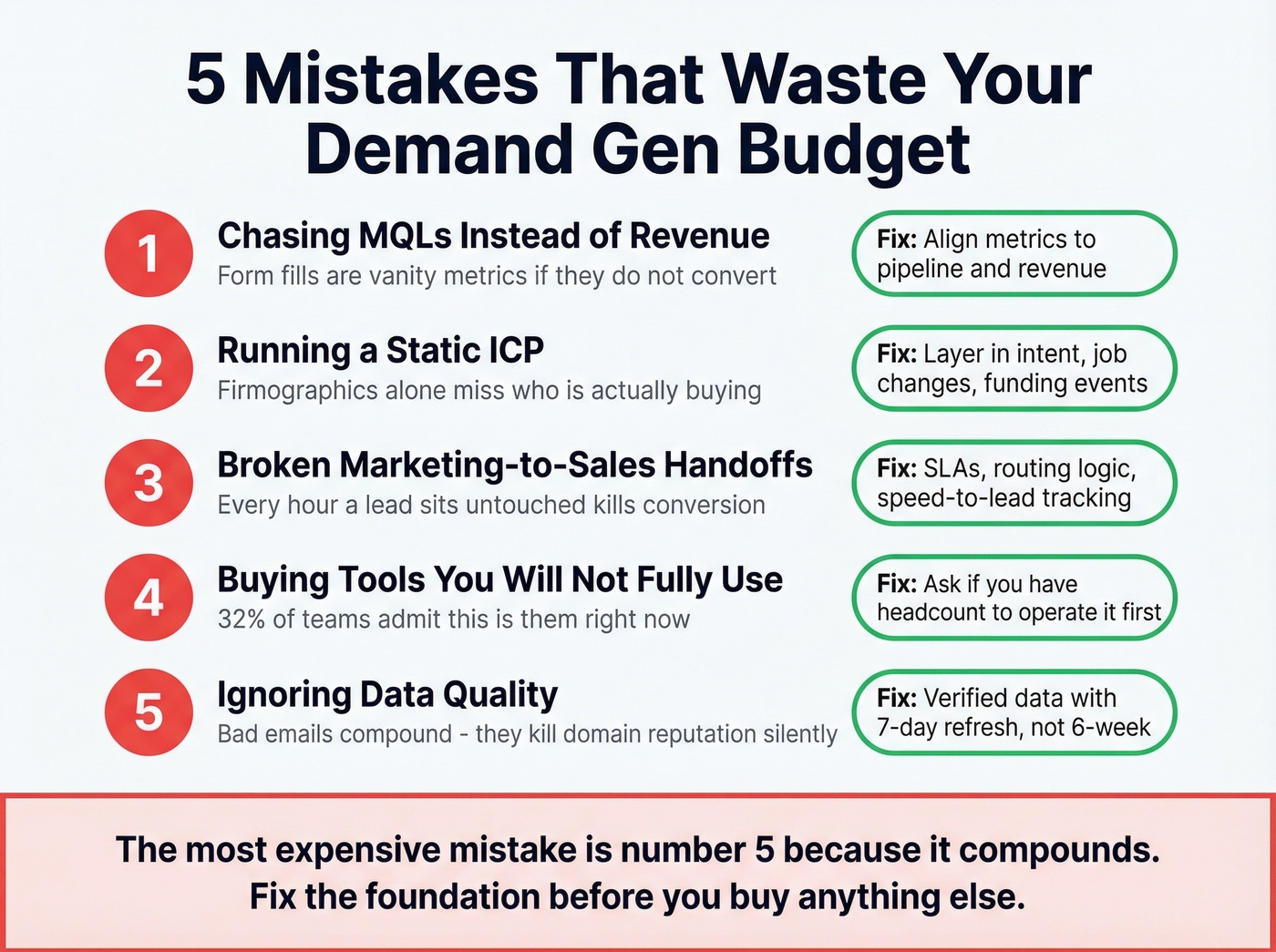
Running a static ICP. Firmographics alone aren't enough. Layer in behavioral signals - intent surges, job changes, funding events - or you're targeting companies that look right but aren't actually buying. Use an ideal customer profile scoring rubric, not a one-line description.
Broken marketing-to-sales handoffs. No SLAs, no routing logic, no speed-to-lead measurement. Every hour a qualified lead sits untouched, your conversion rate drops. Chili Piper exists for exactly this reason.
Buying tools you won't fully use. 32% of teams admit this is them. Before signing a $60K annual contract, ask whether you have the headcount to implement and operate the tool. A cheaper tool you use daily beats an expensive one collecting dust.
Ignoring data quality. This is the most expensive mistake because it compounds. Bad emails kill domain reputation, tank deliverability, and undermine every downstream tactic. Fix the foundation before you buy anything else. (If you’re troubleshooting, start with email bounce rate and email deliverability.) The consensus on r/sales is pretty clear on this one - no amount of clever sequencing fixes a 30% bounce rate.
FAQ
What's the difference between demand generation and lead generation?
Demand generation creates awareness and interest across the full buying journey - from a prospect who's never heard of you to one who's ready to talk to sales. Lead generation is the subset that captures contact information from already-interested buyers. Demand gen feeds lead gen; you need both, but demand gen comes first.
How much should a mid-market company budget for demand gen tools?
Expect $30K-$80K per year for a core stack: marketing automation, intent data, enrichment, and an outbound sequencer like Instantly (~$30-$97/mo) or Lemlist (~$39-$99/mo). Budget 15-25% above quoted license prices for implementation and integration work.
What's the most overlooked demand gen investment?
Data quality and contact verification. Every other tool in your stack - your sequencer, your ABM platform, your ad targeting - depends on accurate contact data. If your bounce rate is above 5%, fix that before buying anything else.
How do I evaluate demand generation solutions for my team?
Map your current gaps across four core capabilities: intent data, account-based orchestration, multi-channel execution, and attribution. Match each gap to a purpose-built tool rather than buying an all-in-one that covers everything loosely. Prioritize transparent pricing, self-serve onboarding, and native CRM integrations.
Should I choose an all-in-one platform or a composable stack?
If your team is under five people, an all-in-one like HubSpot reduces integration headaches. Once you pass $5M ARR with dedicated marketing ops, a composable stack - purpose-built tools connected through Clay or Zapier - delivers better performance at each layer and avoids vendor lock-in. The most common mid-market stack is HubSpot + LinkedIn Ads + Google Analytics, used by 28.5% of companies at that stage.