

The Difference Between Upsell and Cross-Sell - And How to Actually Execute Both
Your VP just told the team to focus on expansion revenue. Half the room thinks that means pushing premium tiers. The other half wants to bundle add-ons into every renewal. They're both right - and they're describing two different motions that get lumped together constantly.
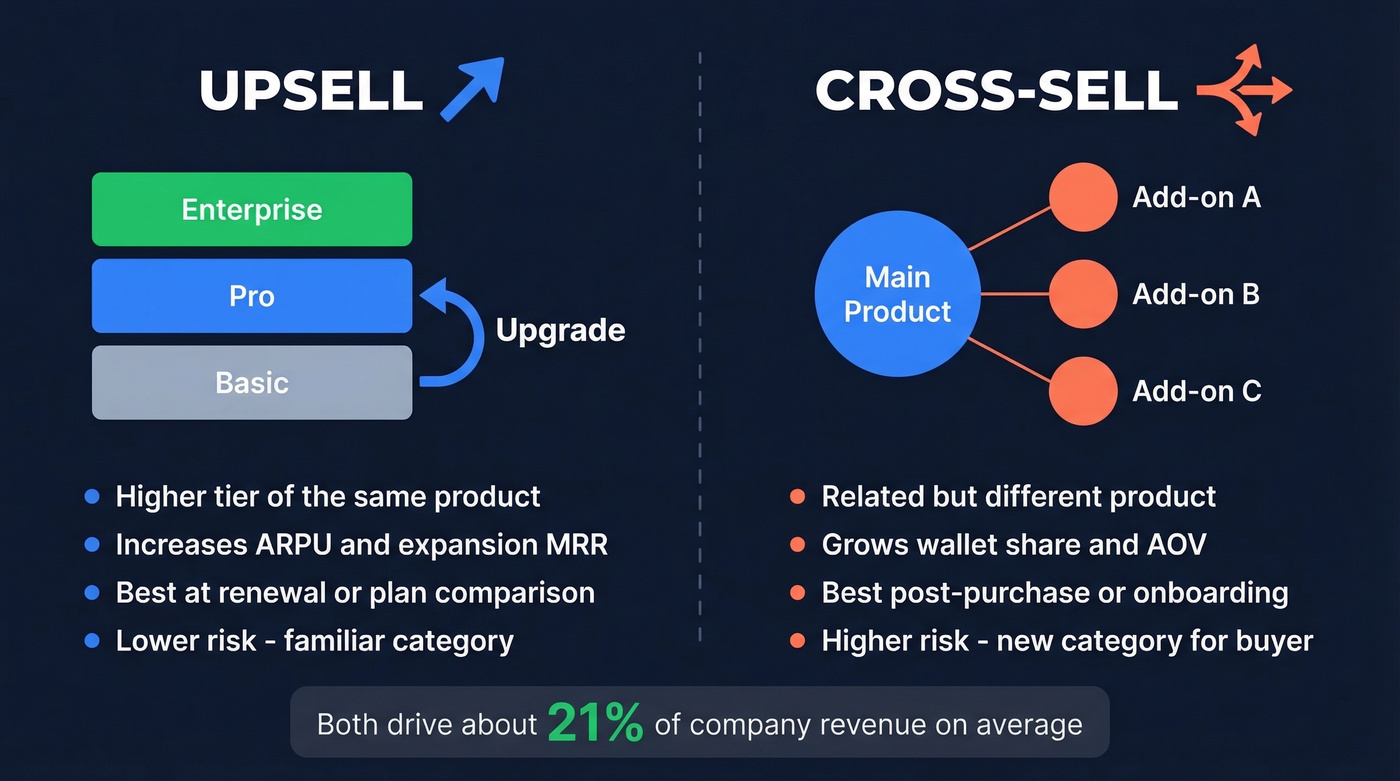
The difference between upsell and cross-sell comes down to direction. Upselling gets a customer to buy a better version of what they already have. Economy to business class. Basic plan to Pro. Same product category, higher price point. Cross-selling gets a customer to buy something related - you bought the laptop, now here's the case, the mouse, and the extended warranty. Different product, added to the basket.
The distinction matters because the execution is completely different. 91% of sales professionals upsell, and 87% cross-sell, and across sales teams these motions bring in an average of 21% of company revenue. That's about a fifth of the top line coming from customers who already trust you enough to buy more.
Quick version
- Upselling = upgrading the same product. Cross-selling = adding a related product.
- Both drive ~21% of company revenue on average.
- Existing customers are 60-70% likely to buy; new prospects sit at 5-20%.
- Start with post-purchase cross-sells (ecommerce) or account expansion plays (B2B/SaaS).
Core Differences at a Glance
The table below covers the six dimensions that actually matter when you're deciding which motion to run.
| Dimension | Upsell | Cross-Sell |
|---|---|---|
| Offer type | Higher tier of same product | Related product |
| Goal / metric | Higher ARPU, expansion MRR | Broader wallet share, AOV |
| Best timing | During purchase or renewal | Post-purchase or onboarding |
| Risk level | Lower (familiar category) | Higher (new category) |
| Billing impact | Upgrades existing line item | Adds new line item |
| Motion | Depth (more of the same) | Breadth (more categories) |
The two most important rows are timing and risk. Upselling works best when a customer is already evaluating options - comparing plans, approaching a usage limit, or sitting in a renewal conversation. The decision context is already open. Cross-selling works best after a commitment, when the customer has said yes and is receptive to "while you're here" additions.
Both tactics share one massive structural advantage: you're selling to someone who already knows you. That 60-70% close rate on existing customers versus 5-20% for new prospects applies to both motions equally. The hard part - earning trust - is already done.
Why Both Matter: The Numbers
McKinsey research shows cross-selling alone can boost revenue up to 30%. In SaaS specifically, the upsell/cross-sell rate benchmarks at 23% - roughly one in four existing customers expands their spend. If you're in B2B/SaaS, expansion revenue math overwhelmingly favors growing existing accounts over chasing new logos.
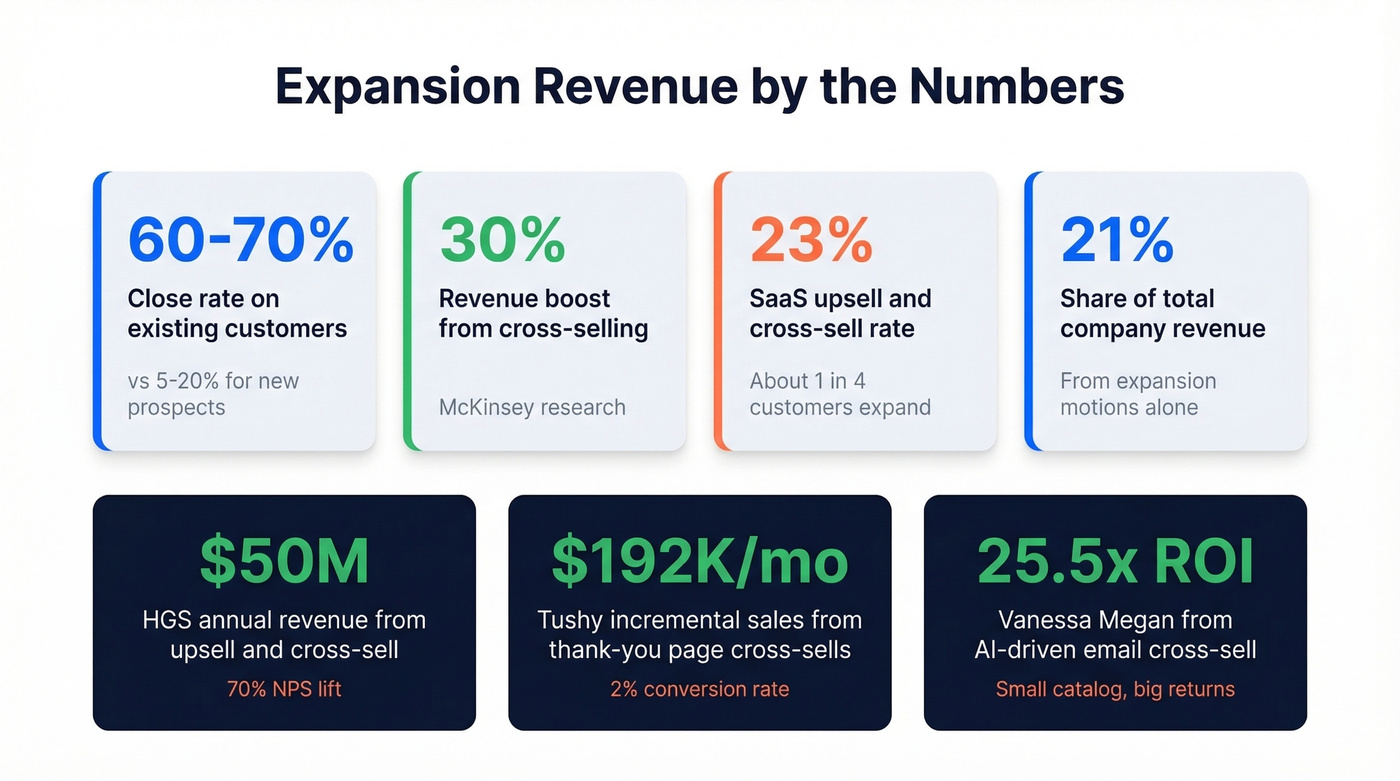
Three case studies put real dollars on this. HGS generated $50M in annual revenue from cross-sell and upsell initiatives - alongside a 70% NPS lift. On the ecommerce side, bidet brand Tushy added $191,786 in monthly incremental sales from post-purchase offers on their thank-you page, converting at a 2% rate. And skincare brand Vanessa Megan reported 25.5x ROI from AI-driven email cross-sell recommendations - proof that even small catalogs can generate outsized returns when the targeting is right.
These aren't outliers. They're what happens when expansion revenue gets treated as a real program instead of an afterthought tacked onto the end of a sales call.
When to Upsell vs Cross-Sell
Upsell when:
- The customer is evaluating tiers or comparing plans
- They're approaching a usage limit or contract renewal
- Your product has clear "good / better / best" packaging
- The value gap between tiers is easy to articulate
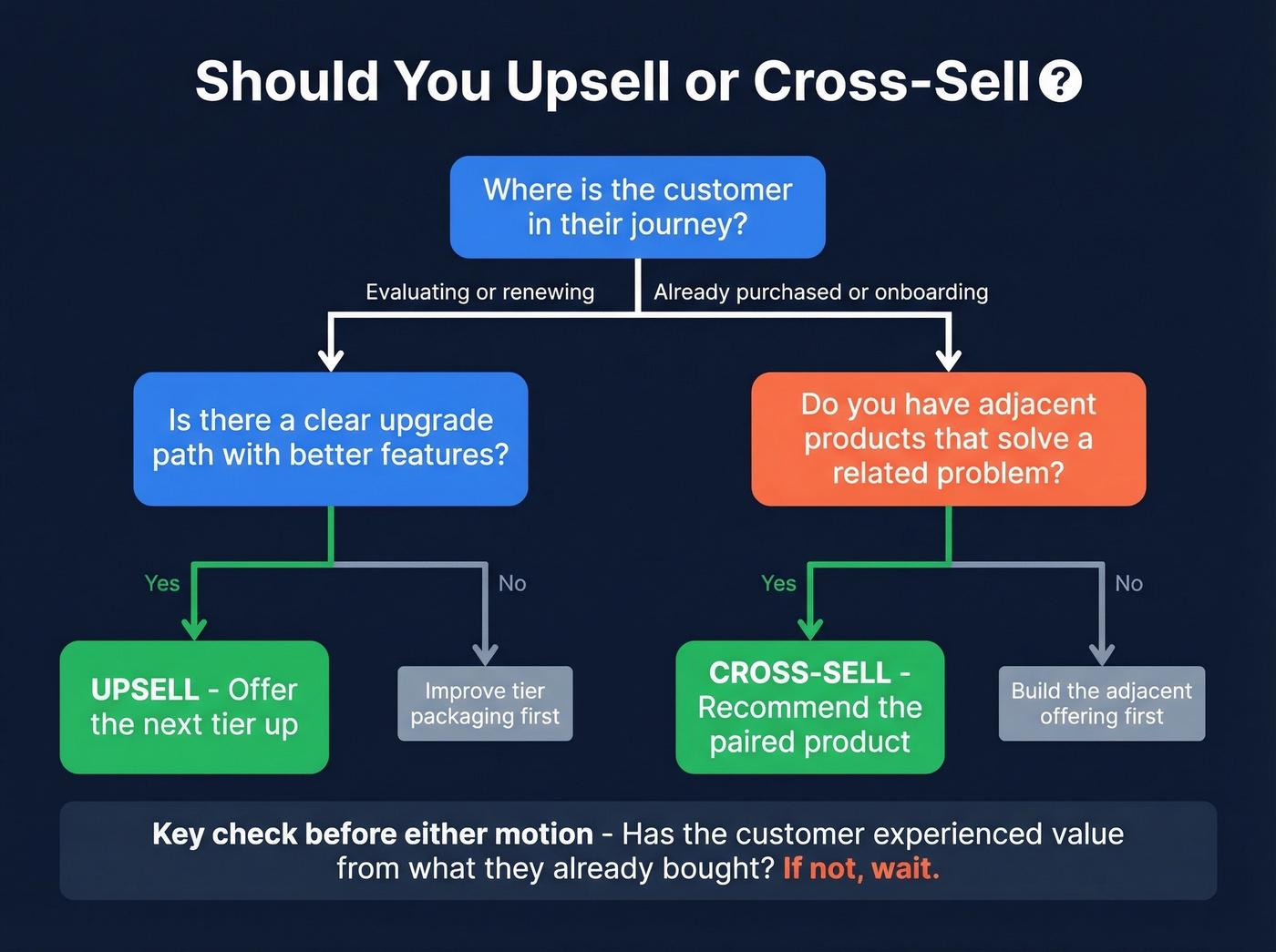
Cross-sell when:
- The customer has already committed to a purchase
- You have adjacent products that solve related problems
- Onboarding reveals workflows your other products address
- The customer's tech stack has obvious gaps you can fill
For sales reps running these conversations live, three discovery questions do most of the work: "What other workflows does this touch?" / "What are you using for [adjacent problem] today?" / "If we could solve X alongside what you're already buying, would that change the conversation?" (If you want a deeper bank of prompts, start with these discovery questions.)
Here's the thing: upselling and cross-selling aren't really sales tactics. They're product strategy. If your product tiers don't have clear value differentiation, no amount of sales training fixes your upsell motion. If you don't have paired products worth buying, cross-selling is just annoying your customers. Ask any account manager and they'll tell you the same - the cross-sell pitch that works in a QBR dies in a cold email, because the context and trust level are completely different. (If you're operationalizing this, treat it like sales execution, not a one-off script.)

Cross-sell and upsell campaigns only work when you reach the right contacts. Prospeo gives you 30+ filters - including buyer intent, technographics, and headcount growth - so you can identify which accounts are ready to expand and reach decision-makers with 98% verified emails.
Stop pitching expansion deals to dead inboxes.
Channel Playbook
Checkout & Thank-You Page
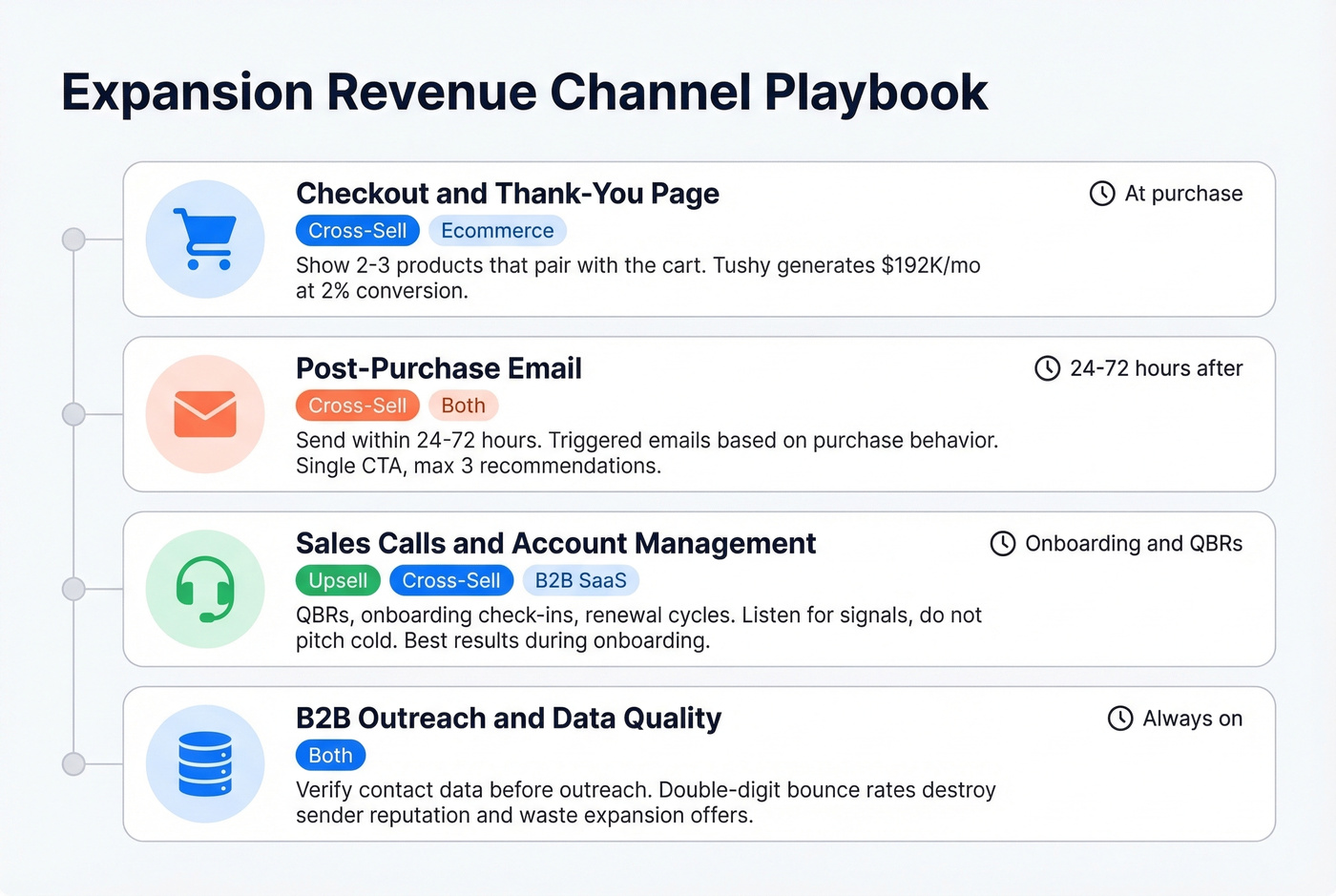
This is the ecommerce sweet spot. Tushy's thank-you page cross-sells convert at 2%, which sounds modest until you realize it's generating nearly $192K/month in incremental revenue on traffic that's already converted. The key is relevance: show products that genuinely pair with what's in the cart, not whatever has the highest margin.
If you're building this as a repeatable motion, treat it like funnel instrumentation: define the offer, the trigger, and the measurement loop (see funnel metrics).
Post-Purchase Email
The window is 24-72 hours after purchase. After that, attention drops off a cliff. Triggered emails based on actual purchase behavior outperform generic "you might also like" blasts by a wide margin. Keep the product count to two or three recommendations max, use a single clear CTA, and make the connection to the original purchase explicit. "You bought X - here's what pairs with it" beats vague recommendations every time.
If you're running this through lifecycle, the fastest wins usually come from better email copywriting and tighter email call to action structure.
Sales Calls & Account Management
In B2B, the expansion conversation happens during QBRs, onboarding check-ins, and renewal cycles. The best account managers don't pitch - they listen for signals. A customer mentioning they're "evaluating tools for X" is a cross-sell opening. A customer hitting usage ceilings is an upsell opening. Build these triggers into your CRM so reps don't have to rely on memory. (If you need a system for this, use a lightweight approach to how to track sales triggers.)
In our experience, the best expansion conversations happen during onboarding - not renewals - because the customer is actively mapping their workflows and gaps are visible. We've seen teams double their attach rate just by adding a structured "what else are you solving for?" question to their onboarding call script.
B2B Outreach & Data Quality
You can have the perfect cross-sell offer, but if you're emailing dead addresses, none of it matters. Double-digit bounce rates on the first send aren't rare when lists haven't been verified - and that's not just wasted effort, it's active damage to your sender reputation. (If you're seeing this, start with email bounce rate and then fix sender reputation.)

Mistakes That Kill Results
1. Too many options. Offering five upsell tiers or eight cross-sell products paralyzes the customer. Stick to 2-3 options max. Decision fatigue is real.
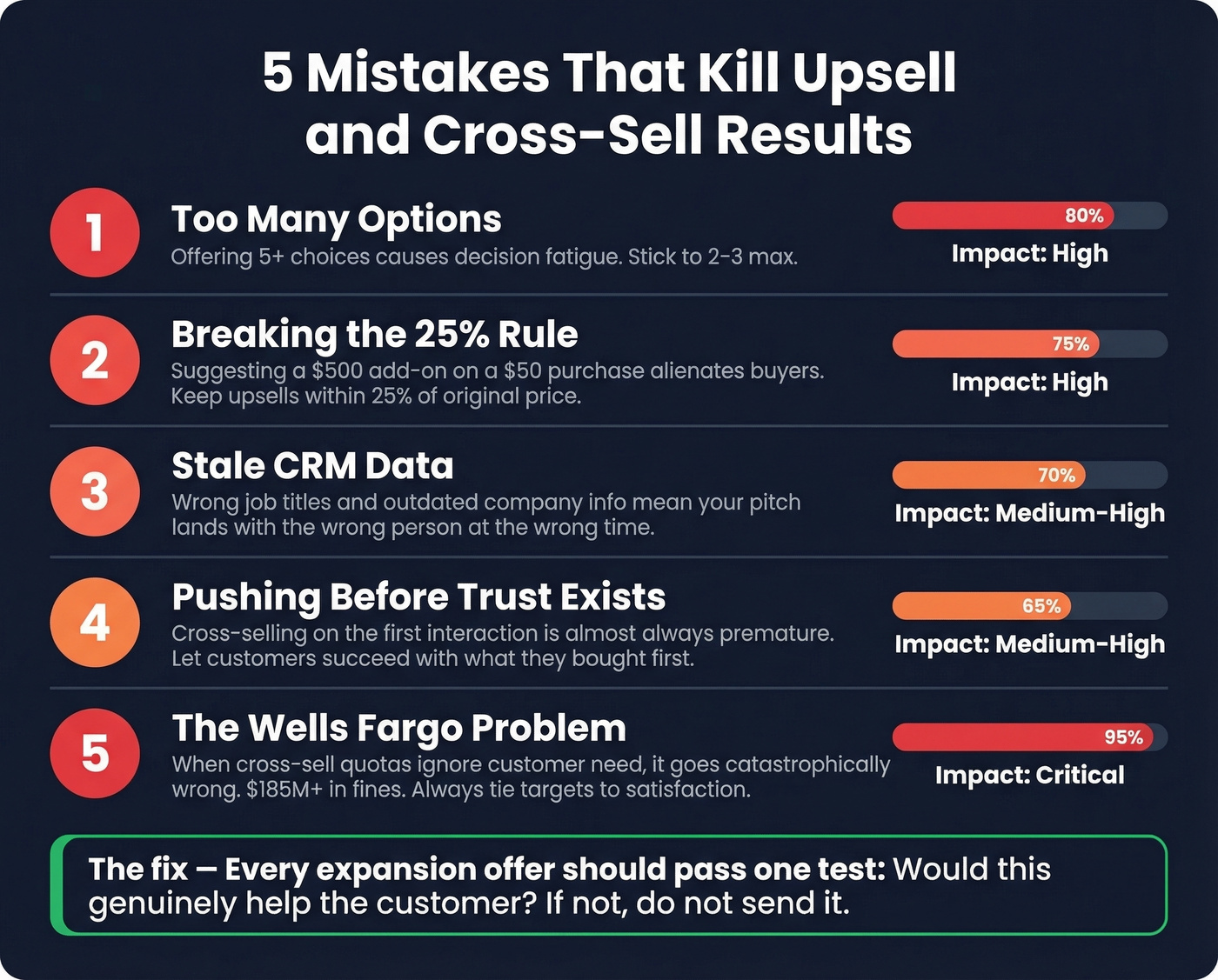
2. Breaking the 25% rule. Suggesting a $500 add-on to someone who bought a $50 product isn't upselling - it's alienating. Keep upsell suggestions within 25% of the original purchase price. Cross-sells can stretch further because they're separate line items, but the principle holds. And if you can't clearly communicate why the upgrade is worth the price difference, the offer will fall flat regardless of the dollar amount.
3. Irrelevant recommendations built on stale data. If your CRM still shows a contact as "Marketing Manager" when they've been VP of Demand Gen for eight months, your cross-sell pitch lands wrong. Enriching your CRM with current job titles and company data isn't optional - Prospeo's enrichment returns 50+ data points per contact including job changes, so your segmentation reflects reality.
4. Pushing before trust is established. Cross-selling during the first interaction with a new customer is almost always premature. Let them succeed with what they bought first. The expansion conversation earns its place after the customer has experienced value.
5. The Wells Fargo problem. Let's be honest: when cross-selling becomes a quota metric divorced from customer need, it goes catastrophically wrong. Wells Fargo was fined more than $185 million and refunded more than $2.8 million to customers for opening accounts they never asked for. That's the extreme case, but the underlying dynamic - incentivizing volume over relevance - destroys trust at every scale. If your team's cross-sell targets don't include a customer satisfaction guardrail, you're building a time bomb. (If you want to formalize guardrails, start with ethics in sales.)
Your account managers need verified contact data to run expansion plays across buying committees. Prospeo's CRM enrichment returns 50+ data points per contact at a 92% match rate - so every QBR and renewal conversation targets the right stakeholder, not a stale record.
Enrich your accounts before the next renewal cycle hits.
How to Measure Success
The fact that most upselling guides don't include a single KPI tells you they were written by content teams, not operators. Here's what to actually track:
| KPI | What it measures | Benchmark |
|---|---|---|
| Attach rate | % of purchases with a cross-sell | Low double digits at checkout; higher at renewal when packaged well |
| Expansion MRR | Monthly revenue from upgrades | Track as % of total MRR, segmented by SMB / mid-market / enterprise |
| Net revenue retention | Revenue kept + expanded | 110%+ is strong for SaaS |
| AOV lift | Average order value increase | Should show measurable lift when pairings are relevant |
| Cross-sell conversion | % of offers accepted | SaaS benchmark: ~23%; email cross-sells: low single digits |
For SaaS teams, net revenue retention is the number that matters most. We track NRR as the single most important expansion metric - it captures both churn prevention and expansion in one number. Anything above 110% means your existing customer base is growing even without new logos, and that's where upselling and cross-selling compound into something that fundamentally changes your growth math. (If you're diagnosing why NRR is stuck, start with a clean churn analysis.)
Here's a hot take most revenue leaders won't say out loud: if your NRR is below 100%, you don't have an expansion problem. You have a product problem. No amount of upsell playbooks will fix a leaky bucket. Fix retention first, then layer in expansion motions.
FAQ
Can you upsell and cross-sell at the same time?
Yes, and many businesses do - but sequence matters. Upsell during the purchase decision when the customer is evaluating options, then cross-sell post-purchase when they've committed and are open to additions. Trying both simultaneously in a single pitch tends to overwhelm rather than convert.
Which is more profitable?
Upselling typically yields higher per-transaction revenue because the price delta between tiers is larger. Cross-selling often has higher acceptance rates because the ask feels smaller. Best results come from running both as complementary motions - SaaS companies benchmarking 23% expansion rates usually combine both.
What's a good cross-sell conversion rate?
Post-purchase page offers convert around 1-3% in ecommerce. In SaaS, the combined upsell/cross-sell rate benchmark is 23%. For email-based cross-sells, low single digits is typical - but even 1-2% on a large list generates meaningful incremental revenue that compounds over time.
What data do I need for effective cross-sell targeting?
At minimum: accurate contact information, current job titles, and purchase history. Stale CRM data silently kills cross-sell campaigns - bounced emails and outdated role-based segmentation waste even the best offers. Regular enrichment that returns fresh data points per contact, including job changes, gives you the foundation accurate targeting requires.