

Digital Sales Enablement: What It Is, What to Buy, and How to Build It
Your enablement materials live in HubSpot. Your process docs are in Google Docs. Your product roadmap's in Jira. And your reps? They're toggling between all three, finding nothing, and winging the demo.
29% of organizations still rely on multiple disconnected GTM tools. The ones that don't have figured out something the rest haven't: digital sales enablement isn't a tool category. It's the operating system for how your team sells.
What Is Digital Sales Enablement?
It replaces the binder, the PDF, and the tribal knowledge with software that actually scales. Cloud-based tools, data-driven workflows, and AI-assisted training merge into a single stack that helps reps sell more effectively - and increasingly helps post-sale teams drive retention and expansion revenue too.
Traditional enablement meant printing battlecards and running quarterly SKOs. The digital approach means reps access the right content, the right contact data, and the right coaching from one platform, in real time, from anywhere. The difference isn't subtle. Research from CSO Insights shows 8% higher revenue growth for companies running digital enablement strategies, alongside a 34% increase in customer satisfaction.
Why It Matters in 2026
The sales enablement platform market hit $6.1-6.6B in 2025 and is projected to reach $25-36B by 2034-2035 at a 17-18% CAGR, according to Fortune Business Insights and Precedence Research. That's not a niche category anymore.
What's driving it: 90% of organizations are either using AI for GTM or actively planning to. 48% are investing in digital sales rooms. And Gartner published its inaugural Magic Quadrant for Revenue Enablement Platforms in November 2025 - a clear signal that the analyst community now treats this as a standalone enterprise category, not a feature of CRM.
Here's the thing: most teams don't need a $100K enterprise enablement platform. They need clean data, a content hub reps actually use, and a coaching cadence that isn't quarterly. We've watched teams spend six figures on Seismic and still lose deals because half their outbound emails bounced.
Five Components of an Enablement Stack
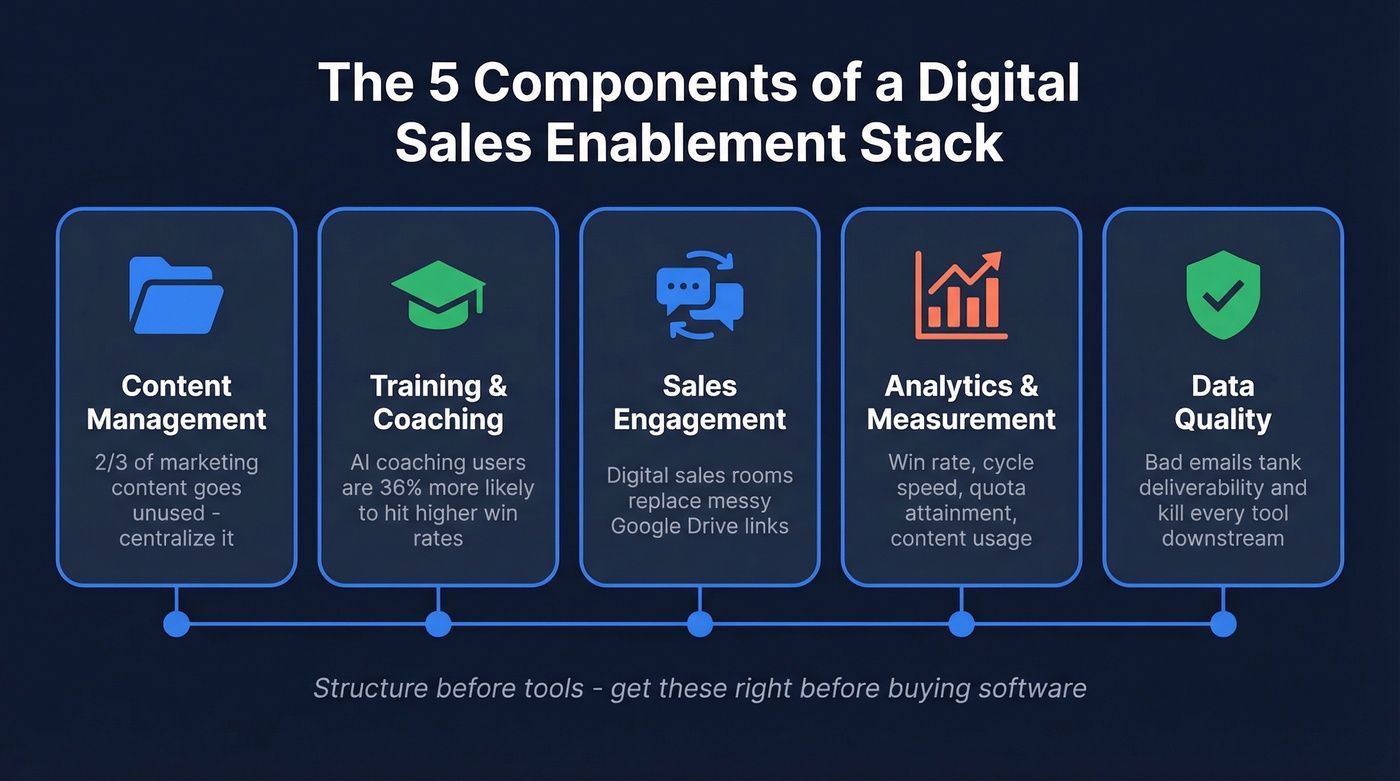
Content Management
Two-thirds of marketing content goes unused by sales. The fix isn't creating more - it's centralizing what exists. Showpad is a common pick in enablement-lead discussions, especially for teams that care about Salesforce and Marketo integrations. Both Highspot and Showpad position themselves as Leaders in Gartner's 2025 Magic Quadrant for Revenue Enablement Platforms, but Showpad often wins on ease of adoption for mid-market teams.
Training and Coaching
AI coaching adoption jumped 164% year-over-year, and teams using it are 36% more likely to report higher win rates. The shift is from event-based training to continuous coaching embedded in daily workflow.
The gap is closing between post-call analysis tools like Gong and real-time coaching platforms like Trellus that prompt reps mid-conversation. Both matter, but real-time coaching is where the category is heading. For organizations expanding into new markets, multilingual capabilities - localized coaching scripts, translated battlecards - are becoming table stakes rather than nice-to-haves.
Sales Engagement
Digital sales rooms are the underrated category in enablement. The practitioner consensus on Reddit is blunt: using Google Drive as a makeshift deal room means you lose visibility into what buyers actually engage with, plus mutual action plans and real collaboration. For complex sales, that's a dealbreaker.
Among the options, Aligned leads on mutual action plans and engagement signals. Trumpet is cleaner but has minimal support for mutual action plans and weaker collaboration features. DealHub tracks engagement well but has a steeper learning curve. For most teams, Aligned is the pick.
Analytics and Measurement
The targets that matter: win rate up 5-10% year-over-year, sales cycle 10-20% faster, quota attainment above 60%, and content usage above 70%. Don't build dashboards for vanity - measure what changes behavior. This is where data-driven sales enablement earns its keep. Teams that instrument every stage of the funnel and act on what the numbers reveal consistently outperform those running on gut feel.
Data Quality
Your enablement stack can have perfect content and beautiful digital sales rooms. It'll still fail if reps are emailing invalid addresses.
High bounce rates damage your domain reputation, tank deliverability, and make every other investment downstream less effective. When Snyk addressed this problem across 50 AEs, their bounce rate dropped from 35-40% to under 5%, and AE-sourced pipeline jumped 180%. That wasn't an enablement problem. It was a data problem everyone kept blaming on their tools.
If you're seeing bounces, start with email bounce rate benchmarks and fixes, then tighten your email deliverability fundamentals.


Every enablement tool in your stack depends on one thing: reaching real buyers. When Snyk's 50 AEs switched to Prospeo, bounce rates dropped from 35-40% to under 5% and AE-sourced pipeline jumped 180%. 300M+ profiles, 98% email accuracy, 7-day refresh cycle.
Stop funding enablement tools that run on bad data.
Tools and Pricing
Most vendors hide pricing behind demo requests. Here's what teams actually pay:
| Tool | Category | Best For | Price Range | G2 Rating |
|---|---|---|---|---|
| Highspot | Content + Enablement | Enterprise content ops | $45-65/user/mo | 4.7/5 |
| Seismic | Content + Enablement | Large, complex orgs | $40-75/user/mo | 4.7/5 |
| Showpad | Content + Enablement | Mid-market adoption | ~$50-65/user/mo | 4.6/5 |
| Prospeo | Data Quality | Verified contacts at scale | Free-~$0.01/email | - |
| Salesloft | Sales Engagement | Outbound sequencing | $75-125/user/mo | 4.5/5 |
| Gong | Conversation Intel | Call coaching (20+ reps) | $120-250/user/mo + platform fees | - |
| Dock | Digital Sales Rooms | Lightweight deal rooms | Free / $350 / $750/mo | - |
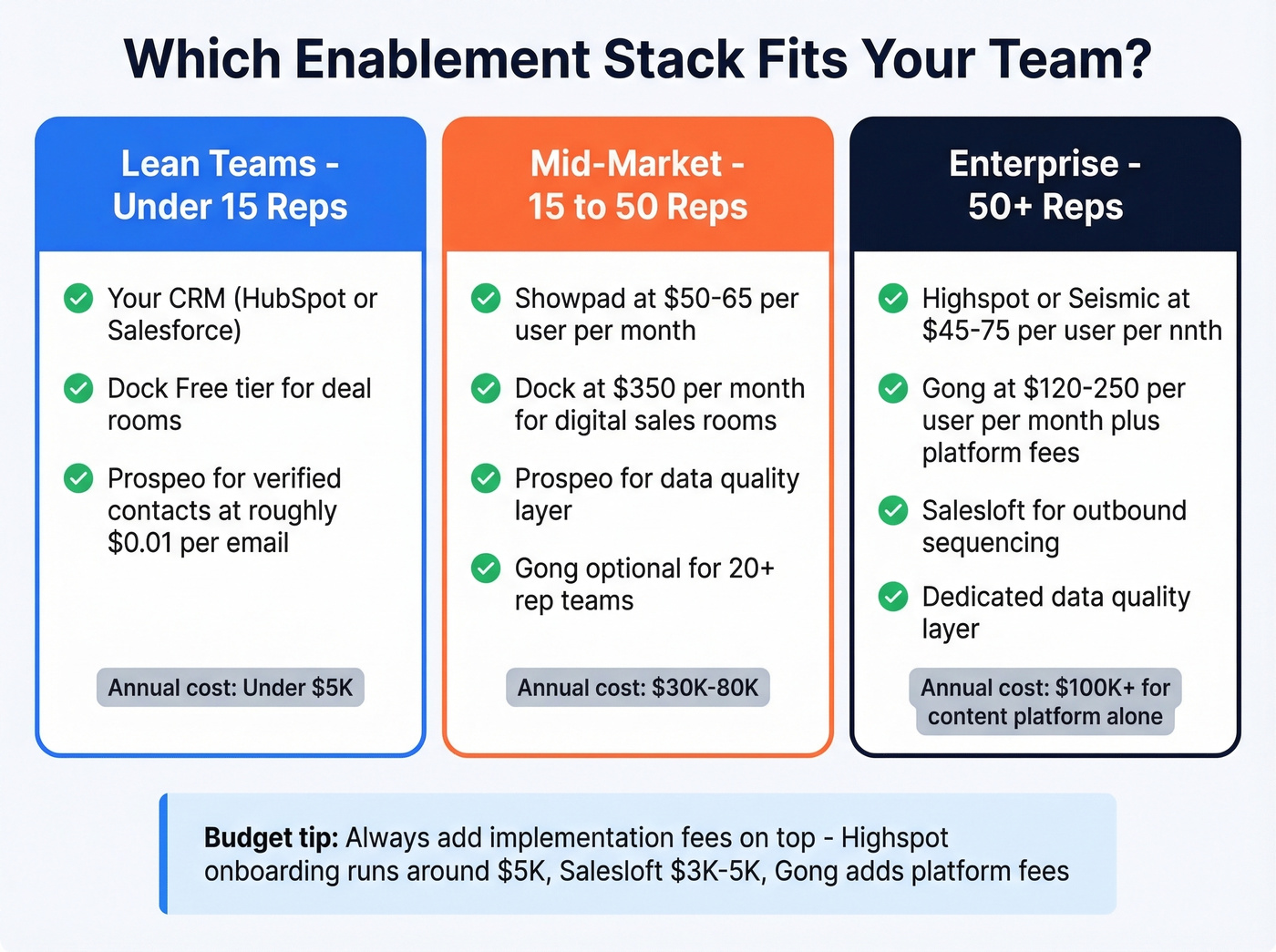
Budget for implementation fees on top of licensing. Highspot onboarding commonly runs around $5K, and Salesloft onboarding often hits $3K-$5K. Gong adds platform and implementation fees on top of per-user costs.
Enterprise teams (50+ reps) should start with Highspot or Seismic for content, Gong for coaching, and a data quality layer underneath. Expect $100K+ annually for the content platform alone.
Mid-market (15-50 reps) gets solid coverage from Showpad at ~$50-65/user/month plus a lightweight DSR like Dock's $350/month tier.
Lean teams under 15 reps should resist the urge to overbuy. Your CRM, a free Dock tier, and Prospeo for verified contacts will outperform a bloated stack you'll never fully adopt. At roughly $0.01 per lead versus $1+ from legacy providers, you're not cutting corners - you're cutting waste.
If you're building outbound on a budget, pair this with free lead generation tools and a tighter lead generation workflow.
Lean teams don't need six-figure platforms - they need verified contacts that actually connect. At $0.01 per email vs $1+ from legacy providers, Prospeo delivers 30+ search filters, intent data across 15,000 topics, and a data refresh cycle 6x faster than the industry average.
Build your enablement stack on data that doesn't bounce.
How to Build Your Program
Follow the five-pillar framework from GTM Playbook: Onboarding, Content Library, Competitive Intel, Ongoing Training, and Performance Measurement. The Sales Enablement Collective uses a similar five-stage model - both converge on the same principle: structure before tools.
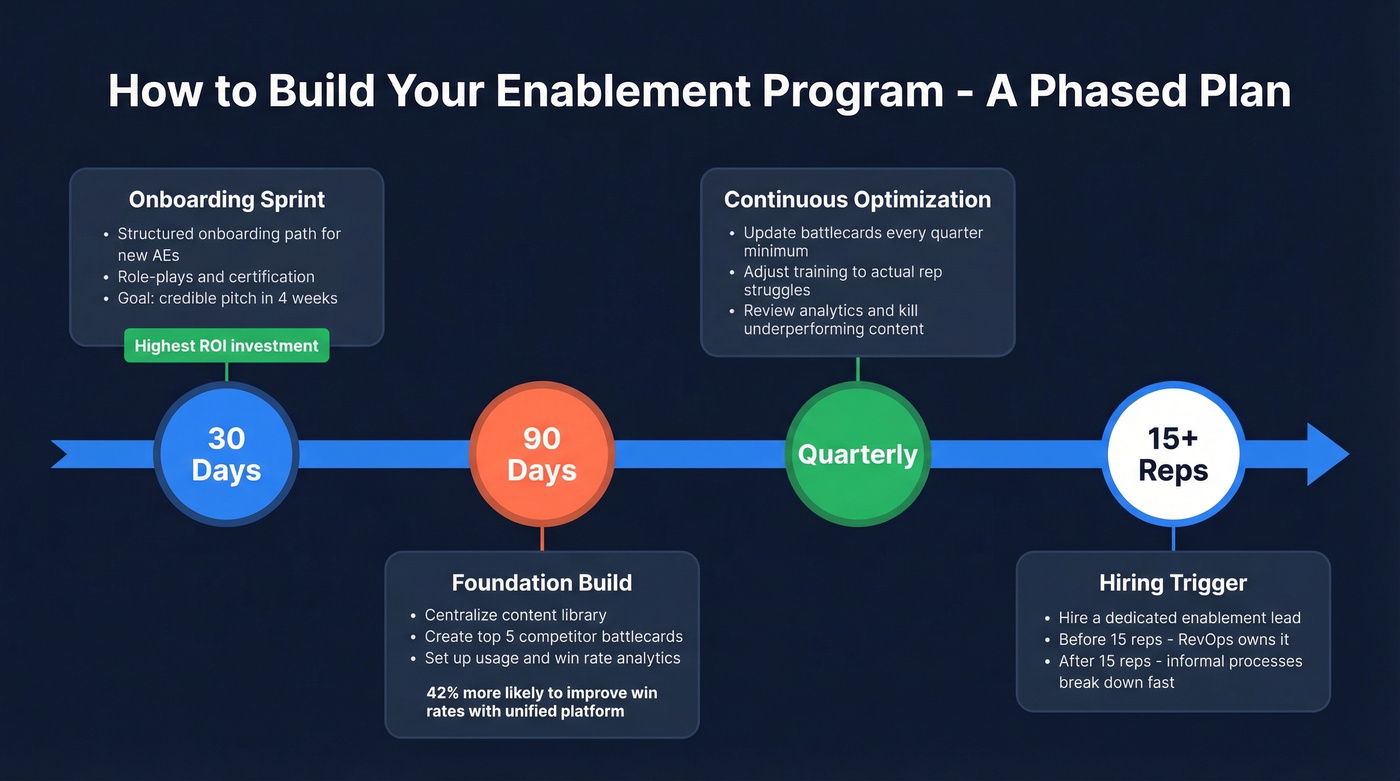
First 30 days: Get new AEs delivering a credible pitch within four weeks. Build a structured onboarding path with role-plays, certification, and shadowing. In our experience, this is the single highest-ROI enablement investment you'll make. (If you want a template, adapt a 30-60-90 day plan for your reps.)
First 90 days: Centralize your content library. Create battlecards for your top five competitors. Set up analytics to track content usage and win rates. Teams using a unified enablement platform are 42% more likely to improve win rates - largely because they can finally see what's working and what's gathering dust.
Quarterly: Update battlecards at minimum every quarter, and immediately on major competitor changes. Adjust training based on where reps are actually struggling, not where you assume they are.
The hiring trigger: bring on a dedicated enablement lead once your sales team exceeds 15 reps. We've seen that threshold hold true across dozens of teams. Before it, enablement is a RevOps responsibility. After it, informal processes break down fast.
Three Mistakes That Kill Enablement
1. No defined strategy. Buying tools before setting goals is how you end up with shelfware. Assign ownership, define success metrics, and align with sales leadership before you sign a single contract.
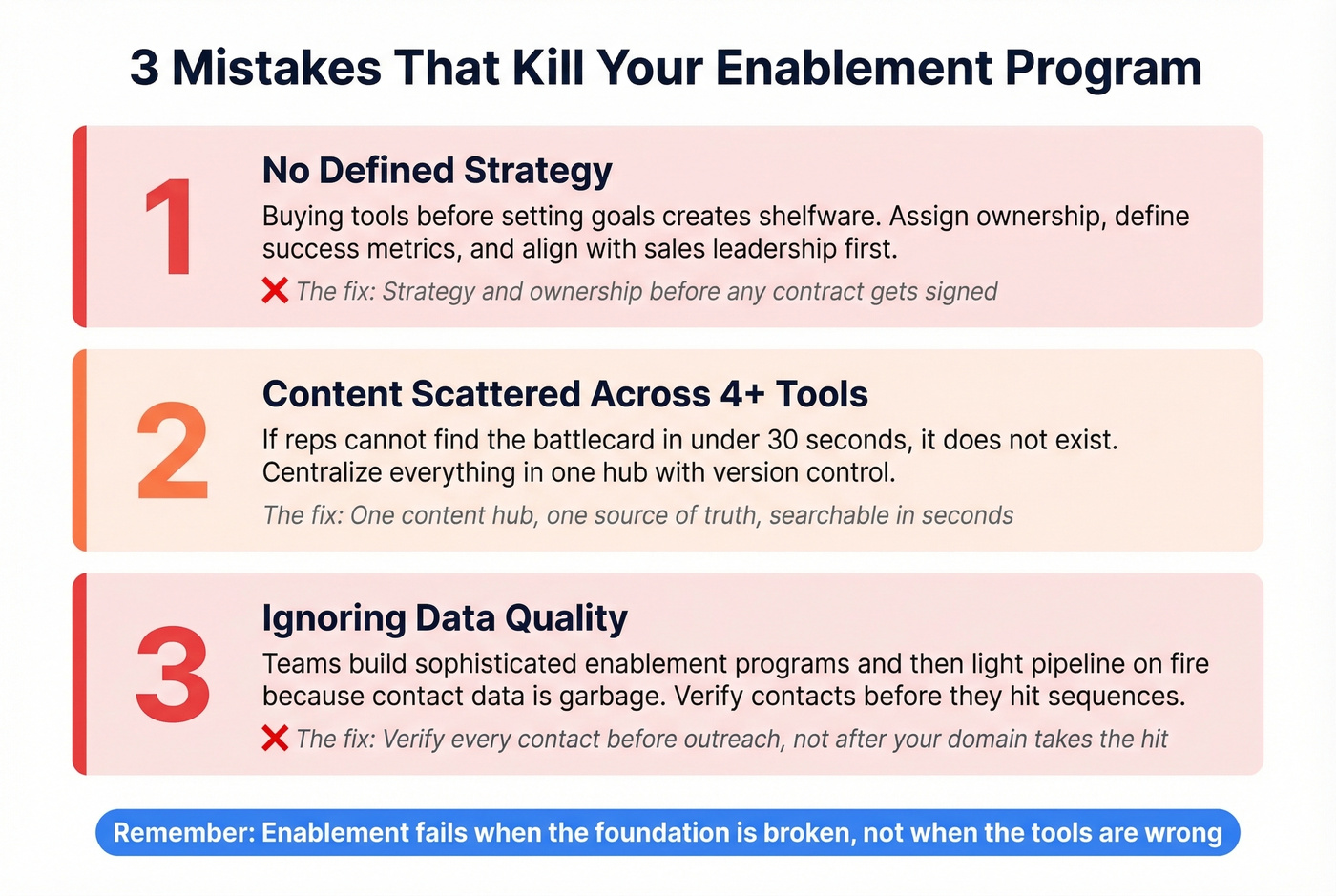
2. Content scattered across four-plus tools. If reps can't find the battlecard in under 30 seconds, it doesn't exist. Centralize everything in one hub with version control. And while you're consolidating, audit data governance and compliance - especially if you're selling into regulated industries where a stale or non-compliant asset can kill a deal faster than a bad demo.
3. Ignoring data quality. Let's be honest - we've watched teams build sophisticated enablement programs and then light pipeline on fire because their contact data was garbage. Verify contacts before they hit your sequences, not after your domain reputation takes the hit. (If you need a process, start with how to check if an email exists.)
Scaling for International Sales
As your team expands into new regions, international enablement introduces challenges a domestic-only stack won't surface: localized content, region-specific compliance requirements, and buyer expectations that vary dramatically by market.
The companies that get this right treat localization as a core enablement function, not an afterthought handled by a single marketing coordinator. Your content management platform needs multi-language versioning. Your training modules need regional context. And your data layer needs verified contacts across geographies, not just North America. Skip this step and you'll burn budget on outbound campaigns that never land.
FAQ
What's the difference between traditional and digital sales enablement?
Traditional enablement relies on static playbooks and in-person training events. The digital version integrates cloud tools, AI coaching, and real-time analytics into one platform reps access from anywhere - yielding 34% higher customer satisfaction and 8% higher revenue growth per CSO Insights data.
How much does an enablement platform cost?
Enterprise platforms like Highspot and Seismic run $40-75/user/month with $100K+ annual commitments. Mid-market options like Showpad start around $50/user/month. Digital sales rooms offer free tiers up to $750/month. Data quality tools start free and scale from there.
When should a team invest in enablement tooling?
Once your sales team exceeds 15 reps. Below that threshold, your CRM plus lightweight tools handle the load. Above it, tribal knowledge and ad hoc training start actively costing you deals - that's the inflection point where structured enablement pays for itself.
What does data-driven enablement look like in practice?
It means every decision - from which battlecards to update to which reps need coaching - is informed by usage analytics, win/loss data, and engagement metrics rather than anecdotal feedback. Teams that adopt this approach tie specific content assets and training interventions directly to revenue outcomes, typically seeing 5-10% win-rate improvements year-over-year.