

Direct Sales: What It Is, How It Works in 2026
The direct sales industry loves to cite its $36.7 billion in U.S. revenue. What it doesn't love to cite is how that revenue gets distributed - or how many of those 6.1 million sellers actually turn a profit after expenses. If you've spent 20 minutes reading "what is direct sales" articles and still can't tell whether the opportunity your college friend pitched you is legitimate or a pyramid scheme, that's not your fault. The existing content is either industry cheerleading or vague glossary entries.
This piece is neither.
What Does Direct Sales Actually Mean?
It's any transaction where a seller delivers a product or service directly to a buyer outside of a fixed retail location. No storefront, no Amazon listing, no retail shelf. The seller finds the customer, makes the pitch, and closes the deal - whether that's a door-to-door solar installer, an enterprise SDR booking demos via cold email, or someone hosting a kitchenware party in their living room.
Here's the distinction most articles bury: direct selling is the umbrella category. MLM (multi-level marketing) is one type underneath it. They aren't synonyms. Single-level selling, party plans, B2B outbound, and DTC e-commerce all fall under the umbrella without involving multi-tier compensation structures. The industry's refusal to draw a hard line between these models is its biggest credibility problem, and it's the reason so many people conflate "direct sales" with "that thing my cousin tried to recruit me into at Thanksgiving."
The Quick Version
- Not the same as MLM. Person-to-person selling outside retail is the broad category. MLM adds a multi-tier recruiting compensation layer. They overlap, but they aren't the same thing.
- The U.S. market is $36.7 billion in retail sales (2023) - but income distribution is wildly uneven. Most MLM participants lose money after expenses. Top performers in single-level and B2B models earn six figures.
- If you're evaluating an opportunity, apply the FTC's four-factor Koscot test before committing a dollar. We break it down below.
- If you're building a B2B outbound team, your data quality determines everything. Multichannel sequences outperform single-channel outreach by 287% - but only when your contact data is accurate enough to actually reach people.
Direct Selling by the Numbers
The DSA's data, compiled by Fortune Business Insights, paints a picture of a massive but shifting industry. In 2023, U.S. direct selling generated $36.7 billion in retail sales across 6.1 million sellers serving 37.7 million customers.
The real story is where the money flows. Services now lead the category mix - not wellness products, which dominated for decades.
| Category | Share of U.S. Sales |
|---|---|
| Services | 33.7% |
| Wellness | 32.4% |
| Home & Family | 16.0% |
| Personal Care | 10.2% |
| Clothing | 5.0% |
| Leisure & Education | 2.7% |
Services overtaking wellness is a structural shift worth watching. It signals that the industry is moving beyond the "supplements and skincare" stereotype into financial services, telecom, and energy - categories with higher transaction values and recurring revenue.
Five Types With Real Examples
Not all models look the same. Five matter.
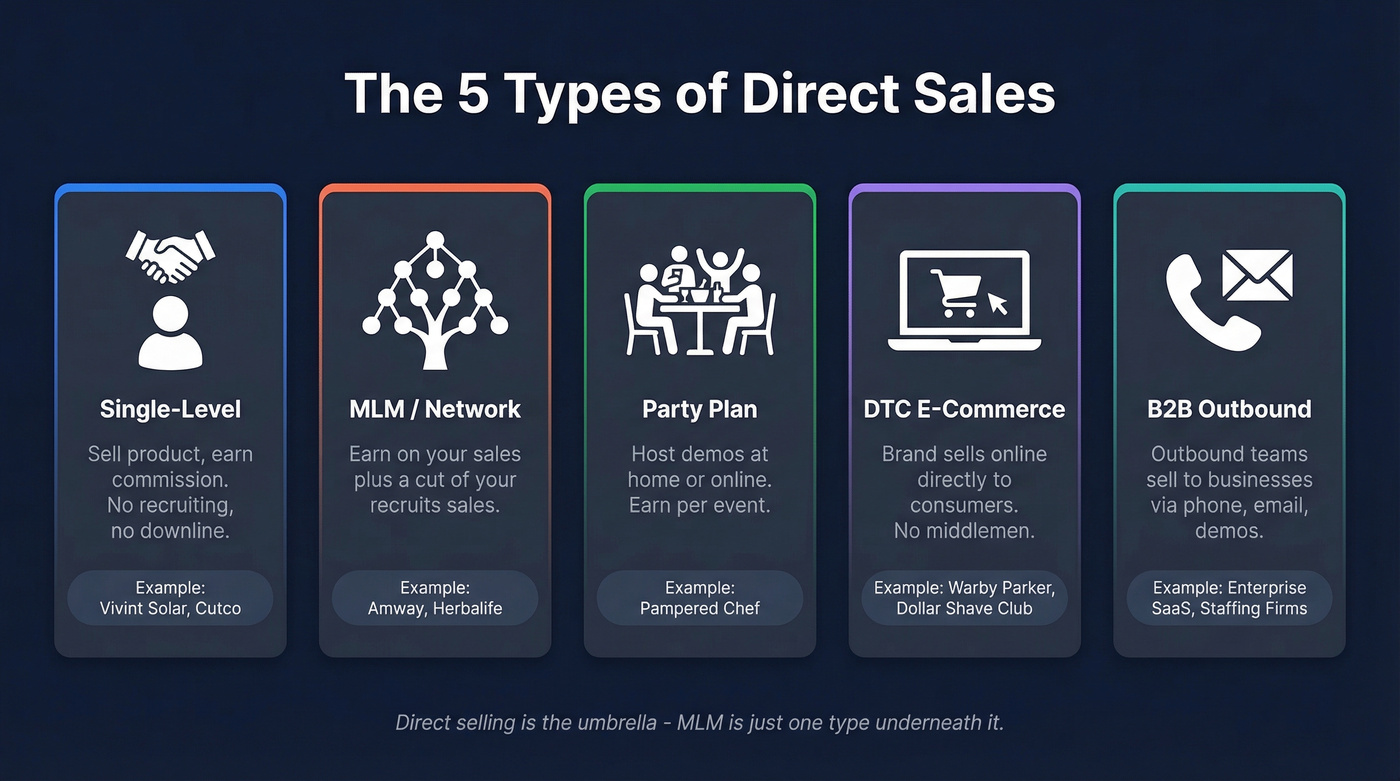
| Type | How It Works | Examples | Best For |
|---|---|---|---|
| Single-Level | Rep sells directly; earns commission on own sales only | Vivint Solar, Cutco | People who want to sell, not recruit |
| MLM / Network | Reps earn on own sales + commissions from recruits' sales | Amway, Herbalife | Those comfortable building downlines |
| Party Plan | Host demos in homes or virtual events; earn per event | Pampered Chef | Social sellers, community builders |
| DTC E-Commerce | Brand sells online directly to consumers, no middlemen | Warby Parker, Dollar Shave Club | Brands wanting margin control |
| B2B Outbound | Outbound teams sell to businesses via phone, email, demos | Enterprise SaaS, staffing firms | Companies with complex products |
Single-level selling is the cleanest model. You sell a product, you earn a commission. No downline, no recruiting bonuses. Vivint Solar reps knock doors and close solar installations - their comp is tied entirely to deals closed. That's it.
MLM / network marketing adds the recruiting layer. You earn on your sales plus a percentage of what your recruits sell. The most common complaint in direct selling communities isn't about the products - it's about comp plans that make recruiting mathematically necessary to break even. The income distribution is heavily skewed toward early and top-tier participants, which is why the FTC scrutinizes these structures so closely.
Party plan shifted hard as virtual selling accelerated. The format still works for the right products, but it's no longer the default playbook.
DTC e-commerce is the modern evolution. Brands like Warby Parker and Dollar Shave Club cut out retail entirely, selling directly through their own websites. It's "direct" in the truest sense - just without a human salesperson in the loop.
B2B outbound is what most sales professionals actually do in 2026. Enterprise SDRs and AEs running multichannel sequences to book meetings and close deals. SaaS companies running outbound prospecting teams are the most common example, and it's the model we know best from working with thousands of sales teams through Prospeo.
MLM vs. Pyramid Scheme
The line between a legitimate MLM and an illegal pyramid scheme isn't as bright as the industry wants you to believe. The FTC's guidance on multi-level marketing lays out the framework, and it's worth understanding even if you never join an MLM - because someone in your life will pitch you one eventually.
The FTC uses the Koscot test, named after a landmark case. A pyramid scheme exists when participants pay money for the right to sell a product and the right to receive rewards for recruiting that are unrelated to sales to actual end users. The FTC's 2016 Herbalife settlement showed exactly how this plays out in practice - the company was forced to restructure its compensation plan because too much income came from recruiting rather than retail sales.
Four factors drive the evaluation:
- Marketing representations - Does the company's messaging focus on recruiting or on selling products to real customers?
- Participant experiences - What do people actually earn after expenses? How much product do they buy themselves vs. sell to outside customers?
- Compensation structure - Can you earn meaningful income without recruiting?
- Recruiting incentives - Are participants pushed to recruit aggressively and make large purchases just to stay eligible for commissions?
The FTC has found that a substantial majority of participants in pyramid schemes lose money. Not because they didn't hustle hard enough - because the structure makes it mathematically inevitable.
The Four-Question Test
Your college friend just messaged you about an "incredible opportunity." Before you commit, ask:
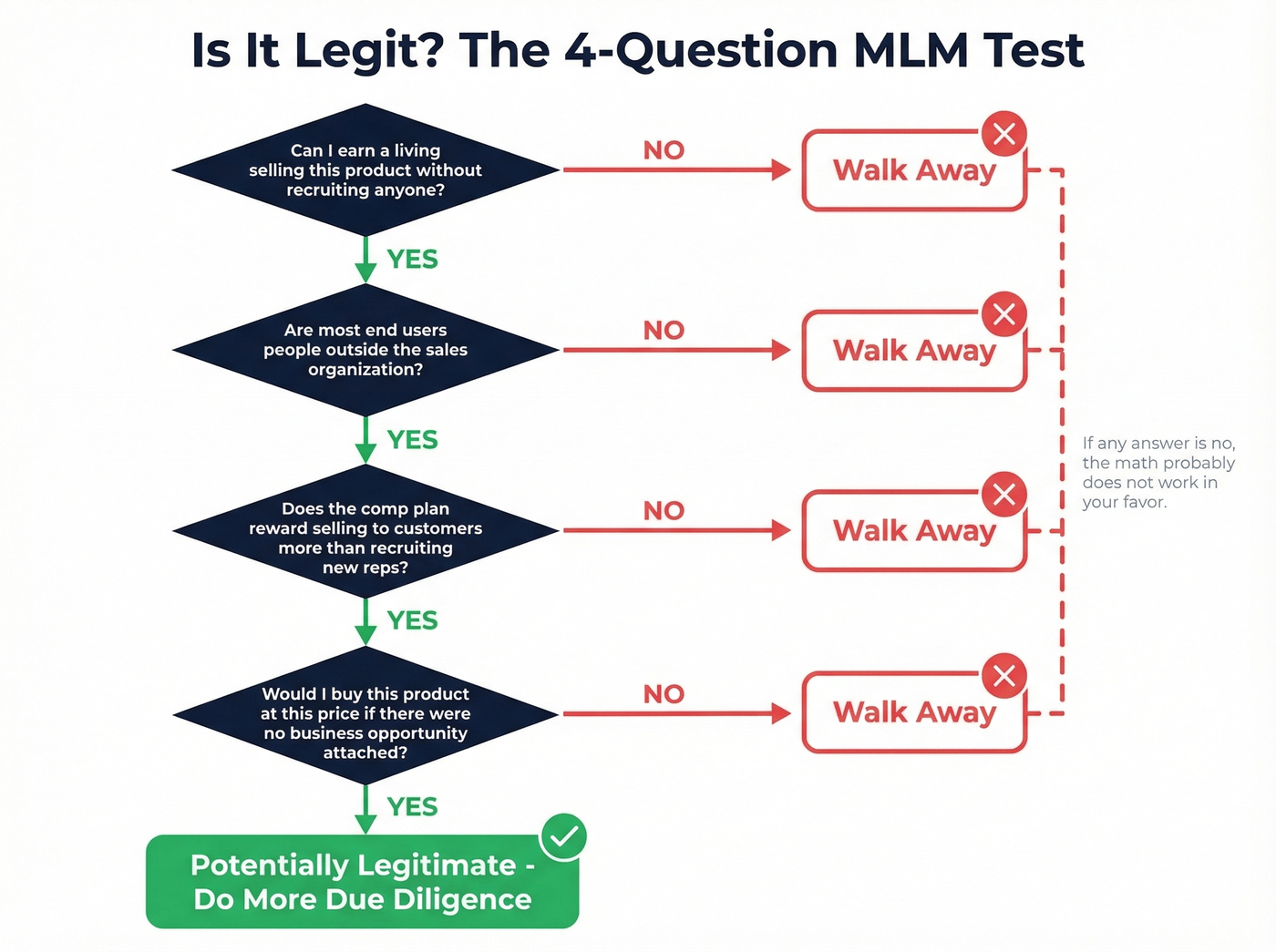
- Can I earn a living selling this product without recruiting anyone?
- Are most of the product's end users people outside the sales organization?
- Does the comp plan reward selling to customers more than recruiting new reps?
- Would I buy this product at this price if there were no business opportunity attached?
If any answer is "no," walk away. The consensus on r/antiMLM is that most people can't distinguish "real direct selling" from "MLM with extra steps" - which tells you how muddied the waters have become. This test cuts through it.

Multichannel direct sales sequences only work when your contact data connects you to real people. Prospeo delivers 98% email accuracy and 125M+ verified mobile numbers with a 30% pickup rate - so your outbound team spends time selling, not bouncing.
Stop burning sequences on bad data. Start reaching decision-makers directly.
Direct Sales vs. DTC E-Commerce
Traditional person-to-person selling and DTC e-commerce both cut out middlemen, but they solve different problems in fundamentally different ways.
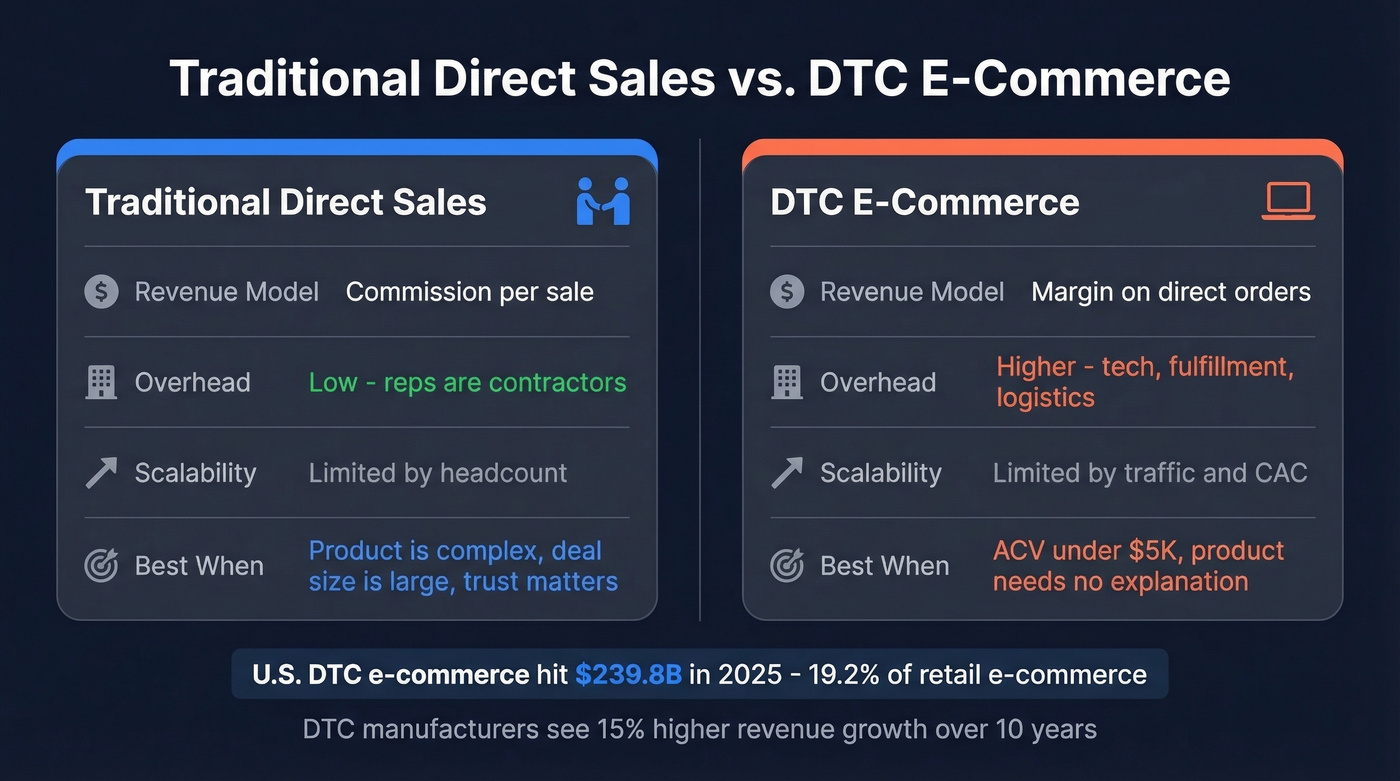
| Dimension | Traditional Model | DTC E-Commerce |
|---|---|---|
| Revenue Model | Commission per sale | Margin on direct orders |
| Overhead | Low (reps are contractors) | Higher (tech, fulfillment) |
| Scalability | Limited by headcount | Limited by traffic/CAC |
| Examples | Avon, Vivint, Amway | Warby Parker, Glossier |
U.S. DTC e-commerce hit roughly $239.8 billion in 2025, representing about 19.2% of retail e-commerce. McKinsey research shows manufacturers selling DTC see 15% higher revenue growth over ten years than non-DTC peers, with middleman savings of ~15% when replacing marketplaces and ~40% when replacing wholesalers/retailers. And 75% of DTC shoppers will pay more for personalized experiences, compared to just 28% of standard online shoppers - a gap that rewards brands investing in customer data.
Let's be honest: if your average contract value is under $5,000 and your product doesn't require explanation, DTC e-commerce will outperform a human sales force every time. Direct selling earns its keep when the product is complex, the deal size justifies human involvement, or the buyer needs trust before writing a check. Everything else is better served by a good website and a paid ads budget.
How It Actually Works
Whether you're selling solar panels door-to-door or running enterprise outbound sequences, the process follows a four-step loop: prospect, demo, close, follow up. The tools change. The process doesn't.
Step 1: Find the Right People
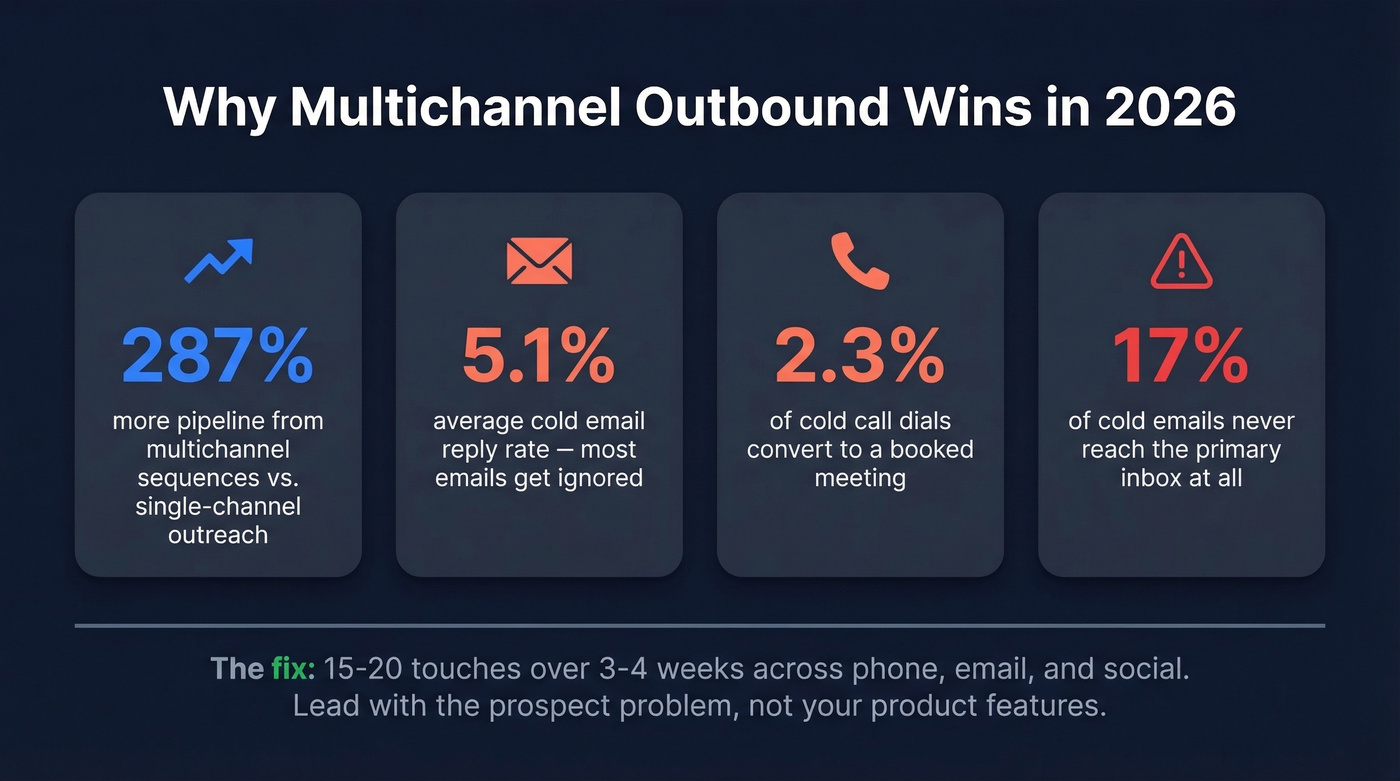
This is where most efforts die. Your team is burning through contact lists and half the phone numbers are disconnected. About 17% of cold emails never reach the primary inbox. If your data is bad, nothing downstream matters.
For B2B teams, build your ideal customer profile first - industry, company size, job titles, geography - then pull a targeted list from a verified data source and verify it before loading into your sequencer. We've seen teams waste entire quarters on unverified lists that bounce at 25%+ rates. Don't be that team.
Step 2: Present and Demo
Cold email reply rates average about 5.1%. Cold calling converts at roughly 2.3% of dials to booked meetings. These numbers aren't great - which is exactly why multichannel sequences outperform single-channel outreach by 287%. Build persona-based sequences with 15-20 touches over 3-4 weeks across phone, email, and social. When you get the meeting, lead with the prospect's problem, not your product's features. Hands-on demos convert better than slide decks because they surface objections in real time, and they give you a chance to read the room and adapt your pitch on the fly.
Step 3: Close and Follow Up
Watch for buying signals: questions about implementation timelines, pricing for larger teams, or "can you send me a proposal?" Offer clear next steps. "I'll send the contract by 3pm, and we can kick off onboarding next Tuesday" beats "let me know what you think."
Ambiguity kills deals.
Most reps stop after a couple of follow-ups. Personalized follow-ups - referencing something specific from the demo or sharing a relevant case study - outperform generic "just checking in" emails by a wide margin. One of our team members once closed a $40K deal on the seventh follow-up, simply by sending a two-sentence email linking to a case study that matched the prospect's exact use case. Persistence with relevance wins. If you need copy you can steal, start with these sales follow-up templates.
7 Mistakes That Kill Sales Teams
We've watched enough teams stumble to recognize the patterns.
- Rushed onboarding. New reps get a product sheet and a login, then they're told to start dialing. Fix: structured first two weeks with shadowing, scripts, and product immersion. (Use a 30-60-90 day plan to make it repeatable.)
- One-time training. A single bootcamp doesn't build skills. Fix: recurring weekly role-plays and coaching sessions.
- No daily metrics. If reps don't know their activity targets, they can't self-correct. Fix: set clear daily dials, emails, and meetings-booked numbers.
- Outdated scripts. Scripts written 18 months ago don't reflect current objections. Fix: iterate monthly based on field feedback.
- Reactive coaching. Managers only step in when a rep is already failing. Fix: proactive weekly 1:1s reviewing calls and emails together.
- Top-down communication. Leadership dictates strategy without listening to what reps hear in the field. Fix: two-way feedback channels where field insights shape messaging.
- Failing to celebrate wins. Morale erodes when closed deals go unacknowledged. Daily Slack shoutouts and weekly leaderboards cost nothing and change everything.
The Tools Stack That Matters
CRMs increase sales productivity 20-30% on average - but only if the data going in is clean. Start with verified prospecting data, then worry about your CRM.
Prospecting & Data
Prospeo is where your pipeline starts. The database covers 300M+ professional profiles with 98% email accuracy and a 30% mobile pickup rate. You can search by job title, company size, technographics, and buyer intent signals across 15,000 topics, and every record refreshes on a 7-day cycle - the industry average is six weeks. The free tier includes 75 verified emails and 100 Chrome extension credits per month, enough to validate whether the platform fits your workflow before committing. Teams like Snyk have used it to cut bounce rates from 35-40% to under 5% while growing AE-sourced pipeline by 180%.
If you're comparing sources, start with a shortlist of sales prospecting databases and layer in data enrichment services where you need missing fields.

CRMs
| Tool | Best For | Starting Price |
|---|---|---|
| Zoho CRM | Budget-friendly all-in-one | $14/user/mo |
| Pipedrive | Visual pipeline management | $14-$99/user/mo |
| HubSpot CRM | Free starter CRM | Free / paid from ~$20/user/mo |
| Salesforce | Enterprise scale | ~$25-$165/user/mo |
For teams with fewer than 10 reps who need email, social, and live chat in one place without breaking the budget, Zoho CRM at $14/user/month is the move. It includes omnichannel tools and 300+ integrations.
Pipedrive is the pick for reps who think visually about their deals. The drag-and-drop pipeline genuinely changes how you manage opportunities. Skip it if you need deep reporting - that's not its strength.
Most teams should start with HubSpot CRM's free tier and only upgrade when they hit its automation limits. Paid plans from around $20/user/month unlock the workflows that justify the spend. If you want more options, here are more examples of a CRM with real pricing.
Salesforce is overkill for teams under 20 reps. But if you've got a dedicated admin and need enterprise-grade customization, nothing else comes close.
Field & MLM-Specific
SPOTIO ($39/user/month) handles territory mapping, route optimization, and door-to-door tracking for field sales teams. Penny ($6.99/month) manages conversations and follow-ups specifically for MLM sellers. Infinite MLM Software ($799 one-time) provides commission tracking and genealogy tree management for companies running their own MLM programs.
B2B outbound is the direct sales model that scales in 2026 - but only with data that keeps up. Prospeo refreshes 300M+ profiles every 7 days, not every 6 weeks. Teams using Prospeo book 35% more meetings than Apollo users.
Your direct sales pipeline is only as good as your data. Fix that today.
Where This Industry Is Heading
The global picture is shifting fast. Three trends stand out.
Latin America is booming. Colombia maintained over 1.73 million active sellers throughout 2025, with cumulative net sales growth exceeding 5%. Mexico is tracking similar growth, driven by distributors acting as micro-influencers on social platforms.
China is rewriting the model. The "Expanded Direct Selling" framework combines offline relationship selling with online distribution and AI-powered tools. It's the most aggressive digital transformation happening in the industry, and Western companies are watching closely.
Social commerce is eating traditional channels. With 19.4% of e-commerce now happening through social platforms, the line between "direct seller" and "content creator with a product link" is disappearing. The sellers who thrive in 2026 are the ones treating every social touchpoint as a sales channel - not just a branding exercise. (If you're building pipeline in that environment, these sales prospecting techniques are the baseline.)
The party-plan-in-your-living-room era isn't dead. But it's no longer the growth engine. The future belongs to digitally native sellers who combine verified data, multichannel outreach, and genuine product expertise.
FAQ
Is direct sales the same as MLM?
No. Direct sales is the broader category covering any person-to-person selling outside a fixed retail location. MLM is one specific type that adds a multi-tier compensation structure rewarding recruitment. Single-level selling, party plans, and B2B outbound all qualify without MLM's recruiting layer.
How much do direct sellers earn?
It depends entirely on the model. Top performers in single-level or B2B outbound roles earn six figures - enterprise AEs at SaaS companies routinely clear $150K+ OTE. In MLM structures, the FTC has found that a substantial majority of participants lose money after expenses. Evaluate the comp plan and realistic sales volume before committing.
What's the difference between direct sales and DTC?
Traditional direct selling involves a person selling to another person through demos, door-to-door visits, or conversations. DTC e-commerce means a brand selling online directly to buyers without retail middlemen. Both eliminate intermediaries, but the mechanism differs - human relationship vs. digital storefront.
What tools do B2B sellers need to start?
At minimum: a verified contact data source like Prospeo for accurate emails and phone numbers, a CRM to track your pipeline (Zoho or Pipedrive from $14/month), and a multichannel outreach sequence combining email, phone, and social touches.
Is direct selling legal?
Yes - it's legal in the U.S. and most countries worldwide. What's illegal is operating a pyramid scheme disguised as legitimate selling. Apply the FTC's four-factor Koscot test - evaluating marketing claims, participant earnings, compensation structure, and recruiting incentives - to assess any opportunity before joining.