

How to Write an Email Introduction That Actually Gets a Reply
You've drafted the email introduction, hovered over send, and felt that familiar knot in your stomach. You're not alone - 88% of office workers say they've regretted an email right after hitting send, and 28% say an email has actively hurt their career. The stakes feel high because they are high.
Most intro emails fail because they're too long. Warm intros get 20-60% reply rates vs. 3-5.1% for cold. This guide gives you the exact frameworks, word counts, and templates for every scenario - plus the follow-up playbook for when you get ghosted.
What Is an Email Introduction?
An email introduction connects people or establishes a new relationship. Sounds simple, but there are three distinct types, and each follows different rules.
Third-party introductions are when you connect two people who don't know each other. You're the bridge - your reputation is on the line for both sides. Self-introductions are when you're reaching out to someone new, whether for networking, a new role, or a client relationship. Sales and prospecting introductions are when you're initiating a business conversation with someone who didn't ask to hear from you.
The structure, tone, and length differ for each. A third-party intro needs to serve two audiences in one email. A self-introduction needs to establish credibility fast. A sales intro needs to earn attention from someone who gets dozens of these a week. We'll cover all three with templates you can steal.
Anatomy of a Great Intro Email
Every effective email introduction follows the same skeleton, regardless of type: subject line, opening line, context, ask, CTA, sign-off. Let's break down what the data says about each piece.
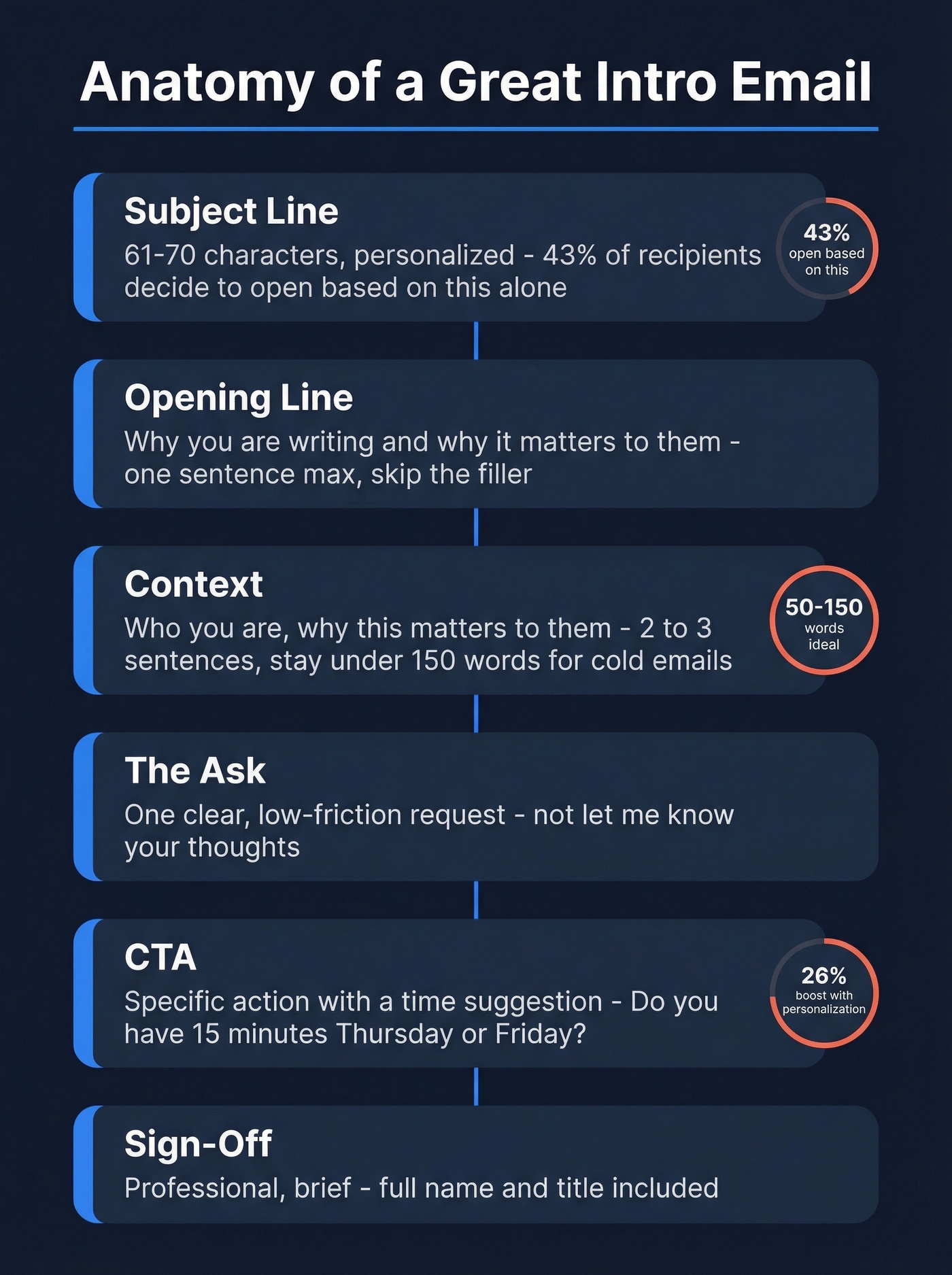
Subject lines carry disproportionate weight. 43% of recipients decide whether to open based on the subject line alone. Subject lines between 61-70 characters hit the highest open rates at 43.38% and the highest CTR at 17.57%. Personalization in the subject line boosts opens by 26%. That means "Quick intro - [mutual connection] suggested we connect" will outperform "Introduction" every single time. If you want more ideas, borrow from these subject line patterns.
The opening line determines whether they keep reading. Skip the "I hope this finds you well" filler. Lead with why you're writing and why it matters to them. One sentence. Two at most.
Context is where most people over-write. For cold emails, aim for 50-150 words total. For warm intros, stay under 200. The moment you cross into wall-of-text territory, you've lost them.
An 11M-email analysis of cold outbound campaigns found that deeper personalization drives 52% higher reply rates, and targeting cohorts of 50 or fewer outperform broad blasts by 2.76x. Spray-and-pray is dead. If you're building a sequence, this B2B cold email sequence guide will help you structure the touches.
Your CTA should be one specific action. Not "let me know your thoughts" - that's not a CTA, it's an invitation to ignore you. "Do you have 15 minutes Thursday or Friday?" gives them something concrete to respond to. For more examples, use these email call to action rules.
Quick checklist before you hit send:
- Subject line: 61-70 characters, personalized, specific
- Opening: why you're writing (one sentence)
- Context: who you are, why this matters to them (2-3 sentences)
- Ask: one clear, low-friction request
- Sign-off: professional, brief, includes your full name and title
Email Introduction Benchmarks
The gap between cold and warm intros is enormous, and understanding it changes how you prioritize your outreach strategy entirely.
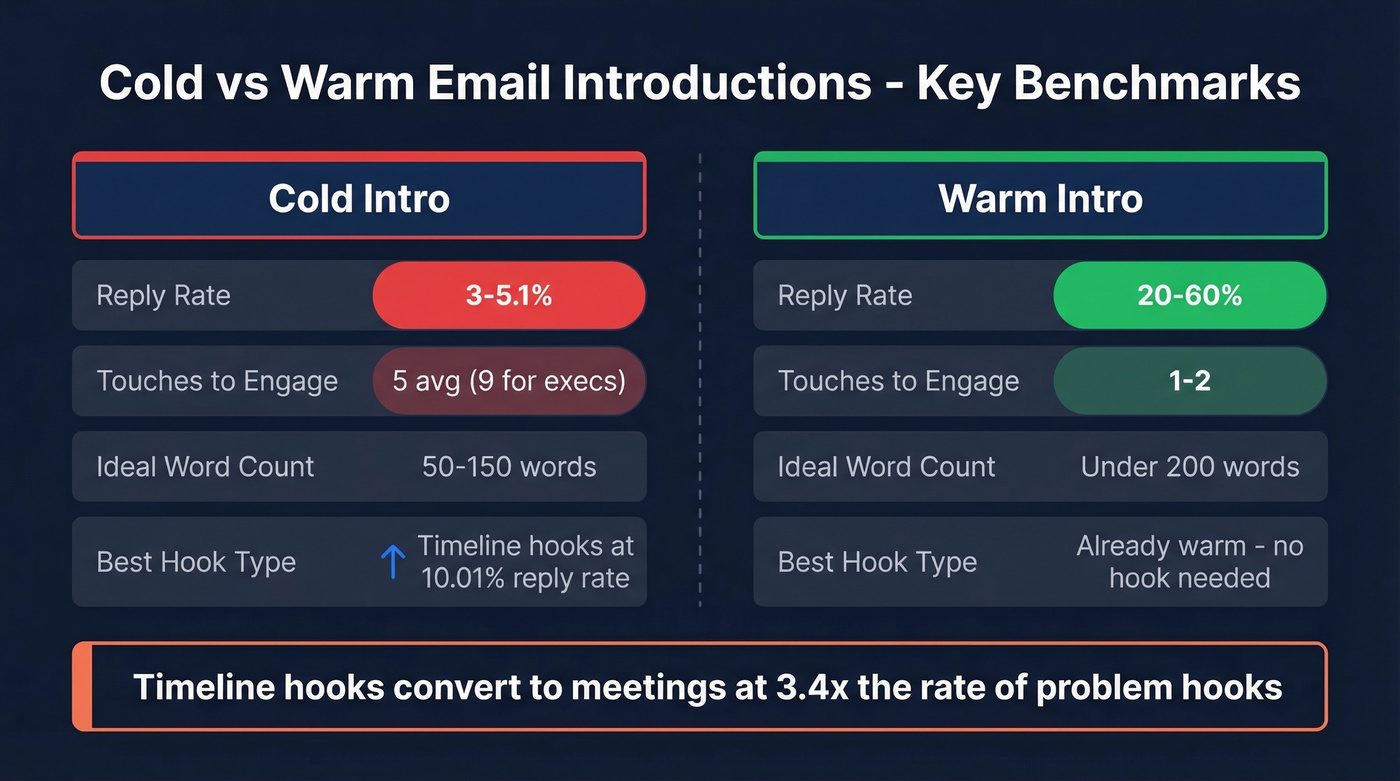
| Metric | Cold Intro | Warm Intro |
|---|---|---|
| Avg reply rate | 3-5.1% | 20-60% |
| Timeline hook reply | 10.01% | N/A (already warm) |
| Problem hook reply | 4.39% | N/A |
| Touches to engage | 5 avg (9 for execs) | 1-2 |
| Ideal word count | 50-150 | Under 200 |
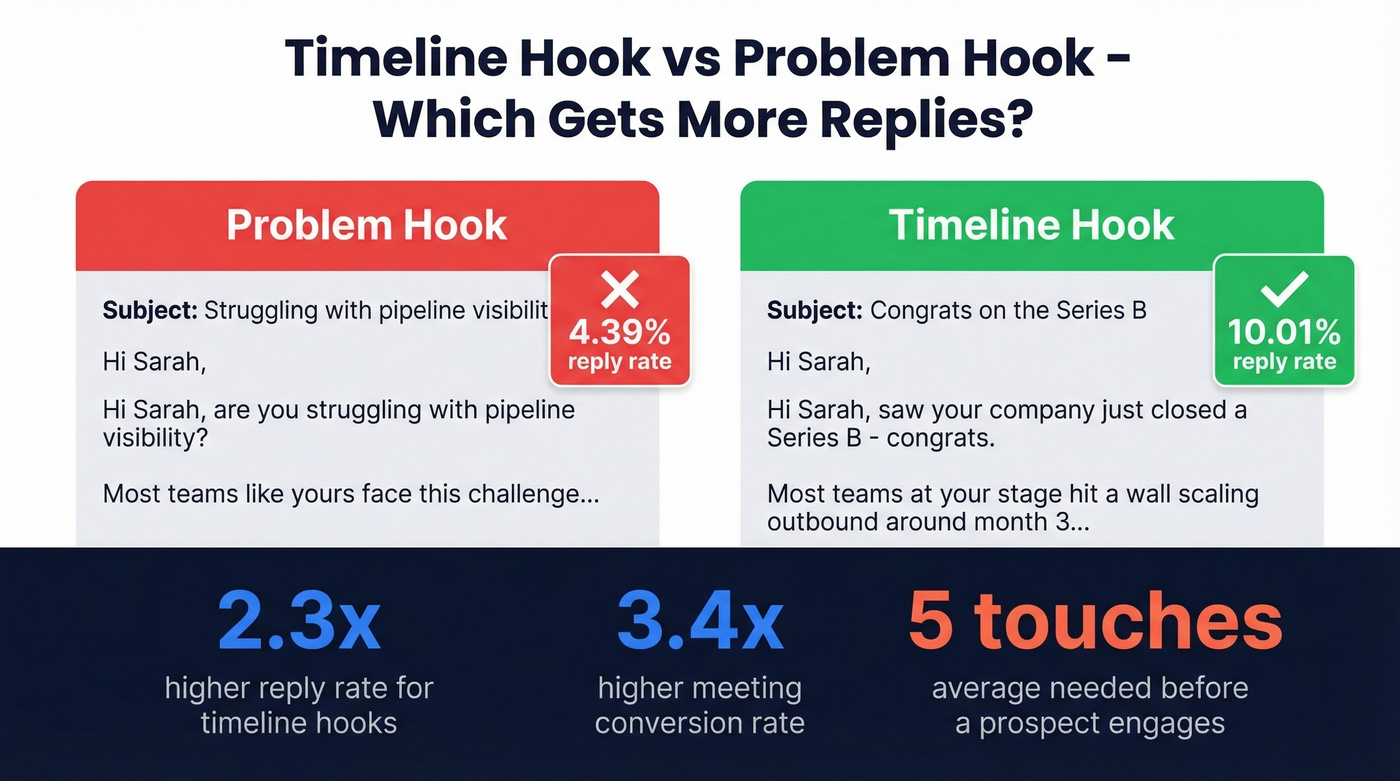
A few things jump out. Timeline-based hooks - referencing a trigger event like a funding round, a job change, or a product launch - averaged a 10.01% reply rate. Problem-based hooks ("Are you struggling with X?") hit just 4.39%. That's a 2.3x gap. The difference widens at the meeting stage: timeline hooks convert to meetings at 2.34% vs. 0.69% for problem hooks, a 3.4x difference. If you're writing cold intros, lead with what just happened, not what might be wrong. (More on this in our sales prospecting techniques breakdown.)
For broader context, MailerLite's benchmark study across 3.6M campaigns found a median open rate of 43.46%. But take open rates with a grain of salt - Apple Mail Privacy Protection inflates them significantly. Reply rates and meeting rates are the metrics that actually matter.
Here's the thing we see over and over: teams obsess over open rates while ignoring reply rates. Opens tell you your subject line works. Replies tell you your email works. Top-quartile cold emailers reach 15-25% reply rates through better targeting and hooks - proof that the ceiling is much higher than most people assume.
How to Introduce Two People Over Email
The third-party intro is the highest-stakes email introduction because your reputation backs both sides. Get it wrong and you've annoyed two people instead of one.
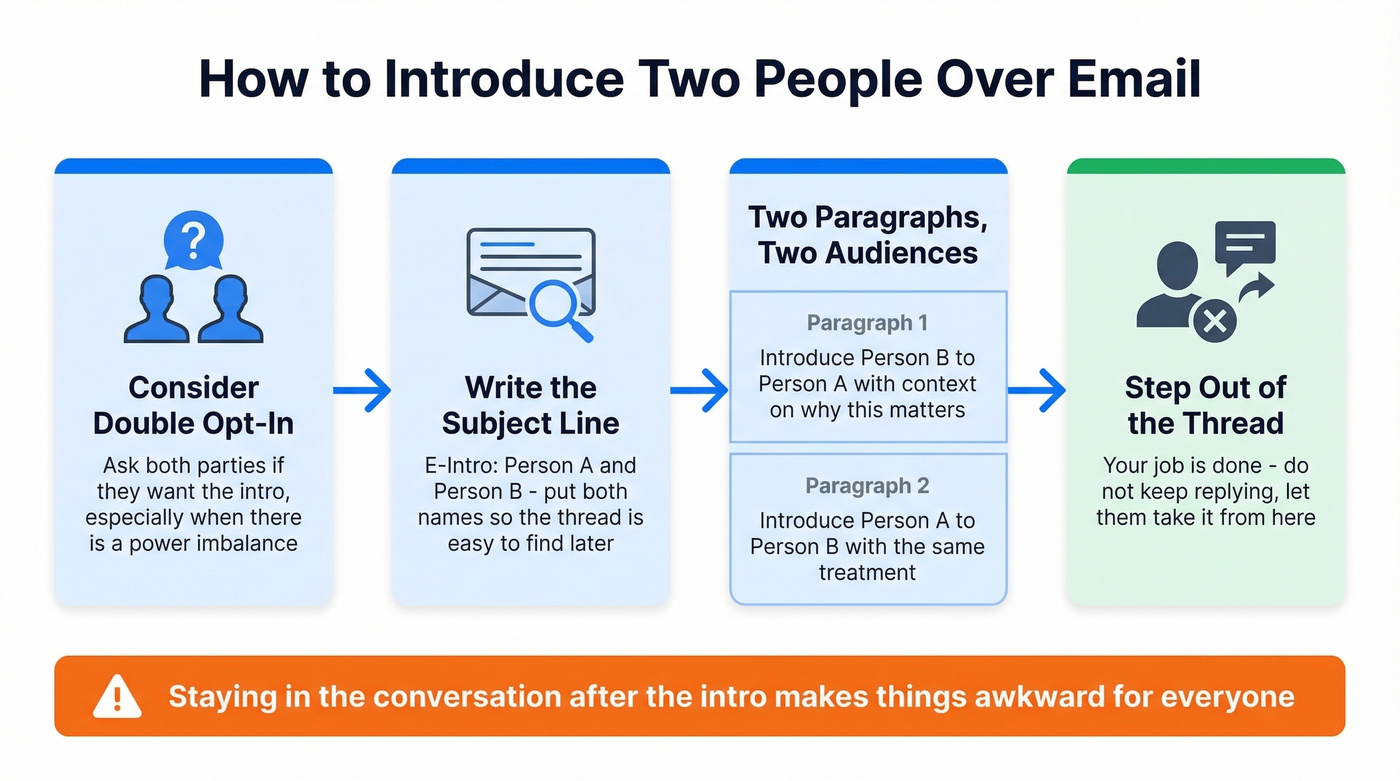
The cleanest structure comes from Andy Ellwood's framework: two paragraphs, each addressed to one person. Paragraph one introduces Person B to Person A with context on why the connection matters. Paragraph two introduces Person A to Person B with the same treatment. That's it.
Subject line: "E-Intro: [Person One] & [Person Two]"
Putting both names in the subject line makes the thread easy to find later. Copy-paste this template and customize:
Subject: E-Intro: Sarah Chen & Marcus Rivera
Sarah - meet Marcus Rivera, VP of Product at [Company]. He's building out their enterprise tier and mentioned he's looking for someone with deep payments infrastructure experience. Thought of you immediately.
Marcus - Sarah Chen runs product at [Company] and led their payment platform migration last year. She's exactly the kind of person who'd have useful perspective on what you're tackling.
I'll let you two take it from here. Keep me posted!
The critical rule: step out of the thread. After sending, don't keep replying. You've done your job. Staying in the conversation makes things awkward for everyone. If you're on the receiving end, here's how to handle the email after introduction.

Timeline hooks get 2.3x more replies than problem hooks - but only if you're emailing the right person at a real address. Prospeo's 300M+ profiles refresh every 7 days, so your intro emails land on current, verified addresses with 98% accuracy. No bounces torching your domain reputation.
Stop crafting perfect intros that bounce. Start with verified data.
The Double Opt-In Debate
Should you ask both parties before making an introduction? This is genuinely contested.
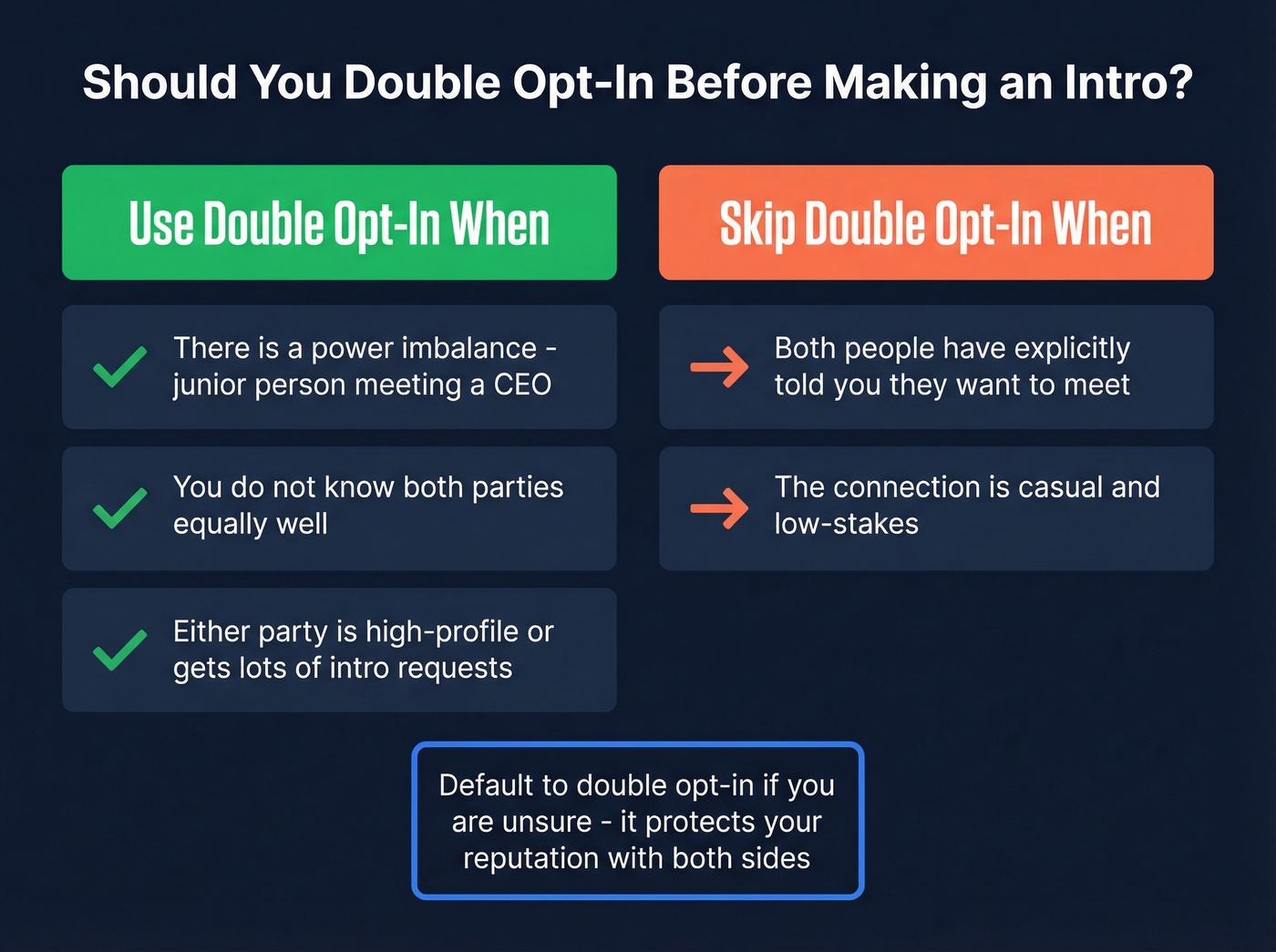
The case for double opt-in: Richard Titus argues that checking with the "to-be-introduced" party first aligns with GDPR's spirit and basic politeness. For high-volume connectors - VCs, community leaders, executives who get dozens of intro requests - double opt-in protects their time and your relationship with them.
The case against: Adam Draper makes the contrarian argument that double opt-in adds friction that can stall introductions from being written at all. The intermediary gets busy, forgets to follow up, and the intro never happens. His stance: just send it, but think before you do.
Default to double opt-in when there's a power imbalance (junior person meeting a CEO), when you don't know both parties equally well, or when either party is high-profile. Skip it when both people have explicitly told you they want to meet, or when the connection is casual and low-stakes.
Scenario Templates
Self-Introduction Emails
Self-introductions cover everything from networking outreach to starting a new job to onboarding a new client. The key is establishing credibility without writing your autobiography.
Casual networking variant:
Subject: Fellow [industry/community] member - quick hello
Hi [Name], I'm [Your Name], [role] at [Company]. I caught your talk at [event] / read your piece on [topic] and it resonated with a challenge we're working through right now.
Would love to swap notes sometime. Open to a 15-minute call next week?
New role variant:
Subject: New [role] at [Company] - looking forward to working together
Hi [Name], I just joined [Company] as [role] and I'll be your main point of contact going forward. [Previous person] spoke highly of the work you've done together.
I'd love to set up a quick intro call this week to learn about your priorities. Does Thursday or Friday work?
Keep both under 100 words. If a recipient can't process your message in 15 seconds, it won't get a reply.
Sales Introduction Emails
Sales intros are where most people go wrong. The average prospect needs 5 touches before engaging - and reaching executives often takes 9. Your first email isn't supposed to close the deal. It's supposed to earn the second touch. If you want plug-and-play options, use these sales follow-up templates.
We've found that if your average contract value is under $10K, you probably don't need a 7-touch sequence. Two well-researched, personalized emails will outperform seven generic ones.
Instead of "Are you struggling with pipeline visibility?" try "Saw [Company] just closed a Series B - congrats. Most teams at your stage hit a wall scaling outbound around month 3. We helped [similar company] avoid that." See the difference? One is a vague question. The other proves you did your homework.
Sales intro template with a mutual connection:
Subject: [Mutual connection] suggested I reach out
Hi [Name], [Mutual connection] mentioned you're building out [specific initiative]. We helped [similar company] [specific result] last quarter.
Worth a 15-minute call to see if there's a fit? I'm open Tuesday or Wednesday.
The best sales intro is worthless if it bounces. Before sending, verify addresses with a tool like Prospeo - 98% email accuracy and a free tier with 75 lookups a month. A bounced email doesn't just waste your time; it damages your sender reputation for every email that follows.
Fundraising Intro Emails
Fundraising intros follow a specific set of rules because they're almost always forwarded. The golden rule: make your blurb forwardable in 15 seconds.
Chris Neumann's framework nails the structure. Your introductory passage should answer four questions in 2-3 paragraphs: what the company does, why it matters, who the founders are, and what you've accomplished so far. That's the entire email. Anything beyond that is noise a busy VC won't read, and the person forwarding it on your behalf won't bother trimming.
Common mistakes that kill fundraising intros: exceeding 250 words, omitting traction data, not including a deck, asking for intros to 10-20 investors at once instead of 1-2, and responding slowly after the intro is actually made.
Forwardable blurb template:
Subject: Intro to [Investor Name] - [Company Name]
[Company] is [one-sentence description]. We're [key traction metric - e.g., "$40K MRR, 3x growth QoQ"]. Team: [founder credentials in one line].
We're raising a [$X round] and [Y]% is subscribed. [Investor Name] would be a great fit because [specific reason]. Deck attached.
Never fake personalization. VCs spot it instantly and it goes straight to trash.
Event Follow-Up Intros
Event follow-ups have a narrow window. Send within 24-48 hours while the conversation is still fresh.
Subject: Great chatting at [Event] - [specific topic]
Hi [Name], really enjoyed our conversation about [specific detail from the conversation] at [Event] yesterday. Your point about [specific thing they said] stuck with me.
I'd love to continue the conversation. Free for coffee or a call next week?
The specific detail is what separates this from the 50 other "great meeting you" emails they'll get. Reference something only you two discussed.
Email Introduction Etiquette
Seven rules that separate professionals from amateurs:
- Default to double opt-in. Ask before you connect people, especially when there's a power imbalance.
- Exit the thread. After making an intro, step out. Don't hover.
- Don't over-introduce. If you're making more than 2-3 intros per week for the same person, you're diluting your social capital.
- Respect power dynamics. Don't intro a junior employee to a C-suite exec without context that justifies the connection.
- Proofread ruthlessly. 48% of professionals judge typos in email more harshly than in Slack or Teams. One typo in an intro email undermines your credibility with both parties. (If you want help, an AI email checker can catch issues fast.)
- Keep it under 150 words. For cold and third-party intros, brevity isn't just polite - it's strategic.
- Verify before you send. A bounced intro email signals carelessness. Run uncertain addresses through an email verification tool before sending - it takes seconds and protects your reputation. If you're troubleshooting, start with email bounce rate basics.
When Your Intro Gets No Response
Silence doesn't mean no. It usually means "not right now" or "I missed it."
Wait at least 3 business days before following up - this patience yields 31% more replies compared to immediate follow-ups. The optimal cadence is 3-7-7: follow up on Day 3, Day 10, and Day 17. Data shows 93% of replies come by Day 10. If you want a deeper cadence breakdown, see when should i follow up on an email.
What's wild is how few people actually persist. 35% follow up only once or twice, then give up. The recommended range is 6-11 attempts. The 12% who persist are significantly more likely to get a response - and in our experience running outbound campaigns, that persistence is the single biggest differentiator between teams that hit quota and teams that don't.
Follow-up template:
Subject: Re: [Original subject line]
Hi [Name], wanted to bump this in case it got buried. [One-sentence reminder of your original ask.]
Still happy to [specific CTA] if the timing works. If not, no worries - just let me know and I'll stop cluttering your inbox.
That last line matters. Giving them an easy out paradoxically makes them more likely to respond. Nobody wants to feel trapped.
Writing a strong email introduction is half the battle. The other half is making sure it actually lands in someone's inbox. Whether you're sending a warm e-intro between colleagues or a cold sales outreach, the principles are the same: be brief, be specific, and verify before you send.
You just read that targeting cohorts under 50 outperform broad blasts by 2.76x. Prospeo's 30+ filters - buyer intent, job changes, funding rounds, technographics - let you build hyper-targeted lists of exactly the right people to introduce yourself to. At $0.01 per verified email, precision outreach costs less than a single bounced campaign.
Build the exact list your intro emails deserve.
FAQ
How long should an email introduction be?
Cold intro emails should be 50-150 words; warm introductions can stretch to 200. Fundraising forwardable blurbs should stay under 250 words. If a recipient can't scan your message in 15 seconds, it won't get a reply - or a forward.
Should I CC or BCC when introducing two people?
CC both parties so they can see each other's addresses and reply directly. Never BCC - it creates confusion about who's in the conversation. After sending, step out of the thread and let them take it from there.
How many times should I follow up after an intro email?
Data supports 6-11 follow-up attempts using a 3-7-7 cadence: Day 3, Day 10, Day 17. By Day 10, you'll have captured 93% of people who were going to reply. Most senders quit after 1-2 attempts - persistence is a real competitive advantage.
What's the best free tool to verify emails before sending intros?
Prospeo offers 75 free email lookups per month with 98% accuracy and real-time verification. Hunter provides 25 free searches monthly but caps enrichment features. For teams sending more than a handful of intro emails per week, Prospeo's free tier covers more ground.
When should I use double opt-in for introductions?
Default to double opt-in whenever there's a power imbalance - say, a junior person being introduced to a CEO. Also use it when you don't know both parties equally well, or when either person is high-profile. Skip it only when both people have explicitly asked to meet or the connection is casual and low-stakes.