

EDM Click-Through Rate: Benchmarks, Formulas, and How to Fix a Stuck CTR
Your open rate says 43%. Your EDM click-through rate says 2.09%. One of those numbers is lying - and it's the open rate. If you're a B2B marketer watching "strong" opens while clicks flatline at 2-3%, welcome to email marketing reality.
Here's the short version: average EDM CTR sits at 2-3%, but automated flows hit 5.58%. Open rates are broken thanks to Apple MPP. CTR is the most reliable engagement metric you've got. And the highest-leverage fix? One CTA per email plus automated flows instead of batch sends.
What Is EDM Click-Through Rate?
EDM (electronic direct mail) is the APAC-preferred term for email marketing. CTR measures how many recipients clicked a link.
Formula: (unique clicks / emails delivered) x 100
Use unique clicks - one per recipient - not total clicks. And use delivered as your denominator, not sent. Delivered strips out bounces, so your CTR reflects people who actually had a chance to see the email. This distinction matters more than most teams realize, because a 0.5% swing in your denominator can make a mediocre campaign look decent or a good one look flat.
CTR vs CTOR - Which One Matters?
CTR measures overall engagement across your entire list. CTOR isolates content performance among people who opened.
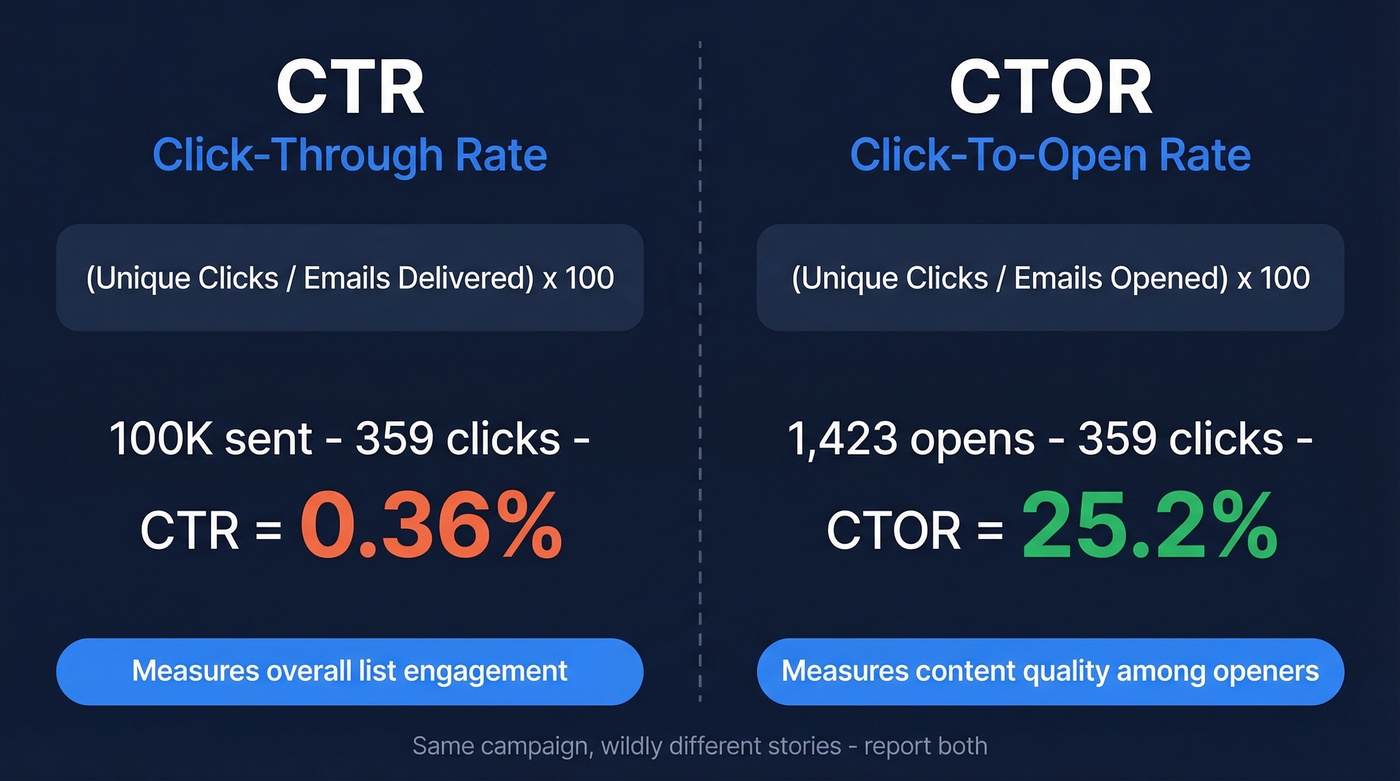
Here's a concrete example. You send to 100K contacts. 1,423 open. About 359 click. CTR across the full list: roughly 0.36%. CTOR among openers: 25.2%. Same campaign, wildly different stories. MailerLite's median across 3.6M campaigns puts CTR at 2.09% and CTOR at 6.81%. Report both, but know which question each answers.
If you want the deeper breakdown of CTR vs CTOR, start with what each metric is actually for.
Why Open Rates Are Broken in 2026
Apple Mail Privacy Protection preloads tracking pixels via proxy servers - firing an "open" even when nobody reads your email. Up to 75% of reported opens in some segments are artificial. That's not a rounding error. It's a structural failure of the metric.
MPP doesn't affect link tracking. Clicks remain reliable because they require a real human to take a real action. If open rate is still your primary KPI, you're measuring noise. Shift to click rate, replies, and conversions as your core performance indicators.
If you’re still troubleshooting inboxing, start with an email deliverability audit before you touch creative.

Your EDM click-through rate starts with deliverability - and deliverability starts with clean data. Prospeo's 5-step email verification catches spam traps, honeypots, and invalid addresses at 98% accuracy, refreshed every 7 days. Stop losing clicks to the spam folder.
Fix your list first. Everything else compounds from there.
2026 Benchmarks by Industry
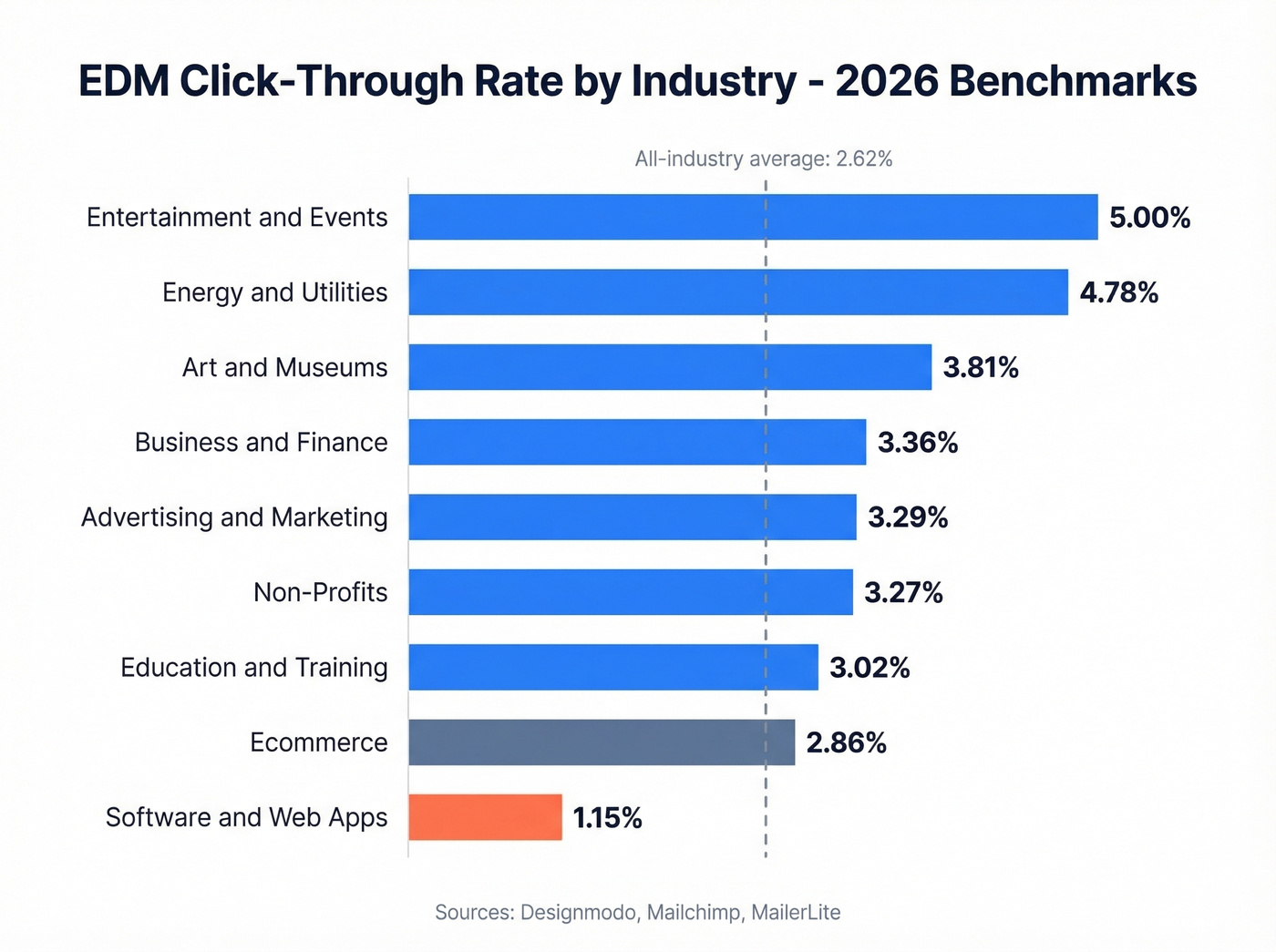
These benchmarks come from multiple sources with different methodologies. We've added a source column so you can trace every number.
| Industry | Open Rate | CTR | CTOR | Source |
|---|---|---|---|---|
| Entertainment & Events | 57.00% | 5.00% | 7.00% | Designmodo |
| Energy & Utilities | 34.34% | 4.78% | 12.85% | Designmodo |
| Art & Museums | 34.66% | 3.81% | 10.20% | Designmodo |
| Business & Finance | 33.18% | 3.36% | 10.15% | Designmodo |
| Advertising & Marketing | 25.48% | 3.29% | 12.82% | Designmodo |
| Non-Profits | 40.04% | 3.27% | - | Mailchimp |
| Education & Training | 35.64% | 3.02% | - | Mailchimp |
| Ecommerce | 25.74% | 2.86% | 10.60% | Designmodo |
| Software & Web Apps | 39.31% | 1.15% | - | MailerLite |
Mailchimp's all-users average sits at 2.62% across billions of emails - use that as your universal baseline. Software and web apps clock in at a brutal 1.15%, and beehiiv data puts SaaS/B2B outbound even lower at 1.67%. If you're in SaaS, stop comparing yourself to the 3%+ industries.
Transactional emails (order confirmations, password resets) typically surpass 5% CTR because the recipient is expecting them. Promotional emails sit closer to 1-3%. Comparing the two is meaningless.
If you need a clean definition and denominator rules, see our guide to the click rate formula.
B2B vs B2C
| Segment | CTR | CTOR |
|---|---|---|
| B2B | 3.2% | 13.0% |
| B2C | 2.1% | 5.5% |
B2B's higher CTOR reflects smaller, more targeted lists with content directly relevant to the recipient's job. Larger B2C lists dilute engagement across less interested subscribers.
Flows vs Campaigns
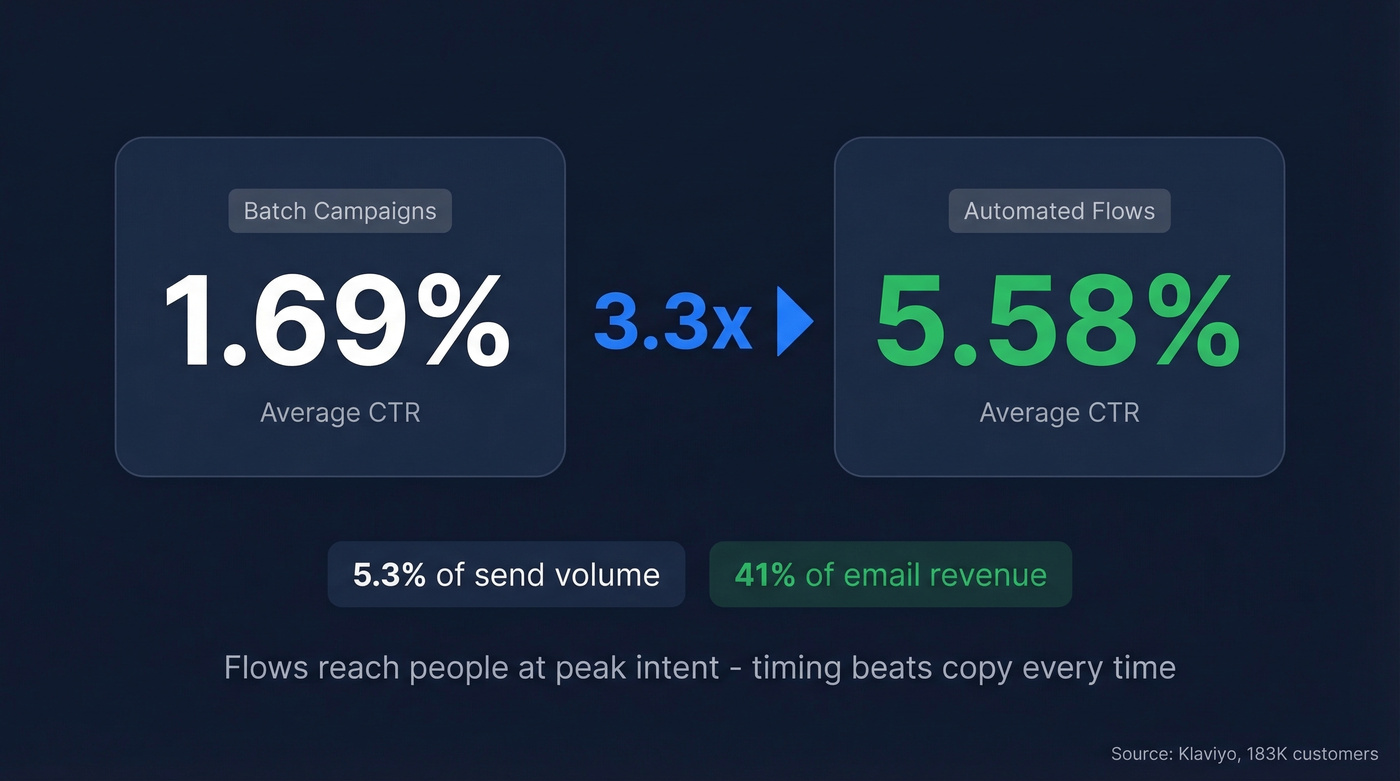
Klaviyo's data across 183,000 customers shows automated flows averaging 5.58% CTR versus 1.69% for batch campaigns - a 3.3x gap. Flows generate roughly 41% of total email revenue from just 5.3% of send volume. If you're only running batch campaigns, you're ignoring the format that triples your click rate.
If you’re building these sequences for outbound too, borrow structure from a B2B cold email sequence and adapt it to lifecycle triggers.
Diagnose Your CTR Problem First
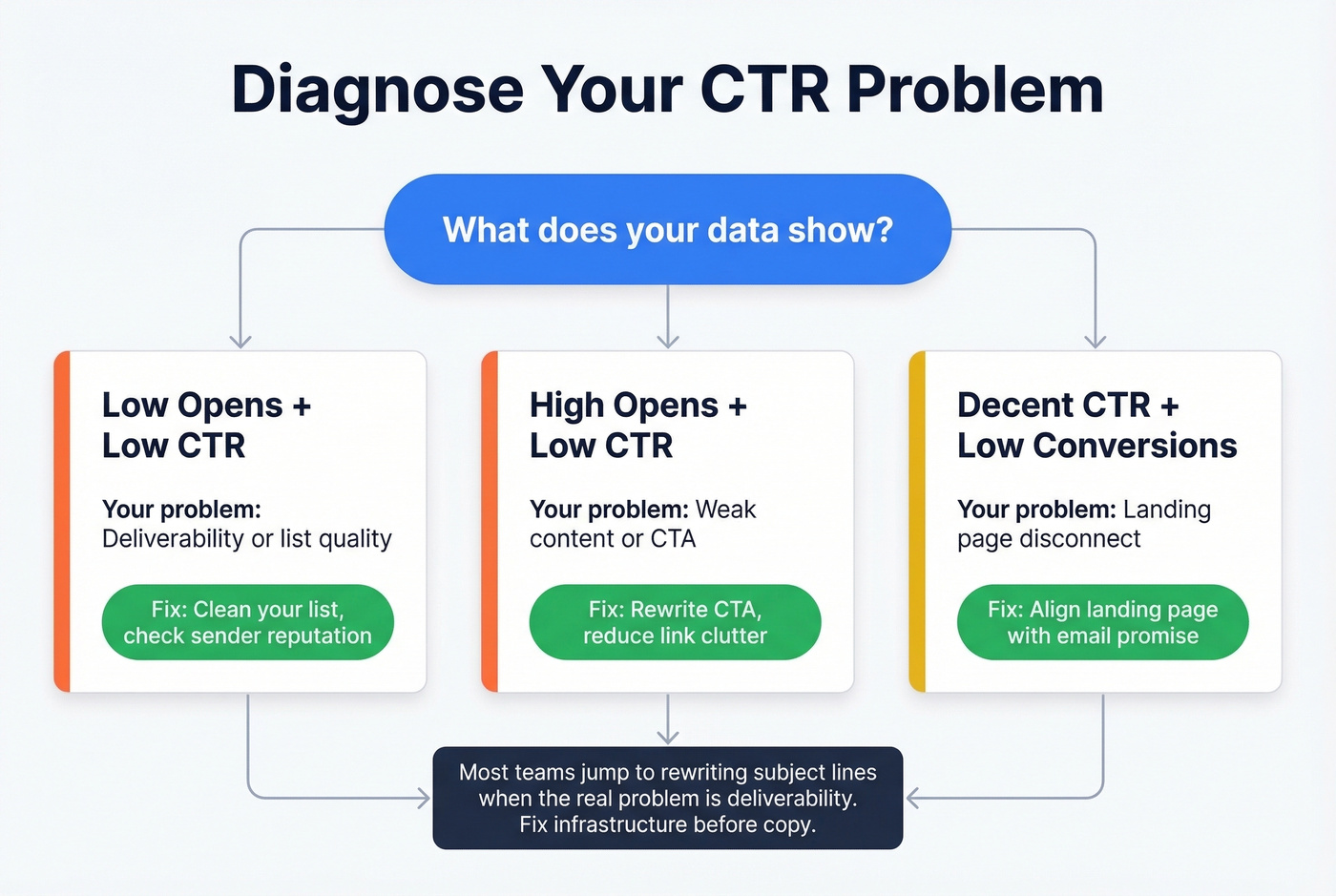
Before you start fixing things, figure out which problem you actually have.
| Pattern | Likely Cause | First Fix |
|---|---|---|
| Low open rate + low CTR | Deliverability or list quality | Clean your list, check sender reputation |
| High open rate + low CTR | Weak content or CTA | Rewrite CTA, reduce link clutter |
| Decent CTR + low conversions | Landing page disconnect | Align landing page with email promise |
Look - most teams jump straight to rewriting subject lines when their real problem is deliverability. A perfectly crafted email that lands in spam has a 0% CTR. Fix the infrastructure before you touch the copy.
To narrow down root causes faster, track email bounce rate alongside CTR and inbox placement.
How to Fix a Stuck Email CTR
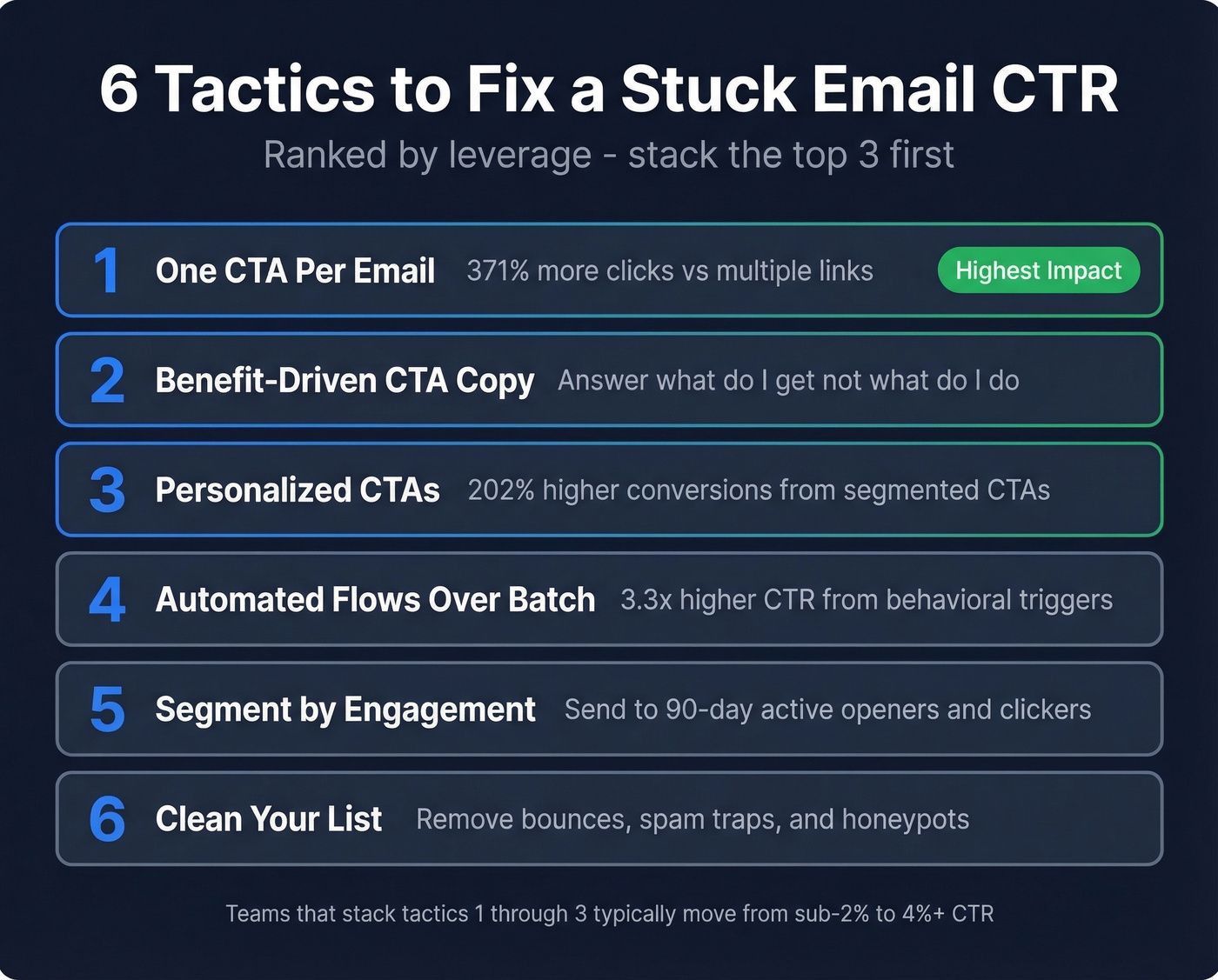
Six tactics, ranked by leverage. We've seen teams move from sub-2% to 4%+ by stacking just the first three.
One CTA per email
A single prominent CTA generates 371% more clicks than emails with multiple competing links. Every additional link dilutes attention. Pick one action and make it unmissable. In our experience, this is the fastest win most teams overlook - and the one that meets the most internal resistance because stakeholders want to cram three offers into every send.
If you want examples and rules, use this email call to action playbook to standardize buttons and links.
Benefit-driven CTA copy
"Get your free checklist" beats "Click here" every time. The CTA should answer "what do I get?" not "what do I do?" The consensus on r/emailmarketing echoes this constantly: frame the click as a reward, not a task. Skip this tactic if your emails are purely transactional - those already have built-in motivation.
When you do test copy, pair it with a subject-line test plan (see email subject line examples) so you don’t “fix” the wrong variable.
Personalized CTAs
Personalized calls-to-action boost conversions by 202%, and higher conversions start with higher clicks. This doesn't mean slapping a first name on a button. It means showing different CTAs to different segments based on behavior or profile data.
If your segmentation is thin, start by improving your data enrichment so personalization isn’t guesswork.
Automated flows over batch sends
Flows trigger on real behavior - abandoned cart, content download, signup - reaching people at peak intent. We converted one client's top-performing newsletter into a welcome sequence and watched CTR jump from 1.8% to 5.2% in the first month. The content barely changed. The timing did everything.
Segment by engagement
Create a "high-confidence opener" segment: people who've both opened and clicked in the last 90 days. Sending to engaged contacts improves inbox placement, which lifts CTR for everyone on your list. Use click rate to test subject lines and CTR to test CTA variations - they answer different questions.
If you’re doing this at scale, it helps to formalize intent based segmentation so “engaged” maps to buying signals, not just curiosity.
Clean your list
Bounces damage sender reputation. Damaged reputation means ISPs route you to spam. CTR tanks - not because your content is bad, but because nobody sees it. Prospeo's email verification catches invalid addresses, spam traps, and honeypots at 98% accuracy with a 7-day data refresh cycle. There's a free tier to test it.
Fix the data quality problem first. Everything else compounds from there.
If you’re actively remediating list hygiene issues, follow a dedicated spam trap removal process before you ramp volume.

Automated flows hit 5.58% CTR - but only if your contact data actually reaches real inboxes. Prospeo delivers 143M+ verified emails with catch-all handling and spam-trap removal, starting at $0.01 per email. No contracts, free tier included.
Clean data turns every flow into a high-CTR machine.
FAQ
What's a good EDM click-through rate?
Between 2-5% depending on industry and email type. B2B averages 3.2%, B2C around 2.1%. Automated flows regularly hit 5.58%+. If you're above your industry benchmark in the table above, you're in good shape.
What's the difference between CTR and CTOR?
CTR equals unique clicks divided by emails delivered - it measures action across your full list. CTOR equals unique clicks divided by opens - it isolates content quality among people who saw the email. Use CTR to judge campaign performance and CTOR to evaluate copy and design.
How do I improve email CTR without changing my content?
Switch batch campaigns to automated behavioral flows, which average 3.3x higher CTR. Clean your list to reduce bounces and protect sender reputation. Both tactics lift your click rate without touching a word of copy.