

The Best Email Address Checkers in 2026: Real Accuracy, Real Pricing
You've got 5,000 contacts in your CRM and a campaign launching Monday. How many of those emails are already dead? If that list hasn't been cleaned in the last year, the answer is roughly 1,400 - because email lists decay by about 28% annually. That's not a rounding error. That's a bounce rate that'll get your domain flagged before lunch.
Every verification tool promises 99% accuracy on their homepage. Almost none deliver it. We've tested enough of these tools to know the gap between marketing copy and real-world performance is wide - and expensive if you pick wrong.
Our Picks (TL;DR)
| Use Case | Pick | Why |
|---|---|---|
| B2B prospecting (find + verify) | Prospeo | Find + verify in one step, 98% accuracy |
| Standalone accuracy + value | Bouncer | $7/1,000 emails, 4.8 on G2 |
| High-volume list cleaning | ZeroBounce | Deep feature set, 515+ G2 reviews |
| Budget pay-as-you-go | Kickbox | $5 for 500 verifications, solid benchmarks |
For pure list cleaning - marketing lists, newsletter hygiene, re-engagement campaigns - Bouncer or ZeroBounce are the workhorses. Kickbox is the budget entry point that still performs.
What "99% Accuracy" Really Means
Here's the thing most vendors don't want you to hear: the best independently tested email verification tool scored 70% accuracy. Not 99%. Seventy.
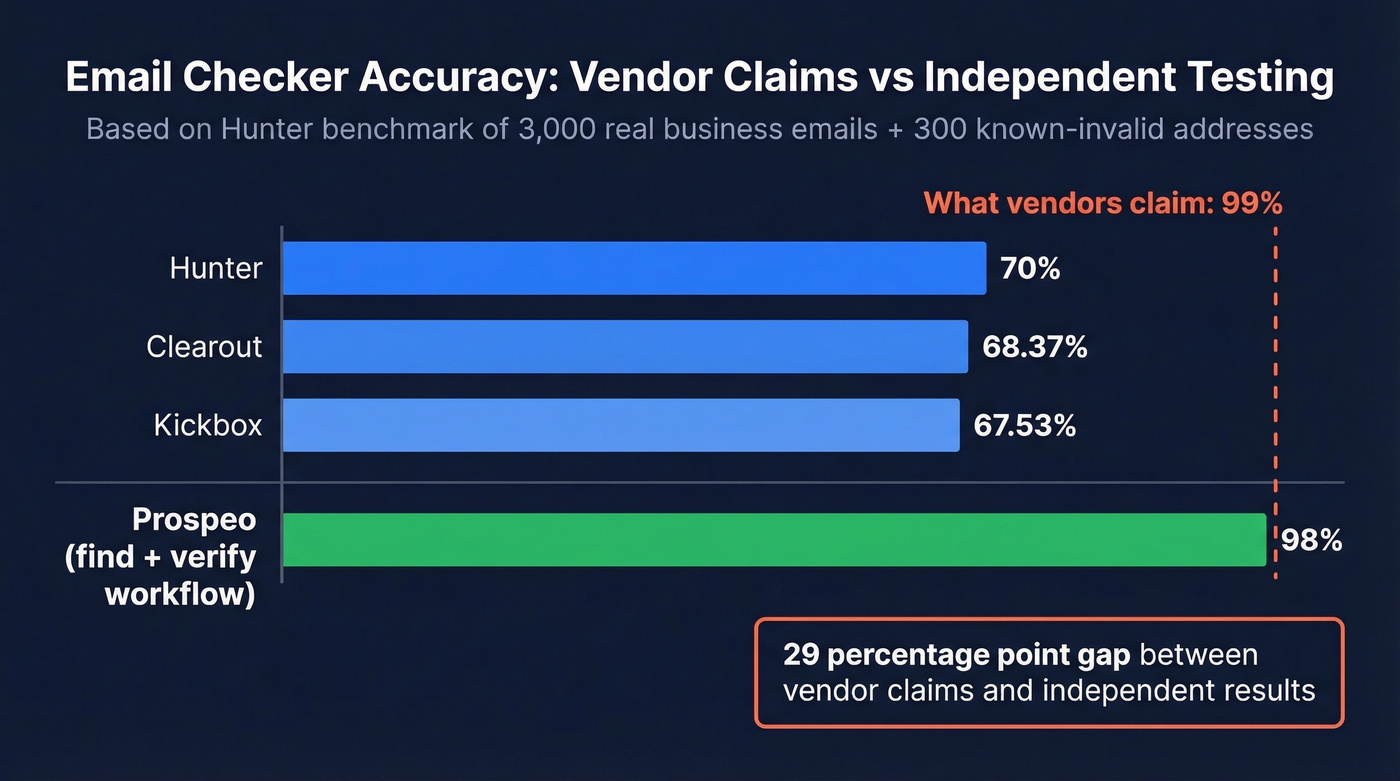
Hunter ran a benchmark of 15 email verifiers against 3,000 real business emails, segmented by company size, plus 300 known-invalid addresses - all tested under identical conditions via Clay integrations. The top three performers: Hunter at 70%, Clearout at 68.37%, Kickbox at 67.53%. That's a 29-percentage-point gap between vendor claims and independent testing. Accuracy drops even further on mid-market and enterprise domains, where stricter server configurations return more "unknown" or "accept-all" results that nobody can resolve cleanly.

Why such a gap? Most standalone checkers work with a bare email address and nothing else. When verification happens earlier in the workflow - with real-time SMTP handshakes, catch-all handling, and spam-trap removal running before you ever export the data - accuracy and bounce outcomes look very different from batch-checking a stale CRM export.
Best Email Address Checkers Compared
Prospeo - Find and Verify in One Step
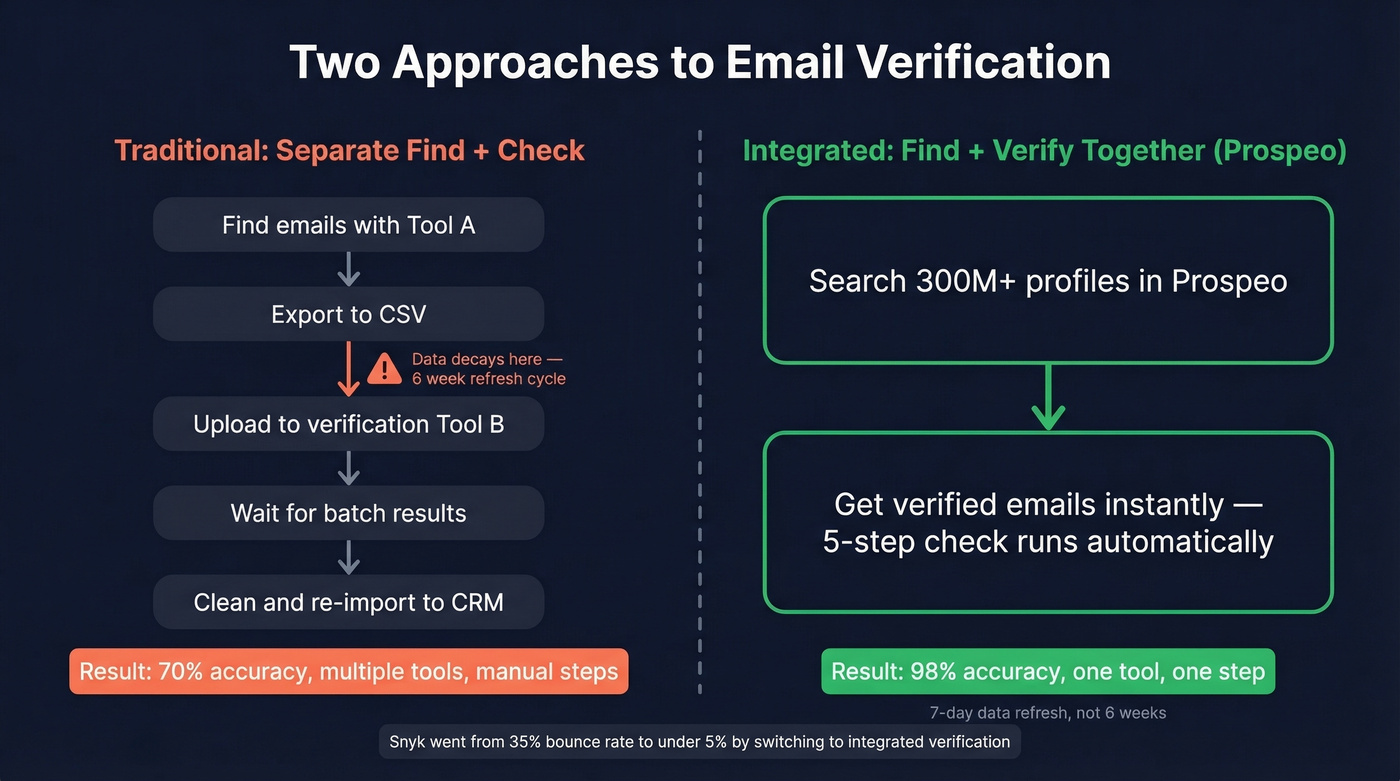
Most email checkers solve half the problem. You still need to find the email somewhere else, export it, upload it, wait, then clean the results. Prospeo collapses that entire workflow. If you're comparing combined workflows, see our breakdown of email finder and verifier tools.
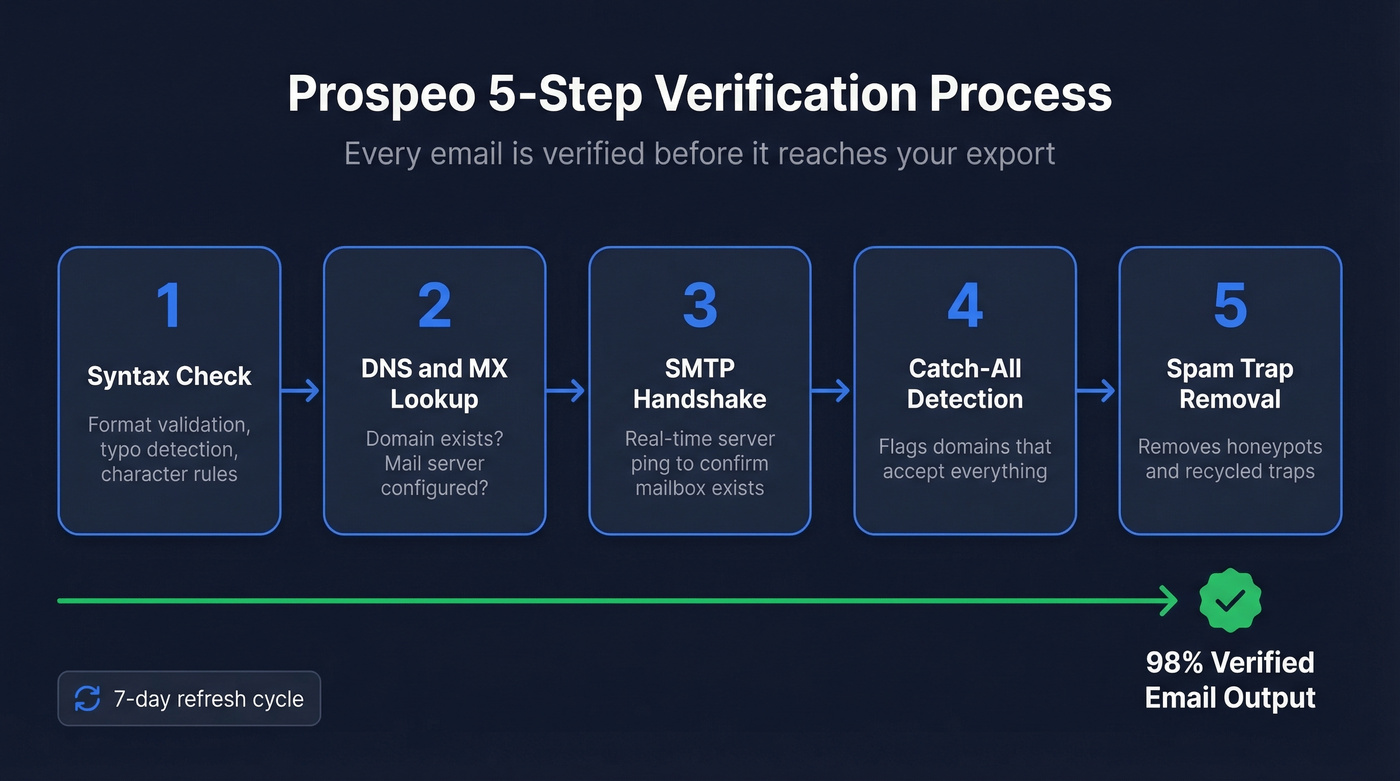
The platform pulls from 300M+ professional profiles and 143M+ verified emails (more context on what to look for in a B2B contact database). Every address runs through a 5-step verification process - syntax, DNS, SMTP handshake, catch-all detection, and spam-trap removal - before it hits your export. The result is 98% email accuracy out of the box, with a 7-day data refresh cycle that keeps addresses current while most competitors refresh every six weeks.

The Chrome extension has 40,000+ users and lets you pull verified contacts from company websites, web sources, or CRMs in one click (if you're shopping extensions, compare options in our Email Finder Chrome Extensions guide). Pricing runs about $0.01 per email with a free tier of 75 emails/month. Real results: Snyk's 50-person AE team went from a 35-40% bounce rate to under 5% after switching, generating 200+ new opportunities per month. That's the kind of before-and-after that makes the "find and verify together" approach click - you're not stitching two tools together and hoping the data stays clean between steps.
Bouncer
Use this if you need a standalone verification tool with best-in-class accuracy and don't want to overthink it. Bouncer's 4.8 rating on G2 across 232 reviews isn't an accident - it consistently lands at or near the top in independent tests. A Lemlist test showed 99% accuracy on their 1,000-email sample, and the pricing is hard to beat at $7 per 1,000 emails. Your first 1,000 verifications are free, so you can run a real test before spending anything. Subscriptions start at $24/mo, and API access is available on paid plans with solid documentation (if you need programmatic checks, see our roundup of an email check API).

Skip this if you need email finding bundled with verification, or you're looking for a full prospecting platform. Bouncer is a pure checker - excellent at that one job, but it won't help you build lists.
ZeroBounce
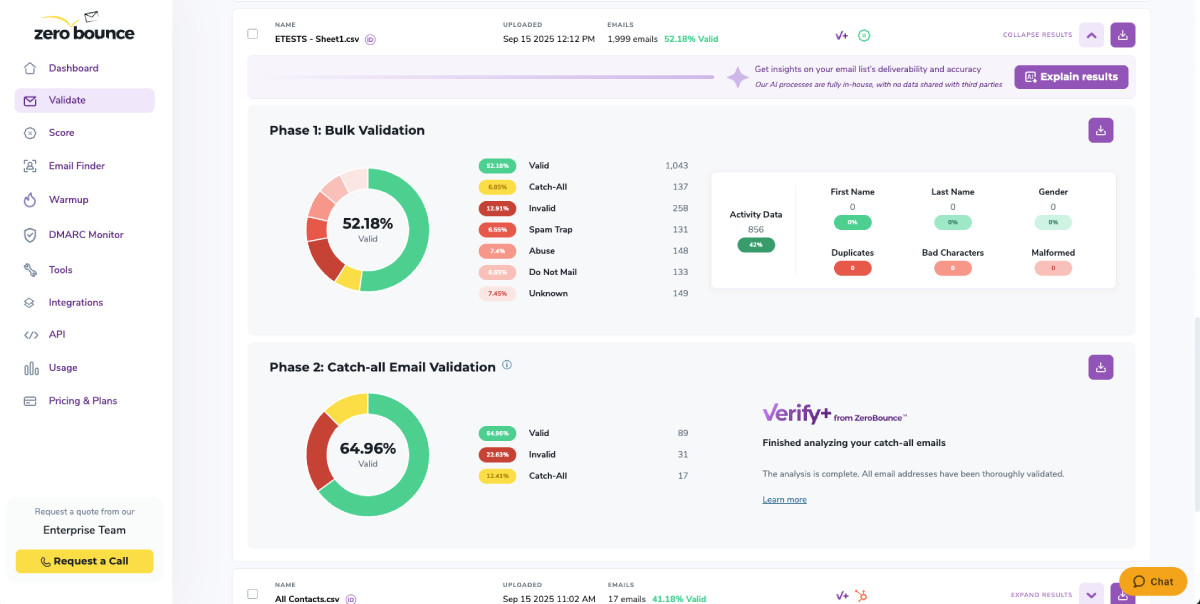
ZeroBounce is one of the most-reviewed verification tools on G2 - 4.7 stars across 515+ reviews - and the feature set justifies the attention. Beyond basic verification, you get activity scoring, abuse detection, catch-all handling, and a toxicity data append that flags high-risk addresses before they damage your sender reputation. It supports 60+ integrations.
Subscriptions start at $18/mo, with pay-as-you-go at $15 per 2,000 minimum. You get 100 free monthly verifications when you sign up with a business or premium domain. The 2,000-email minimum on pay-as-you-go is annoying if you just need to spot-check 200 addresses, and the premium pricing means you're paying for the brand and the extras. But ZeroBounce is the safe corporate pick - the tool nobody gets fired for choosing.
Hunter
Hunter deserves credit for publishing the benchmark that exposed the entire industry's accuracy problem. Their own tool scored highest at 70% - impressive relative to competitors and sobering in absolute terms. The free plan includes 100 verifications/month, and paid plans start at $34/mo with email finding bundled in (more on best-fit scenarios in our Hunter.io use cases). Hunter's real strength is the combined find-and-verify workflow for individual lookups, though the database is smaller than dedicated B2B platforms. Solid for freelancers and small teams who need a Swiss Army knife.
NeverBounce
Use this if you're processing massive lists and need predictable per-email pricing. At ~$0.008 per email on pay-as-you-go with 1,000 free credits to start, NeverBounce is built for volume. The API is clean, integrations are broad, and turnaround is fast.
Skip this if accuracy is your top priority. A Lemlist test pegged NeverBounce at 93% - noticeably lower than Bouncer's 99% in the same test. For cold outbound where every bounce hurts your domain, that gap matters (see our cold email verification playbook for stricter standards).
Emailable
Emailable's billing model is the friendliest in the category. You get 250 free credits to start, unknown results get refunded automatically, and credits never expire. That last part is underrated - most tools force you to use credits within 30-90 days, which means you're either rushing to verify or losing money. Monthly subscriptions save 15%, credits roll over, and the minimum purchase is 5,000 credits. Expect around $0.003-$0.01 per verification depending on volume. A quiet workhorse that doesn't get enough attention.
Kickbox
Kickbox is the budget entry point that actually performs. At $5 for 500 verifications on pay-as-you-go, the barrier to entry is basically zero. It placed third in the independent benchmark at 67.53% - within striking distance of the top spot. For teams testing email verification for the first time or running low-volume campaigns, Kickbox gives you real results without a real commitment.
Clearout
Clearout scored 68.37% in the 15-tool benchmark - second place overall. Pay-as-you-go pricing starts around $0.006 per email, making it a strong value play for teams that prioritize independently benchmarked accuracy over brand recognition.
Verifalia
Verifalia claims a 30+ step verification process and often ranks well for standalone email verification. It's a solid validator, but it's a pure checking tool with no B2B finding workflow. Worth considering if you need a lightweight, API-first checker.
EmailListVerify
EmailListVerify targets the high-volume, budget-conscious segment with bulk pricing around $0.004-$0.008 per email at scale. The free tier is limited to just 3 checks - essentially a proof of concept. Worth evaluating if you're cleaning lists of 100K+ regularly and cost is the primary driver.
BriteVerify
BriteVerify runs $10 per 1,000 emails with no free trial - it's built for teams with procurement processes, not for self-serve buyers shopping on price. Unless you're already locked into their ecosystem, you're overpaying for the same SMTP checks.

The best standalone checker scored 70% in independent tests. Prospeo's 5-step verification - syntax, DNS, SMTP, catch-all detection, and spam-trap removal - delivers 98% accuracy before the email ever reaches your list. Snyk's 50 AEs went from 35% bounce rates to under 5%.
Stop batch-cleaning stale data. Start with emails that are already verified.
Pricing Compared
Pricing structures vary wildly - some charge per email, others require minimums, and a few lock credits behind expiration dates (for a deeper comparison set, see our Best Email Verification Tools ranking).
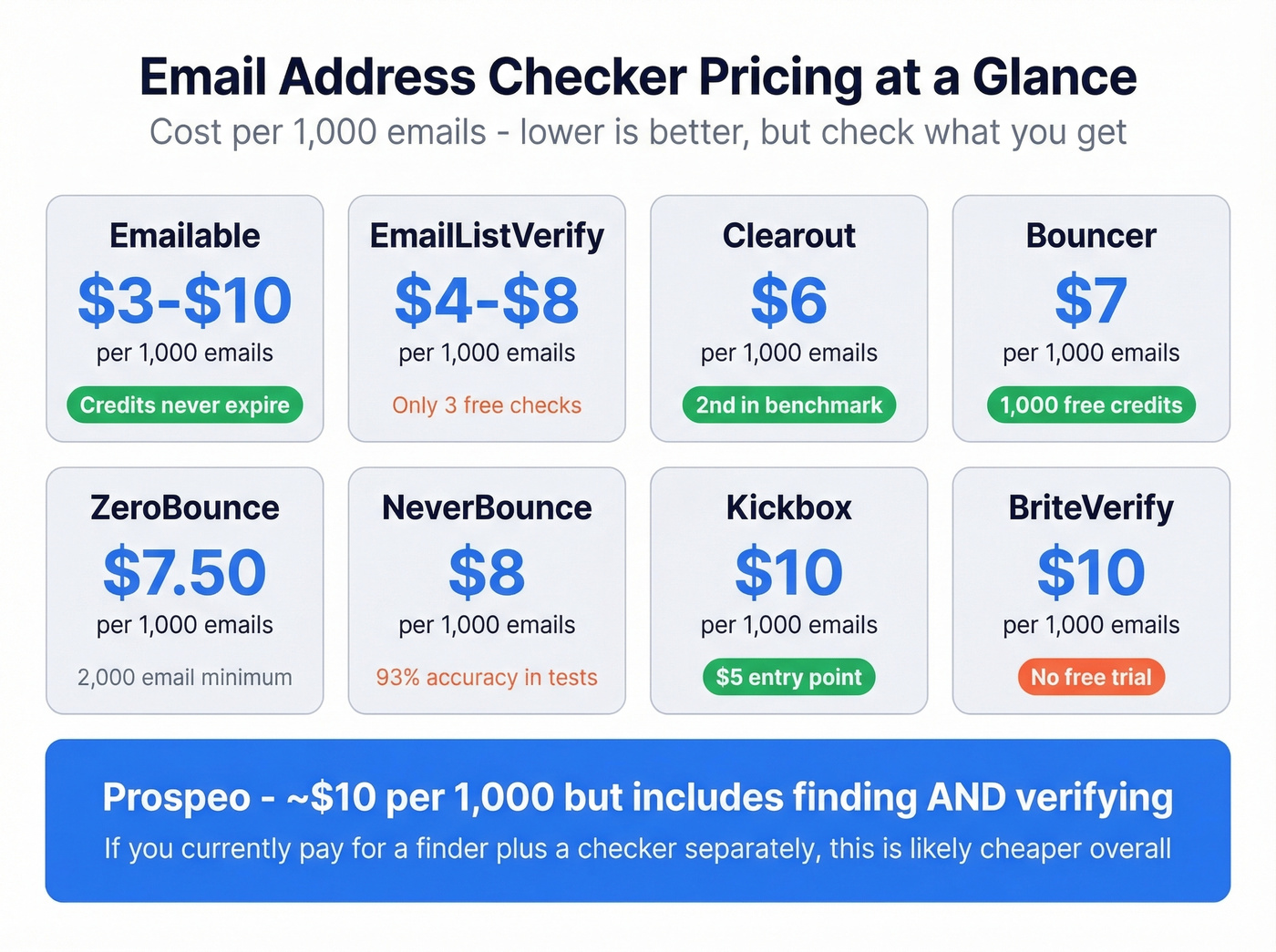
| Tool | Cost/1,000 | Free Tier | Min Purchase | Credits Expire? |
|---|---|---|---|---|
| Prospeo | ~$10 (find + verify) | 75 emails/mo | None | No |
| Bouncer | $7 | 1,000 credits | None | Varies by plan |
| ZeroBounce | ~$7.50 | 100/mo | 2,000 emails | Varies by plan |
| Hunter | $34/mo (bundled plan) | 100/mo | $34/mo plan | Monthly allowance |
| NeverBounce | $8 | 1,000 credits | None | Varies by plan |
| Emailable | ~$3-$10 | 250 credits | 5,000 credits | Never |
| Kickbox | $10 | None | $5 / 500 | Varies by plan |
| Clearout | ~$6 | Limited | None | Varies by plan |
| Verifalia | Paid plans available | Free online checker | Varies | Varies by plan |
| EmailListVerify | ~$4-$8 | 3 checks | None | Varies by plan |
| BriteVerify | $10 | None | Varies | Varies by plan |
Note that Prospeo's cost covers the full workflow - finding and verifying - not just the checking step. If you're currently paying for a finder plus a separate checker, the combined cost often comes out cheaper.
Stitching a finder and a checker together means data decays between steps. Prospeo finds and verifies in one workflow across 300M+ profiles, refreshed every 7 days - not the 6-week industry average. At $0.01 per email, it costs less than most standalone checkers.
One step. Verified emails. No bounce-rate surprises on launch day.
How Email Verification Works
Every tool follows the same basic pipeline, whether they charge $3 or $15 per thousand. Understanding the steps helps you evaluate which tools are doing more work versus just marketing the same process differently (we also break this down in our email verification process guide).
Step 1: Syntax check. Is the email formatted correctly? No spaces, valid characters, proper domain structure. This catches typos and obvious garbage - table stakes.
Step 2: DNS and MX lookup. Does the domain exist, and does it have mail exchange records configured? If there's no MX record, nobody's receiving email at that domain. Dead stop.
Step 3: SMTP handshake. The tool connects to the mail server and initiates a conversation - HELO, MAIL FROM, RCPT TO - without actually sending an email. The server responds with a 250 OK (mailbox exists) or a 550 rejection (user not found). No message is delivered; it's just a handshake (more detail in our SMTP verification explainer).
Step 4: Catch-all detection. The tool sends a verification request for a randomly generated, obviously fake address at the domain. If the server accepts it with a 250 OK, the domain is catch-all - meaning it accepts everything, and you can't confirm whether any specific mailbox actually exists.
Catch-All Domains - The Blind Spot
Catch-all domains are the dirty secret of email verification. When a mail server accepts every incoming address - real or fake - standard SMTP verification becomes useless. The server returns 250 OK for ceo@company.com and asdfghjkl@company.com with equal enthusiasm.
Most checkers handle this by returning "unknown" or "accept-all" as the result. That's technically honest but practically useless - what teams actually need is a go/no-go decision, not an "unknown" label that pushes the risk back to them. Emailable is a notable exception: they refund credits for unknown results automatically.
The real problem is what happens next. Teams either include all accept-all addresses (risky - some will bounce) or exclude them all (safe - but you lose real contacts at catch-all domains, which includes many enterprise companies). There's no clean answer, only risk management. Tools that bake catch-all handling and spam-trap removal into the verification pipeline - rather than treating them as afterthoughts - give you meaningfully better data to make that call.
Mistakes That Kill Sender Reputation
We see teams make these five verification mistakes repeatedly, and every one is avoidable.
Treating accept-all as valid. Accept-all means "we don't know," not "this works." Sending to every accept-all address without risk scoring is how you hit a 6% bounce rate on what should've been a clean list.
Not re-verifying before sends. A verified list loses roughly 2% of valid addresses every four weeks. That list you cleaned in January? It's lost 15-20% of its validity by July. Re-verify before every major campaign (step-by-step: How to Clean Your Email List).
Verifying after sending instead of before. If you're waiting for bounce reports to identify bad addresses, the damage is already done. ESPs track your bounce rate in real time - by the time you see the report, your sender score has already taken the hit. One company reduced bounce rates from 18% to 0.8% and saved $12,000 in ESP costs over six months by implementing pre-send verification. That's the magnitude of difference proper timing makes.
Burning credits on inactive contacts. Filter your list before you verify. Remove contacts who haven't engaged in 12+ months, duplicates, and obvious role addresses like info@ or support@. Why pay to verify addresses you shouldn't be emailing anyway?
Trusting vendor "99% accuracy" claims. The best independently tested accuracy was 70%. Build your workflow around reality, not marketing pages. Target a bounce rate under 2% - ideally under 1%. The consensus on r/sales and r/coldemail echoes this: run your own test batch before committing to any tool, because published accuracy numbers are marketing, not engineering.
FAQ
Is email verification legal?
Yes. Verification checks whether a mailbox can receive mail via an SMTP handshake - no email is actually sent during the process. It's a technical lookup, not unsolicited communication.
How often should I re-verify my list?
Re-verify every four weeks before a major send. Lists decay about 2% per month and roughly 28% per year, so a list verified three months ago has already lost ~6% of valid addresses.
What's a safe bounce rate target?
Under 2% is the industry standard. Under 1% is ideal for cold outbound. Above 5% and most ESPs will throttle or flag your sending domain.
Can I check emails free before paying?
Yes - Bouncer gives 1,000 free verifications, ZeroBounce offers 100 per month, and Prospeo includes 75 verified emails monthly at no cost. These free tiers are enough to benchmark accuracy on a real sample before committing.
Do I need a separate checker if I use a prospecting tool?
Most prospecting platforms find emails but don't verify them rigorously, so you still need a standalone checker. The exception is tools that verify at the point of finding with real-time SMTP checks - addresses arrive pre-verified, making a separate tool redundant for that data.