

How to Write an Email Asking for a Meeting That Actually Gets a Reply
You send 200 emails asking for a meeting. You get 3 replies. One is a "no thanks," one is an auto-responder, and one is a maybe that ghosts after your follow-up.
That's not a writing problem - it's a systems problem. The average cold email reply rate sits at 3.43%, top quartile performers hit 5.5%+, and elite senders crack 10.7%+. The gap between average and elite isn't talent. It's knowing what the data says and building your emails around it.
The Quick Version
Keep cold meeting requests under 80 words - the best-performing campaigns stay there. Write at a 3rd-grade reading level. Include one clear question. Use a subject line under 33 characters. Send Tuesday through Thursday between 9-11 AM in the recipient's time zone. If your reply rate is below 3%, the problem is almost certainly your contact data, not your copy.
What the Data Says
Boomerang analyzed 40M+ emails and found clear patterns separating emails that get responses from emails that get ignored. We've tested these findings across hundreds of campaigns, and they hold up every time.
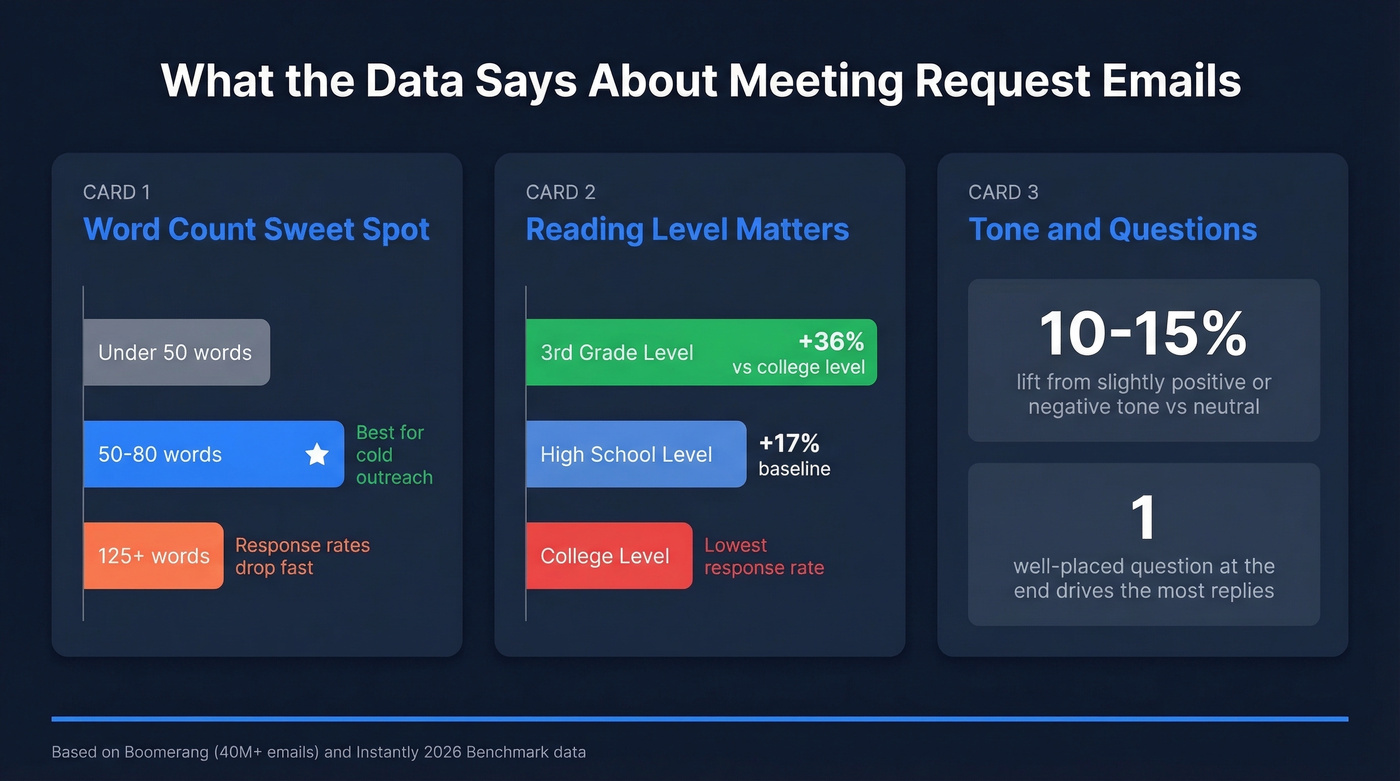
Emails between 50 and 125 words hit response rates above 50%. Past 125 words, every sentence costs you replies. For cold outreach specifically, the sweet spot is tighter - under 80 words. Instantly's 2026 benchmark data confirms this.
Reading level matters more than most people think. Emails written at a 3rd-grade level outperform college-level writing by 36% and high-school-level writing by 17%. Short words. Short sentences. No jargon.
Tone should be slightly positive or slightly negative - never completely neutral. Neutral emails underperform by 10-15%. A little warmth or a little urgency beats corporate blandness, but excessive flattery drops response rates right back down. Including 1-3 questions drives replies; keep it to one well-placed question at the end, and make your CTA answerable in two words. "Worth a 15-minute call next week?" beats "Let me know your availability for a 30-60 minute deep dive into our platform capabilities." If you want more rules and examples, see Email Call to Action.
Subject Lines That Get Opened
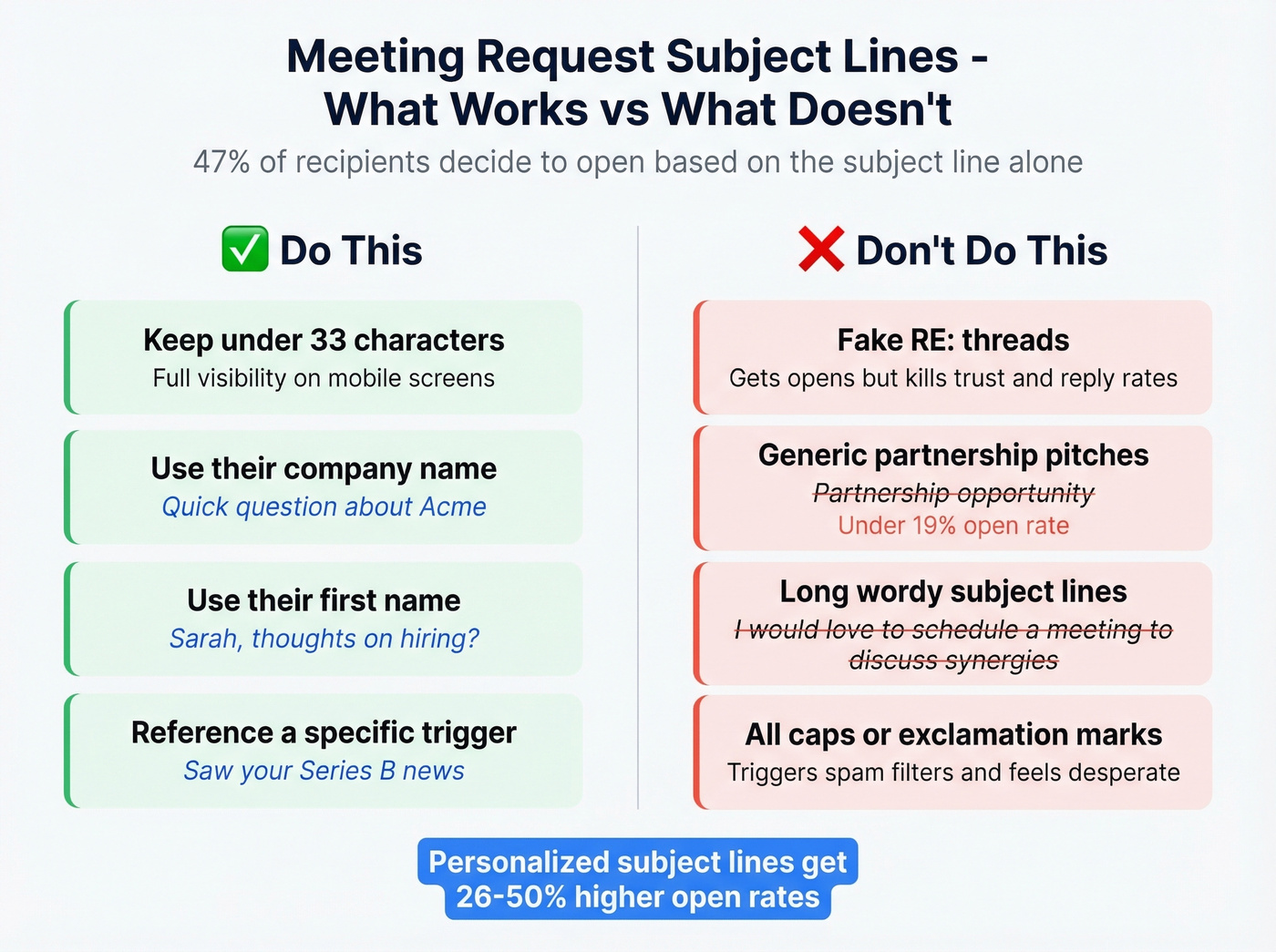
47% of recipients decide whether to open based on the subject line alone. Personalized subject lines deliver 26-50% higher open rates. And on mobile - where most business email gets read first - only 33 characters display fully.
| Subject Line Pattern | Open Rate | Why It Works |
|---|---|---|
| "Quick question" | ~39% | Curiosity + brevity |
| {{Company name}} reference | ~33% | Personalization signal |
| "{{FirstName}}, thoughts on [challenge]?" | - | Personal + specific |
| "Following up: [topic]" | - | Context from prior touch |
| "Partnership opportunity" | <19% | Feels salesy, generic |
Stay under 33 characters for full mobile visibility. Use the recipient's company name or first name. Never fake a "RE:" thread - it gets opens but tanks trust and reply rates. The consensus on r/coldemail is that deceptive subject lines feel manipulative even when they technically work. Your open rate doesn't matter if the reader is annoyed before they hit sentence one. For more tested options, browse these email subject line examples.

The best meeting request email in the world won't get a reply if it bounces. 35% of teams using other data providers see bounce rates that destroy their domain reputation before a single prospect reads their ask. Prospeo delivers 98% email accuracy with a 7-day refresh cycle - so every meeting request lands in a real inbox.
Fix the data before you fix the copy. Start free with 75 verified emails.
8 Meeting Request Templates
Each template below is tied to a specific research finding. Copy, customize, send.
Cold Outreach to a Prospect
Hi {{FirstName}},
Noticed {{Company}} just {{specific trigger event}}. We helped {{similar company}} {{specific result}} in a similar situation.
Worth a quick 15 minutes to see if it's relevant?
Short, one question, built around the under-80-words rule that top cold campaigns follow. This is the best template to get a meeting with someone who's never heard of you - trigger-based relevance does the heavy lifting. If you’re building a full sequence, use this B2B cold email sequence guide.
Warm Introduction (Mutual Connection)
Hi {{FirstName}},
{{Referral Name}} suggested I reach out - they mentioned you're working on {{specific challenge}}. We've helped teams like yours with {{outcome}}.
Would a brief call this week make sense?
A personalized subject line like "{{Referral Name}} suggested we connect" taps that 26-50% open rate lift from personalization. For more frameworks, see Personalized Outreach.
Before/After: The Internal Meeting Request
Most internal meeting requests look like this:
"Hi team, I wanted to reach out and see if we could potentially schedule some time to discuss the Q3 roadmap and align on deliverables. Please let me know what works."
That's 37 words of nothing. Here's the rewrite:
Hi {{Name}},
I'd like 30 minutes to align on {{project}}. I've got ideas that could save us a week on {{deliverable}}.
Does Thursday afternoon work?
Slightly positive tone, which Boomerang found performs 10-15% better than neutral phrasing. The specific time suggestion eliminates back-and-forth.
Emailing a C-Suite Executive
Here's the thing: executives don't read - they scan. If they can't understand your ask in 10 seconds, they'll archive it.
Hi {{FirstName}},
Three things worth 15 minutes:
- {{Bullet 1: specific pain point you solve}}
- {{Bullet 2: proof point or result}}
- {{Bullet 3: relevance to their company}}
Open to a brief call next Tuesday?
The Three Bullets and a CTA framework is designed for executive inboxes. The CTA is answerable in two words ("sure" or "not now"). Executives don't need to be convinced in the email - they need to be convinced it's worth delegating 15 minutes. Make the CTA easy enough that they can reply from their phone while walking between meetings, and include a scheduling link to eliminate friction.
Networking / Coffee Chat
Hi {{FirstName}},
I've been following your work on {{topic}} - your take on {{specific insight}} was sharp. I'm working on something adjacent and would love to pick your brain.
Any chance you're free for a 20-minute coffee chat?
Ends with a question. The compliment is specific, not generic flattery - which matters because excessive flattery drops response rates back to neutral.
Event Follow-Up
Send this within 3 days of the event while context is fresh.
Hi {{FirstName}},
Great connecting at {{event}} on {{day}}. Your point about {{specific topic}} stuck with me.
I'd love to continue that conversation - free for a quick call this week?
The specific reference proves you actually talked. Generic "great meeting you" emails get deleted.
Re-Engagement (Gone Cold)
Hi {{FirstName}},
I know timing wasn't right when we last spoke. Wanted to check - has anything changed with {{specific initiative}}?
Happy to reconnect if it's useful. If not, no worries at all.
42% of replies come from follow-ups, not the first email. A low-pressure re-engagement catches prospects whose situation has shifted. If you need more options, use these cold email follow-up templates.
Partnership or Collaboration
Hi {{FirstName}},
{{Your company}} and {{their company}} share a lot of the same customers. I think there's a simple way we could help each other.
Open to a 15-minute call to explore it?
Written at a 3rd-grade reading level - short words, simple structure. That simplicity delivers a 36% lift over complex, corporate-sounding language.
Follow-Up Cadence That Works
Most people send one email, get no reply, and give up. That's leaving nearly half your potential replies on the table.
Send Tuesday through Thursday, 9-11 AM in the recipient's time zone. One practitioner on r/Entrepreneur reported a 16% open rate improvement just by shifting to this window. Space follow-ups 3-7 days apart - closer for warm leads, wider for cold. For deeper timing guidance, see best time to send cold emails.
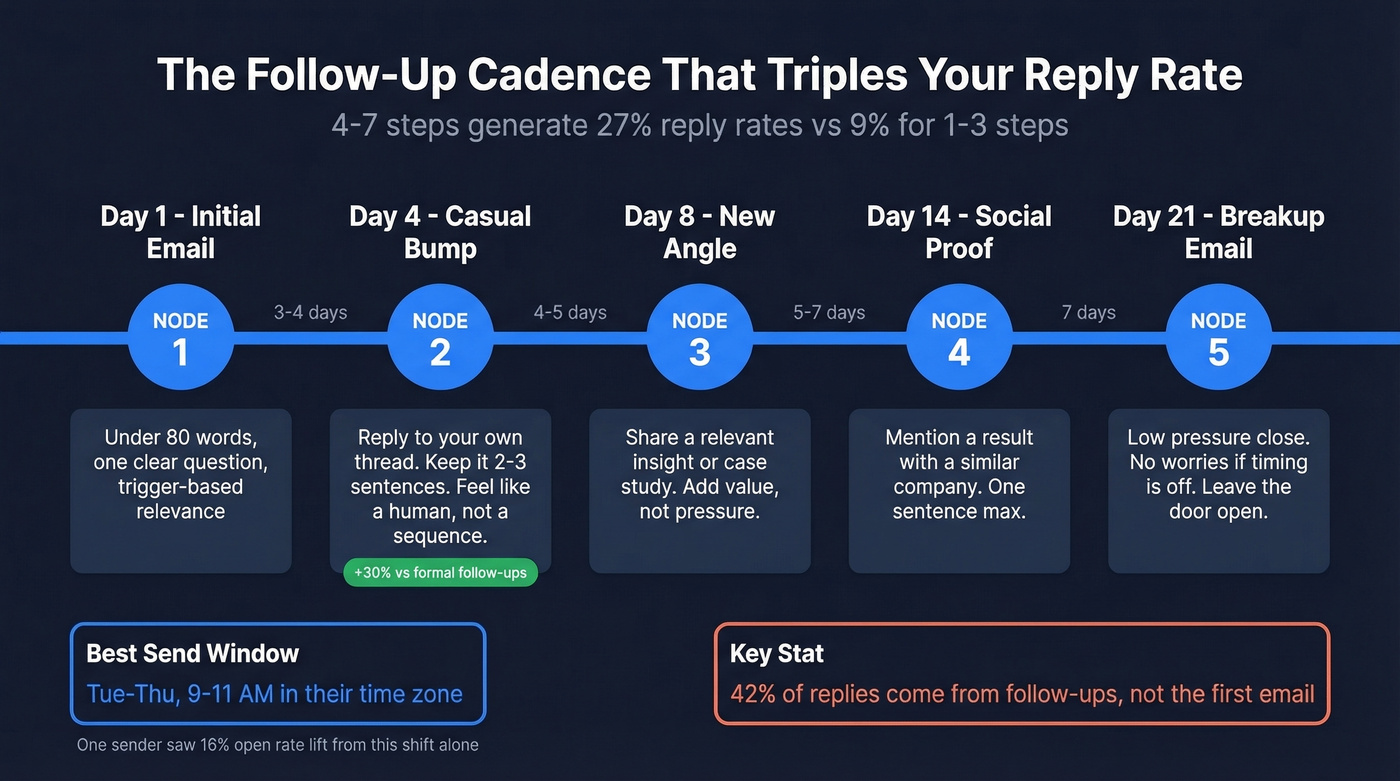
Run 4-7 steps per sequence. Campaigns with 4-7 steps generate 3x the reply rate of those with 1-3 steps (27% vs 9%). Make step 2 feel like a reply, not a formal follow-up - casual "bumping this up" emails outperform structured follow-ups by ~30%. If you want more ready-to-send options, use these sales follow-up templates.
If your deal size is under five figures, you don't need a 12-step sequence with video, gifts, and a carrier pigeon. Four well-timed emails with clean data will outperform a bloated sequence sent to unverified addresses every single time.
The exception for founders and C-suite: they often check email Sunday evenings or before 7 AM. Test those windows separately.
Fix Your Data First
None of the templates above matter if your email bounces.
A practitioner on r/Entrepreneur shared their full journey: bounce rate at 11%, reply rate stuck at 3%. After 62 days of testing across 7 domains (max 26 emails per day each), they got bounce rate under 2% and reply rate doubled to 6%. Their full stack cost ~$420/month and generated 16 qualified leads/month. The single biggest lever? Stopping purchased lists and manually verifying every address.
Google requires spam complaint rates below 0.3%. High bounce rates destroy your domain reputation, which pushes future emails - even good ones - straight to spam. One bad send can haunt you for weeks. If you’re troubleshooting, start with email deliverability and email bounce rate.
Before you send your meeting request sequence, verify every email address. We use Prospeo for this - it handles verification with 98% accuracy and a 5-step process that catches catch-all domains, removes spam traps, and filters honeypots. There's a free tier to start. Bad data is the silent killer of outbound campaigns, and fixing it upstream makes every template in this article work harder.
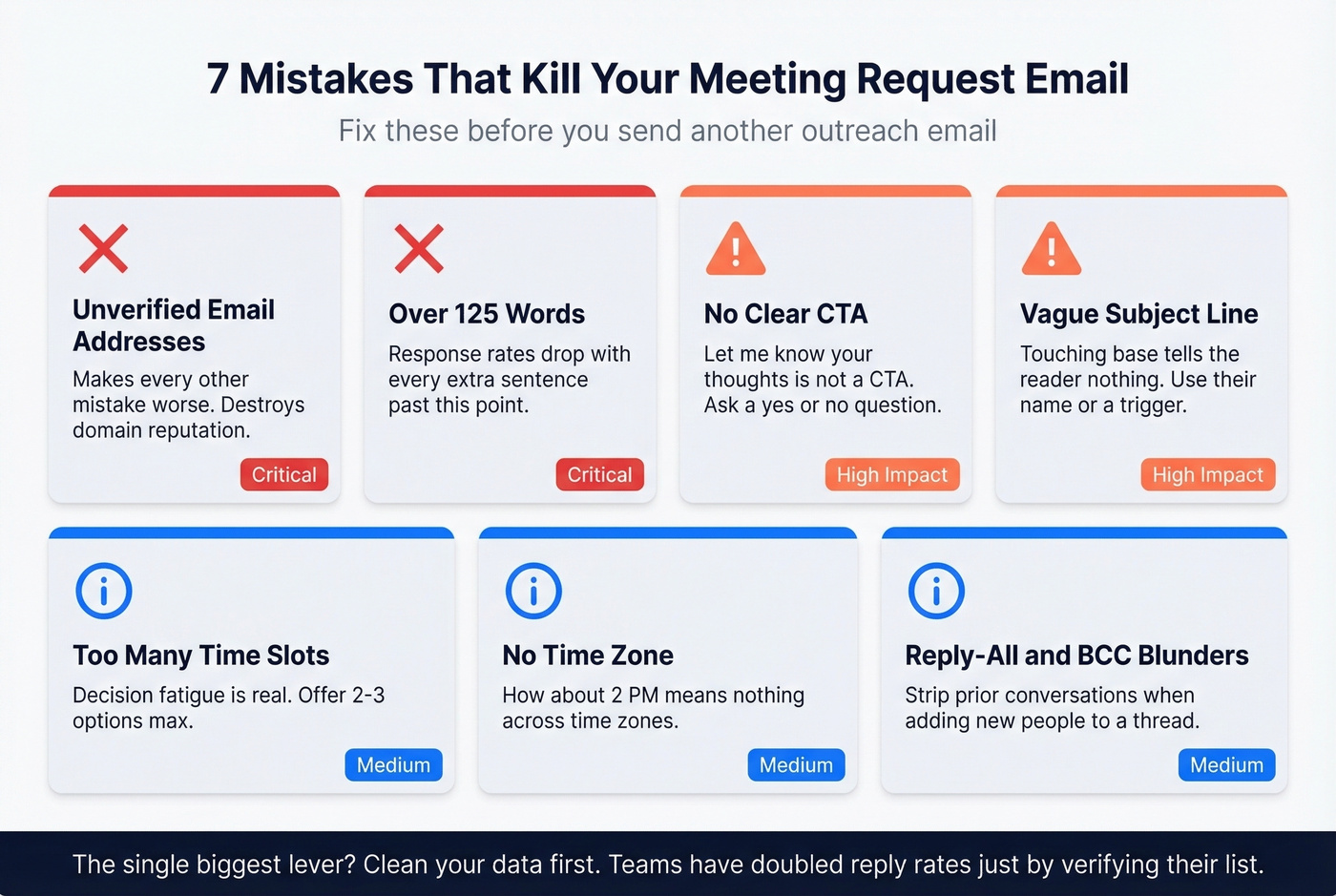
7 Mistakes That Kill Your Meeting Request
- Vague subject line. "Touching base" tells the reader nothing. Use their company name or a specific trigger.
- Email over 125 words. Response rates drop steadily past this threshold. Cut ruthlessly.
- No clear CTA. "Let me know your thoughts" isn't a CTA. "Free for 15 minutes Thursday?" is.
- Proposing more than 3 time slots. Decision fatigue is real. Two or three options max.
- Not specifying time zone. "How about 2 PM?" means nothing when you're in EST and they're in PST.
- Reply-all and BCC blunders. If a BCC'd person hits reply-all, the BCC is exposed. When adding someone new to a thread, strip the prior conversation and update the subject line.
- Sending to unverified email addresses. This is the mistake that makes every other mistake worse. We've seen teams double their reply rates just by cleaning their lists before hitting send. Prospeo's Chrome extension lets you find and verify contact emails from any website in one click - so your carefully crafted meeting request actually reaches someone.
You just spent time crafting the perfect 80-word meeting request. Now you need the right person's verified email to send it to. Prospeo's 300M+ database with 30+ filters - including buyer intent and job changes - lets you find decision-makers who are actually ready for that conversation.
Find the email. Send the ask. Book the meeting. At $0.01 per lead.
FAQ
How long should a meeting request email be?
Aim for 50-125 words for warm contacts and under 80 words for cold outreach. Boomerang's analysis of 40M+ emails found this range yields response rates above 50%. Every word past 125 costs you replies - cut aggressively. Your CTA closes the deal, not your word count.
What's the best day and time to send?
Tuesday through Thursday, 9-11 AM in the recipient's time zone consistently outperforms other windows. The exception is C-suite executives, who often check email Sunday evenings or before 7 AM - test those slots separately.
How do I keep my meeting request out of spam?
Keep your bounce rate under 2% by verifying every address before sending. Google requires spam complaint rates below 0.3%, and high bounces compound into domain reputation damage that takes weeks to recover.
Do you have a meeting request example I can copy right now?
Yes - the cold outreach template above is the most versatile starting point. Swap in your prospect's trigger event, add a one-line proof point, and close with a single question. Every example in this guide follows the same data-backed structure: under 80 words, one CTA, 3rd-grade reading level.