

Email Automation Examples: The Workflows That Actually Make Money
Automated emails account for 5.3% of total sends but generate nearly 41% of email revenue - across 183,000+ brands on Klaviyo alone. That's not a rounding error. That's the entire business case for automation in one stat.
The gap between teams running smart automations and teams blasting campaigns is widening every quarter. The email automation examples below are where the money actually lives.
If You Only Build Three Flows
Welcome series, abandoned cart recovery, and post-purchase. Those three account for 87% of all automation-driven orders.
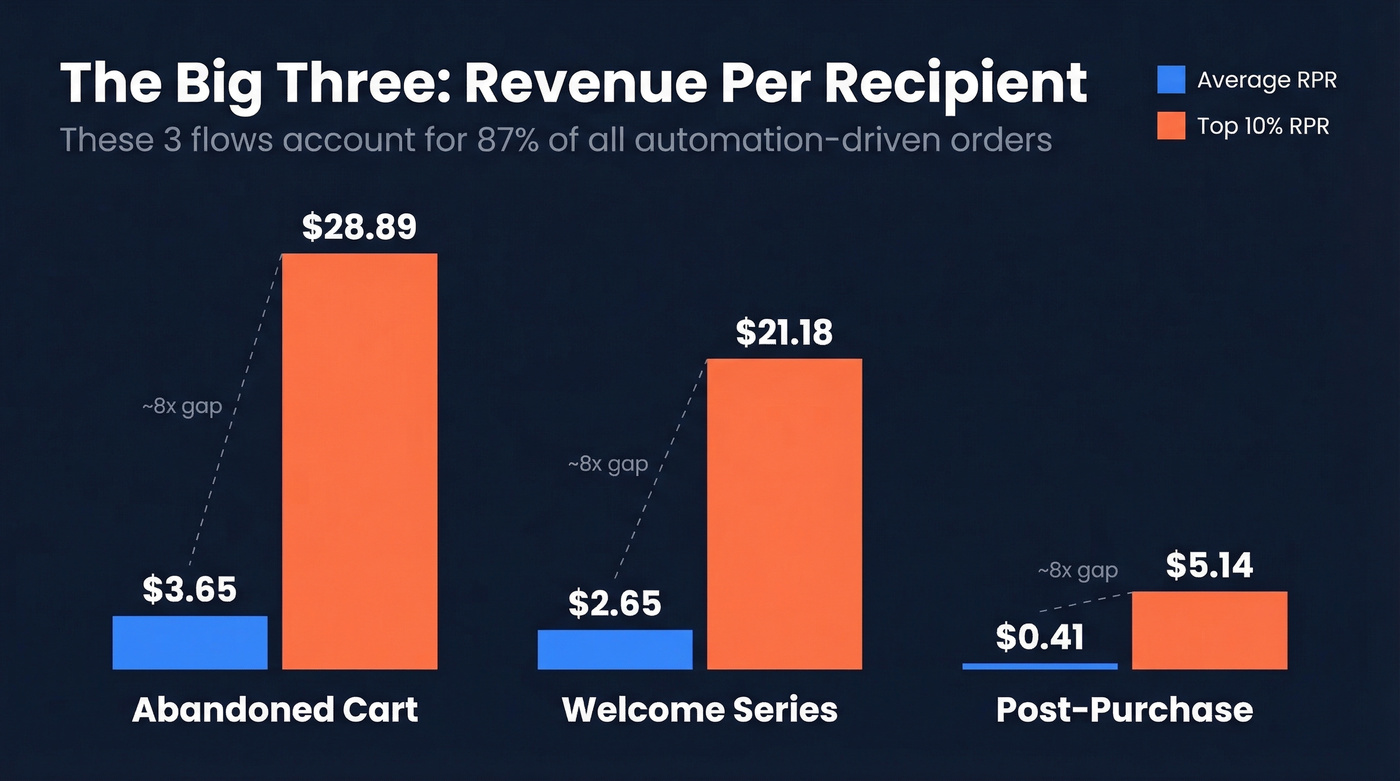
Average revenue per recipient runs $3.65 for abandoned cart, $2.65 for welcome, and $0.41 for post-purchase - but top-10% performers hit $28.89, $21.18, and $5.14 respectively. The rest of this guide covers 15+ examples with exact timing, benchmarks, and the one prerequisite most guides skip: data quality.
Why Automations Outperform Campaigns
The numbers aren't subtle. Flows deliver a 5.58% click rate versus 1.69% for campaigns. Placed order rates hit 2.11% for flows versus 0.16% for campaigns - that's 13x higher. Nearly 48% of flow-driven revenue comes from new buyers, compared to just 16% for campaigns.
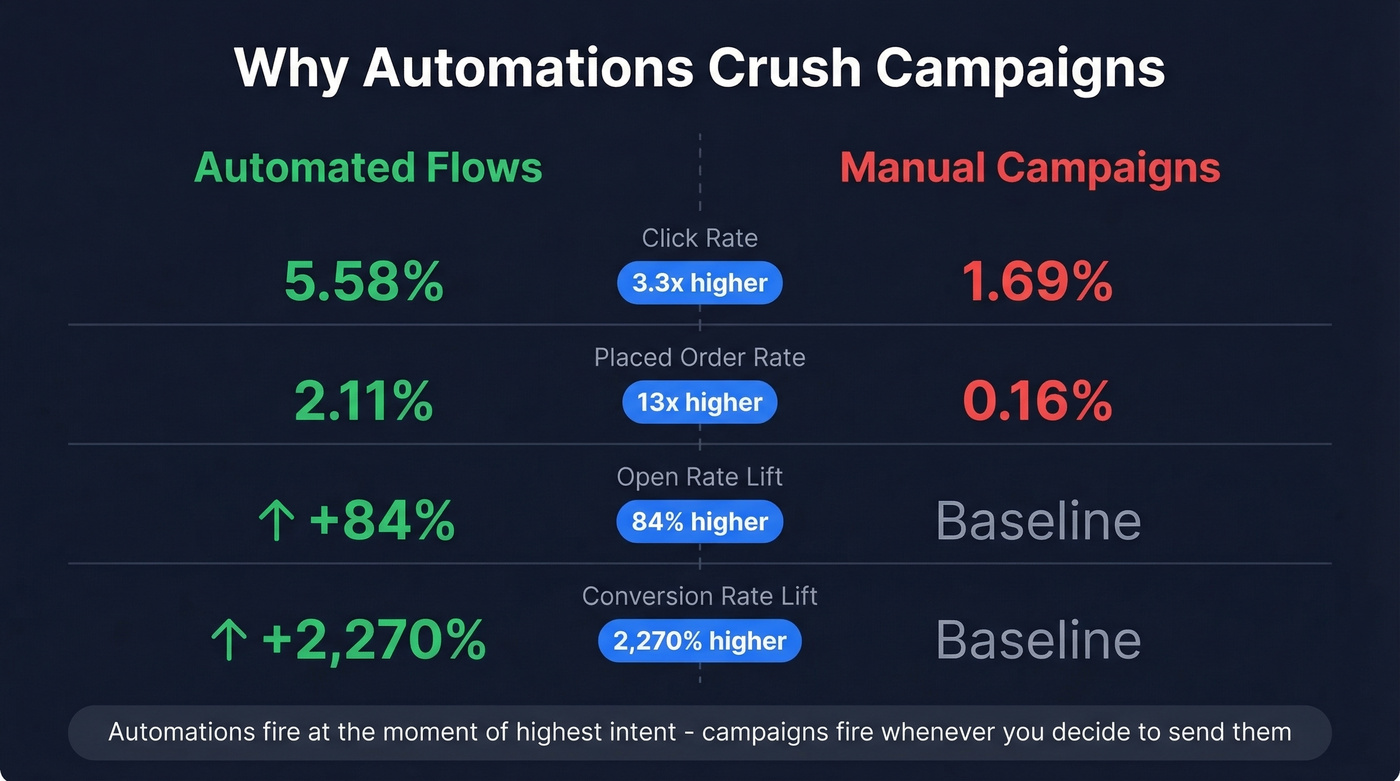
Omnisend's analysis of 17 billion emails confirms the pattern: automated emails achieve 84% higher open rates, 341% higher click rates, and a 2,270% increase in conversion rates versus manual campaigns. Why? Automations fire at the moment of highest intent. A cart abandonment email hits when someone was literally about to buy. A welcome email arrives when brand awareness peaks. Campaigns hit whenever you decide to send them, which is almost never the right moment.
Revenue Benchmarks by Automation Type
| Automation | Avg RPR | Top 10% RPR |
|---|---|---|
| Abandoned Cart | $3.65 | $28.89 |
| Welcome Series | $2.65 | $21.18 |
| Browse Abandonment | $1.07 | $7.21 |
| Post-Purchase | $0.41 | $5.14 |
The gap between average and top 10% is enormous - nearly 8x for both abandoned cart and welcome. That gap isn't about having a fancier tool. It's about timing, segmentation, and whether your emails actually reach inboxes.
Ecommerce Automated Workflows
Welcome Series
A practitioner breakdown of high-performing flows ranked welcome as the most profitable automation - "probably 4x the next runner up." Here's the cadence:
| Timing | Content | |
|---|---|---|
| #1 | Immediately | Brand intro + top products |
| #2 | Day 1-2 | Founder story / differentiation |
| #3 | Day 3-4 | Social proof + reviews |
| #4 | Day 5-7 | Product education |
Fire email #1 immediately on signup - peak engagement is in the first 15 minutes. One ecommerce operator on Reddit shared that simply fixing their welcome timing from a batch schedule to an instant trigger doubled their flow's RPR overnight. That's not a creative win. That's an infrastructure win.
Abandoned Cart Recovery
The highest RPR flow at $3.65 average, $28.89 for top performers. With around 70% cart abandonment across ecommerce, this is pure money on the table.
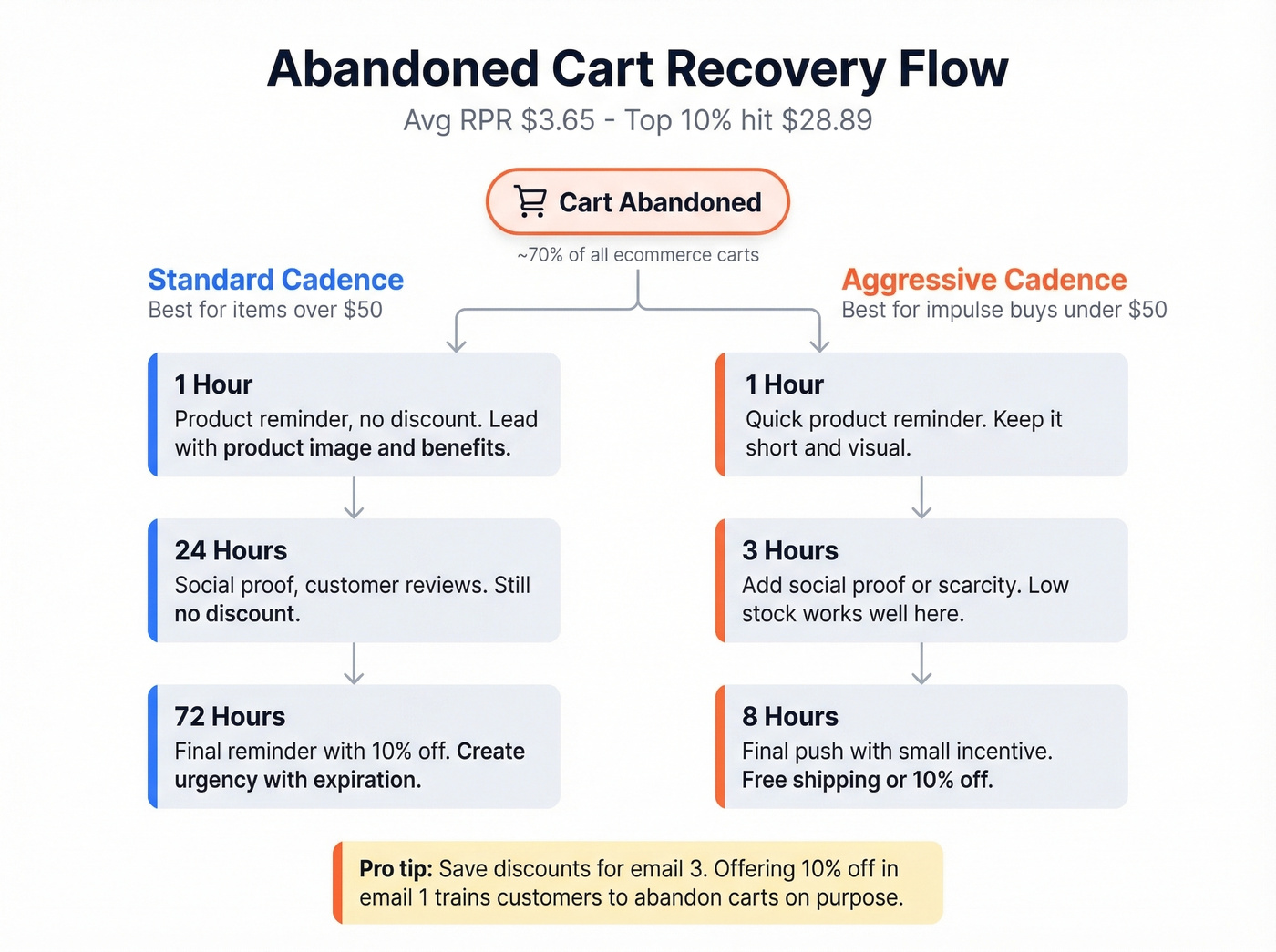
Two timing cadences work well. The standard approach sends at 1 hour, 24 hours, and 72 hours after abandonment. A more aggressive cadence runs 1 hour, 3 hours, and 8 hours. We've found the faster cadence works better for impulse-buy products under $50; for higher-ticket items, give people breathing room with the standard timing.
Skip the "Did you forget something?" copy - it reads as surveillance, not service. And save discounts for email #3. Offering 10% off in the first email trains customers to abandon carts on purpose. Manly Bands takes this approach: their first reminder is purely about the product, with incentives reserved for the final touchpoint.
Browse Abandonment
Triggers when someone views a product page without adding to cart. RPR runs $1.07 average, $7.21 for top 10%. Most teams skip this because it feels "too early" - but it's one of the highest-volume revenue drivers once you set it up.
The key differentiator from cart abandonment: the prospect hasn't committed yet, so lead with social proof and reviews rather than urgency. Inaction is a trigger too - a non-click after 48 hours can branch the flow to a different message with a stronger hook or alternative product recommendations.
Post-Purchase Sequence
Here's where most brands leave money behind. The typical post-purchase flow is two emails: a thank-you and a cross-sell. One ecommerce operator on Reddit shared a radically different approach - 12 emails, one week apart, over roughly three months, rotating between education, social proof, feedback requests, and cross-sells. Performance: $4-$8 per email sent. On a list of 10,000 recipients, that math gets interesting fast.
Even a modest sequence of 4-5 emails will outperform the two-email default. The secret is patience: don't cross-sell in email #1.
Review Request
Send 7-14 days after delivery - long enough for the customer to use the product, short enough that the purchase is still fresh. One CTA, no distractions. Don't bundle this with a cross-sell.
Replenishment / Reorder
Trigger based on estimated product lifespan. Dollar Shave Club is a classic example: send a reorder reminder a few days before the customer is likely to run out. Works exclusively for consumables, but for those brands, it's a quiet revenue machine.
Back-in-Stock Notification
Trigger on inventory change matched against wishlist or browse history. These emails have some of the highest open rates of any automation because the recipient explicitly wanted the product. Keep the email short. The product image and a buy button are all you need.
Birthday / Anniversary
Starbucks runs one of the most recognizable birthday automations - a free drink offer with a clear expiration. The deadline drives urgency, and the personalization makes it feel like a gift rather than a promotion. Include a discount or exclusive offer with a firm expiration date. These convert well because they feel personal, even though they're fully automated.
Winback / Re-engagement
Set up inactivity tiers at 30, 60, and 90 days. The 30-day email is a gentle nudge. The 60-day email includes an incentive. The 90-day email is a sunset warning: "We're going to stop emailing you."
Then actually suppress non-responders. Keeping dead addresses on your list tanks deliverability for everyone else.
VIP / Loyalty Tier
Trigger on spend threshold or order count. Offer exclusive access, early product launches, or VIP-only discounts. Your top 10% of customers drive a disproportionate share of revenue - making them feel recognized keeps them there.
B2B Email Automation Examples
Lead Nurture Sequence
Trigger: first top-of-funnel form conversion like a whitepaper download or webinar signup. Automated lead nurturing can generate 450%+ more qualified leads - the compounding effect of consistent, well-timed follow-up is enormous.
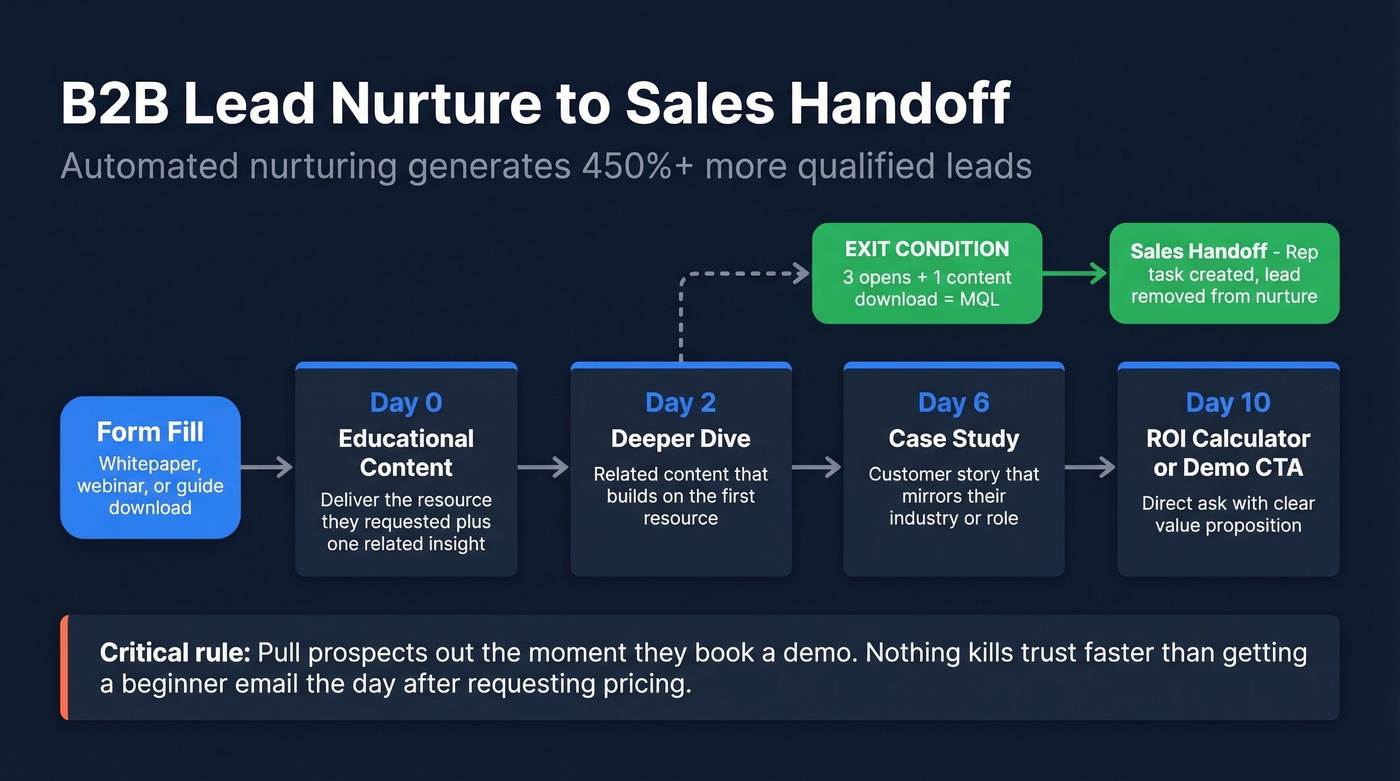
The cadence that works for most B2B teams is day 0, day 2, day 6, day 10 - starting with educational content and progressing toward case studies and ROI calculators. Exit conditions matter as much as the emails themselves: pull someone out the moment they book a demo or their lifecycle stage changes. Nothing kills trust faster than getting a "What is ABM?" email the day after you requested pricing.
Sales Handoff Trigger
This isn't a sequence - it's a single automation rule that prevents leads from rotting in marketing's nurture forever. Set an engagement threshold: three opens plus one content download equals MQL, which triggers SQL handoff and a rep task. 72% of B2B organizations already use email automation, but most have a leaky handoff between marketing and sales. This automation plugs that gap. If you need a tighter process, start with a simple lead scoring model and align it to your lead status definitions.
Lost-Deal Winback
Trigger on closed-lost deals with a "not now" reason. Wait 60 days, then send a check-in email with a new case study or product update. If they click or reply, create a rep task and reopen the deal. This flow has low volume but a surprisingly high conversion rate because the prospect already went through discovery - they just weren't ready.
Renewal Reminder
Cadence: 90, 60, and 30 days before renewal. The 90-day email includes an ROI recap. The 60-day email links to a QBR scheduling page. The 30-day email is the final reminder with contract details. Don't wait until the last week - by then, the customer has already started evaluating alternatives.
Customer Health Alert
Trigger on usage drops or no logins for 30 days. Send a helpful tip email, not a "we miss you" guilt trip. If there's no activity within 7 days, escalate to the CSM. This automation catches churn signals before they become cancellation requests.

The gap between average and top-10% automation performance isn't creative - it's data quality. When 35% of your emails bounce, every flow in this guide bleeds money. Prospeo delivers 98% email accuracy with a 7-day refresh cycle, so your welcome series, cart recovery, and nurture sequences actually reach real inboxes.
Fix your data before you fix your flows. Start at $0.01 per verified email.
Cold Outbound Sequences
Cold email sequences are the B2B counterpart to cart abandonment flows - they catch intent at the right moment, except you're creating the moment instead of reacting to it. Expect low single-digit reply rates of 2-5% and sub-1% meeting-booked rates per sequence. But at scale, even 1% across 1,000 prospects is 10 meetings per month.
A solid cold sequence runs 4-5 emails:
- Personalized opener - reference something specific about the prospect's company or role. Generic "I noticed your company..." doesn't cut it.
- Social proof - a customer result or metric that mirrors the prospect's situation.
- Resource or offer - a relevant guide, benchmark, or free audit. Give before you ask.
- Breakup email - short, direct, no guilt. "Seems like the timing isn't right. I'll check back in Q3."
Look, cold sequences are unforgiving on data quality. One bad batch - 10%+ bounces - can flag your domain with Gmail and Microsoft, and recovering sender reputation takes weeks. We've seen outbound agencies lose entire sending domains over a single unverified list. Build prospect lists with verified data from the start. Prospeo's email finder covers 300M+ profiles with 98% email accuracy, so your sequence actually reaches decision-makers instead of spam folders. If you're building outbound from scratch, use a proven B2B cold email sequence structure and keep an eye on email velocity.
Data Quality: The Prerequisite Nobody Mentions
Your welcome series open rate is 22% versus the 31% benchmark. Before you rewrite subject lines or test new send times, check whether 15% of your addresses are invalid.
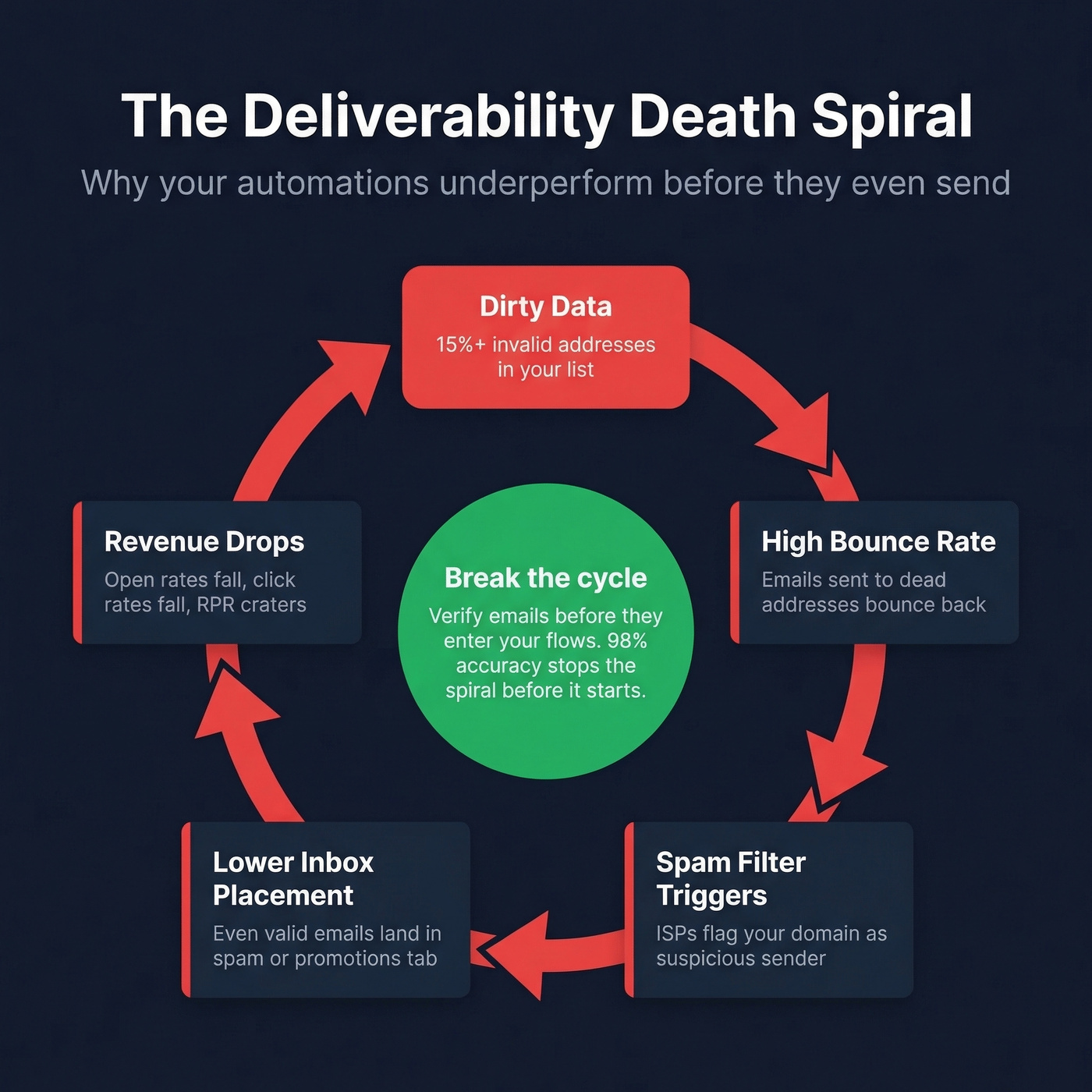
Bad emails bounce. Bounces trigger spam filters. Spam filters tank deliverability for your entire domain - including emails going to perfectly valid addresses. It all starts with dirty data, and your automation platform doesn't verify emails. It sends to whatever's in your list.
For cold outbound specifically, Prospeo verifies emails in real-time with 98% accuracy and refreshes data every 7 days, so your lists don't decay between campaigns. The free tier covers 75 verifications per month - enough to validate a test list before scaling. If you're troubleshooting, start with email bounce rate benchmarks and a full email deliverability guide.
B2B lead nurture sequences generate 450% more qualified leads - but only if your contact data connects you to real buyers. Prospeo's 300M+ verified profiles and 30+ filters let you build targeted lists by intent, tech stack, and job changes, then feed clean data straight into your automation platform.
Stop nurturing dead addresses. Build lists that convert.
Mistakes That Kill Your Automations
Delayed welcome emails. Peak engagement is the first 15 minutes after opt-in. If your welcome email fires on a batch schedule instead of an immediate trigger, you've already lost the moment.
SMS overload. Don't fire an SMS the same minute as an email. Build a 6-12 hour delay, and only send SMS if the email goes unopened. Stacking channels without conditions feels aggressive.
Lazy segmentation. "All subscribers" isn't a segment. Tag at point of capture, segment by behavior and purchase history, and build separate flows for different lifecycle stages.
Stale workflows. Review metrics weekly for active campaigns, monthly for evergreen flows. Do a full quarterly audit - click every link, check for expired offers, verify that exit conditions still make sense.
Ignoring data quality. Every other mistake on this list gets amplified by bad data. A perfectly timed, beautifully written email that bounces generates exactly zero revenue.
Let's be honest: if your average cart value is under $30, you probably don't need a 5-email abandoned cart sequence. Two emails - one reminder, one with social proof - will capture 90% of the recoverable revenue. Save the complexity for flows where the math justifies it.
Best Tools for Automated Email Workflows
By install base, HubSpot leads at 28% market share, followed by Mailchimp at 25% and Klaviyo at 14% across 338,000 tracked sites. But market share doesn't mean best fit.
| Tool | Starting Price | Best For | Key Limitation |
|---|---|---|---|
| Klaviyo | From $20/mo | Ecommerce + Shopify | Pricey outside ecom |
| ActiveCampaign | From $19/mo | B2B + deep automations | Steep learning curve |
| Omnisend | From $16/mo | Ecom + SMS multichannel | Limited outside ecom |
| Brevo | Free (300/day) | Budget teams + SMS | Basic editor/templates |
| HubSpot | From $20/mo/seat | B2B CRM integration | Expensive at scale |
| Mailchimp | From $13/mo | Beginners + templates | Automations limited |
| MailerLite | From $15/mo | Simple, low-bloat email | Fewer advanced flows |
| Drip | From $39/mo | Ecom mid-market | Smaller ecosystem |
| GetResponse | From $19/mo | All-in-one marketing | Less flexible automations |
Klaviyo is the default choice for Shopify-native ecommerce brands. Its predictive analytics - expected next order date, customer lifetime value scoring - are genuinely best-in-class for ecom. The downside: pricing scales steeply once you leave the Shopify ecosystem, and B2B teams will find the feature set misaligned.
ActiveCampaign has the deepest automation builder of any mid-market platform. You can build conditional logic that rivals enterprise tools at a fraction of the cost. The consensus on r/MarketingAutomation is that the learning curve is brutal but worth it.
Omnisend hits the sweet spot for ecommerce teams that want email plus SMS in one platform without Klaviyo's price tag. Its visual workflow builder handles complex conditional logic without needing a developer. Where it falls short: anything outside ecommerce. For B2B lead nurture, skip it.
For B2B, the real choice is ActiveCampaign versus HubSpot - automation depth versus CRM integration. If your sales team already lives in HubSpot, don't fight it. If you're starting fresh and care more about workflow sophistication, ActiveCampaign wins. For budget-conscious teams just getting started, Brevo or MailerLite will handle the core three automations without breaking the bank.
Mailchimp's dataset of billions of emails shows ecommerce click rates averaging 1.74% and all-user click rates at 2.62% - useful cross-platform validation if you're benchmarking your own performance.
How to Measure Performance
Stop using open rate as your north-star metric. After Apple Mail Privacy Protection launched, open rates rose by 18 points across 80,000+ accounts in just six months. With Apple Mail representing 46% of email clients, your open rate is essentially fiction.
Use click-to-open rate instead - the average sits at 5.3%. For revenue-generating flows, RPR is the metric that actually matters. The benchmark gap is massive: average workflows generate $1.94 RPR while top 10% hit $16.96.
If your flows are below $1.94, the problem isn't your tool. It's your timing, segmentation, or data quality. If you want to push CTR up, start with proven email subject lines and a tighter email copywriting process.
FAQ
How many automations should I start with?
Three: welcome series, abandoned cart, and post-purchase. These flows drive 87% of all automation-driven orders. Get them running and optimized before adding complexity. Layer in browse abandonment and winback flows once the core three perform above average benchmarks.
What's a good revenue per recipient?
The average across all automation types is $1.94 RPR; top 10% performers hit $16.96. Abandoned cart leads at $3.65 average and $28.89 for top 10%. If you're below $1.94 across your flows, focus on timing optimization and list hygiene before testing creative changes.
Do automated workflows work for B2B?
Yes - 72% of B2B organizations already use them. The highest-impact B2B flows are lead nurture sequences, renewal reminders, and lost-deal winback. Cadences run longer than ecommerce (days and weeks instead of hours), but the efficiency gains are just as significant.
How often should I audit my automations?
Check metrics weekly for active campaigns, monthly for evergreen flows, and run a full audit quarterly. During that quarterly review, click every link, verify offers aren't expired, confirm exit conditions still work, and check that suppression lists are current.
How do I keep automated emails from bouncing?
Verify your list before activating any workflow - even a 10% bounce rate can trigger spam filters that suppress deliverability across your entire sending domain. Run a test batch through a verification tool first, then scale once you've confirmed list quality.