

The 12 Best Email Campaign Software Tools for 2026
Automated flows account for just 5.3% of email send volume - yet they generate 41% of total email revenue for ecommerce brands on Klaviyo. That single stat tells you why your email campaign software choice matters more than most teams realize. Email converts at 2.8% for B2C and 2.4% for B2B, beating most paid channels. But average deliverability across 15 tested ESPs is just 83.1% - nearly one in five emails never reaches the inbox.
Pick the wrong platform, and you're burning budget before a single subscriber opens anything.
Stop comparing 15 tools. You need one ESP and one data quality tool. Here are the ones worth your time, sorted by what actually matters: deliverability, automation depth, and what it'll cost when your list grows past 10K.
Our Top Picks
| Pick | Best For | Starting Price | Free Plan? |
|---|---|---|---|
| ActiveCampaign | Automation-first teams | $15/mo (1K contacts) | No (14-day trial) |
| Brevo | Free plan + multichannel | $9/mo (5K emails) | Yes (100K contacts, 9,000 emails/mo) |
| Klaviyo | Ecommerce revenue | $20/mo (250+ profiles) | Yes (250 profiles) |
| MailerLite | Simplicity + value | $9/mo (500 subs) | Yes (500 subs) |
| Prospeo | List verification before send | ~$0.01/email | Yes (75/mo) |
ActiveCampaign is the automation engine. Brevo is the best free plan by a mile. Klaviyo is the right answer for ecommerce and the wrong answer for everyone else. MailerLite is the tool you recommend to your friend who's "just getting started." And Prospeo is the data quality layer you run before loading contacts into any ESP - 98% email accuracy, spam-trap removal, catch-all handling.
Here's the thing: if your average deal size is under $5K, you probably don't need a $300/mo email marketing platform. A $9/mo ESP paired with a clean list will outperform an enterprise tool sending to garbage data every single time.
What to Look For
Not every ESP comparison matters equally. These seven criteria separate good tools from expensive ones.
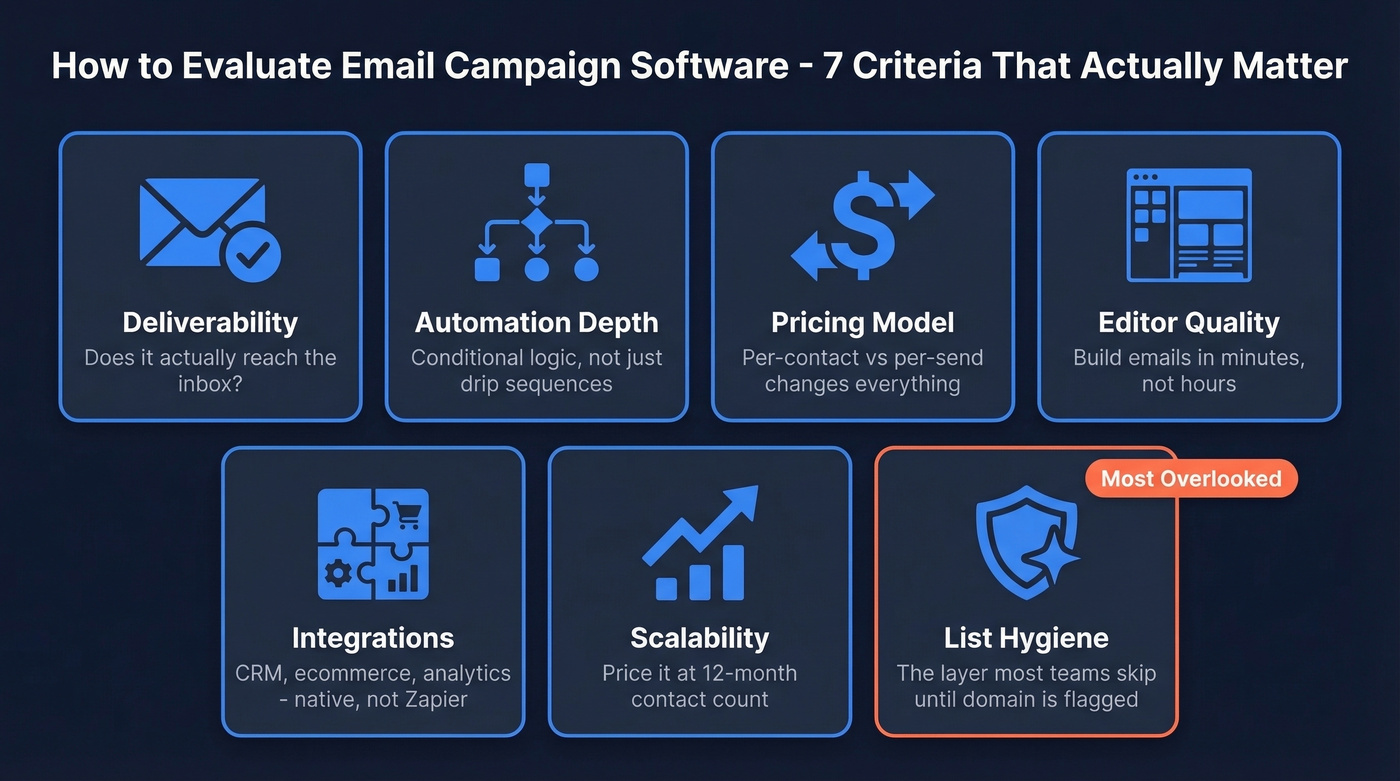
1. Deliverability track record. The only metric that directly affects whether your emails work. An ESP with a 3-star deliverability rating will quietly kill your campaigns. Klaviyo leads in EmailTooltester's testing; Omnisend is close behind; Mailchimp lags.
2. Automation depth. Basic drip sequences are table stakes. Conditional branching, behavioral triggers, lead scoring, and the ability to A/B test within automations - that's what separates serious platforms from glorified mail-merge tools. ActiveCampaign is the benchmark here. Mailchimp still doesn't offer A/B testing inside automations, a gap that drives switching.
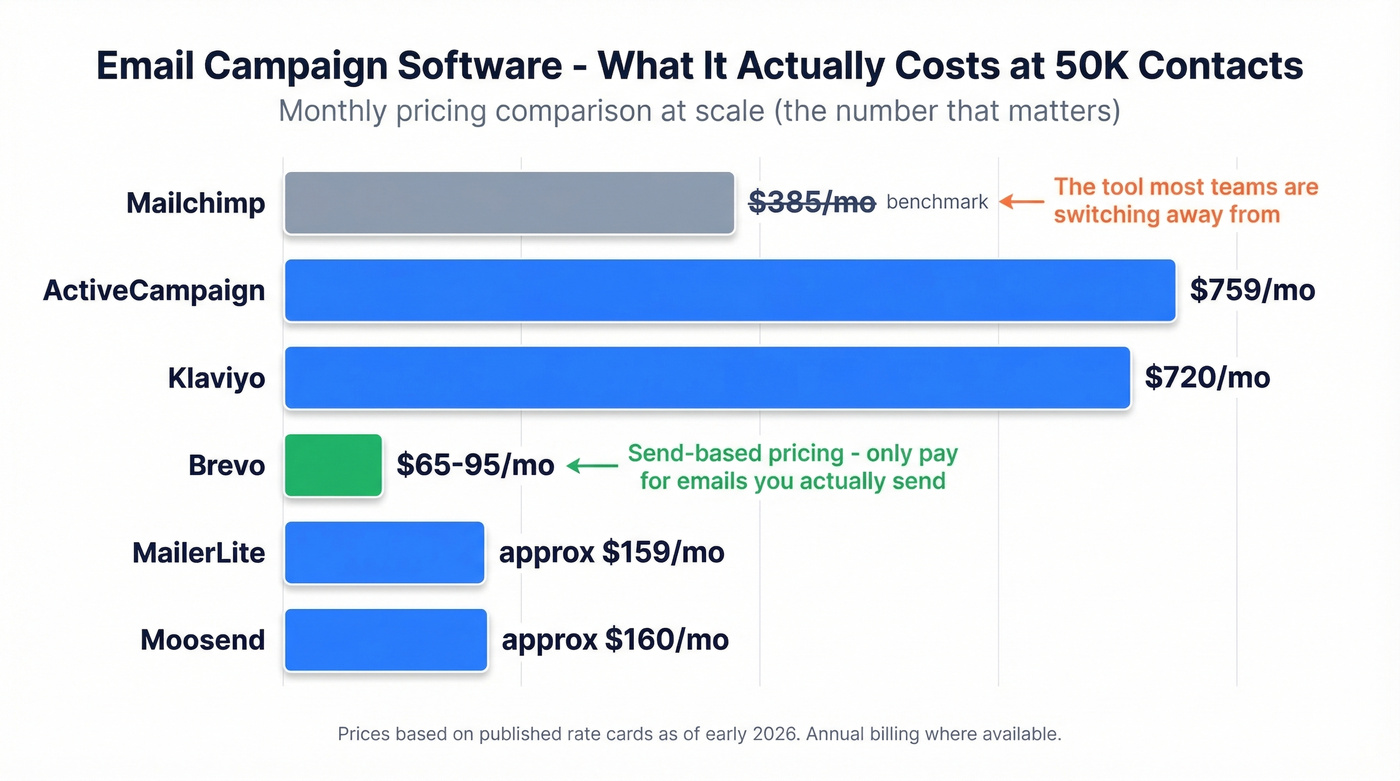
3. Pricing model. Contact-based pricing (Mailchimp, ActiveCampaign, Klaviyo) charges you for every contact on your list, whether you email them or not. Send-based pricing (Brevo) charges per email sent. At 50K contacts, the difference runs hundreds of dollars a month.
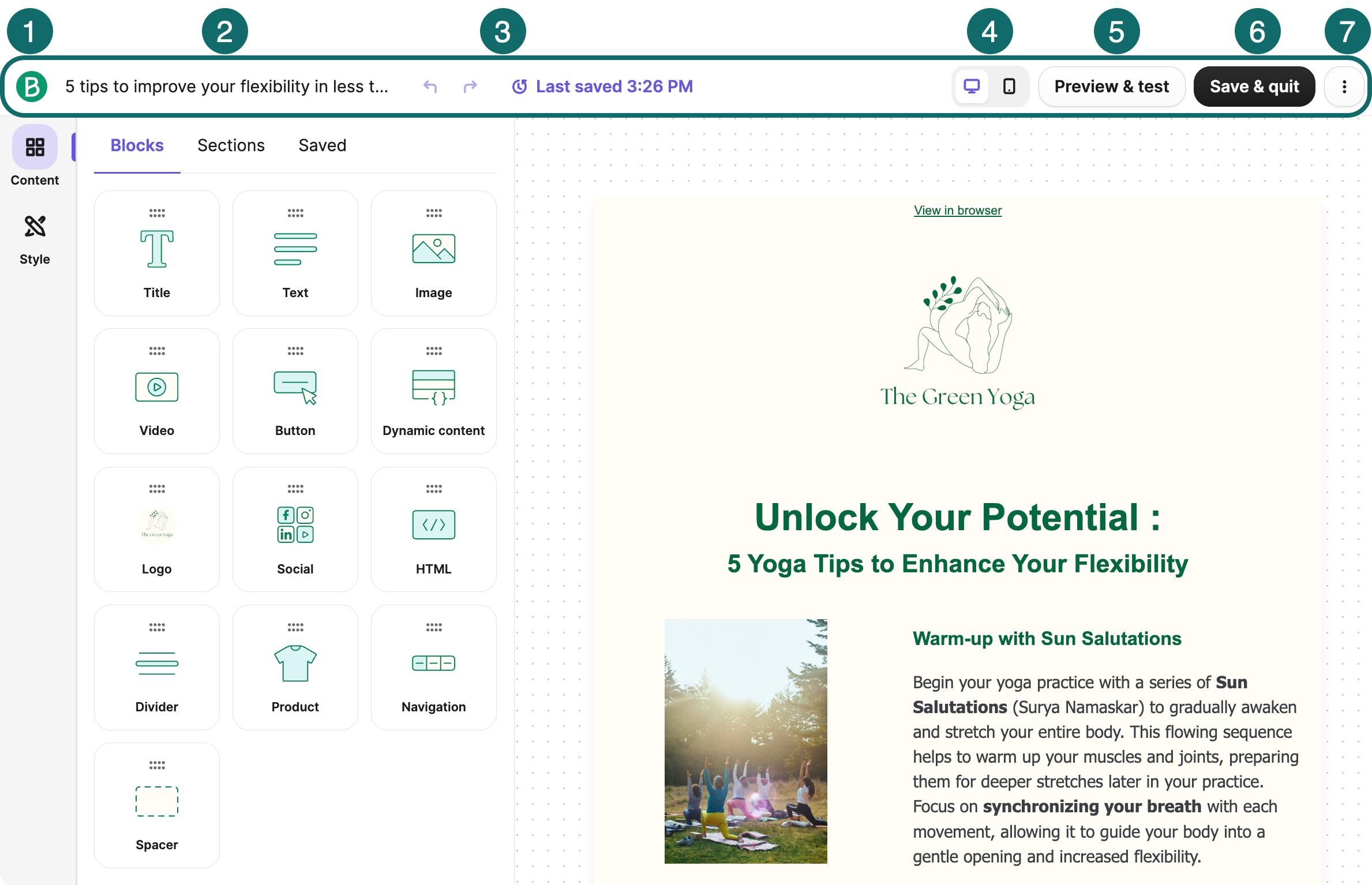
4. Template and editor quality. You'll build emails weekly. A clunky drag-and-drop editor wastes hours. MailerLite and Brevo have the cleanest editors for non-designers - the kind of tools that let you design and send without fighting the interface.
5. Integrations. Your ESP needs to talk to your CRM, your ecommerce platform, your analytics stack. Check native integrations before you sign up - Zapier workarounds add cost and fragility. (If you're evaluating CRMs too, start with these examples of a CRM.)
6. Scalability. What costs $15/mo at 1K contacts might cost $759/mo at 50K. Map out your growth trajectory and price the tool at your 12-month contact count, not today's.
7. Data quality and list hygiene. Every ESP advertises "great deliverability," but none of them clean your list for you. Bad emails, spam traps, and catch-all domains tank your sender reputation regardless of which platform you use. This is the layer most teams ignore until their domain gets flagged. If you're in a restricted vertical like crypto, CBD, or dating, many mainstream ESPs will reject you outright - you'll often need a specialized provider or direct sending infrastructure like Amazon SES.
The 12 Best Tools for 2026
Mailchimp isn't on this list. We use it as a pricing benchmark because it's what most teams are switching away from.
| Tool | Free Plan | Starting Price | Rating | Best For |
|---|---|---|---|---|
| ActiveCampaign | No (trial) | $15/mo | ★★★★ | Automation |
| Brevo | Yes (100K contacts / 9,000 emails) | $9/mo | ★★★★ | Free + multichannel |
| Prospeo | Yes (75/mo) | ~$0.01/email | N/A (verification) | List quality |
| Klaviyo | Yes (250) | $20/mo | ★★★★★ | Ecommerce |
| MailerLite | Yes (500) | $9/mo | ★★★½ | Simplicity |
| Omnisend | Yes (250) | $16/mo (500 contacts) | ★★★★½ | Ecom alt to Klaviyo |
| Kit | Yes (10K) | $39/mo | ★★★★ | Creators |
| GetResponse | Yes (500) | $19/mo | ★★★½ | All-in-one + webinars |
| Moosend | No (trial) | $7/mo | ★★★★ | Budget pick |
| Sender | Yes (2,500) | $39.90/mo | ★★★½ | Generous free tier |
| beehiiv | Yes (2,500) | $49/mo | ★★★½ | Newsletters |
| Constant Contact | No | ~$12/mo | ★★★½ | Local business |
ActiveCampaign
The automation engine that Reddit consistently endorses. In a thread on r/DigitalMarketing, a team migrating off Salesforce's Predictive Response chose ActiveCampaign over alternatives - citing pricing, integrations, automations, and analytics as the deciding factors. That tracks with what we've seen in practice.
ActiveCampaign's conditional automation builder is best-in-class under 10K contacts. You get if/else branching, lead scoring, site tracking, and predictive sending - features that competitors like Mailchimp still gate behind higher tiers or don't offer at all. Send limits run at 10x your contact count on Starter and Plus plans, generous enough for most cadences.
Use this if: You're an automation-first team that needs behavioral triggers, lead scoring, and CRM pipeline management in one platform. The Starter plan at $15/mo (1K contacts, annual billing) is a strong entry point.
Skip this if: You need a free plan. The 14-day trial caps at 100 contacts and 100 emails - barely enough to evaluate.
Watch the pricing at scale, too. At 50K contacts, you're looking at $759/mo on Plus, and add-ons like Pipelines ($68/mo) and SMS ($16.83/mo) stack up fast. ActiveCampaign's pricing page shows "Starts at --/mo" until you enter your contact count. If you have to hide the price, the price is the problem.
Pricing at scale: 1K contacts: $15/mo (Starter, annual). 10K: $189/mo. 50K: $759/mo (Plus required). Pair Postmark for transactional emails at $15/mo for 10K sends.
Brevo
Brevo's free plan is the most generous in the market and it's not close. You get 100K contacts, 9,000 emails per month, and a 300/day sending cap - all for $0. Mailchimp's free plan caps at 250 contacts. That's not a free plan; that's a demo.
The real differentiator is Brevo's pricing model. While many ESPs charge per contact, Brevo charges per email sent. At 50K contacts, this is a massive cost advantage. If you email your full list twice a month (100K sends), you're paying roughly $65-95/mo on Brevo versus $385-720/mo on Mailchimp or Klaviyo. The math isn't subtle.
Brevo also bundles SMS, WhatsApp, and live chat into the platform - actual multichannel, not email with SMS tacked on as an afterthought. Deliverability scores 4 stars, adequate but not top-tier.
Use this if: You have a large contact list but don't email everyone every week. The send-based model saves serious money at scale. Also the obvious choice for multichannel without stitching together three tools.
Skip this if: You need deep automation branching. Brevo's automation is competent but doesn't match ActiveCampaign's conditional logic. The free plan also limits automation to 2K subscribers - fine for getting started, frustrating if you're trying to evaluate the feature properly.
Pricing: Free (100K contacts, 300/day). Paid from $9/mo for 5K emails. No per-contact charges.
Prospeo
Prospeo isn't an ESP. It's the data quality layer that every ESP on this list depends on - and the tool most teams don't realize they need until their domain reputation is already damaged.
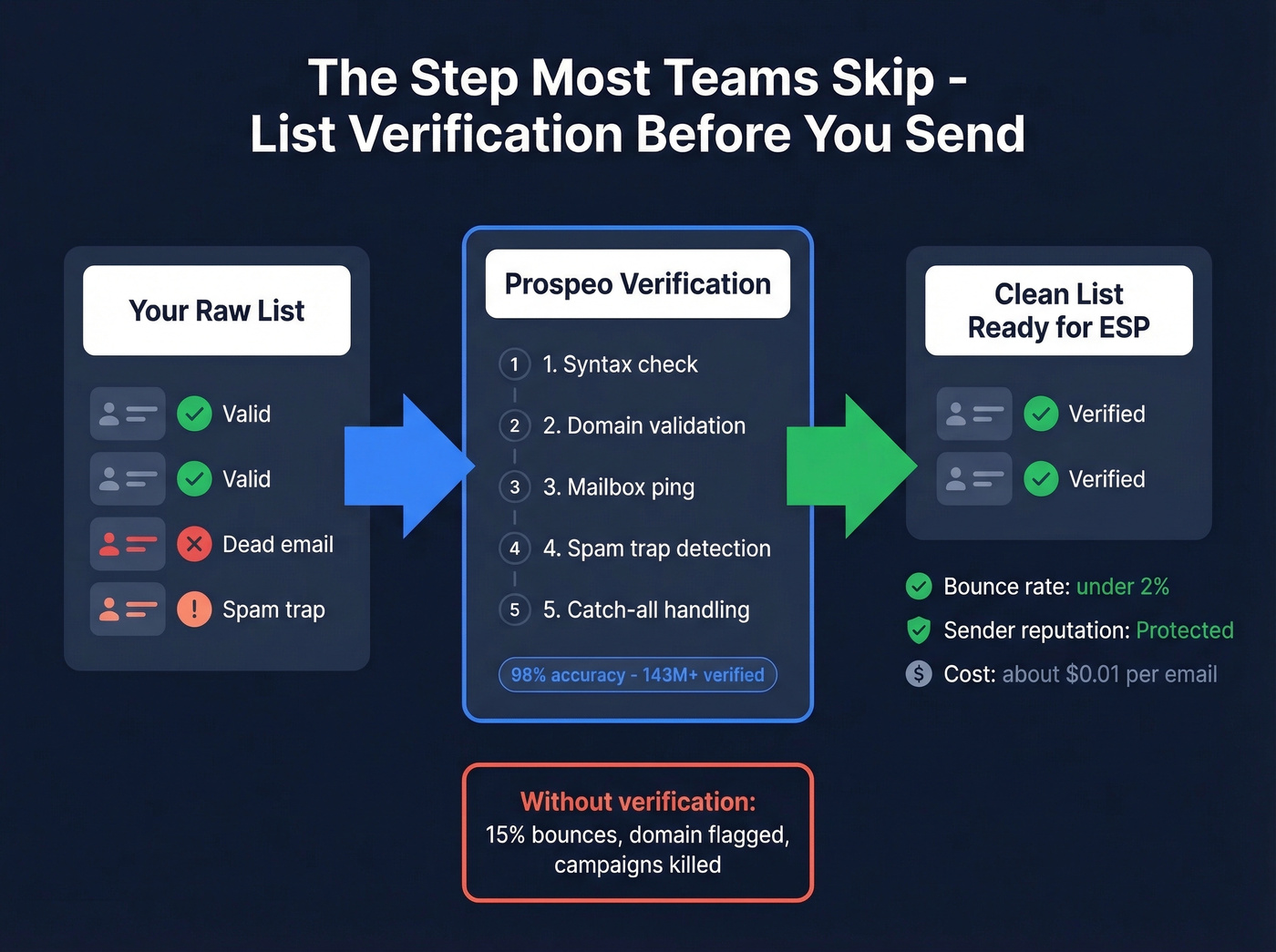
Your email platform can have 5-star deliverability, beautiful templates, and world-class automation. None of it matters if 15% of your list bounces. Prospeo's 5-step verification process catches dead emails, spam traps, honeypots, and catch-all domains before they ever touch your sending infrastructure. The result is 98% email accuracy across 143M+ verified addresses.
The platform covers 300M+ professional profiles with a 7-day data refresh cycle - the industry average is six weeks. That freshness gap matters because an email that was valid last month can bounce today. Intent data across 15,000 topics (powered by Bombora) helps you prioritize contacts who are actively researching solutions, so you're not just sending to clean addresses - you're sending to the right ones. Native integrations with HubSpot, Salesforce, Instantly, Lemlist, and Zapier mean verification fits into whatever workflow you're already running.
Use this if: You're running outbound campaigns, importing trade show lists, or enriching CRM data before loading it into your ESP. At ~$0.01 per email verified, it's cheap insurance against domain damage. (If you're comparing vendors, see our roundup of data enrichment services.)
Pricing: ~$0.01/email. Free tier: 75 verifications/month, no credit card required. No contracts.
Klaviyo
Klaviyo is the ecommerce revenue machine, and the benchmarks back it up. Across 183,000+ customers, automated flows deliver 18x higher revenue per recipient than campaigns, with click rates of 5.58% versus 1.69%. The top 10% of flows hit revenue per recipient above $7.79. AI product recommendations lift click rates to 3.75% on average, with top performers hitting 8.79%. If you're running a Shopify or WooCommerce store, Klaviyo's product recommendation engine and behavioral triggers are hard to replicate elsewhere.
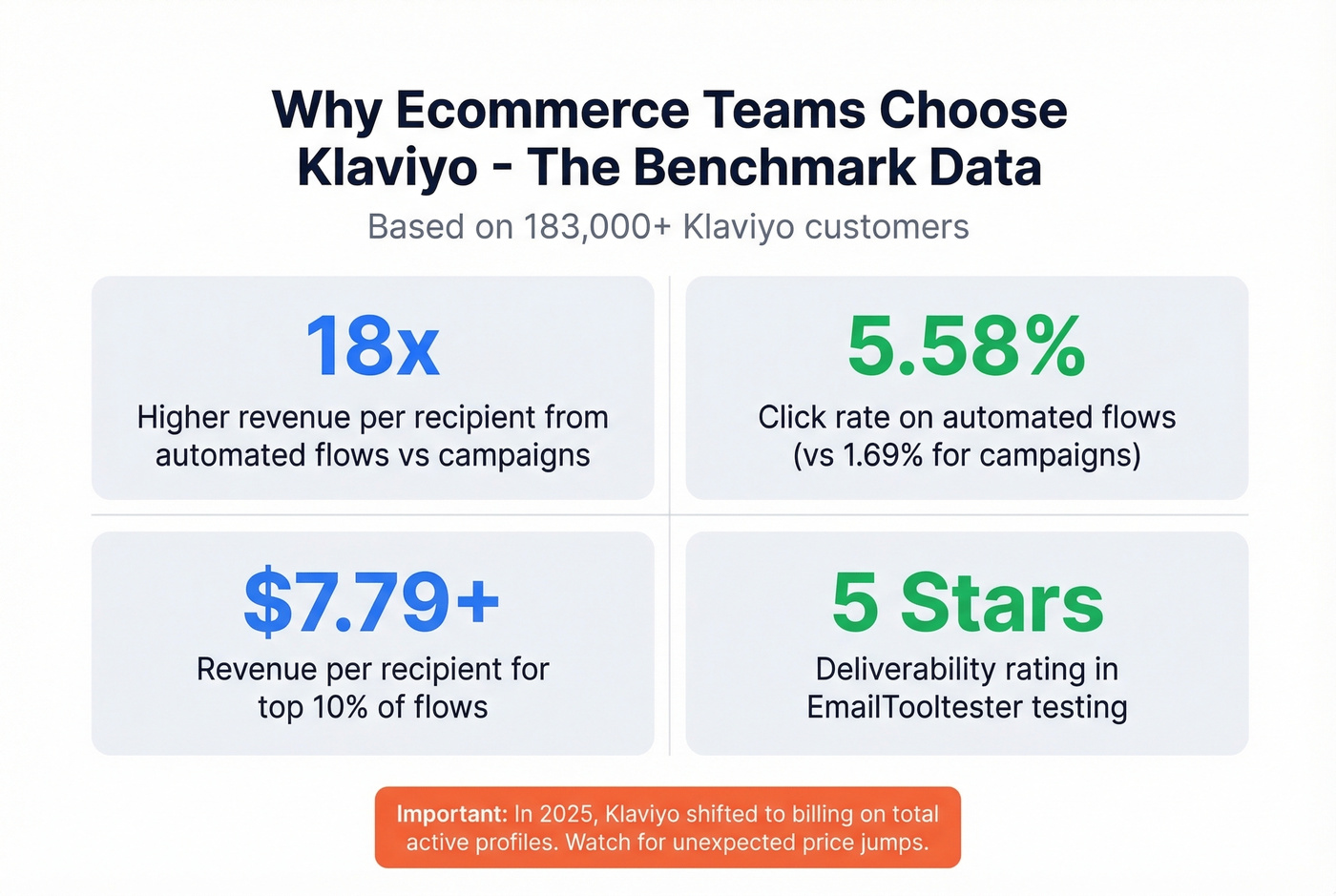
Deliverability earns a 5-star rating in EmailTooltester's testing. That alone justifies consideration for any ecommerce team where email drives a meaningful chunk of revenue.
Use this if: You sell products online and want email to be a revenue channel, not just a communication tool. The free plan (250 profiles, 500 emails) is enough to test flows before committing.
Skip this if: You're not in ecommerce. Klaviyo's pricing, UX, and feature set are all optimized for product-based businesses. A SaaS newsletter doesn't need abandoned cart flows. Also watch the billing model - in early 2025, Klaviyo shifted to billing on total active profiles, not just contacts you email. Some long-time customers saw unexpected price jumps after the change.
Pricing: Free: 250 profiles, 500 emails. Email plan from $20/mo. At 10K profiles: $150/mo. At 50K: $720/mo. Active profiles exclude unsubscribed and suppressed contacts - a real advantage over Mailchimp.
MailerLite
MailerLite is the tool you recommend when someone asks "what's the simplest option that isn't terrible?" The drag-and-drop editor is clean, the free plan covers 500 subscribers with 12,000 emails/month, and paid plans start at $9/mo. Deliverability scores 3.5 stars - not best-in-class, but adequate for most use cases.
The UI is the cleanest in this list. Landing page builder, paid newsletters, and digital product sales are all built in. Under 5K subscribers, it's hard to beat the value. The tradeoff is automation - basic compared to ActiveCampaign - and reporting depth that leaves power users wanting more.
Best for: Solopreneurs, small businesses, and anyone who values simplicity over power features.
Omnisend
The ecommerce alternative for teams that find Klaviyo's pricing too steep. Omnisend's pre-built ecommerce workflows - welcome series, cart abandonment, browse abandonment - work out of the box with Shopify, BigCommerce, and WooCommerce. Deliverability hits 4.5 stars, second only to Klaviyo.
Strong deliverability, SMS and push notifications included, and pre-built automations save setup time. The free plan covers 250 contacts and 500 emails. On the downside, segmentation isn't as sophisticated as Klaviyo's, reporting isn't as deep, and third-party integrations are thinner.
Best for: Ecommerce teams under 10K contacts who want serious marketing automation without Klaviyo-level pricing. Paid plans start at $16/mo.
Kit (ConvertKit)
Kit's free plan gives creators 10,000 subscribers with unlimited emails. That's not a typo. No other email marketing platform comes close to that free tier for audience building. The catch is limited automation on the free plan - you get basic sequences but not the visual automation builder. Paid plans start at $15/mo for creators with fewer than 300 subscribers, and run $39/mo at 1K subscribers, which is expensive per-contact. But creators monetizing through paid subscriptions or digital products often recoup that through Kit's native commerce tools and Creator Network, which cross-promotes newsletters to help you grow organically. The email editor is intentionally minimal - text-focused, no drag-and-drop templates - which creators love and marketers hate. Deliverability: 4 stars.
Best for: Newsletter operators and creators who want to build an audience before spending money.
GetResponse
GetResponse includes webinar hosting. If webinars are part of your funnel, running them inside your email platform eliminates the Zoom-plus-ESP stitching that wastes time and creates data gaps. The free plan covers 500 contacts and 2,500 emails. Paid plans from $19/mo include landing pages, a decent automation builder, and basic CRM. The UI feels dated compared to MailerLite or Brevo, and deliverability is middle-of-the-pack at 3.5 stars. Pricing scales aggressively past 10K contacts - budget accordingly.
Best for: Teams that run webinars as part of their funnel and want everything in one platform.
Moosend
Budget pick with surprisingly strong deliverability (4 stars). No free plan, but the 30-day trial is ungated and paid plans start at $7/mo for 500 subscribers with unlimited emails. Solid automation builder for the price. If you're bootstrapping and need more than a free tier can offer, Moosend is the cheapest path to competent email automation.
Sender
Generous free tier: 2,500 subscribers and 15,000 emails/month with unlimited automation. Paid plans start at $39.90/mo at 10K subscribers. A good option for bootstrapped teams that need drip campaigns and automation without paying for it.
beehiiv
Newsletter-first platform built for media operators and content creators. Free plan covers 2,500 subscribers with unlimited sends. Scale plan runs $49/mo. The monetization tools - paid subscriptions, ad network, referral program - are the real draw. Deliverability: 3.5 stars. Skip this if you're not building a newsletter business.
Constant Contact
Legacy player that still works for local businesses and nonprofits who need event management and social posting alongside email. Pricing starts around $12/mo but scales quickly. The platform hasn't kept pace with modern automation or deliverability standards. Most teams reading this article have outgrown what Constant Contact offers.
Deliverability: The Metric That Matters
Every ESP advertises "great deliverability." None of them publish actual inbox placement rates. Independent data tells a different story.
EmailTooltester's testing across 15 ESPs found an average deliverability rate of 83.1%. That means 10.5% of emails land in spam and 6.4% go missing entirely. Their thresholds: above 89% is good, above 95% is excellent, below 80% is poor. Most ESPs fall in the "mediocre" range.
| ESP | Deliverability |
|---|---|
| Klaviyo | ★★★★★ |
| Omnisend | ★★★★½ |
| ActiveCampaign | ★★★★ |
| Brevo | ★★★★ |
| Moosend | ★★★★ |
| Kit | ★★★★ |
| MailerLite | ★★★½ |
| GetResponse | ★★★½ |
| beehiiv | ★★★½ |
| Mailchimp | ★★★ |
But "delivered" doesn't mean "inbox." Unspam's dataset - based on millions of email tests - found that only 60% of emails reached a visible inbox location. 36% landed in spam. 4% were blocked or went missing. In our experience, the gap between "technically delivered" and "actually seen" is even wider than these numbers suggest.
Industry matters, too. Unspam's inbox placement benchmarks by vertical: Travel hits 68%, Retail/ecommerce 62%, Software/tech 58%, Financial services 57%, and Media/publishing 59%. If you're in fintech or SaaS, expect to work harder for inbox placement than a travel brand.
Gmail inbox placement isn't stable either - Unspam tracked it swinging from 87.5% to 63.5% over seven months in 2025. Yahoo runs around 87%, Apple 82%, and Microsoft a concerning 77%. These four providers represent about 77% of email market share. If your emails don't land on Microsoft, you're missing a quarter of your business audience.
The technical factors that correlate with spam placement are fixable. Authentication adoption is decent (SPF 92%, DKIM 88%) but DMARC lags at 69%. Only 14% of emails include a compliant List-Unsubscribe header. HTML structure is the silent killer: only 26% of emails pass best-practice HTML checks, and the 74% with structural issues are 18-25% more likely to land in spam. (For a deeper playbook, use this email deliverability guide.)
The deliverability checklist that actually moves the needle: authenticate everything (SPF, DKIM, DMARC), include List-Unsubscribe headers, validate your HTML structure, fix broken links before sending, and - most critically - clean your list. No amount of template optimization fixes a 15% bounce rate. If you’re troubleshooting bounces specifically, start with email bounce rate.

Average ESP deliverability is 83.1%. That means 1 in 5 emails never reaches the inbox - and no campaign software can fix a dirty list. Prospeo's 5-step verification catches spam traps, honeypots, and catch-all domains before they tank your sender reputation. 98% accuracy at ~$0.01/email.
Verify your list before your next campaign destroys your domain.
True Cost at Scale
Here's what you'll actually pay as your list grows. Monthly prices on standard plans, not promotional rates.
Contact-based platforms:
| Contacts | Mailchimp (Essentials) | ActiveCampaign (Starter) | Klaviyo (Email) | MailerLite |
|---|---|---|---|---|
| 1,000 | $13 | $15 | $30 | $9 |
| 5,000 | $75 | $99 | ~$70 | ~$32 |
| 10,000 | $110 | $189 | $150 | ~$54 |
| 50,000 | $385 | $759 (Plus) | $720 | ~$159 |
Send-based alternative: Brevo charges per email sent, not per contact stored. At 50K contacts emailed twice monthly (100K sends), you're paying roughly $65-95/mo versus $385-759/mo on contact-based platforms.
The pricing gap at 50K contacts is staggering. Three gotchas that catch teams off guard:
Mailchimp charges for unsubscribed contacts. If someone opts out but you don't delete them, they still count toward your billing tier. This quietly inflates your bill by 10-20% over time.
Klaviyo's billing model changed. Previously, you were billed based on contacts you actively emailed. Now it's total active profiles - every subscribed contact counts, even ones you haven't emailed in months.
ActiveCampaign's add-ons add up. The base Starter plan is lean, but Pipelines ($68/mo), SMS ($16.83/mo), and custom reporting ($159/mo) are separate line items. A "fully loaded" ActiveCampaign setup at 10K contacts easily runs $400-500/mo.
There's a real pattern on Reddit: users with 50K+ subscriber lists who only pay for 5K because full-list sending is "too expensive." They end up constantly pruning segments and fielding subscriber complaints about missing emails. That's not a strategy - it's a workaround for broken pricing.
Your List Determines Everything
Let's be honest about a scenario we've seen play out dozens of times. A team imports a trade show list - 3,000 contacts collected over two days. They load it into their ESP, build a beautiful nurture sequence, and hit send. Bounce rate comes back at 35%. Their ESP flags the account. Their domain reputation takes a hit that takes weeks to recover from.
The Unspam data makes the problem clear: 36% of emails land in spam even under normal conditions. Start with a dirty list, and that number climbs fast. Bounce rates above 5% trigger ESP warnings. Above 10%, you're looking at account suspension. And domain reputation damage compounds - once Gmail or Microsoft flags your sending domain, every future campaign suffers. (If you need a remediation plan, see how to improve sender reputation.)
No amount of template optimization fixes a bad list. Run your contacts through verification before importing them into any ESP. A 5-step verification process that catches invalid addresses, spam traps, honeypots, and catch-all domains eliminates the exact signals that destroy sender reputation. The proof is in the results: Stack Optimize maintains 94%+ deliverability and under 3% bounce rates across all client campaigns with zero domain flags. Meritt dropped their bounce rate from 35% to under 4% after switching to verified lists. (If spam traps are the issue, start with spam trap removal.)
At ~$0.01 per email verified, list cleaning is the cheapest insurance policy in your email stack.
A $9/mo ESP with clean data beats a $300/mo platform sending to garbage contacts. Prospeo removes invalid emails, spam traps, and catch-all risks so every send counts. 75 free verifications/month, no contract required.
Stop paying more for your ESP - start paying attention to your list.
When to Switch ESPs
The consensus on r/Emailmarketing is clear about what triggers a switch: prices go up, deliverability tanks, the UI gets slow, or support stops responding. Switching is painful - you're rebuilding automations, migrating contacts, and warming a domain from scratch. Nobody does it for fun.
But staying on the wrong platform costs more than switching. Mailchimp's lack of A/B testing in automations and its clunky reporting exports are the kind of feature gaps that compound into hours of wasted time every month.
The five-step migration checklist:
- Export everything. Contacts, automation logic, templates, historical performance data. Screenshot your automation flows - most ESPs don't export visual workflows.
- Verify your list before importing. Run your export through a verification tool to catch dead emails and spam traps before they damage your new sender reputation. (If you’re choosing a verifier, compare options in our AI email checker.)
- Set up authentication. Configure SPF, DKIM, and DMARC on your new platform before sending a single email. (If you want to validate setup, see how to verify DKIM is working.)
- Warm your domain gradually. Start with your most engaged segment - people who opened in the last 30 days. Scale volume over 2-4 weeks.
- Monitor for 30 days. Watch bounce rates, spam complaints, and open rates closely. If anything spikes, slow down before scaling further.
Real talk: if your current ESP works and your deliverability is solid, don't switch just because a new tool looks shinier. The migration cost in time and risk is real. Switch when the math stops working or the features hold you back.
Compliance in 60 Seconds
The penalties are real. CAN-SPAM violations can cost $53,088 per email. CASL fines reach $10 million for businesses. GDPR penalties go up to EUR 10 million.
Four things every campaign needs:
- Explicit consent. Don't email people who didn't opt in. Pre-checked boxes don't count under GDPR or CASL.
- Clear unsubscribe. Every email, every time. One click, no login required.
- Real physical address. Your business address must appear in every marketing email. A PO box works.
- Honor opt-outs within 10 business days. CAN-SPAM gives you 10 days. Best practice is instant - every modern ESP handles this automatically.
FAQ
What's the best free email campaign software?
Brevo offers the most generous free plan: 100,000 contacts with 9,000 emails per month and a 300/day sending cap. Kit gives creators 10,000 subscribers with unlimited emails but limited automation. Sender covers 2,500 subscribers and 15,000 emails. Mailchimp's free plan caps at 250 contacts - more demo than free plan.
How much does this type of platform cost at 10,000 contacts?
At 10,000 contacts, expect roughly $110-135/mo on Mailchimp Essentials, $189/mo on ActiveCampaign Starter, and $150/mo on Klaviyo's email plan. Brevo's send-based model drops this to $65-95/mo for equivalent volume. The pricing model matters more than the sticker price - contact-based billing punishes list growth.
What's a good email deliverability rate?
Above 89% is good, above 95% is excellent, and below 80% is poor - based on EmailTooltester's thresholds. The average across 15 tested ESPs is 83.1%. "Delivered" doesn't mean "inbox" - Unspam's data shows only 60% of emails reach a visible inbox location, with 36% landing in spam.
How do I stop emails from landing in spam?
Authenticate your domain (SPF, DKIM, DMARC), clean your list before sending, fix HTML structure issues, remove broken links, and include a List-Unsubscribe header. Only 14% of emails currently include List-Unsubscribe - and Gmail and Yahoo now require it for bulk senders.
Which tools work best for cold outbound campaigns?
Dedicated sending tools like Instantly and Lemlist are purpose-built for cold outreach with inbox rotation and warm-up sequences. Traditional ESPs like Mailchimp or Brevo aren't designed for cold email and will suspend your account. Whichever tool you choose, verify your list first - outbound lists have higher bounce rates than opt-in lists, and a single bad send can torch your domain reputation.