

The Best Email Finder Apps That Won't Burn Your Credits
A RevOps lead we know ran a bake-off across four email finder apps last quarter. The "winner" on paper - biggest database, slickest UI - bounced 23% of its emails on the first outbound sequence. The cheapest tool in the test had the lowest bounce rate. Most lists rank tools by feature count instead of the only metric that matters: do the emails actually work?
The #1 complaint on r/SaaS about these tools? Paying for contacts that bounce. One user on r/DigitalMarketing reported paying $50/mo for RocketReach and getting almost no replies. In that same thread, Hunter gets called out with bounce rates in the 20-25% range. When your sender reputation tanks because half your list is garbage, no amount of "275M contacts" marketing copy saves you.
Let's fix that. Here are 10 tools ranked by what actually matters - accuracy, data freshness, and whether the pricing model punishes you for bad data.
What Separates a Good Email Finder App From a Budget Drain
Most "best email finder" articles compare feature lists. That's the wrong lens entirely. Three criteria separate a useful B2B contact tool from wasted spend.
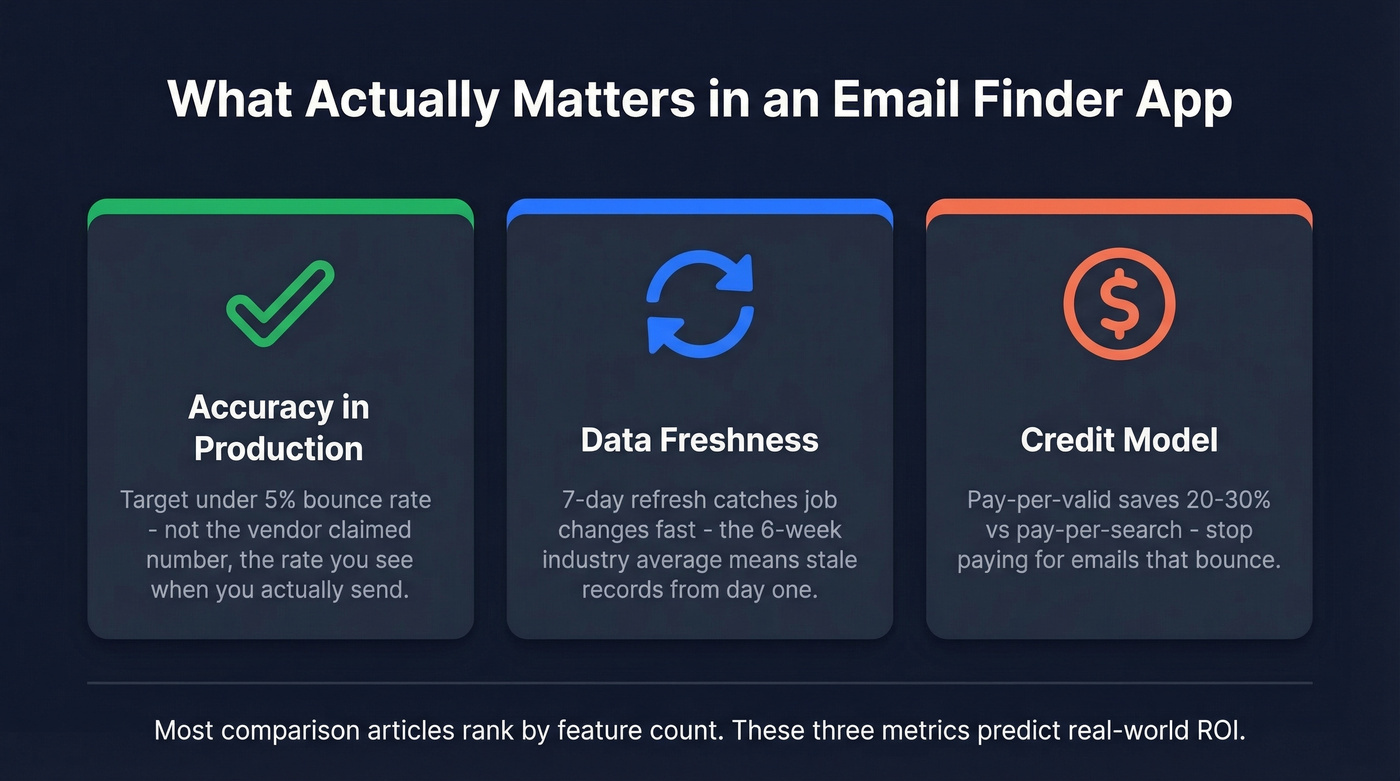
Accuracy that holds up in production. Not the vendor's claimed accuracy - the bounce rate you actually see when you send. Practitioners on r/agency target under 5% bounce rate as the baseline for protecting domain reputation. Most email lookup tools don't get there without external verification layered on top. (If you want the deeper playbook, start with this email deliverability guide.)
Data freshness. People change jobs roughly every 2-3 years. If your tool refreshes its database every six weeks - the industry average - you're working with stale records from day one. A 7-day refresh cycle catches job changes before your sequences hit dead inboxes.
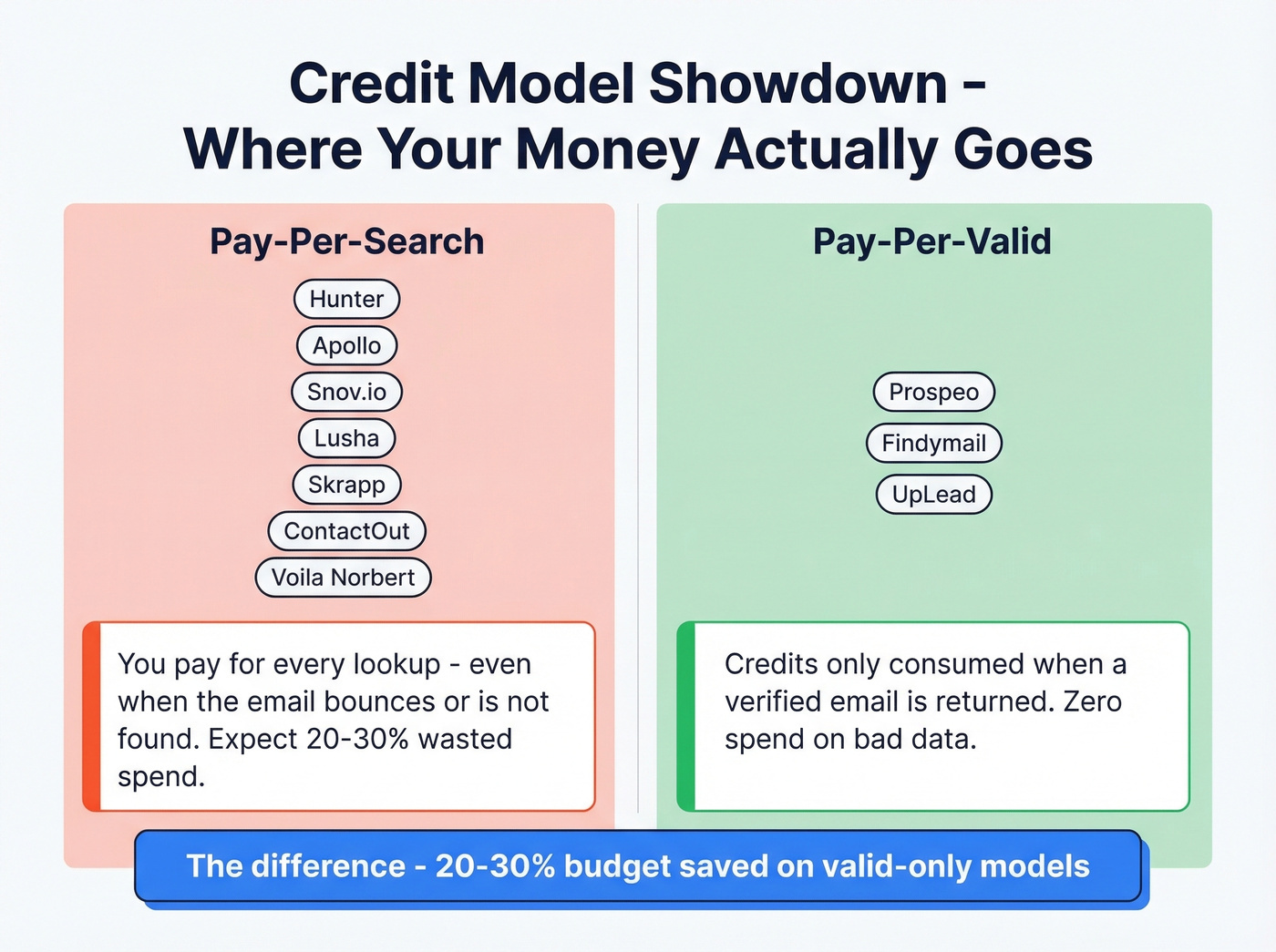
Credit model. This is where tools quietly drain your budget. Pay-per-search charges you for every lookup, even when the result bounces. Pay-per-valid tools charge only when they return a verified result. The difference can mean 20-30% wasted spend on platforms that bill for bad data. (More context in our breakdown of data enrichment services.)

Our Picks (TL;DR)
| Use Case | Pick | Why |
|---|---|---|
| Best accuracy & freshness | Prospeo | 98% email accuracy, 7-day refresh, pay only for valid addresses |
| Best free tier to start | Apollo.io | 75 free credits/mo, massive filters - verify externally |
| Best for international | Snov.io | Strong non-US coverage, affordable credits, built-in outreach |
Short on time? Prospeo wins on data quality, Apollo wins on getting started for free, and Snov.io is the pick if your ICP lives outside the US. The rest of this article explains why - and covers seven more tools worth knowing about.
Here's a strong opinion: if your deal sizes sit below $10k, you probably don't need a $15k/year ZoomInfo seat. A focused tool with high accuracy will outperform an enterprise platform you only use at 20% capacity.
Comparison Table
Scan for the columns that matter to your workflow, then read the detailed reviews below.
| Tool | Best For | Accuracy | Free Tier | Starting Price |
|---|---|---|---|---|
| Hunter | Verification layer | N/A (finder); 70% (verifier)* | 50 credits/mo | $34/mo yearly |
| Apollo | Free prospecting start | Not public | 75 credits/mo | $49/seat/mo |
| Snov.io | International leads | Varies by region | 50 credits/mo | $39/mo |
| Lusha | Quick one-off lookups | Not public | 70 credits/mo | Not public |
| Findymail | Pay-per-valid at scale | Not public | 10 emails | $99/mo |
| Skrapp | Budget list building | Not public | 100 credits/mo | $39/mo |
| UpLead | Accuracy guarantee | 95% (guaranteed) | 7-day trial | $74-99/mo |
| ContactOut | Recruiting lookups | Not public | 5 emails/day | $49/mo |
| Voila Norbert | Simple email search | Not public | 50 credits | $49/mo |
*Hunter's 70% figure is from their email verifier benchmark.
| Tool | Credit Model | Mobiles | Refresh |
|---|---|---|---|
| Hunter | Pay-per-search | No | Not public |
| Apollo | Hybrid (seat + credits) | Yes | Not public |
| Snov.io | Pay-per-search | No | Not public |
| Lusha | Pay-per-search | Yes | Not public |
| Findymail | Pay-per-valid | Yes | Not public |
| Skrapp | Pay-per-search | No | Not public |
| UpLead | Pay-per-valid | Yes | Not public |
| ContactOut | Pay-per-search | Yes | Not public |
| Voila Norbert | Pay-per-search | No | Not public |
Top 10 Email Finder Apps in 2026
Prospeo - Best for Accuracy and Data Freshness
Prospeo's database covers 300M+ professional profiles with 143M+ verified emails and 125M+ verified mobile numbers. The 98% email accuracy comes from a 5-step verification process that handles catch-all domains, removes spam traps, and filters honeypots - the edge cases that trip up most finders.
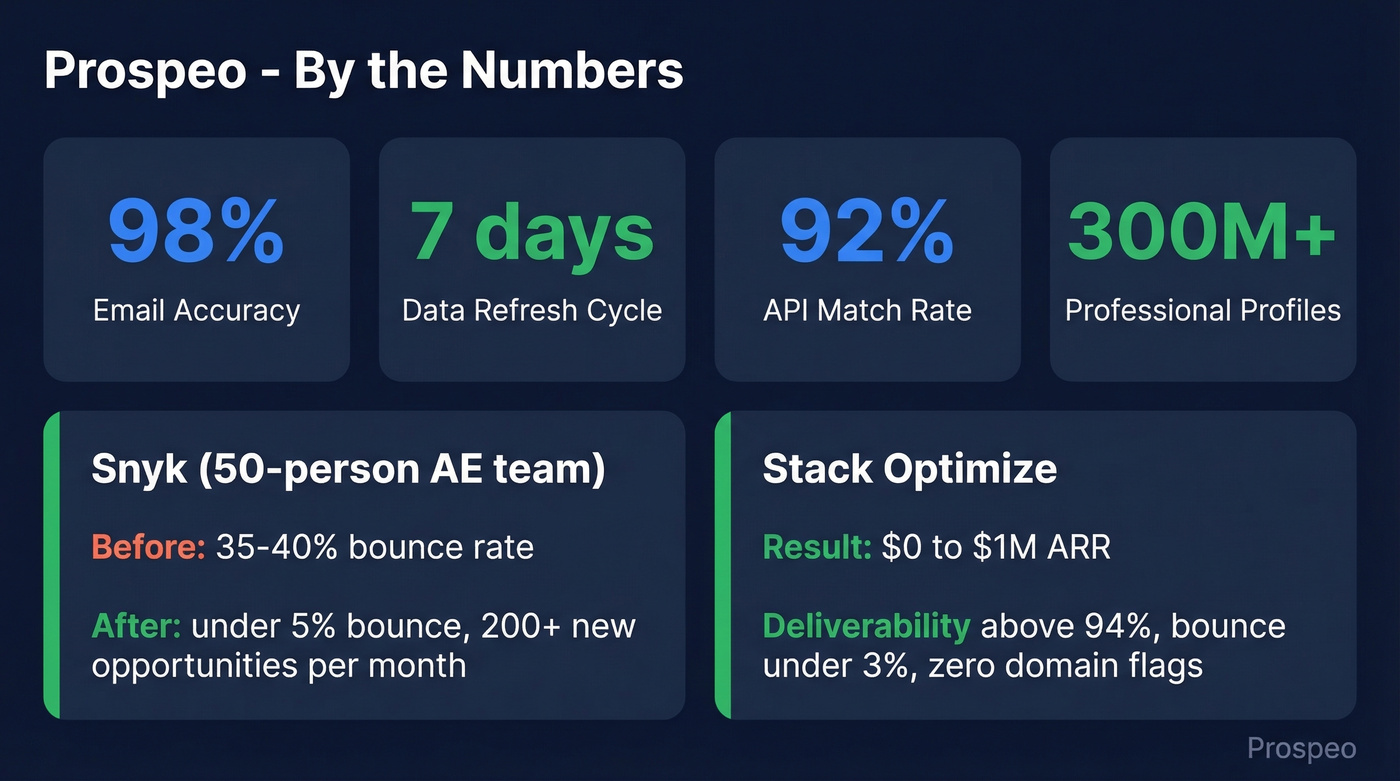
The 7-day data refresh cycle is the real differentiator. While most tools update every 4-6 weeks, Prospeo catches job changes and role shifts before they become bounced emails. The 92% API match rate means enrichment workflows return usable data on nearly every query.

Over 30 search filters cover buyer intent powered by Bombora across 15,000 topics, technographics, job changes, and headcount growth - so you're not just finding emails, you're finding the right people at the right time. The Chrome extension with 40,000+ users works across company websites and professional profiles. Native integrations push contacts straight into Salesforce, HubSpot, Lemlist, Instantly, and Clay. (If you're building lists in Clay, this Clay list building guide helps.)
Real-world proof: Snyk's 50-person AE team went from 35-40% bounce rates to under 5% after switching, generating 200+ new opportunities per month. Stack Optimize built from $0 to $1M ARR while maintaining client deliverability above 94% and bounce rates under 3%, with zero domain flags across all clients.
Use this if: You need the highest deliverability rates in the market and don't want to bolt on a separate verification step. At ~$0.01 per email with a free 75-email monthly tier, the cost-per-valid-contact math is hard to beat.
Skip this if: You need a full outbound sequencing platform built in - pair with Lemlist or Instantly for that. (More on building sequences in our B2B cold email sequence guide.)
Hunter.io - Best as a Verification Layer
Here's the thing about Hunter: it's a great verification tool that gets marketed as a finder. Reddit practitioners consistently describe it as having "solid verification accuracy" but a "pretty small" database. That tracks with what we've seen - Hunter works best when you already have emails and need to clean them, not when you're building lists from scratch.
Use this if: You have emails from another source and need a reliable verification pass. Hunter charges 0.5 credits per verification, so the free plan's 50 credits give you 100 verifications monthly. Starter runs $34/mo billed yearly for 2,000 credits.
Skip this if: You need a primary lead generation tool with deep coverage. In the r/SaaS thread linked above, Hunter is associated with bounce rates in the 20-25% range when used as a sole source. Hunter's own benchmark found the best email verifier only hits 70% accuracy - and they noted their dataset may have given them an edge. (If you're comparing options, see our Hunter alternatives roundup.)

Apollo.io - Biggest Free Tier, Stale Data Risk
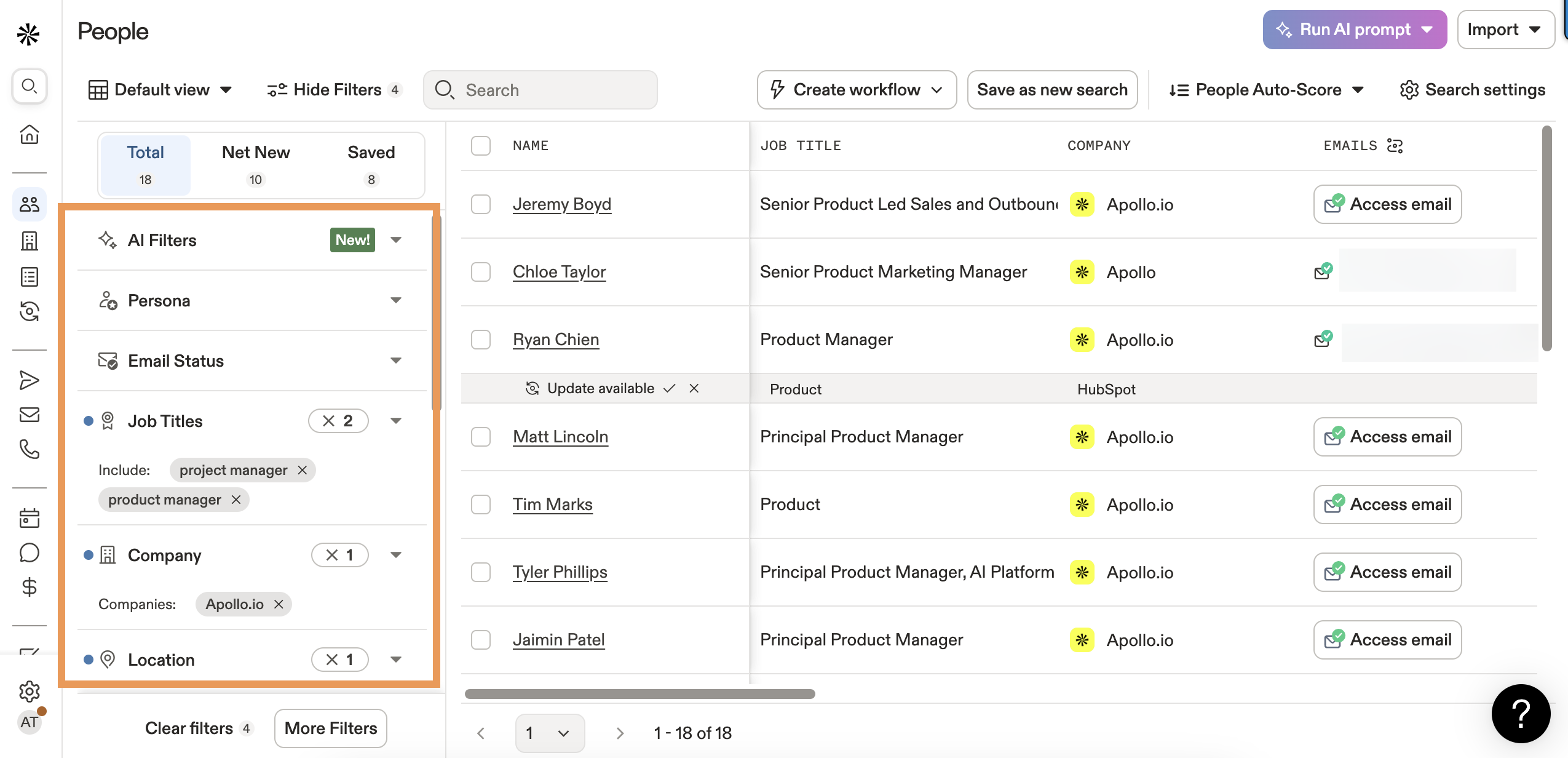
Apollo's database is often described as 250M+ contacts, and some comparisons list it at 210M+ - either way, it's huge. Pair that with 75 free credits per month and it's the obvious starting point for teams with zero budget. The filter set is deep: company size, tech stack, funding stage, and dozens of other criteria without paying a dime.
The problem shows up at scale. Reddit users describe the data as feeling "bad sometimes," with "lots of bounces on older contacts." Apollo's hybrid pricing model - per-seat fees plus usage-based credits - compounds the issue. Credits don't roll over, so unused credits expire at month's end.
Use this if: You're bootstrapping and need to start prospecting today. The free tier is legitimately useful for testing your ICP and building initial lists. (You can also stack it with other free lead generation tools.)
Skip this if: You're running high-volume outbound without external verification. Paid plans start around $49/seat/month, with tiers commonly listed around $79 and $119 (often with a 3-seat minimum on higher tiers). Those per-seat costs add up fast when you still need to verify the emails elsewhere.
Snov.io - Best for International Leads
We watched a team running outbound into DACH and Nordics struggle with US-centric tools for months before switching to Snov.io. The difference in coverage for European prospects was immediate.
Snov.io's strength is non-US data paired with built-in email sequences. You find the contact, verify it, and launch a drip campaign without leaving the platform. Reddit users praise it for affordable credits and solid international coverage. For enterprise-level EU and UK data, Cognism is worth evaluating too - but at enterprise pricing that starts around $15k-25k/year, it's a different budget tier entirely.
Use this if: Your ICP lives outside North America and you want finding plus outreach in one tool. Free tier gives you 50 credits monthly, and Starter runs $39/mo.
Skip this if: You need high accuracy on US enterprise contacts. A Tomba benchmark (February 2026) reported Snov.io at 20.1% combined accuracy. Always test a sample of your target geography before committing volume.
Lusha - Quick Lookups, Expensive Phone Numbers
Lusha is the tool you reach for when you need one person's email in the next 30 seconds. The interface is fast, the Chrome extension is snappy, and the free 70 credits per month are generous for casual prospecting. Unused credits even roll over up to 2x your monthly limit.
The catch is the credit math. One email costs 1 credit, but one phone number costs 10. Your free plan gets you 70 emails OR 7 phone numbers - not both. That ratio makes Lusha expensive the moment you need mobile numbers at any volume.
Use this if: You do occasional one-off lookups and value speed over volume.
Skip this if: You're building lists at scale or need mobile numbers regularly. The credit economics don't survive contact with a real outbound program.
Findymail - Pay-Per-Valid Pioneer
Findymail only charges for verified results. No credit burned on bounced or unfound emails. That billing model is the entire reason to consider it. Starter at $99/mo includes 5,000 finder credits plus 5,000 verifier credits, and credits roll over up to 2x your plan limit.
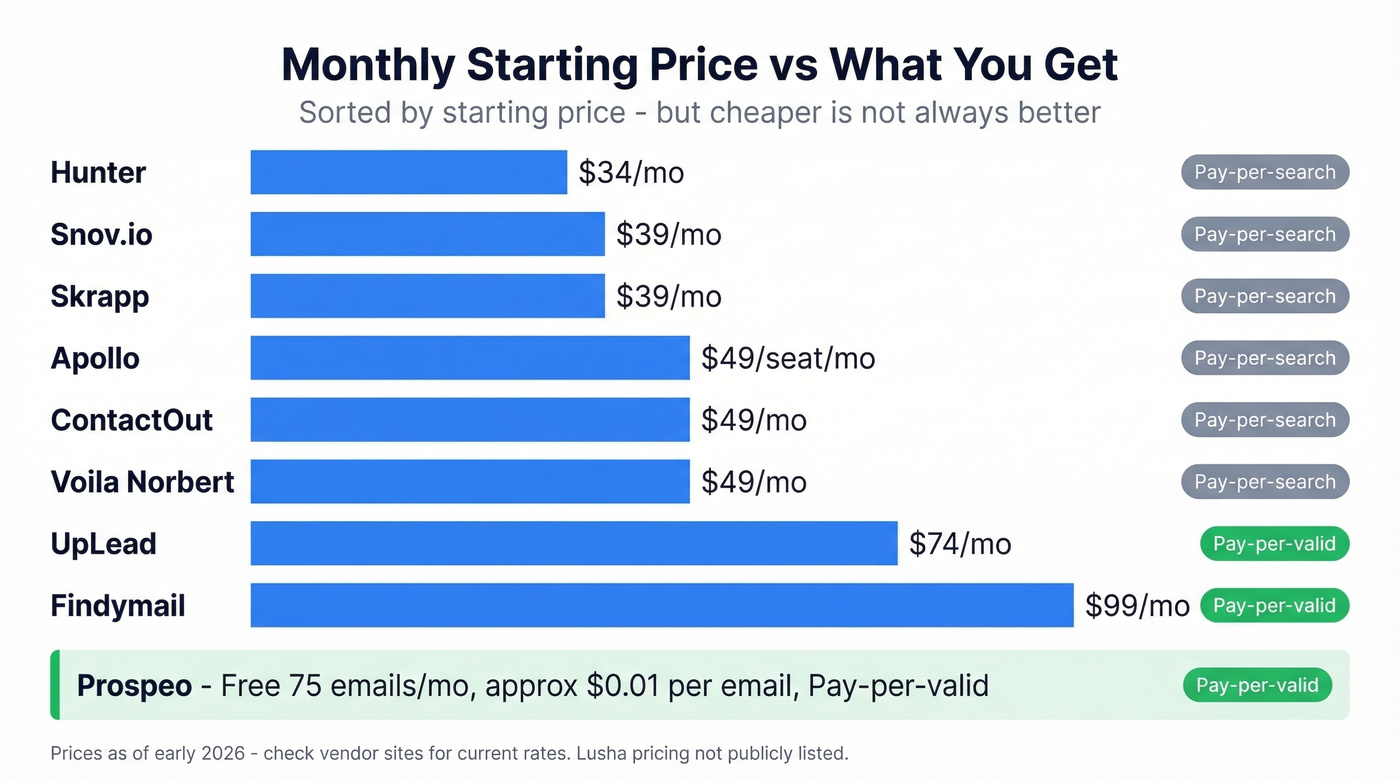
The tradeoffs: higher entry price than competitors offering free tiers, phone lookups eat your balance at 10 credits per number, and the community feedback pool is smaller than established players. The $99/mo entry point is steep for solo operators, but the per-valid model means your effective cost-per-contact runs lower than the sticker price suggests. Ten free emails let you trial before committing.
Skrapp.io - Budget-Friendly for Small Teams
Skrapp leads the pack on free-tier generosity with 100 credits per month - double what most competitors offer. The Professional plan at $39/mo gets you 1,000 searches, scaling to Enterprise at $349/mo for 50,000 searches. The Chrome extension handles profile-based prospecting well enough for small teams getting started.
Don't expect the accuracy or enrichment depth of more established tools. Independent benchmarks are scarce, the feature set is basic, and intent data is absent. For straightforward email finding on a tight budget, though, Skrapp delivers adequate results at a price that's hard to argue with. (If you're cost-checking, see Skrapp pricing.)
UpLead - Accuracy Guarantee Built In
UpLead takes a different approach to the accuracy problem: they guarantee 95%. If accuracy anxiety is your main concern and you don't want to manage a separate verification step, that guarantee reduces risk. Intent data powered by Bombora adds in-market buyer signals, and the 7-day free trial lets you test before committing.
The downside is price. Essentials is commonly listed at $74/month billed annually or $99/month billed monthly, and pricing climbs steeply on higher plans with advanced features locked behind enterprise tiers. The database is also smaller than Apollo or ZoomInfo. For teams that value accuracy guarantees over raw database size, UpLead earns its premium - just watch the bill on higher tiers.
ContactOut - Recruiter-Focused
ContactOut gives you 5 free emails per day and works well for recruiting use cases where you're looking up individual candidates. Email plan runs $49/mo, Email+Phone at $99/mo. It's less suited for high-volume sales prospecting - the daily limits and pricing structure favor one-at-a-time lookups over bulk list building. If you're a recruiter, it's a strong pick. If you're in sales, look elsewhere.
Voila Norbert - Simple and Straightforward
Voila Norbert offers 50 free credits to start, with paid plans from $49/mo (Valet, 1,000 leads) scaling to $499/mo. Type a name and domain, get an email. It lacks the advanced filters and intent data of newer tools, but if simplicity is what you're after, it delivers without complexity. A solid "just works" option for teams that don't need bells and whistles.

Every email finder app in this list charges you credits. The question is whether those credits buy you real inboxes or bounced emails. Prospeo's 5-step verification - with catch-all handling, spam-trap removal, and honeypot filtering - delivers 98% accuracy so you never pay for dead addresses.
Get 75 free verified emails this month and see the difference.
Notice how most tools in this comparison list 'Not public' under refresh cycle and accuracy? Prospeo publishes both: 98% email accuracy and a 7-day data refresh. Snyk's 50 AEs dropped bounce rates from 35% to under 5% and added 200+ opportunities per month after switching.
Stop guessing which email finder actually works. Test it yourself.
How Waterfall Enrichment Works
Single-source finders miss contacts. Every database has gaps - different tools index different companies, roles, and regions. Waterfall enrichment solves this by querying multiple providers sequentially: if Provider A can't find the email, the system automatically tries Provider B, then C, until it gets a result. (Related: lead enrichment workflows.)
The concept is straightforward, but the execution matters. Teams using multi-provider waterfall approaches report finding contact info for 85%+ of their target leads, compared to 50-65% from any single source. The tradeoff is complexity - you're managing multiple subscriptions, API connections, and deduplication logic.
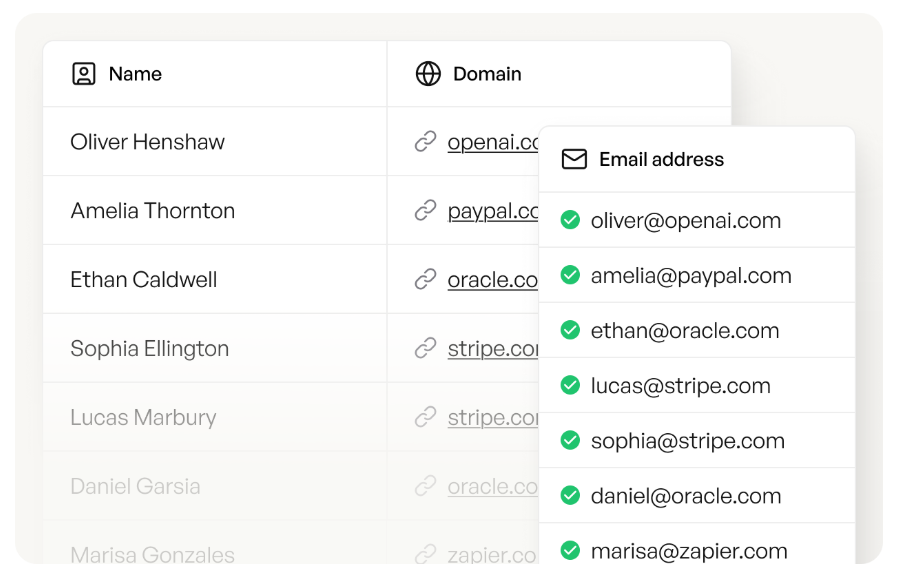
Tools with proprietary email-finding infrastructure and high API match rates can replicate much of the waterfall benefit from a single integration point. For teams that don't want to build and maintain a multi-vendor stack, that's the simpler path to the same outcome.
Five Mistakes That Kill Deliverability
Sending without recent verification. Email addresses decay constantly. Best practice is verifying close to your send date - ideally within a month. A list verified in January is already degrading by March. (More benchmarks in our email bounce rate guide.)
Trusting "risky" emails. Most finders categorize results as verified, risky, or unknown. Risky emails have roughly a 70% success rate versus 90%+ for verified. Sending to risky addresses without separating them from your main sends is how domains get flagged.
Ignoring catch-all domains. Companies using catch-all email configurations accept mail to any address at their domain - meaning verification tools can't confirm whether a specific mailbox exists. External verifiers can reduce your valid list by up to 20% when they encounter catch-alls. Use a tool with dedicated catch-all handling to avoid wasting credits on unverifiable addresses.
Skipping a secondary domain for unverified sends. Look, if you must send to risky or unverified contacts, do it from a secondary domain. Protect your primary domain's reputation at all costs. One bad campaign can take months to recover from. (See: how to improve sender reputation.)
Ignoring data refresh cycles. This is the silent killer. A tool with a 6-week refresh cycle means every contact found is already aging. By the time you build a list, verify it, write sequences, and hit send, some of those emails are two months stale. Shorter refresh cycles dramatically reduce this decay.
Compliance Quick Reference
If you're using an email finder app for outbound, you're handling personal data. GDPR requires explicit consent before tracking opens and clicks - no pre-checked boxes, no implied consent. Fines run up to EUR 20 million for violations.
You need to be transparent about what data you collect (open time, location, device), how long you retain it, and whether third parties access it. Data subject requests - access, deletion, export - require a response within 30 days.
CAN-SPAM is less strict but still enforced: include a physical address, honor opt-outs within 10 business days, and don't use deceptive subject lines.
If your tool can't support data subject rights or provide audit trails, that's a compliance risk you'll pay for eventually. Factor compliance into your tool selection, not just accuracy and price.
Email Finder App FAQ
How accurate are email finder apps really?
Published benchmarks range from about 20% to 80% depending on methodology and target audience. Reddit users report 20-25% bounce rates with Hunter as a primary source. Prospeo runs at 98% accuracy with 5-step verification. Always test against your specific ICP before scaling - no benchmark replaces a real-world sample of 50-100 sends.
Are free email finder tools worth using?
For testing and small-volume prospecting, absolutely. Apollo offers 75 credits/mo, Prospeo provides 75 free emails/mo with full verification, and Skrapp leads with 100 credits/mo. Free plans let you evaluate accuracy on your target audience before committing budget. Just don't expect free-tier volume to sustain a real outbound program.
What's the difference between pay-per-search and pay-per-valid?
Pay-per-search charges for every lookup regardless of whether a valid email comes back. Pay-per-valid charges only when a verified result is returned. The difference typically means 20-30% wasted spend on pay-per-search tools. Prospeo, Findymail, and UpLead all use pay-per-valid models - prioritize this billing structure if budget efficiency matters.
Do email finder apps work for non-US contacts?
Coverage varies dramatically. Snov.io gets consistent praise for European data, particularly DACH and Nordics. Cognism is strong for EU and UK coverage at enterprise pricing ($15k-25k/year). US-centric tools like Apollo have deeper North American data but thinner coverage in EMEA and APAC. Always test a sample of your target geography before committing to annual plans.
The bottom line: database size is a vanity metric. The email finder app that sends the fewest bounces and charges you only for valid results will outperform a tool with 10x the contacts and half the accuracy. Test before you buy, verify before you send, and protect your domain reputation like the revenue asset it is.