

Email Format Checker Online: What It Actually Checks and Which Tools to Use
Email lists decay by almost 28% every year. A quarter of the addresses you collected last January are dead right now. Globally, one in six emails never reaches the inbox - and a format checker alone won't fix that. It catches typos and syntax errors, sure, but it can't tell you whether a mailbox actually exists. That gap is where bounce rates spike, sender reputation tanks, and campaigns quietly die.
Here's the thing: most people who need a format checker actually need full verification. Let's break down what format checking covers, where it falls short, and which tools handle the whole job.
What You Need (Quick Version)
- Checking one email fast? Paste it into Hunter or Mailmeteor - both free, no signup for single checks.
- Big list, tight budget? MillionVerifier runs about $0.60 per 1,000 emails, but accuracy drops to 95.8%.
Format checking alone won't prevent bounces. You need full verification: syntax, DNS/MX, SMTP, catch-all handling, and disposable detection. If you're comparing options, start with a broader list of email verifier websites and narrow down by accuracy.
What Is an Email Format Checker?
Validation and verification aren't the same thing. Validation checks whether an email address could exist based on its structure - correct syntax, no illegal characters, a properly formed domain. Verification goes further and confirms whether the mailbox actually exists and can receive mail. If you want the deeper breakdown, see email validation vs verification.
An online format checker is a validation tool. It catches the easy stuff: missing @ symbols, spaces where they shouldn't be, consecutive dots, domains that don't resolve. Think of it as a spell-checker for email addresses - it'll flag john..doe@company or jane@.com instantly.
What it can't do is tell you whether john.doe@acme.com has an active inbox behind it. That address might be perfectly formatted and completely dead. The mailbox could've been deactivated six months ago, and a format checker would still give it a green light. Every serious outbound team needs verification on top of validation, and the tools worth using combine both steps automatically - especially if you're doing single email verification before sending.
RFC 5322 Rules for Valid Emails
Email format rules come from RFC 5322, and they're more permissive than most people realize. Any time you check email address format against these standards, you'll find that most homegrown regex patterns are too restrictive. For more examples and patterns, compare against common email address formats.
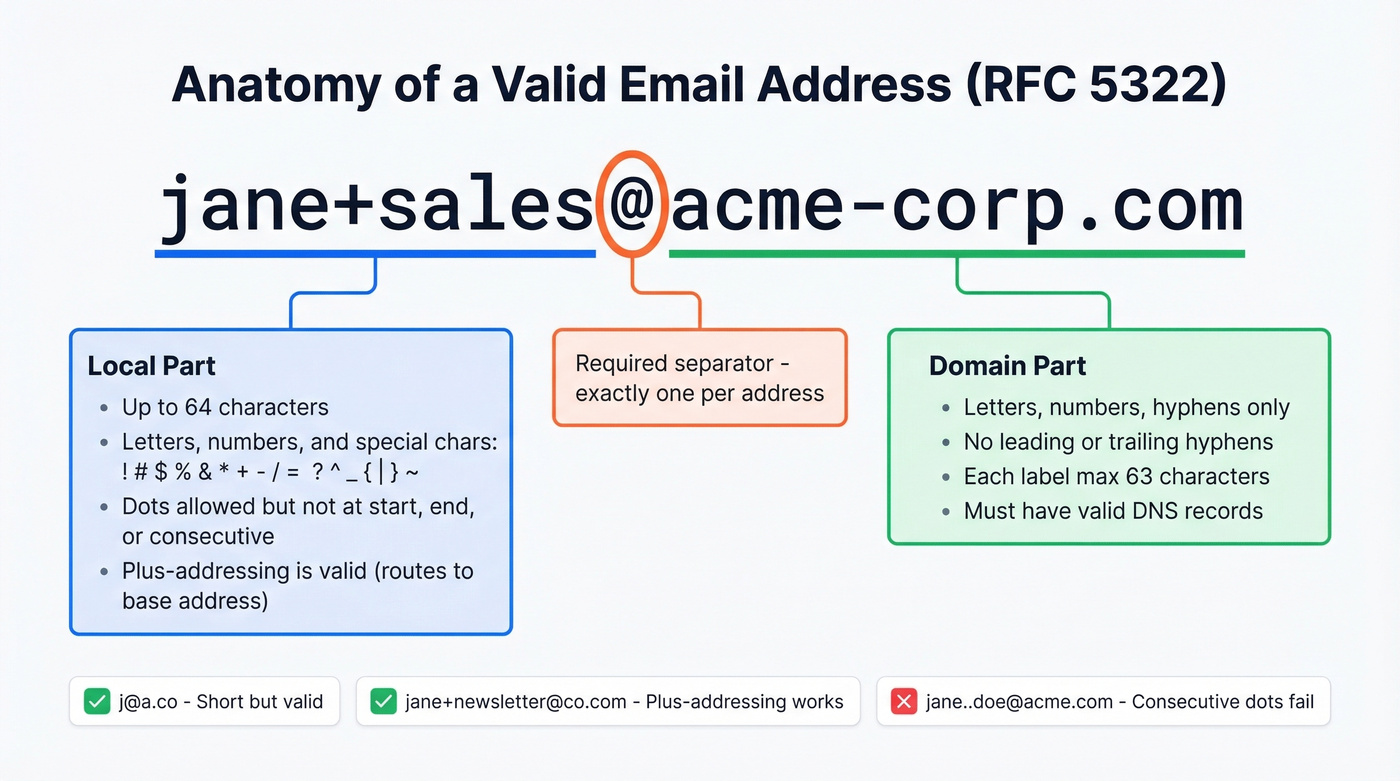
The local part - everything before the @ - can include letters, numbers, and these special characters: ! # $ % & ' * + - / = ? ^ _ { | } ~. Dots are allowed but not at the start, not at the end, and never two in a row. Maximum length is 64 characters. Plus-addressing works too: jane+newsletter@company.com routes to jane@company.com. Quoted strings can even contain spaces, though that's rare in practice.
The domain part - everything after the @ - allows letters, numbers, and hyphens only. No leading or trailing hyphens. Each label between dots maxes out at 63 characters.
| Valid? | Why | |
|---|---|---|
jane.doe@acme.com |
✅ | Standard format |
jane+sales@acme.com |
✅ | Plus-addressing |
jane..doe@acme.com |
❌ | Consecutive dots |
.jane@acme.com |
❌ | Dot at start |
jane@-acme.com |
❌ | Leading hyphen |
j@a.co |
✅ | Short but valid |
The plus-addressing rule trips up a surprising number of systems. The + character is explicitly valid per RFC standards, yet many forms and validators reject it. That's a format checker failing at its one job.

Format checkers stop at syntax. Prospeo's 5-step verification covers syntax, DNS, SMTP, catch-all handling, and spam-trap removal - returning 98% accurate emails from a database refreshed every 7 days. Start with 75 free verifications per month.
Stop guessing which formatted emails are actually live.
Why Format Checking Alone Isn't Enough
A developer once wrote about getting locked out of his own account because the service's regex rejected his plus-addressed email. The address was perfectly valid - the validator was wrong. Overly strict regex conflates format validity with mailbox existence, rejecting real addresses while approving dead ones.
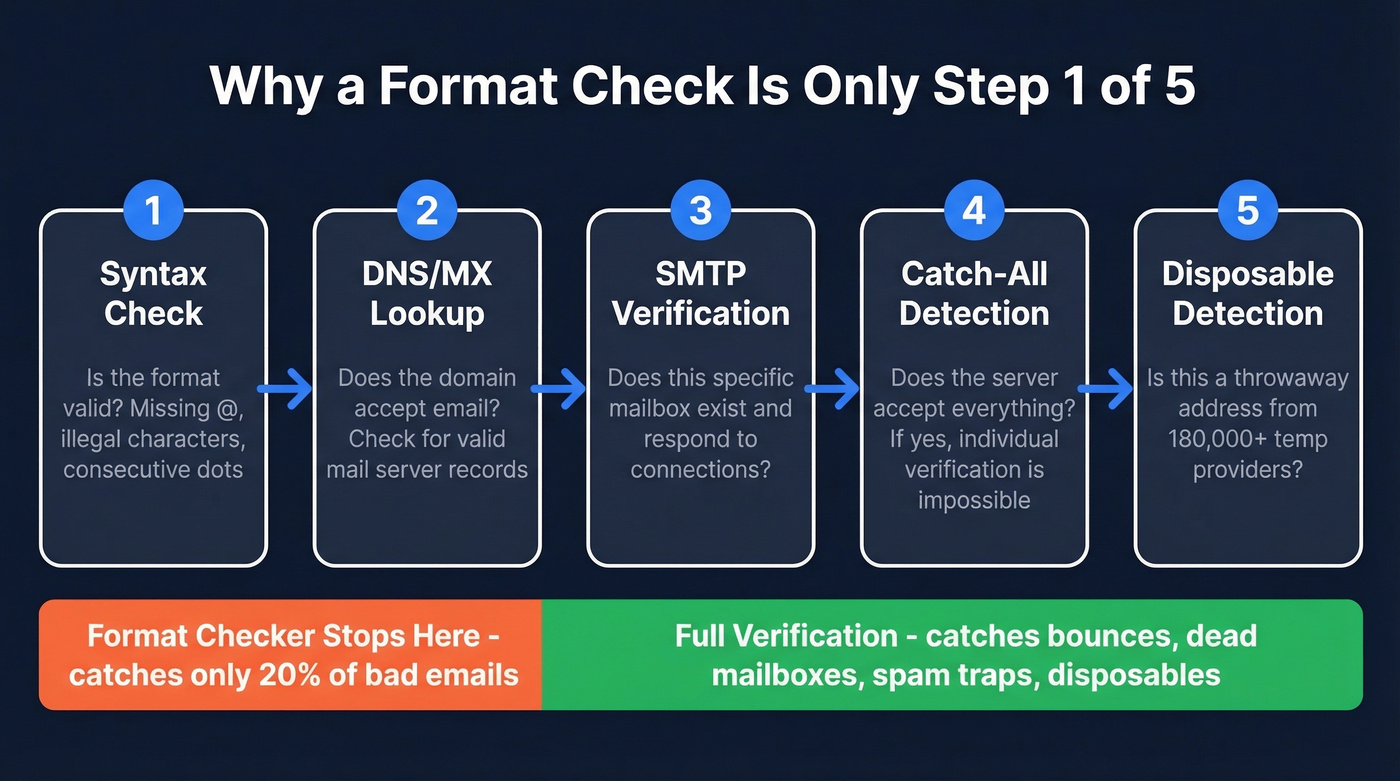
Regex-based format checking is a starting point, not a solution. A properly formatted email can still bounce hard if the mailbox doesn't exist, the domain has no MX records, or the address is a spam trap. The full verification process looks like this:
- Syntax check - is the format valid?
- DNS/MX lookup - does the domain accept email?
- SMTP verification - does the specific mailbox respond?
- Catch-all detection - does the server accept everything, making individual verification impossible?
- Disposable detection - is this a throwaway address?
Modern disposable email databases track 180,000+ temporary providers using domain databases, MX record analysis, and pattern recognition - updated weekly. No regex pattern catches that. If you’re dealing with throwaway inboxes a lot, it helps to understand what a disposable email is and how tools flag them.
Best Online Email Verification Tools
Here are the tools worth considering, from full verification platforms to quick free checkers. We've tested most of these on real outbound lists, and the differences in accuracy are bigger than you'd expect. If you want a wider benchmark set, compare these against the best email checker tools.
Prospeo
Prospeo runs a 5-step verification process covering syntax, DNS, SMTP, catch-all handling, and spam-trap removal. The database holds 143M+ verified emails with 98% accuracy, and data refreshes every 7 days - most competitors run on roughly a 6-week cycle. The free tier gives you 75 email verifications plus 100 Chrome extension credits per month. Paid plans work out to about $0.01 per email, with native integrations into HubSpot, Salesforce, Instantly, and Lemlist. If you’re building a repeatable workflow, follow a simple email verification process so checks don’t get skipped.
Hunter - Best for Quick Single Checks
Hunter's Email Verifier is the fastest way to verify one address without creating an account. It runs syntax validation, domain checks, SMTP verification, and accept-all detection, and it also looks up the email in Hunter's B2B database. Ratings are solid - 4.6 on Capterra, 4.4 on G2 - and 6+ million users have run checks through it. The free plan includes 100 verifications per month, with paid plans starting at $40/month.
Don't pick Hunter for high-volume list cleaning. Its strength is the email finder + verifier combo for individual lookups. For that use case, you may also want to compare dedicated B2B email finders.
ZeroBounce - The Accuracy-First Cleaner
ZeroBounce markets 99.6% accuracy. In a 10,000-email benchmark, the result came in at 97.8% - still strong, but worth knowing the gap. Catch-all resolution sits at 12%. You get 100 free monthly verifications when you sign up with a business or premium domain, and paid plans start at $15/month for 2,000 emails.
Skip ZeroBounce if catch-all domains make up a big chunk of your list. That 12% resolution means most catch-alls come back as "unknown," which doesn't help you make a send/don't-send decision.
NeverBounce
NeverBounce charges from $0.008 per email, and volume discounts bring the effective rate lower. The benchmark showed 96.9% accuracy and 8% catch-all resolution. You get 1,000 free credits to start, and the real-time API integrates with most major ESPs. For teams sending 5,000-20,000 emails per month, pay-as-you-go often beats subscription tools on cost.
Bouncer
Bouncer's 15% catch-all resolution is the highest among the non-premium tools in the benchmark, beating both ZeroBounce and NeverBounce. The interface is dead simple - upload a CSV, get results. Effective cost runs about $5.50 per 1,000 emails with 96.5% accuracy and a 1.2% false positive rate. You get 1,000 free credits to start.
If sub-1% false positive rates matter to you, look elsewhere. That 1.2% means a few bad addresses slip through on large lists.
Mailmeteor
Mailmeteor's free email checker runs 15+ checks including format, DNS, MX, and SMTP - no signup required for single checks. The Google Sheets add-on gives you 50 free verifications per month. It's a fast way to spot-check an address without creating yet another account.
MillionVerifier
The budget pick. MillionVerifier costs about $0.60 per 1,000 emails. The trade-off is real: 95.8% accuracy and only 5% catch-all resolution. For large, low-stakes newsletter lists, it works. For outbound sales where every bounce hurts your domain, you'll want something more precise.
Verifalia
Verifalia's free online tool provides real-time deliverability results. It verifies formatting and mailbox existence, runs DNS/MX checks, detects disposable addresses, and uses a discreet "stealth" approach that doesn't send messages while testing. Their verification involves over 30 steps and can generate detailed reports - useful for developer workflows that need granular status codes.
Email Hippo
Email Hippo offers a free verifier with a maximum of 100 daily checks (quota resets at midnight UTC). Results are grouped into OK, Bad, or Unverifiable, which is useful when mail servers block SMTP checks or a domain is catch-all.
Accuracy and Pricing Compared
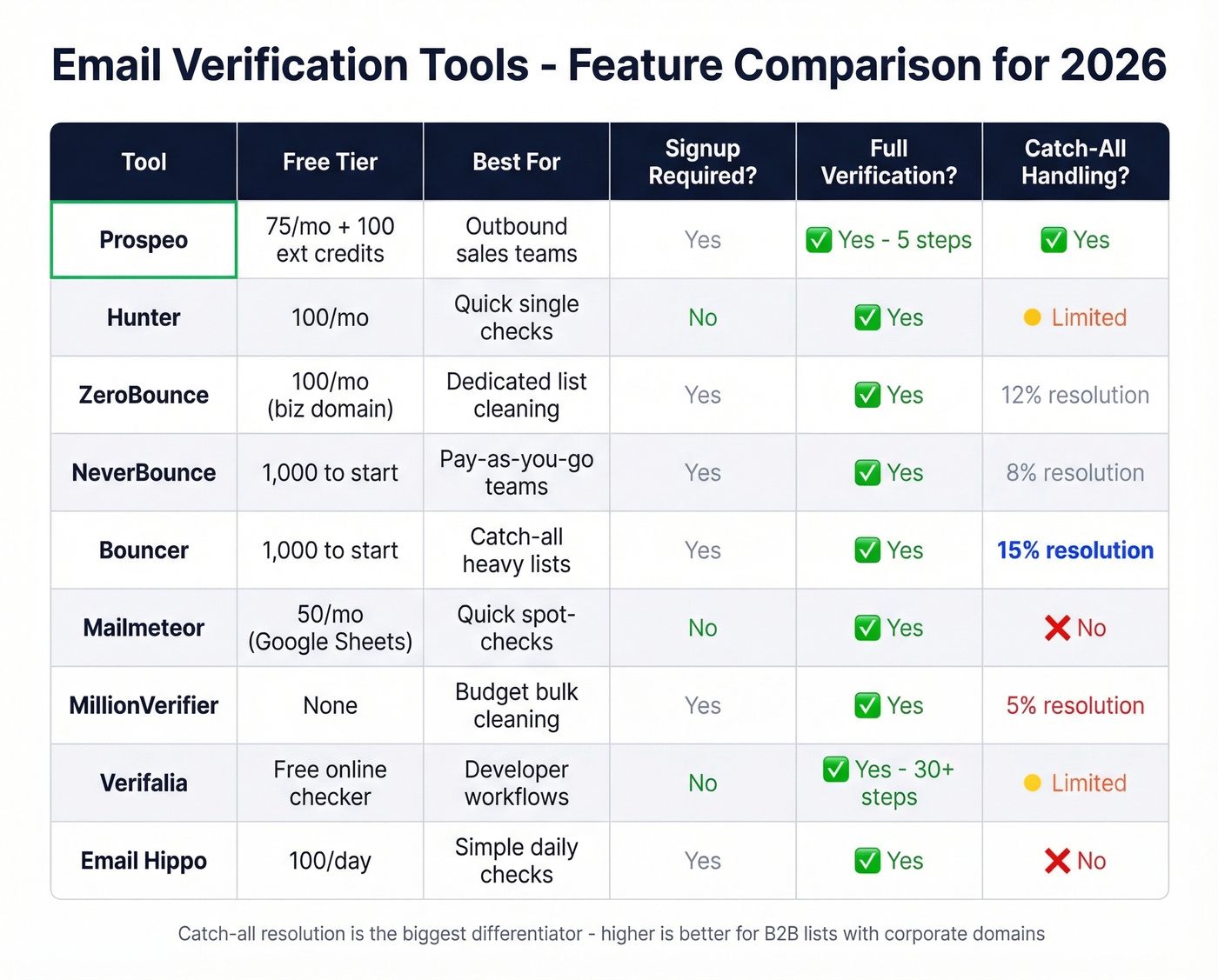
Catch-all resolution is the single biggest differentiator between verification tools. A catch-all domain accepts mail to any address, which means standard SMTP checks can't confirm whether a specific mailbox exists. If bounces are your main pain, use a dedicated bounce checker to diagnose what’s happening after sends.
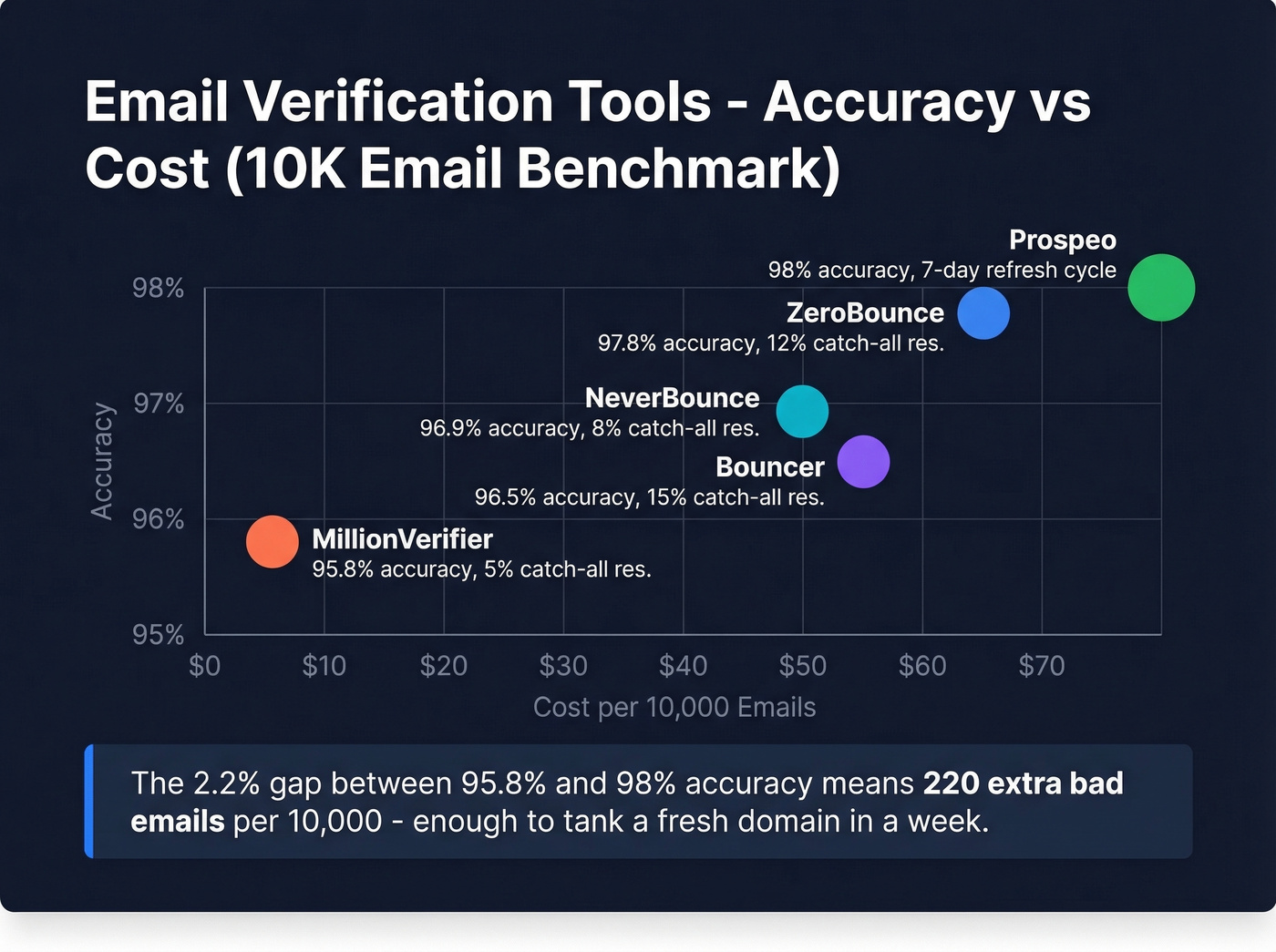
We've run lists through multiple tools side by side, and the gap between 95% and 98% accuracy compounds fast. On a 10,000-address list, that 2.2 percentage point difference means 220 extra bad emails hitting inboxes - enough to tank a fresh domain's reputation in a week.
Let's be honest: if your average deal size is under $8K, you probably don't need the most expensive verification tool. But you absolutely need something beyond a format check. If you’re cleaning uploads regularly, follow a repeatable how to clean your email list workflow.
The benchmark below tested 10,000 emails across a mix of 42% corporate, 28% catch-all, 15% known-invalid, 5% disposable, 4% role-based, 4% free providers, and 2% typo domains:
| Tool | Accuracy | Catch-All Res. | False Positive | Cost/10K | |------|----------|---------------|----------------|----------| | ZeroBounce | 97.8% | 12% | 0.9% | ~$65 | | NeverBounce | 96.9% | 8% | 1.4% | ~$50 | | Bouncer | 96.5% | 15% | 1.2% | ~$55 | | MillionVerifier | 95.8% | 5% | 1.8% | ~$6 |
| Tool | Free Tier | Paid Pricing | Best For |
|---|---|---|---|
| Prospeo | 75/mo + 100 ext. | ~$0.01/email | Outbound teams |
| Hunter | 100/mo | From $40/mo | Single checks |
| ZeroBounce | 100/mo (business domain) | $15/mo (2K) | Dedicated cleaning |
| NeverBounce | 1,000 to start | From $0.008/email | Pay-as-you-go |
| Bouncer | 1,000 to start | ~$5.50/1K | Catch-all balance |
| Verifalia | Free online checker | Paid plans available | Developer workflows |
| Mailmeteor | 50/mo (Sheets) | Paid plans available | Quick spot-checks |
| MillionVerifier | None | ~$0.60/1K | Budget bulk |
| Email Hippo | 100/day | Paid plans available | Simple checks |
Catch-all domains, deactivated mailboxes, spam traps - no format checker catches these. Prospeo verifies 143M+ emails at $0.01 each with proprietary infrastructure that doesn't rely on third-party providers. Native integrations push clean data straight into HubSpot, Salesforce, or your sequencer.
Go from syntax check to full verification in one platform.
FAQ
What's the difference between email validation and verification?
Validation checks whether an email follows correct format rules - proper syntax, valid characters, well-formed domain. Verification goes further by confirming the mailbox actually exists via DNS, MX, and SMTP checks. Most online verification tools combine both steps automatically, so you rarely need to run them separately.
Can I check email format with regex?
Yes, but regex alone is unreliable. Even well-crafted patterns reject valid plus-addressed emails, and they can't detect dead mailboxes, disposable domains, or spam traps. Use regex for basic client-side validation, then run real verification server-side.
How many emails can I verify for free?
Prospeo gives 75 free verifications per month plus 100 Chrome extension credits. Hunter offers 100 monthly verifications. ZeroBounce provides 100/month with a business domain signup. NeverBounce and Bouncer each offer 1,000 free credits to start. Mailmeteor allows 50 bulk checks per month via Google Sheets.
What is a catch-all domain?
A catch-all domain accepts email sent to any address at that domain, whether the specific mailbox exists or not. Standard SMTP verification can't distinguish real from fake addresses on these servers. In our benchmark, catch-all resolution ranged from 5% (MillionVerifier) to 15% (Bouncer) - it's the single biggest accuracy differentiator between tools.
Which free tool is best for checking email format online?
For a quick single-address check, Hunter and Mailmeteor both run format validation plus SMTP verification with no signup required. For ongoing use, Prospeo's 75 free monthly verifications include full 5-step verification - syntax, DNS, SMTP, catch-all, and disposable detection - which goes far beyond what a basic format checker provides.