

150+ Email Headline Examples That Actually Get Opened in 2026
You've rewritten the subject line four times. Swapped "quick question" for "one idea" for "thought on {{company}}." Open rate: 12%.
The problem probably isn't your words - 47% of recipients decide to open based solely on the subject line, but the other 53% never see it because the email bounced or landed in spam. Below you'll find 150+ email headline examples organized by psychology and use case, the device-level data to nail your character count, and the benchmarks to know whether your subject lines are actually the bottleneck.
The Cheat Sheet
Before you scroll through every example, here's what matters most.
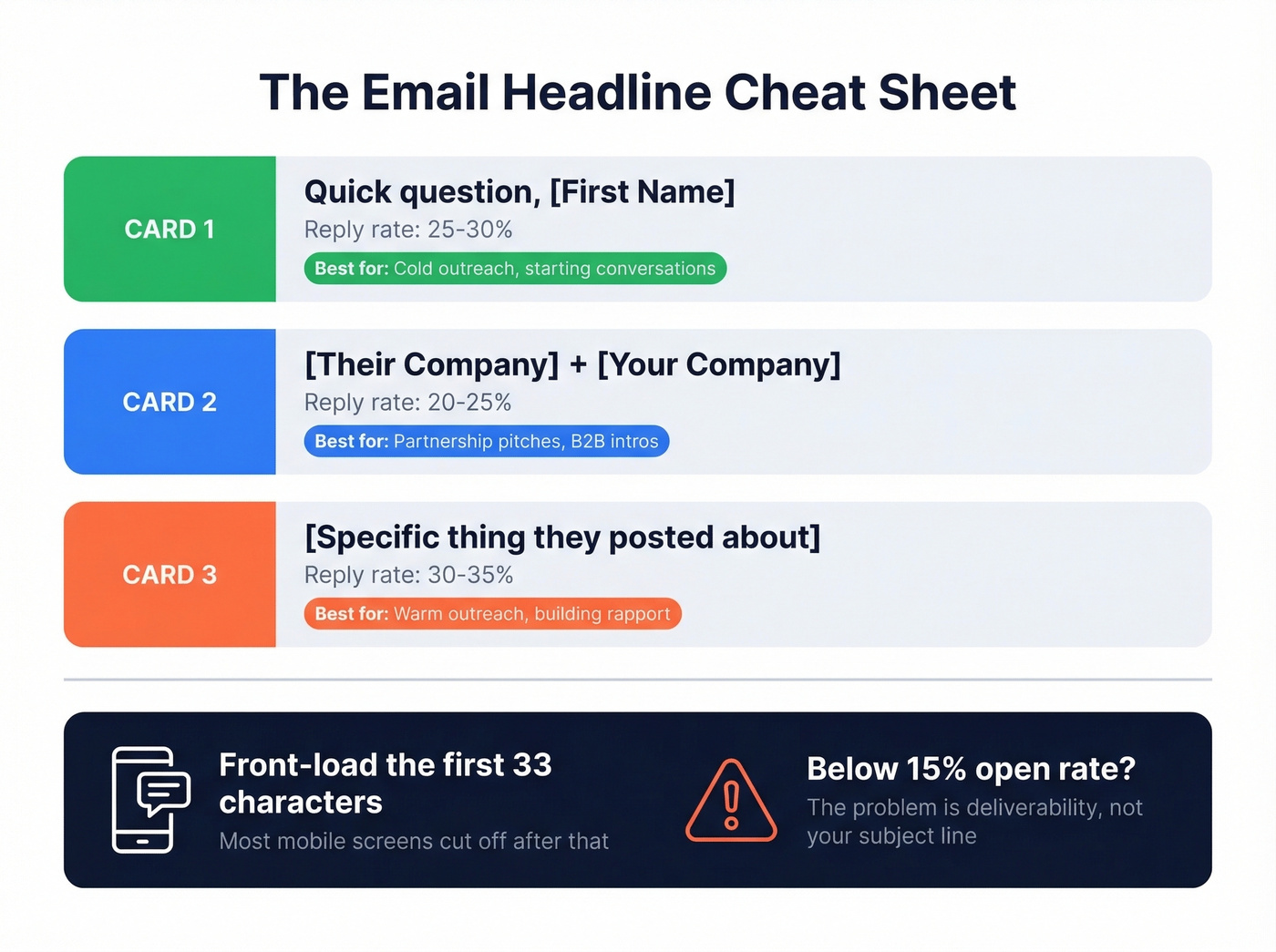
The 33-character rule. The Pixel 7 Gmail app shows just 33 characters of your subject line. iPhone 14 Gmail shows 37. Apple Mail shows 48. If your key message isn't in the first 33 characters, most mobile readers never see it. Front-load everything.
Three B2B patterns that actually get replies. A Reddit practitioner shared cold email data showing "Quick question, [First Name]" pulling 25-30% reply rates, "[Their Company] and [Your Company]" hitting 20-25%, and "[Specific thing they posted about]" reaching 30-35%. Short, specific, human.
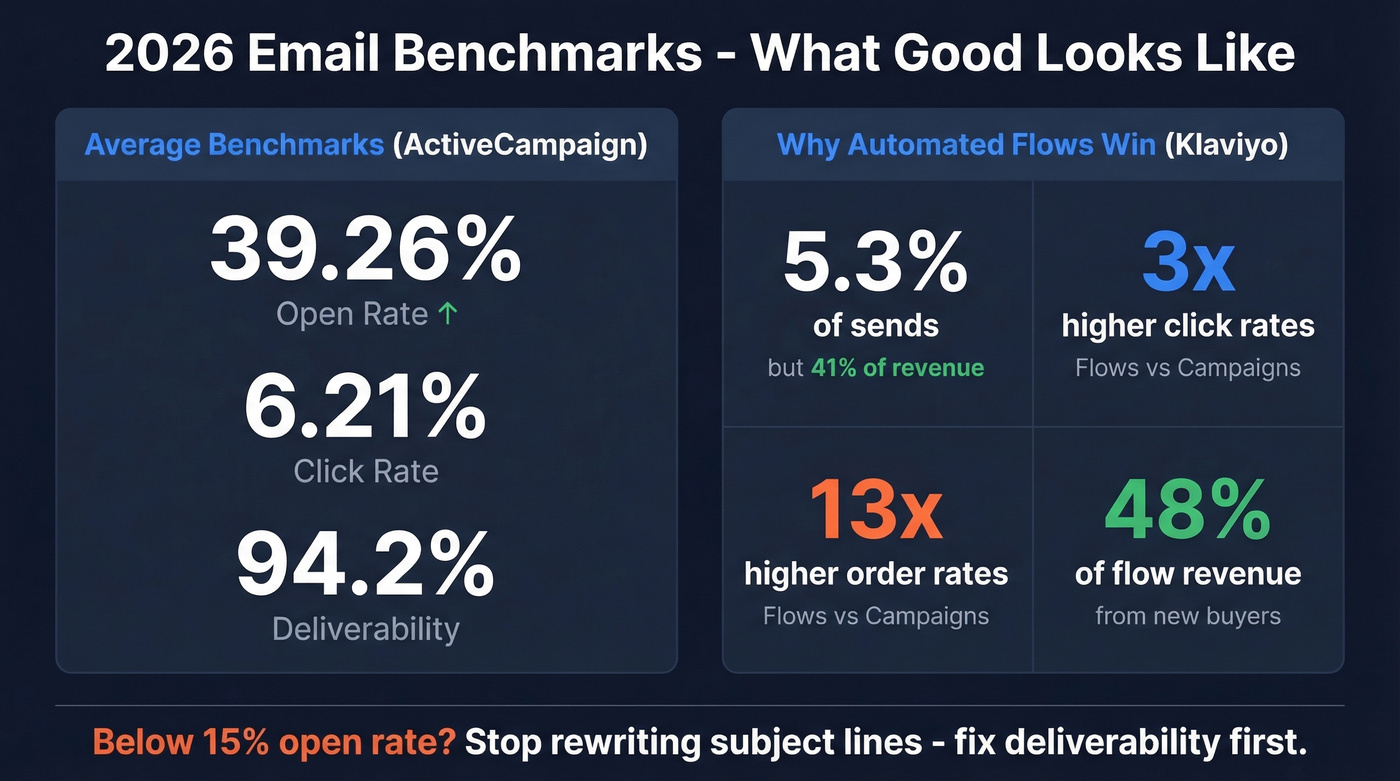
2026 benchmarks so you know what "good" looks like. ActiveCampaign's average across customers sits at 39.26% open rate and 6.21% click rate. If you're below 15%, stop rewriting headlines - the problem is your list, your sender reputation, or both.
The contrarian truth nobody wants to hear. If your open rate is below 15%, no amount of subject line wizardry will save you. Fix deliverability and list hygiene before you polish the words.
What Good Looks Like in 2026
Let's ground this in real numbers. ActiveCampaign's 2026 benchmarks show a 39.26% average open rate, 6.21% average click rate, and 94.2% deliverability. Those are healthy numbers - and they vary wildly by industry.
| Industry | Open Rate | Click Rate |
|---|---|---|
| Media/Publishing | 43.16% | 7.32% |
| Non-profit | 42.68% | - |
| Blogger/Author | 41.99% | 7.73% |
| Healthcare | 41.48% | - |
| Consulting/Agency | - | 7.05% |
| Software | - | 6.67% |
The more interesting data comes from Klaviyo's 2026 benchmarks across 183,000+ ecommerce customers. Automated flows - welcome sequences, cart abandonment, post-purchase - account for just 5.3% of total email sends but generate nearly 41% of total email revenue. Flows deliver 3x higher click rates (5.58% vs 1.69% for campaigns) and 13x higher placed order rates. Nearly 48% of flow-driven email revenue comes from new buyers, and AI-powered product recommendations within those flows lift average click rates to 3.75%.
Your automated flows deserve your best headline work. They're high-intent moments where a great subject line compounds into real revenue - a welcome email with a mediocre subject line is leaving money on the table at the exact moment a new subscriber is most engaged.
How Many Characters Actually Show
This is where most advice falls apart. "Keep it under 50 characters" is too generous. Here's what EmailToolTester found when they tested actual devices:
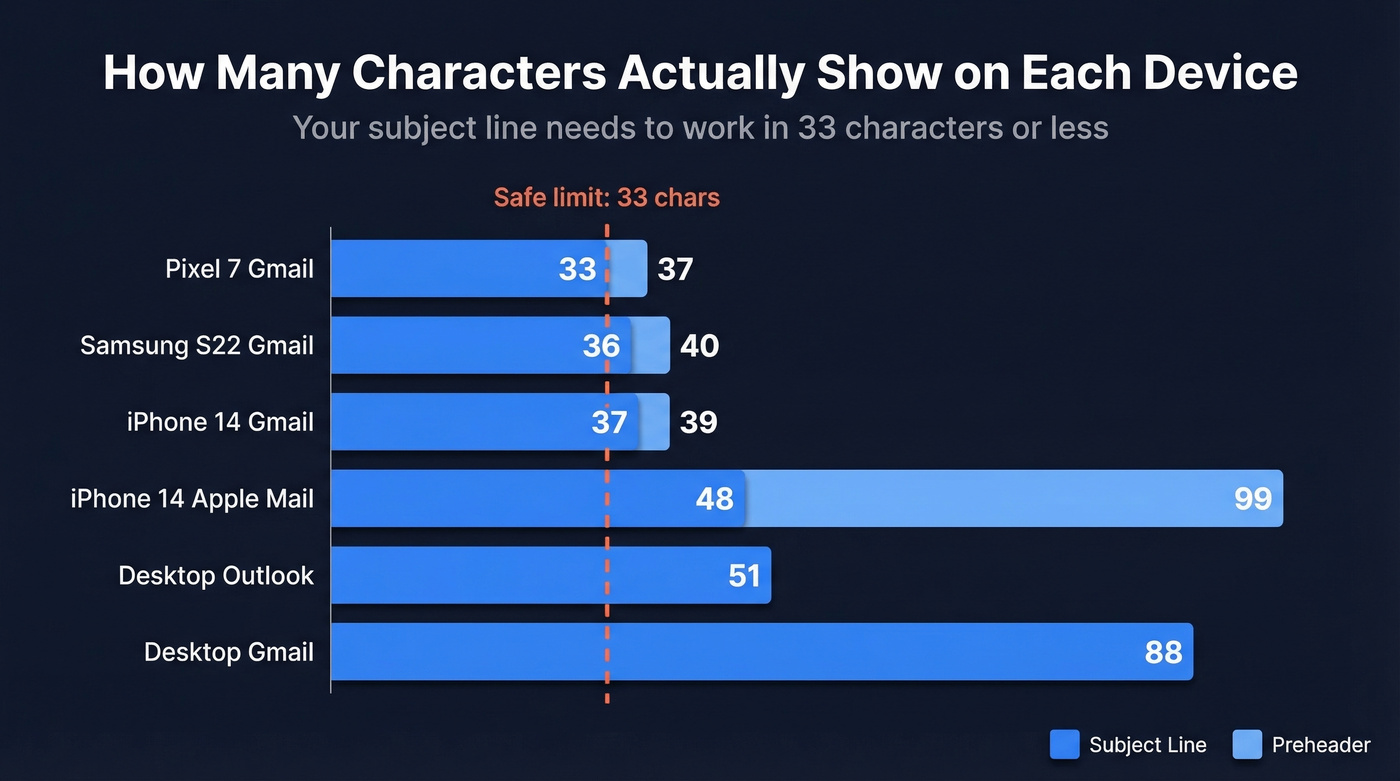
| Device / App | Subject Chars | Preheader Chars |
|---|---|---|
| Pixel 7 Gmail | 33 | 37 |
| Samsung S22 Gmail | 36 | 40 |
| iPhone 14 Gmail | 37 | 39 |
| iPhone 14 Apple Mail | 48 | 99 |
| Desktop Outlook | ~51 | - |
| Desktop Gmail | ~88 | - |
If you want full visibility across every major device, you've got 33 characters. Character width matters too - "WELCOME" takes more horizontal space than "welcome" - but 33 is your safe ceiling. Twilio SendGrid's Cyber Week data reinforces this: the best-performing subject lines during peak inbox competition were just 2-4 words. The average was 6 words. Shorter wins when attention is scarce.
Before you hit send: make sure your key message lands in the first 33 characters, your full subject line stays under 50, your preheader text continues the thought rather than wasting space on "View in browser," and you've previewed on a real phone - not just desktop.
150+ Subject Lines by Category
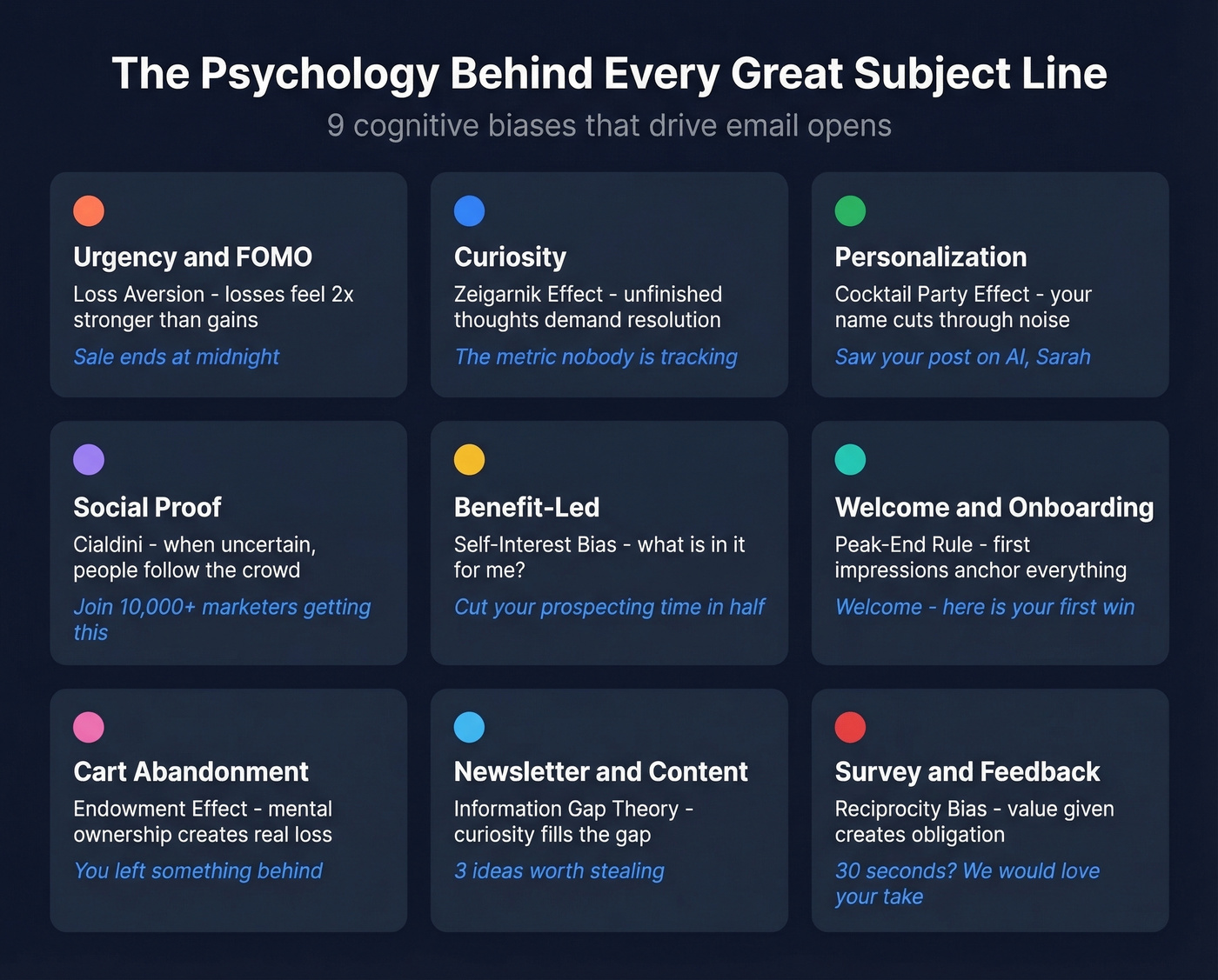
Every example below maps to a specific cognitive bias. Understanding why a subject line works matters more than copying it verbatim - the psychology transfers across industries, the exact words don't. If you want more swipeable options, see our full list of email subject line examples.
Urgency & FOMO
Psychology: Loss aversion - people feel losses roughly twice as strongly as equivalent gains (Kahneman & Tversky). Use for flash sales, limited inventory, and deadline-driven offers. Overuse kills credibility fast.
- "Sale ends at midnight"
- "Only 3 left at this price"
- "Your cart expires in 2 hours"
- "Last call: free shipping ends today"
- "48 hours to lock in current pricing"
- "We're pulling this offer Friday"
- "Final seats for the June cohort"
- "Price goes up tomorrow - heads up"
- "This deal won't come back"
- "Ending tonight: 40% off everything"
- "Doors close at noon ET"
- "Your discount code expires tonight"
- "2 spots left in the workshop"
- "Early-bird pricing ends in 6 hours"
- "Going, going... almost gone"
Curiosity & Open Loops
Psychology: The Zeigarnik Effect - unfinished thoughts create mental tension that demands resolution.
- "This changed how we write proposals"
- "The metric nobody's tracking"
- "We were wrong about subject lines"
- "I wasn't going to share this"
- "The email that booked 14 meetings"
- "What happened after we cut our list in half"
- "One tweak, 3x the replies"
- "The tool our team almost missed"
- "Why your best rep is underperforming"
- "Here's what the data actually says"
- "We tested 500 subject lines. Here's what won"
- "The strategy behind our best quarter"
- "I deleted half our email list"
- "The worst advice I got about outbound"
- "This one chart changed our strategy"
Personalization
Personalized emails deliver 6x more transactions than generic campaigns. Your own name cuts through noise like nothing else - the cocktail party effect in action. Even basic first-name tokens outperform generic alternatives. If you're building this into outbound, a B2B cold email sequence makes personalization scalable without sounding templated.
- "{{First Name}}, quick question"
- "Saw your post on {{Topic}}, {{First Name}}"
- "{{Company}} + [Your Company] - worth a chat?"
- "{{First Name}}, your trial ends Thursday"
- "A recommendation based on your last order"
- "{{First Name}}, you left something behind"
- "Your {{Product}} is due for an upgrade"
- "Happy anniversary, {{First Name}} - 1 year in"
- "{{First Name}}, here's your monthly recap"
- "Based on what you browsed last week"
- "{{First Name}}, we noticed a pattern"
- "Your {{Industry}} peers are doing this"
- "{{First Name}}, one thing before Friday"
Social Proof
Psychology: Cialdini's social proof principle - when uncertain, people follow the crowd. Numbers and names make it concrete.
- "Join 10,000+ marketers getting this weekly"
- "Why 500 teams switched this quarter"
- "Rated #1 by G2 users - here's why"
- "How Stripe's team runs outbound"
- "Our most-shared post this year"
- "3,200 people registered. You in?"
- "What top-performing SDRs do differently"
- "The playbook 200+ agencies use"
- "Customers are saying this about v3.0"
- "See why founders keep recommending us"
- "4.8 stars from 2,000+ reviews"
- "The framework our fastest-growing clients use"
Benefit-Led
Psychology: Self-interest bias - people scan for "what's in it for me" before anything else. The strongest subject lines for sales lead with a specific, measurable outcome rather than a vague promise.
- "Cut your prospecting time in half"
- "Get 3x more replies from cold email"
- "Save 5 hours/week on data entry"
- "Your emails, delivered to the inbox"
- "Build a pipeline without cold calling"
- "Write proposals 10x faster"
- "Stop guessing - here's your ICP data"
- "Land more meetings with less effort"
- "Turn website visitors into booked calls"
- "Hire faster with these 3 templates"
- "Close deals without the back-and-forth"
- "Onboard new reps in half the time"
Welcome & Onboarding
Psychology: The peak-end rule - people remember first impressions and final moments most vividly. Your welcome email sets the anchor. Per Klaviyo's data, these flows punch far above their weight in revenue.
- "Welcome - here's your first win"
- "You're in. Here's what happens next"
- "Your account is ready - start here"
- "Welcome to {{Brand}}, {{First Name}}"
- "3 things to do in your first 5 minutes"
- "Here's the shortcut most new users miss"
- "Your free trial starts now - make it count"
- "Welcome aboard - one quick question"
- "Day 1: the fastest way to see results"
- "Your setup guide (takes 2 minutes)"
- "{{First Name}}, let's get you started"
- "The one feature to try first"
Cart Abandonment & Re-engagement
Psychology: The endowment effect - once someone mentally "owns" an item by adding it to their cart, losing it feels like a real loss.
- "You left something behind"
- "Still thinking it over?"
- "Your cart misses you (and so do we)"
- "Complete your order - free shipping added"
- "That {{Product}} is selling fast"
- "We saved your cart for 24 more hours"
- "Forget something? Here's 10% off"
- "Your items are almost gone"
- "Last chance to grab what you picked"
- "We noticed you didn't finish"
- "Your {{Product}} is waiting"
- "Come back - we sweetened the deal"
- "Still want this? It's going fast"
Newsletter & Content
Psychology: Information gap theory - when people sense a gap between what they know and what they could know, curiosity drives action.
- "This week: 3 ideas worth stealing"
- "The Friday roundup you'll actually read"
- "What we learned shipping v4.0"
- "5 links our team couldn't stop sharing"
- "The one article everyone forwarded"
- "New data on {{Industry}} trends"
- "Your monthly dose of what's working"
- "Fresh takes on stale advice"
- "The contrarian take on AI in sales"
- "Read this before your Monday standup"
- "Issue #47: the one about churn"
- "What nobody told you about Q3 planning"
Event & Webinar
- "You're invited: {{Event Name}}"
- "Save your seat - only 50 spots"
- "Live tomorrow: {{Speaker}} on {{Topic}}"
- "Reminder: your webinar starts in 1 hour"
- "Missed it? Here's the recording"
- "What 300 attendees learned yesterday"
- "{{First Name}}, your spot is confirmed"
- "The session everyone's talking about"
- "Join us live - bring your questions"
- "Post-event recap + slides inside"
- "We saved you a front-row seat"
- "The replay is live (for 48 hours)"
Survey & Feedback
Psychology: Reciprocity bias - when you've given someone value, they feel obligated to give back.
- "30 seconds? We'd love your take"
- "How'd we do, {{First Name}}?"
- "One question - your honest opinion"
- "Help us make {{Product}} better"
- "Your feedback = our roadmap"
- "Quick survey - win a $50 gift card"
- "We're listening. What should we build?"
- "Rate your experience (takes 15 sec)"
- "{{First Name}}, one quick favor"
- "Tell us what's missing"
- "Your opinion shapes what's next"
- "We made changes based on your feedback"
Win-Back & Re-Engagement
This category is underrated. A lapsed subscriber who re-engages is worth more than a new one - they already know your brand.
- "We miss you, {{First Name}}"
- "It's been a while - here's what's new"
- "Should we stop emailing you?"
- "A lot has changed since you left"
- "Your account is still here"
- "Come back and see what you've missed"
- "One reason to give us another look"
- "We've made the changes you asked for"
- "{{First Name}}, still interested?"
- "Before we say goodbye..."
Product Update & Feature Launch
- "New: {{Feature}} is live"
- "You asked, we built it"
- "The update you've been waiting for"
- "{{Product}} just got faster"
- "Now you can {{specific action}}"
- "Big news: {{Feature}} is here"
- "We rebuilt {{Feature}} from scratch"
- "Your top request - shipped today"
- "See what's new in v4.2"
- "One-click {{action}} is finally here"
Seasonal & Holiday
- "Our Black Friday picks (curated for you)"
- "New Year, new {{Product}} features"
- "Your holiday gift guide is ready"
- "Spring cleaning for your tech stack"
- "Back-to-school savings inside"
- "End-of-year wrap: your 2026 in review"
- "Valentine's Day - sorted in 5 minutes"
- "Summer sale: 48 hours only"
Referral & Loyalty
- "Give $20, get $20"
- "{{First Name}}, share the love"
- "Your friend gets 30 days free"
- "You've earned a reward"
- "Thanks for being here since day one"
- "Exclusive: early access for loyal members"
- "Refer a friend, unlock premium"
- "{{First Name}}, you're in our top 10%"
Before and After Rewrites
Before: "Check Out Our New Product Features!" After: "You can now {{specific action}} in one click" Why it works: The original is vague and ends with an exclamation mark that screams marketing. The rewrite names a concrete benefit and reads like a message from a colleague.
Before: "Don't Miss This Limited Time Offer!!!" After: "Offer ends Friday - details inside" Why it works: Triple exclamation marks and ALL CAPS trigger spam filters. The rewrite preserves urgency with a specific deadline while sounding human.
Before: "Monthly Newsletter - June Edition" After: "3 things that worked for us in June" Why it works: "Monthly Newsletter" tells the reader exactly what to expect - and it's boring. The rewrite creates an information gap and implies practical value. Some of the best email headline examples reframe routine content as something worth clicking.

You read it above: if your open rate is below 15%, the problem isn't your subject line - it's your list. Prospeo's 98% email accuracy and 7-day data refresh mean your carefully crafted headlines actually reach real inboxes instead of bouncing into the void.
Stop perfecting subject lines for emails that never arrive.
Sales Subject Lines That Drive Replies
Here's the thing about cold email subject lines: the best ones don't sound like marketing. A Reddit practitioner shared real performance data that lines up with what we've seen across dozens of outbound campaigns.
"Quick question, {{First Name}}" pulled 25-30% reply rates. It works because it's short, personal, and implies a real conversation. The email has to contain an actual question, though - if it's a disguised pitch, replies crater.
"{{Their Company}} and {{Your Company}}" hit 20-25% reply rates. It positions the email as a partnership conversation, not a sales pitch.
"{{Specific thing they posted about}}" reached 30-35% reply rates - the highest performer because it proves you did homework. It feels like a real human wrote it.
What tanks cold email open rates? Anything that sounds like a marketing email. "Boost your ROI by 300%," "Transform your pipeline," excessive punctuation, ALL CAPS. The consensus on r/sales and r/b2bmarketing is consistent: if it reads like a billboard, it gets deleted or filtered. When you study subject lines that actually convert, the pattern is always the same - they read like one person talking to another. For more, compare with these prospecting email subject lines.
Timing matters too. Tuesday through Thursday, 9-11am in the recipient's timezone consistently outperforms Monday mornings and Friday afternoons. (If you want a deeper breakdown, see the best time to send cold emails.)
One thing people overlook: the best subject line in the world can't save a bounced email. We use Prospeo to verify addresses before crafting headlines - 98% email accuracy means you're actually reaching inboxes, not burning sender reputation on dead addresses. If bounces are creeping up, start with your email bounce rate.
Mistakes That Kill Deliverability
Your subject line doesn't just affect open rates - it affects whether the email reaches the inbox at all. ESPs evaluate engagement signals (opens, delete-without-reading, spam complaints) to decide where your future emails land. A pattern of poor engagement trains the algorithm to route you to spam. If you need a full diagnostic flow, use this email deliverability guide.
Folderly's analysis identifies several high-risk categories. Modern spam filters use machine learning and look for clusters of problematic terms rather than individual trigger words, but these patterns still matter:
| Category | Spam Trigger | Safer Alternative |
|---|---|---|
| Financial | "Earn $$$ fast" | "Here's how teams grow revenue" |
| Urgency | "Act immediately!!!" | "Available through June 15" |
| Promises | "100% guaranteed" | "See results in your first week" |
| Sales pressure | "Buy now, limited time" | "New option available for you" |
| Scam language | "You've been selected" | "An invitation for {{First Name}}" |
| Formatting | ALL CAPS + !!!! | Sentence case, one exclamation max |
A VerticalResponse 2026 analysis found that ALL CAPS combined with excessive punctuation increases spam scores by 40-60%. That's not the difference between a slightly lower open rate and a slightly higher one - it's the difference between inbox and junk folder.
The compliance angle matters too. CAN-SPAM explicitly prohibits misleading subject headings. Fake "Re:" and "Fwd:" prefixes aren't just sleazy - they're illegal. GDPR's Article 5 transparency and fairness principles also make deceptive framing a real risk for EU-targeted emails.
Here's a threshold that's saved our team hours of pointless A/B testing: if your open rate is below 15%, the problem almost certainly isn't your subject line. It's deliverability, list quality, or sender reputation. Cold email open rates have declined from 36% to 27.7% on average over the past two years - you can't subject-line your way out of a reputation problem. If you're troubleshooting, start with how to improve sender reputation.

The fastest way to improve open rates isn't rewriting subject lines - it's cleaning your list. Bounced emails destroy sender reputation, which tanks future deliverability for all your emails, not just the campaign that bounced.
A/B Testing After iOS 15
Apple Mail Privacy Protection changed the game in 2021, and by 2026 the impact is fully baked in. Apple Mail pre-fetches email content, including tracking pixels, regardless of whether the recipient actually opens the email. Every Apple Mail user looks like an opener. This inflates open rates for any segment with significant Apple Mail usage - which is most B2C lists and a growing share of B2B.
The fix is straightforward. Stop using open rate as your primary metric. In our testing, click-through rate and conversion rate have been far more reliable signals of subject line performance since iOS 15 rolled out. We've seen campaigns where the "winning" subject line by open rate actually produced 30% fewer clicks than the runner-up. If you want to standardize how you measure email performance, use this click rate formula in email marketing.
Test one variable at a time - change the subject line and nothing else, not the send time, not the preheader, not the sender name. Aim for 1,000+ recipients per variant when you can; a test with 200 recipients usually isn't statistically meaningful. Run tests long enough to cover multiple hours of opens, because early openers skew results. And always track downstream metrics. The subject line that gets more opens but fewer clicks isn't actually winning.
AI Subject Line Generators
Around 75% of marketers now use AI-powered tools to optimize email campaigns, and subject line generation is the most common entry point.
If you just want a free gut-check, CoSchedule's Headline Analyzer is the place to start. Paste your subject line, get a score with specific improvement suggestions. It's not a generator, but it's the best free pressure-test tool for your top 2-3 variants before you send. (More options here: best free subject line testers.)
Copy.ai offers strong tone control - you can specify whether you want the output to sound urgent, playful, or professional, and iterate on results without losing context. Plans start around $30-50/month.
Skip the general-purpose tools if you're running a Shopify store. Omnisend is built specifically for ecommerce, with a free plan covering up to ~250 contacts and paid plans starting around $16-20/month.
Mailmodo takes a template-driven approach that works well for teams with established brand guidelines. You feed it your constraints and it generates within those guardrails. Plans start around $39-50/month.
Look, I'll be honest about AI subject lines: these tools are excellent at generating 10-15 variants in 30 seconds, but they're terrible at strategy. They don't know your audience's sophistication level, your sender reputation history, or whether your list has been burned by too many "LAST CHANCE" emails. Use AI for volume, then apply your judgment to pick the top 2 for A/B testing.
Subject Line Audit Checklist
Run through this before every send:
- Key message in the first 33 characters
- Total length under 50 characters
- Previewed on a real mobile device (not just desktop)
- No spam-trigger clusters (ALL CAPS, !!!, $$$, "free" + "guaranteed" together)
- Personalization token present and tested (no "Hi {{First Name}}" disasters)
- Preheader text complements the subject line - doesn't repeat it
- Sender name is recognizable (person name > company name for cold email)
- A/B variant ready for lists over 2,000 recipients
- Email list verified - no sends to unverified addresses (see: AI email checker)
- Sender reputation checked via Google Postmaster Tools
Emojis: When They Help, When They Don't
Emojis can lift open rates for B2C brands - particularly in ecommerce, where a fire or clock emoji adds visual contrast in a crowded inbox. But they render inconsistently across email clients (what looks fine on iOS might show as a blank square on older Outlook versions), and stacking multiple emojis triggers spam filters.
Test one emoji at a time and check rendering on Gmail, Apple Mail, and Outlook before sending. For B2B cold email, skip emojis entirely. They signal "marketing blast," which is the opposite of what you want when you're trying to look like a real person writing a real email.
Personalized subject lines drive 6x more transactions - but only if you have accurate contact data to personalize with. Prospeo returns 50+ data points per contact at $0.01/email, giving you the {{First Name}}, {{Company}}, and {{Industry}} tokens that make those high-performing headlines possible.
Fuel every personalized subject line with data that's actually correct.
FAQ
What's the ideal subject line length?
Aim for 33 characters or fewer for full visibility on every mobile device. Desktop clients show 70-88 characters, but mobile is where most emails get opened first. Front-load your key message in those first 33 characters, then use remaining space for supporting context. Two to four words performed best in SendGrid's Cyber Week analysis.
Do emojis help or hurt open rates?
For B2C, a single well-placed emoji can increase open rates by adding visual contrast in crowded inboxes. For B2B cold email, skip them - they signal a marketing blast. They render inconsistently across clients and can trigger spam filters when overused. Test one at a time on Gmail, Apple Mail, and Outlook before sending.
How do I know if the problem is my subject line or my email list?
If your open rate is below 15%, the issue is almost certainly deliverability or list quality - not your subject line. Verify addresses before sending and check sender reputation via Google Postmaster Tools before rewriting a single word. Bad data destroys deliverability for every future send.
What are the best cold email subject lines?
Short, personal, and specific. "Quick question, {{First Name}}" consistently pulls 25-30% reply rates. Referencing something specific the recipient posted or published reaches 30-35%. Anything that sounds like a marketing email - "Boost your ROI," "Transform your pipeline" - gets deleted.
How many words should a subject line be?
Two to four words performed best during SendGrid's Cyber Week analysis, when inbox competition peaked. The average was six words. For everyday sends, aim for four to seven words. The real constraint isn't word count - it's the 33-character mobile display limit that determines whether recipients see your full message.