

How to Write an Email Introduction to an Unknown Person
You've found the perfect prospect. You've got their company email. And now you're staring at a blank compose window, cursor blinking, paralyzed by "Dear Sir or Madam."
Here's the thing: writing an email introduction to an unknown person isn't really about the greeting. It's about everything around it. Cold emails average a 1-5% reply rate, and the difference between a reply and the trash folder comes down to your subject line, your first sentence, and your CTA. Get those right and the greeting barely matters. Get them wrong and "Dear Sir or Madam" is the least of your problems.
What You Need Before Writing
Before you write a single word, nail these five things:
- Find the person's actual name. Generic greetings signal zero effort.
- Keep the email under 125 words. Emails in the 50-125 word range get materially higher reply rates.
- Use a 1-4 word subject line. No salesy language. All lowercase outperforms. (If you need ideas, borrow from these email subject line examples.)
- Include one specific CTA. Not "let me know your thoughts" - a concrete next step. (More rules and examples in this email call to action guide.)
- Follow up 3 days later. 42% of replies come from follow-ups. Skip this and you're leaving almost half your responses on the table. (Use these sales follow-up templates if you want plug-and-play options.)
Find the Right Person First
Stop obsessing over "Dear Sir/Madam." Start obsessing over whether you're emailing the right person at all. 17% of cold emails never reach the inbox, and a big chunk of that is sending to outdated or wrong addresses. "To Whom It May Concern" is dead - it tells the reader you didn't spend 90 seconds researching them.
Here's the workflow that eliminates generic greetings entirely:
- Check the company website. Team pages and "About Us" sections often list names and titles.
- Search professional networking sites. Look for the person's role, department, and pronouns.
- Call reception. Old school, but it works when digital trails run cold.
Greeting Options at a Glance
Once you've done your research, pick the greeting that matches your context:
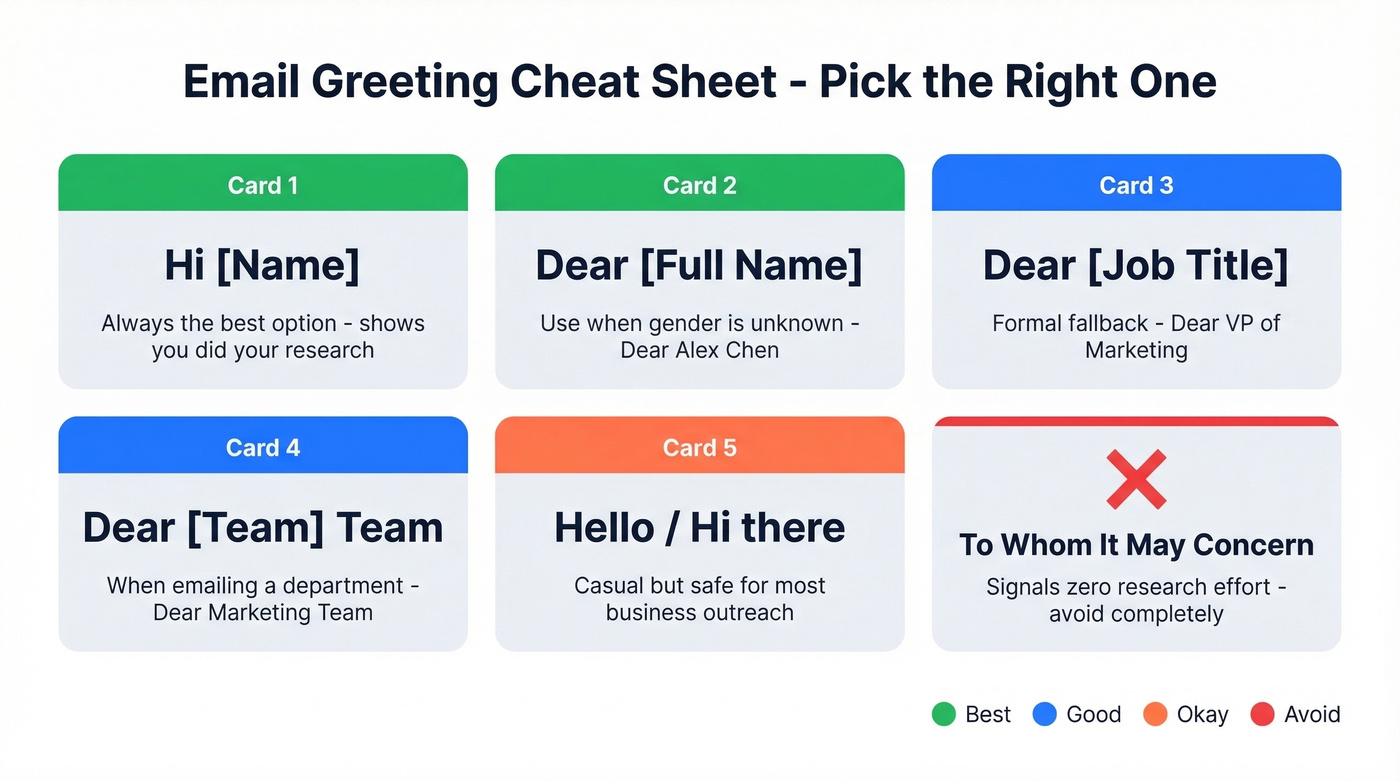
| Scenario | Greeting | Notes |
|---|---|---|
| Know the name | Hi [Name] / Dear [Name] | Always the best option |
| Formal, name unknown | Dear [Job Title] | E.g., "Dear VP of Marketing" |
| Team or department | Dear [Team] Team | E.g., "Dear Marketing Team" |
| Casual business context | Hello / Hi there | Safe for most outreach |
| Unknown gender | Dear [Full Name] | "Dear Alex Chen" - skip titles |
| Avoid | To Whom It May Concern | Signals zero research effort |
Ms. is the safest default for women when you're using a title - it doesn't imply marital status. Use Dr. or Professor when applicable, and check professional profiles for pronouns before assuming anything.

You don't need a better greeting - you need the right person's verified email. Prospeo gives you names, titles, and 98% accurate emails from 300M+ profiles so you never send another "Dear Sir or Madam" again.
Kill generic greetings forever - start with the right name and a verified email.
The 6-Part Email Structure
Let's be honest: the greeting debate is a distraction. We've seen teams agonize over "Hi" vs. "Hello" while sending 200-word walls of text that nobody reads. Knowing how to introduce yourself in an email to someone you've never met comes down to these six elements:
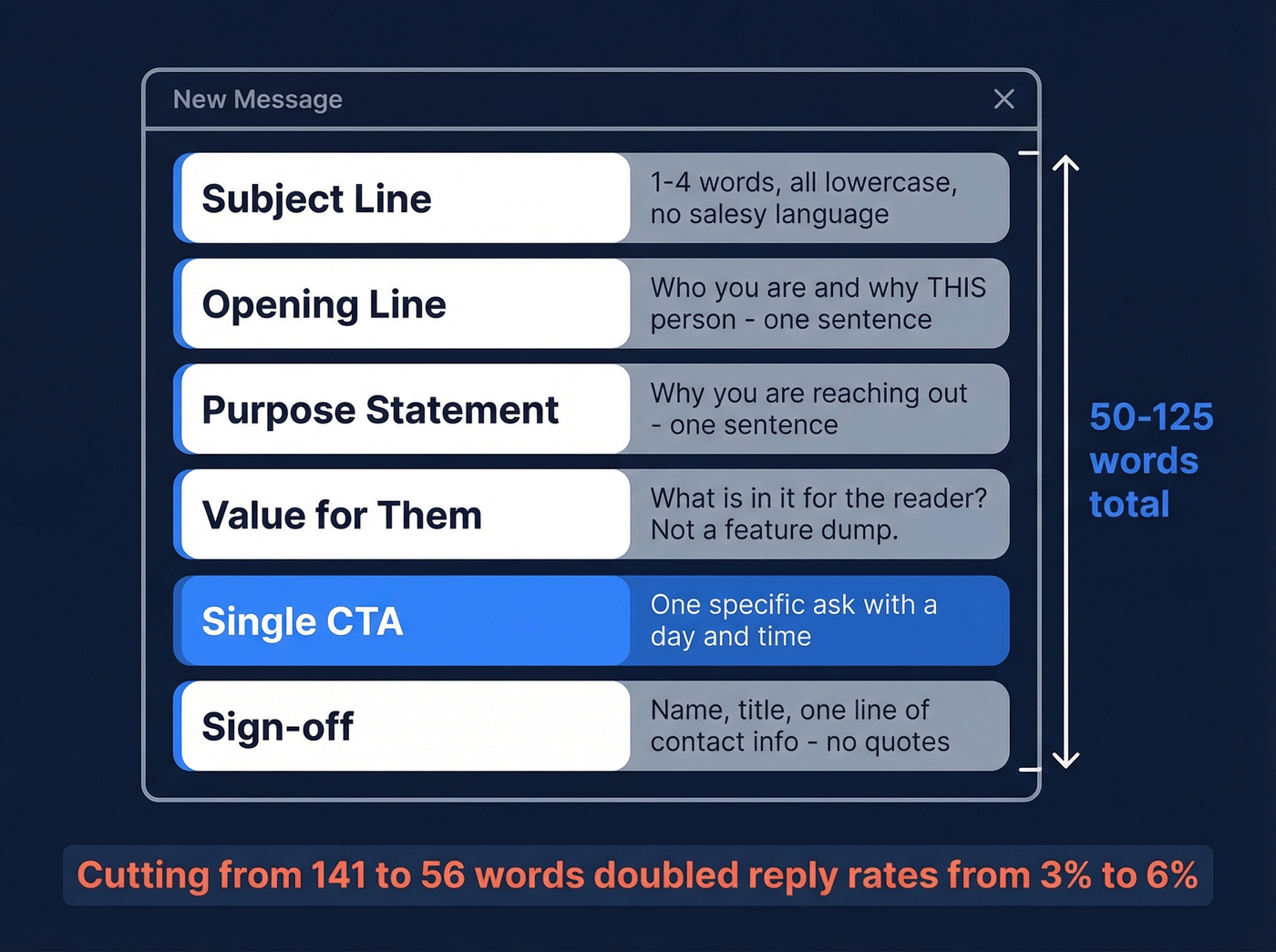
Subject line. Keep it to 1-4 words, all lowercase. 33% of recipients decide to open or delete based on the subject line alone. Salesy language can reduce opens by up to 17.9%. One Reddit operator saw "Partnership opportunity" pull under 19% opens while "Quick question" hit 39%. Personalized subject lines boost open rates by 26%. (For a deeper playbook, see prospecting email subject lines and these cold email subject line examples.)
Opening line. One sentence: who you are and why this person specifically. No "I hope this email finds you well." (If you want a framework, use this email copywriting guide.)
Purpose statement. Why you're reaching out, in one sentence.
Value for them. What's in it for the reader? A relevant insight, a resource, a connection. Not a feature dump about your product. (This personalized outreach breakdown helps.)
Single CTA. One specific ask. "Do you have 15 minutes Thursday afternoon?" beats "Let me know if you'd like to chat sometime."
Professional sign-off. Name, title, one line of contact info. No inspirational quotes. Match the formality of your greeting - if you opened with "Hi Sarah," close with "Best" or "Cheers," not "Yours faithfully."
The whole thing should land between 50 and 125 words. That operator on r/Entrepreneur cut their emails from 141 words to under 56 and watched reply rates double from 3% to 6%. Three short paragraphs max. (If you're building a full sequence, use this B2B cold email sequence guide.)
Templates You Can Steal
Networking / Informational Interview
Subject: your work at [company]
Hi [Name],
I'm [Your Name], a [role/student] focused on [specific area]. I've followed your work in [industry/topic] and would love to learn from your experience.
Would you have 15 minutes for a quick call this week or next? Happy to work around your schedule.
Best, [Your Name]
Why this works: It's specific, short, and the CTA gives a concrete timeframe without being pushy.
Sales / Business Development
Most sales intros look like this:
Hi [Name], I'm [Your Name] from [Company]. We're a leading provider of [solution] that helps businesses [vague benefit]. I'd love to schedule a call to discuss how we can help your team. Let me know your availability.
That's 45 words of nothing. Here's what actually gets replies:
Subject: quick question
Hi [Name],
I noticed [Company] is [specific observation - hiring for X, expanding into Y, launched Z]. We help teams like yours [specific outcome] - [Client Name] saw [metric] after working with us.
Worth a 15-minute chat on Thursday?
[Your Name]
The difference: observation-first, proof included, single CTA with a specific day. Our team has tested dozens of variations, and the ones that lead with a genuine observation about the prospect's company consistently outperform generic intros by 2-3x.
Job Application / Hiring Manager
Subject: [role title] application
Hi [Name],
I'm [Your Name], and I'm applying for the [Role] position. My background in [relevant skill] maps directly to [specific requirement from the job posting].
I'd love to share how I could contribute. Are you available for a brief call this week?
Best, [Your Name]
Post-Event Follow-Up
Subject: great meeting you at [event]
Hi [Name],
It was great connecting at [Event] - your point about [specific topic] stuck with me. I'd love to continue that conversation.
Free for a 15-minute call next week?
[Your Name]
Every template above is under 125 words with a single, specific CTA. Swap in your details and send.
Follow Up or Lose the Reply
48% of sales reps never send a second email. That's leaving 42% of potential replies on the table. In our experience, the follow-up is where most conversations actually start.
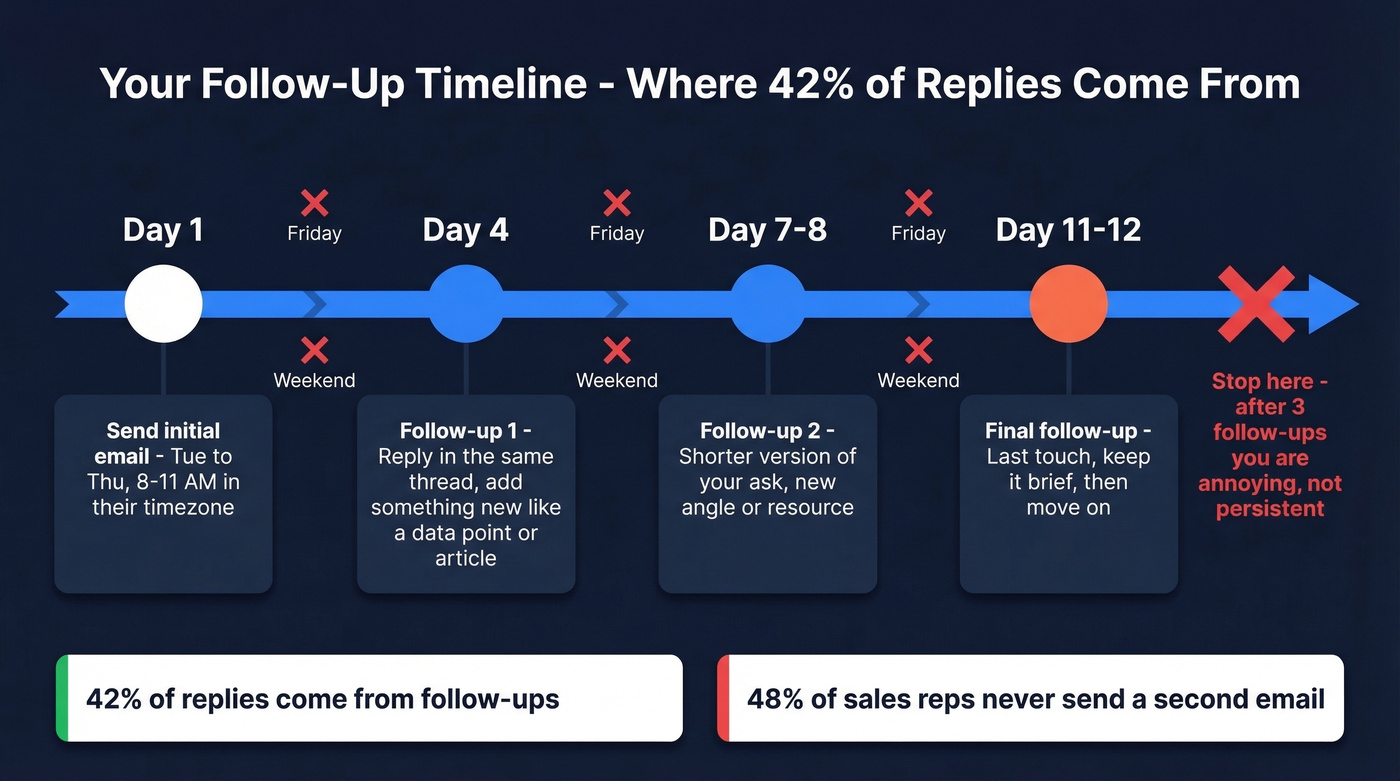
Send your first follow-up 3 days after the initial email, and reply in the same thread - don't start a new one. Aim for Tuesday through Thursday, 8-11 AM in the recipient's timezone. Cap it at 2-3 follow-ups total. After that, you're not persistent - you're annoying. (If you're unsure about timing, see when should i follow up on an email.)
Avoid Fridays and weekends entirely. Your email gets buried under the Monday avalanche, and nobody's making decisions at 4 PM on a Friday. And please, never write "just bumping this to the top of your inbox." Everyone hates that line. Instead, add something new: a relevant article, a fresh data point, a shorter version of your ask.
Mistakes That Kill Your Reply Rate
Going over 125 words is the most common killer. That Reddit operator proved it - cutting from 141 to 56 words doubled their reply rate. Every sentence needs to earn its place.
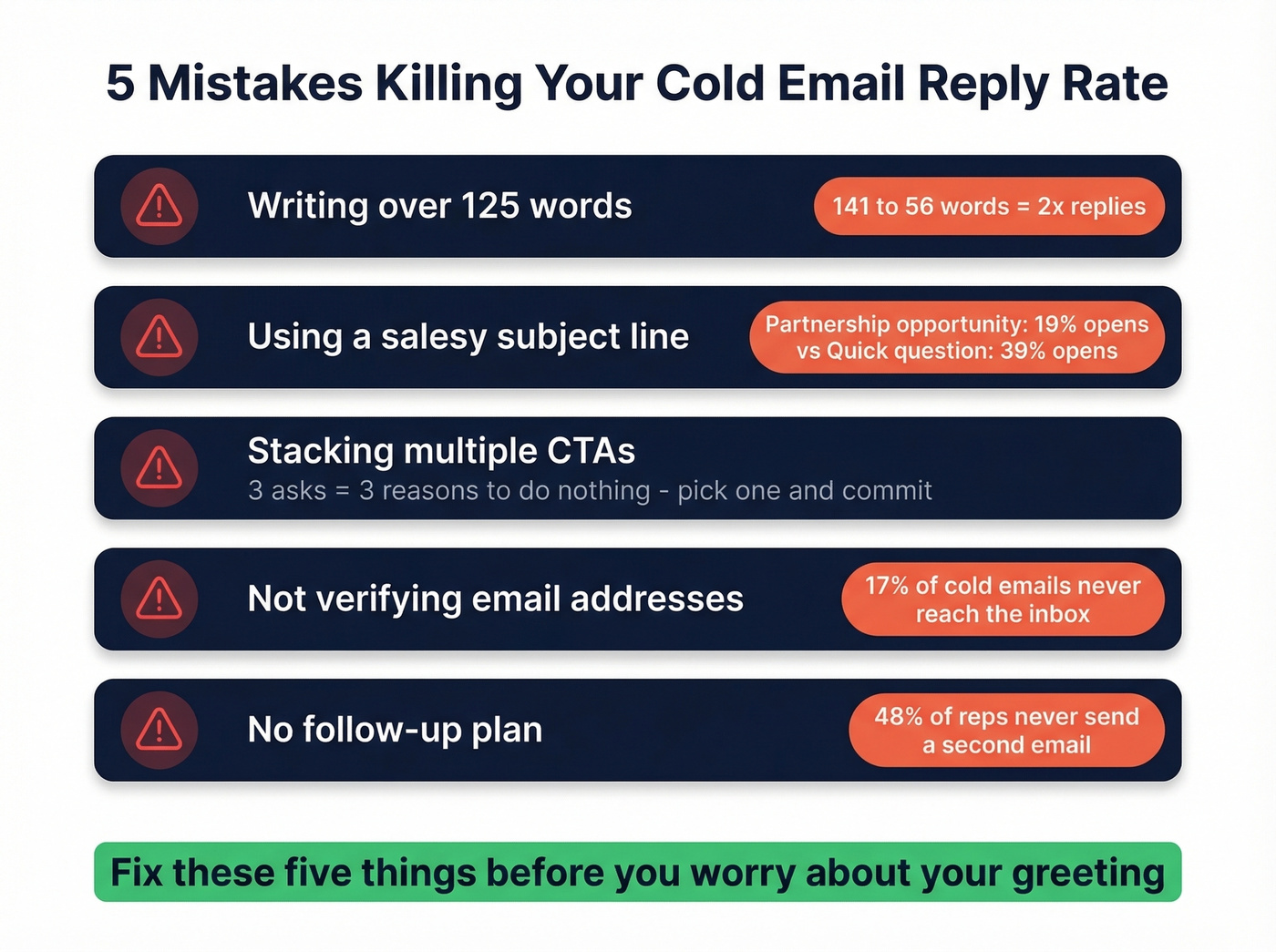
Stacking multiple CTAs is almost as bad. "Let's chat, or check out our site, or reply with your thoughts" gives the reader three reasons to do nothing. Pick one ask and commit.
The subject line matters more than most people think. "Partnership opportunity" pulls under 19% opens. "Quick question" pulls 39%. If your subject line sounds like it came from a marketing playbook, rewrite it.
On the technical side, not verifying your email address before sending is a rookie mistake that tanks deliverability before your carefully crafted intro ever reaches anyone. 17% of cold emails never hit the inbox because of invalid addresses, spam traps, and catch-all domains. Prospeo's 5-step verification handles catch-all domains, removes spam traps and honeypots, and flags risky addresses before you hit send. (If you want the full technical checklist, use this email deliverability guide.)
Two more mistakes we see constantly: skipping domain authentication and having no follow-up plan. Set up SPF and DKIM records - your IT team can do this in 20 minutes. And if you wrote the email, sent it, and moved on, that's not a strategy. Build 2-3 follow-ups into every outreach sequence before you send email one. (Start here: SPF record examples and how to verify DKIM is working.)
Skip the clever intro entirely if your average deal is under $5k. You need volume with clean data, not wordsmithing. Spend less time on the perfect opening line and more time making sure you're reaching verified inboxes at the right companies.
17% of cold emails never reach the inbox because the address is wrong. Prospeo's 7-day data refresh and 5-step verification mean your perfectly crafted intro actually lands in front of a real person - not a dead mailbox.
Your best email template is worthless if it bounces. Fix that first.
FAQ
What's the best greeting when you don't know someone's name?
Use "Hello" or "Dear [Job Title]" - never "To Whom It May Concern." But spend two minutes finding the actual name first. Check the company website, search professional networking sites, or use an email finder tool to pull verified contact details. A personalized greeting dramatically improves reply rates.
How long should an introduction email be?
Keep it between 50 and 125 words - emails in this range get materially higher reply rates. That's three short paragraphs max: who you are, why you're reaching out, and one specific ask. One operator cut from 141 to 56 words and saw replies double from 3% to 6%.
How do I introduce myself to someone I've never met?
Lead with context, not credentials. Open with one line showing you've done your research - reference their company, a recent project, or a shared connection. State your purpose in a single sentence and close with a specific ask. The templates above give you a plug-and-play starting point for networking, sales, job applications, and event follow-ups.
How do I find someone's email before reaching out?
Check the company's team page first, then search professional networking sites for the right contact. For verified addresses, use an email finder - paste a company URL, filter by role, and get an accurate email in seconds. That way you're opening with a name instead of a generic greeting, which is half the battle.