

Email Open Rate Tracking: What Still Works (and What Doesn't)
Your open rate jumped 15 points last quarter. Clicks didn't move. Replies are flat. That gap is the new normal for email open rate tracking - and most teams haven't adjusted.
The Short Version
Open rates are inflated by Apple Mail Privacy Protection and distorted by Gmail image caching. Don't use them for individual-level decisions. Track reply rate for outbound or click rate for marketing instead. And before you trust any metric, verify your list is clean - bad data corrupts every number downstream.
There's also a compliance risk most teams are ignoring entirely.
How Open Rate Tracking Actually Works
Your email platform embeds an invisible 1x1 pixel image in every HTML message. When a recipient opens the email and their client loads that image, the server logs an "open." Each pixel URL is unique per recipient, so it ties the event back to a specific person.
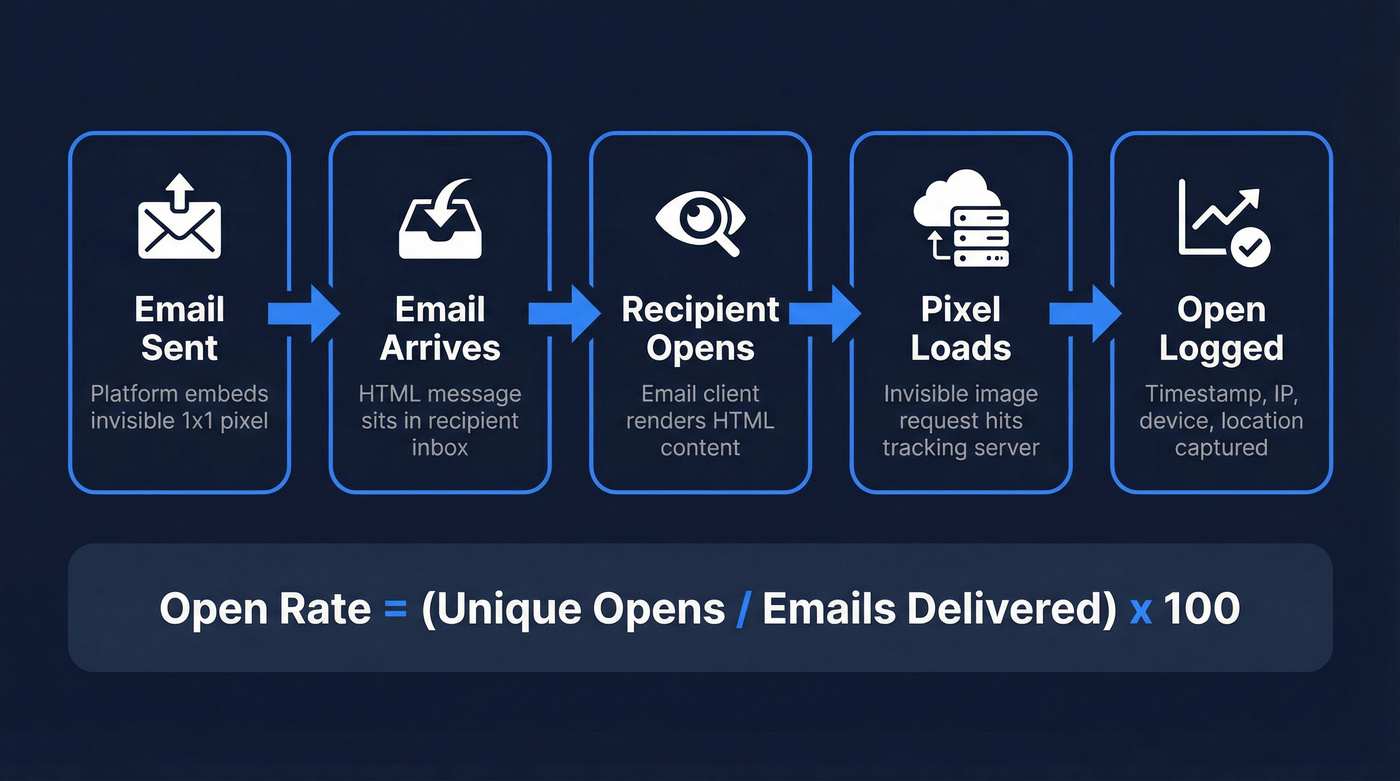
Open rate = (unique opens / emails delivered) x 100.
That single pixel request can capture timestamp, IP address, approximate geolocation, device type, and email client. It's a rich signal when it works. The problem is that "when it works" now covers a shrinking share of your list.
Why Tracking Is Unreliable in 2026
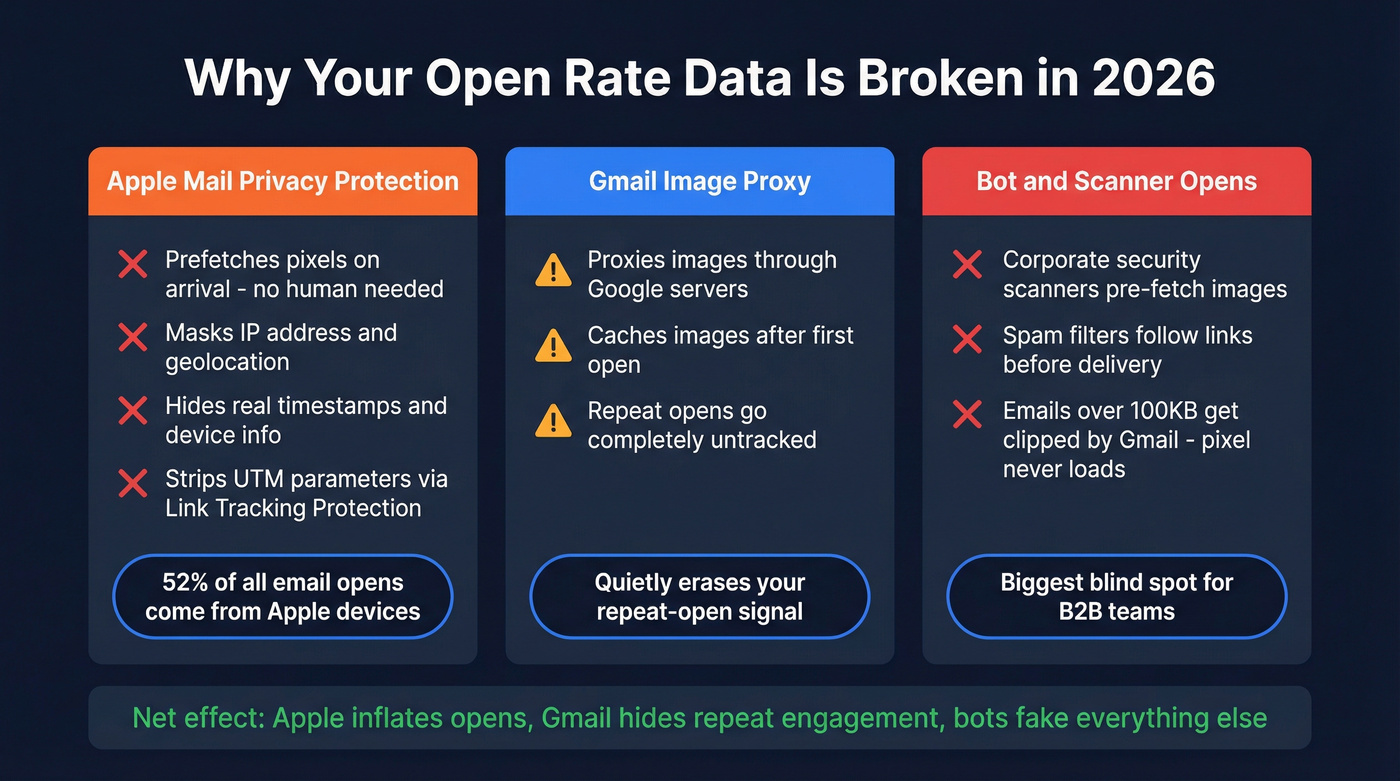
Three distortion sources corrupt the open signal, and they pull in different directions.
Apple Mail Privacy Protection
MPP launched in September 2021 and remains the biggest disruptor. Apple Mail prefetches images - including tracking pixels - the moment an email arrives, whether or not the recipient reads it. That masks IP addresses, timestamps, device info, and geolocation. Apple devices accounted for roughly 52% of all email opens in 2021, so this isn't a niche problem. It's the majority of your data.
MPP is technically opt-in, but adoption is high enough that the distortion is real and widespread. One newsletter saw open rates jump from 28% to 55% after MPP rolled out - with zero change in actual readership. Apple Link Tracking Protection can also strip UTM parameters, so the standard "just use UTMs" workaround has a hole in it.
| Apple MPP | Gmail Proxy | |
|---|---|---|
| Trigger | Prefetches on arrival (no human action) | Proxies/caches images on first open |
| Effect | Inflates opens, masks IP | Skews repeat-open data via caching |
Gmail Image Proxy
Gmail proxies images through Google's servers and caches them. Unique opens can look cleaner because images tend to load on first open, but repeat opens often go untracked because the image gets served from cache instead of hitting your server. Where Apple inflates your numbers, Gmail quietly erases a chunk of your repeat-open signal.
If you're trying to measure engagement inside Gmail specifically, use a click-first approach and review what still works in Gmail email tracking.
Bot and Scanner Opens
Here's the one that catches B2B teams off guard. Corporate security scanners and spam filters pre-fetch images and follow links before a message even reaches an inbox. For teams targeting enterprise accounts, bot opens can represent a meaningful portion of your "open" count. Long emails exceeding roughly 100KB also get clipped by Gmail, which prevents the tracking pixel from loading at all.
If you're building sequences around these signals, it’s worth sanity-checking your setup against modern email tracking metrics and email campaign tracking practices.

Bot opens and Apple MPP inflate your numbers, but bad emails corrupt them entirely. Prospeo's 5-step verification catches spam traps, honeypots, and catch-all domains - the invisible junk that inflates your delivered count and poisons every metric downstream. 98% email accuracy at $0.01 per email.
Fix the denominator before you optimize the numerator.
Should You Still Monitor Opens?
Track them. Just don't trust them for individual-level decisions.
Salesforce's dataset shows cross-industry averages climbing from 33.07% in 2023 to 36.24% in 2024 - MPP inflation is a big reason why. The data also reveals a consistent seasonal pattern: open rates dip around March and correct by late August, so compare month-over-month rather than week-over-week.
Opens still work as an aggregate trend signal. If your open rate drops off a cliff between sends, that's a deliverability alarm worth investigating immediately, even if the absolute number is inflated. Think of opens as a thermometer, not a diagnosis - they tell you something's wrong without telling you what. In our experience, the teams that accept this distinction and shift to reply rate as their primary metric start making better decisions within weeks.
If you need a deeper breakdown of what’s changed, see email open tracking and the updated guide on how to track email opens.
The consensus on r/sales and r/Emailmarketing is blunt: open-triggered automations, A/B test winners based on opens, re-engagement segments built on "didn't open" - all unreliable now.
The Compliance Risk Nobody Mentions
Regulators are starting to treat tracking pixels like cookies. The EDPB's Guidelines 2/2023, adopted October 2024, explicitly state that pixel tracking falls under ePrivacy Directive Article 5(3) - even if you're not processing personal data.
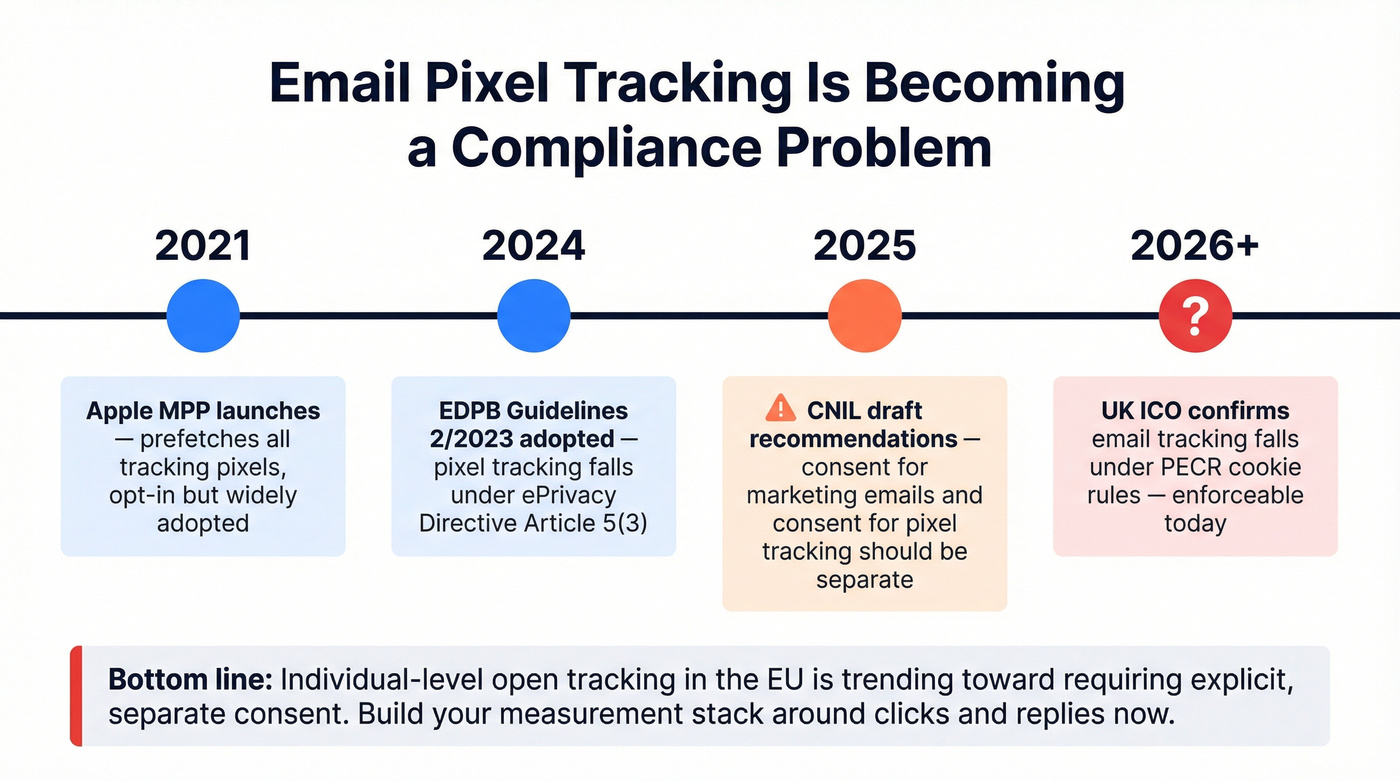
France's CNIL went further with June 2025 draft recommendations proposing that consent to receive marketing emails and consent to pixel tracking should be separate. The UK's ICO has confirmed email tracking falls under PECR cookie rules. This is enforceable today. If you're sending to EU or UK recipients and tracking opens at the individual level, you're in a gray zone that's getting less gray every quarter.
For a practical compliance read, review email tracking & GDPR.
Let's be honest: individual-level open tracking in the EU is trending toward requiring explicit, separate consent. Most teams aren't remotely prepared for this. Start building your measurement stack around clicks and replies now, before regulators force the issue.
What to Track Instead of Opens
Microsoft's recommended framework calls it a "dual approach": measure engagement better and improve engagement simultaneously.
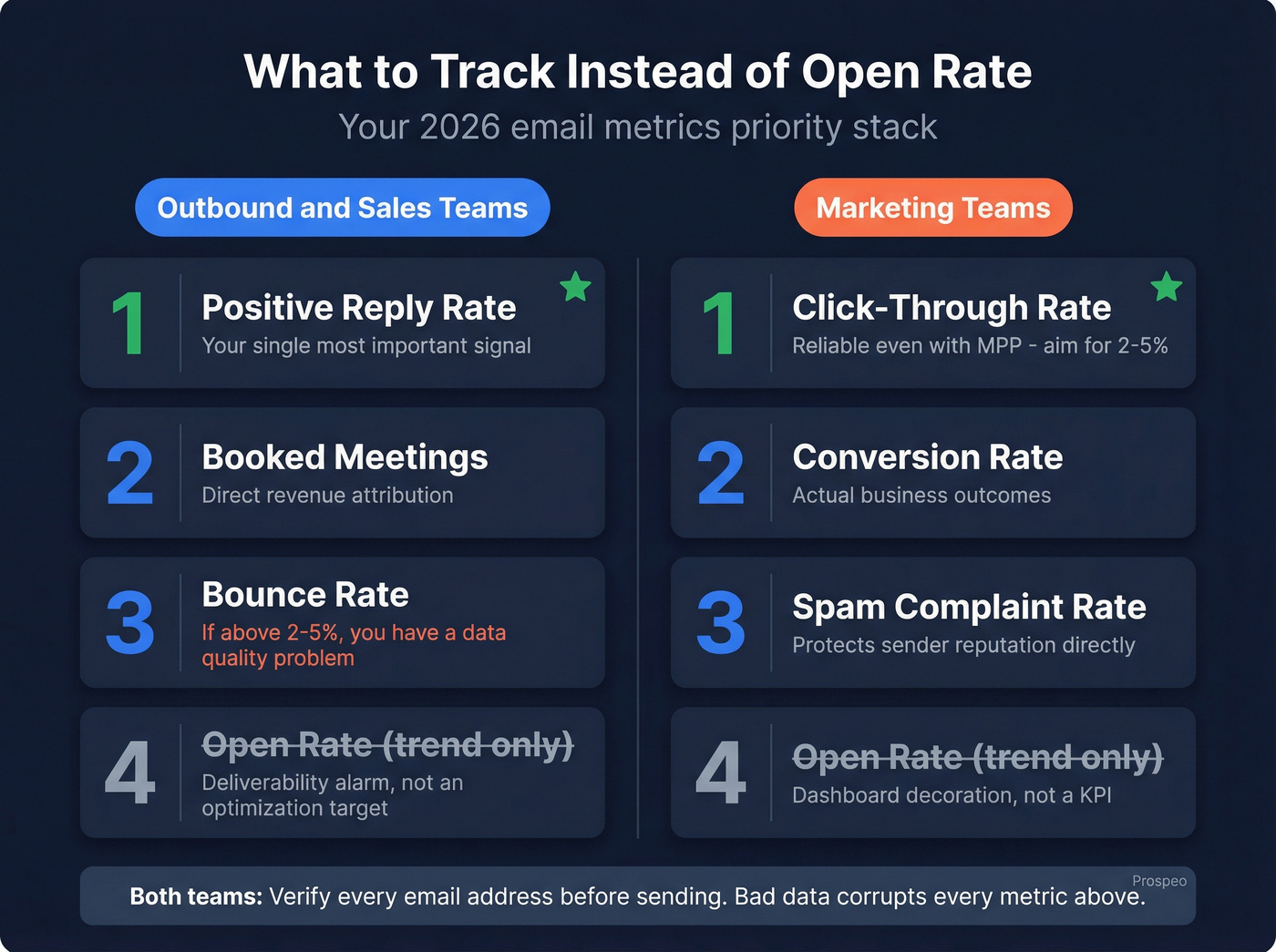
For outbound and sales teams, positive reply rate is your north star. Then booked meetings, then bounce rate. If your bounce rate exceeds 2-5%, you've got a data quality problem poisoning every other metric. We've seen teams cut bounce rates from 15% to under 3% just by running their list through Prospeo's email verification before sending - the 5-step verification process catches spam traps, catch-all domains, and honeypots that inflate your delivered count without adding real recipients.
If you want benchmarks and fixes, use cold email reply rate and email delivery tracking as your reference points.
For marketing teams, click-through rate and conversion rate are your reliable signals. Opens can stay in the dashboard as a trend line, but don't optimize around them. Unique coupon codes and UTM parameters add attribution depth, though Apple Link Tracking Protection strips UTMs for a growing share of recipients. Watch spam complaint rates too - making unsubscribe easy reduces complaints, which directly protects sender reputation.
Email marketing still returns $36-$45 per $1 spent, but only if your messages actually reach inboxes. Get SPF, DKIM, and DMARC configured properly - these authentication protocols are deliverability levers that indirectly improve every engagement metric.
Fix the Upstream Data Problem First
If 15-20% of your list is invalid, your "delivered" count is inflated before any pixel fires. That means your open rate denominator is wrong from the start, and every metric downstream is built on bad math.

Verify every address before sending. Skip this step and no amount of metric sophistication will save you. Stack Optimize built to $1M ARR on verified lists: client deliverability stayed above 94%, bounce rates under 3%, zero domain flags. That kind of result doesn't come from better dashboards - it comes from cleaner data at the source.
If you’re auditing the root cause, start with CRM data audit and a repeatable process for how to keep CRM data clean.
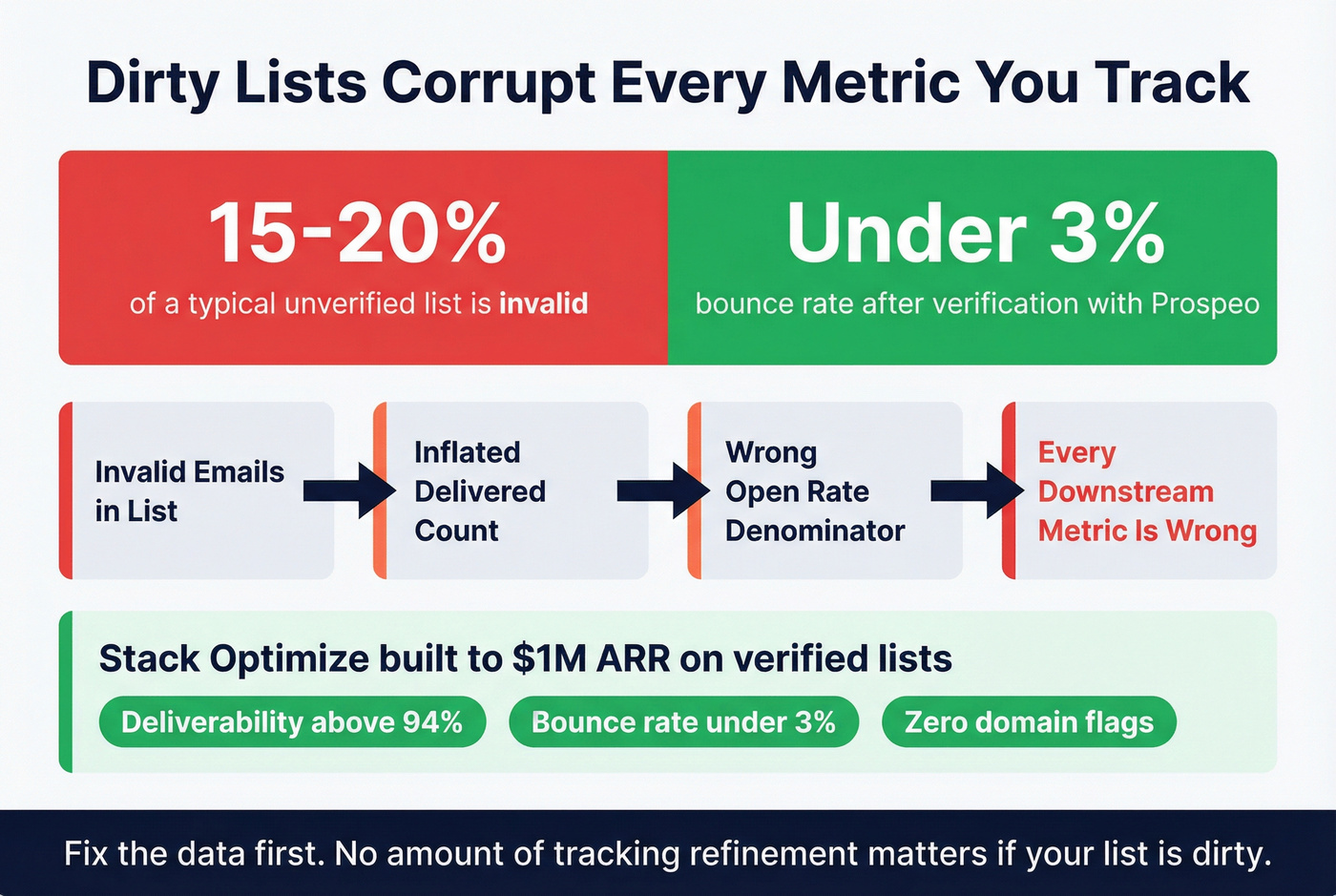
No amount of tracking refinement matters if your list is dirty. Fix the data first.
Stack Optimize kept bounce rates under 3% and deliverability above 94% across every client campaign - zero domain flags. They built a $1M agency on verified data from Prospeo. When your list is clean, every metric you track actually means something.
Stop optimizing around corrupted data. Start with verified contacts.
FAQ
What's a good email open rate in 2026?
Cross-industry averages sit around 36%, but Apple MPP inflates this by 10-25 percentage points depending on your list's Apple Mail share. Focus on click rate (2-5% is healthy) and reply rate for an honest engagement benchmark.
Does pixel-based tracking hurt deliverability?
It can. Tracking pixels force HTML formatting and introduce known tracker domains that some spam filters flag. The risk is small per send but compounds with link rewriting and aggressive follow-up sequences. For teams already on the edge of deliverability trouble, it's one more variable working against you.
How do I make email metrics more accurate?
Start with list hygiene - verify every address before sending so your delivered count reflects real inboxes. Then shift your primary KPIs to reply rate and click-through rate. If you're using HubSpot, note that its open rate dashboard is subject to the same MPP inflation as every other platform. Don't assume your tool is immune.