

How to Build an Email Outreach Campaign That Gets Replies in 2026
Your reply rate is dropping. You rebuilt your sequences last quarter, swapped subject lines, even tried a new sending tool - and the numbers still slid. Here's the thing: the teams running a successful email outreach campaign in 2026 didn't fix their copy first. They rebuilt their infrastructure from the ground up. We've tested dozens of sequences across industries, and the biggest gains always come from systems, not subject lines.
What You Need (Quick Version)
- Infrastructure first. Dedicated sending domains, SPF/DKIM/DMARC configured, 4-6 week warmup. Skip this and nothing else matters.
- Verified data under 2% bounce. Bad emails burn your domain faster than bad copy burns your pipeline.
- Emails under 80 words, 4-7 follow-ups. Brevity wins. Persistence wins more.
- Measure reply rate, not open rate. Apple Mail Privacy Protection made opens unreliable. Replies are the only metric that correlates with revenue.
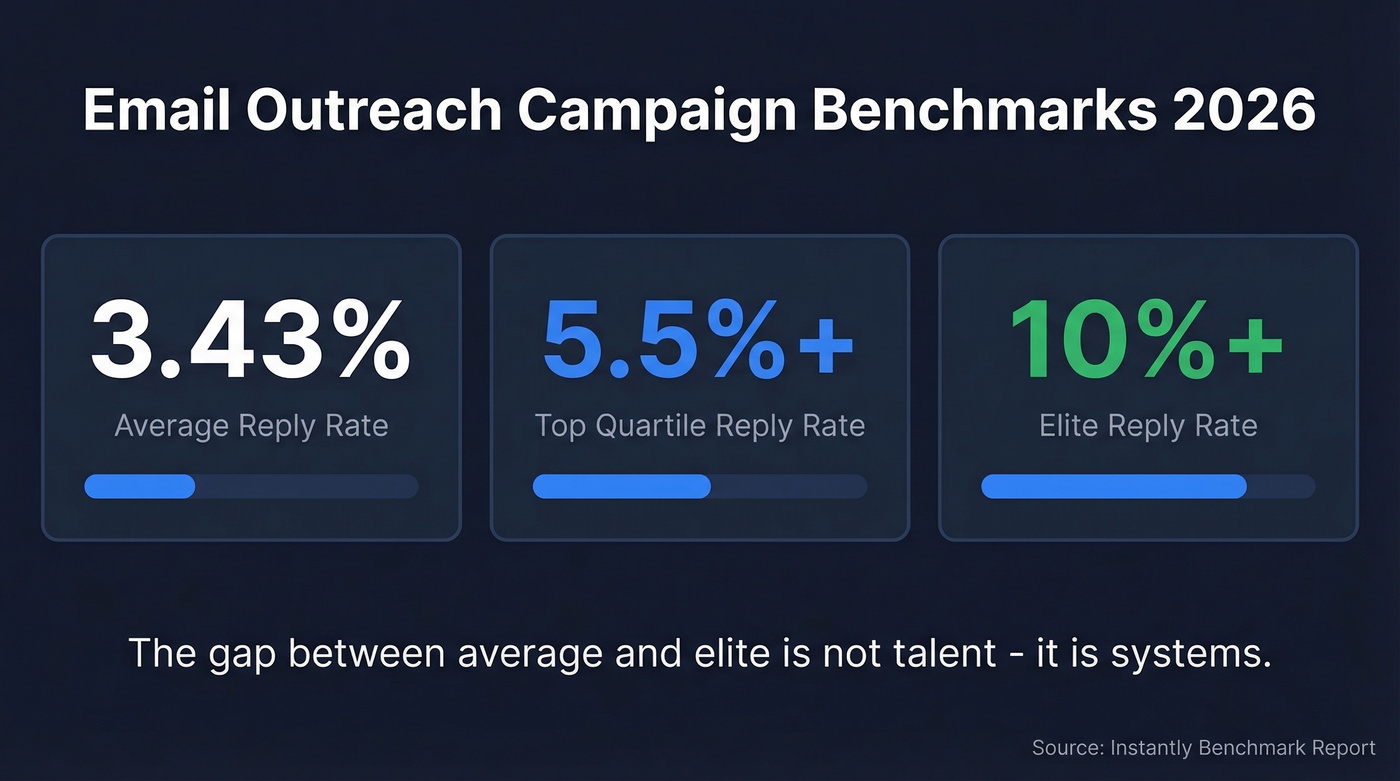
The average cold email reply rate in 2026 is 3.43%. Top-quartile campaigns hit 5.5%+. Elite operators exceed 10%. The gap between average and elite isn't talent - it's systems. Let's build one.
What Is Cold Email Outreach?
An email outreach campaign is a structured sequence of cold emails sent to prospects who haven't opted in, designed to start a sales conversation. It's not a newsletter. It's not a marketing blast to 50,000 subscribers. It's targeted, one-to-one communication at scale - typically 3-7 emails per prospect over roughly 2-4 weeks.
The cold email software market grew from $1.2B in 2023 to a projected $3.5B by 2032, and that growth reflects a simple reality: when done right, cold email is still the most cost-effective way to fill a B2B pipeline.
2026 Benchmarks: What Good Looks Like
Before you build anything, you need to know what "working" actually means. Open rates used to be the default metric, but Apple Mail Privacy Protection pre-loads tracking pixels, inflating opens across the board. Reply rate is your primary KPI now.
| Metric | Average | Top Quartile | Elite |
|---|---|---|---|
| Open rate | 20-30% (SaaS) | 35-50% | - |
| Reply rate | 1-3% (SaaS) | 4-8% | 10%+ |
| Positive reply rate | 0.5-1.5% | 2-4% | - |
| Meeting booked rate | 0.3-0.8% | 1-2% | - |
| Bounce rate | 2-5% | <2% | <1% |
Open rates are included for context, but treat them as directional at best. Instantly's benchmark report puts the overall reply rate average at 3.43% and top quartile at 5.5%+. SaaS-specific numbers run lower because buyers are more saturated. If you're below 2%, your infrastructure or data quality needs work before you touch your messaging.

The article is clear: bounce rates above 2% destroy your domain before bad copy ever hurts your pipeline. Prospeo's 5-step verification delivers 98% email accuracy across 143M+ verified addresses - refreshed every 7 days, not every 6 weeks.
Stop burning domains. Start with data that keeps you under 2% bounce.
How to Design Your Campaign in 7 Steps
Step 1 - Deliverability Infrastructure
This is the step everyone wants to skip. Don't.
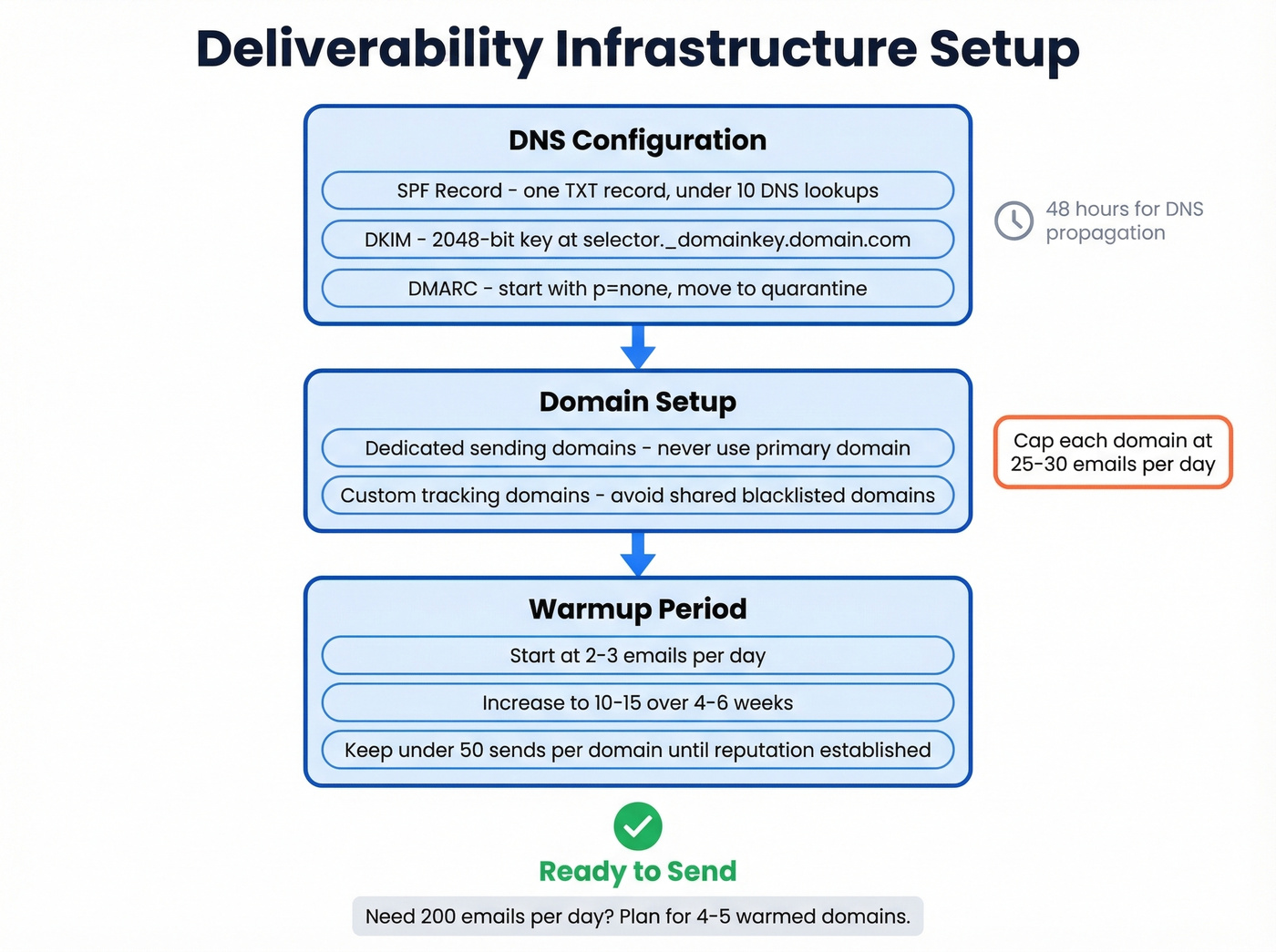
Gmail has enforced SPF, DKIM, and DMARC for bulk senders since February 2024. Outlook followed with its own enforcement for high-volume senders in May 2025. If your DNS records aren't right, your emails hit spam before a human ever sees them.
Three records to configure:
- SPF record: One TXT record per domain. For Google Workspace:
v=spf1 include:_spf.google.com ~all. Stay under 10 DNS lookups or you'll trigger a PermError that breaks DMARC alignment. - DKIM: Publish your public key at
selector._domainkey.yourdomain.com. Use 2048-bit keys when your provider supports them. - DMARC: Start with
v=DMARC1; p=none; rua=mailto:reports@yourdomain.comand move to quarantine or reject once you've validated DMARC alignment.
Allow 48 hours for DNS propagation. Keep a change log - you'll thank yourself later.
Beyond DNS, you need dedicated sending domains and custom tracking domains. Never send cold email from your primary domain, and avoid shared tracking domains that end up on blacklists. A practitioner on r/Entrepreneur shared their rebuild: they went from 3 domains to 7, capping each at 26 emails per day. Their reply rate doubled from 3% to 6%.
The warmup debate is real, and I'll take a side: skip automated warmup services. The r/coldemail crowd is increasingly skeptical - too many red flags with those tools. Manual ramping is slower but safer. Start at 2-3 emails per day, increase to 10-15 over 4-6 weeks.
Daily volume caps matter just as much. Keep sends under 50 per domain per day until your reputation is established. That means if you want to send 200 emails a day, you need at least 4-5 warmed domains. Plan accordingly. (If you want a deeper breakdown of safe sending limits, see email velocity.)
Step 2 - Build a Verified Prospect List
Your ICP definition comes before any data sourcing. Who are you targeting? What title, company size, industry, tech stack? Get specific. "VP of Marketing at B2B SaaS companies with 50-200 employees using HubSpot" is an ICP. "Decision-makers" is not. (If you need a structure, use an ideal customer profile template.)
Once you know who you're after, verification is non-negotiable. The same r/Entrepreneur team was running an 11% bounce rate before they stopped buying lists and started verifying every address. After the switch, bounce dropped below 2% and their domain reputation recovered within weeks.
Bad data is the silent killer of outreach campaigns. Prospeo runs 300M+ professional profiles through a 5-step verification process - catch-all handling, spam-trap removal, honeypot filtering - delivering 98% email accuracy on 143M+ verified addresses. The database refreshes every 7 days, compared to the 6-week industry average. You can search by 30+ filters including technographics, buyer intent, and job change signals, then export verified contacts directly to Instantly, Lemlist, or Smartlead.

Elite outreach campaigns hit 10%+ reply rates by combining verified data with precise targeting. Prospeo gives you 30+ filters - buyer intent, technographics, job changes, headcount growth - across 300M+ profiles at $0.01 per email. No contracts, no sales calls.
Build the prospect list your outreach campaign actually deserves.
Step 3 - Write Emails That Get Replies
Brevity is the single biggest lever. The best-performing cold emails run under 80 words. The team that doubled their reply rate cut their emails from 141 words to under 56. That's not a tweak - it's a rewrite. In our experience, the biggest reply rate gains come from cutting word count, not rewriting copy. (For more on structure and phrasing, see email copywriting.)
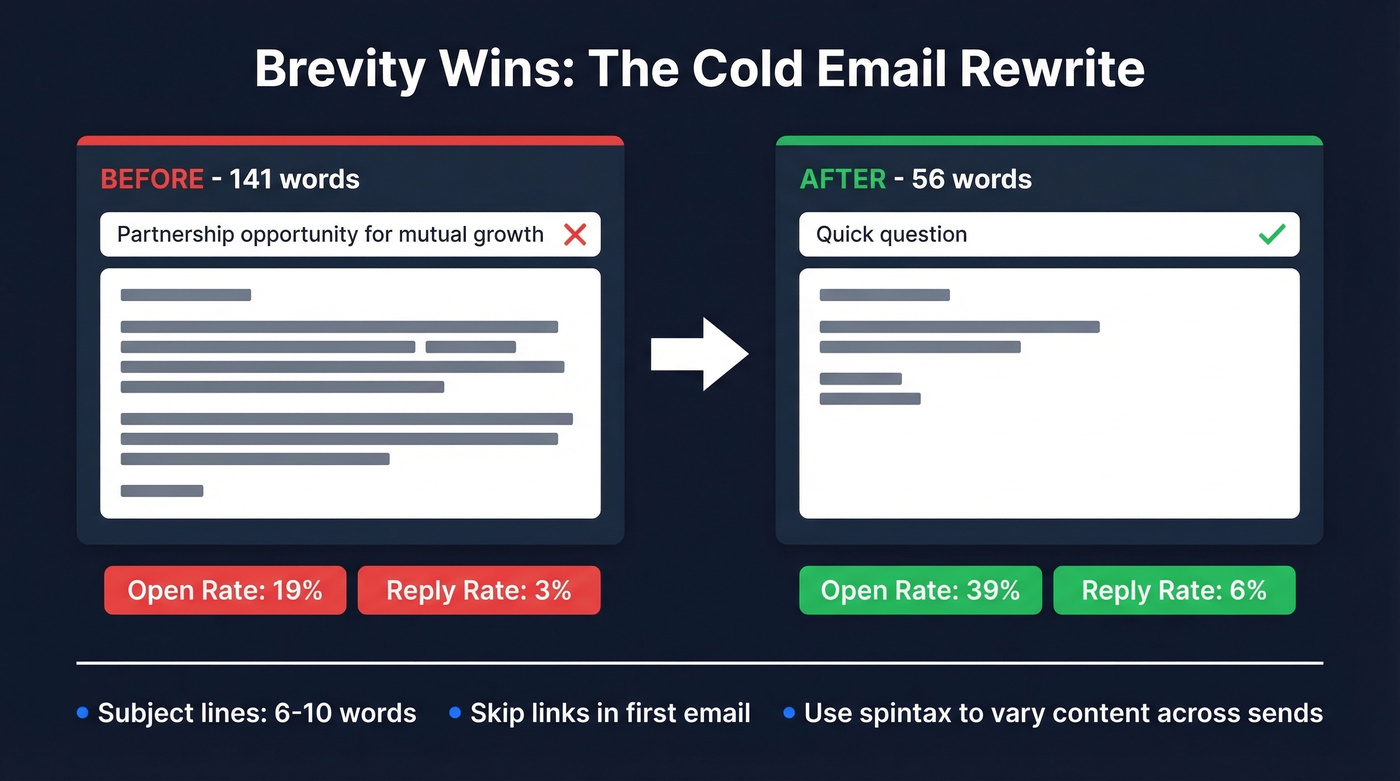
Subject lines should be 6-10 words. In one campaign, "Quick question" pulled 39% opens while "Partnership opportunity" limped in under 19%. Shorter, curiosity-driven subjects consistently outperform formal ones. If you need ideas, pull from these cold email subject line examples.
Personalization has to be genuine. Siege Media runs thousands of customized emails weekly and hit 81% opens with a 13% reply rate on one campaign. Their rule: don't lie in your personalization. Reference something specific - a recent post, a company milestone, a hiring signal. Generic "I love what you're doing at [Company]" fools no one.
Skip links in your first email. They hurt deliverability and make the email feel like marketing, not conversation. Use spintax to vary your content across sends - subject lines, opening lines, even signatures - so you're not sending the exact same message to hundreds of recipients.
Step 4 - Set Up Your Follow-Up Sequence
70% of cold email chains stop after the first message. That's a massive missed opportunity.
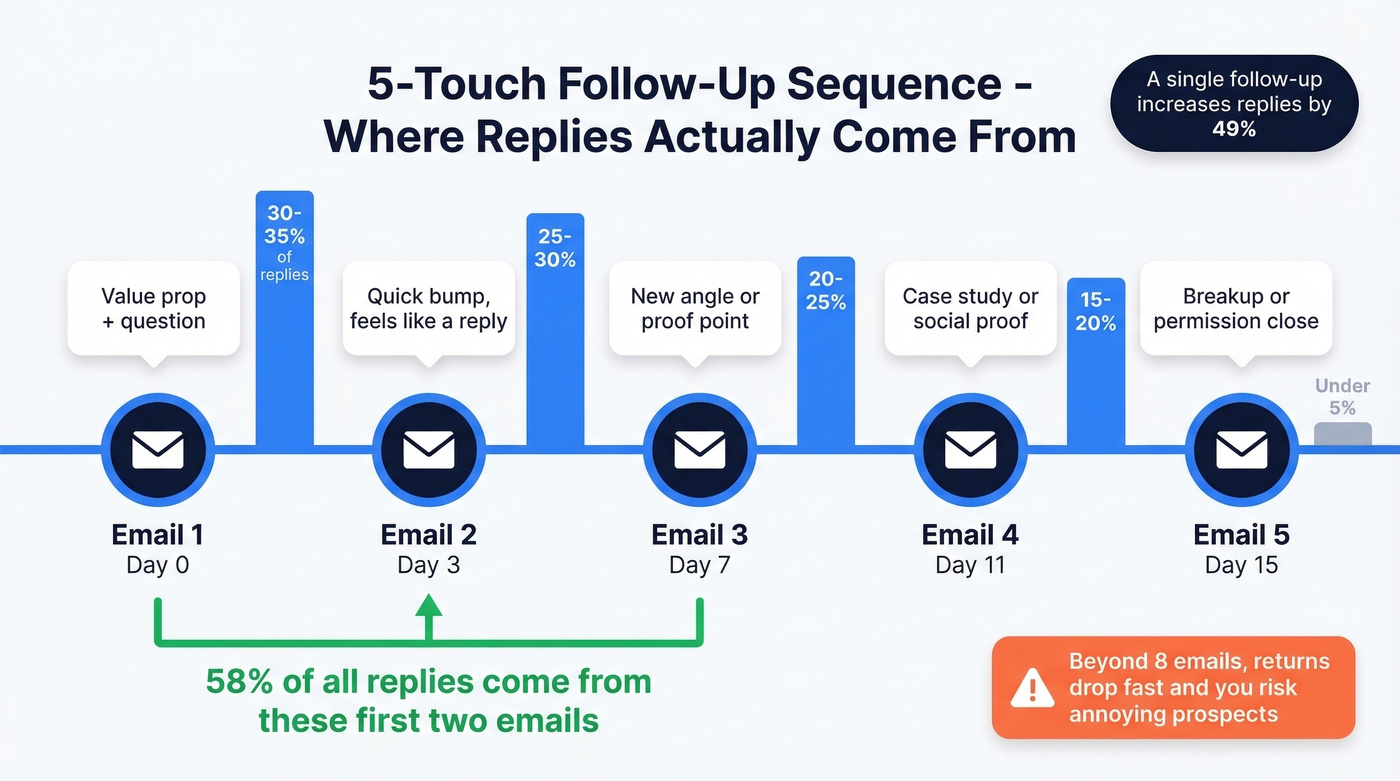
The reply split tells the story: 58% of replies come from the first email, but 42% come from follow-ups. A single follow-up alone increases replies by 49%. Campaigns with 4-7 touches generate 3x more responses than those with 1-3. Beyond 8 emails, returns drop fast and you risk annoying prospects.
Here's a framework that works:
| Touch | Day | Purpose | Reply Share |
|---|---|---|---|
| Email 1 | Day 0 | Value prop + question | 30-35% |
| Email 2 | Day 3 | Quick bump, feels like a reply | 25-30% |
| Email 3 | Day 7 | New angle or proof point | 20-25% |
| Email 4 | Day 11 | Case study or social proof | 15-20% |
| Email 5 | Day 15 | Breakup / permission close | <5% |
The bulk of your replies come from steps 1-2, which means those first two emails carry disproportionate weight. Space touches 3-4 days apart. That second email should feel like a casual follow-up, not a formal re-pitch - follow-ups styled as replies outperform formal messages by roughly 30%. Keep each touch under 50 words if you can. (If you want plug-and-play copy, use these cold email follow-up templates.)
Step 5 - Schedule and Send
Tuesday through Thursday, 8-11 AM in the recipient's timezone. That's the window. Wednesday consistently pulls the highest engagement. Monday works for launching new sequences. Avoid Friday - it has the highest auto-reply rate.
Shifting to Tue-Thu, 8-11 AM improved open rates by 16% in the r/Entrepreneur case study we referenced earlier. Throttle your sends across the morning window rather than blasting everything at 8:01 AM. Staggered delivery looks more natural to mailbox providers and avoids rate-limiting. For a deeper breakdown, see best time to send cold emails.
Step 6 - Measure What Matters
| Metric | Target | Why it matters |
|---|---|---|
| Reply rate | >3% | Primary success signal |
| Positive reply rate | >1.5% | Filters out "not interested" |
| Meeting booked rate | >0.8% | Revenue-adjacent metric |
| Bounce rate | <2% | Domain health indicator |
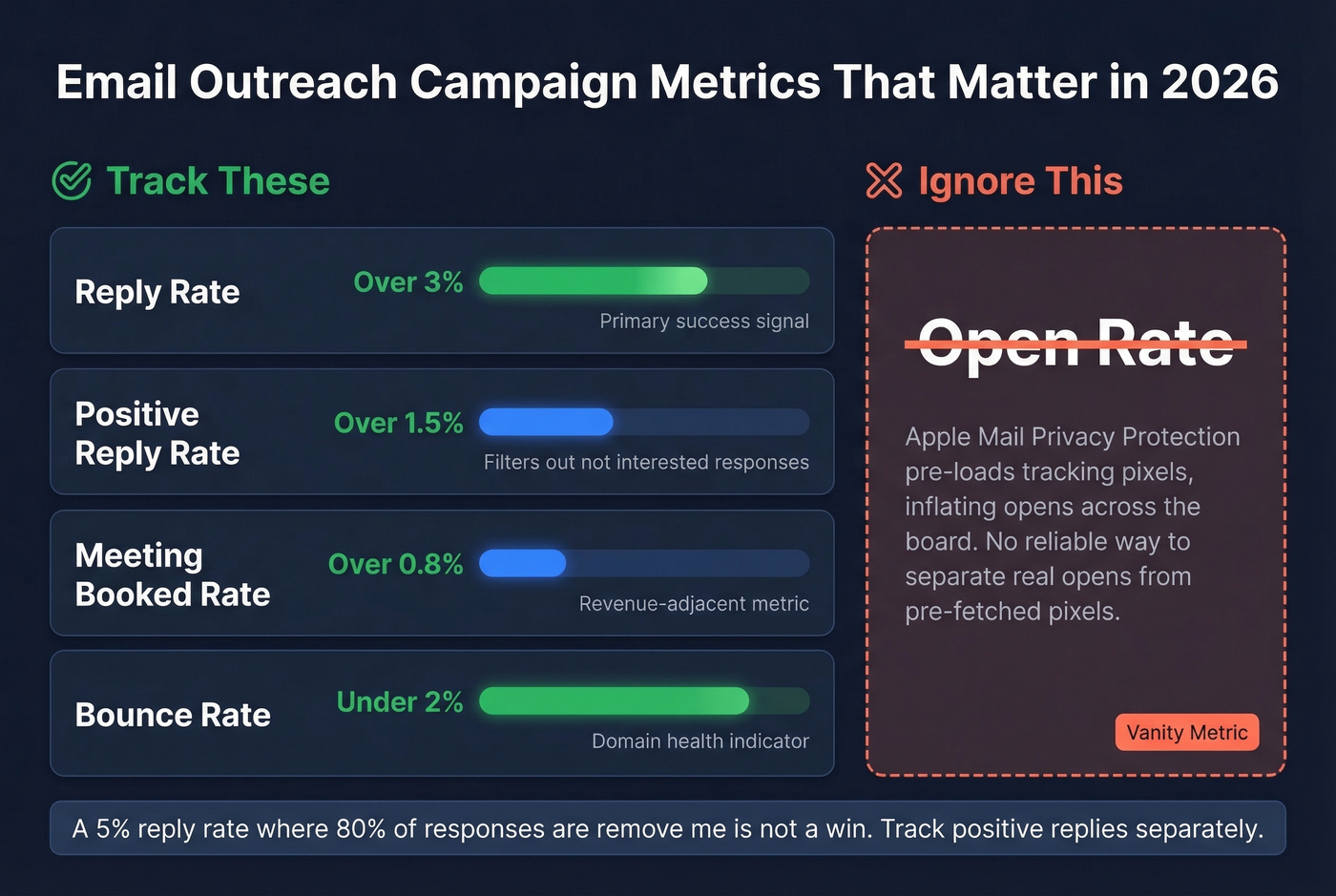
Open rates are a vanity metric in 2026. Apple Mail Privacy Protection inflates them, and there's no reliable way to separate real opens from pre-fetched pixels. Track positive reply rate separately - a 5% reply rate where 80% of responses are "remove me" isn't a win. If you're troubleshooting bounces specifically, start with email bounce rate.
Step 7 - Iterate Weekly
A/B test new messaging every week. Not monthly, not quarterly - weekly. Test one variable at a time: subject line, opening line, CTA, email length. Review which sequence step generates the most replies and prune steps that aren't pulling weight.
One pattern we see repeatedly: teams start with 5-8 step sequences, then realize later-step replies have dried up. The fix is simple. Cut to 3 steps and reinvest that sending volume into fresh prospects. The r/coldemail community has been vocal about this shift - more emails per prospect isn't always better than more prospects per campaign.
Hot take: if you're selling deals under $10K, you probably don't need a 7-step sequence at all. Three emails, tight targeting, and high volume will outperform a long nurture sequence every time. Save the elaborate cadences for enterprise deals where a single meeting is worth $5K+ in pipeline.
Once you've maxed out your email-only performance, consider adding a second channel. Sequences mixing email with phone or social touches outperform email-only by 15-25% on positive reply rate. That's a next-level play, but it's where elite teams go after nailing the fundamentals. (If you want more channels and tactics, see sales prospecting techniques.)
Compliance: Don't Skip This
Cold email is legal in most jurisdictions, but the rules vary and the penalties are real.
United States (CAN-SPAM): Opt-out framework. You can email anyone, but you must include truthful headers, non-deceptive subject lines, a physical mailing address, and a clear unsubscribe mechanism. Honor opt-outs within 10 business days. Penalties run up to $53,088 per email.
European Union (GDPR): Cold B2B email is permitted under legitimate interest, but this is a balancing test - not blanket permission. Document your legitimate interest assessment. Fines reach EUR 20M or 4% of global turnover.
Canada (CASL): The strictest major framework. It generally requires express or implied consent before sending. If you're prospecting into Canada, get legal advice before scaling.
UK (PECR): Similar to GDPR with a maximum penalty of GBP 500,000. B2B exemptions exist but are narrower than most teams assume.
The biggest compliance risk isn't your email copy - it's your data sourcing. Buying scraped lists or using unverified third-party data creates liability. Verified, compliant data sources are your legal foundation. (Related: Is It Illegal to Buy Email Lists?.)
What It Actually Costs
A serious outreach operation runs $300-500 per month once you add sending tools, verification, and dedicated domains. The r/Entrepreneur team that doubled their reply rate spent ~$420/month on their full stack: sending tools, verification, and 7 dedicated domains. The output: 16 qualified leads per month from email alone. At any reasonable B2B deal size, that math isn't close.
| Tool | Annual Starting Price | Best For |
|---|---|---|
| Instantly | ~$360/yr | SMB teams scaling volume |
| Woodpecker | ~$240/yr | Budget-conscious teams |
| Saleshandy | ~$300/yr | Mid-market with CRM needs |
| Smartlead | ~$390/yr | Multi-inbox rotation |
| Lemlist | ~$662/yr | Personalization-heavy campaigns |
| Apollo | Free plan; ~$59/mo/user | All-in-one prospecting |
For the data and verification layer, Prospeo starts free with 75 emails per month plus 100 Chrome extension credits, and scales at roughly $0.01 per email - a fraction of what enterprise data providers charge, with no contracts locking you in.
FAQ
Is cold email outreach legal?
Yes, in most regions. The US operates on an opt-out model under CAN-SPAM - you can send as long as you include an unsubscribe option and physical address. The EU allows B2B outreach under GDPR's legitimate interest provision. Canada's CASL is the strictest, generally requiring consent before sending.
What's a good reply rate for an email outreach campaign?
The 2026 average is 3.43%, and top-quartile campaigns hit 5.5%+. Elite operators exceed 10%. If you're consistently below 2%, focus on deliverability infrastructure and data quality before optimizing messaging - those two factors account for most underperformance.
How many follow-ups should I send?
Four to seven emails per sequence is the sweet spot, generating 3x more responses than 1-3 touch campaigns. A single follow-up alone increases replies by 49%. Beyond 8 emails, diminishing returns kick in hard and you risk damaging sender reputation.
Does cold email still work in 2026?
Yes, but the bar is higher than it was two years ago. Gmail and Outlook now enforce authentication standards. You need verified data, dedicated domains, and manual warmup. Teams that rebuilt their infrastructure are seeing 5-6%+ reply rates while everyone else watches their numbers slide.