

Email Templates for Lead Generation That Actually Get Replies
You copied a template from some blog, swapped in a first name and company, hit send on 200 emails, and got two replies. One was an out-of-office. The other asked to be removed from your list.
The problem isn't that email templates for lead generation don't work - it's that most people use them wrong. The average cold email reply rate dropped to 5.8% in 2024, based on 16.5M emails analyzed across 93 industries. That's down from 6.8% the year before. Templates alone won't save you. The right templates, a verified list, and proper sending infrastructure will.
What You Need (Quick Version)
Three template types outperform everything else: timeline/trigger hooks, value-first offers, and soft follow-ups. You don't need 55 templates. You need three good ones and a verified list.
The system behind the templates matters more than the copy:
- Verified contact data - run your list through a verification tool before sending a single email (see email verification)
- Deliverability infrastructure - multiple sending domains, proper authentication, warmup
- Send discipline - 25-30 emails per domain per day, not 200 from one inbox (use safe email velocity)
2026 Cold Email Benchmarks
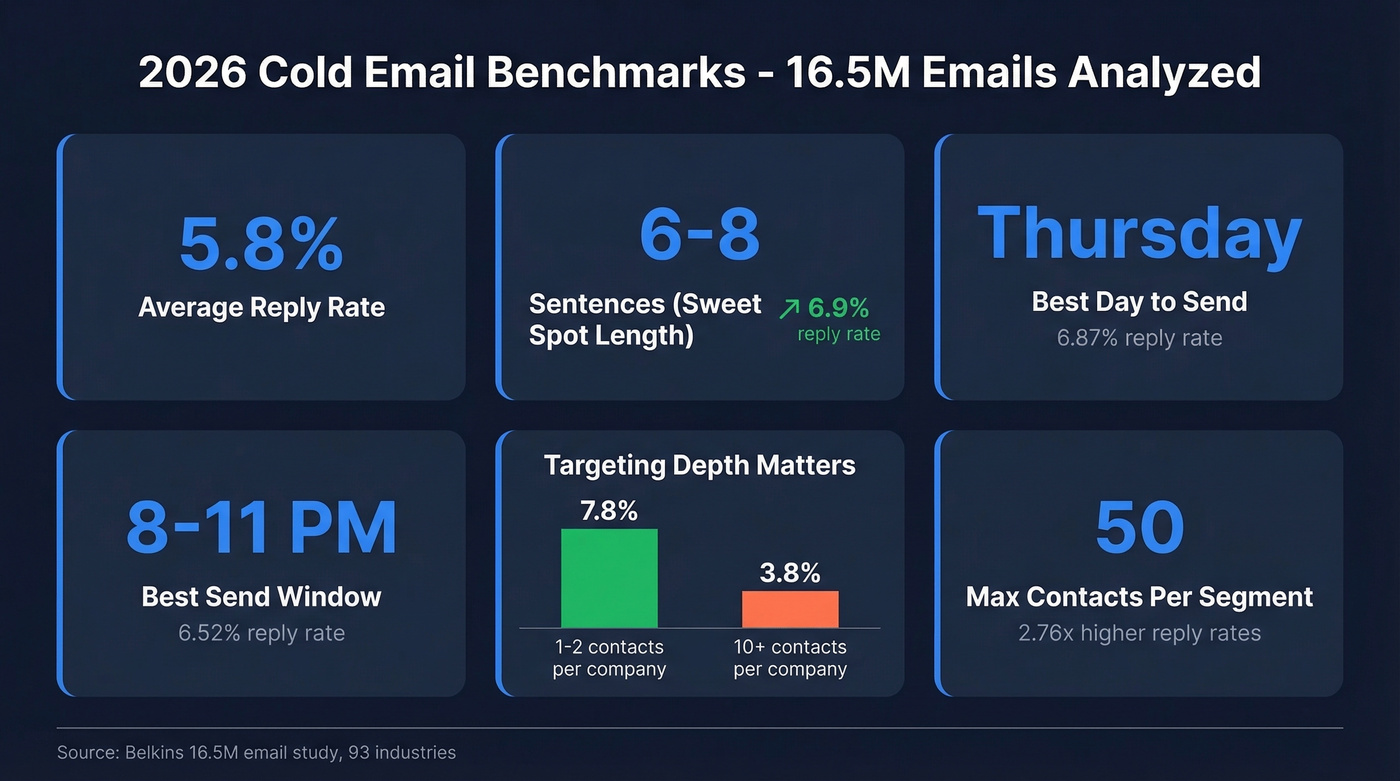
Before you write a word of copy, you need to know what "good" looks like. Here are the numbers from the Belkins study of 16.5M cold emails:
| Metric | Number |
|---|---|
| Avg reply rate | 5.8% |
| Best email length | 6-8 sentences (6.9% reply) |
| Best day | Thursday (6.87%) |
| Best send time | 8-11 PM (6.52%) |
| 1-2 contacts/company | 7.8% reply |
| 10+ contacts/company | 3.8% reply |
Segmenting lists into cohorts of 50 or fewer contacts can increase reply rates 2.76x, based on separate cold outbound benchmark data.
The [GMass analysis](https://www.gmass.co/cold-email-response-rates) puts the general range at 1-5%, which tracks with what we see across most teams. Anything above 6% is strong. Below 3% means your data, deliverability, or messaging needs work - probably all three.
Two things jump out. First, targeting depth matters enormously - emailing one or two contacts per company gets you double the reply rate of spraying ten-plus people at the same org. Second, Thursday evening beats Monday morning. Most teams send Monday at 9 AM because it "feels right." The data says otherwise. The same study also stopped tracking open rates mid-2024 after they swung wildly from 46% to 31%, which is further proof that reply rate is the only metric worth optimizing.
What Makes Cold Emails Convert
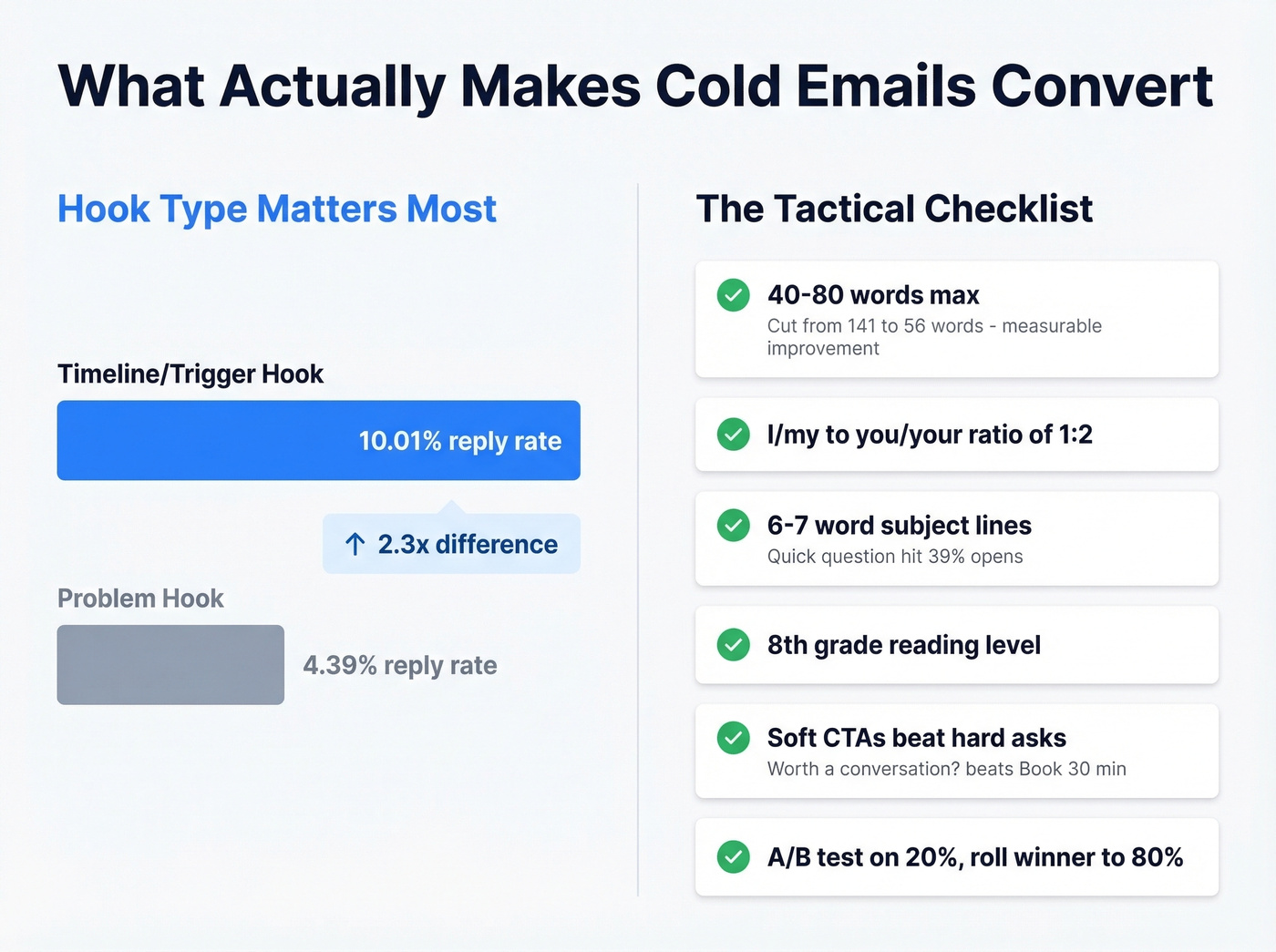
Most cold email advice focuses on frameworks - AIDA, PAS, BAB. The data shows hook type matters far more. Timeline-based hooks average a 10.01% reply rate versus 4.39% for problem hooks. That's a 2.3x gap. If someone just raised a round or changed jobs, lead with that. (More on sales prospecting techniques.)
Here's the thing: the tactical rules that actually move the needle are boring. But they work.
- 40-80 words max. One Reddit practitioner cut from 141 words to under 56 and saw measurable improvement. Shorter wins.
- I/my to you/your ratio of 1:2. Make the email about them, not you.
- 6-7 word subject lines. "Quick question" hit 39% opens in one campaign. "Partnership opportunity" landed below 19%. (See more cold email subject line examples.)
- 8th-grade reading level. 85% of readers comprehend content at this level. Write simply.
- Soft CTAs beat hard asks. "Worth a conversation?" outperforms "Book 30 minutes on my calendar." (Rules + examples in email call to action.)
- A/B test subject lines on 20% of your list, then roll the winner to the remaining 80%.
AI email tools are getting better at generating bespoke copy, but they still need a proven structure to riff on. These templates give you that structure. (If you're building with AI, see AI cold email outreach.)
10 Cold Outreach Templates That Work
Every template below is under 80 words. We practice what we preach.
Timeline / Trigger-Event Templates
Timeline hooks deliver a 10.01% reply rate - more than double what problem-based openers get. Use them when you can reference a specific event. They work especially well in SaaS and agency contexts where funding rounds and leadership changes happen frequently.
Template 1: Funding Round
Subject: Congrats on the Series B
Hi {{firstName}},
Saw {{company}} just closed your Series B - congrats. Most teams at this stage start scaling outbound but hit a wall with {{specific pain, e.g., "rep ramp time" or "list quality"}}.
We helped {{similar company}} cut that ramp from 10 weeks to 4. Built a quick breakdown of how it'd work for your team.
Worth a look?
Use this soon after a funding announcement. The timely hook and zero-commitment CTA make it effective.
Template 2: Job Change
Subject: Quick thought on {{new role}}
Hi {{firstName}},
Noticed you just moved to {{company}} as {{title}}. The first 90 days are usually about proving pipeline fast.
We work with {{persona type}} teams to {{specific outcome}}. Happy to share what's working for similar orgs right now - no pitch, just context.
Interested?
New hires are actively looking for solutions, which makes the first few weeks after a role change an ideal window. The "no pitch" framing lowers resistance.
Value-First Offer Templates
The consensus on r/coldemail is clear: the offer does the heavy lifting, not the personalization. A free audit beats a discovery call almost every time.
Why Template 3 works before you even read it: at 47 words, it delivers value before the prospect replies. No pitch, no ask, just proof you did the work.
Template 3: Free Audit / Loom
Subject: Found 3 things on {{company}}'s site
Hi {{firstName}},
Took a look at {{company's website/landing pages/ads}} and spotted a few quick wins around {{area}}.
Recorded a 2-min Loom walking through them. Want me to send it over?
Template 4: Benchmark Report
Subject: {{industry}} benchmarks - Q1 2026
Hi {{firstName}},
We just pulled together {{industry}} benchmarks on {{metric}} across 200+ companies. Your segment is doing {{X}} on average - curious how {{company}} stacks up.
Happy to share the full report if useful.
Use this when you have real data or can compile it quickly. It positions you as a resource, not a vendor. This approach works particularly well as a lead magnet outreach email - you're offering something genuinely useful in exchange for a conversation.
First-Touch Prospecting Templates
Templates 5 and 6 are your workhorses - the emails you send when there's no obvious trigger event but you've done enough research to make a relevant observation.
Template 5: Observation-Based Opener
Subject: {{specific observation}}
Hi {{firstName}},
Noticed {{company}} is {{specific observation - hiring SDRs, expanding into EMEA, running new ad campaigns}}. Teams at that stage usually run into {{pain point}}.
We help {{persona}} solve that by {{one-line value prop}}. Worth a quick conversation?
Template 6: Mutual Connection
Subject: {{mutual connection}} suggested I reach out
Hi {{firstName}},
{{Connection name}} mentioned you're working on {{initiative}}. We helped their team {{specific result}} and thought it'd be relevant for {{company}}.
Open to a quick chat this week?
Skip Template 6 if you don't have a genuine mutual connection. Faking it is the fastest way to lose credibility.
Follow-Up Sequence Templates
The 3-7-7 cadence - Day 0, Day 3, Day 10, Day 17 - captures 93% of replies by Day 10. Each email below adds a new angle rather than just "bumping" the thread. (More options in cold email follow-up templates.)
Template 7: Day 3 - The Nudge
Subject: Re: {{original subject}}
Hi {{firstName}},
Wanted to bump this up in case it got buried. The {{offer/insight}} I mentioned is still relevant - especially given {{timely detail}}.
Worth a quick look?
Template 8: Day 10 - New Angle
Subject: Re: {{original subject}}
Hi {{firstName}},
One more thought - {{new angle or additional value point}}. I've seen teams like {{company}} get {{result}} from this approach.
If the timing's off, no worries. Just say the word.
Template 9: Day 17 - Clean Exit
Subject: Re: {{original subject}}
Hi {{firstName}},
Last note from me on this. If {{pain point}} isn't a priority right now, totally understand.
If it ever becomes one, here's where to find me: {{link}}.
Break-Up / Re-engagement Template
Template 10: Soft Close
Subject: Should I close your file?
Hi {{firstName}},
I've reached out a few times and haven't heard back - which usually means the timing isn't right or this isn't relevant.
Either way, no hard feelings. If anything changes, I'm here.
The "close your file" framing creates gentle urgency without pressure. In our experience, it's the most replied-to email in many sequences - people who ignored everything else suddenly respond to this one.

Your templates are only as good as your list. Sending 200 perfectly crafted cold emails to unverified addresses kills your domain reputation and tanks reply rates. Prospeo's 5-step verification delivers 98% email accuracy - teams using it see bounce rates drop from 35% to under 4%.
Stop burning templates on bad data. Verify your list first.
The Follow-Up Sequence That Works
It takes an average of 5 touches to engage a prospect. Executives need roughly 9 touches versus 4 for lower-level contacts.
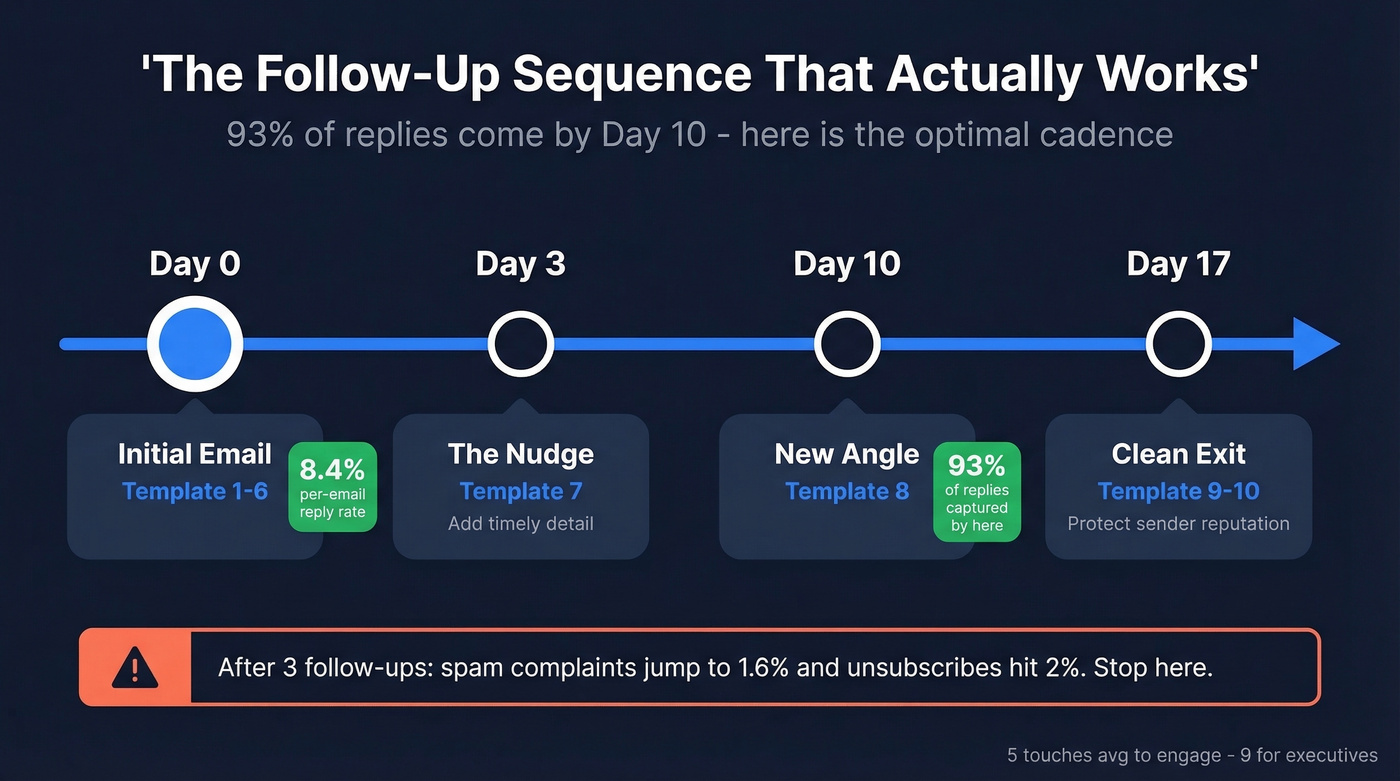
But there's a hard ceiling. A single email actually has the highest per-email reply rate at 8.4%. Each additional touch dilutes that - but the cumulative effect still justifies a short sequence. The 16.5M-email dataset tells the rest of the story: spam complaints jump from 0.5% on the first email to 1.6% by the fourth. Unsubscribes hit 2% by round four.
Three follow-ups is the sweet spot. Four or more burns your domain for diminishing returns. If they haven't replied after three follow-ups, they're not interested. Move on and protect your sender reputation. (More on the importance of follow-up in sales.)
Infrastructure Checklist Before Sending
Templates matter, but infrastructure decides whether your emails land in inboxes or spam. (Full walkthrough: email deliverability guide.)
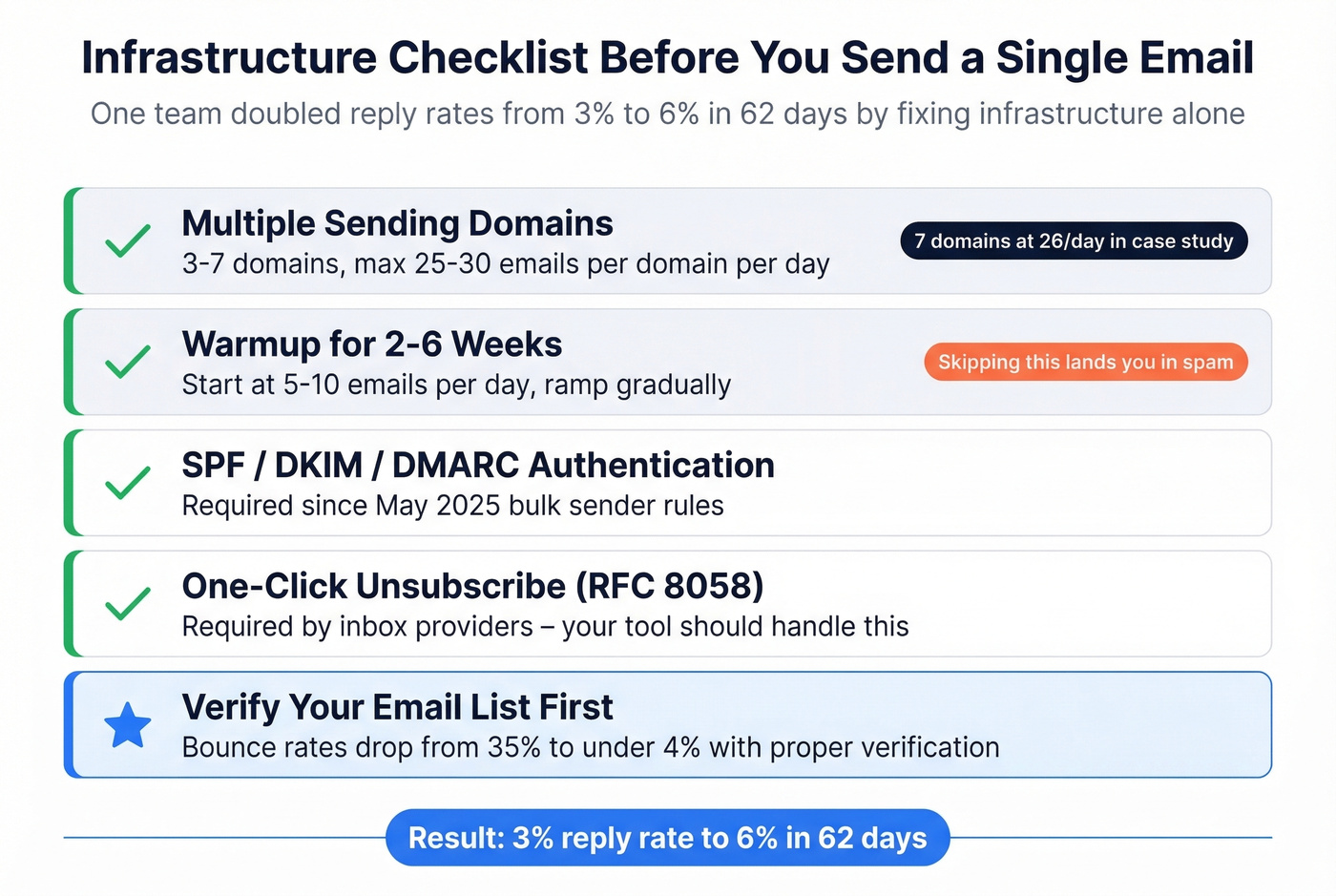
One practitioner on r/Entrepreneur rebuilt their entire cold email stack and doubled reply rates from 3% to 6% in 62 days. Here's the infrastructure that made it work:
- Multiple sending domains. 3-7 domains, each sending max 25-30 emails per day. That case study used 7 domains at 26 emails/day each.
- Warmup for 2-6 weeks. Start at 5-10 emails/day and ramp gradually. Skipping warmup is the fastest way to land in spam. (Tooling options: best unlimited email warmup tools.)
- SPF/DKIM/DMARC authentication. Non-negotiable since the May 2025 bulk sender rules took effect across major inbox providers.
- One-click unsubscribe (RFC 8058). Required by those same rules. Your sending tool should handle this automatically.
- Daily send limits. 25-30 per domain. Not per account - per domain.
- Spam complaints under 0.3%. Gmail Postmaster Tools will tell you where you stand.
- Bounces under 2%. This is where data quality becomes non-negotiable. (Benchmarks + fixes: email bounce rate.)
Your Data Makes or Breaks Everything
B2B contact data decays 20-30% per year. People change jobs, companies get acquired, email servers get reconfigured. Industry estimates put bad data costs at roughly $32,000 per rep annually in wasted time and burned sender reputation.
That Reddit case study? Their bounce rate was 11% before they overhauled their list hygiene. After manual verification, it dropped below 2%. Stack Optimize built from $0 to $1M ARR while maintaining 94%+ deliverability and under 3% bounce rates across all clients.
Let's be honest: none of the templates above matter if half your emails bounce. Before you send a single lead generation email from this article, verify your list. Prospeo's Email Finder pulls from 300M+ professional profiles with 98% verified email accuracy on a 7-day data refresh cycle. The 5-step verification process handles catch-all domains, removes spam traps, and filters honeypots - the invisible threats that tank your domain reputation overnight. It integrates natively with Instantly, Smartlead, Lemlist, HubSpot, and Salesforce, so verified contacts flow straight into your sequences.
The Realistic Cold Email Stack
Here's what a working cold email stack actually costs in 2026:
| Layer | Tool | Cost |
|---|---|---|
| Data + verification | Prospeo | Free-$0.01/email |
| Sending + warmup | Instantly / Smartlead / Lemlist | $30-97/mo |
| CRM | HubSpot (free) / Salesforce | $0-75/mo |
| Domains (3-7) | Any registrar | $30-105/yr |
Total: $100-500/month. That Reddit practitioner spent ~$420/month and generated 16 qualified leads per month. Everything downstream - your sequences, your follow-ups, your templates - depends on reaching real inboxes. That's why data and verification sit at the top.
Real talk: if your average deal size is under $10k, you probably don't need a $15k/year data platform. A self-serve tool at $0.01/email, a sending platform, and three solid templates will outperform an enterprise stack that your team barely uses.
Timeline hooks hit 10% reply rates - but only if you find the right people fast. Prospeo tracks job changes, funding rounds, and hiring signals across 300M+ profiles so you can trigger these templates the moment they matter most.
Find trigger events and verified emails in one search.
FAQ
How many cold emails should I send per day?
25-30 per domain per day. Use 3-7 sending domains to scale volume without triggering spam filters. The case study that doubled reply rates used 7 domains at 26 emails/day each - roughly 180 emails per day total.
What's a good cold email reply rate in 2026?
The average is 5.8% based on 16.5M emails analyzed. Above 6% is strong. Below 3% signals problems with your data, deliverability, or messaging - start with list verification before rewriting copy.
How long should a cold email be?
40-80 words for maximum reply rates. The 16.5M-email study found 6-8 sentences hit the sweet spot at 6.9% reply rate. Reddit practitioners report the best results under 56 words.
Do lead generation email templates still work in 2026?
They work better than ever when paired with verified data and proper infrastructure. Teams hitting 6%+ reply rates aren't using magic copy - they're sending short, specific templates to verified contacts from warmed-up domains.