

How to Write an Email to Introduce Your Company to New Clients
You sent 200 emails last quarter introducing your company to new prospects. Zero replies. When you checked the logs, 35% bounced - they never even arrived. The problem wasn't your copy. It was your data.
Let's fix both.
What You Need (Quick Version)
- Keep it under 80 words - the best-performing cold email campaigns in 2026 use sub-80-word emails
- Lead with your offer, not your bio - what you deliver matters more than who you are (if you need help tightening the offer, borrow from these unique selling proposition examples)
- Verify every email address before sending - bounces destroy your domain reputation
- Follow up 4-7 times - 42% of replies come from follow-ups, not the first email (use these follow-up email best practices to keep the cadence clean)
2026 Benchmarks That Matter
The average cold email reply rate in 2026 is 3.43%. Average B2B open rate sits at 27.7%. The top 10% of senders hit 10.7%+ reply rates, and the gap between average and great isn't talent - it's process: shorter emails, verified addresses, relentless follow-up.
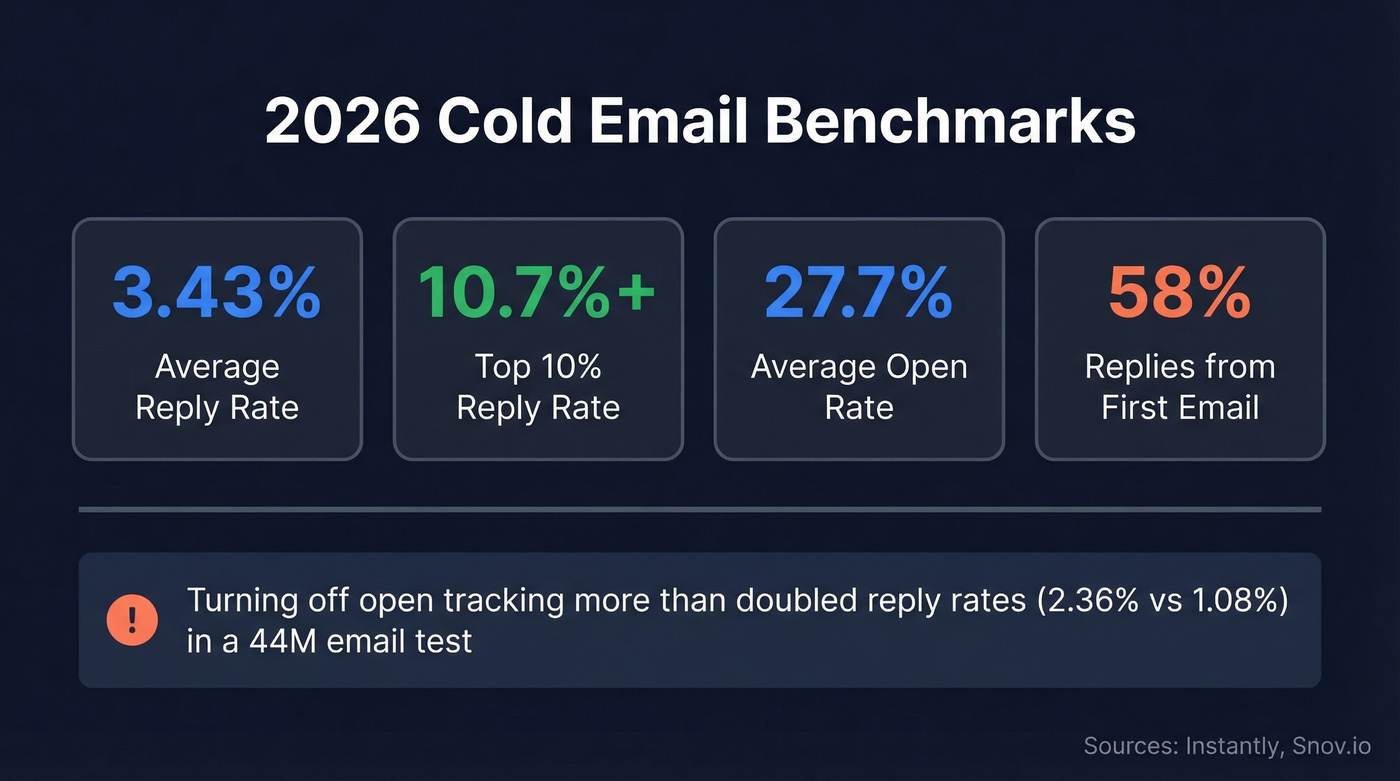
Benchmark data from billions of cold email interactions shows the best-performing campaigns use sub-80-word emails. Practitioners often do well in the 50-125 word range. Tuesday and Wednesday are peak send days, with Wednesday edging ahead. And 58% of replies come from the first email, which means your introduction email carries most of the weight.
Here's a stat worth acting on: in a 44-million-email test, turning off open tracking more than doubled reply rates (2.36% vs 1.08%). If you're chasing open rates, you're tanking the metric that actually matters.
Our take: Personalization is overrated. The consensus on r/sales is that "I read your blog post" doesn't move the needle if your offer is weak. A strong, specific outcome beats a personalized compliment every time.
Anatomy of a Business Introduction Email
Step zero: verify the address. Your perfectly crafted company introduction email is worthless if it bounces. We've seen this firsthand - one customer's bounce rate dropped from 35% to under 4% after switching to verified data, and their pipeline tripled. Run every address through verification before you hit send. Prospeo's email finder handles this at 98% accuracy with a free tier of 75 emails/month. Now, the email itself. Four sentences, four jobs:
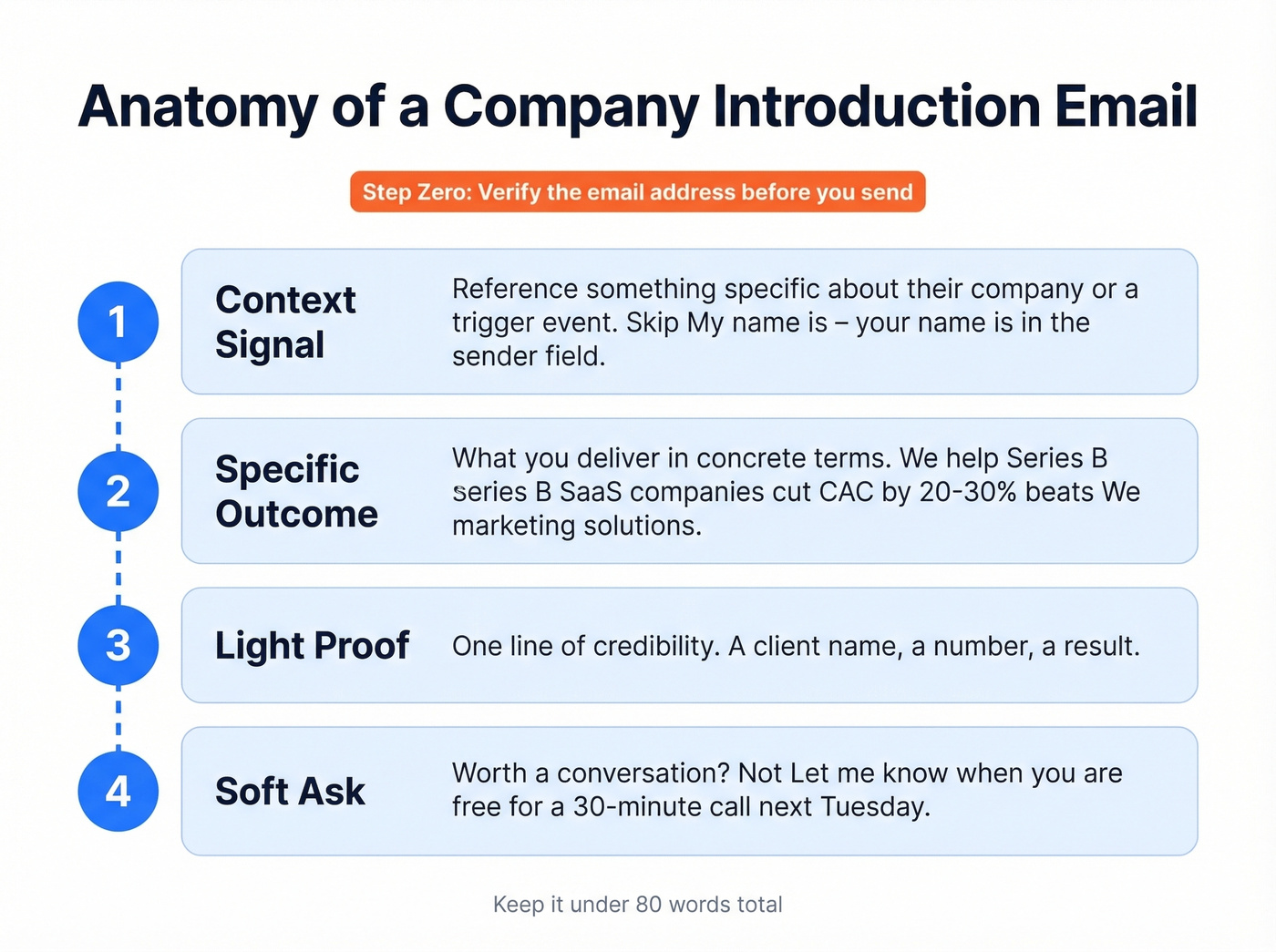
- Context signal - reference something specific about their company, a trigger event, or a shared connection. Skip "My name is..." - your name's in the sender field. (If you want a repeatable research method, use the 3x3 research framework.)
- Specific outcome - what you deliver, in concrete terms. "We help Series B SaaS companies cut CAC by 20-30%" beats "We offer marketing solutions." (More examples: sales message frameworks.)
- Light proof - one line of credibility. A client name, a number, a result.
- Soft ask - "Worth a conversation?" Not "Let me know when you're free for a 30-minute call next Tuesday." (See more email call to action patterns.)
Write simply. Emails at a third-grade reading level perform 36% better on opens than college-level prose, and including 1-3 questions generates 50% more responses. Subject lines follow the same rule: short and specific (steal from these B2B cold email subject lines).

The article says it: step zero is verifying the address. A 35% bounce rate doesn't just waste your intro email - it torches your domain reputation. Prospeo's email finder delivers 98% accuracy at $0.01/email, with a 7-day data refresh cycle so you're never sending to stale addresses.
Stop writing perfect intro emails to dead inboxes.
4 Templates You Can Send Today
These four frameworks cover the most common scenarios for writing an email to introduce your company to new clients. Adapt the structure to your industry and keep every version under 80 words.
Cold Outreach to a New Prospect
Subject: Quick question about [their company]
Hi [Name],
Noticed [company] is scaling [specific area]. We help similar teams [specific outcome] - [Client X] saw [result] in [timeframe].
Worth a quick conversation?
[Your name]
This is the simplest introduction email template for reaching new clients - and often the most effective because it gets straight to value. No preamble, no company history. (For more variations, see these intro email samples.)
Trigger-Event Intro (Funding, Hiring, Expansion)
Subject: Congrats on the raise
Hi [Name],
Saw [company] just closed your Series [X]. Teams at this stage usually hit [specific pain point] fast. We helped [similar company] solve that - [one-line result].
Interested in how?
[Your name]
Referral-Based Intro
Subject: [Mutual contact] suggested I reach out
Hi [Name],
[Mutual contact] mentioned you're working on [challenge]. We helped their team [specific outcome], and they thought we could do the same for [company].
Open to a quick chat this week?
[Your name]
(If you want better options for the subject line, use these referral email subject line examples.)
Partnership or Collaboration Intro
Subject: Idea for [their company] + [your company]
Hi [Name],
Your [product/content/audience] and our [capability] overlap in a way that could benefit both sides. [One specific idea - e.g., "co-hosted webinar for our combined 10K subscribers"].
Worth exploring?
[Your name]
Every template is under 80 words with a soft CTA - no company history, no three-paragraph pitch. (More: professional email introduction templates.)
Building a Follow-Up Sequence
48% of salespeople never follow up once. Meanwhile, 60% of prospects say no four times before saying yes. The math is obvious.
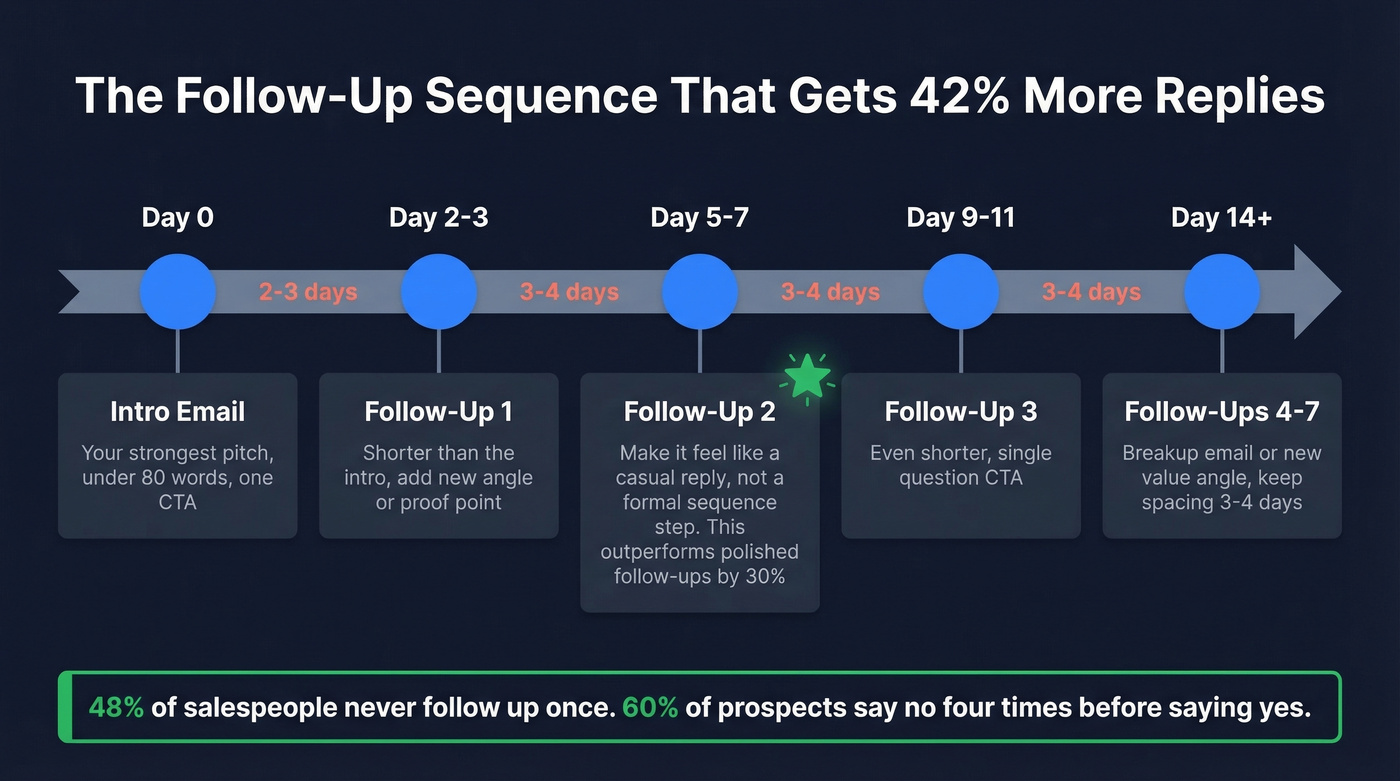
Send follow-up #1 two to three days after the intro email, #2 three to four days after that, and #3 another three to four days later. Four to seven total touchpoints is the sweet spot, and each follow-up should be shorter than the last with a single CTA. One tactic that works well: make follow-up #2 feel like a casual reply rather than a formal sequence step - this approach outperforms polished follow-ups by roughly 30%. (If you need wording that doesn’t sound robotic, use these bump email patterns.)
Skip this if you're only sending to a handful of prospects. Sequences make sense at scale. For five or ten targets, just set a calendar reminder and write something personal.
Legal Requirements You Can't Skip
B2B isn't exempt from CAN-SPAM. Every commercial email needs a valid physical postal address, a working unsubscribe mechanism, non-deceptive subject lines, and opt-outs honored within 10 business days. This applies whether you're sending an email to introduce your company to new clients or a one-off follow-up. (For the technical + legal checklist, see email marketing rules.)
| Regulation | Jurisdiction | Max Penalty |
|---|---|---|
| CAN-SPAM | US | $53,088/email |
| GDPR | EU | EUR 20M or 4% global turnover |
| CASL | Canada | $10M CAD |
| Spam Act | Australia | $1.1M AUD |
Here's the thing: if you're sending cold emails without an unsubscribe link, you're not just risking fines - 53% of recipients mark emails as spam when they can't find one. That's a deliverability death sentence.
7 Mistakes That Kill Your Intro Email
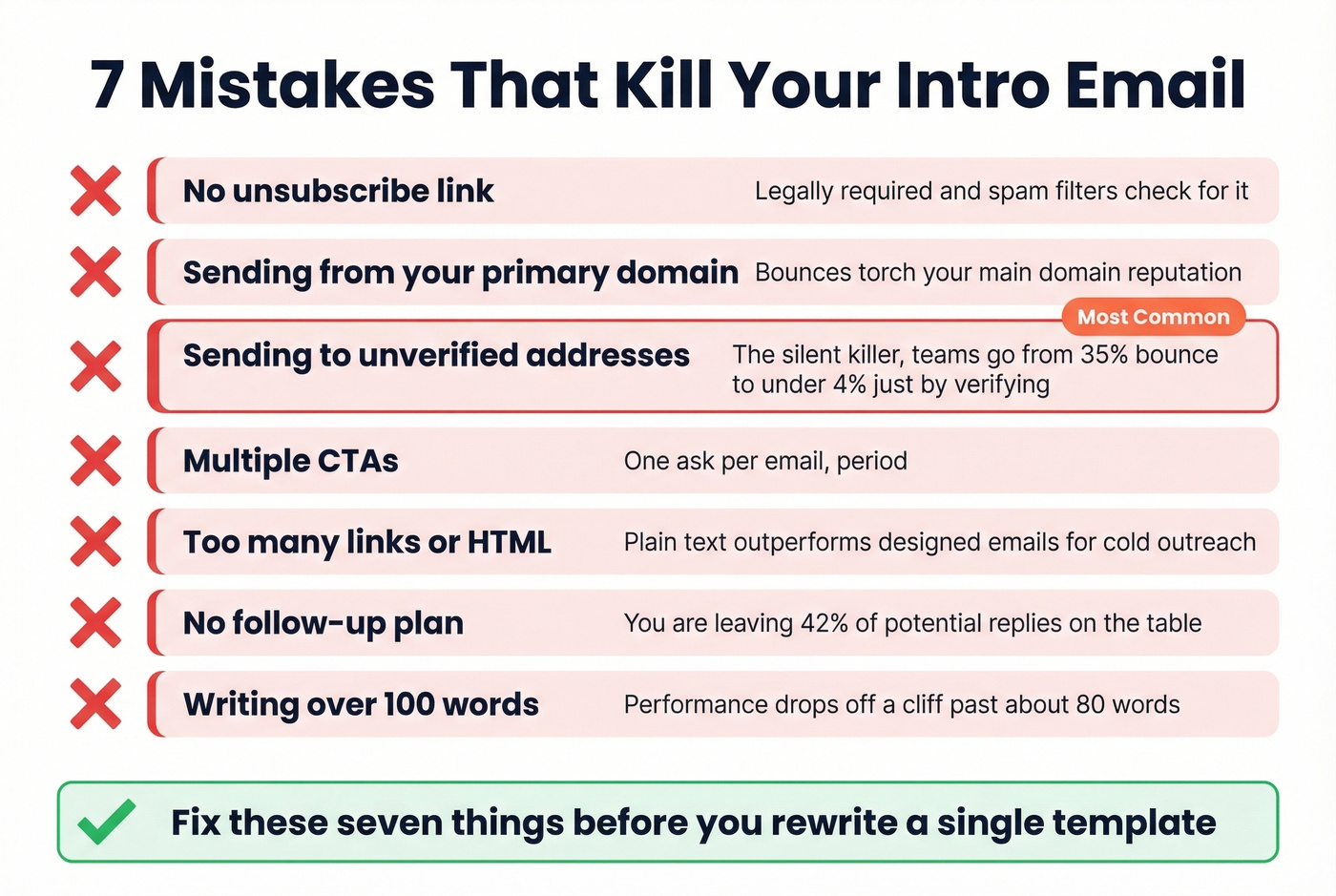
- No unsubscribe link - legally required, and spam filters check for it
- Sending from your primary domain - use a secondary domain so bounces don't torch your main reputation (also watch for email blacklist issues)
- Sending to unverified addresses - the silent killer. We've watched teams go from 35% bounce rates to under 4% just by verifying their lists, tripling pipeline in the process.
- Multiple CTAs - one ask per email. Period.
- Too many links or HTML - plain text outperforms designed emails for cold outreach
- No follow-up plan - you're leaving 42% of potential replies on the table
- Writing over 100 words - once you go past about 80 words, performance drops off a cliff
You just built a follow-up sequence for new client outreach. Now you need verified contact data to fuel it. Prospeo gives you 300M+ profiles with 30+ filters - buyer intent, funding rounds, headcount growth - so every intro email lands with the right person at the right company.
Build your prospect list in minutes, not hours.
FAQ
How long should a company introduction email be?
Under 80 words. 2026 benchmark data shows the best-performing campaigns use sub-80-word emails. Four sentences is the sweet spot: context signal, specific outcome, light proof, soft ask.
What's a good reply rate for introduction emails?
The average cold email reply rate in 2026 is 3.43%. Top performers hit 10.7%+. If you're below average, the issue is likely deliverability or data quality - verify your list, shorten your emails, and follow up consistently before rewriting templates.
Is it legal to send cold introduction emails to businesses?
Yes, in most jurisdictions - but you must comply with CAN-SPAM (US), GDPR (EU), or CASL (Canada). Every commercial email needs a physical address, a working unsubscribe link, and an honest subject line.
How many follow-ups should I send after an introduction email?
Four to seven touchpoints is the sweet spot. 42% of replies come from follow-ups, not the first email. Space them 2-4 days apart and keep each one shorter than the last.