

Professional Email Introduction Templates (2026)
Roughly 95% of cold emails fail to generate a reply. That's not a rounding error - it's the norm. And 17% never even reach the inbox. They bounce, hit spam, or vanish before anyone reads your carefully crafted introduction.
The difference between the 95% that fail and the top 10% pulling reply rates above 10.7%? Structure, brevity, and a deliverability step most template guides skip entirely.
Three Things That Matter Most
- Keep it short (50-125 words). The Instantly 2026 benchmark report found elite performers keep first-touch emails under ~80 words.
- Include 1-3 questions. Emails with 1-3 questions produce 50% more responses than emails without them.
- Verify the address before sending. If 17% of cold emails never reach the inbox, your template is irrelevant until the address is valid - and bad addresses actively damage your domain reputation for every future send.
What the Benchmark Data Says
The Instantly 2026 benchmark analyzed billions of cold email interactions. Average reply rate: 3.43%. Top quartile performers hit 5.5%+. The top 10% clear 10.7%+.
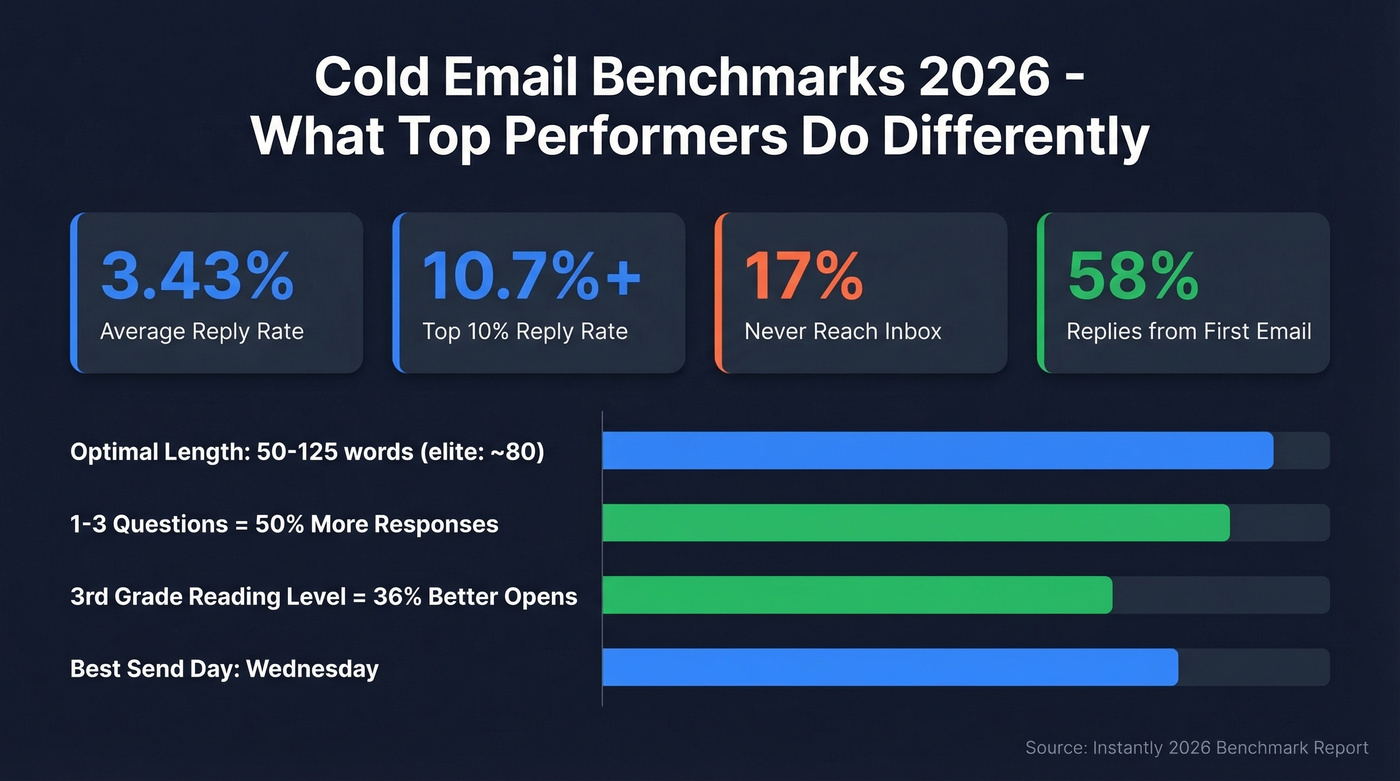
What separates those tiers is a handful of measurable patterns. Optimal email length is 50-125 words, with 80 as the elite benchmark. Emails written at a third-grade reading level see 36% better open rates than college-level writing - which tells you everything about how people actually read email. Including 1-3 questions drives 50% more responses. Wednesday is the best send day, with Tuesday close behind.
Here's the stat that should change how you plan campaigns: 58% of replies come from the first email, but 42% come from follow-ups. 48% of salespeople never send a second email. That's not a strategy. It's self-elimination.
How to Write a Professional Introduction Email
Open with a real greeting. "Hi Sarah" works for SaaS. "Good afternoon Dr. Chen" works for legal or healthcare. Match the tone to the industry.
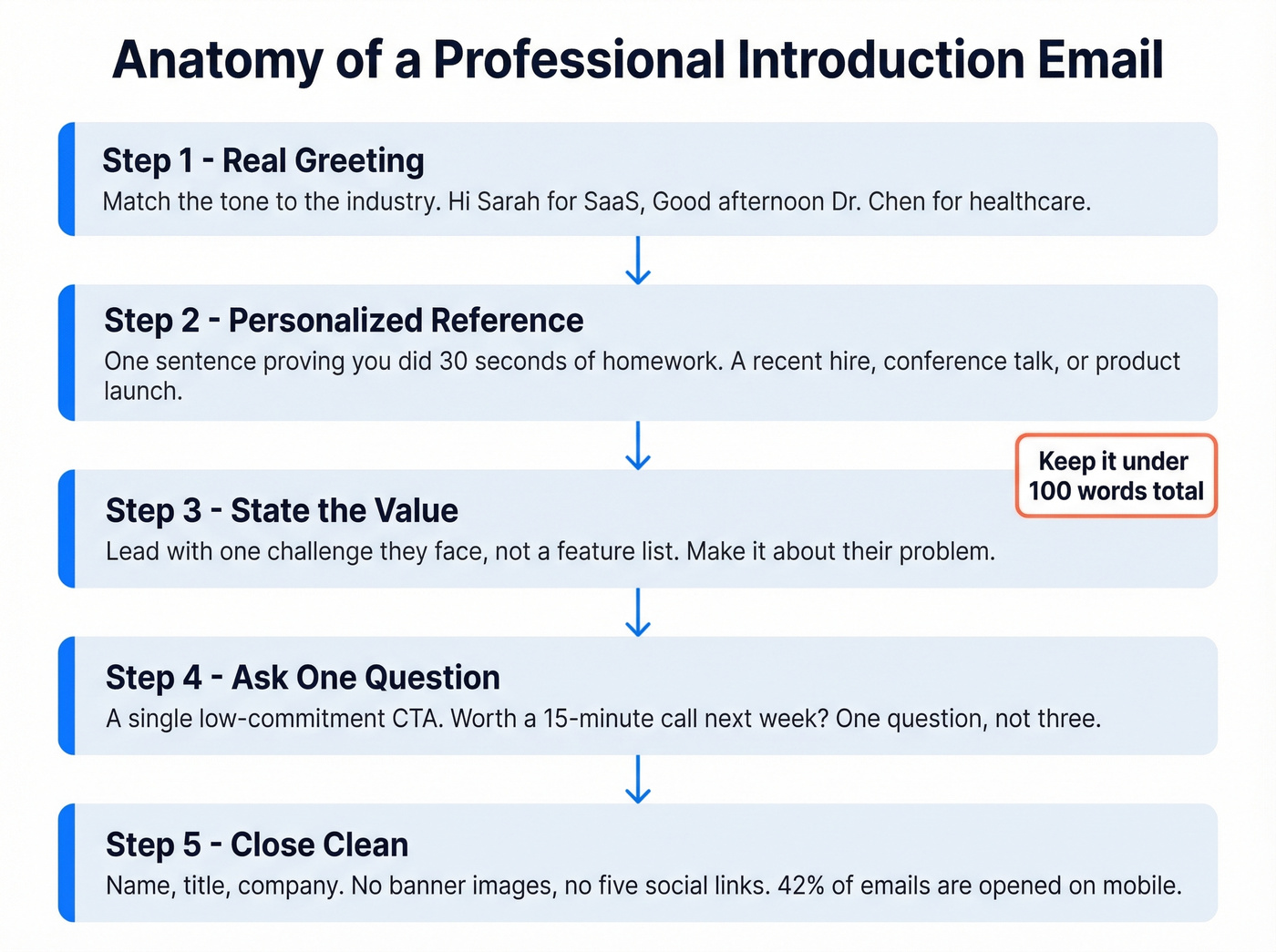
Add a personalized reference. Not "I saw your company is doing great things." Something specific - a recent hire, a conference talk, a product launch. One sentence proving you did 30 seconds of homework. Hyper-personalized "BASHO" emails worked in the early 2010s but became overused; today, personalization needs genuine insight, not just name-dropping. (If you want a deeper playbook, see personalization.)
State the value. Lead with one challenge they're likely facing, not a feature list. "Most VP Sales at Series B companies tell us pipeline visibility breaks past 10 reps" beats "Our platform offers real-time analytics." This is classic email copywriting.
Ask one question. A single low-commitment CTA. "Worth a 15-minute call next week?" One question. Not three. If you need more options, use these email call to action rules.
Close clean. Your name, title, company. No banner images, no five social links. 42% of emails are opened on mobile - a bloated signature eats half the screen. Think of your signature as a silent introduction: it should reinforce credibility, not clutter.
15 Introduction Email Templates That Get Replies
Every template below is under 100 words. We practice what we preach.
Self-Introduction Templates
New role / new team member (internal)
Subject: Quick hello from your new [role]
Hi [Name], I just joined [team/department] as [role] and wanted to introduce myself. I'll be working on [area] and I'm sure our paths will cross. I'd love to grab 15 minutes this week to learn how your team operates. What does your Thursday look like?
Best, [Your name]
For internal intros, skip the formality. "Hey [Name]" and a shorter version - "Just started on [team]. Would love to sync. Free Thursday?" - works better in casual company cultures.
Cold outreach (stranger to prospect)
Subject: [Their company] + [your company] - quick question
Hi [Name], I noticed [specific observation - recent funding round, job posting, product launch]. At [your company], we help [persona] solve [one challenge]. Would a 15-minute call this week make sense?
[Your name]
Casual variant:
Hey [Name], saw [specific observation]. We do [one-line value prop] - thought it might be relevant. Worth a quick chat?
[Your name]
Job seeker to hiring manager
Subject: [Role title] - [your name]
Hi [Name], I saw the [role] opening and wanted to reach out directly. I've spent [X years] doing [relevant experience], most recently at [company] where I [one specific result]. Would you be open to a brief conversation?
Thanks, [Your name]
Common mistake: don't rehash your entire resume. One result. One ask.
Business & Sales Templates
Cold prospect outreach
Subject: Quick question about [their pain point]
Hi [Name], most [their role] at [company size/type] tell us [specific challenge] is eating up [time/money/resources]. We built [your product] to fix that - [one-line value prop]. Is this something your team is dealing with right now?
[Your name]
Formal variant:
Dear [Name], I work with [role] leaders at [industry] companies navigating [challenge]. I'd welcome the opportunity to share how we've helped similar teams. Would you have time for a brief call this week?
Regards, [Your name]
Referral-based introduction
Subject: [Mutual contact] suggested I reach out
Hi [Name], [mutual contact] mentioned you might be dealing with [challenge]. We helped [similar company] [specific result], and they thought it'd be worth connecting. Would you have 15 minutes this week?
[Your name]
Referral emails consistently outperform cold outreach. The social proof is baked into the first line.
Product/service introduction
Subject: Idea for [their company]'s [specific area]
Hi [Name], I've been following [their company]'s growth in [area]. We work with similar companies on [one specific problem], and I had an idea that might help with [specific angle]. Worth a quick chat?
[Your name]
Warm Introduction Templates
Asking someone to introduce you
Subject: Quick favor - intro to [target name]?
Hi [Name], I noticed you're connected with [target person] at [company]. We're working on [brief context], and I think there's a strong fit. Would you be comfortable making a quick intro? Happy to draft something you can forward.
Thanks, [Your name]
Always offer to draft the intro email yourself so the connector can forward it with zero effort.
Making the introduction (connecting two parties)
Subject: Intro - [Person A] and [Person B]
Hi [Person A] and [Person B], I wanted to connect you two. [Person A] - [one-line context]. [Person B] - [one-line context]. I think there's a natural overlap around [topic]. I'll let you two take it from here.
Best, [Your name]
Follow-up after a warm intro
Subject: Re: [Original intro subject]
Hi [Name], great to be connected - thanks to [introducer] for the intro. [One sentence of context]. Would next Tuesday or Wednesday work for a quick call?
[Your name]
Event & Networking Templates
Post-conference follow-up
Subject: Good meeting you at [event]
Hi [Name], enjoyed our conversation at [event] about [specific topic]. You mentioned [something they said] - that stuck with me. I'd love to continue the conversation. Free for a call next week?
[Your name]
Casual variant:
Hey [Name], great running into you at [event]. Your point about [topic] was spot-on. Let's grab coffee or jump on a call - free next week?
[Your name]
Post-webinar follow-up
Subject: Thoughts on [webinar topic]
Hi [Name], saw you attended [webinar title]. The section on [specific point] was interesting - we've been seeing similar patterns. Curious how your team is thinking about this. Worth a quick chat?
[Your name]
Partnership & Collaboration Templates
Partnership outreach
Subject: Partnership idea - [their company] + [your company]
Hi [Name], I've been following [their company]'s work in [area]. We serve a similar audience and I think there's a natural partnership opportunity around [specific idea]. Would you be open to exploring this over a quick call?
[Your name]
Guest post / co-marketing pitch
Subject: Content idea for [their blog/channel]
Hi [Name], I read your recent piece on [topic] - [specific compliment]. I have an idea for a guest post on [angle] that I think your audience would find useful. I can send a quick outline if you're interested?
[Your name]
Internal Templates
New hire introducing themselves to the team
Subject: Hello from the new [role]!
Hi team, I'm [name], just starting as [role] on [team]. Previously I was at [company] working on [area]. Feel free to grab time on my calendar - I'd love to learn what everyone's focused on.
[Your name]
Cross-department introduction
Subject: Intro - [your team] and [their team]
Hi [Name], I'm [your name] from [your team]. We're kicking off [project] and I think there's overlap with what your team is doing on [specific area]. Would love to sync for 15 minutes. What works this week?
[Your name]

17% of cold emails never reach the inbox. Your perfect introduction template doesn't matter if the address is invalid - or worse, a spam trap that tanks your domain. Prospeo's 5-step verification catches bad addresses, honeypots, and catch-all domains before you hit send. 98% email accuracy at $0.01 per email.
Stop crafting introductions for inboxes that don't exist.
Subject Line Formulas
Personalized subject lines boost open rates by 26%. Keep them under 60 characters, avoid spam triggers like "Free" or "Act Now," and test relentlessly. For more ideas, borrow from these email subject line examples.
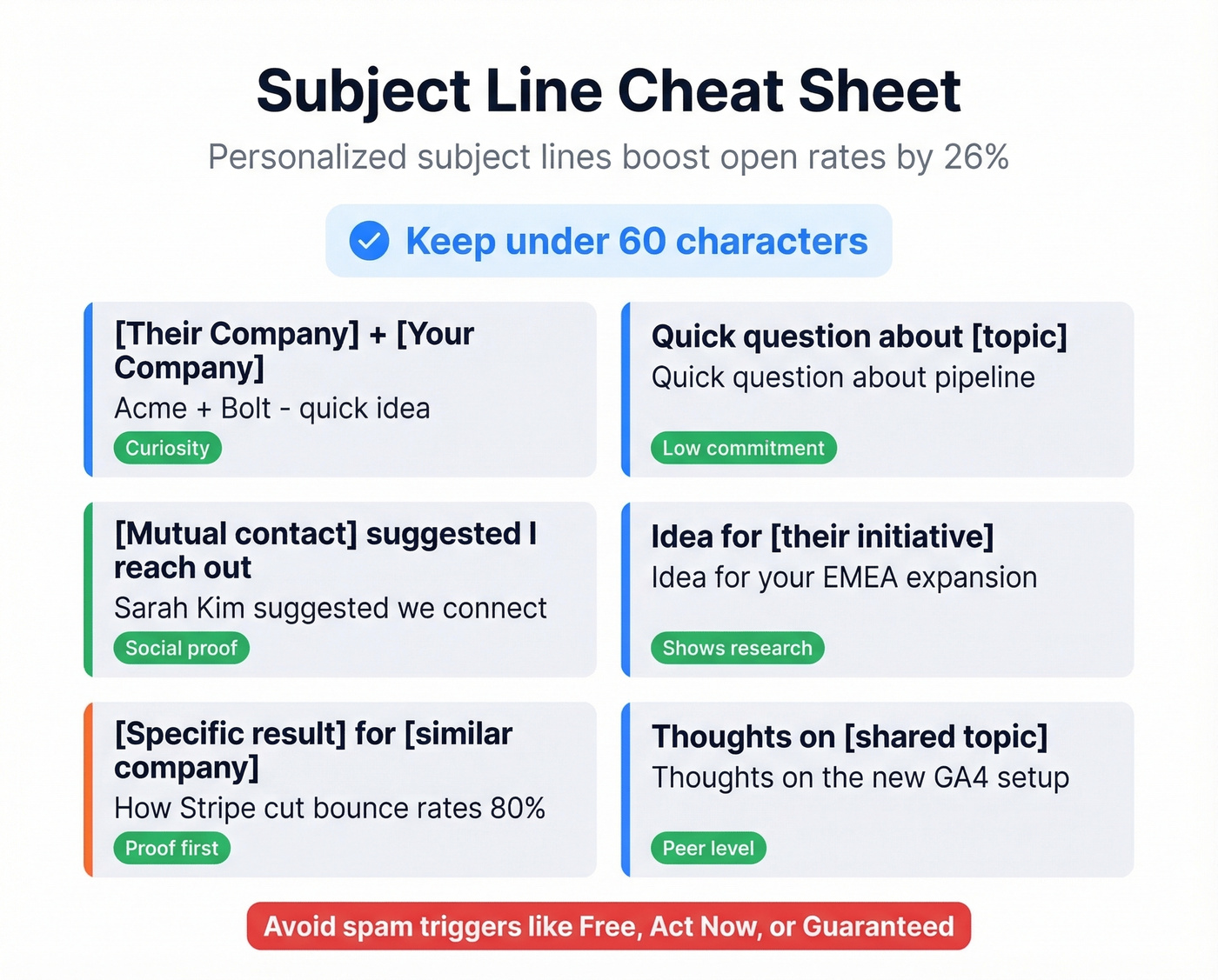
| Formula | Example | Why It Works |
|---|---|---|
| [Their company] + [your company] | "Acme + Bolt - quick idea" | Specific, curiosity-driven |
| Quick question about [topic] | "Quick question about pipeline" | Low-commitment, relevant |
| [Mutual contact] suggested I reach out | "Sarah Kim suggested we connect" | Social proof in the subject |
| Idea for [their initiative] | "Idea for your EMEA expansion" | Shows research |
| [Specific result] for [similar company] | "How Stripe cut bounce rates 80%" | Proof-first |
| Thoughts on [shared topic] | "Thoughts on the new GA4 setup" | Peer-level, conversational |
For A/B testing, you need at least 1,000 recipients total, one variable per test, and 95% statistical significance before declaring a winner.
Follow-Up Sequence
48% of salespeople never send a second email. Meanwhile, 42% of all replies come from follow-ups. If you're sending one email and moving on, you're leaving nearly half your potential responses on the table. If you want plug-and-play options, use these sales follow-up templates.
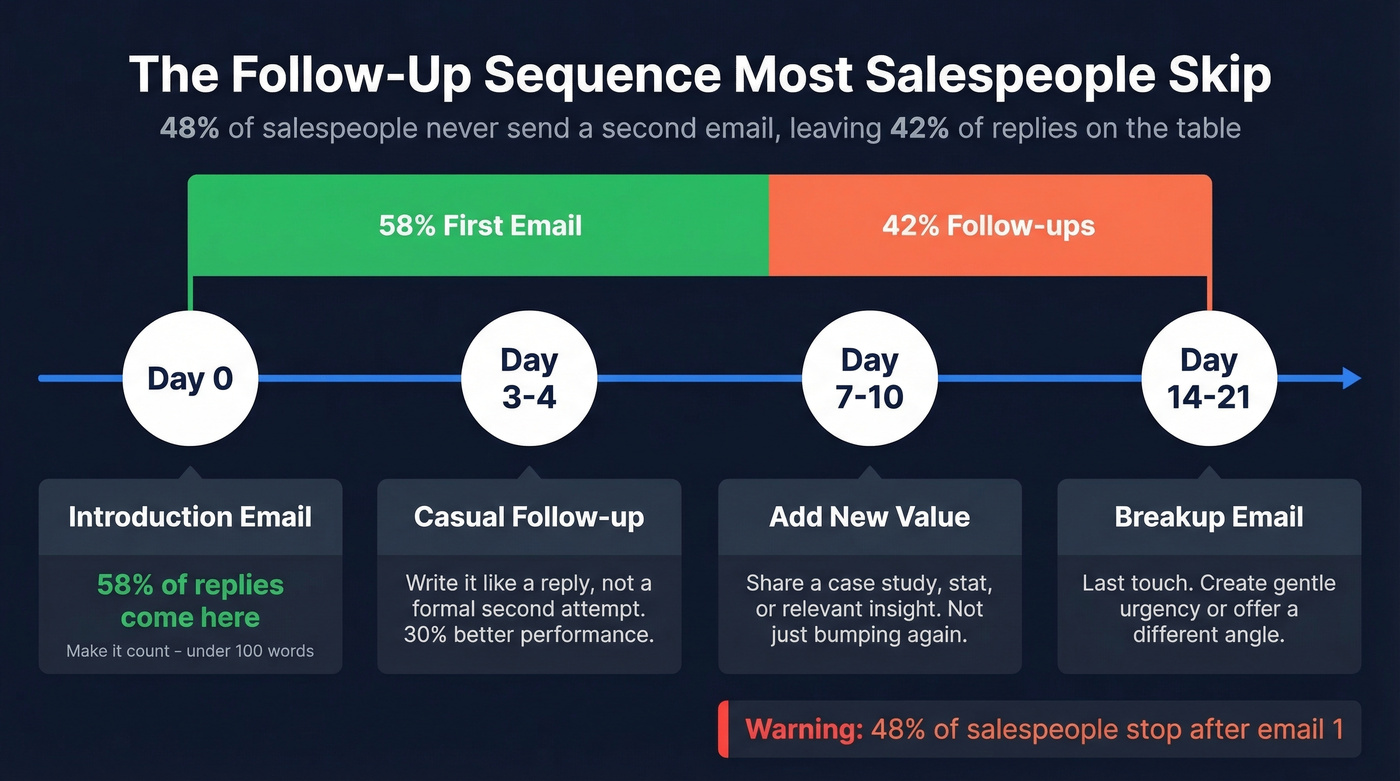
Day 0: Your introduction email. This generates 58% of replies. Make it count.
Day 3-4: The casual follow-up. Write it like a reply to your own email, not a formal second attempt. "Hey [Name], just bumping this up - any thoughts?" Step 2 emails that feel like replies outperform formal follow-ups by roughly 30%. (More on timing in when should you follow up on an email.)
Day 7-10: Add new value. Share a relevant case study, stat, or insight. Don't repeat your first email with different words. The standard B2B pattern runs 4-5 emails, with the sweet spot landing at 4-7 touchpoints before diminishing returns kick in. If you're building the full flow, start with a B2B cold email sequence.
Inbox Placement Checklist
Your template doesn't matter if the email never arrives.
SPF, DKIM, and DMARC are set up. These have been mandatory since May 2025 under Google and Yahoo's bulk sender rules. Include a one-click unsubscribe option - also required. Non-negotiable. (If you need a deeper technical breakdown, use this email deliverability guide.)
Spam complaints stay under 0.3%. Bounces under 2%. Exceed either threshold and inbox placement drops fast. Track this with email bounce rate benchmarks and fixes.
Use secondary domains for cold outreach. Never send cold email from your primary business domain. One bad campaign can poison inbox placement for your entire company. The r/coldemail community treats this as rule number one - and they're right.
Use Google Workspace or Microsoft 365. Warm up new inboxes for 14-21 days, starting at 5-10 emails per day. Cap volume at 10-15 emails per day per inbox and scale by adding inboxes, not by blasting more from one account. (More on safe sending limits in email velocity.)
Verify every email address before sending. This is the step most people skip, and it's the one that causes the most damage. We've seen teams go from 35% bounce rates to under 4% just by running addresses through Prospeo's 5-step verification before hitting send. The free tier gives you 75 verifications per month - enough to validate your first campaigns without spending a dollar.
Mistakes That Kill Introduction Emails
The biggest killer is length. If your email runs over 100 words, cut it. Nobody reads a four-paragraph introduction from a stranger.
The second biggest killer is self-focus. Look, the r/sales consensus is overwhelming on this: most cold email templates fail because they talk about the sender, not the recipient. Lead with their problem, not your product. We've reviewed hundreds of outreach emails across our customer base, and the pattern is always the same - the ones that open with "We are a leading provider of..." get ignored, while the ones that open with a specific observation about the prospect's business get replies. If you want more ways to open strong, use these sales prospecting techniques.
Generic personalization is almost worse than none at all. Using someone's first name isn't personalization. Referencing their recent Series B raise is. And if you're not including at least one question, you're leaving 50% of potential responses on the table.
Skip the seven-touch sequence if your deals average under $8k. Two or three well-crafted emails with verified addresses will often outperform a bloated campaign built on bad data. A brief introduction email that lands in the right inbox beats a sophisticated sequence that bounces.
You've got the template. Now you need verified contact data for the people you're actually emailing. Prospeo gives you 300M+ professional profiles with 30+ filters - job title, company size, intent signals - so every introduction lands with the right person at the right company.
Find the email, verify it, and send your intro - all in one platform.
FAQ
How long should an introduction email be?
Between 50 and 125 words. The Instantly 2026 benchmark shows elite performers average ~80 words on first-touch emails. If yours runs over 100, start cutting - every extra sentence reduces reply probability.
How many follow-ups should I send?
At least 2-3. Data shows 42% of replies come from follow-up emails, and the optimal B2B sequence runs 4-7 touchpoints before diminishing returns set in. Most reps quit after one email, which means they're abandoning nearly half their potential replies.
How do I keep introduction emails out of spam?
Set up SPF, DKIM, and DMARC authentication on your sending domain. Use a secondary domain for cold outreach. Verify every address before sending - tools like Prospeo catch spam traps and invalid addresses with 98% accuracy, keeping bounce rates under the 2% threshold that triggers deliverability problems.
What makes a business introduction email effective?
Clarity, brevity, and relevance. Lead with the recipient's problem, keep the message under 100 words, and close with a single low-commitment ask. Skip jargon, drop corporate filler, and verify the address before hitting send.