

How to Write an Email to Request a Meeting With a Client
You drafted a perfect 4-line meeting request, hit send, and got a bounce notification 30 seconds later. That email never had a chance.
Across 16.5 million cold emails analyzed, the average reply rate sat at 5.8%. Those are cold outreach numbers - your client already knows you, so your baseline is higher. But the principles that move reply rates are identical whether you're emailing a client you've worked with for years or reaching out to a potential one for the first time.
What You Need (Quick Version)
- Structure: Reason, Ask, Times, Sign-off
- Length: 50-125 words is the response-rate sweet spot from Boomerang's 40M-email dataset
- Subject line: Under 50 characters, personalized (see more email subject line examples)
- One CTA: A single ask, nothing else (more on email call to action)
- Verify the address first - B2B contact data decays 30-40% annually (benchmarks in email bounce rate)
The 4-Part Email Structure
Write at a 3rd-grade reading level. That sounds absurd, but a 40-million-email study found it delivers a 36% lift over college-level writing. Short words, short sentences, no jargon.
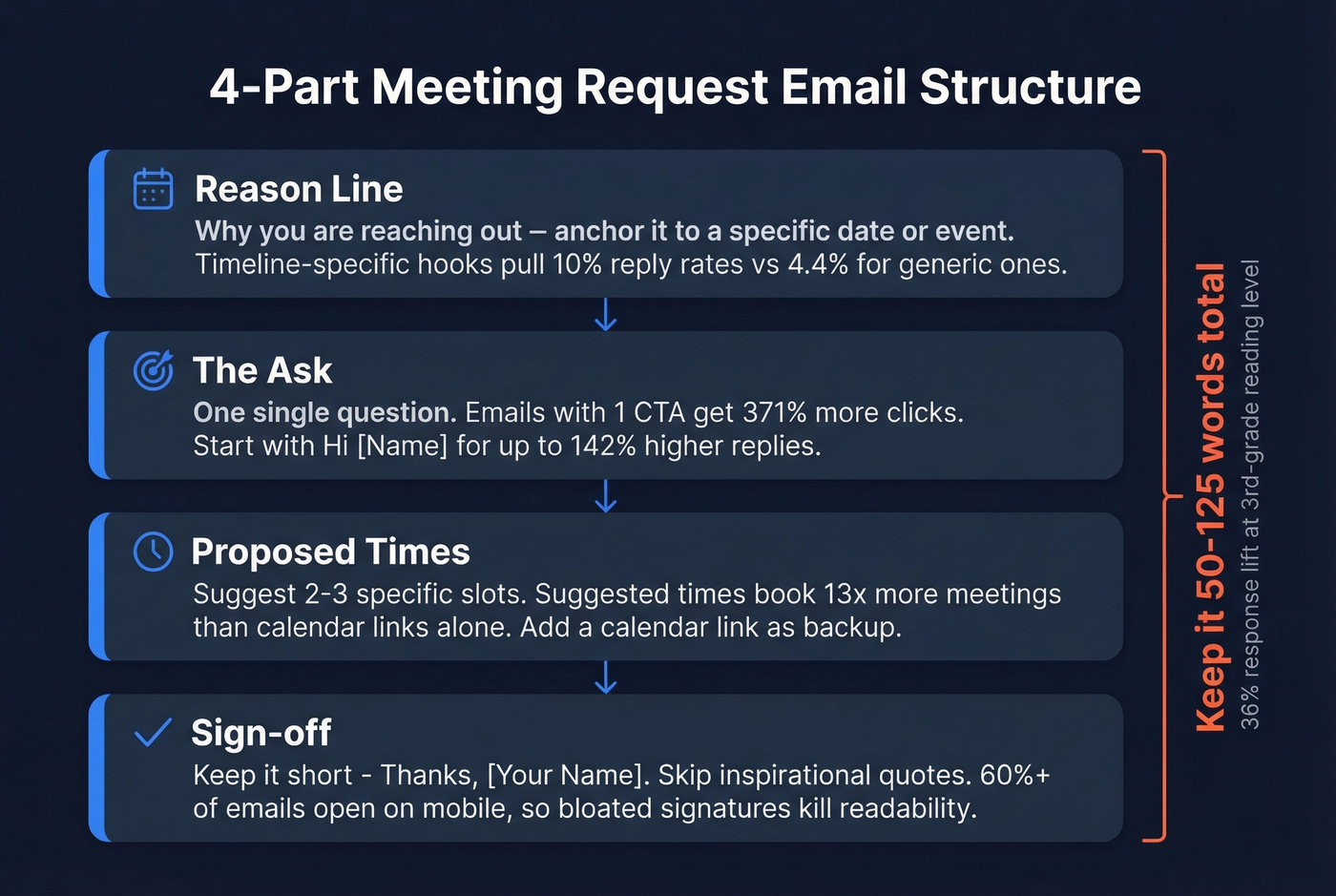
Reason line. Open with why you're reaching out - and make it timeline-specific. Emails anchored to a deadline ("Your renewal is coming up in 6 weeks") pull a 10.01% reply rate vs. 4.39% for generic hooks. Reference a shared project, a date on the calendar, or a recent conversation.
The ask. One question. Emails with a single CTA get 371% more clicks than those juggling multiple requests. And opening with "Hi [Name]" instead of a generic greeting lifts reply rates by up to 142%. (If you want more frameworks, see email copywriting.)
Times. Propose 2-3 specific slots. More on this below.
Sign-off. "Thanks, [Your Name]" works. Skip the inspirational quotes. Over 60% of emails are opened on mobile, and a bloated signature eats half the screen. Slightly positive or slightly negative emails get 10-15% more responses than neutral ones, so don't strip all personality from your message.
Subject Lines That Get Opened
47% of recipients decide whether to open based on the subject line alone. 69% will report you as spam based on nothing but those few words. (More data in subject lines that get opened.)
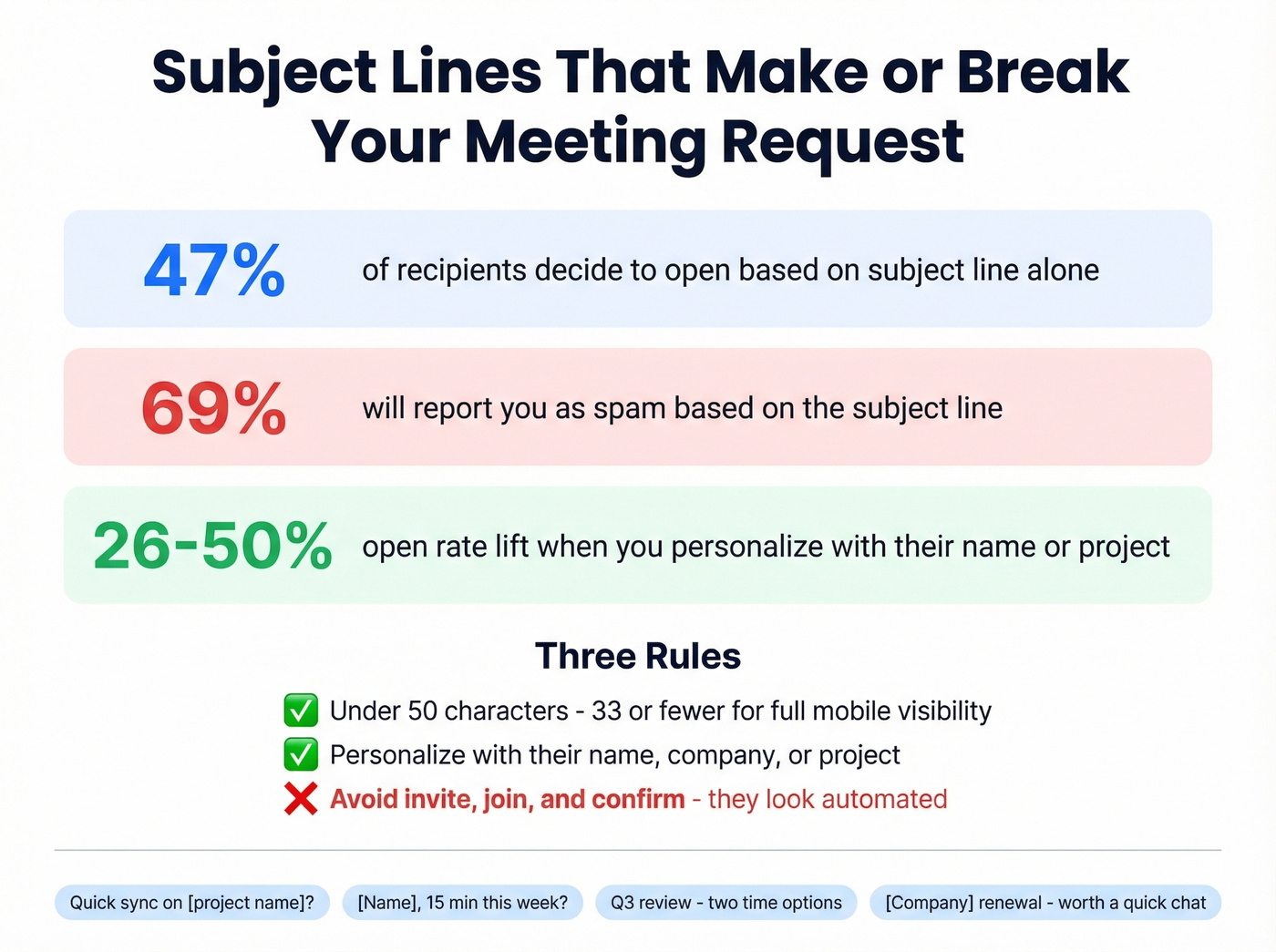
Three rules: keep it under 50 characters (33 or fewer for full mobile visibility), personalize it with their name or project for a 26-50% open rate lift, and avoid "invite," "join," and "confirm" - they tend to underperform and can look automated.
Examples that work:
- Quick sync on [project name]?
- [Name], 15 min this week?
- Q3 review - two time options
- [Company] renewal - worth a quick chat

You just crafted the perfect meeting request. But 30-40% of B2B emails decay every year - so there's a real chance it bounces. Prospeo verifies emails in real time with 98% accuracy on a 7-day refresh cycle, at roughly $0.01 per email. One customer cut their bounce rate from 35% to under 4% overnight.
Verify your client's email before you waste the perfect ask.
Suggest Times, Don't Drop a Link
Look - in our experience, proposing specific times outperforms calendar links every single time. Chili Piper ran a test: 50 emails with only a calendar link vs. 50 with suggested times. The suggested-times version booked 13x more meetings. Small sample, but the gap is hard to ignore.
Proposing slots reduces decision fatigue and feels personal. Drop the calendar link as a backup: "Would Tuesday at 2 PM or Thursday at 10 AM work? Here's my calendar if neither fits."
5 Templates You Can Steal
Each follows the 4-part structure and stays under 125 words. The consensus on r/sales is the same: context, relevance, one ask. (If you need more sequences, grab these sales follow-up templates.)
Quarterly Business Review
Hi [Name],
Q3 wraps soon - I'd love 30 minutes to walk through results and plan Q4 together.
Would Wednesday at 11 AM or Friday at 2 PM work? Calendar link below if neither fits.
Thanks, [Your Name]
Project Kickoff
Hi [Name],
Contract's signed - let's get the kickoff scheduled. I want to align on timeline, deliverables, and your team's involvement.
Does Monday at 10 AM or Tuesday at 3 PM work?
Best, [Your Name]
Renewal / Contract Discussion
Hi [Name],
Your renewal is coming up on [date]. Can we block 20 minutes to review what's working and discuss adjustments?
Thursday at 1 PM or Friday at 10 AM - either work?
Thanks, [Your Name]
Account Manager Introduction
Hi [Name],
I'm [Your Name], your new AM taking over from [Previous AM]. I'd love 15 minutes to introduce myself and hear what's top of mind for you.
Tuesday or Wednesday afternoon work?
Looking forward to it, [Your Name]
General Check-In
Hi [Name],
It's been a few weeks - wanted to check in and see if anything's come up on your end.
Worth a quick 15-minute call this week?
Best, [Your Name]
These templates work whether you're writing to a long-standing account or drafting an email requesting a meeting with a potential client you've just been introduced to. Adjust the reason line to match the relationship. (Related: email after introduction.)
Follow-Up Cadence
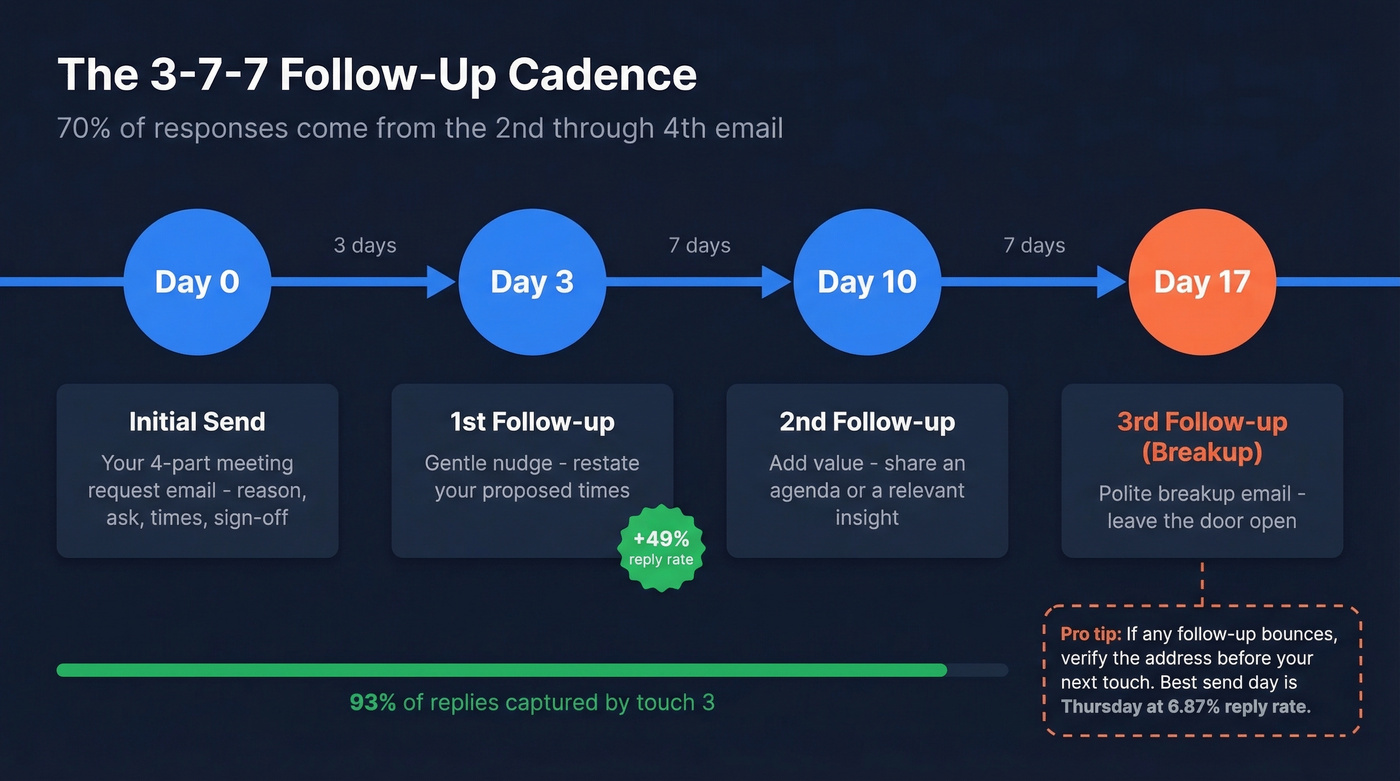
Roughly 70% of responses come from the 2nd-4th email. Reply rates increase up to 49% after the first follow-up, and a 3-7-7 cadence captures 93% of replies by the third touch. (More timing guidance: when should you follow up on an email.)
| Touch | Day | What to Send |
|---|---|---|
| 1st follow-up | Day 3 | Gentle nudge, restate times |
| 2nd follow-up | Day 10 | Add value - share an agenda or insight |
| 3rd follow-up | Day 17 | Polite breakup, leave the door open |
Thursday pulls the highest reply rate at 6.87%. If your follow-up bounces, verify the address before touch #2. A well-crafted request means nothing if the message never lands. (For deliverability fundamentals, see email deliverability guide.)
The Reply-Rate Killer Nobody Mentions
Here's the thing: your meeting request email is probably fine. Your contact data is the problem.
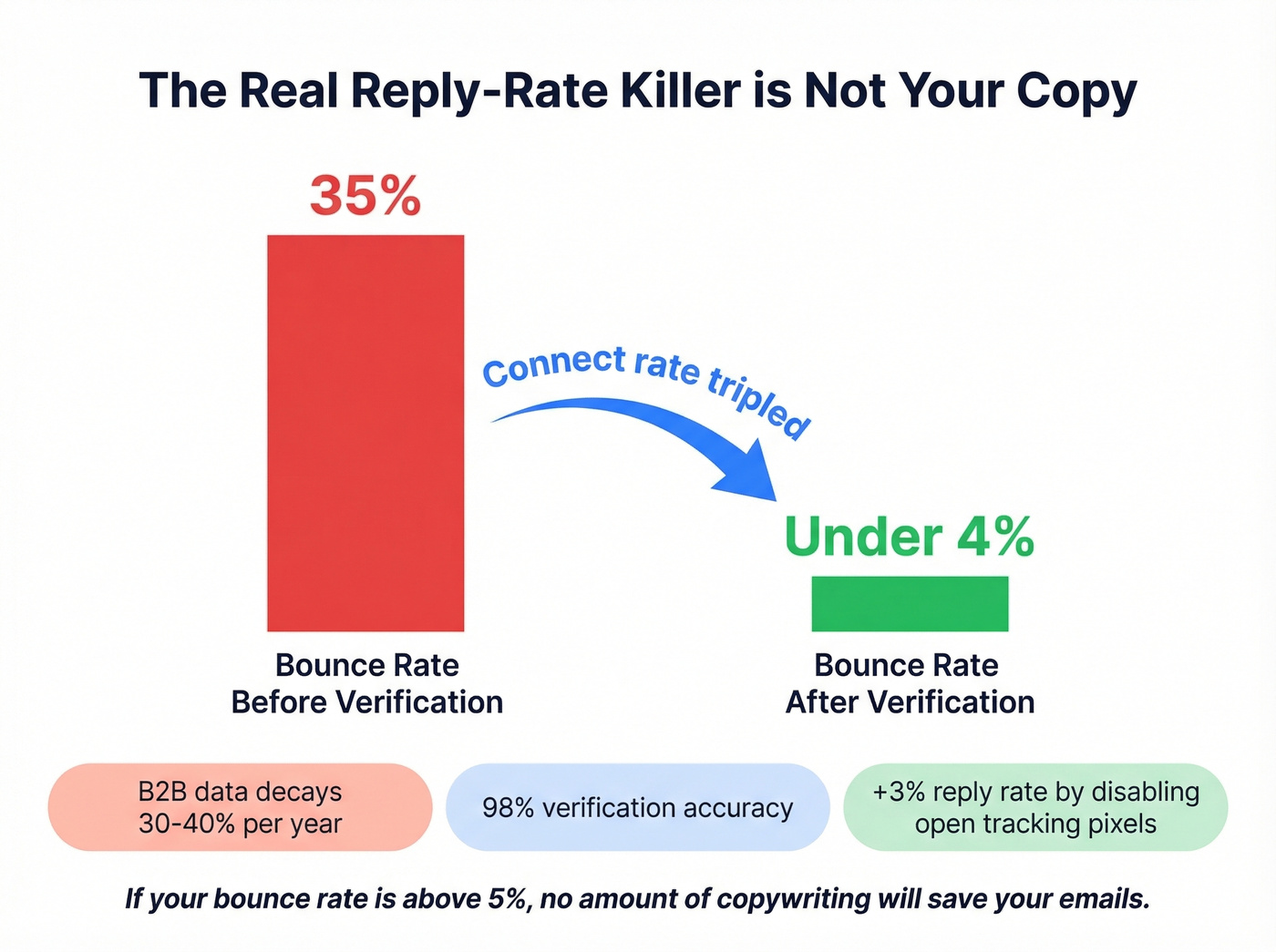
We see this constantly. Teams rewrite their templates five times when the real issue is a high bounce rate. B2B contact data decays 30-40% annually - people change jobs, companies switch domains, and your CRM quietly fills with dead addresses. One of our customers, Meritt, was running a 35% bounce rate. After they started verifying contacts with Prospeo, that dropped to under 4%, and their connect rate tripled.
Prospeo checks emails in real time with 98% accuracy on a 7-day refresh cycle. Before you rewrite your template for the tenth time, verify the address. That's often the actual fix.
Two more quick wins: turn off open-tracking pixels (3% higher response rate without them) and format every email for mobile. (Deep dive: email tracking pixel.)
If your bounce rate is above 5%, no amount of copywriting will save your meeting request emails. Fix the data first, then optimize the words.
Your subject line is dialed in. Your template follows the 4-part structure. But none of it matters if you're emailing a dead address. Prospeo's 5-step verification catches invalid emails, spam traps, and catch-all domains - so every meeting request actually reaches your client's inbox.
Fix the data first. The copywriting is already good enough.
FAQ
How long should a meeting request email be?
50-125 words. A 40-million-email study found this range produces response rates above 50%. This holds for existing accounts and first-touch outreach alike.
What's the best day to send?
Thursday pulls a 6.87% reply rate across 16.5 million emails analyzed. Evenings between 8-11 PM also outperform standard business hours.
How many follow-ups should I send?
Two to three. The first follow-up lifts reply rates by up to 49%. After three emails, returns diminish fast - switch to a different channel like phone or a mutual introduction.
Should I use the same template for existing and potential clients?
The structure stays the same - reason, ask, times, sign-off. For existing clients, lean on shared context like a project or renewal date. For prospects, lead with a specific reason they'd benefit from the conversation.
How do I know if my client's email is still valid?
Use a real-time verification tool before sending. B2B contact data decays 30-40% per year, and stale addresses are a top cause of bounces. Prospeo's free tier lets you verify 75 emails per month - enough to confirm your key contacts before any outreach.