

How to Write an Email to Set Up a Meeting (With 5 Templates)
The average professional gets [121 emails a day](https://www.radicati.com/?p=18519). Your meeting request is competing with 120 others for attention - and cold emails average a 7-10% response rate. We've sent thousands of meeting-request emails over the years, and the ones that actually get booked all share five things.
What You Need (Quick Version)
- Subject line: 2-4 words. Shorter, personalized lines get opened more.
- Body: 50-125 words. Two phone scrolls, max.
- 2-3 specific time slots with time zones labeled.
- Scheduling link as a fallback. "If none of these work, grab a time here."
- A follow-up already planned. Most replies come after the first email.
Anatomy of a Meeting Request That Gets a Yes
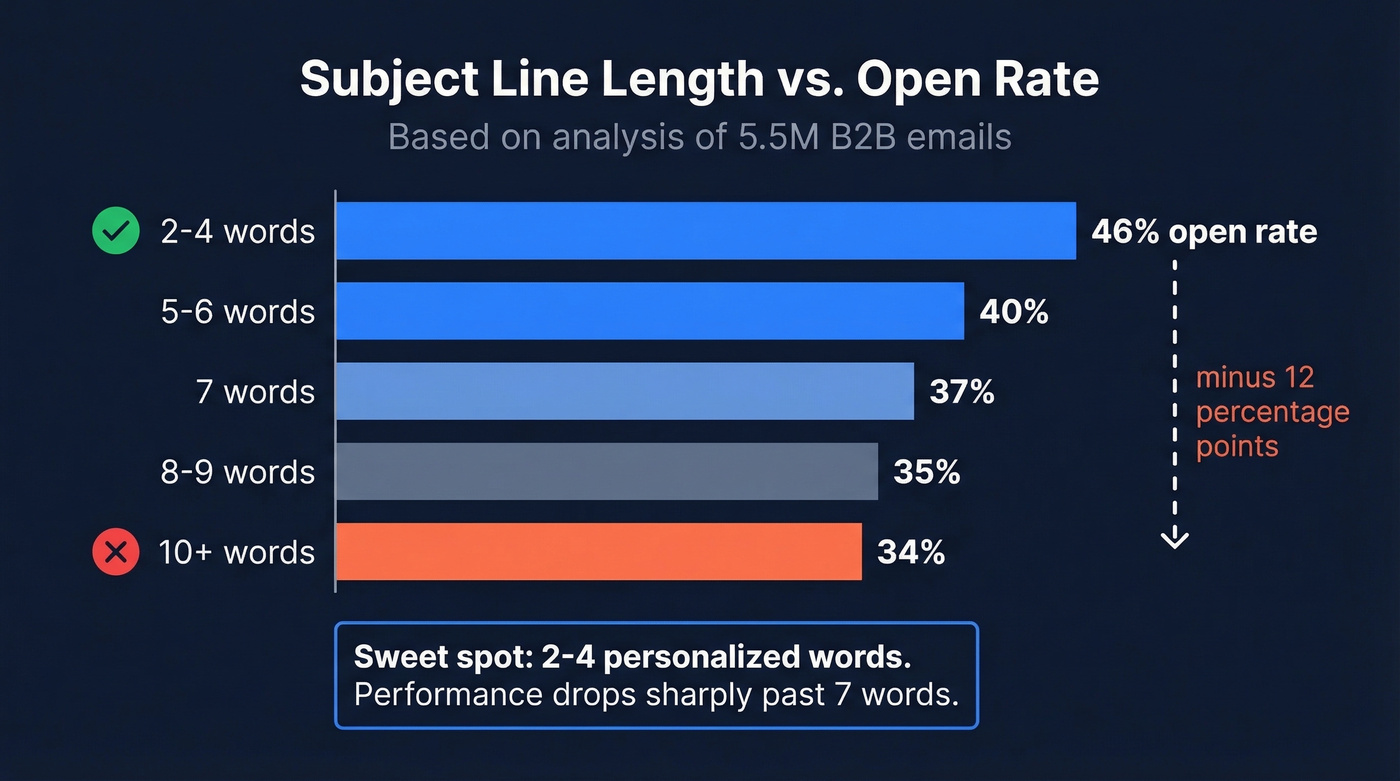
Start with the subject line. A Belkins study of 5.5M emails found that personalized subject lines hit a [46% open rate versus 35%](https://belkins.io/blog/b2b-cold-email-subject-line-statistics) without personalization. The sweet spot is 2-4 words. Performance drops sharply past 7 words - at 10 words, you're down to 34%.
Your body copy should land between 50 and 125 words. That's enough to establish context, deliver one clear value proposition, and make the ask. Once you push past 150 words, reply rates fall fast. Writing concisely is half the battle.
Propose 2-3 specific times with time zones, then drop a scheduling link as a fallback. This removes friction without making you look lazy. Always include the meeting duration. "20 minutes" signals respect for their calendar - nobody wants to accept a meeting with no end time.
Skip apologetic openers like "Sorry to bother you" or "I know you're busy." They signal low status and waste words. Confidence is polite.
Here's the part most guides skip: the biggest variable in meeting-request emails isn't your copy - it's whether the message actually arrives. If your bounce rate is above 2%, you could have the best template in the world and still book nothing. Fix your data first, then worry about your words. (If you’re troubleshooting bounces, see bounce rate benchmarks and fixes.)
5 Copy-Paste Meeting Email Templates
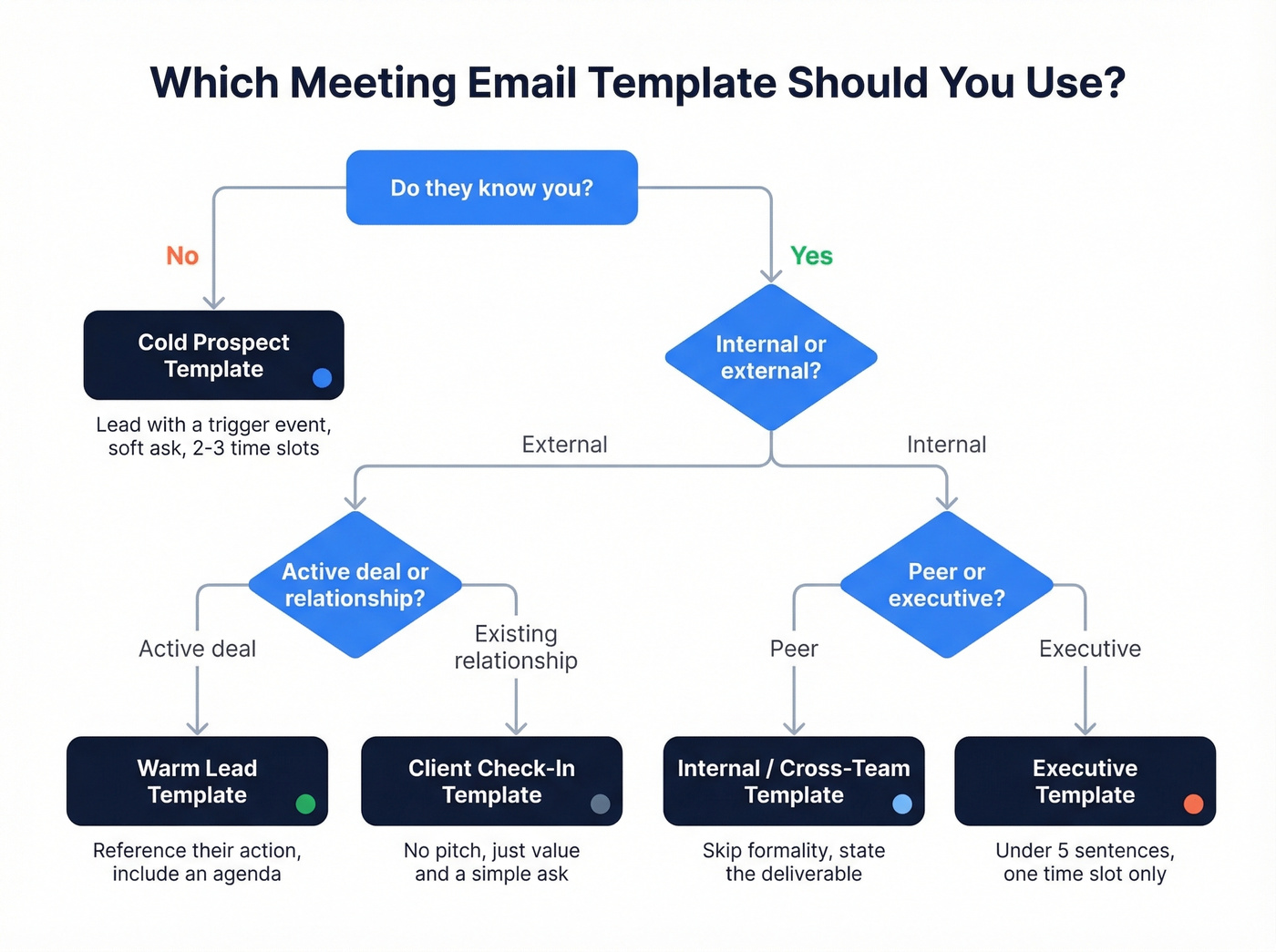
Below are five templates covering every scenario, from cold outreach to executive asks. Pick the one that matches your situation and customize the bracketed fields.
Cold Prospect
Stranger outreach. You need to earn the meeting. A high-performing approach with cold prospects is a softer, interest-based ask instead of a hard "book time on my calendar" push. Rather than "Are you free for a call?", frame the ask around shared curiosity. For more structure, borrow from a proven B2B cold email sequence.
Subject: {FirstName} - quick question
Hi {FirstName},
I noticed {Company} recently {specific trigger - new hire, funding round, product launch}. We help teams like yours {one-sentence value prop}.
Would it make sense to compare notes over 20 minutes this week?
- Tuesday 2:00 PM ET
- Wednesday 10:30 AM ET
- Thursday 3:00 PM ET
Or grab a time here: {scheduling link}
Best, {Your name}
This template works because it leads with something specific about them, not about you. We've found that mentioning a concrete trigger event - a recent hire, a funding round, a product launch - outperforms generic "I help companies like yours" openers by a wide margin. The trigger proves you did your homework in about six words. (Need more ideas? Use sales prospecting techniques that surface real triggers.)
Warm Lead / Inbound
Someone who's already engaged - downloaded content, replied to a previous email, attended a webinar. Calendly's rule of thumb: if there's no agenda, cancel the meeting. Include one.
Subject: Next step on {topic}
Hi {FirstName},
Thanks for {specific action - downloading the guide, attending the webinar}. I'd love to walk through how {relevant outcome} applies to {Company}.
Quick agenda: your current setup, where the gaps are, and whether we can help.
Do any of these work?
- Monday 11:00 AM PT
- Tuesday 1:00 PM PT
If not: {scheduling link}
{Your name}
Client Check-In
Re-engaging an existing relationship. Keep it simple - no pitch, just value.
Subject: Overdue catch-up
Hi {FirstName},
It's been a few months since we last connected. I've got a couple of ideas around {relevant topic} that might be useful for your team this quarter.
Free for 20 minutes next week? I'm open Wednesday or Thursday afternoon ET.
{Your name}
Internal / Cross-Team
Colleagues don't need the preamble. Skip formality, keep clarity.
Subject: Sync on {project}
Hey {FirstName},
Need 30 minutes to align on {specific deliverable}. Can you do Tuesday 3 PM or Wednesday 10 AM? If neither works, here's my calendar: {link}
Thanks, {Your name}
Executive / Senior Stakeholder
Shorter, higher-status framing. Respect their time aggressively.
Subject: 15 min - {topic}
{FirstName},
{One sentence on why this matters to them specifically.} I'd like 15 minutes to share what we're seeing and get your take.
Does Thursday at 9:00 AM CT work?
{Your name}
Let's be honest - if you're emailing a VP or C-suite, anything over five sentences is getting deleted. One sentence of context, one ask, one time slot. That's it.

You read it above: if your bounce rate is over 2%, even the best meeting-request template books nothing. Prospeo's 5-step email verification delivers 98% accuracy - teams using it cut bounce rates from 35% to under 4% and tripled their pipeline.
Fix your data before you fix your copy. Start free with 75 verified emails.
Subject Lines That Get Opened
The Belkins dataset is clear: personalized, short subject lines win. Question-style subjects hit 46% open rates. Lines worth stealing (and more in our email subject line examples):
- {FirstName} - quick question
- 15 min this week?
- Idea for {Company}
- {FirstName}, one thought
- Can we talk {day}?
- {Mutual connection} suggested we connect
- Saw your {trigger event}
- Quick sync on {topic}?
Avoid spam triggers like "urgent," "act now," or "free." They hurt deliverability and make you sound like a newsletter nobody subscribed to. If you want to go deeper, use a dedicated email spam checker before sending.
Follow-Up Cadence That Books Meetings
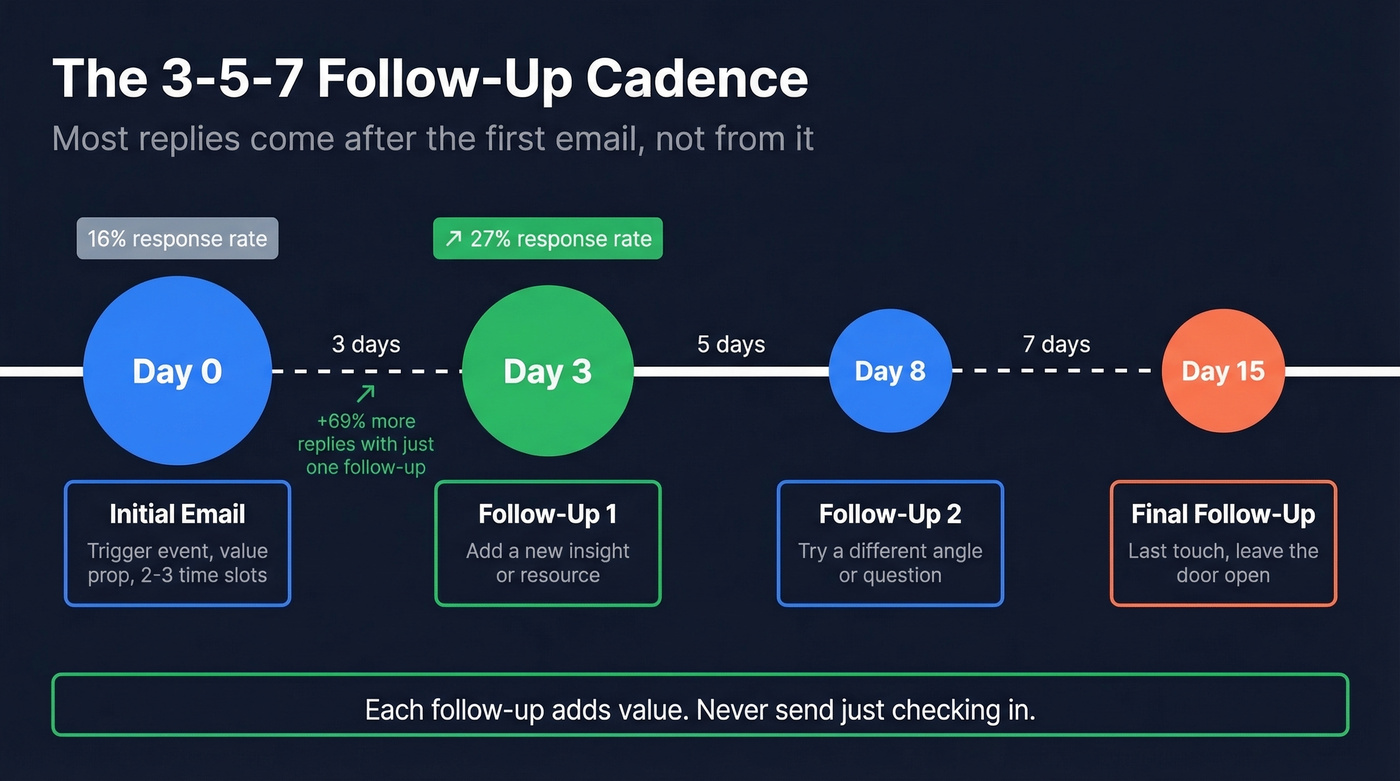
60% of replies come after the first follow-up. Woodpecker's research shows response rates jump from 16% to 27% with just one follow-up. In our experience, the 3-5-7 cadence outperforms daily follow-ups by a wide margin: follow up 3 business days after the first email, then 5 days later, then 7 days after that. Each touchpoint should add value - a relevant insight, a different angle, a resource. "Just checking in" is a waste of everyone's inbox. (If you need copy, steal these sales follow-up templates.)
Subject: Re: {original subject}
Hi {FirstName},
I know things get buried. Wanted to resurface this - I came across {new insight or resource relevant to them} and thought it'd be worth discussing.
Still happy to do 15-20 minutes whenever works. Here's my calendar: {scheduling link}
{Your name}
Skip this cadence if you're emailing an existing client or internal colleague. For warm relationships, one follow-up after 3-4 days is plenty. Anything more feels pushy when there's already a relationship in place.
Before You Hit Send
Send on the right days. Tuesdays and Thursdays between 9:30-11:00 AM or 1:30-3:00 PM in the recipient's time zone consistently outperform other windows. (More data here: best time to send cold emails.)
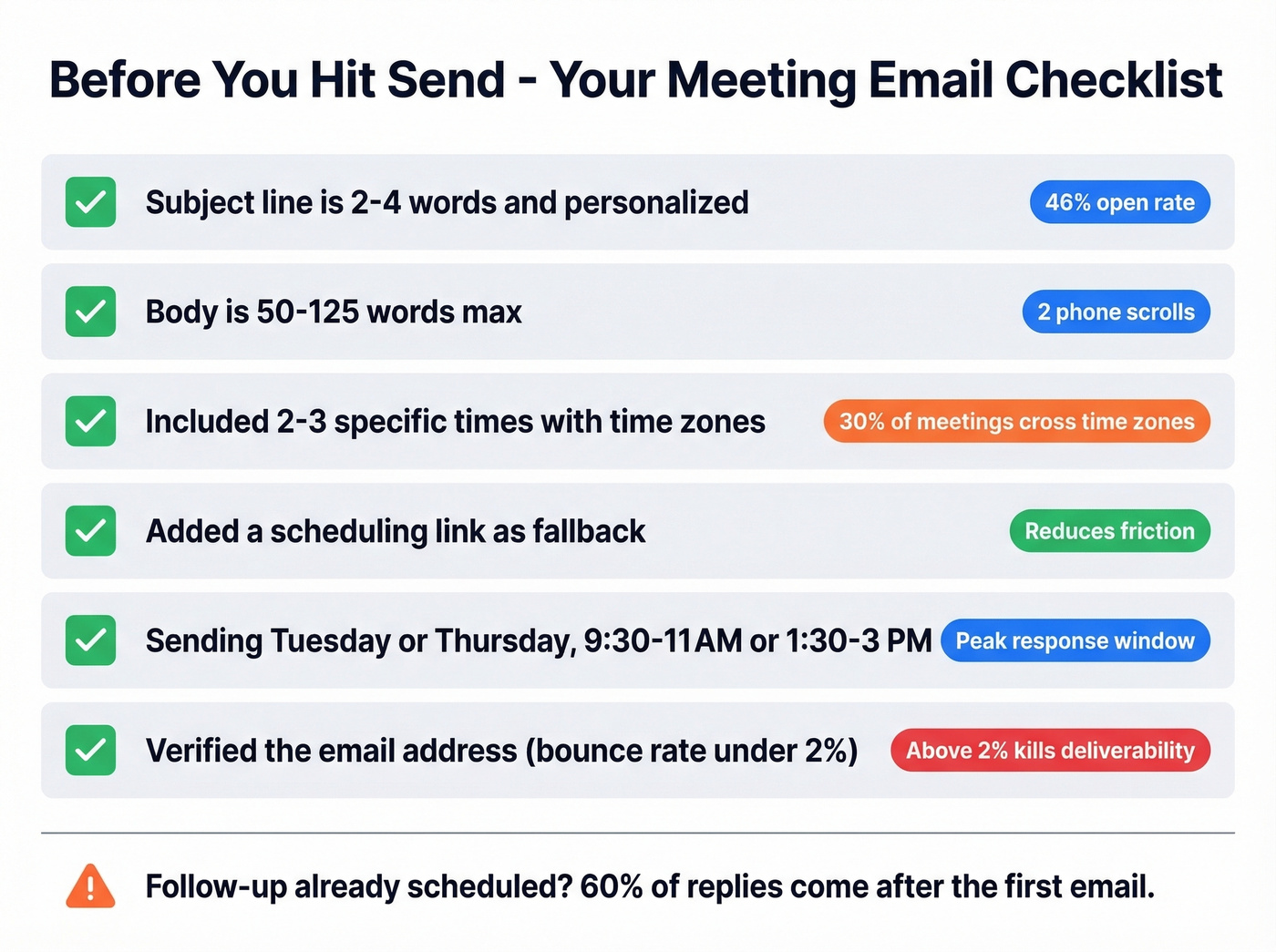
Always label time zones. Nearly a third of meetings now span multiple time zones, up 35% since 2021. Writing "Tuesday at 2" without a time zone is asking for a no-show.
Verify the email address before sending. A bounce rate above 2% damages your sender reputation, and once that's shot, even your best emails land in spam. Prospeo checks emails in real time with 98% accuracy - the free tier covers 75 verifications per month, enough to validate your highest-priority prospects before every send. If you’re building a process around this, follow an email deliverability guide and learn how to improve sender reputation.

Every template above needs one thing to work: a real, verified email address that actually reaches your prospect's inbox. Prospeo gives you 300M+ profiles with 30+ filters - buyer intent, job changes, funding rounds - so you can find the right person and the right trigger event in one search.
Stop crafting perfect emails to dead inboxes. Prospeo emails cost $0.01 each.
FAQ
How many times should I follow up on a meeting request?
Three follow-ups using the 3-5-7 rule: 3 business days after the first email, then 5 days, then 7 days. Each follow-up should add new value - a relevant insight or different angle - not just "checking in." Response rates jump from 16% to 27% with one follow-up alone.
Should I propose specific times or use a scheduling link?
Both. Propose 2-3 specific times with time zones, then add a scheduling link as a fallback. Specific times show effort and reduce back-and-forth; the link removes friction if none of your slots work.
How long should a meeting request email be?
Between 50 and 125 words - two scrolls or fewer on a phone screen. Every template in this guide stays within that range. Past 150 words, reply rates drop noticeably.
What's the best subject line for a meeting request?
Personalized subject lines of 2-4 words perform best, hitting 46% open rates in a study of 5.5M emails. Examples: "{FirstName} - quick question" or "15 min this week?" Avoid anything over 7 words.
How do I make sure my meeting request email actually arrives?
Verify the recipient's address before sending. Bounce rates above 2% damage your sender reputation and tank future deliverability. Real-time verification tools catch invalid addresses before they hurt your domain - Prospeo's free tier covers 75 checks per month with no credit card required.