

EmailListValidation vs Apollo.io: Which Actually Verifies Emails?
Your Apollo export bounced 15% on the first campaign. Now you're eyeing a dedicated verifier like EmailListValidation to clean up the mess. Here's the thing - when comparing EmailListValidation vs Apollo.io, G2 reviewers cross-shop these two tools, but they're solving fundamentally different problems. Understanding that gap saves you money and your domain reputation.
30-Second Verdict
Use EmailListValidation if you already have a list and need cheap bulk cleaning. Test support responsiveness before committing real volume.
Use Apollo if you need a prospecting database and accept layering a standalone verifier on every export.
Skip both if you want verified emails from a prospecting database without the two-tool tax. Prospeo delivers 300M+ profiles with 98% email accuracy and 5-step verification built in - no second pass needed.
Feature Comparison Table
| Feature | EmailListValidation | Apollo.io | Winner |
|---|---|---|---|
| Primary use | List cleaning | Prospecting + CRM | Apollo (does more) |
| Accuracy claim | 99% | 91% | Neither (both overstate) |
| Pricing model | Pay-per-verification | Per-seat subscription | ELV (cheaper for cleaning) |
| Entry price | $19 / 2,500 credits | Free (10,000 email credits/mo), ~$49/user/mo paid | Apollo (free tier) |
| Catch-all handling | Flags as risky | 7-step differentiation process | Apollo (more granular) |
| Integrations | ~6 | 64+ | Apollo |
| G2 rating | 4.3/5 (19 reviews) | 4.7/5 (9,514 reviews) | Apollo |
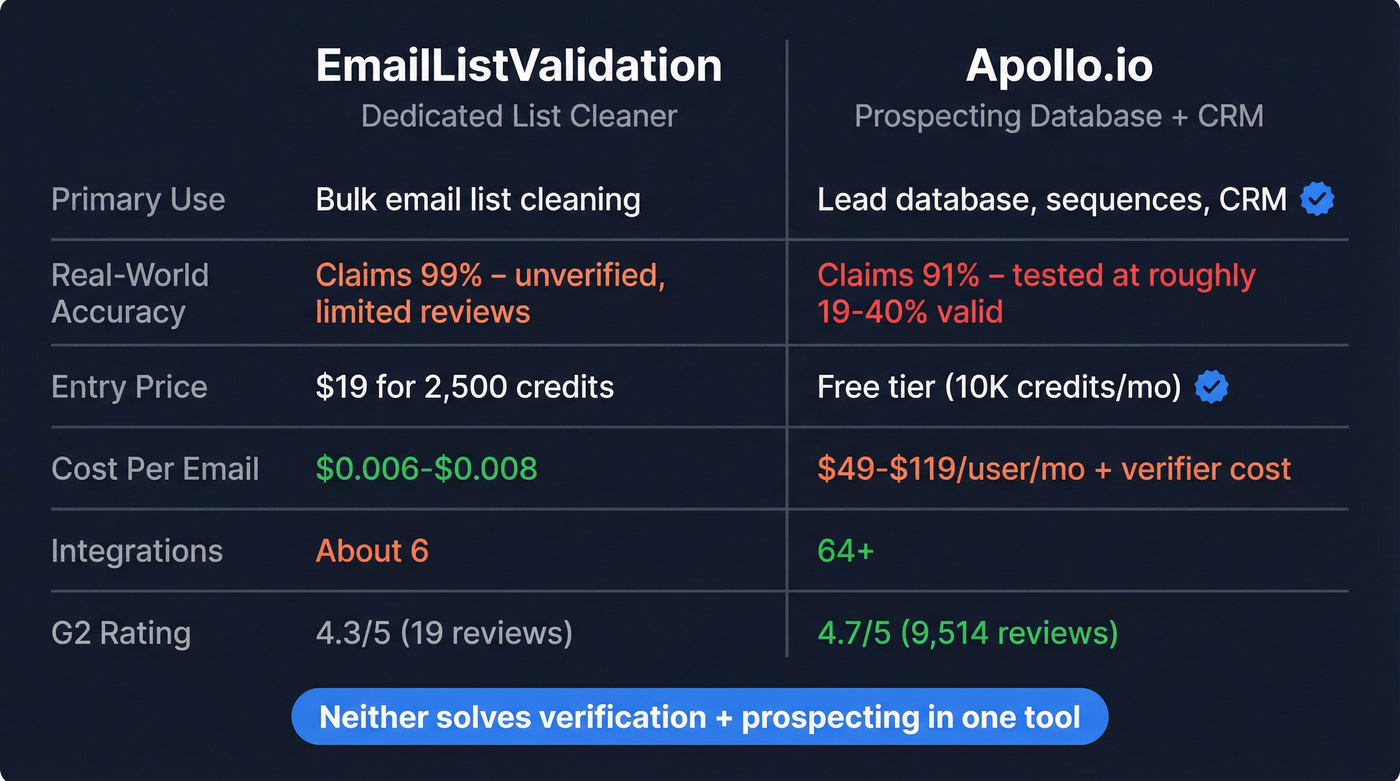
On G2's alternatives page, Apollo scores higher for support and usability. That comparison misses the point - they're different tool categories, and most teams end up buying both.
The Accuracy Problem Nobody Talks About
Both tools' accuracy claims fall apart under real testing. EmailListValidation claims 99%. Apollo claims 91%. A Hunter benchmark testing 15 verifiers against 3,000 real business emails found the top performer hit just 70% overall accuracy. Nobody's touching 99% on real-world data.
If you're trying to keep your email bounce rate low, you need to treat any "verified" label as probabilistic, not absolute.
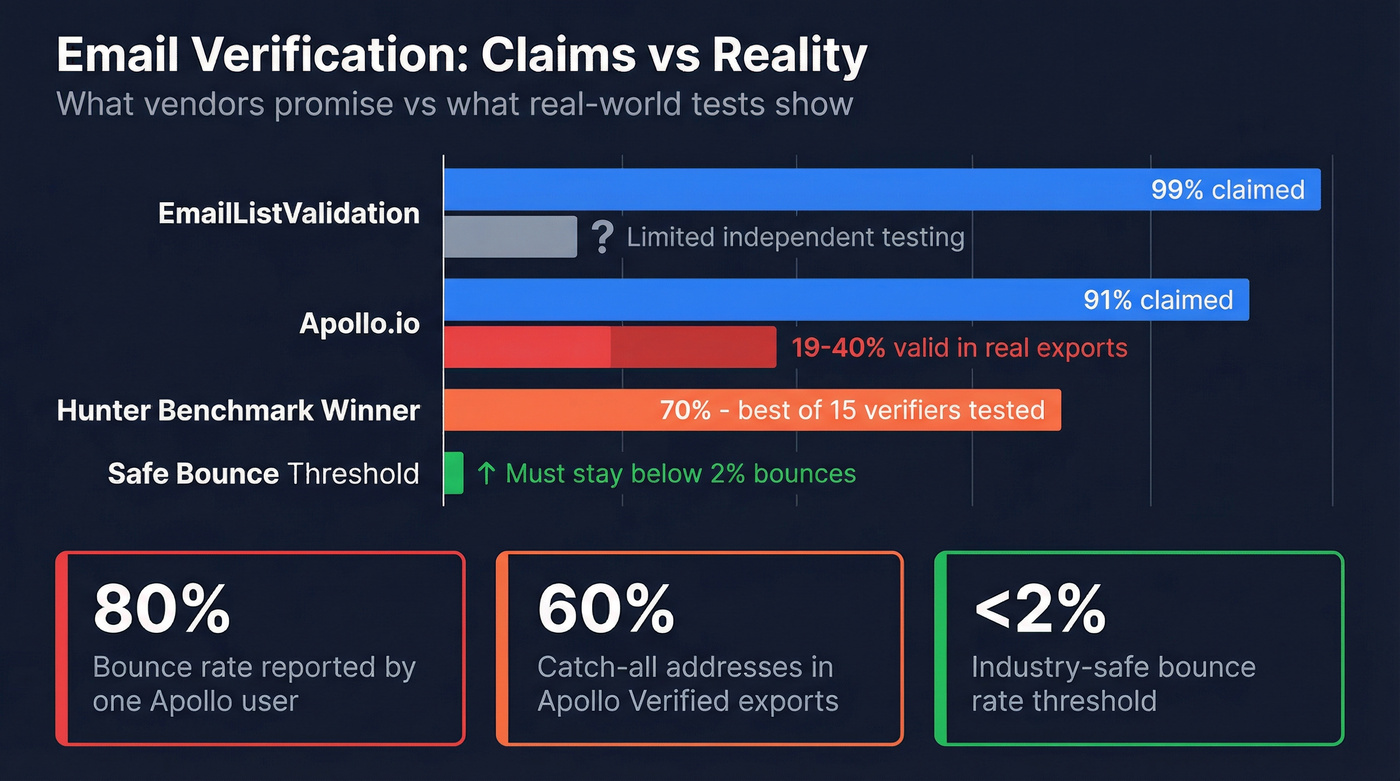
The Reddit evidence on Apollo is brutal. One user reported an 80% bounce rate on "verified" leads. Another exported ~900 "Verified" contacts through MillionVerifier and found only ~19% came back valid, with ~60% flagged as catch-all. The industry-safe threshold sits [below 2% bounces](https://www.socketlabs.com/blog/email-marketing-red-flags-high-bounces-low-delivery/). Apollo's badge doesn't get you there.
We've tested this ourselves across multiple client campaigns, and the pattern holds: "Verified" in Apollo is more of a confidence score than a guarantee. If your average deal size sits below $5K, the time you spend layering verification tools costs more than the leads are worth. Pick one platform that handles both.
If you're running cold email marketing at scale, this is the difference between a repeatable system and constant deliverability firefighting.

Apollo's "Verified" badge lets 60% catch-all addresses through. EmailListValidation means paying for a second tool on every export. Prospeo's 5-step verification - with catch-all handling, spam-trap removal, and honeypot filtering - is built into the database. 300M+ profiles, 98% email accuracy, no second pass needed.
One platform. One cost. Zero bounce rate surprises.
EmailListValidation: Cheap but Fragile
Pricing is genuinely good - $19 for 2,500 credits that never expire, roughly $0.008 per verification. The real-time API with 100 free monthly checks works well for form validation, and the deliverability toolkit add-on bundles inbox placement monitoring from $49/mo.
The problems are harder to ignore. G2 reviewers flag unresponsive support and credits deducted during frozen uploads. With only 19 reviews and a profile that's been inactive for over a year, that's a red flag. One reviewer noted over-filtering that removed valid contacts - the opposite of what you want from a verification tool. Reddit users report internal server errors and a missing contact page. AppSumo reviewers have flagged accuracy concerns too. And the integration list tops out at about 6 connectors, so if your stack is anything beyond basic, you're building workarounds.
If you need a broader view of tooling beyond a single verifier, compare options in our guide to data enrichment services.

Apollo.io: Great Prospecting, Mediocre Verification
Apollo's real value is its 275M+ contact database with a free plan that includes unlimited email credits (10,000/month). For prospecting, it's one of the strongest options at this price point. The 64+ integrations mean it fits into virtually any stack, and the platform does far more than verify - sequences, analytics, CRM functionality, the works.
But we've seen the verification story play out too many times. The "Verified" badge is misleading. One real-world export test (Apollo to MillionVerifier) showed ~60% of "Verified" leads came back as catch-all/risky addresses. Data accuracy varies by region, a theme that shows up across 9,500+ G2 reviews. Paid plans run ~$49-$119/user/mo, and you'll still need to budget $4-10 per 1,000 emails for a second-pass verifier.
If you're evaluating other sources, start with our breakdown of the best sales prospecting databases and the broader category of outbound lead generation tools.
Let's be honest: Apollo is a prospecting tool that happens to have verification, not a verification tool that happens to prospect. Treat it accordingly.
When to Use Which
You have an existing list to clean. EmailListValidation works. It's cheap, credits don't expire, and the API handles real-time validation. Test a small batch first - if support is responsive and accuracy checks out on your data, scale up.
If you're building lists from scratch, it's usually smarter to start with a lead generation workflow that includes verification before outreach.
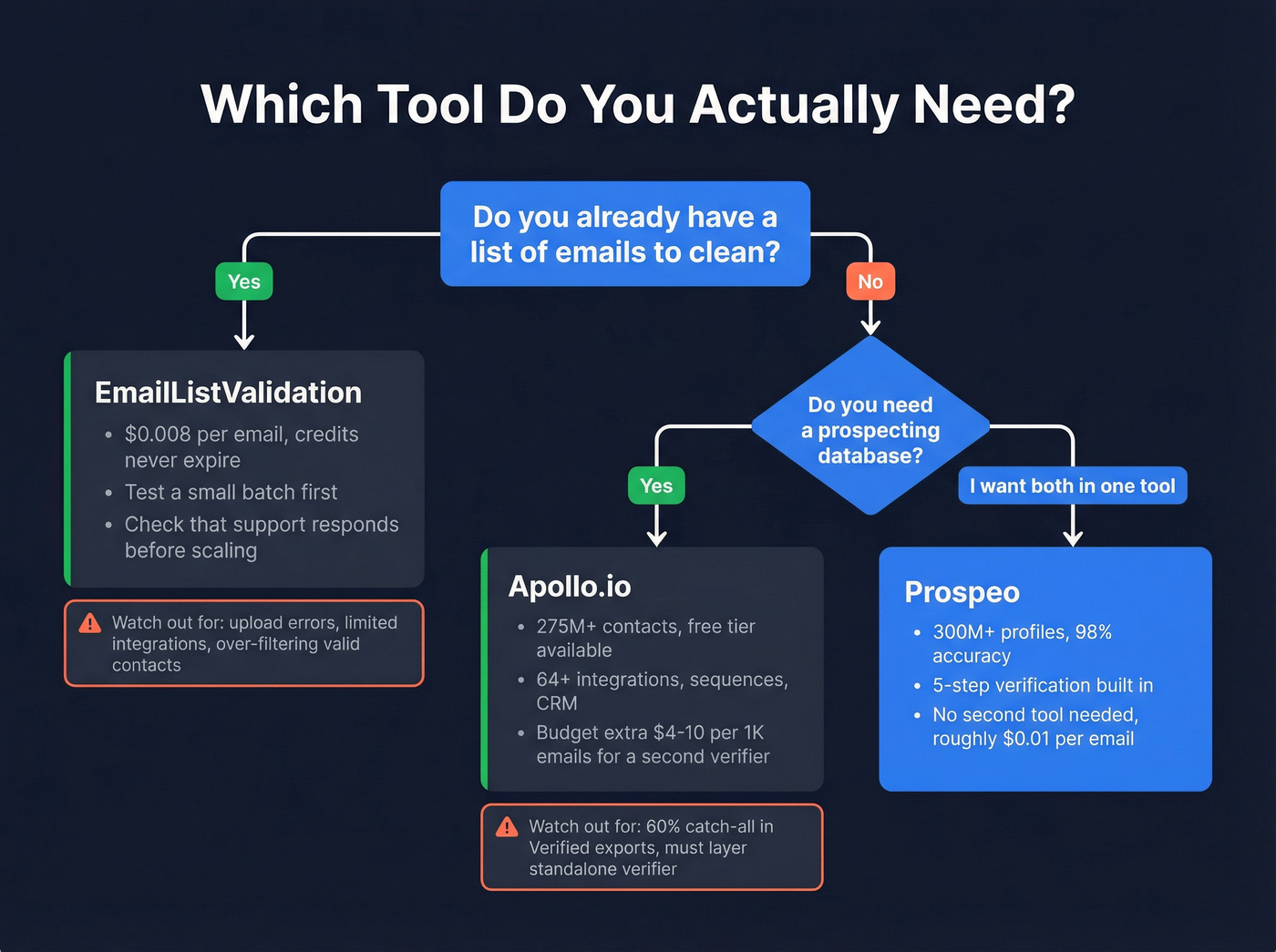
You need a prospecting database and accept layering. Apollo. Export leads, run them through a standalone verifier, budget the extra cost. It works - it's just friction on every campaign.
Skip EmailListValidation if your team doesn't have someone comfortable troubleshooting upload errors and chasing support tickets. The savings evaporate fast when you're debugging instead of sending.
If you're trying to protect deliverability long-term, it helps to understand spam trap removal and the basics of an email deliverability guide.

The two-tool tax kills your workflow. Every Apollo export routed through a standalone verifier is friction you don't need. Prospeo refreshes all 300M+ records every 7 days and verifies at the source - for roughly $0.01 per email. Teams using Prospeo book 35% more meetings than Apollo users.
Ditch the verification workaround and prospect from clean data.
FAQ
Is Apollo's built-in verification good enough for cold outreach?
No. Real-world tests show "Verified" exports can contain up to ~60% catch-all addresses, pushing bounce rates well above the 2% safe threshold. Layer a standalone verifier on every export, or use a platform where multi-step verification is built into the prospecting workflow.
How much does EmailListValidation cost per email?
About $0.006-$0.008 on pay-as-you-go. Credits start at $19 for 2,500 and never expire. That makes it one of the cheapest dedicated verifiers available - though limited integrations and spotty support offset the savings.
What are good alternatives to both tools?
ZeroBounce is G2's top-rated dedicated verifier, with stronger support at around $0.008-$0.01/email. MillionVerifier is the budget pick at ~$0.003-$0.005/email. For teams that want prospecting and verification in one platform, Prospeo offers 300M+ profiles with 98% accuracy at roughly $0.01/email - no second tool required.
Can I use EmailListValidation to verify Apollo exports?
Yes, and many teams do exactly this. Export your Apollo list as CSV, upload it to EmailListValidation, and remove anything flagged invalid or risky before sending. It works, but adds $4-8 per 1,000 contacts and a manual step to every campaign cycle. In our experience, that manual step is where things break down at scale - someone forgets, a batch goes uncleaned, and your domain takes the hit.