

The FAB Framework: Turn Features Into Sales
Apple didn't sell the iPod with "5GB of storage." They sold "1,000 songs in your pocket." That single rewrite - selling the outcome, not the spec - helped define an era of product marketing. The FAB framework is the thinking tool behind that kind of translation, and benefit-led copy commonly lifts conversions 5-20% in A/B tests. If your sales pages, cold emails, or pitch decks still lead with specs, you're leaving money on the table.
The quick version:
Feature (what it is) → Advantage (how it helps) → Benefit (why the buyer cares)
Example: 5GB storage → massive capacity in a tiny device → 1,000 songs in your pocket. If your copy lists features without benefits, you're losing deals.
What Is the FAB Framework?
FAB stands for Features, Advantages, Benefits. It's a messaging methodology that forces you to translate what your product is into what it means for the buyer. Three steps, always in order.
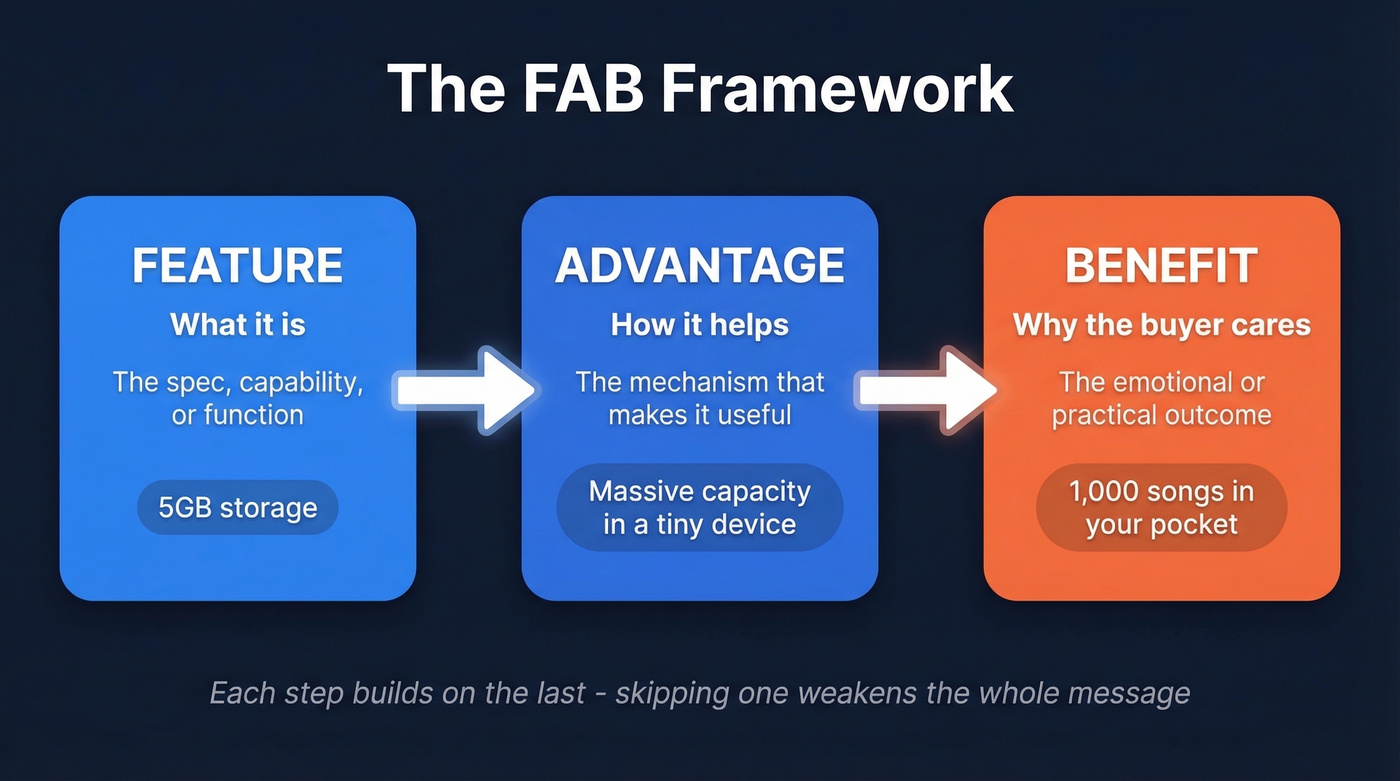
Feature - the literal thing your product has or does. A spec, a capability, a function. "OLED screen."
Advantage - how that feature helps in practice. The mechanism. "Shows more realistic colors with deeper blacks."
Benefit - why the buyer should care. The emotional or practical outcome. "You enjoy your favorite series the way the director intended."
The power is in the chain. Each step builds on the last, and skipping one weakens the whole message.
| Feature | Advantage | Benefit |
|---|---|---|
| OLED screen | More realistic colors | Enjoy shows as intended |
| 256-bit encryption | Data unreadable if intercepted | Sleep at night knowing client data is safe |
| Same-day shipping | Orders arrive faster | Never run out of stock again |
Experienced copywriters on r/copywriting call FAB an "all-purpose key" - versatile enough for landing pages, cold emails, pitch decks, and sales assets. It's not the only framework (we'll compare it to AIDA and PAS later), but it's the one that works when you need to make a specific product capability feel real to a buyer.
FAB also doubles as a questioning tool. In discovery calls, you can reverse-engineer the chain: What feature matters most to you? How would that help your workflow? What would that mean for your business? Same methodology, opposite direction. For more discovery structure, pair this with strong discovery questions.
Why the Advantage Step Matters
Most people get features. Most people understand benefits. The advantage is where things fall apart.
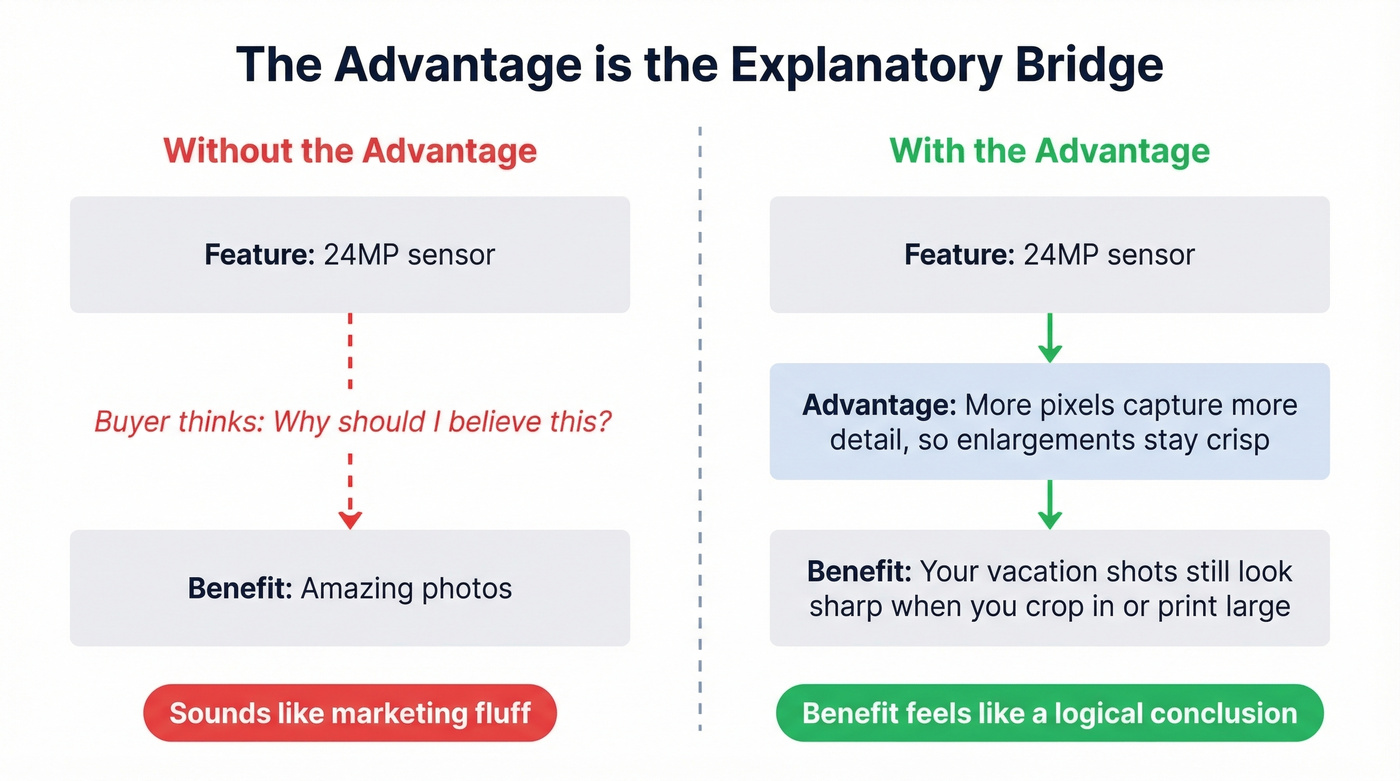
Here's the thing: sellers assume buyers connect features to benefits on their own. They don't. Fit4Market's breakdown of the FAB technique nails this - the advantage is the "explanatory bridge" that makes the benefit believable. Without it, you're asking the buyer to do the mental work for you.
Take a camera. A 24MP sensor is a feature. "Enlarge photos without losing sharpness" is a benefit. But the buyer needs to understand how - the advantage is that more pixels capture more detail, so enlargements stay crisp. Skip that middle step and the benefit sounds like marketing fluff. Include it and the benefit becomes a logical conclusion.
This matters most in complex or technical sales, where the gap between what a product does and why someone should care is widest. The advantage closes that gap. Product teams fall into the same trap - they ship features without translating them into user outcomes, the classic "build trap." FAB forces product managers to articulate time-to-value: not just what shipped, but how it helps and why users should adopt it.
Real FAB Examples Across Industries
Five examples to show this isn't just a copywriting trick. It works for SaaS, physical products, services, and everything in between.
SaaS - Acquire.com
Acquire.com's homepage is a masterclass in benefit-led messaging without ever naming the framework. Feature: "Everything you need to buy and sell startups." Advantage: "No fees. No hassle. Total anonymity." Benefit: "Get your startup acquired at the maximum price in as little as 30 days."
The advantage handles the objections - fees, complexity, exposure - before the benefit delivers the outcome. That's the chain doing heavy lifting in three lines.
B2B Sales Tool - Prospeo
Feature: 300M+ professional profiles with real-time email verification. Advantage: 98% email accuracy on a 7-day refresh cycle, which means fewer bounces than providers refreshing every six weeks. Benefit: Your cold emails actually reach decision-makers, so your pipeline doesn't stall because of bad data.
If you're comparing data sources, start with a shortlist of sales prospecting databases and then validate accuracy with an AI email checker.

Consumer Electronics - Smartphone Camera
Here's a before/after rewrite to show the difference.
Before (feature dump): "108MP sensor, f/1.8 aperture, optical image stabilization, 8K video recording."
After (FAB): "The 108MP sensor captures extremely detailed photos, so your vacation shots still look sharp when you crop in or print them large. Optical stabilization keeps video smooth without a gimbal - your kids' soccer highlights look like they were shot by a pro."
Same specs. Completely different emotional response.
Professional Services - Consulting Firm
Every consulting firm claims senior talent and deep expertise. None of that differentiates. What does: assigning a dedicated project manager to the engagement, meaning one point of contact who knows your business instead of a rotating cast. The benefit isn't just efficiency - you look like the organized, strategic leader your board expects, because projects close on time and nothing falls through the cracks.
If you need a tighter narrative for services, borrow patterns from proven sample elevator pitches.
Ecommerce - Fitness Equipment
| Element | Detail |
|---|---|
| Feature | Adjustable dumbbells replacing multiple sets |
| Advantage | Switch weights quickly with a single dial |
| Benefit | Full gym workout in your apartment - no dedicated room, no waiting for someone to finish their set |
Physical products default to listing dimensions and materials. The chain pushes you past the spec sheet into the buyer's actual life.

The FAB framework only works when your emails actually land. Prospeo's 98% email accuracy and 7-day data refresh mean your benefit-led cold emails reach real inboxes - not bounce logs.
Stop crafting perfect FAB emails that bounce. Start reaching decision-makers.
Using FAB in Cold Email
Cold email is where this approach earns its keep - or dies trying. The average cold email open rate sits around 23.9%, and response rates hover near 1%. Personalized subject lines lift open rates by 39%. You don't have room for a feature dump. Every sentence needs to pull its weight.
A benefit-led cold email has six parts, and the whole thing should be 4-6 sentences:
- Subject line: [Benefit] for [Company Name]
- Opening: One sentence acknowledging the prospect's role or a recent trigger event
- Feature: What your product does, stated in one line
- Advantage: How that's different or better than what they're doing now
- Benefit: The outcome they care about - revenue, time saved, risk reduced
- CTA: One clear ask
For more options, pull from these cold email subject line examples and sales follow-up templates.
Here's what that looks like written out:
"Hi Sarah - saw Acme just expanded into EMEA. We help international sales teams verify prospect emails across 300M+ profiles in real time (feature), which keeps bounce rates below 4% (advantage). Our customers book 26% more meetings (benefit). Worth 15 minutes this week?"
We've tested both approaches internally - benefit-led subject lines consistently outperform feature-led ones. Lead with the outcome, not the spec.
The best email in the world bounces if the address is wrong. Run your list through a verification tool before you hit send. If you're troubleshooting, use these benchmarks for email bounce rate and the full email deliverability guide.
FAB vs. AIDA vs. PAS
FAB isn't the only messaging framework, and it's not always the right one. Let's break down when each one fits.
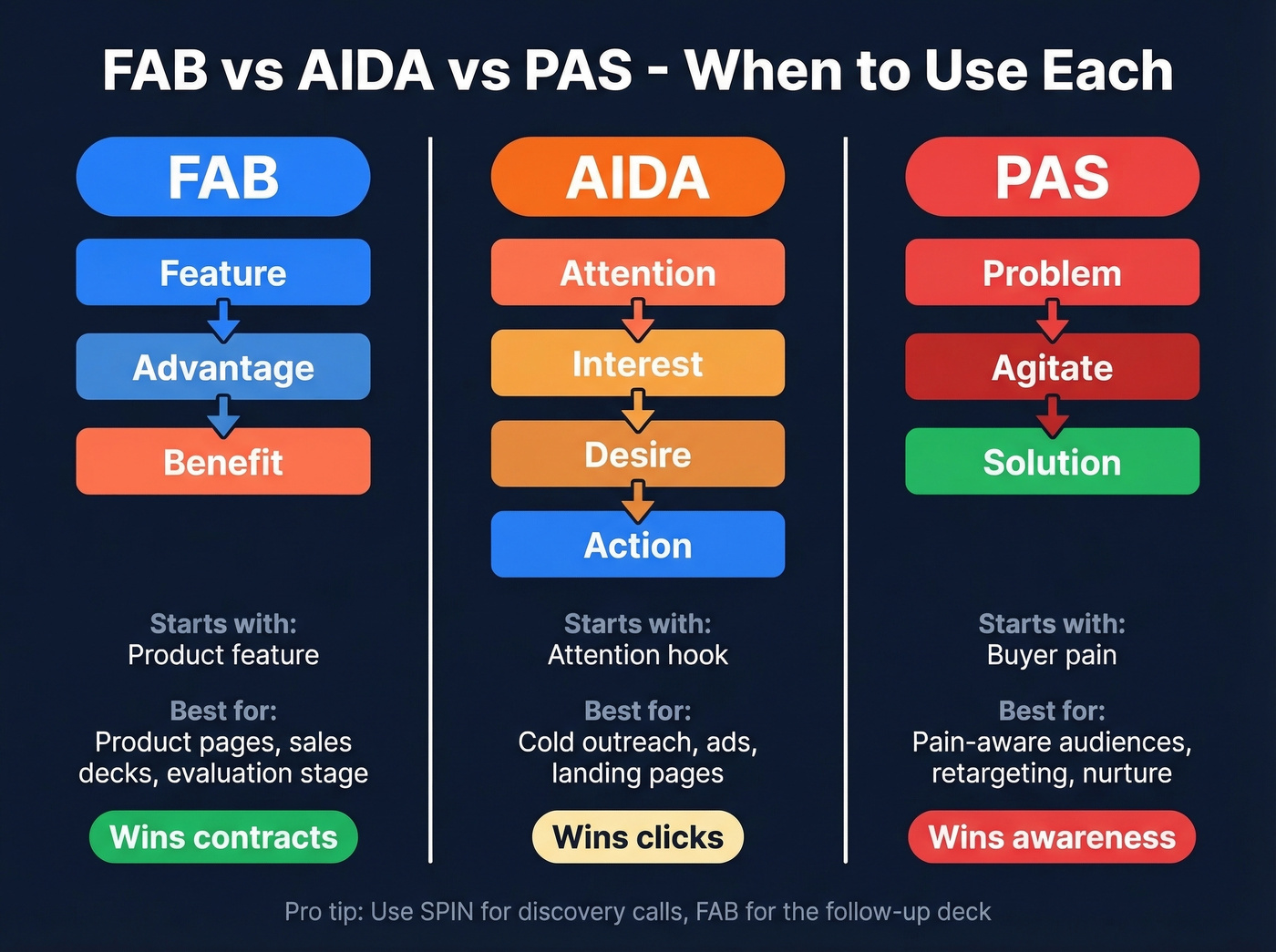
| Framework | Starts With | Best For |
|---|---|---|
| FAB | Product feature | Product pages, sales decks |
| AIDA | Attention hook | Cold outreach, ads, landing pages |
| PAS | Buyer's pain | Pain-aware audiences, retargeting |
AIDA dates back to E. St. Elmo Lewis in the 1890s - the original ad framework. It's great for cold audiences who don't know you yet because it grabs attention first. But as practitioners on Reddit point out, "people no longer buy in such a linear way," which limits AIDA for complex B2B cycles.
PAS works best when your buyer already knows they have a problem. You name the pain, twist the knife, then present the solution. It's powerful for retargeting and nurture sequences where awareness already exists.
FAB shines when you need to explain a specific product or feature. It's the go-to for product pages, sales one-pagers, and any context where the buyer is evaluating what you offer rather than discovering they have a problem.
In our experience, most teams default to AIDA or PAS because those frameworks feel more "creative." But in higher-consideration B2B deals, buyers are evaluating specific capabilities against competitors. FAB wins evaluation-stage deals. AIDA wins clicks; FAB wins contracts.
One useful distinction: FAB is a presentation framework - you use it to communicate value. SPIN is a discovery framework - you use it to uncover value. Pair them: SPIN on the call, FAB in the follow-up deck.
Common Mistakes to Avoid
Three patterns kill effectiveness. We see them constantly.
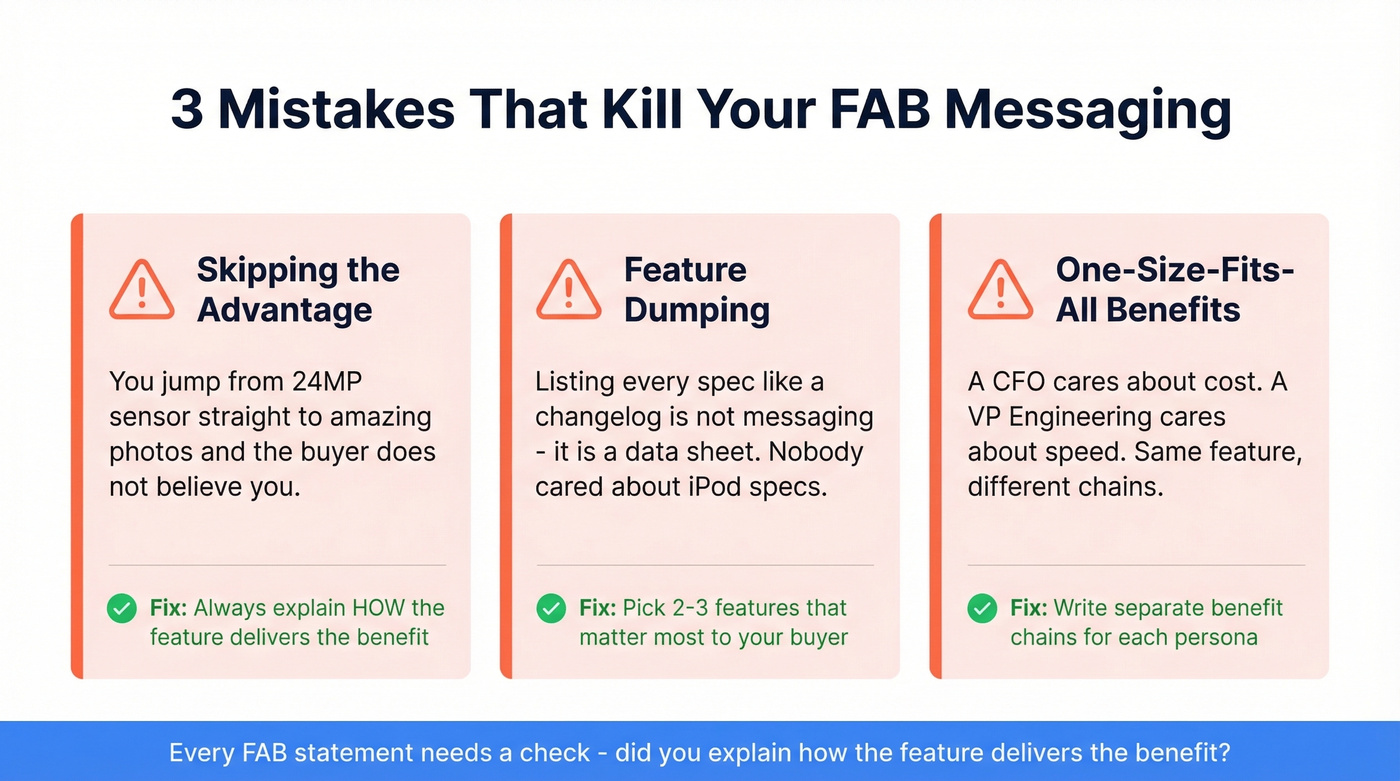
Skipping the advantage. This is the most common mistake by far. You jump from "24MP sensor" straight to "amazing photos" and the buyer doesn't believe you. The advantage is the proof mechanism - without it, the benefit is just a claim. Every time you write a FAB statement, check: did you explain how the feature delivers the benefit?
Feature-dumping. Feature-heavy sales reps love listing every spec like a changelog, but that isn't messaging - it's a data sheet. The iPod lesson still applies: nobody cared about specs. They cared about "1,000 songs in your pocket." Pick the 2-3 features that matter most to your buyer and run those through the chain. Leave the rest for the comparison table.
One-size-fits-all benefits. A CFO cares about cost reduction. A VP of Engineering cares about implementation speed. A CMO cares about pipeline impact. The same feature can produce three different benefit chains depending on who you're talking to. If you're writing one benefit statement for all personas, you're writing for none of them.
Worksheet + ChatGPT Prompt
The Reddit consensus on frameworks is clear: "Copywriting templates are BS... rigid and don't provide room for creativity. Instead, learn frameworks." Use this worksheet as a thinking tool, not a fill-in-the-blank script.
| Feature | Advantage | Benefit |
|---|---|---|
| Real-time email verification | Catches invalid addresses before send | Zero bounces, protected sender reputation |
| Same-day onboarding | Team is productive on day one | Revenue impact in week one, not month two |
| API with a 92% match rate | Enriches CRM records automatically | Reps stop manual research, start selling |
| (your feature) | (how it helps) | (why the buyer cares) |
If you want to speed things up with AI, here's a ChatGPT prompt that works:
"Write a product description for [product]. For each key feature, explain the advantage over alternatives and the benefit to [target persona]. Use the FAB framework: Feature → Advantage → Benefit. Keep each FAB chain to 2-3 sentences."
Swap in your product and persona. Review the output for generic language - AI loves vague benefits like "save time and money." Push it to be specific. If the benefit wouldn't make a buyer pause mid-scroll, it's not sharp enough.
If you're operationalizing this for outbound, map FAB to your B2B cold email sequence and tighten your email copywriting standards.
You've seen the Prospeo FAB example above: 300M+ profiles, 98% accuracy, 7-day refresh. That's the feature-advantage chain. The benefit? Teams book 26% more meetings than with ZoomInfo - at $0.01 per email.
Turn your FAB copy into pipeline with data that actually connects.
FAQ
Is FAB only for copywriting?
No. SDRs use it in cold emails and call scripts, product teams use it for roadmap prioritization, and founders use it in pitch decks to translate technical capabilities into investor-friendly outcomes. Any time you're converting what something does into why someone should care, the chain applies.
What's the difference between an advantage and a benefit?
The advantage explains how the feature helps - the mechanism. The benefit explains why that matters to the buyer - the outcome. A 24MP sensor captures more detail (advantage) so you can print larger photos without blur (benefit). The advantage is proof; the benefit is payoff.
How do I stop selling features and start selling benefits?
Write down the feature, then ask "so what?" twice. The first answer is your advantage; the second is your benefit. If you can't articulate the benefit in terms the buyer would use in their own internal meetings, you're still stuck at the feature level.
Skip this if you already have clean data
Once you've written a benefit-led email, you need verified contact data to send it. Bad addresses kill deliverability and tank your sender reputation regardless of how good your copy is. Pair your outbound stack - tools like Lemlist or Instantly for sequencing - with a verification layer so your messages actually land.