

Field Sales Rep: What the Job Actually Looks Like in 2026
Most search results for "field sales rep" are job listings. A title, a bullet-point wish list of qualifications, and a salary range so wide it's useless. None of them tell you what the job actually feels like on a Tuesday afternoon when you're sitting in a parking lot between meetings, updating your CRM on your phone, wondering if the next prospect even still works at that company.
Here's what the job listings won't tell you - real salary data, a realistic daily workflow, the tools that matter, and an honest career path from entry-level to six figures.
The Quick Version
- The role in one sentence: You sell face-to-face, in the field, not behind a desk. Territory management, client meetings, demos, and closing - all on the road.
- Realistic first-year comp: Around $48k total with base plus commission. Experienced reps clear $95k+, and senior field sales executives average $117k.
- Three tools you need on day one: A mobile CRM, a route planner, and a prospecting tool with verified contact data.
- The ramp is real: Outside sales ramp time is typically 6-9 months. That's normal, not a red flag.
- Field sales isn't dying: 71.2% of the sales force is still field-based. The "everything is going remote" narrative is overblown.
What Does a Field Sales Rep Do?
A field sales representative - also called an outside sales rep, territory rep, or regional sales rep - is someone whose core job is meeting prospects face-to-face to generate leads, close deals, and build lasting relationships. You're not stuck behind a screen making 80 cold calls a day. You're in the car, at the client's office, at trade shows, in conference rooms.
The distinction from inside sales is straightforward: inside reps sell remotely via phone, email, and video. Outside reps sell in person. That dividing line shapes everything - deal size, sales cycle, comp structure, and daily routine.
Don't let anyone tell you this is a shrinking role. Field sales teams still make up 71.2% of the sales force. The channel is evolving, hybrid models are growing, and reps lean harder on technology than ever - but the fundamental job of showing up, building trust, and closing complex deals in person isn't going anywhere.
Daily Responsibilities
The job title sounds simple. The actual role is a blend of prospecting, consulting, presenting, negotiating, and relationship management - with a healthy dose of windshield time and admin work mixed in. Think of it as part brand ambassador, part market analyst. You're simultaneously representing the company and gathering competitive intelligence that no dashboard can capture.
Here's how a typical week breaks down:
Prospecting and lead generation. Finding new accounts in your territory through cold outreach, referrals, networking events, and inbound follow-up. Many outside reps do their own prospecting - you can't rely on marketing to fill your pipeline. (If you need a refresher, start with sales prospecting.)
Client meetings and demos. This is the core. You're sitting across from decision-makers, running product demos, presenting proposals, and answering objections in real time. Outside reps spend 60-70% of their active selling time in face-to-face meetings.
Negotiating and closing. Field sales deals tend to be larger and more complex. You're navigating multi-stakeholder buying committees, handling procurement, and working through contract terms that inside reps rarely touch.
Post-sale relationship management. The deal doesn't end at signature. You're the ongoing face of the company - checking in, handling escalations, identifying upsell opportunities.
Market intelligence. Competitor activity, customer pain points, market shifts - you're gathering intel that product and marketing teams simply can't get from analytics.
Here's the uncomfortable truth: reps spend only about 28% of their week actually selling. The rest is admin, travel, CRM updates, and internal meetings. The best territory reps ruthlessly protect their selling time. The rest drown in logistics.
A Typical Day in the Life
It's Monday morning. You've got 15 accounts in your territory and no idea which to visit first. This is where the job either clicks or falls apart.
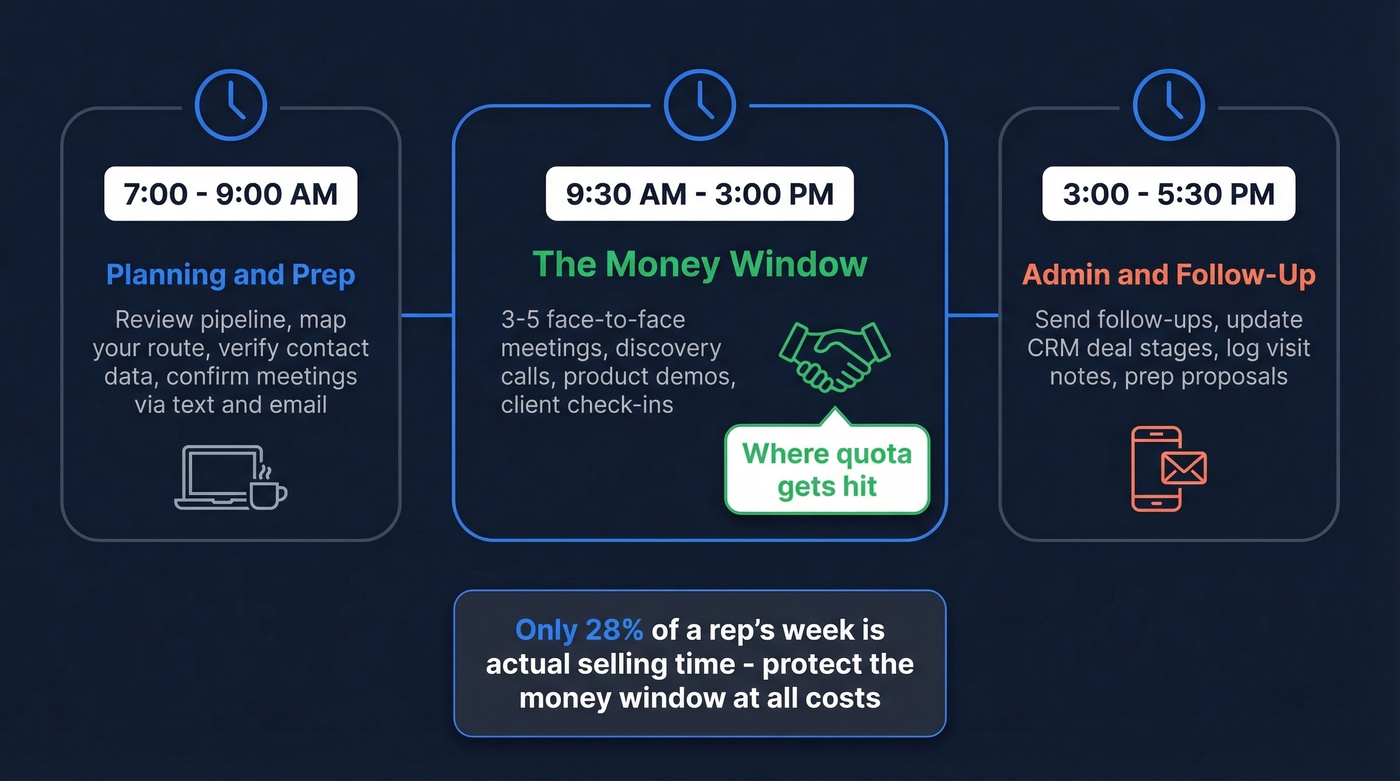
Morning (7:00-9:00 AM). You're at your kitchen table or a coffee shop, not an office. The first hour is planning: reviewing your pipeline, checking which deals need follow-up, and mapping your route for the day. You pull fresh contact data for your target accounts, verify emails, and confirm direct dials so you can lock in meetings before you leave the house. A few confirmation texts, one rescheduled meeting, and your route is set.
Midday (9:30 AM-3:00 PM). This is the money window. You're running 3-5 face-to-face meetings - discovery calls with new prospects, product demos for warm leads, and check-ins with existing clients. The best reps batch meetings geographically so they're not crisscrossing the city. Route optimization tools can increase daily visits by 25-40% just by cutting drive time.
Afternoon (3:00-5:30 PM). The meetings are done, but the work isn't. You're sitting in your car or at a cafe, sending follow-up emails, updating deal stages in your CRM, logging visit notes, and prepping proposals. This is the admin block that separates disciplined reps from the ones who let deals slip through the cracks.
Salary and Compensation
Let's talk money - with real numbers, not the "$40k-$150k" ranges that job boards love to publish.
Base Salary Ranges
PayScale data for US field sales representatives:
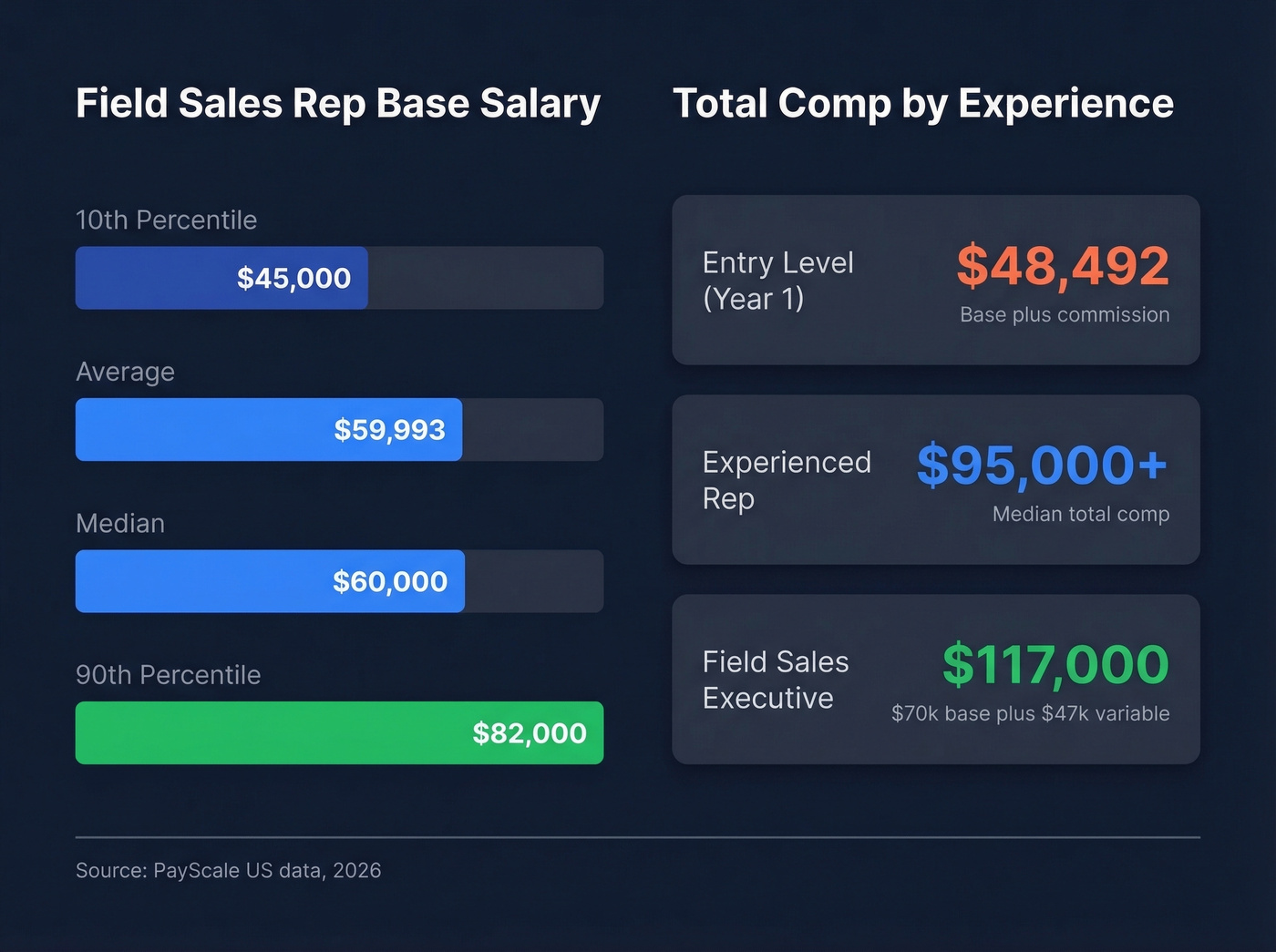
| Percentile | Base Salary |
|---|---|
| 10th | $45,000 |
| Median | $60,000 |
| 90th | $82,000 |
| Average | $59,993 |
Commission adds $4k-$35k on top of base, with total comp ranging from $41k to $95k. Entry-level reps with less than one year of experience average about $48,492 in total comp. That's the honest starting point - not glamorous, but it scales fast if you're good.
Field sales executives - reps who've moved up to managing larger accounts and negotiating at a higher level - average around $117k with a $70k base and $47k in variable comp. The ceiling is real, but you have to earn it. In our experience, the reps who negotiate hardest on base salary during hiring are the ones who survive the ramp.
Understanding OTE
You just got offered a role with "$140k OTE." Here's what that actually means.
OTE stands for on-target earnings - your annual base salary plus the commission you'd earn if you hit exactly 100% of quota. A 50/50 pay mix means equal base and variable: $70k base + $70k commission at target = $140k OTE. (If you want the math and benchmarks, see OTE in sales.)
The catch is the quota-to-OTE ratio. In mid-market SaaS, quota is typically 1-3x your OTE, so a $140k OTE might come with a $280k-$420k annual quota. In non-tech industries, ratios can stretch to 10-20x. Always ask what quota looks like before you get excited about OTE. A high OTE with an unreachable quota is just a modest base with extra steps.

You just read that field reps spend only 28% of their week actually selling. Bad contact data makes it worse - every bounced email and wrong number is selling time you'll never get back. Prospeo gives you 98% verified emails and 125M+ direct dials so you can confirm meetings before you hit the road, not discover dead leads in a parking lot.
Stop burning windshield time on prospects who moved companies six months ago.
Field Sales vs. Inside Sales
Everyone says field sales is dying. The data says the opposite.
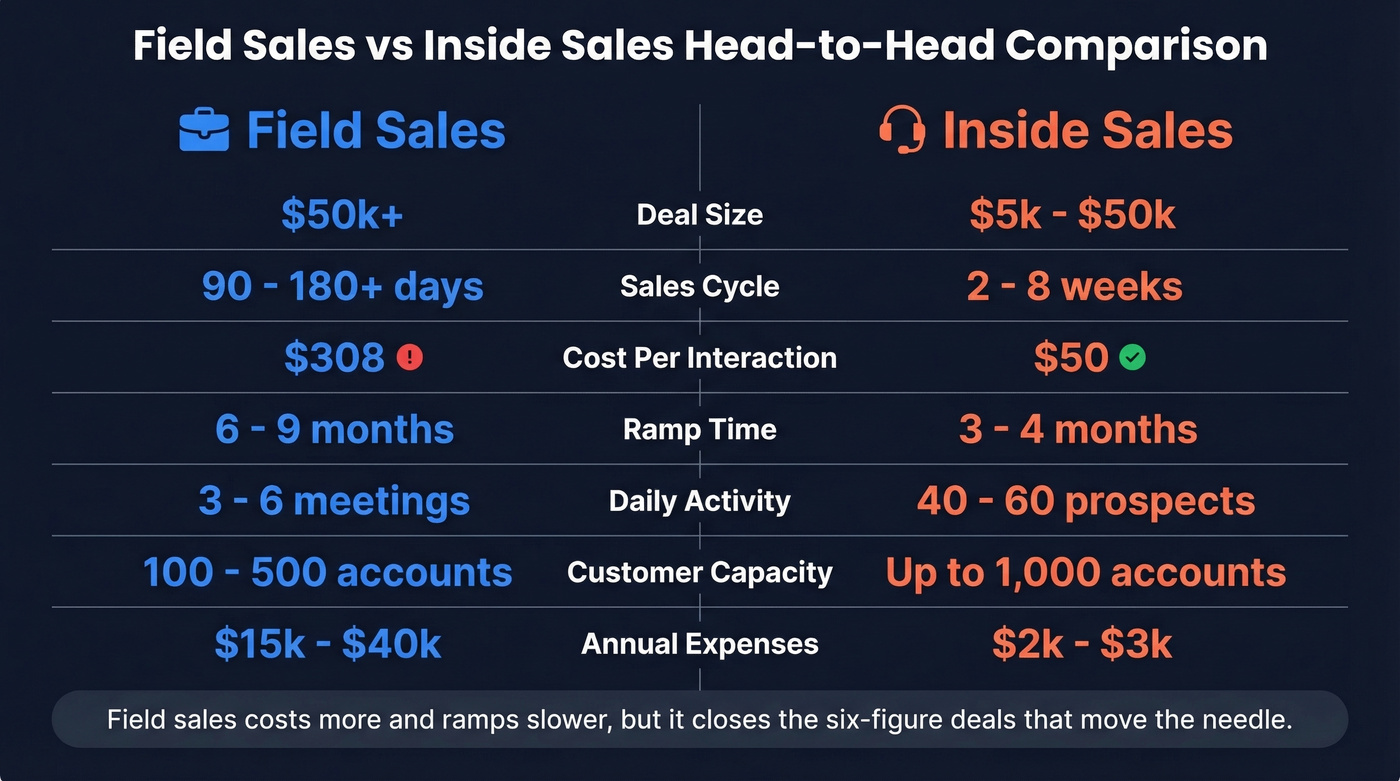
| Metric | Field Sales | Inside Sales |
|---|---|---|
| Typical deal size | $50k+ | $5k-$50k |
| Sales cycle | 90-180+ days | 2-8 weeks |
| Cost per interaction | ~$308 | ~$50 |
| Annual expenses | $15k-$40k | $2k-$3k |
| Ramp time | 6-9 months | 3-4 months |
| Daily activity | 3-6 meetings | 40-60 prospects |
| Customer capacity | 100-500 | Up to 1,000 |
The numbers tell a clear story: outside sales is more expensive, slower to ramp, and lower volume. But it closes the deals that move the needle. When you're selling a $200k enterprise contract, nobody's closing that over a Zoom call and a DocuSign link.
Yes, 70-80% of B2B buyers prefer digital interactions for initial research. But preference for self-service in the research phase doesn't mean preference for self-service at the close. The 40% of high-growth teams running hybrid models have figured this out - inside reps handle early-stage qualification, and outside reps close in person.
Here's the thing: if your average contract value is under $25k, you probably don't need a field sales team. Inside reps can handle that deal size more efficiently. But the moment you're selling six-figure contracts with multi-stakeholder buying committees, in-person selling isn't a luxury - it's the only model that consistently works. (For the playbook, see enterprise B2B sales.)
Skills That Actually Matter
You can find a dozen listicles with "top 10 field sales skills." Most are generic enough to apply to any job. Here's what actually separates reps who hit quota from reps who wash out.
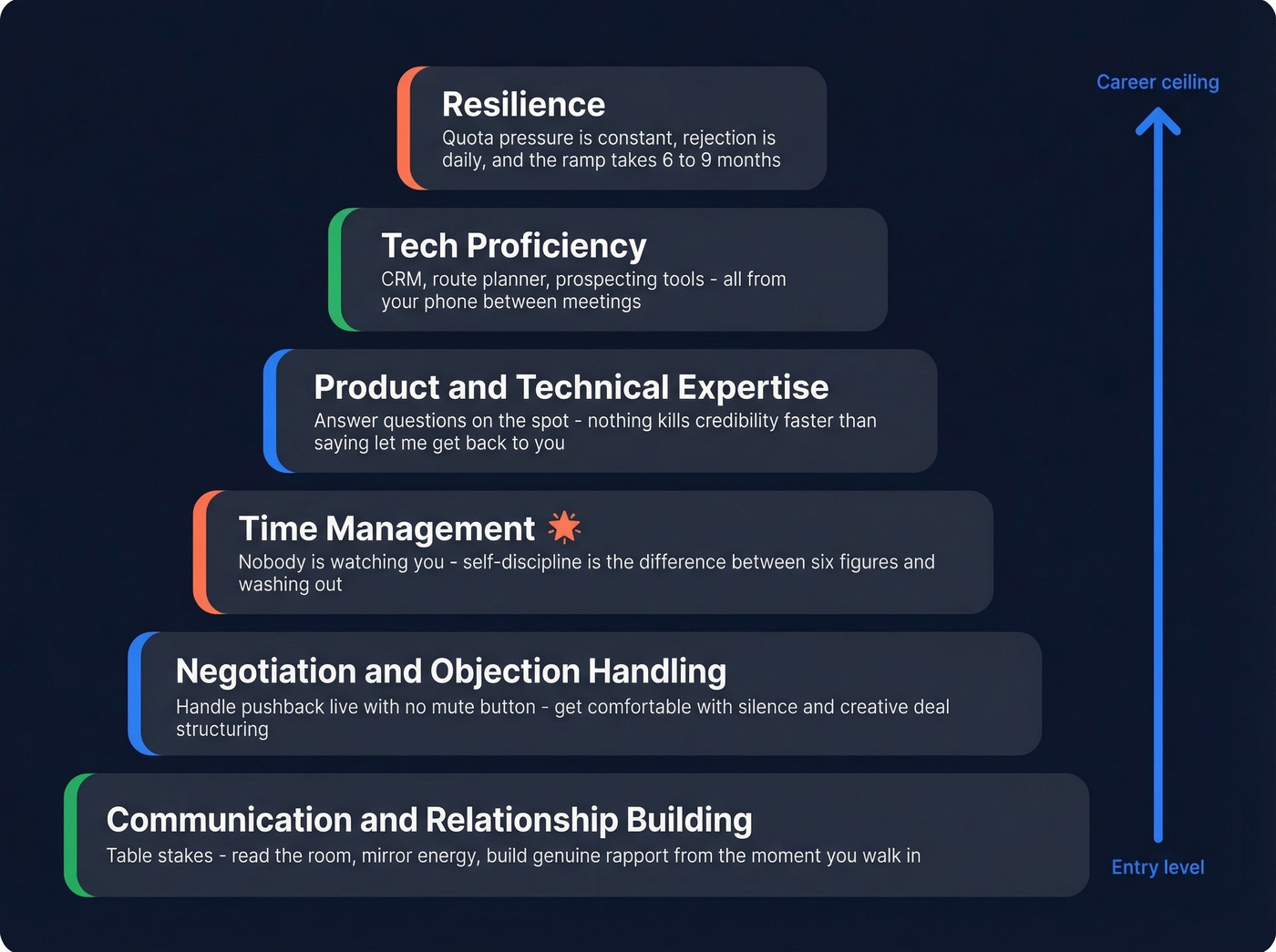
Communication and relationship-building are table stakes. If you can't read a room, mirror a prospect's energy, and build genuine rapport in person, this isn't your role. Outside sales is a relationship game, and the relationship starts the moment you walk through the door.
Negotiation and objection handling matter more here than in inside sales because you're handling objections live, in real time, with no mute button to buy yourself thinking time. You need to be comfortable with silence, with pushback, and with creative deal structuring on the fly. (If you want a tactical framework, learn how to use an anchor in negotiation.)
Time management is the skill that separates six-figure reps from washouts. Nobody's watching you. That's the freedom and the trap. You decide when to wake up, which accounts to visit, and whether to squeeze in one more meeting or call it a day at 3 PM. Self-discipline isn't a nice-to-have - it's the whole game.
Product and technical expertise let you answer questions on the spot without saying "let me get back to you." In field sales, credibility is built in person, and nothing kills it faster than not knowing your own product. We've watched reps lose deals in the first ten minutes because they couldn't answer a basic integration question.
Tech proficiency isn't optional anymore. If you can't navigate a CRM, route planner, and prospecting platform on your phone between meetings, you're already behind the reps who can. (A good starting point is a modern set of SDR tools.)
Resilience rounds it out. Quota pressure is constant, rejection is daily, and the 6-9 month ramp means you'll feel underwater for a while before things click. If you struggle with the mental side, build a system for resilience in sales.
Essential Tools and Tech Stack
If reps only spend 28% of their week selling, the other 72% is where technology either saves you or buries you. Skip this section if your company already has a mature tech stack - but if you're at a startup or building your own kit, pay attention.
Mobile CRM
Your CRM is where deals live. Salesforce is the enterprise standard, and HubSpot is popular with a strong free tier. Pricing ranges from free to roughly $25-$150+/user/month depending on features and seats. (If you're comparing options, start with examples of a CRM.)
Either works. What matters is that you can update deals, log visits, and check pipeline from your phone between meetings. If you can't do that, you'll fall behind on admin and your pipeline data will be garbage by Friday.
Route Planning and Territory Management
Driving is the hidden tax on field sales productivity. Route optimization tools cut windshield time and increase daily visits by 25-40%. (If you're evaluating platforms, see sales mapping software.)
Badger Maps (from $58/user/month) is a strong dedicated option. Map My Customers (from $50/user/month) adds territory mapping and analytics. ForceManager (from $19/user/month) blends CRM with route planning for smaller teams. SalesRabbit (from $25/user/month) works well for door-to-door and canvassing workflows.
Prospecting and Contact Data
Your CRM is only as good as the data in it. Prospeo gives outside reps access to 300M+ professional profiles, 143M+ verified emails, and 125M+ verified mobile numbers with 98% email accuracy. That 30% mobile pickup rate improves your odds of actually getting an answer when you call a prospect before a territory visit. Data refreshes every 7 days, so you're not driving 45 minutes to meet a contact who left the company last month. (For a broader comparison, see data enrichment services.)
The Chrome extension (40K+ users) lets you pull contact data from any website in one click, and the free tier gives you 75 verified emails plus 100 Chrome extension credits per month - enough to start building a territory list without spending anything.
| Tool | Category | Starting Price |
|---|---|---|
| Salesforce | CRM | Free-~$150+/user/mo |
| HubSpot | CRM | Free-~$100+/user/mo |
| Badger Maps | Route Planning | $58/user/mo |
| Map My Customers | Territory Mapping | $50/user/mo |
| ForceManager | Field CRM | $19/user/mo |
| SalesRabbit | Field Sales | $25/user/mo |
| Prospeo | Prospecting/Data | Free; ~$0.01/email |
Career Path and Progression
Field sales offers one of the highest-ceiling careers in sales - but only if you can survive the ramp.
The typical ladder: SDR -> Account Executive -> Senior/Enterprise AE -> Sales Manager -> VP of Sales -> CRO. Not everyone climbs every rung, and plenty of reps build lucrative careers staying as individual contributors at the enterprise level. But the path exists, and it's well-worn.
The SDR-to-AE jump usually happens after 12-18 months of consistently hitting pipeline goals. This is where most people enter outside sales - you've proven you can prospect and qualify, and now you're ready to run full-cycle deals. The AE-to-Enterprise AE transition takes another 2-3 years, and enterprise cycles stretch to 6-12 months per deal. It's a different skill set entirely: multi-threading across buying committees, navigating procurement, and managing deals worth hundreds of thousands of dollars over timelines that test your patience and your forecasting ability.
Comp scales with the ladder. Entry-level total comp starts around $48k. Experienced reps clear $95k+. Field sales executives average $117k. Enterprise AEs at top SaaS companies push well past $200k OTE. Sales careers fuel nearly 13% of all US jobs - the infrastructure is massive, and the demand for people who can sell complex deals in person isn't shrinking.
Biggest Challenges (and How to Handle Them)
Travel fatigue and windshield time. You'll spend more time in your car than you expect. Route optimization tools help - a 25-40% increase in daily visits means fewer wasted hours on the road. Batch your meetings geographically and protect at least one admin day per week.
Quota pressure and long ramp. The 6-9 month ramp is brutal. You're learning the product, building a territory, and trying to hit quota simultaneously. Set expectations with your manager early: what does "good" look like at month three versus month nine? Realistic milestones prevent panic. (A simple 30-60-90 day plan helps.)
Admin overload. CRM updates, visit reports, expense tracking, proposal writing - it piles up fast. A mobile CRM with automated visit logging can save hours each week. Guard your selling time like it's money, because it is.
Bad prospect data leading to wasted visits. This one stings the most. You drive 45 minutes to a meeting only to find out your contact left the company two months ago. Verified contact data with a short refresh cycle eliminates this problem almost entirely. Pre-qualify every meeting before you get in the car. The consensus on r/sales is that bad data is the single biggest time-killer for outside reps, and we'd agree - it's the one problem that compounds every other problem on this list.
Trends Shaping Field Sales in 2026
The outside sales role in 2026 looks different from 2020. Not unrecognizably different, but the toolkit and expectations have shifted.
Hybrid selling is the dominant model. 40% of high-growth teams now run hybrid structures where inside reps handle early-stage qualification and territory reps close in person. Pure field-only or inside-only teams are becoming the exception.
Buyers arrive pre-educated. 70-90% of research happens before a buyer ever talks to a rep. The role has shifted from presenter to consultant and problem-solver. If you're still showing up to "pitch," you're already behind. Prospects want someone who understands their business and can connect dots they haven't connected themselves.
The digital paradox. 70-80% of B2B buyers say they prefer digital interactions - yet field sales still makes up 71.2% of the workforce. The resolution is simple: buyers prefer digital for research and initial contact, but they still want a human in the room for high-stakes decisions. Reps who master both digital engagement and in-person selling will consistently outperform their peers.
The reps who treat technology as a force multiplier rather than a threat are the ones thriving right now. Data-driven territory planning, verified contact databases, and AI-assisted prep aren't replacing in-person selling - they're making the best reps even better.
Your morning planning block is only as good as your data. Prospeo refreshes 300M+ profiles every 7 days - not every 6 weeks like other providers - so the decision-maker you're visiting at 10 AM actually still holds that title. At $0.01 per email, it costs less than the gas to drive to a meeting that was dead on arrival.
Lock in real meetings with contacts verified this week, not last quarter.
FAQ
Is field sales a good career?
Yes - it offers one of the highest earning ceilings in sales, real autonomy, and relationship-driven work that many people find deeply satisfying. Entry-level total comp starts around $48k, but experienced reps regularly clear $95k+, and enterprise roles push well past $150k OTE. The tradeoff is a 6-9 month ramp and significant travel.
How much do field sales reps make?
The average base salary is about $59,993/year per PayScale, with total comp ranging from $41k to $95k after commission. Senior field sales executives average $117k. OTE for mid-market SaaS roles can reach $140k+ with a 50/50 pay mix. Geography, industry, and deal size all shift these numbers significantly.
What's the difference between field sales and door-to-door sales?
Door-to-door is a subset of outside sales focused on residential or small-business cold-calling. Field sales broadly includes B2B territory management, scheduled client meetings, trade shows, and enterprise deal-making. Most B2B field reps work from pre-qualified prospect lists and scheduled appointments rather than unannounced visits.
Do you need a degree to become a field sales rep?
No - most employers prioritize sales experience, communication skills, and industry knowledge over formal education. Many successful reps start as SDRs or inside sales reps and transition to outside sales after 12-18 months of strong performance. A degree helps at some enterprise companies, but it's rarely a hard requirement.
What free tools can field sales reps use for prospecting?
Prospeo's free tier (75 verified emails + 100 Chrome extension credits/month) is enough to start building a territory list without spending anything. HubSpot offers a free CRM for pipeline management. Combine those with Google Maps for basic route planning and you've got a functional starter stack before your company provides paid tools.