

How to Find Emails for People: The 8 Best Tools in 2026
You send 500 cold emails on Monday. By Wednesday, 23% have bounced, your domain reputation is tanking, and the "verified" list you paid for is destroying your sender score in real time. That's a normal week for any team trying to find emails for people using tools that treat "found" and "deliverable" as the same thing. The industry standard is clear: keep total bounces below 2% and hard bounces under 1% and hard bounces under 1%. Most tools can't get you there.
The gap between "we found an email" and "this email will actually land in an inbox" is where campaigns die. We've tested these tools extensively, and the difference always comes down to what happens after the lookup - whether the email survives a real send, not just a syntax check.
Our Picks (TL;DR)
If you test three tools this week, start with these. You don't need ten.
| Pick | Best For | Why |
|---|---|---|
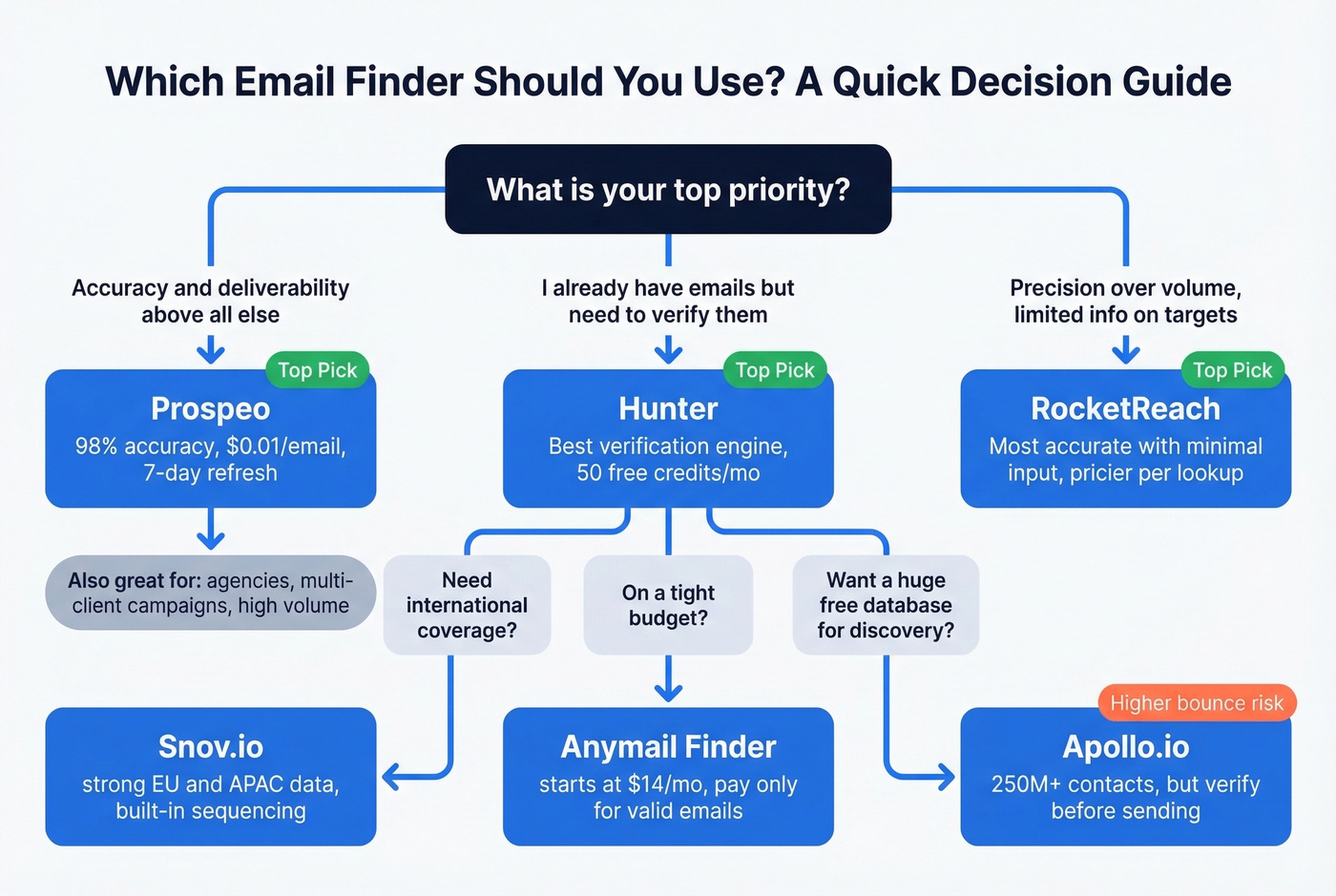
| Prospeo | Accuracy + value | 98% email accuracy, 7-day refresh, ~$0.01/email |
| Hunter | Verification layer | Strong verification engine, 50 free credits/mo |
| RocketReach | Precision targeting | Practitioners report major bounce-rate drops |
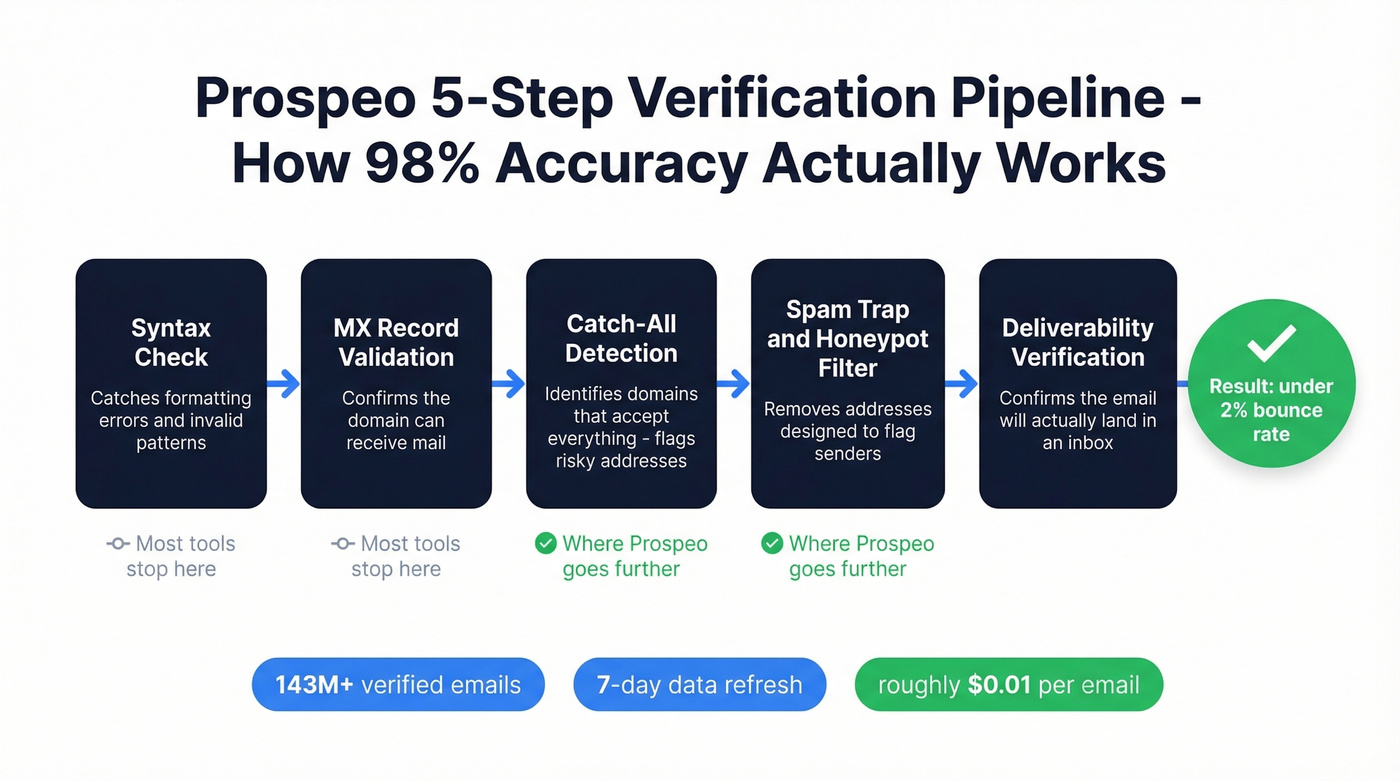
Prospeo is the pick when deliverability is the priority. 143M+ verified emails, a 5-step verification pipeline that handles catch-all domains, and a data refresh cycle that runs every 7 days instead of the industry-average six weeks. At roughly a penny per email, it's the best cost-to-accuracy ratio on this list.
Hunter earns its spot not as a primary database but as the verification specialist you pair with a larger source. 50 free credits a month and unlimited users across every plan make it easy to test without commitment.
RocketReach is the tool one practitioner on r/coldemail called "the most accurate so far," reporting that bounces "dropped a lot" after switching. It's pricier per lookup, but the accuracy holds up when you're working with limited info on mid-market targets.
The Accuracy Problem Nobody Talks About
Most email finder comparisons rank tools by database size. That's the wrong metric.
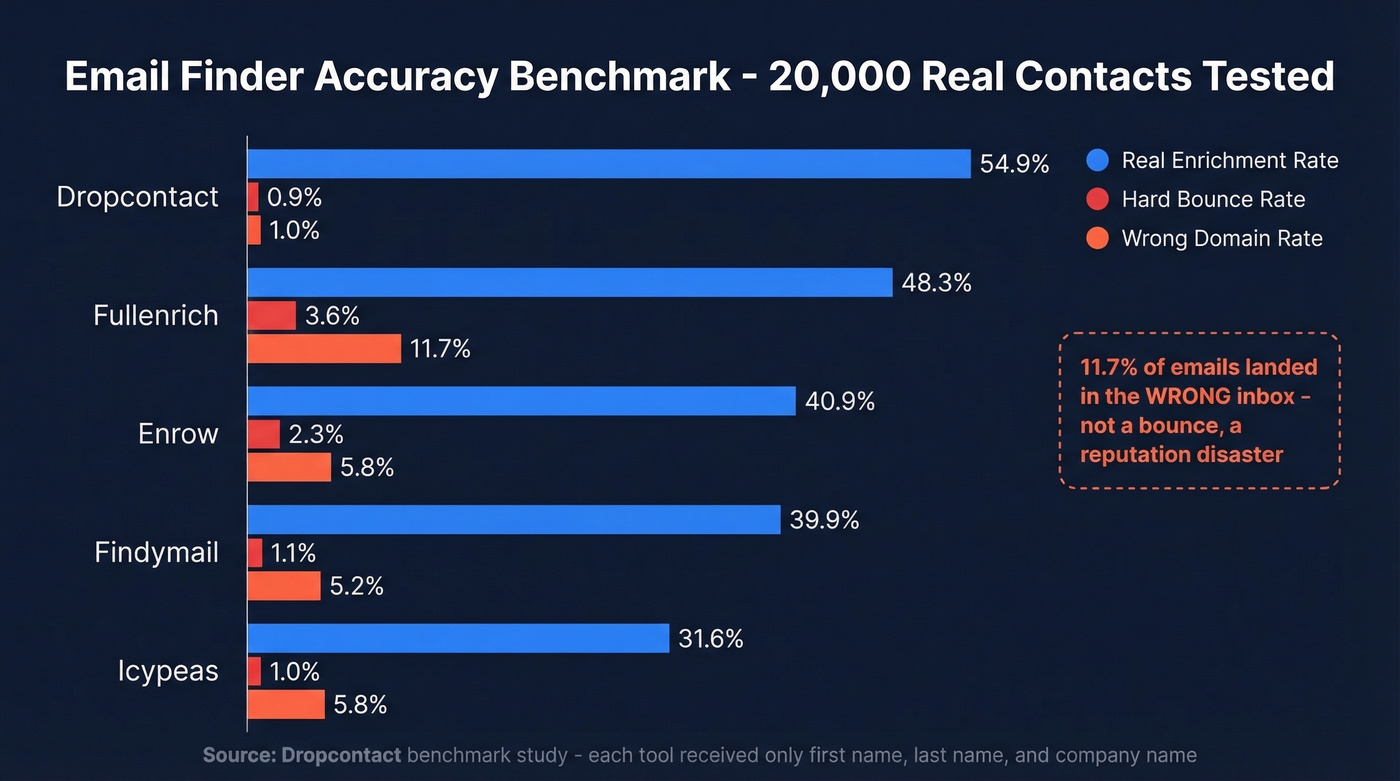
A benchmark study by Dropcontact - who also participated in the test - measured 15 email finders against 20,000 real contacts across the US and Europe, tracking what actually matters: did the email survive a real send? The methodology was unusually rigorous. Each tool received only a first name, last name, and company name. No domain, no profile URL. Then every found email was actually sent to measure hard bounces, and a dual-entry manual check flagged wrong-domain errors - emails that look valid but point to the wrong company entirely.
| Tool | Real Enrichment Rate | Hard Bounce | Wrong Domain |
|---|---|---|---|
| Dropcontact | 54.9% | 0.9% | 1.0% |
| Fullenrich | 48.3% | 3.6% | 11.7% |
| Enrow | 40.9% | 2.3% | 5.8% |
| Findymail | 39.9% | 1.1% | 5.2% |
| Icypeas | 31.6% | 1.0% | 5.8% |
The "real enrichment rate" strips out hard bounces and wrong-domain results from the raw find rate. A tool that finds 60% of emails but bounces 8% of them is worse than one that finds 45% and bounces under 1%.

Wrong-domain rate is the hidden killer. Fullenrich found emails for nearly half the list, but 11.7% pointed to the wrong company. That's not just a bounce - it's an email landing in a stranger's inbox with your company name on it.
8 Best Tools to Find People's Emails
Prospeo
Use this if: You need emails that actually land - not just emails that pass a syntax check. Ideal for outbound teams, agencies running multi-client campaigns, and anyone whose domain reputation has been burned by bad data before.
Skip this if: You need a full-stack sales engagement platform with built-in sequencing and a dialer. Prospeo focuses on data accuracy; pair it with Instantly, Lemlist, or Outreach for the sending layer.
Prospeo's database covers 300M+ professional profiles and 143M+ verified emails, built on proprietary email-finding infrastructure that doesn't rely on third-party providers. The 5-step verification process handles the things most tools skip: catch-all domain verification, spam-trap removal, and honeypot filtering. API match rate sits at 92%, and CRM and CSV enrichment returns 50+ data points per contact.
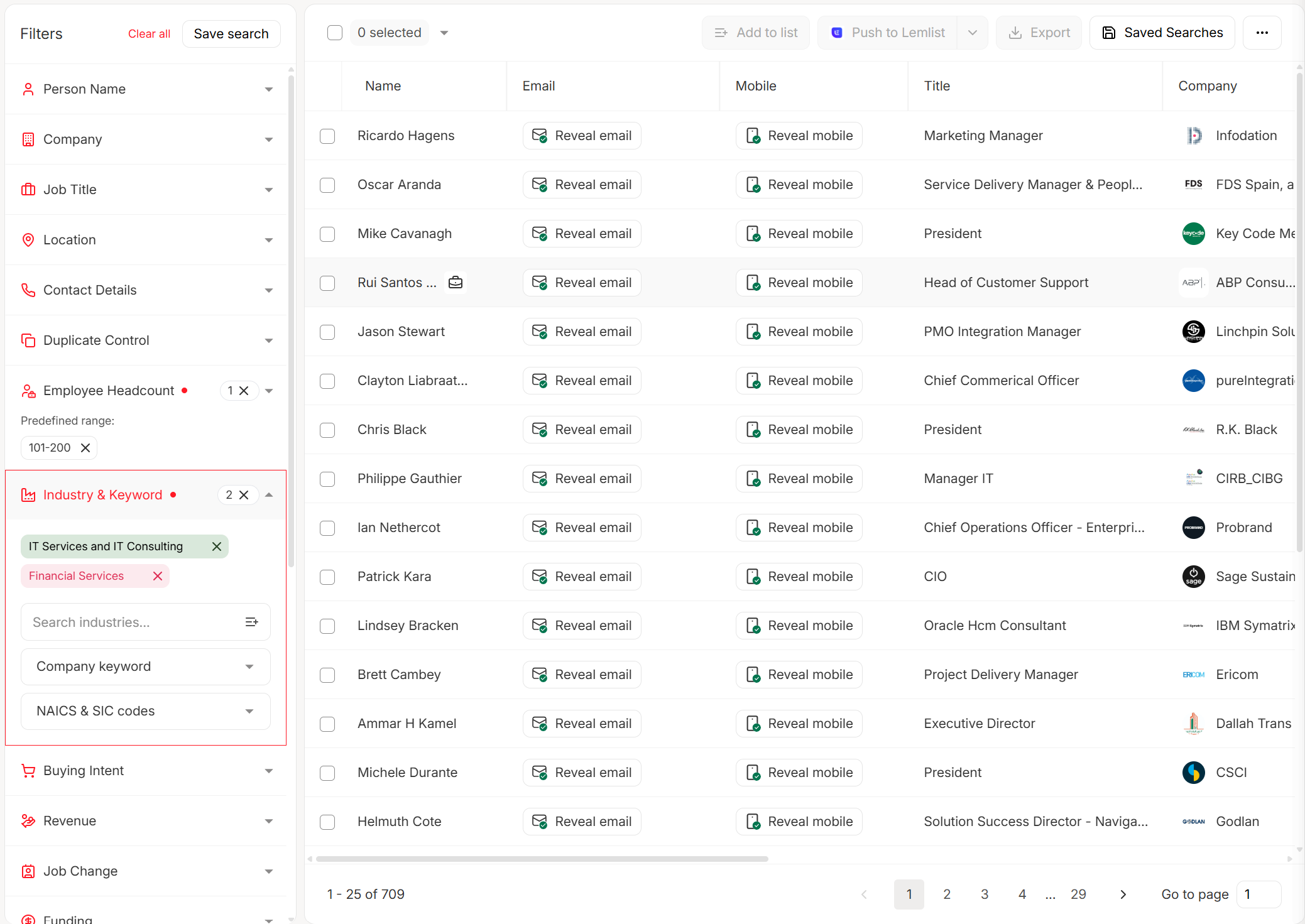
The proof is in the customer results. Meritt went from a 35% bounce rate to under 4% after switching, tripling their pipeline from $100K to $300K per week. Stack Optimize built to $1M ARR with client deliverability above 94% and zero domain flags. The Chrome extension has 40K+ users and lets you pull verified emails from any website, professional profiles, or CRM in one click. Pricing starts free at 75 emails + 100 Chrome extension credits per month, with paid plans running roughly $0.01 per email - no contracts, no sales calls, cancel anytime.
If you're comparing data sources, see our breakdown of email list providers and sales prospecting databases.
Hunter
Use this if: You already have a primary database and need a verification layer to clean it before sending. Hunter's verification engine is genuinely strong, and the free tier is generous enough to test properly.
Skip this if: You need a large primary email database. Hunter's own contact database is relatively small. Practitioners on Reddit consistently describe it as better for verification than as a primary source.

Hunter's real strength is email pattern detection - give it a domain, and it maps out the naming convention with confidence scores. Verification costs just 0.5 credits per email, which means the Starter plan at $49/mo gives you 2,000 credits - enough for 4,000 verifications. The free plan offers 50 credits monthly, and every plan includes unlimited users.
If you're shopping around, compare it against other options in our guide to Hunter alternatives and Bouncer alternatives.
RocketReach
Use this if: You're targeting mid-market SaaS companies and need to locate someone's email address even when you're working with limited information - just a name and company, no domain or profile URL.
Skip this if: You're doing high-volume prospecting. At $0.30-$0.45 per overage lookup, costs escalate fast once you exceed your plan limits.

RocketReach earned its spot based on practitioner results. One user on r/coldemail reported testing multiple tools and landing on RocketReach because bounces "dropped a lot" - they'd been seeing 20%+ bounces on "verified" emails from other providers. The tool works well with minimal input, which matters when you're prospecting outside your existing CRM data.
Pricing runs $80-$300/user/month for individual plans, with team plans starting at $83/user/month billed annually. The Essentials plan gives you 125 lookups per month, Pro bumps that to 375. Accurate but expensive at scale - this is a precision tool, not a volume play.
Snov.io
Best for: International prospecting with built-in outreach across EU and APAC markets.
Snov.io combines email finding with automation and sequencing, so you're not stitching together three separate tools. US-centric databases consistently fall short on European and Asian contacts, and Snov.io fills that gap. Agency operators on Reddit call it out specifically for affordable credits and international coverage. Pricing starts at $39/mo for 1,000 credits, with a free tier offering 50 credits monthly. For EU/UK-specific data, Cognism is another option, though pricing is enterprise-level. If you're running outbound across multiple geographies and want one platform for finding and sending, Snov.io is the more accessible choice.
For more list-building workflows, see our guide to Clay list building.
GetProspect
You only pay for verified contacts. That's GetProspect's entire pitch, and it's a good one.
Credits aren't deducted until the email passes deliverability checks, and duplicates are free. Unused credits roll over up to one month's allowance - a small but meaningful detail when your prospecting volume fluctuates. The Starter plan runs $49/mo for 1,000 valid emails (plus 2,000 verifications), scaling to $99/mo for 5,000. Accept-all emails are included for free until you hit your valid-email limit. For teams that hate paying for bad data, the pay-per-valid model removes the sting.
If you're doing enrichment at scale, compare approaches in our roundup of data enrichment services.
VoilaNorbert
Key stat: 98% success rate on found emails, and you only get charged for successful finds.
Miss on a lookup? No credit deducted. The pay-as-you-go verification at $0.003/email is among the cheapest standalone verification options available. Plans start at $49/mo for 1,000 leads or $39/mo billed annually, with 50 free credits when you create an account. It's a clean, focused tool - no sequencing, no CRM, just finding and verifying. If you want a simple lookup without platform bloat, VoilaNorbert delivers.
Apollo.io
Apollo's database is massive - 250M+ contacts with a generous free tier that lets you search by name and company without paying anything. Built-in sequencing means you can discover and email prospects from one platform.
Here's the thing, though: the data quality doesn't match the database size. Reddit threads consistently flag "lots of bounces on older contacts" and data that "feels bad sometimes." Per-seat pricing also gets expensive once you're past the free tier - paid plans typically start around $49/mo per seat with varying credit limits by tier. The practitioner consensus is clear: Apollo is great for discovery and building initial lists, but verify every email through a dedicated tool before you send. Treat it as a top-of-funnel source, not a deliverability guarantee.
If you're building a full outbound stack, pair list building with cold email marketing best practices and a solid email deliverability guide.
Anymail Finder
Budget-friendly option for solo operators. Anymail Finder charges only for valid emails, offers 100 free credits to start, and plans begin at $14/mo. Coverage is narrower than the Tier 1 tools, but if you're doing low-volume prospecting and every dollar matters, it's a solid entry point.
Honorable mentions: Skrapp.io for profile-focused prospecting and Mailmeteor for Gmail-native workflows are both worth a look if those use cases match yours.

Wrong-domain emails and hard bounces destroy sender reputation. Prospeo's 5-step verification catches catch-alls, spam traps, and honeypots before you hit send - 98% accuracy across 143M+ verified emails, refreshed every 7 days.
Find emails for people that survive a real send, not just a syntax check.
Pricing Compared
Now that you know what each tool does best, here's what they actually cost per verified email.
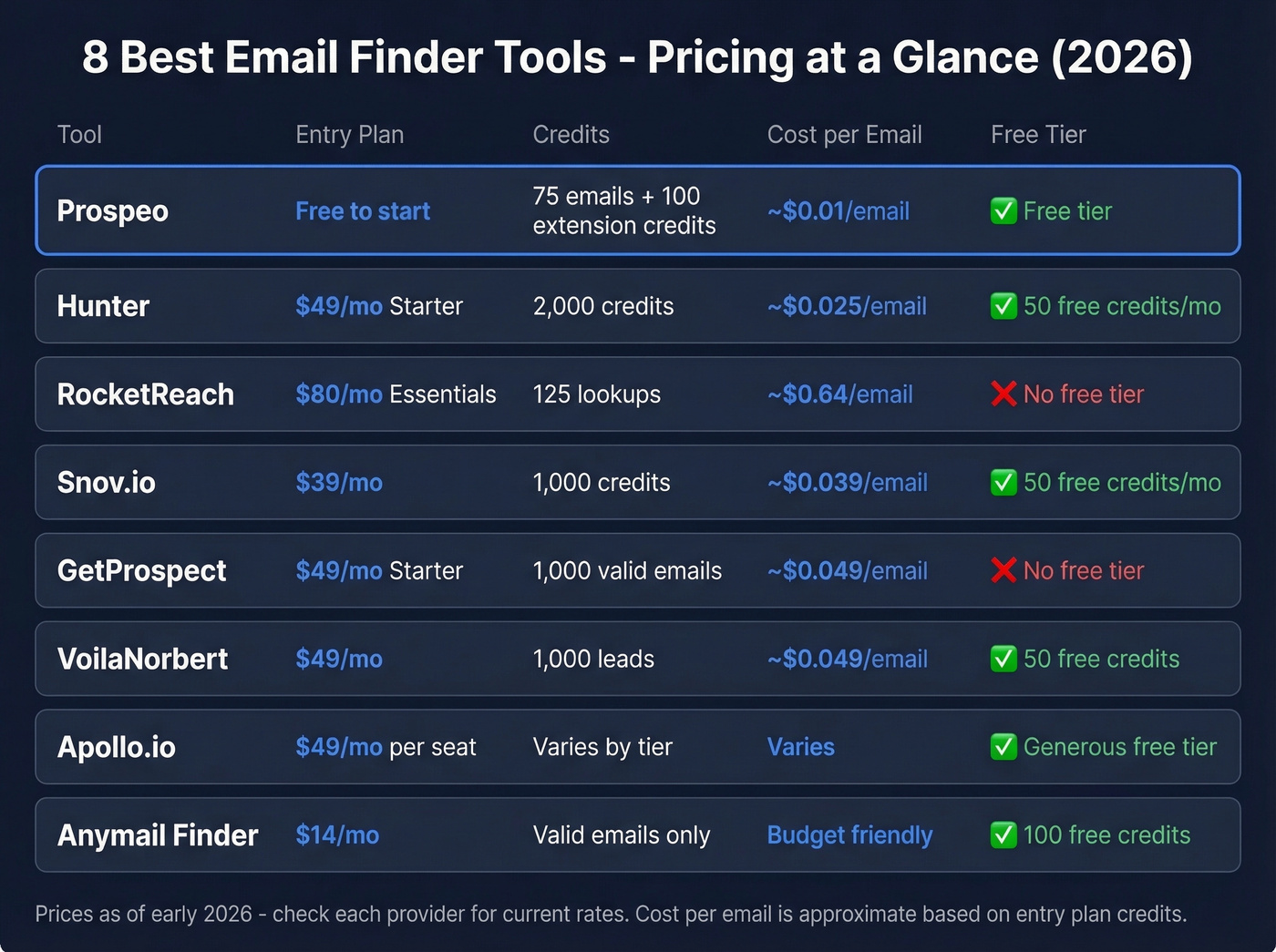
| Tool | Entry Plan | Credits Included | Cost/Email | Free Tier |
|---|---|---|---|---|
| Hunter | $49/mo | 2,000 credits | ~$0.025 | 50 credits/mo |
| RocketReach | $80/mo | 125 lookups | ~$0.64 | Limited |
| Snov.io | $39/mo | 1,000 credits | ~$0.039 | 50 credits/mo |
| GetProspect | $49/mo | 1,000 valid | ~$0.049 | 50 valid/mo |
| VoilaNorbert | $49/mo | 1,000 leads | ~$0.049 | 50 (one-time) |
| Apollo.io | Free/$49/mo | Varies by tier | ~$0.04+ | Generous |
| Anymail Finder | From $14/mo | Varies | ~$0.14 | 100 credits |
Hunter sits in a reasonable middle ground for verification specifically - 0.5 credits per verify effectively means $0.012/verification on the Starter plan. Snov.io, GetProspect, and VoilaNorbert cluster around $0.04-$0.05 per email, which is fair for the quality you get.
If you're trying to reduce bounces fast, start with the fundamentals in our email bounce rate guide.
How to Find Anyone's Email for Free
Before you spend anything, exhaust the free methods. They won't scale, but they'll teach you how email patterns work - and that knowledge makes you a better buyer when you do pick a paid tool.
Google operators are more powerful than most people realize. Try "John Smith" + "@acmecompany.com" to find exact email mentions. Use "John Smith" + "email" + site:acmecompany.com to search within a specific domain. Adding "PDF" to your query surfaces whitepapers and reports where authors often list their direct email in the footer or byline - we've pulled dozens of executive contacts this way that weren't in any paid database.
Pattern guessing and company websites work hand-in-hand. Once you've confirmed one email at a company - say, jane.doe@acme.com - you know the pattern. Common formats include firstname.lastname@, firstinitiallastname@, and firstname@. Check Contact pages, About pages, and blog author bios, where executives frequently list direct emails.
One warning: data decay is real. An email that worked six months ago will bounce today if the person changed roles. Pattern-guessed emails carry the highest bounce risk of any method here. Always verify before sending.
For more tactics beyond tools, see our sales prospecting techniques roundup.
Why Freshness Beats Database Size
Let's be honest: if your average deal size is under $50K, you probably don't need a 500M-contact database. You need a 150M-contact database that was updated this week.
Job changes are frequent - especially in tech. Every job change creates a dead email address that sits in databases for weeks or months before anyone updates it. A tool with 500M contacts and a 6-week refresh cycle is serving you stale data on a significant percentage of those records. A tool with 150M contacts refreshed weekly is giving you emails that work right now.
Catch-all domains make this worse. A significant share of business domains accept any email sent to them - verification tells you nothing because the server says "yes" to everything. The email might land in a real inbox, or it might hit a dead alias that nobody monitors. Tools that don't handle catch-all domains specifically will mark these as "verified" when they're really "unknown." This is exactly why tracking down people's email addresses becomes such a frustrating problem - the tools say "found" when the reality is "maybe."
We've seen teams obsess over database coverage numbers while ignoring the freshness problem entirely. They'll pay $40K/year for a massive database, then wonder why 15% of their "verified" list bounces on the first sequence. The answer is almost always stale data, not bad verification logic.
The cost of getting this wrong isn't just bounced emails. It's domain reputation damage that takes weeks to recover from, sequences that underperform because half your emails land in spam, and sales cycles that stall because your outreach never reaches the prospect.
If you're troubleshooting deliverability, start with how to improve sender reputation and then tighten your email velocity.
Meritt cut their bounce rate from 35% to under 4% and tripled pipeline to $300K/week. Stack Optimize hit $1M ARR with zero domain flags. The difference? Emails verified through proprietary infrastructure at ~$0.01 each.
Stop paying for emails that bounce. Start with 75 free lookups today.
GDPR and Email Finding
If you're finding and emailing people in the EU or the UK, GDPR applies regardless of where your company is based. Cumulative fines have exceeded EUR 5.88B across 2,245+ enforcement actions - this isn't theoretical risk.
The lawful basis most B2B outbound teams rely on is legitimate interest under Article 6(1)(f). The ICO's three-part test requires you to demonstrate a legitimate purpose, that the processing is necessary to achieve it, and that the individual's rights don't override your interest. For B2B cold email, this generally holds when you're contacting someone in their professional capacity about something relevant to their role.
Practical steps to stay compliant:
- Record-keeping. Log timestamps, data source, and lawful basis for every contact. If you can't show where you got someone's email, you're exposed.
- Data accuracy. Article 5(1)(d) requires that personal data be accurate and kept up to date. Using a tool with a weekly refresh cycle isn't just good for deliverability - it's a compliance obligation.
- Opt-out enforcement. Process unsubscribes immediately and globally, not just per-campaign.
- Relevance. Emailing a CFO about your accounting software? Legitimate interest is defensible. Emailing a random employee about something unrelated to their role? Much harder to justify.
FAQ
What's the most accurate email finder in 2026?
Prospeo leads with 98% email accuracy, a 7-day data refresh cycle, and a 5-step verification process including catch-all handling. The Dropcontact benchmark tested 15 tools on 20,000 contacts using live sends - the methodology that matters most.
Can I find someone's email address for free?
Yes. Google operators work for one-off lookups, and stacking free tiers across Hunter (50 credits/mo), GetProspect (50 valid/mo), Snov.io (50 credits/mo), and Prospeo (75 emails/mo) gives you 225+ free lookups monthly. For fewer than 50 contacts per week, free tiers are often enough.
What's the difference between "verified" and "deliverable"?
A "verified" email passed a technical check - correct syntax and a responsive mail server. A "deliverable" email actually lands in an inbox. The gap exists because catch-all domains accept everything, stale records pass verification, and spam traps look legitimate. Real deliverability requires live-send testing, catch-all detection, and fresh data.
Is it legal to find emails for people using these tools?
In most B2B contexts, yes - provided you have a lawful basis. Under GDPR, legitimate interest is the standard basis for B2B outreach. You need to demonstrate relevance to the recipient's professional role, maintain auditable records, and honor opt-outs immediately.
How can I find all email addresses at a specific company?
Use Hunter's domain search to map naming conventions and list known contacts, then run a company enrichment tool to return multiple verified addresses per organization. Combining pattern detection with verified delivery - and cross-referencing against professional profiles to confirm current employees - gives you the most complete coverage.