


Findymail vs OneMoreLead: Which B2B Email Finder Is Worth Your Money in 2026?
Both Findymail and OneMoreLead start at $99/month. But the similarity ends the second you look at credits: one plan gives you 5,000+5,000 credits, the other gives you 250.
That 20x gap isn't a rounding error. It changes how you build lists, how aggressively you can test campaigns, and how painful it feels when a tool charges you for data that doesn't deliver.
Let's break it down.
30-second verdict
- Pick Findymail if you want real-time finding + verification, a <5% bounce guarantee, and a product with visible customer feedback.
- Pick OneMoreLead if you specifically want a database-style workflow with multi-user pricing baked in, and you're OK validating quality yourself.
- Skip both if you need verified mobile numbers, intent signals, and a much larger dataset than either tool offers.
Pricing: credits, tiers, and the math that matters
Here's the thing: "same monthly price" doesn't mean "same cost."
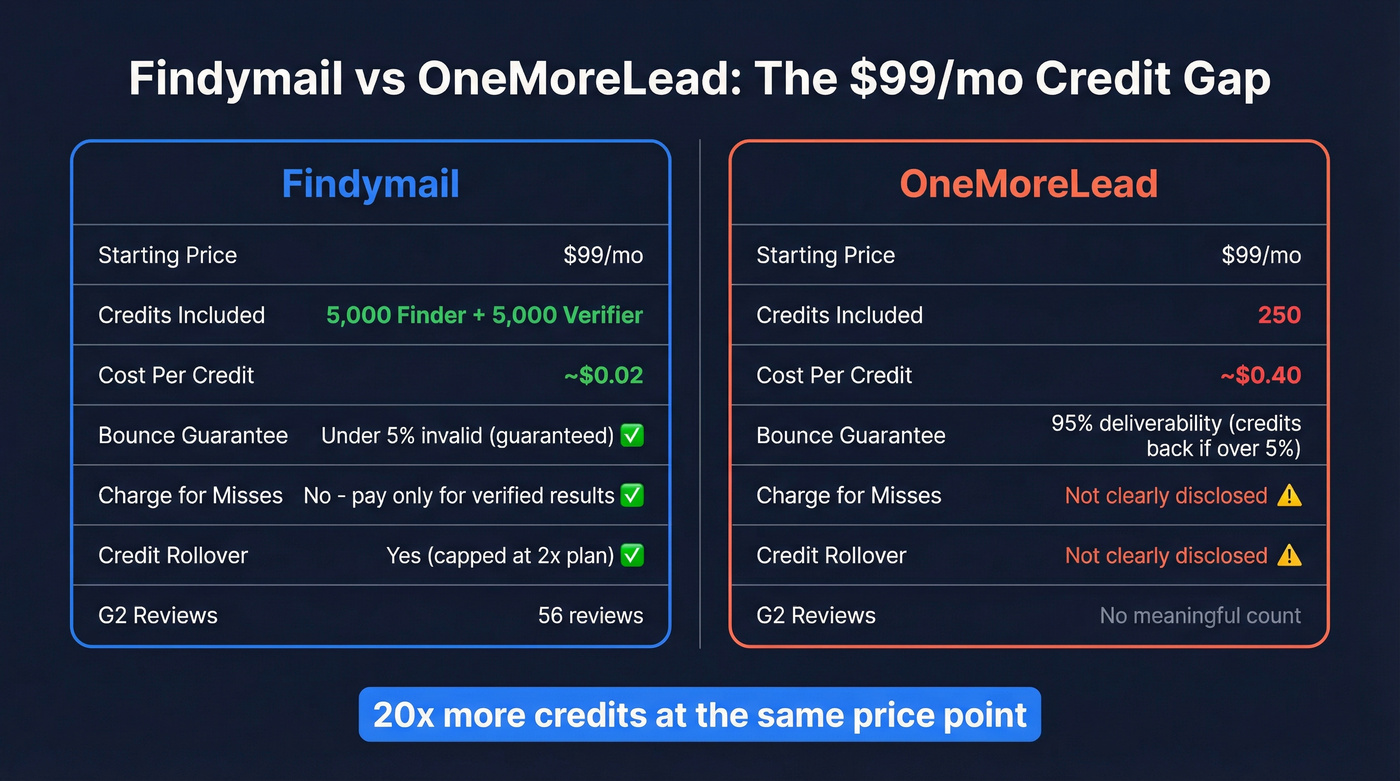
| Feature | Findymail | OneMoreLead |
|---|---|---|
| Starting price | $99/mo | $99/mo |
| Credits included | 5,000 Finder credits + 5,000 Verifier credits | 250 |
| Cost per credit | ~$0.02 | ~$0.40 |
| Phone credits | 10 credits per phone (non-EU only) | Includes email + phone, but per-type credit cost isn't published |
| Bounce guarantee | <5% invalid emails (guaranteed) | 95% deliverability (credits if >5% bounce) |
| Charge for misses | No - pay only for verified results | Not clearly disclosed |
| Credit rollover | Yes (capped at 2x plan) | Not clearly disclosed |
| Free trial | 10 emails | 14 days, no card |
| Reviews | 56 reviews on G2 | No meaningful review count on G2 |
OneMoreLead says email + phone are included in its credit system, but it doesn't spell out what a phone export costs in credits. That's not a small detail. If you're buying the tool for direct dials, you need to know whether a phone number is "1 credit" or "10 credits" (or something else entirely), because that changes your effective price overnight.
Full tier breakdown
OneMoreLead
- Freelancer: $99/mo for 250 credits
- Startup: $199/mo for 750 credits
- Business: $399/mo for 2,000 credits (up to 10 users; extra users $25/mo each)
Findymail
- Starter: $99/mo for 5,000 Finder credits + 5,000 Verifier credits
- Scales via a volume slider on their pricing page: https://www.findymail.com/pricing/
OneMoreLead's one clear pricing win is seats. If you truly need a shared account for up to 10 users at $399/month, that's straightforward and, for some small teams, genuinely convenient.
But for most outbound teams, credits are the budget. And on credits, Findymail's unit economics are in a different league.
Accuracy: verification style beats big promises
Findymail is built around real-time finding and verification. That matters because you're not just pulling an email from a stored record; you're checking it at the moment you need it. They also publish a <5% bounce guarantee and position catch-all handling as a core feature (not an afterthought). Findymail also points to Clay's testing that ranked it #1 for email finding.
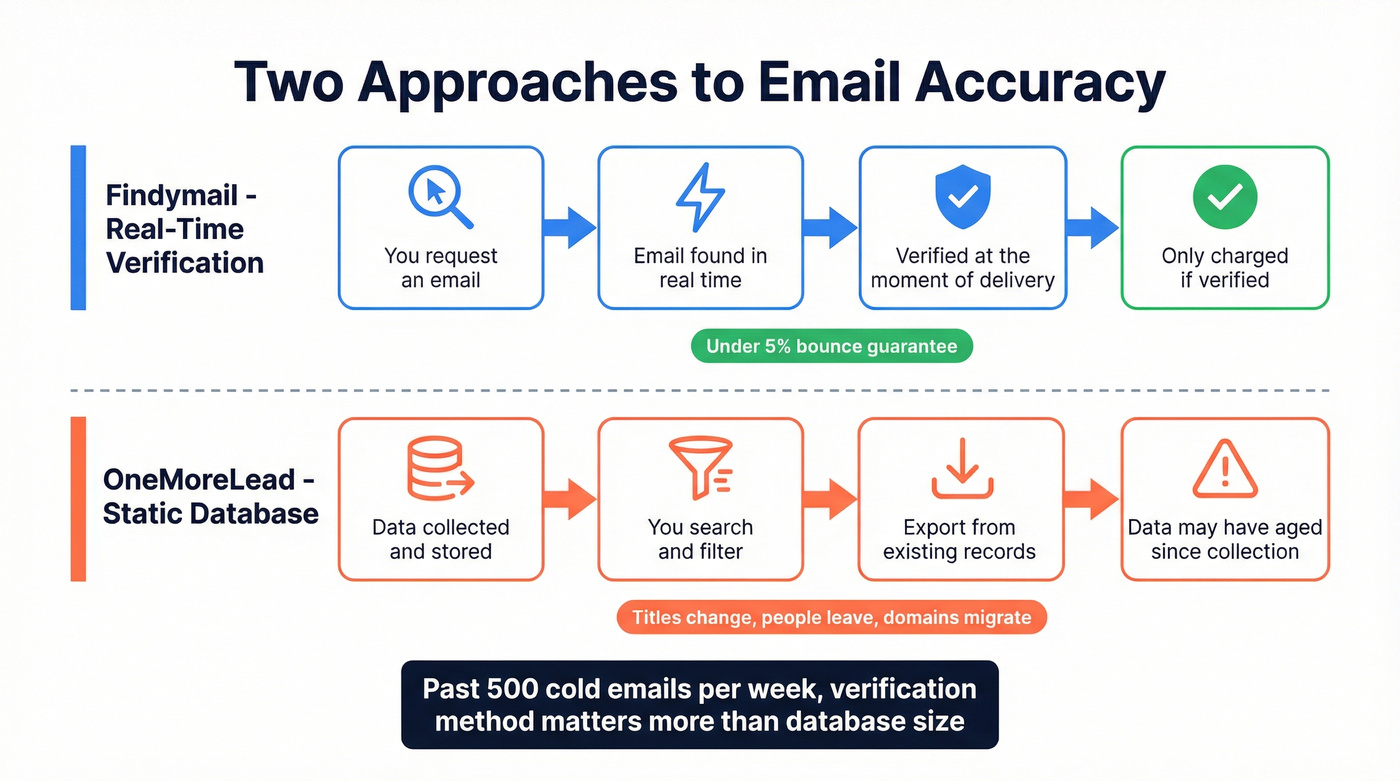
OneMoreLead positions itself more like a database: filters, saved lists, enrichment, and exports. It advertises 95% deliverability and credits back if bounce exceeds 5%. On an older page, it also mentions "human-verified lists" alongside automated processes: https://onemorelead.com/onemorelead1/
Real talk: database tools age. Even if the data started clean, titles change, domains migrate, and people leave companies. If you're sending meaningful volume (or you've already had a domain take a hit), you feel that drift fast.
Our rule of thumb after testing a lot of these: once you're past ~500 cold emails a week, the verification method matters more than the size of the marketing number on the homepage. A smaller list that stays valid will beat a bigger list that bounces. (If you're optimizing for deliverability, see our Email Bounce Rate benchmarks and fixes.)

You're comparing 250 credits vs 5,000 credits - but neither tool gives you verified mobiles, intent data, or a 7-day refresh cycle. Prospeo delivers 300M+ profiles, 125M+ verified mobile numbers, and 98% email accuracy at ~$0.01/email. No bounce-rate gambles, no conflicting database claims.
Run your next bake-off against the tool with actual receipts.
Trust signals: reviews, consistency, and what you can actually verify
OneMoreLead's site gives multiple, conflicting database-size claims across different pages. You can find references to 55M+ leads, 170M employees, 150M contacts, and "40 million" candidates. That inconsistency is frustrating because it makes it harder to know what you're paying for and what "coverage" really means.
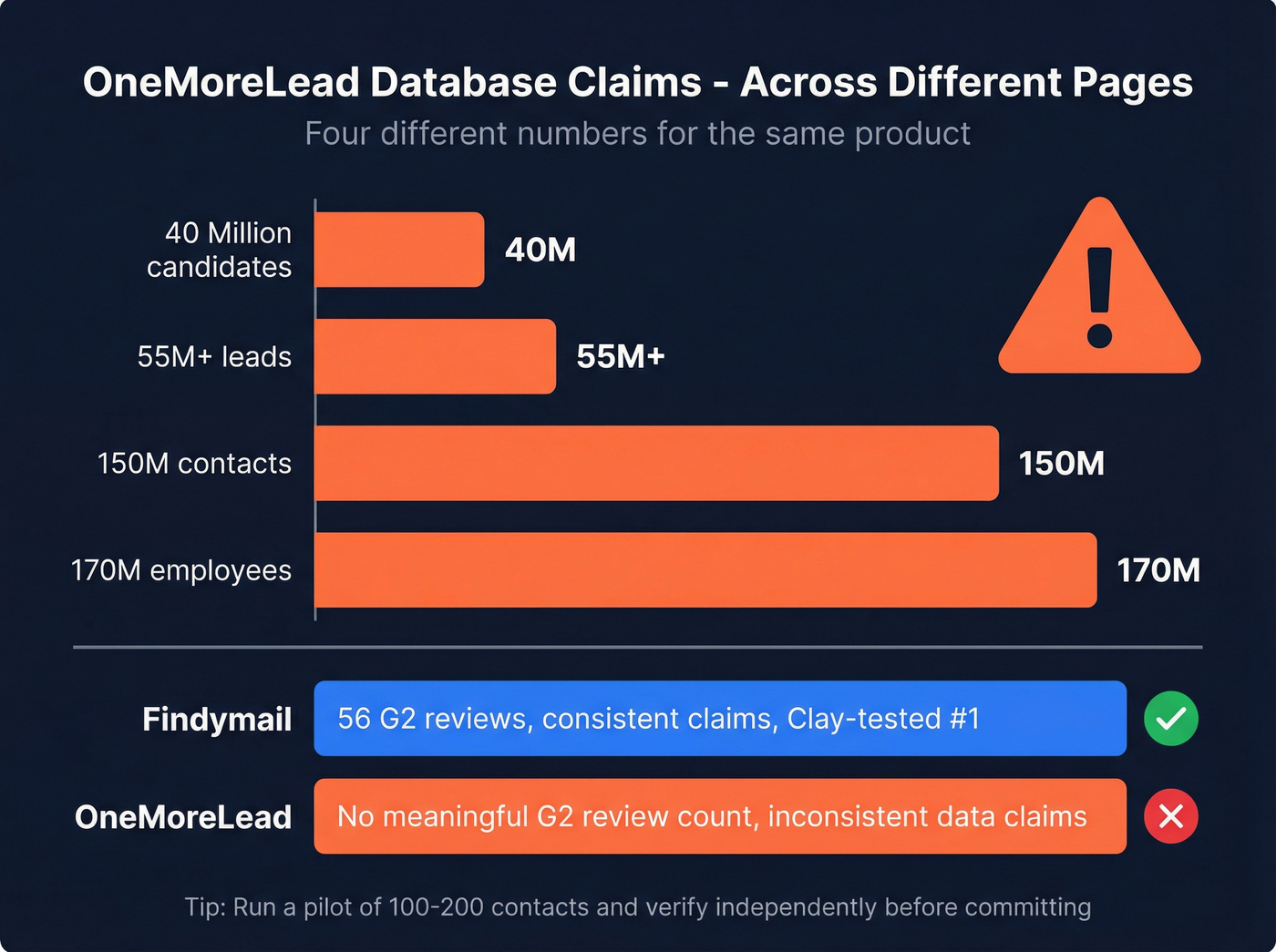
Findymail, on the other hand, has a visible review footprint: 56 reviews on G2 (and additional reviews on Capterra). Here are the pages:
- Findymail reviews on G2: https://www.g2.com/products/findymail/reviews
- Findymail on Capterra: https://www.capterra.com/
OneMoreLead has a G2 listing, but not a meaningful review count. And Woodpecker's write-up on OneMoreLead calls out the same issue plainly: there are basically no reviews online. That's the article: https://woodpecker.co/blog/onemorelead/
We also checked community chatter. The consensus on r/sales and r/coldemail is pretty consistent: people trust tools that (1) show receipts in public reviews and (2) have clear refund/credit rules when data fails. OneMoreLead doesn't give you much to lean on there, so you're stuck doing your own QA. (If you're building a repeatable process, this ties closely to lead generation workflow design.)
A quick scenario (because this is where teams get burned)
Say you're an agency building a list of 2,000 prospects for a new client. You export, enrich, and launch. If your bounce rate comes back at 8-10%, you don't just lose credits - you risk the client's domain, your sending accounts, and your relationship with the client.
We've seen teams try to "save money" with unknown databases, then spend the next month cleaning lists, warming new domains, and explaining why reply rates cratered. It's a brutal trade.
If you're considering OneMoreLead, run a small pilot first: export 100-200 contacts, verify independently, and track bounces on a controlled send. Don't buy blind. (For more options, compare data enrichment services and dedicated email verification tools.)
Integrations: named connectors beat vague claims
OneMoreLead claims "3,000+ brands to integrate" without naming specific partners. Usually, that means a generic connector layer (Zapier/webhooks) rather than deep, native integrations.
Findymail is more direct about what it connects to: Smartlead, Instantly, Lemlist, HubSpot, Salesforce, Google Sheets, Zapier, Make, and an API. (If you're standardizing your stack, see how to connect outreach tool to CRM.)
If your workflow lives in a CRM + an outbound tool, native integrations save hours. If you're doing this at any scale, hours matter.
A stronger third option (when email-only isn't enough)
If you need more than email finding - verified mobiles, intent signals, enrichment, and a dataset that doesn't feel like it was last updated in another quarter - it's worth looking at Prospeo. (This is the same logic behind choosing sales prospecting databases vs point tools.)
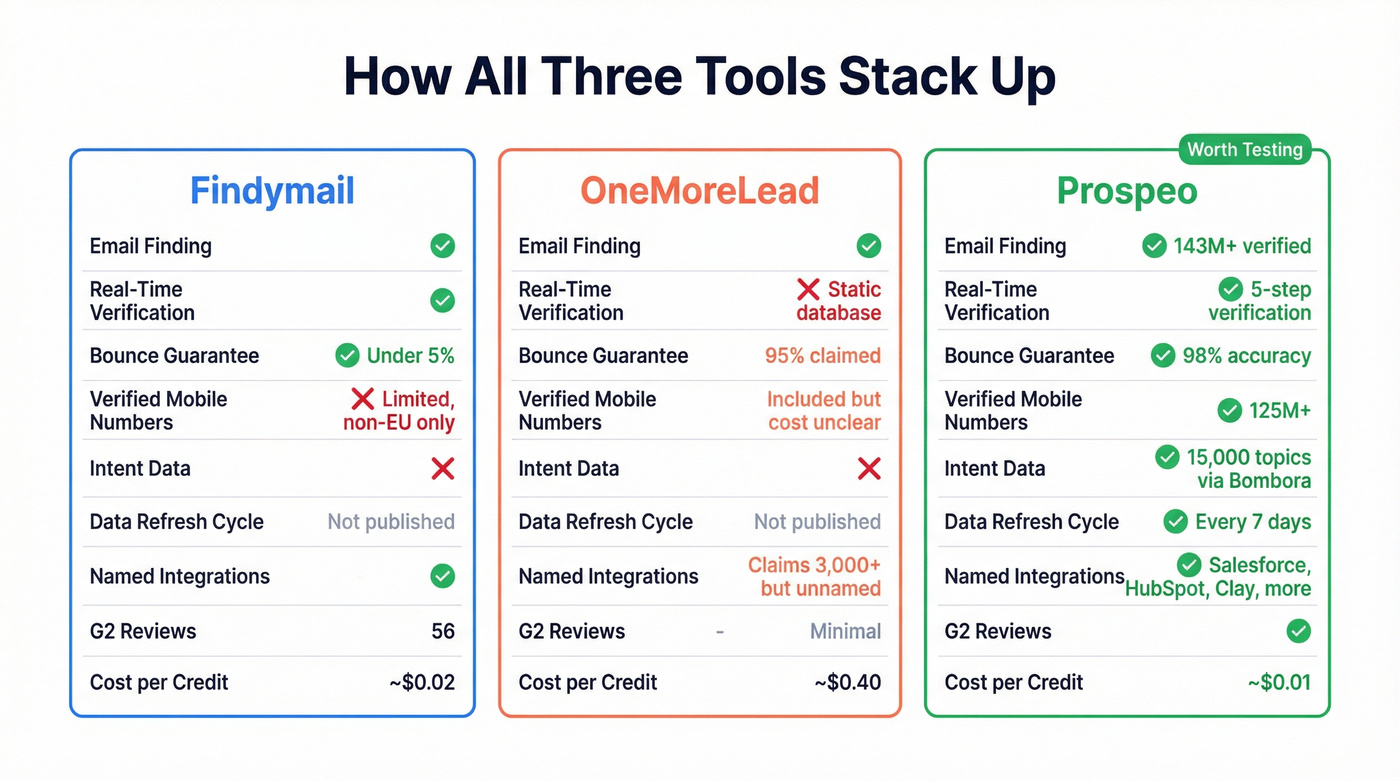
Prospeo includes 300M+ professional profiles, 143M+ verified emails, and 125M+ verified mobile numbers, with 98% email accuracy and a 7-day data refresh cycle (the industry average is about six weeks). It also layers in intent data across 15,000 topics (powered by Bombora), plus API access and native integrations like Salesforce, HubSpot, Smartlead, Instantly, Lemlist, Clay, Zapier, and Make. (If you're operationalizing intent, see intent based segmentation.)
One detail we like in practice: the Chrome extension is actually useful day-to-day. A rep can grab verified contact data from web sources while they're researching accounts, instead of bouncing between tabs and CSVs for an hour. (Related: personalized outreach workflows.)
Agency teams can't afford 8-10% bounce rates on client domains. Prospeo's 5-step verification, catch-all handling, and spam-trap removal keep bounce rates under 2% - backed by 143M+ verified emails refreshed every 7 days, not every 6 weeks.
Protect your client domains with data that actually verifies.
Final verdict
Findymail wins this head-to-head for most teams. The credit math is dramatically better, the product is built around real-time verification, and it has enough public reviews to sanity-check the claims.
OneMoreLead isn't impossible to justify, but it's a niche pick. The multi-user pricing is the one clean differentiator, and it might fit a small team that wants shared access and is willing to validate data quality with a trial and a tight pilot.
If you're serious about deliverability, pick the tool that charges only for verified results. Between these two, that's Findymail. If you also need verified mobiles and intent signals, skip the whole tradeoff and use a platform built for that. (If you're scaling safely, align with an email deliverability guide and improve sender reputation.)
FAQ
Is OneMoreLead legit?
It's a real product with a live site and a G2 listing, but it doesn't have a meaningful third-party review footprint. That doesn't mean it's bad; it means you can't rely on social proof to judge deliverability or support.
Use the 14-day trial, export a small batch, verify independently, and measure bounces before you commit.
Does Findymail find phone numbers?
Yes. Phone numbers cost 10 credits each versus 1 credit per email, and phone finding works for non-EU contacts only due to GDPR restrictions. Credits roll over monthly, capped at 2x your plan.
What if I need verified mobiles and emails in one tool?
Prospeo includes 125M+ verified mobile numbers and 143M+ verified emails, with 98% email accuracy and a 7-day refresh cycle. It also supports intent data (15,000 topics) and enrichment workflows via API and integrations.
How do these tools compare on integrations?
Findymail lists named integrations (Smartlead, Instantly, Lemlist, HubSpot, Salesforce, Google Sheets, Zapier, Make, plus an API). OneMoreLead claims thousands of integrations but doesn't name partners, which usually points to generic connectors rather than native integrations.