

9 First Sales Meeting Tips That Actually Convert to Pipeline
You just booked your first real prospect meeting. It's in 48 hours. You've got no agenda, no research, and a 47-slide deck your marketing team built for a conference six months ago.
Here's the thing: that deck isn't going to save you. These first sales meeting tips will get you ready with a proven structure - not guesswork.
The short version:
- Send a time-boxed agenda before the meeting - not a pitch deck.
- Ask 11-14 questions and talk less than 57% of the time (Gong-based benchmarks).
- Book the next meeting before you hang up - opportunities that close within 50 days have a 47% win rate.
Your Meeting Is in 48 Hours - Here's the Reality
80% of B2B sales interactions now happen through digital channels, and 96% of buyers have already researched your product before they talk to you. By the time they accept your invite, they're 57% through their decision process. Your first meeting isn't an introduction. It's an audition.
This playbook assumes you initiated the meeting, which means you're driving the demand. That changes everything about how you structure the conversation.
Mistakes That Kill Deals Early
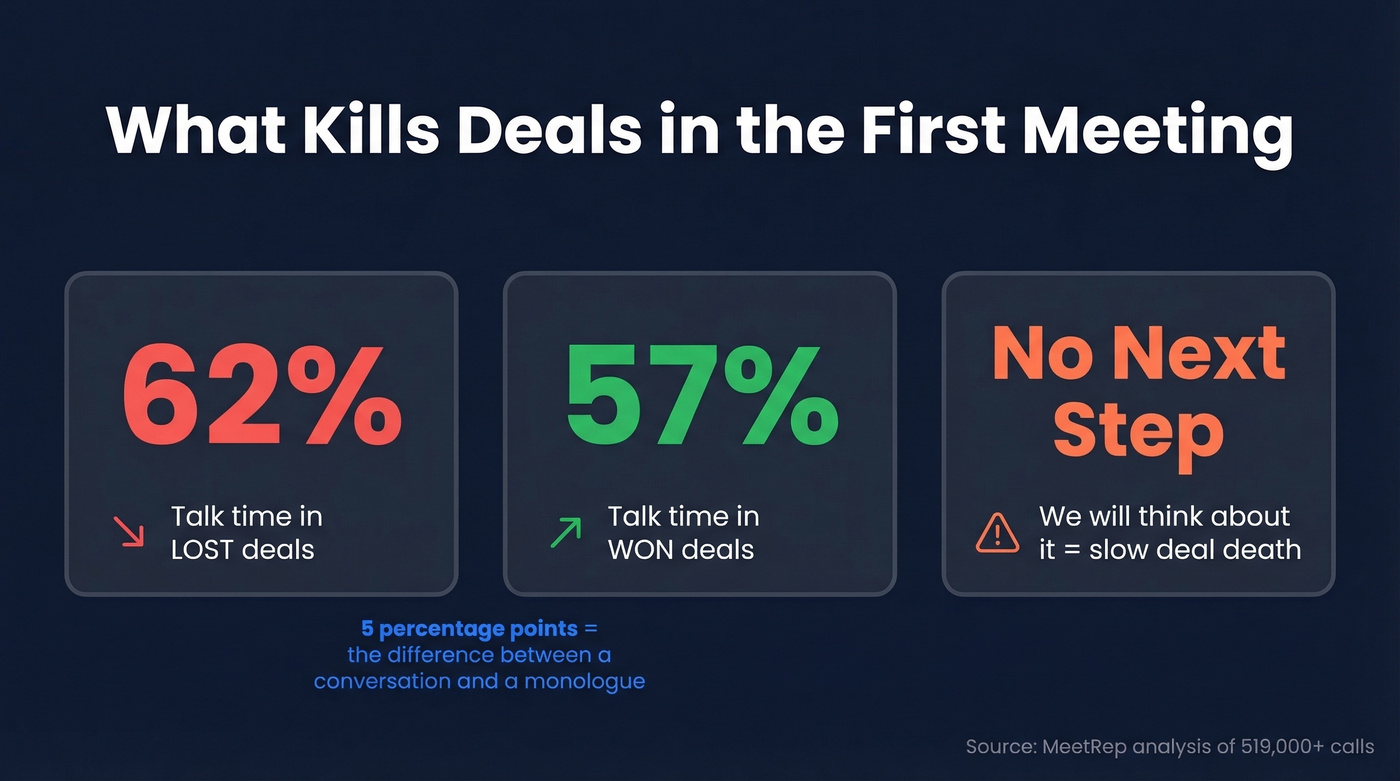
Talking too much. MeetRep's analysis of 519,000+ recorded calls shows reps talk 62% of the time in lost deals versus 57% in won deals. Five percentage points is the difference between a conversation and a monologue.
Rushing to pitch before understanding the problem. You wouldn't trust a doctor who prescribed medication before asking about symptoms. Same principle. Jump to solutions before you've diagnosed the pain and you lose credibility instantly.
Ending without a next step. "We'll think about it" isn't an outcome. It's a slow death.
Research Your Prospect Before the Call
The fastest way to lose credibility is asking a question you should already know the answer to. We've seen reps blow meetings by asking "So what does your company do?" when the answer was on the homepage. Here's a 15-minute checklist:
- Re-read the thread that got you the meeting. Match your opening to their expectations.
- Check their professional profile and recent activity. Posts, promotions, or role changes give you a conversation hook.
- Research the company. Hiring signals, recent funding, tech stack, competitive landscape - all shape what problems they're likely facing.
- Identify likely decision-makers. Who else will be in the room? Who's missing but should be?
- Verify contact data. Nothing kills momentum like a bounced follow-up email after a great call.
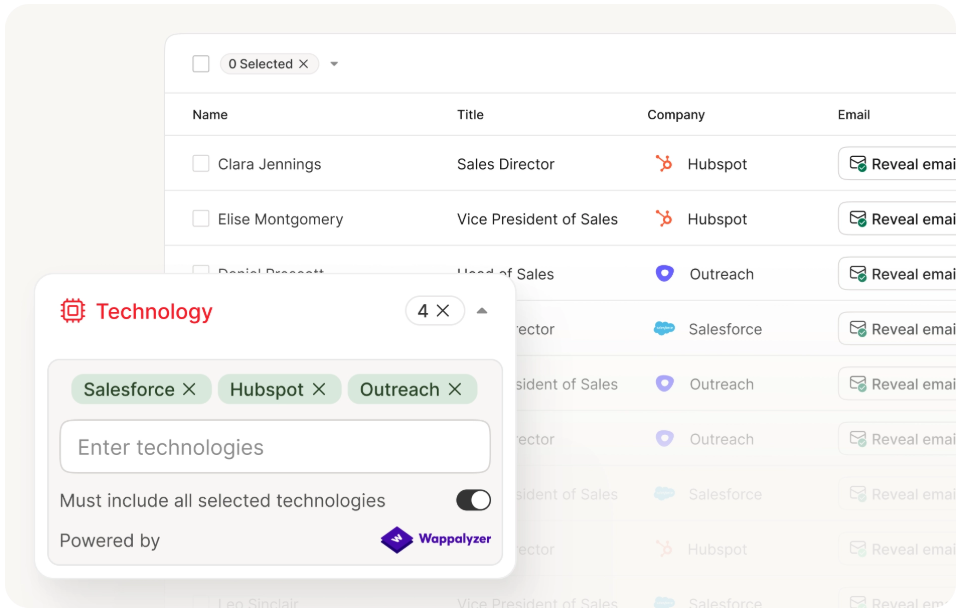
Run your prospect through Prospeo's enrichment before the call to pull 50+ data points per contact - verified mobile numbers, technographics, funding signals, and intent across 15,000 topics. It turns scattered research into a single, structured view you can use to personalize your opening and your questions.
If you want to compare options, start with data enrichment services and build a repeatable lead enrichment workflow.
Set Your Goal: Leave With an Assignment
Your goal in a first meeting isn't to pitch. It's to leave with an assignment - a specific, expensive problem the prospect will pay to solve.
The Center for Sales Strategy frames this well: tell the prospect upfront that you want to understand their biggest challenge, not run through slides. When you leave with a real problem to solve, you've earned the second meeting.
If your deal sizes are under $15k, you probably don't need a 60-minute discovery call or a multi-threading strategy. You need this 30-minute structure, executed well, every single time.
If you’re tightening your qualification, a structured set of discovery questions helps you get to Level 3 faster.

Your first meeting prep shouldn't take hours. Prospeo enriches any prospect with 50+ data points - verified emails, mobile numbers, tech stack, funding signals, and intent data across 15,000 topics. Walk into every call knowing exactly what problems they're facing.
Stop asking questions you should already know the answer to.
The 30-Minute Agenda (Copy This)
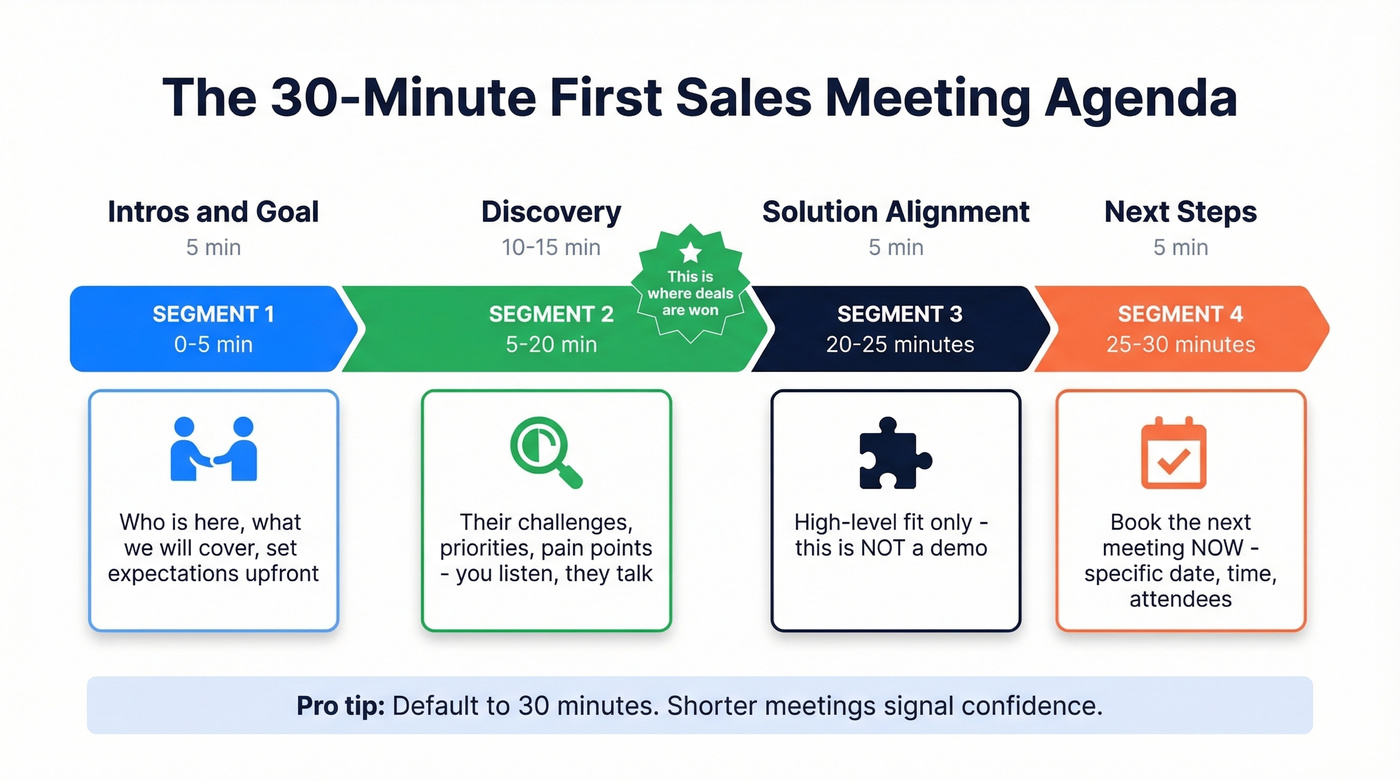
Send this before the meeting - not a deck, just a short email.
| Block | Time | What Happens |
|---|---|---|
| Intros & goal | 5 min | Who's here, what we'll cover |
| Discovery | 10-15 min | Their challenges, priorities |
| Solution alignment | 5 min | High-level fit, not a demo |
| Next steps | 5 min | Book the next meeting now |
Thirty minutes is enough for a first discovery conversation. You can always extend if the conversation warrants it, but defaulting to 30 keeps you focused and respects the prospect's time. The consensus on r/sales is that shorter meetings actually signal confidence - you're not padding time because you don't know what to say.
If you’re running these calls over video, borrow a few remote sales meeting tips to keep momentum high.
Ask 11-14 Questions, Not 20
The Gong-Based Benchmarks
- 11-14 questions per call = highest win correlation
- Won deals average 15-16 questions total including follow-ups; lost deals hit ~20 (interrogation mode)
- Reps talk 57% of the time in won deals vs 62% in lost deals
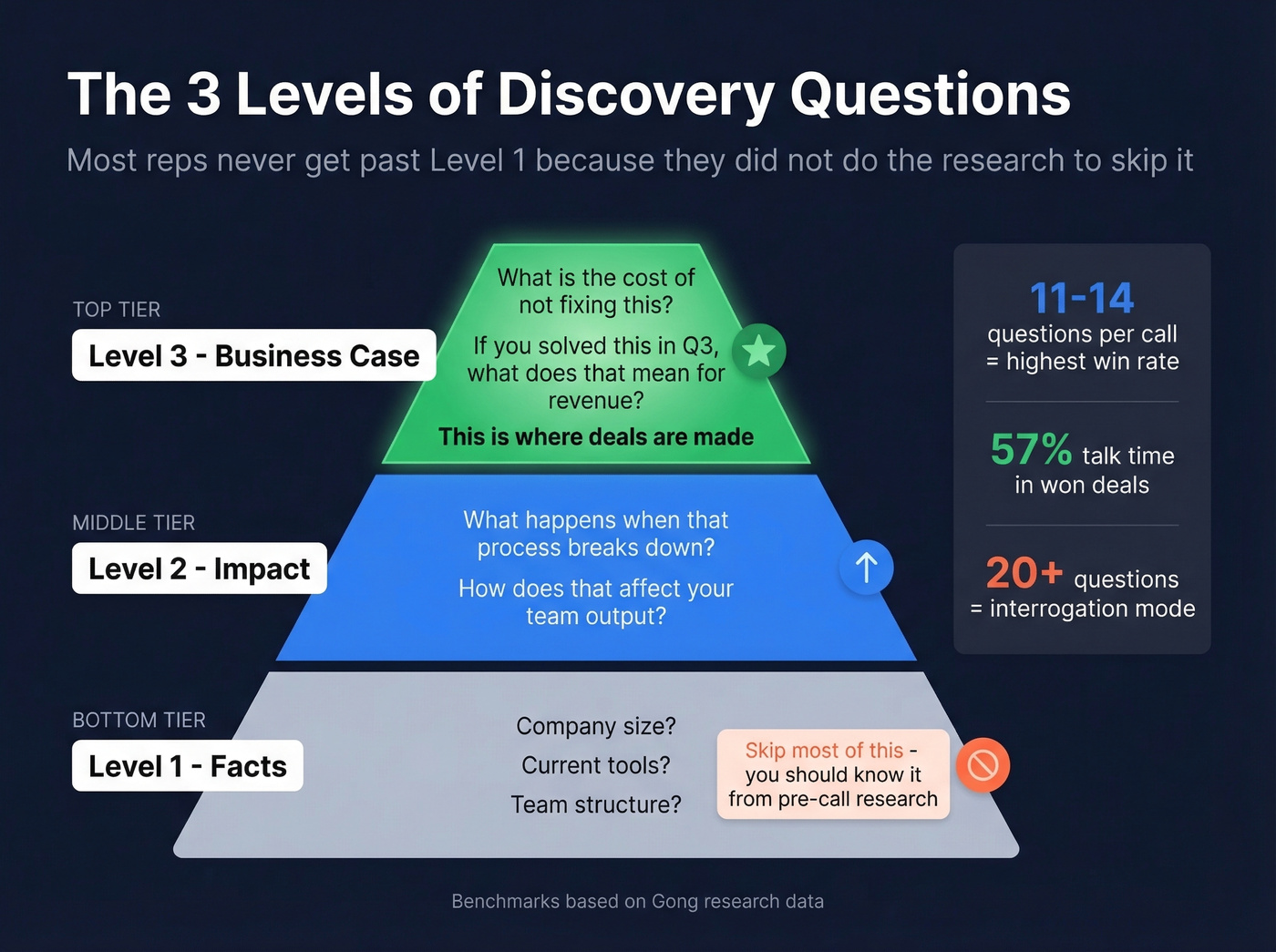
The sweet spot is 11-14 well-chosen questions. A solid practitioner rule: aim for 70% listening, 30% talking. Even 57/43 correlates with wins - anything better than that is gravy.
Structure your questions in levels:
Level 1 - facts. Company size, current tools, team structure. You should already know most of this from pre-call research, so don't waste time here.
Level 2 - impact. "What happens when that process breaks down?" "How does that affect your team's output?"
Level 3 - business case. "What's the cost of not fixing this?" "If you solved this in Q3, what does that mean for your revenue target?"
Level 3 is where deals are made. Most reps never get past Level 1 because they didn't do the research to skip it. Weaving in what other buyers in their industry have told you can also help prospects articulate problems they haven't fully defined yet.
If you want a tighter framework for moving from discovery to commitment, map your flow to the steps to close a sale.
Lock the Next Step Before You Hang Up
This is the single most impactful tip in this entire playbook.
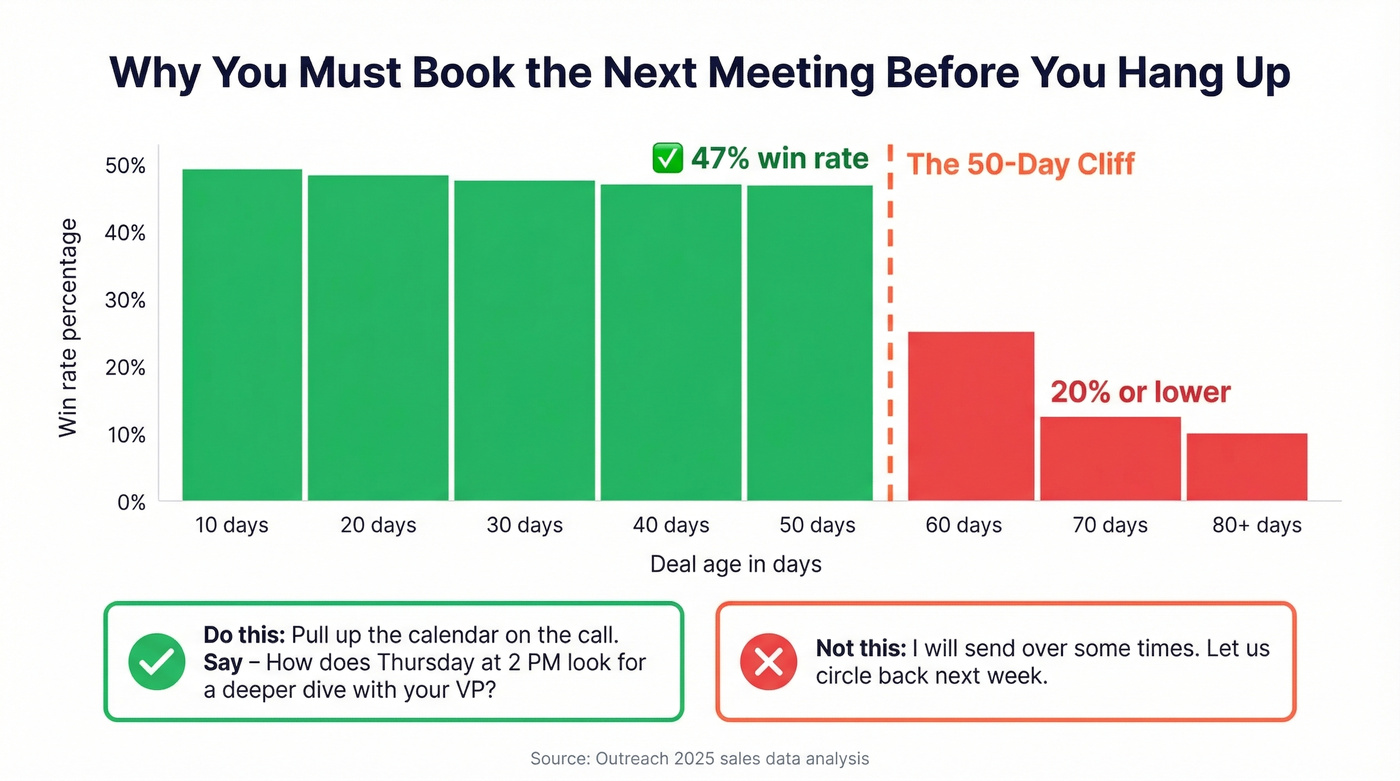
Outreach's data is clear: opportunities closed within 50 days have a 47% win rate. After that threshold, win rates drop to 20% or lower. Every day without a booked next step is a day your deal is dying.
Don't say "I'll send over some times." Pull up the calendar while you're still on the call. "How does Thursday at 2 PM look for a deeper dive with your VP?" Specific date, specific time, specific attendees. I've watched reps lose six-figure deals because they ended with "let's circle back next week" and never got the prospect on the phone again.
If you’re building consistency across reps, document this as part of your sales process optimization.
Follow Up Within 24 Hours
Your follow-up email should hit their inbox within 24 hours. In our experience, anything past that window and the prospect has mentally moved on. Here's a copy-paste skeleton:
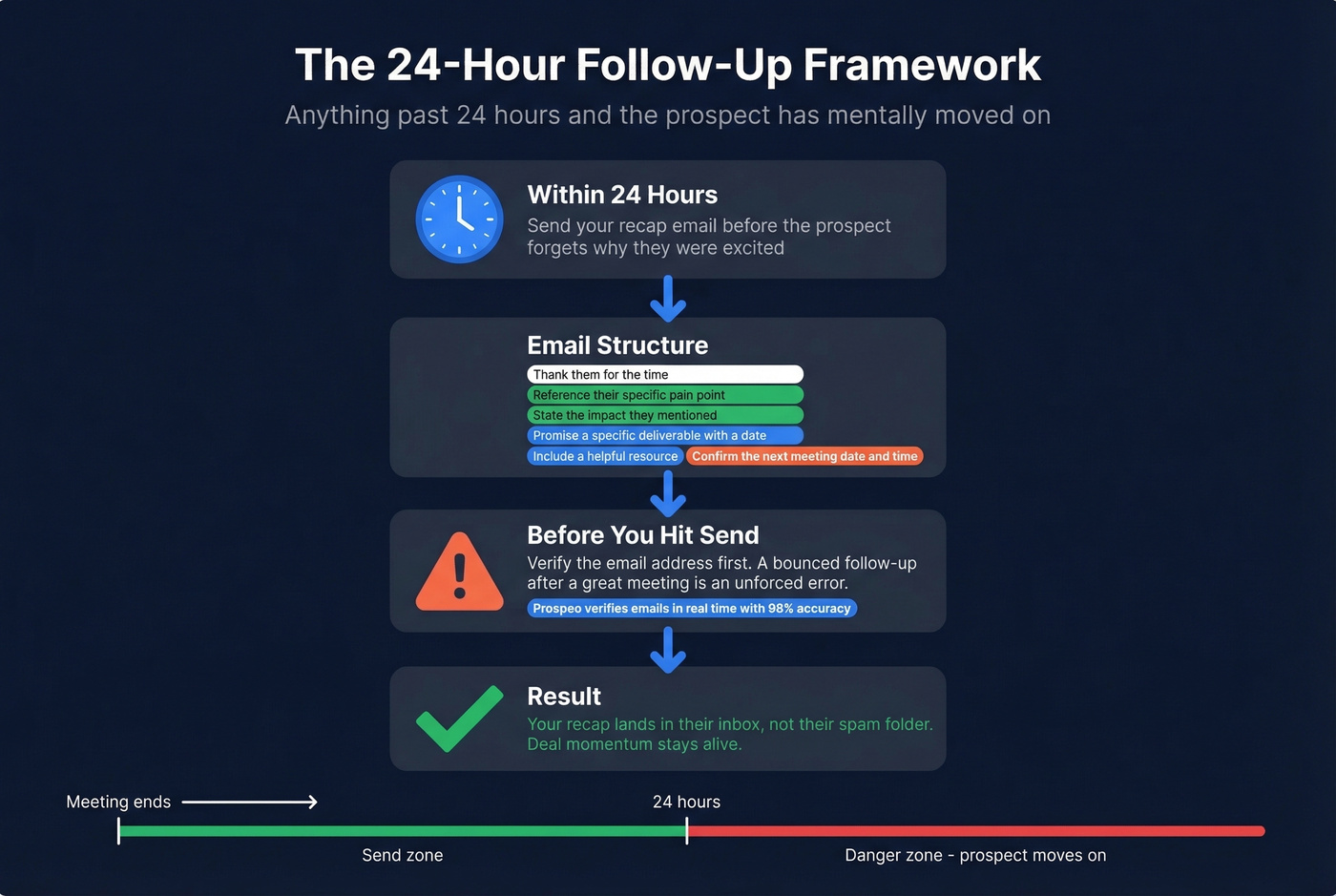
Hi [Name], thanks for the time today. You mentioned [key pain point] is costing your team [impact]. I'm pulling together [specific deliverable] to address that - I'll have it ready for our call on [date/time]. In the meantime, here's [resource]. Talk soon.
Before you hit send, verify the email address. A bounced follow-up after a great first meeting is an unforced error - use Prospeo's real-time verification to catch bad addresses before they damage your sender reputation.
If you need more copy you can steal, keep a set of sales follow-up templates and a dedicated sales meeting follow-up email format for recaps.
Skip This If...
Let's be honest: not every first meeting deserves this level of prep. If the prospect was a cold inbound who can't articulate why they booked the call, or if they won't confirm attendees beforehand, you're probably looking at a tire-kicker. Qualify harder before investing 15 minutes of research and 30 minutes of your calendar. Your time has a cost too.
A bounced follow-up after a great first meeting kills your deal momentum. Prospeo verifies emails in real time with 98% accuracy - so your recap lands in their inbox within 24 hours, not their spam folder. At $0.01 per email, there's no excuse for an unforced error.
Verify every email before you hit send. Your pipeline depends on it.
FAQ
How long should a first sales meeting be?
Thirty minutes for a pure discovery call. If you're combining discovery with a brief demo, 45-60 minutes works - but default to 30. You can always extend if the conversation is productive.
Should I send a pitch deck before the first meeting?
No. Send a brief agenda instead. 96% of buyers have already researched your product before the call. They want to be heard, not presented to.
How do I research a prospect quickly before the call?
Use an enrichment tool to pull company size, tech stack, funding, and buyer intent signals in seconds. Combine that with a quick review of their professional profile and recent activity. Fifteen minutes of focused research beats an hour of aimless Googling.