

How to Follow Up After No Response From a Client (Without Sounding Desperate)
You sent the proposal Monday. By Thursday, you've refreshed your inbox eleven times, drafted three versions of a "just checking in" email, and deleted all of them. Writing a follow-up email after no response from a client is one of the most anxiety-inducing tasks in business - and the worst part isn't the silence. It's not knowing whether they even opened the thing.
Most follow-up advice is written for cold outreach. That's a different game entirely. Maybe you're three months into a project and the client just... stopped responding to requests for the information you need to finish the work. Generic "bump" templates won't cut it here. What you need is a professional follow-up email that actually gets a reply.
What You Need (Quick Version)
- Use graduated spacing between follow-ups: 2, 4, 7, and 14 days - not daily pings.
- Every follow-up must add something new. A deadline, a question, a resource.
- Stop writing "just following up." It's one of the most ignored phrases in business email.
- After two to three unanswered emails, verify the email address is still valid before blaming your copy.
- Your breakup email (attempt #4) is your most powerful tool.
Why Clients Go Silent
Most people assume silence means rejection. Usually, it doesn't. Clients go quiet for boring, human reasons.
Inbox overload. Your email landed between a Slack notification and a vendor invoice. It got read, half-processed, and buried.
Internal red tape. They need sign-off from someone else. That someone is on vacation, in budget meetings, or just slow. We've watched deals stall for three weeks because a VP was out sick and nobody else had approval authority.
Decision paralysis. They liked your proposal but can't commit yet. Responding feels like committing, so they don't respond at all.
The "slow ghost." A freelancer on r/Freelancers described it perfectly - the client reduces communication, cancels syncs, but never formally ends things. You're left in limbo.
They opened it but didn't reply. This is a distinct category. If you use email tracking and can see opens without responses, the problem isn't deliverability - it's your ask. The email arrived, they read it, and something about your call-to-action didn't compel a response. Revisit what you're actually asking them to do.
Your email never arrived. Job changes invalidate addresses. Spam filters catch normal business emails. This happens more than people think, and it's the most fixable problem on this list.

The Cadence That Works
Cold outreach data paints a grim picture: the average reply rate is 3.43%, and depending on the dataset, follow-ups drive 20-42% of cold replies. Client follow-ups operate in a completely different universe. Expect 30-60% response rates within two to three touches, because the existing relationship does most of the heavy lifting.
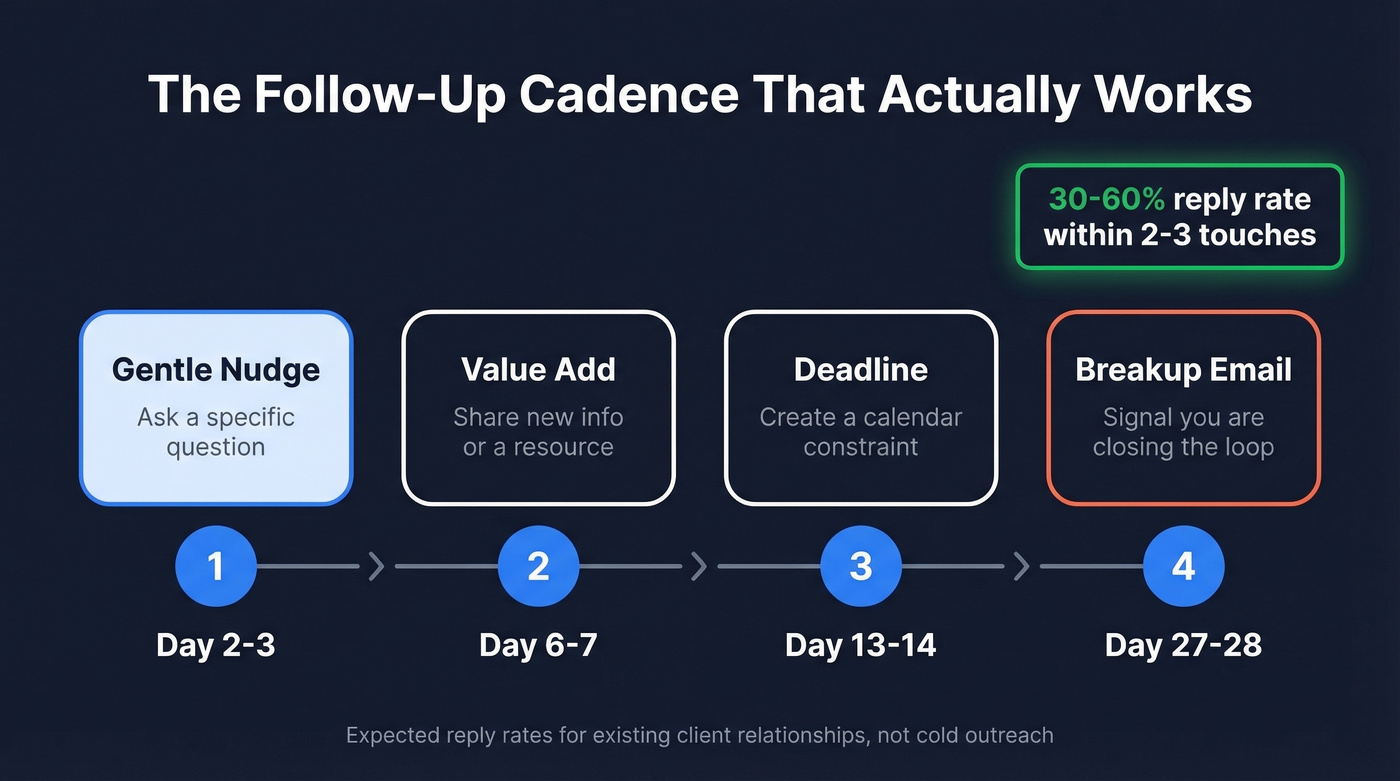
The timing still matters, though.
| Follow-Up | When to Send | What to Add |
|---|---|---|
| #1 Gentle Nudge | Day 2-3 | A specific question |
| #2 Value Add | Day 6-7 | New info or resource |
| #3 Deadline | Day 13-14 | Calendar constraint |
| #4 Breakup | Day 27-28 | Door-closing signal |
An analysis of 85,000+ personalized emails found 6-9am PST on Mondays had the highest reply rates, while Instantly recommends 9-11am local time Tuesday through Thursday for B2B. For client follow-ups, mid-morning in their time zone is the safe bet. And don't follow up the next day - next-day follow-ups reduce reply rates by 11% in cold email benchmarks. If you want a deeper timing breakdown, see best time to send cold emails.

You mentioned your email might never have arrived. Job changes, spam filters, and stale data kill follow-up sequences before they start. Prospeo verifies emails with 98% accuracy on a 7-day refresh cycle - so you know the address is real before you waste a single follow-up.
Stop following up with inboxes that don't exist anymore.
The 4-Step Escalation Framework
You don't need 28 templates. You need four emails, each one escalating the urgency slightly while keeping the tone professional. If you want more options, borrow from these sales follow-up templates.
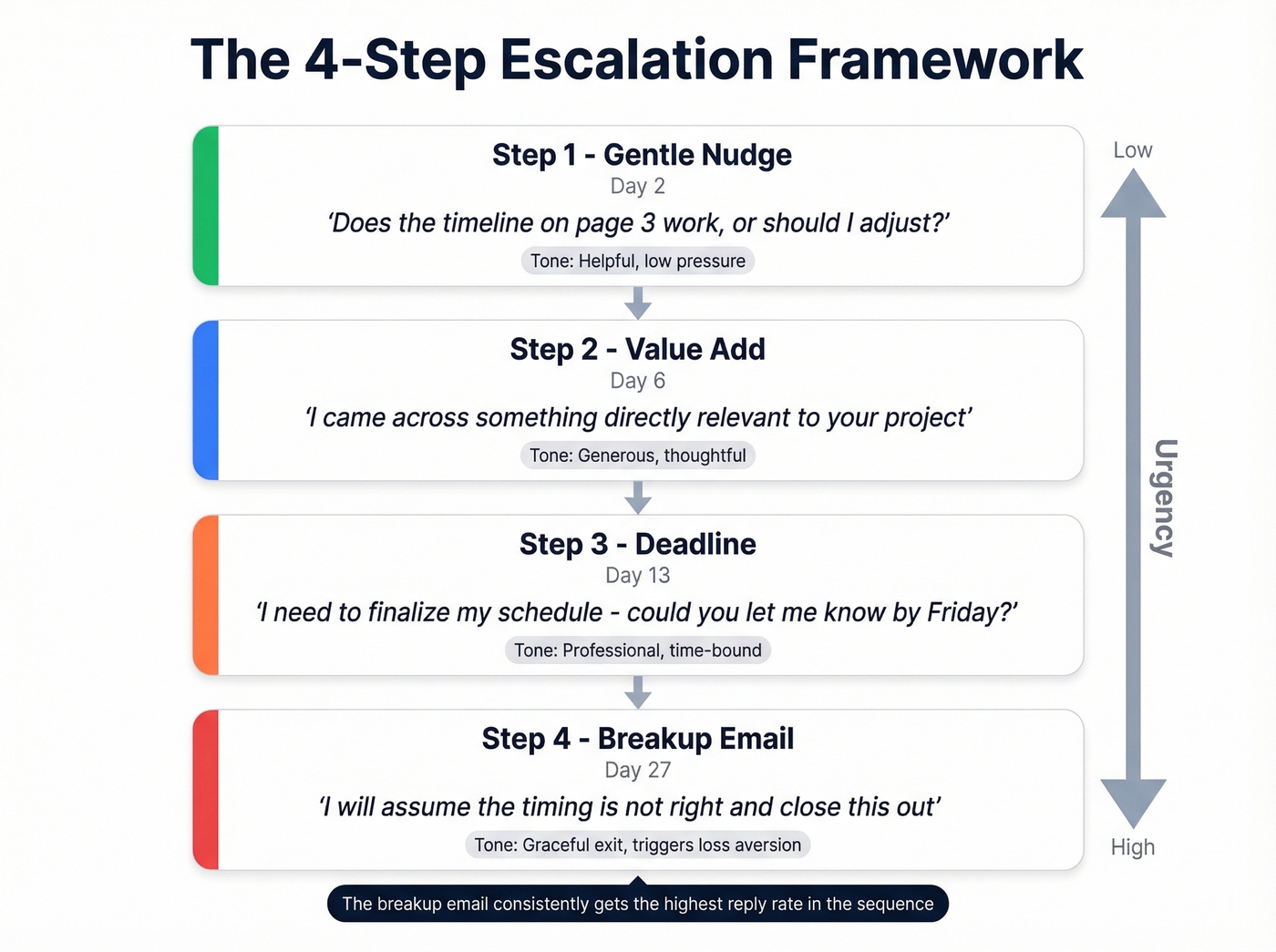
Step 1: The Gentle Nudge (Day 2)
Hi [Name], wanted to make sure the proposal came through okay. Quick question - does the timeline on page 3 work with your Q2 plans, or should I adjust?
You're not "checking in." You're asking something specific that requires a short answer. It gives them an easy on-ramp to reply - a binary choice instead of an open-ended void.
Step 2: The Value Add (Day 6)
Every follow-up earns its place in their inbox when it carries new context. The psychology is simple: you're demonstrating you're still thinking about their problem, not just your pipeline.
Hi [Name], since we last spoke I came across [relevant article/case study/data point] that's directly relevant to [their project]. Thought it might help with the decision. Happy to walk through it if useful.
The key is "relevant." A generic blog post doesn't count. Find something that connects to a specific challenge they mentioned in your last real conversation.
Step 3: The Deadline (Day 13)
Hi [Name], I'm finalizing my schedule for the next two weeks and want to make sure I hold capacity for your project. Could you let me know by [specific date] whether you'd like to move forward?
This is the schedule-finalization trick that's a go-to line on r/sales. You're not pressuring them - you're creating a real calendar constraint. It reframes the follow-up from "please respond" to "I need to plan."
Step 4: The Breakup Email (Day 27)
Loss aversion is one of the most reliable psychological levers in follow-up sequences. The moment you signal you're walking away, the client has to decide whether they're okay losing access to you.
Hi [Name], I haven't heard back, so I'll assume the timing isn't right and close this out on my end. If things change down the road, I'm happy to revisit. Thanks for considering us.
A good breakup email works because it closes the loop and forces a decision. Three touches is enough for most client situations - if they haven't responded after three well-crafted messages with escalating urgency, the problem isn't your copy. The breakup email is consistently the highest-reply message in a follow-up email after no response from client sequence because it triggers that loss aversion hard.
Mistakes That Get You Ignored
Let's be honest - most follow-up emails fail because of the same five or six errors, repeated endlessly. If you're trying to improve the fundamentals, start with email copywriting.
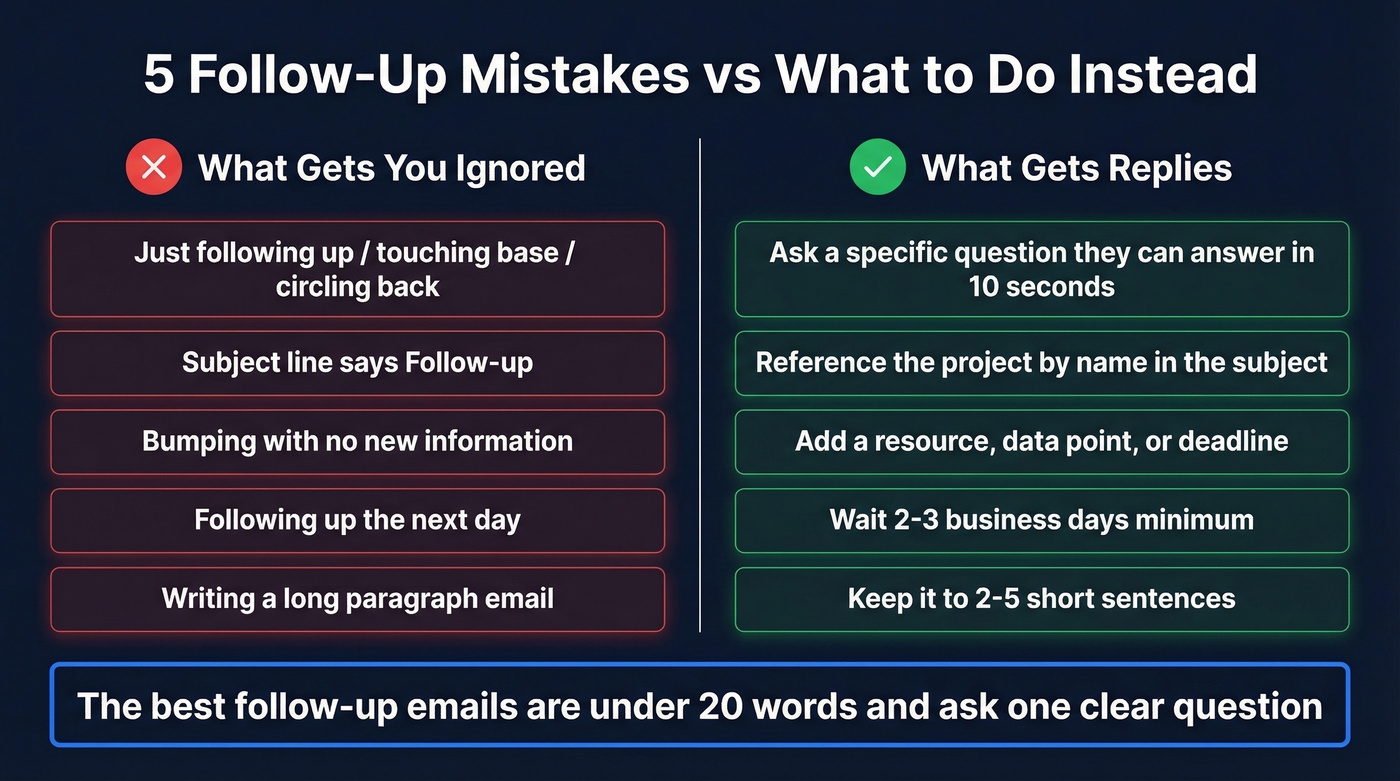
"Just following up" / "touching base" / "circling back." These phrases are meaningless filler that signal you have nothing new to say. Replace with a specific question or piece of value.
Putting "Follow-up" in the subject line. It screams low priority. Keep the original thread or write a subject that references the project by name. (If you need ideas, use these email subject line examples.)
Bumping with no new information. "Just making sure you saw my last email" is the professional equivalent of poking someone on the shoulder repeatedly. Stop it.
Following up the next day. It feels eager. It reads as impatient. Wait at least two business days.
Writing a novel. Aim for two to five short sentences. If it scrolls, it won't get read.
Here's the difference in practice:
Before: "Hi Sarah, just wanted to circle back on my previous email regarding the proposal I sent over last week. I know you're busy but wanted to make sure it didn't get lost. Let me know your thoughts when you get a chance!"
After: "Hi Sarah - does the Q2 timeline in the proposal work, or should I adjust for a July start?"
The second version is 19 words. It asks a specific question. It takes ten seconds to answer. That's the whole game.
Verify the Email Before Rewriting Your Copy
Before you rewrite your follow-up for the fifth time, check whether the email even arrived. People change jobs. Companies rebrand and retire old domains. Spam filters evolve. If your client's email address is no longer valid, every perfectly crafted message is going straight into the void.
We've seen teams agonize over follow-up wording when the real problem was a bounced email they never checked. Verify first, then worry about copy. If you want the technical side, read our email deliverability guide and email bounce rate breakdown.
After three unanswered emails, the problem often isn't your copy - it's a bounced address or a contact who changed roles. Prospeo's 5-step email verification catches invalid addresses, spam traps, and catch-all domains so every follow-up actually lands. 143M+ verified emails, $0.01 each.
Fix deliverability before you rewrite another follow-up template.
Prevent Client Ghosting Before It Starts
The best follow-up is the one you don't have to send. Build these habits into your client relationships from day one. For more process guidance, see how to follow up with a client.
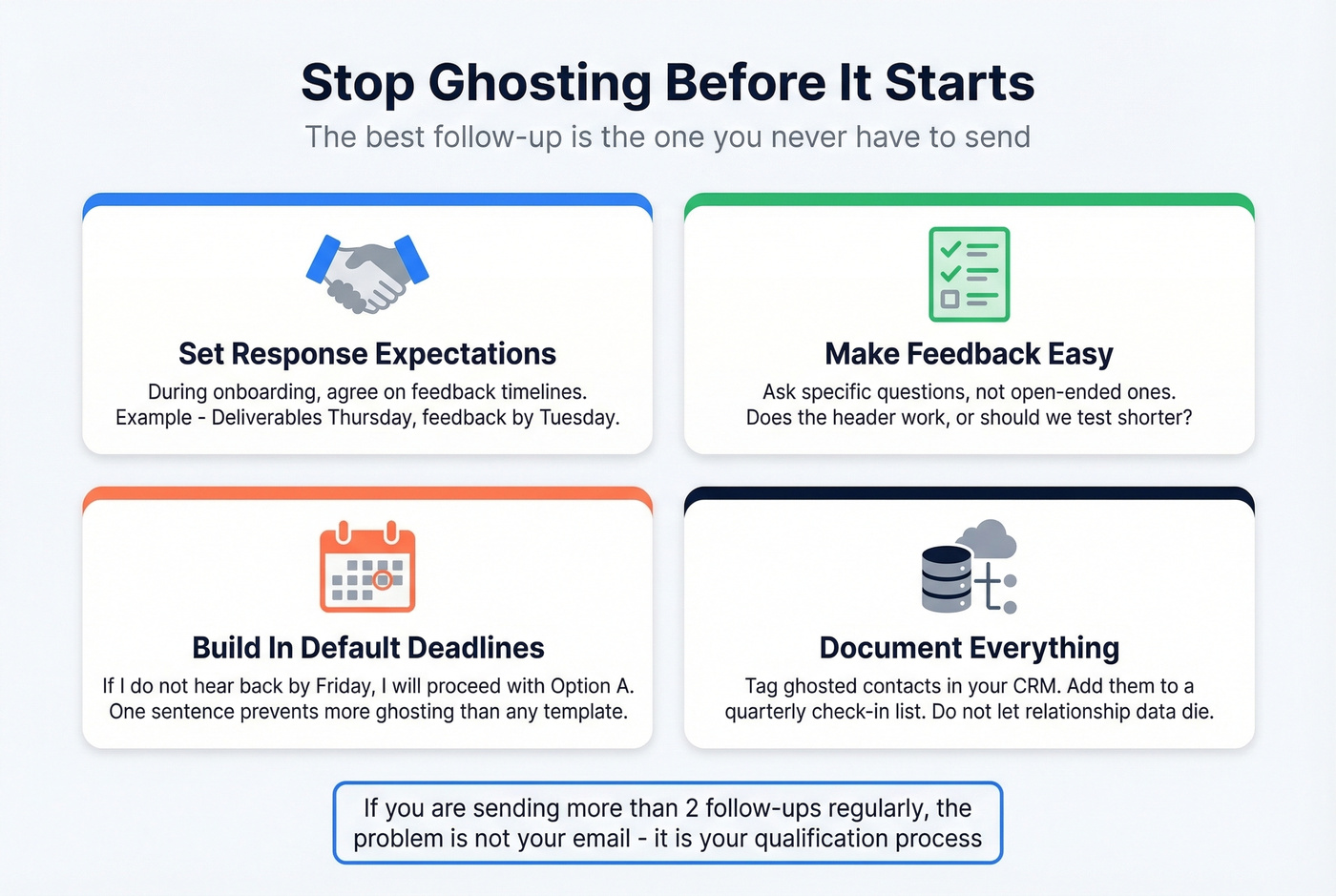
Set response expectations during onboarding. "I'll send deliverables by Thursday; I'll need feedback by the following Tuesday." Simple, explicit, agreed upon. In our experience, teams that set these expectations upfront cut their follow-up volume by half or more.
Make feedback easy. Ask specific questions ("Does the header copy work, or should we test a shorter version?") instead of open-ended ones ("What do you think?"). Open-ended questions create decision fatigue, and decision fatigue creates silence.
Build deadlines into your process. "If I don't hear back by [date], I'll proceed with Option A" removes the burden of a formal reply. This one sentence prevents more ghosting than any template ever will.
Document everything in your CRM. After the breakup email, tag the contact as "ghosted," note the date, and add them to a quarterly check-in list. Don't let the relationship data die with the thread. If you're evaluating tools, start with contact management software.
For teams in regulated industries like accounting, legal, or financial services, document your follow-up attempts - they may be required for compliance.
Here's the thing: if you're sending more than two follow-ups regularly, the problem isn't your email game. It's your qualification process. Clients who are genuinely interested respond. Clients who needed more convincing before you sent the proposal will ghost you after. Fix the conversation before the proposal, and you'll rarely need the breakup email.
FAQ
How long should I wait before the first follow-up?
Two to three business days. Following up the next day reduces reply rates by 11% in cold email benchmarks. Give your client time to process, then nudge with a specific question - not "just checking in."
How many follow-ups is too many?
Three well-crafted follow-ups over two to three weeks is the sweet spot for most client situations. After three emails with escalating urgency and no reply, the issue is timing or fit - not your messaging.
Should I call instead of emailing?
After two unanswered emails, yes. A quick call or voice message often breaks through when email can't. If you share a Slack workspace or another channel with the client, try that first - it's less intrusive than a phone call but still changes the medium.
What if my client changed jobs?
Their old email address is bouncing and they'll never see your follow-ups. Use Prospeo's email finder to locate their current business email - paste their name and new company, and you'll have a verified address in seconds.
Is it okay to send a breakup email?
Absolutely. A polite "closing the loop" message triggers loss aversion - the client has to decide whether they're okay losing access to you. Skip this step if you're dealing with a long-term retainer client where the relationship warrants a phone call instead, but for project-based work, the breakup email is your strongest closer.