The Follow-Up Email Format That Actually Gets Replies
You sent the proposal three days ago. Nothing. You check your sent folder - yep, it went through. With 333 billion emails sent daily and climbing toward 392.5 billion by 2026, your message got buried under an avalanche of newsletters, internal threads, and other people's follow-ups. 40% of consumers have 50+ unread emails sitting in their inbox right now. Meanwhile, cold email open rates have dropped from 36% to 27.7% in just one year.
You don't need 28 templates. You need one reusable follow-up email format after no response - a skeleton you can adapt to any situation, whether it's a sales proposal, a job application, or a cold outreach that went cold.
The quick version:
- Format: Context -> Value-add -> Single CTA -> Easy out
- Wait 3 business days before your first follow-up
- Send around 1 PM, keep subject lines under 33 characters
- Stop at 3 follow-ups - 4+ more than triples spam complaints and unsubscribes
The 4-Part Follow-Up Format
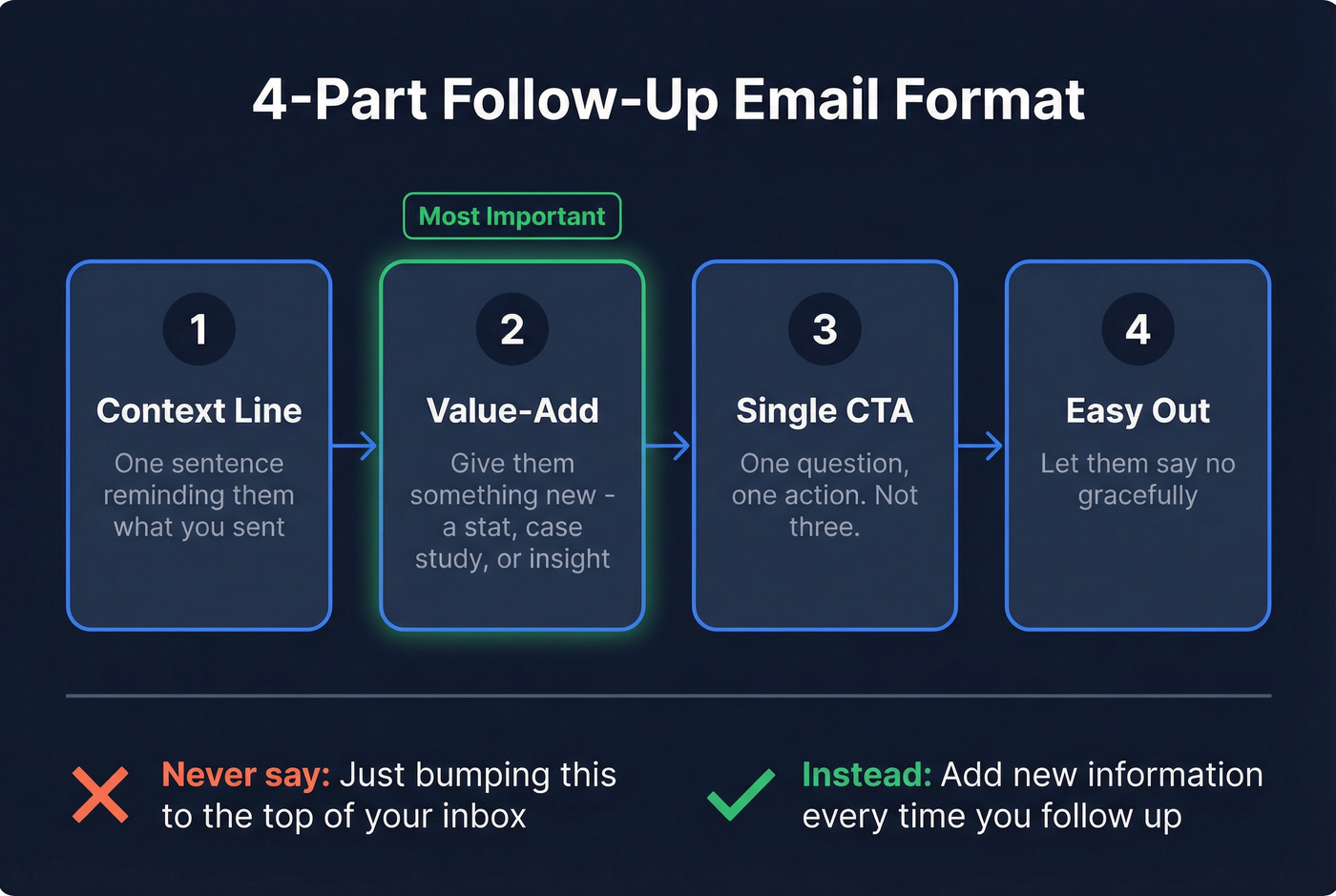
Every follow-up that works follows the same skeleton. "Just bumping this to the top of your inbox" is the number-one mistake - it adds zero new information, so it gives zero reason to reply.
Here's what actually works:
- Context line. One sentence reminding them what you sent.
- Value-add. Give them something new - a stat, a case study, a relevant insight. This is the single most important element and what separates a follow-up from a nag.
- Single CTA. One question, one action. Not three.
- Easy out. Let them say no gracefully.
Here's what that looks like assembled:
Hi Sarah,
I sent over the onboarding proposal last Tuesday - wanted to make sure it didn't get buried.
Since then, we helped a similar-sized team cut their ramp time from 10 weeks to 4. Happy to share the breakdown if it's useful.
Would a 15-minute call Thursday afternoon work?
If the timing isn't right, totally fine - just let me know.
We've used this exact structure for cold outreach, proposals, and job applications. It works across contexts because it respects the reader's time while giving them a reason to care.
Subject Line Rules
Keep it under 33 characters - anything longer often gets truncated on mobile. Avoid "Free," "Guarantee," ALL CAPS, and excessive punctuation. These are spam triggers that tank deliverability before anyone sees your message.
And skip "Just checking in." It's a cliche that gets ignored. Reference the original topic instead: "Quick update on [project name]" or "Re: [original subject]." If you need examples, pull from a swipe file of subject lines.
When to Send and How Often
Waiting three business days before your first follow-up yields a 31% reply lift compared to following up sooner. After that, space touches 3-4 days apart.
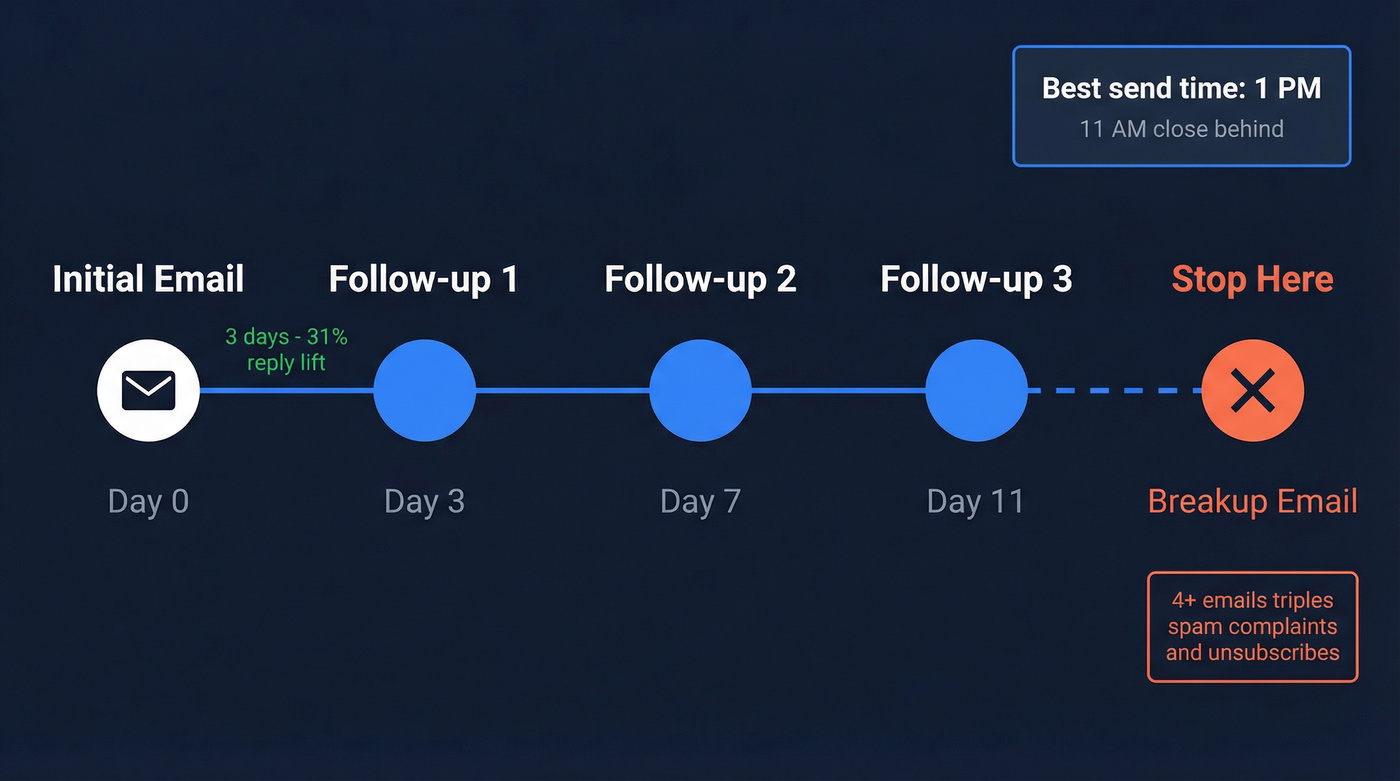
Here's the cadence Yesware found most effective across 10M email threads:
| Touch | Day After Initial Send |
|---|---|
| Initial email | 0 |
| Follow-up 1 | 3 |
| Follow-up 2 | 7 |
| Follow-up 3 | 11 |
Yesware's full cadence extends to 6 touches over roughly three weeks. For time-of-day, 1 PM tends to perform best, with 11 AM close behind. If you're optimizing send windows, use a dedicated guide on the best time to send prospecting emails.
But three follow-ups is the ceiling for most B2B sequences in practice. Belkins analyzed 16.5 million cold emails and found that 4+ emails in a sequence more than triples spam complaints and unsubscribe rates. After three, send a breakup email and give yourself permission to stop.
Here's the thing: if your average deal size is under five figures, you almost certainly don't need more than two follow-ups. The math doesn't justify the domain risk.

The best follow-up format in the world won't save you if 35% of your emails bounce. Prospeo's 5-step verification delivers 98% email accuracy - so every follow-up actually lands in a real inbox. At $0.01 per email, fixing your data costs less than one wasted sequence.
Stop perfecting copy for addresses that don't exist.
Why They're Not Responding
It's rarely about you. Most non-responses come down to five objections, and each calls for a different value-add adjustment.
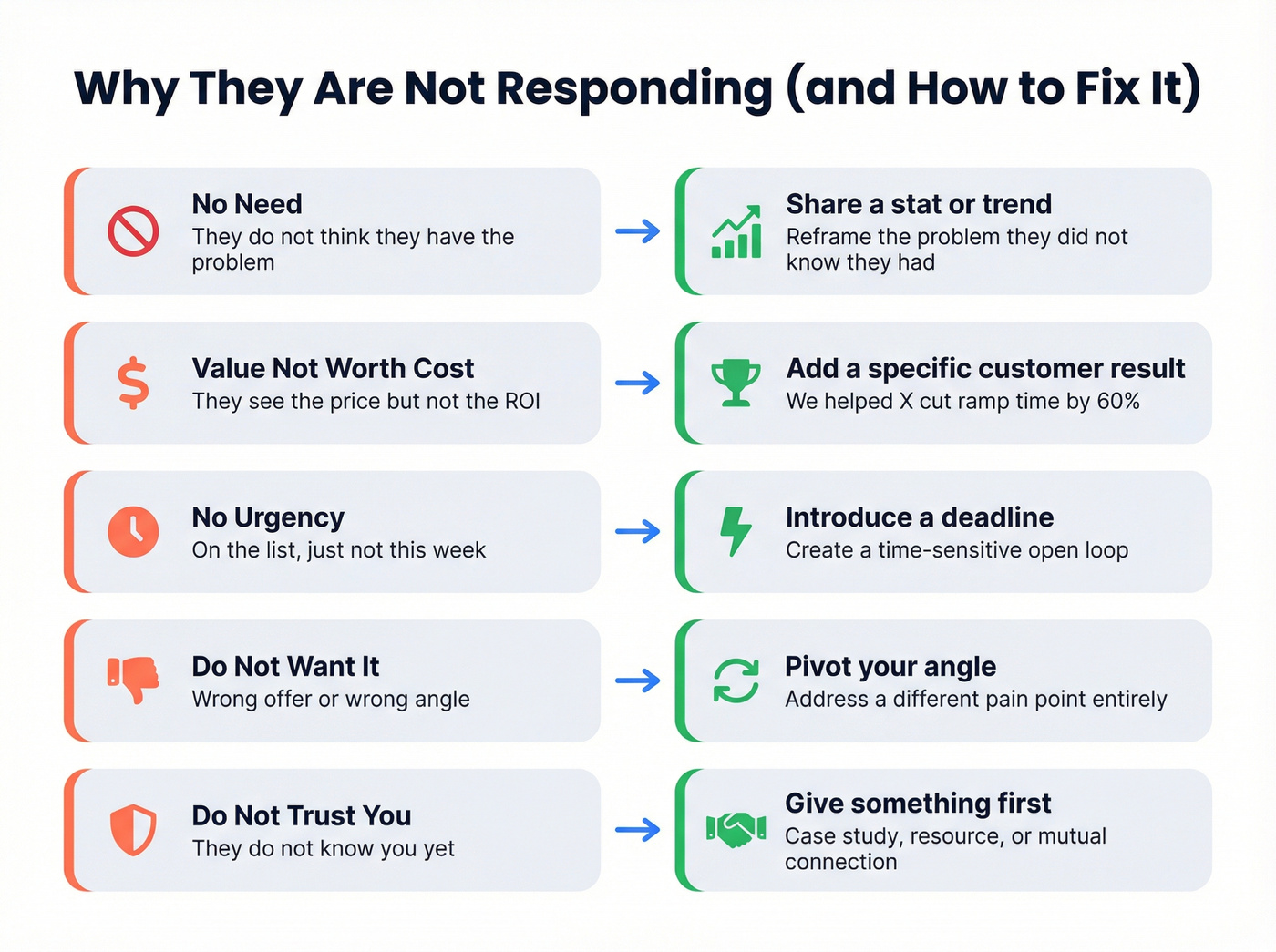
No need. They don't think they have the problem you solve. Share a stat or trend that reframes it. The Zeigarnik Effect - our brains fixate on unfinished tasks - is why planting an open question works here.
Value not worth cost. They see the price but not the ROI. Add a specific customer result with numbers. Something like "We helped [company] cut ramp time by 60%" hits harder than "our solution drives efficiency."
No urgency. It's on the list, just not this week. Introduce a deadline or time-sensitive insight to create the open loop their brain can't ignore.
Don't want it. Wrong offer, wrong angle. Pivot your value-add to a different pain point entirely.
Don't trust you. They don't know you yet. Offer something first - a case study, a resource, a mutual connection. Reciprocity is why giving before asking dramatically outperforms "just checking in." (If you want a deeper framework, see how to build credibility in sales.)
Same Thread or New Thread?
| Same thread | New thread |
|---|---|
| Less than 7 days since last email | 2+ weeks of silence |
| Same topic, same ask | New angle or different offer |
| Fewer than 3 unanswered replies | 3+ unanswered in the chain |
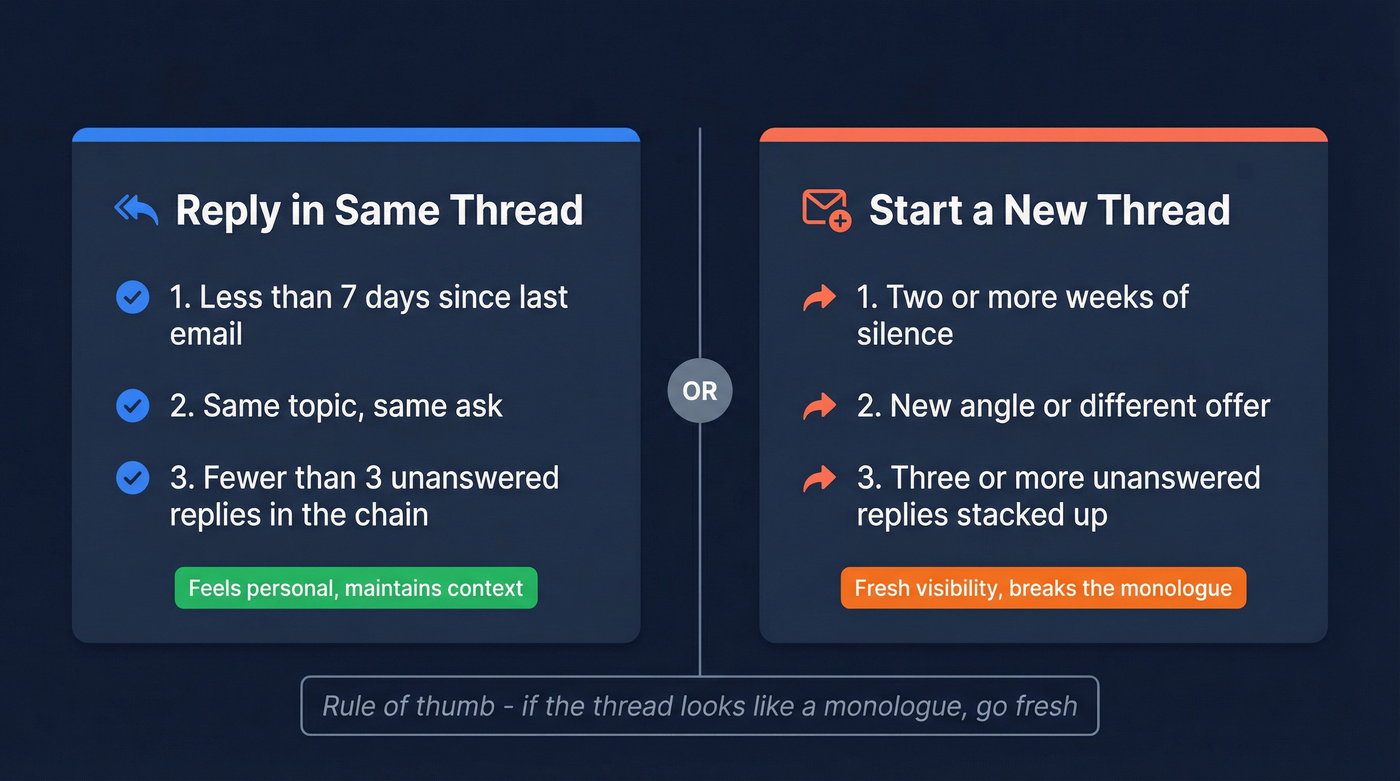
Replies in the original thread feel more personal and maintain context. But if the thread looks like a monologue - three messages from you, zero from them - a fresh subject line can resuscitate visibility.
Templates for Every Scenario
Each template follows the 4-part format. Use them as a starting point, then customize the value-add for your specific prospect. The value-add is where you earn the reply; everything else is scaffolding. For more variations, start with these outreach email templates.
Sales Follow-Up
Hi [Name], I reached out last week about [specific topic]. Since then, we helped [similar company] increase pipeline by 140% in one quarter. Would 15 minutes this week work to see if that's relevant? If not, no pressure at all.
Proposal Follow-Up
Hi [Name], wanted to follow up on the proposal I sent on [date]. I've attached a projected ROI breakdown based on your team size. Any questions, or should we schedule a walkthrough? Happy to revisit next quarter if timing's off.
Job Application Follow-Up
Hi [Name], I applied for the [role] on [date]. I noticed your team just launched [specific initiative] - my experience with [relevant skill] maps directly to that. Is there a good time to chat briefly? Completely understand if the role's been filled.
The Breakup Email
Hi [Name], I've reached out a few times about [topic] and haven't heard back - totally understand. I'll leave you with this: [one compelling stat or resource]. If things change down the road, I'm easy to find.
Skip the breakup email if you've only sent one follow-up. It reads as passive-aggressive after just two total touches. Save it for the end of a real sequence.
Your Follow-Ups Won't Work If the Address Is Dead
Let's be honest about something most follow-up guides ignore entirely. If your follow-ups consistently get zero replies across dozens of prospects, the problem isn't your copy - it's your data. We've seen teams obsess over subject lines while a third of their emails bounce. A generic message sent to a verified address will always outperform a perfectly crafted one that never arrives.
One of our customers, Meritt, had exactly this problem: a 35% bounce rate that was destroying their domain reputation. After switching to Prospeo's 5-step email verification, their bounce rate dropped under 4% and their connect rate tripled to 20-25%. The best follow-up email format after no response is useless if the address is dead. (If you're troubleshooting, start with hard bounces and an email deliverability checklist.)

Teams using Prospeo cut bounce rates from 35%+ down to under 4% - and tripled their connect rates. When your follow-ups reach real people at real addresses refreshed every 7 days, the 4-part format actually gets to do its job.
Fix the data first. The replies will follow.
FAQ
How many follow-up emails should I send?
Three is the safe maximum for most B2B sequences. Belkins' 16.5M-email study shows 4+ emails more than triples spam complaints and unsubscribes. After three unanswered messages, send a breakup email and move on.
What's the best subject line for a follow-up?
Keep it under 33 characters and reference the original topic - something like "Re: Q3 onboarding plan" or "Quick update on [project]." Avoid "Free," ALL CAPS, and vague openers like "Just checking in."
Should I reply in the same thread or start a new one?
Reply in the same thread if it's been less than seven days and you're discussing the same topic. Start fresh after two-plus weeks of silence or when three unanswered replies are stacked in the chain.
How do I make sure my follow-ups actually reach the inbox?
Verify every address before sending. Beyond verification, warm your domain gradually, keep send volume under 50 per day per mailbox, and avoid spam-trigger words in subject lines. The r/coldemail community consistently recommends verifying your entire list before any sequence - it's the single highest-ROI step most people skip.